Search This Blog

Saturday, April 20, 2024

'People Who Rent Will Decide the 2024 Presidential Election'

 Immigration won’t decide the election. Polls have not yet captured what will. This may come as a surprise, but the top issue housing. More explicitly, it’s shelter costs.

Image courtesy of Axios + Generation Lab Youth Poll

The Economy

The economy is a very broad category that encompasses inflation, jobs, unemployment, wages, rent, and housing.

Other polls split the economy in various pieces, such as inflation and jobs. Not a single poll mentioned housing specifically.

Q: What is it that young voters really have on their minds?
A: Rent

The CPI Rose Sharply in March Led by Shelter and Gasoline

The CPI rose 0.4 percent in March. Rent was up another 0.4 percent with gasoline up 1.7 percent. Together, the pair was about half of the total rise.

Rent of primary residence, the cost that best equates to the rent people pay, jumped another 0.4 percent in March.  Rent of primary residence has gone up at least 0.4 percent for 31 consecutive months! 

The “rents are falling” (or soon will) projections have been based on the price of new leases and cherry picked markets. But existing leases, much more important, keep rising.

Only 8 to 9 percent of renters move each year. It’s been a huge mistake thinking new leases and finished construction would drive rent prices.

For discussion, please see The CPI Rose Sharply in March Led by Shelter and Gasoline

Rent does not really go up every month. The BLS smooths things out over time. Instead, rent has surged once a year more than wages have kept up.

Immigration Not the Key Issue Where It Matters

I sympathize with the view that immigration is the key issue, and perhaps it is to voters nationally.

Mayors in Chicago, Denver, and New York city are all bitterly complaining. So are governors Greg Abbot in Texas and Ron DeSantis in Florida. Add in California for good measure.

Those six states provide 188 of the 270 electoral college votes but none of them are in play.

The six swing states are Wisconsin, Michigan, Pennsylvania, Nevada, Georgia, and Arizona. Immigration is only a hot issue in Arizona where abortion is also in play.

Blacks Abandon Biden

A WSJ Swing State Poll show blacks, especially black males, are abandoning Biden in huge numbers.

In the swing states, 30 percent of black males now support Trump. That’s up from 12 percent in the 2020 election. Trump support from black females is up from 6 percent to 11 percent.

The numbers are not directly comparable because the 2020 numbers are national. However, the numbers flash a huge warning sign.

The WSJ poll confirms the NYT/ Siena poll from last October: Trump Leads in 5 Critical States as Voters Blast Biden, Times/Siena Poll Finds

Young Voters Say Their Discontent Goes Deeper Than Israel and Gaza

Israel is a big issue in Michigan, likely more so than immigration.

But across the board, Young Voters Say Their Discontent Goes Deeper Than Israel and Gaza

Generational Homeownership Rates

Home ownership rates courtesy of Apartment List

Who Are the Renters?

The answer is younger voters and blacks.

The Apartment List 2023 Millennial Homeownership Report shows Millennial homeownership seriously lags other generations.

Generation Z homeownership is dramatically lower still.

And according to the National Association of Realtors, the homeownership rate among Black Americans is 44 percent whereas for White Americans it’s 72.7 percent.

That’s the largest Black-White homeownership rate gap in a decade.

Home Prices Hit New Record High

Case-Shiller, OER and CPI data from St. Louis Fed, chart by Mish

The latest Case-Shiller housing data shows home prices hit a new record high.

Adding insults and costs, the 30-year mortgage rate ended last week at 7.30 percent according to Mortgage News Daily.

Those looking to buy a home are very angry about being priced out while watching rent soar for nearly three years.

Explaining the Polls

The homeownership discrepancy (Black/White, and Young/Old) fully explains the polls. Yet not a single pollster or economist is in tune with relationship.

A high percentage of blacks and young voters are likely vote for Biden, but the shift vs 2020 is what will matter.

President Biden and economists in general keep singing the praises of the economy.

On average the economy is doing OK. And asset holders have generally fared well in this economy. But averages will not decide the election.

The Abortion Issue Comes Alive in Arizona

On April 17, I wrote The Abortion Issue Comes Alive in Arizona, It Could Cost Republicans Dearly

That’s still my position with an emphasis on the word “could”.

What About Trump’s Legal Issues?

Trump will lose some Republicans and undecided voters who may sit the election out on grounds that Trump was part of an insurrection or contributed to one.

However, The Need to Prevent a Biden Economic Collapse Outweighs Charges Against Trump

Republicans are willing to look the other way on the charges against Trump.

So, if current trends hold, it’s the economy that will matter.

Specifically, the election will be decided by extreme unhappiness in the block of voters who rent but want to by a home, concluding things were better under Trump.

https://mishtalk.com/economics/people-who-rent-will-decide-the-2024-presidential-election/

Multilateral development banks eye up to $400 billion more lending over 10 years

 The Inter-American Development Bank on Saturday said leaders of 10 multilateral development banks committed to take action in five critical areas, including additional lending headroom totaling $300-400 billion over the next decade.

Following a retreat held in Washington at the IDB headquarters, on the sidelines of the International Monetary Fund and World Bank spring meetings, the MDBs said the agreed plan involves "joint steps to work more effectively as a system" to take action on climate change.
https://www.reuters.com/business/finance/multilateral-development-banks-eye-up-400-bln-more-lending-over-10-years-2024-04-20/

Australia Bins 35% of Covid Vaccine Supply

 As part of its pandemic response, the Australian government purchased 267.3 million doses of Covid vaccines, enough to vaccinate Australia’s population of approximately 26 million people ten times over. 

But figures released to Dystopian Down Under by the Department of Health (DOH) this week confirm that, three years into the vaccine program, only 70 million doses, or 26% of the 267.3 million doses purchased, have been administered, while 35% of vaccines doses have been wasted since the start of the vaccine rollout.

Last week, the Australian reported that more than 35% of Covid vaccines were being tossed out as of January due to oversupply. The revelation came from the DOH’s public submission to the federal Covid inquiry. 

The wording made it unclear if this was a cumulative figure or applicable only to the month of January, so I contacted the DOH to confirm the total wastage to date, along with some further questions on the value of doses purchased, delivered, and wasted, and exactly how many had been administered.

A DOH spokesperson responded,

“As of 31 March 2024 the total COVID-19 vaccine program wastage rate was at 35.69%. Australia’s wastage rate is within the World Health Organization (WHO) acceptable wastage parameters for multidose vials of 15% and 40%.

“Approximately 80% of COVID-19 vaccine wastage is attributed to expiry of doses across warehouses and vaccine administration sites.”

This appears to mean that 80% of the wasted doses simply expired on the shelf. 

The remaining 20% of wasted doses would likely be due to administration sites not managing to use the entire contents of multi-dose vials once opened. While unopened vials have a shelf-life of anywhere between 9-18 months, opened vials must be used within 6-48 hours.

The DOH refused to confirm the value of doses purchased or wasted, or how many of the purchased doses have actually been delivered, “for contractural and security reasons.” The Australian government has repeatedly refused to release details of its taxpayer-funded Covid vaccine purchase agreements.

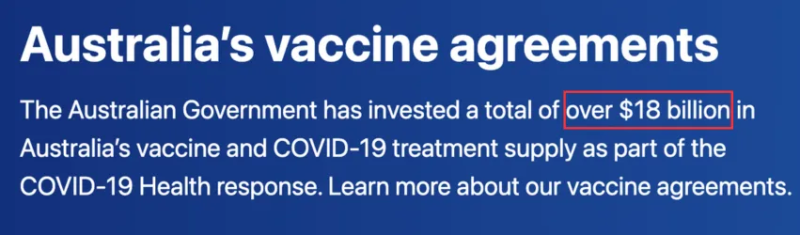
However, we know that total government spending on Covid vaccines and treatment supply amounts to over $18 billion, of which it appears that the lion’s share was allocated to purchasing vaccine doses.

Source: Department of Health and Aged Care

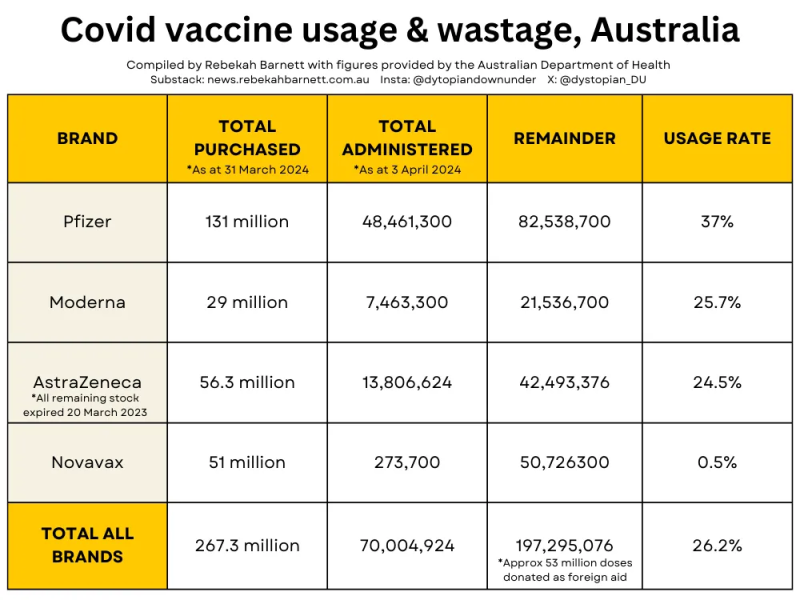
Most of these remain unused. DOH figures provided to me this week show that as of 3 April, only a quarter (70 million) of the 267.3 million purchased doses had been used, at a total usage rate of 26.2%.

Of the remaining 197.3 million unadministered doses, the DOH advised that approximately 53 million doses have been donated as foreign aid.

That leaves approximately 144 million doses, more than half of the total stockpile, either already expired, or likely to expire within the next several years, as booster rates hover below 10%.

As Australia’s vaccine purchases extend into 2023 and 2024, it is probable that a portion of these doses still be viable up to 2025. 

But even if vaccine doses never expired, it would take Australians 29 years to work their way through the glut, based on the five million boosters administered in the past 12 months.

As it stands, usage rates by brand are as below:

  • Of 131 million Pfizer doses purchased, 48.5 million have been administered, a usage rate of 37%. And 82.5 million doses remain.
  • Of 29 million Moderna doses purchased, 7.5 million have been administered, a usage rate of 25.7%. And 21.5 million doses remain.
  • Of 56.3 million AstraZeneca doses purchased, 13.8 million have been administered, a usage rate of 24.5%. As the AstraZeneca stockpile expired on 20 March 2023, the remaining 42.5 million doses have been binned, unless they were donated as aid prior to this date.
  • Stunningly, of 51 million Novavax doses purchased, only 273,700 have been administered, a usage rate of 0.5%. And 50.7 million doses, 99.5% of the stockpile, remain. This is because by the time Novavax was approved for use, in December 2021, over 90% of Australians aged 16 and over had already been double-vaccinated.

In a July 2022 article investigating Australia’s already apparent vast vaccine wastage, the ABC asked if perhaps the government had bought too many vaccines?

Deborah Gleeson, Associate Professor of Public Health at La Trobe University, criticised the government’s run on the global vaccine supply, suggesting that Australia had hoarded more than its share.

Prof Gleeson told the ABC,

Australia really participated in a bigger trend that we’ve seen worldwide of wealthy countries buying up far more doses of COVID-19 vaccines than they needed early on in the pandemic. And this is a practice that unfortunately has continued.

It’s enough to make advocates for global vaccine equity lose sleep at night.

The news of the Australian government’s wastage of billions of dollars worth of Covid vaccines comes as Australians are grappling with the soaring cost of living and the worst housing crisis on record, with over a quarter of a million Australians accessing homelessness services in 2022-2023.

https://brownstone.org/articles/australia-bins-35-of-covid-vaccine-supply/

Attack on Iran next to nuclear site sends message: We could have done worse here

 Sources have confirmed to The Jerusalem Post that the attack on Iran at Isfahan, attributed by sources in the New York Times to Israel, hit Iranian air force assets at Isfahan, almost right next door to the Islamic Republic's nuclear site in the same area.

The message was unmistakable, 'we chose not to hit your nuclear sites this time, but we could have done worse right here,' sources told the Post.

Israel sends a clear message to Iran

In other words, the attack at Isfahan was designed not only to hurt Iran but also to make it eminently clear how vulnerable to attack its nuclear sites are.


Long-range missiles from aircraft were used to avoid Tehran's radar detection capabilities.

This could be done again at any time.

The Israeli Air Force works to fight new and developing threats across the region (credit: IDF SPOKESPERSON UNIT)Enlrage image
The Israeli Air Force works to fight new and developing threats across the region (credit: IDF SPOKESPERSON UNIT)

At the same time, by not attacking the actual nuclear site at Isfahan or other nuclear sites at Natanz and Fordow, the attacker signaled to Iran that it was not seeking a spiraling and escalating regional war.

A nuanced attack 

This was a very nuanced middle-of-the-road attack, designed to threaten optimally for the future but also reduce the likelihood of another Iranian counter-strike following the Islamic Republic's launching around 350 aerial threats at the Jewish state last weekend. 

Whether it will work, both stopping Iran from moving forward with its nuclear program and deterring it from copying its strike on Israel last weekend while also avoiding an escalation into a larger war, will remain to be seen in the coming days and weeks.


https://www.jpost.com/middle-east/attack-on-iran-next-to-nuclear-site-sends-message-we-could-have-done-worse-here-analysis-797899

Want to Be a Better Psychiatrist? Enter a Beauty Pageant!

 With the elegant gowns, stylized hair, carefully applied makeup, and moments in the spotlight, beauty pageants have attracted longstanding criticism for being allegedly superficial competitions that foster narcissism. But beneath that stereotypical surface lies a wealth of opportunities for personal growth and skill development.

Most modern pageants have moved away from being modeling competitions that assess superficial beauty. Instead, they have been reframed as personality competitions, evaluating qualities such as communication skills, leadership and social advocacy, and the ability to be a strong role model worthy of the job of representing a pageant company.

For aspiring psychiatrists, participating in a pageant can be a transformative experience that contributes to gaining valuable insights and transferable skills and competencies that are integral to the practice of the specialty.

Building Confidence and Resilience

One of the most notable benefits of competing in beauty pageants is the opportunity to build confidence, resilience, and the ability to step outside of one's comfort zone to achieve goals.

Patients can sometimes challenge a psychiatrist's confidence, some patients may take much longer to treat effectively, and psychiatrists sometimes find they need to abandon preconceived notions and try different approaches to truly heal their patients.

The rigorous long-term preparation and public scrutiny involved in succeeding in pageants demand self-assurance, perseverance, and the ability to constructively integrate feedback -- qualities that are equally essential for success in psychiatry. Aspiring psychiatrists who have experienced the challenges of navigating the competitive landscape of pageants are better equipped to handle the pressures and uncertainties inherent in clinical practice.

Enhancing Professionalism

Representing one's home city, state, province, or country in a pageant essentially elevates the average person into a public figure. While most people would not consider psychiatrists to be public figures, many licensing bodies have strict professionalism expectations that sometimes even require a psychiatrist to behave professionally during personal time when not actively practicing.

Aspiring psychiatrists can prepare for such expectations by stepping into the role of a public figure. Many pageant queens are role models for younger women. Similarly, embracing the goal of being a positive role model can help psychiatrists be professional with both their patients and trainees.

Developing Empathy and Cultural Competence

Pageants also provide a platform for contestants to interact with people from diverse backgrounds and cultures, fostering the development of empathy and cultural competence.

Through engaging with fellow contestants, judges, and community members during pageant activities, aspiring psychiatrists gain valuable insights into the complexities of human behavior and the importance of understanding diverse perspectives. This heightened sensitivity to cultural nuances and individual differences enhances the ability to connect with patients from various backgrounds -- a crucial aspect of providing culturally sensitive and effective psychiatric care.

Enhancing Communication and Public Speaking Skills

Effective communication is a cornerstone of psychiatry, and competing in pageants offers many opportunities to hone this skill. Contestants are required to articulate their thoughts and opinions eloquently during private interviews, on-stage presentations, and interpersonal interactions, thereby sharpening the ability to communicate with concise clarity and confidence.

Most contestants seek a pageant coach to help enhance their communication and interviewing skills. The ability to engage with others and convey complex ideas effectively is indispensable for building rapport with patients, facilitating therapeutic alliances, and conveying empathy and understanding in clinical settings.

Improving Collegiality

Gone are the days in pageants of catty contestants undermining each other to win a prize. Pageants have become a source of friendship and sisterhood, giving delegates a sense of community. The ability to be pleasant and friendly with competitors is a transferable skill that enhances the collegiality of psychiatrists working within a team setting, even if there may sometimes be a disagreement. Working professionally with colleagues is important for optimizing patient outcomes.

Fostering Leadership and Advocacy

Pageants often involve engaging in community service initiatives and advocacy efforts, giving contestants a platform to address social issues and promote positive change.

Aspiring psychiatrists who participate in pageants develop leadership skills and a sense of social responsibility as they advocate for causes that align with their values and contribute to the well being of their communities.

This capacity for leadership and advocacy translates seamlessly into the realm of psychiatry, where clinicians play a vital role in advocating for the rights and needs of their patients as well as for social justice within the mental health system.

Cultivating Self-Awareness and Emotional Intelligence

Competing in pageants requires contestants to engage in introspection and self-reflection, cultivating self-awareness and emotional intelligence. By navigating the highs and lows of the pageant experience, contestants gain insights into their personal strengths, weaknesses, and areas for growth, fostering personal development and resilience.

This heightened self-awareness equips aspiring psychiatrists with the capacity to recognize and manage their own emotions effectively -- a critical skill for navigating the complex dynamics of therapeutic relationships with patients.

The Transformative Power of Pageants

In conclusion, competing in pageants offers aspiring psychiatrists a unique opportunity for personal and professional growth, equipping them with a diverse array of skills and insights that are invaluable in the practice of psychiatry.

From building confidence and resilience to enhancing communication and cultural competence, the benefits of pageants extend far beyond the realm of physical appearance, shaping individuals into empathetic, skilled, and socially conscious practitioners.

By embracing the transformative power of pageants, aspiring psychiatrists can cultivate the qualities and competencies needed to excel in their careers and make meaningful contributions to the field of mental health.

Patricia Celan, MDopens in a new tab or window, is a psychiatrist.

https://www.medpagetoday.com/opinion/kevinmd/109758

When Neglect Becomes Criminal: Harsh Reality of Failing a Dependent

 We live in a society where the bad news cycle runs nonstop in the media. In practice, this means we often become so inundated with bad news content that when there is a trend we should be aware of, it can get lost in the noise.

With more peopleopens in a new tab or window caring for a person dependent upon themopens in a new tab or window, whether a child, elderly individual, or someone with a disability, there is an upward trendopens in a new tab or window in abuse and neglect. Neglecting the care of a dependent person can constitute a serious criminal offense known as "negligent care of a dependent person."

What is "Negligent Care"?

The legal concept of negligent care of a dependent person is defined in state statutes, such as Pennsylvania's 18 Pa. C.S. § 2713opens in a new tab or window, which criminalizes the neglect of a "care-dependent person" by a caretaker. A "care-dependent person" is any adult who, due to physical or cognitive disability or impairment, requires assistance to meet their needs for food, shelter, clothing, personal care, or healthcare. A "caretaker" is any person who has an obligation or legal responsibility for providing any kind of care to the dependent individual, including family members, healthcare providers, nursing home employees, or other designated caregivers; the "care" doesn't always have to be medical care.

Under Pennsylvania law, a caretaker commits the offense of neglect if they "intentionally, knowingly or recklessly" cause "bodily injury, serious bodily injury or death by failing to provide treatment, care, goods or services necessary to preserve the health, safety or welfare of the care-dependent person..." This could include failing to provide basic necessities, ignoring or concealing harmful conditions or environmental factors, using improper physical or chemical restraints, or isolating the dependent person in a way that results in bodily harm.

Pennsylvania expanded the scope of this offense in 2018 through Act 53

opens in a new tab or window, which added a new provision criminalizing a caretaker who "intentionally, knowingly or recklessly endangers the welfare of a care-dependent person for whom he is responsible by failing to provide treatment, care, goods or services necessary to preserve the health, safety or welfare of the care-dependent person." This broadened the law to cover neglect that does not necessarily result in physical injury but still jeopardizes the dependent person's well-being.

Other states have laws similar to Pennsylvania's "Neglect of Care-Dependent Person" statute. For example, in California, Penal Code Section 368opens in a new tab or window criminalizes elder abuse, including neglect of a dependent adult. In New York, Penal Law Section 260.32opens in a new tab or window criminalizes endangering the welfare of a vulnerable elderly person or an incompetent or physically disabled person. The legal specifics vary by state.

High-Profile Cases

In Pennsylvania, one high-profile caseopens in a new tab or window was that of Christann Gainey, a Philadelphia nurse who, in 2022, pleaded guilty to neglect of a care-dependent person and tampering with records. Her patient, Herbert R. McMaster, Sr., 84, was "left in the lobby of the facility and died hours after suffering a fall and serious head injury." McMaster, Sr., was the father of H.R. McMasteropens in a new tab or window, a national security adviser under former President Trump.

Another notable caseopens in a new tab or window is that of former Pennsylvania nurse Heather Pressdee, who, according to prosecutors, confessed to "harming, with the intent to kill" 19 people at different rehabilitation centers where she worked. These charges followed previous charges against Pressdee for allegedly killing patients in her care through lethal doses of insulin. In sum, the charges against her included: "two counts of first-degree murder, 17 counts of attempted murder and 19 counts of neglect of a care-dependent person, in connection with the 19 patients she allegedly mistreated."

While these high-profile, tragic cases underscore the importance of proper training, supervision, and accountability for those entrusted with the care of vulnerable individuals -- both for nurses and all other caretakers -- what we don't see are the ongoing cases that rarely hit the news cycle.

Ken Fulginiti, JD, and Sarah Dooley, JD, run Fulginiti Lawopens in a new tab or window, a Philadelphia firm with a focus on negligent care litigation. Fulginiti has a current case in which he just deposed (for an ensuing civil lawsuit) a person convicted of three counts of negligent care, one count for each of his clients who was sexually abused at a nursing home.

Fulginiti told me he has seen a marked upward trend over the past decade in negligent care cases, with a spike during the COVID pandemic that has persisted.

"Fortunately, laws such as Pennsylvania's Act 53 have widened the definition of 'neglect' to encompass behaviors that could jeopardize a dependent's welfare, even if they don't cause physical harm. Some of these victims cannot communicate and are the most vulnerable members of our society, relying upon others for proper care so they can maintain their dignity and health. This legislation is significant for safeguarding individuals, as it expands the understanding of what constitutes neglect."

Imbalance of Power

Part of what makes these cases so challenging is the massive power imbalance between the parties. In previous cases, Fulginiti has heard defense counsel argue, "How are you going to prove your case? Your client has dementia."

As Fulginiti explains, "Asking a lawyer how they're going to prove a case since their client has dementia ignores the reality that these victims of abuse feel what is happening to them. Being a victim of abuse and being unable to communicate effectively exacerbates the harm. An abuse victim unable to communicate can only internalize what happened to them -- they generally can't seek the help they need."

Negligent care of a dependent person is one of those areas at the intersection of law and healthcare that doesn't get enough attention because of how often it's swept under the rug -- and how deeply uncomfortable it is. Yet, when we reflect on the urgency of addressing negligent care, we need to remember that at the heart of each legal definition, statute, and court case are real people -- individuals who, despite their vulnerabilities, deserve to live with dignity, respect, and the assurance of proper care. This applies whether they are being treated in a long term care facility, a hospital, or simply at home by a family member.

The conversation about negligent care of dependent persons challenges us to look beyond the noise of the daily news cycle and focus on the pressing issues that can no longer afford to be lost in the shuffle. It is a call to action for healthcare professionals, lawmakers, caregivers, families, and society at large to recommit to the protection and care of the most vulnerable among us, ensuring that their health, safety, and welfare are not just protected by law but enshrined in cultural practice. Only then can we hope to build a society that truly cares for all its members, regardless of their dependency status.

Aron Solomon, JD, is the chief strategy officer for Amplify, a legal marketing and media agency. He has taught entrepreneurship at McGill University and the University of Pennsylvania, and was elected to Fastcase 50, recognizing the top 50 legal innovators in the world. Solomon is a Pulitzer Prize-nominated writer.

https://www.medpagetoday.com/opinion/second-opinions/109762

FISA-702 Extension of Warrantless Document Searches & Electronic Surveillance Passed On Patriots Day

 by 'Sundance' via TheConservativeTreehouse.com,

The fourth amendment to the United States constitution says:

The right of the people to be secure in their persons, houses, papers, and effects, against unreasonable searches and seizures, shall not be violated, and no warrants shall issue, but upon probable cause, supported by oath or affirmation, and particularly describing the place to be searched, and the persons or things to be seized.”

Late last night, early this morning (after midnight), the United States Senate passed a FISA reauthorization bill that directly and specifically violates every tenant of the 4th amendment.

The senate voted to authorize warrantless federal government searches of every American’s private papers, effects, emails, electronic data records, cell phone calls, contact lists, text messages, buying habits, purchases, banking records, social media posts, direct messages, private communications and every keystroke of every electronic device in your life. 

All of it continues to be subject to the capture, review and surveillance of an unelected opaque law enforcement mechanism, and congress supports it.

The issue is magnified because the Supreme Court has never ruled on the constitutionality of the FISA-702 data collection system, because the Supreme Court also says no American has standing to challenge the federal government violation of their 4th Amendment right to privacy.  It’s all infuriating…  It’s all FUBAR!

Oh, and if you are reading this… you’re likely on the list.

Last night Senator Dick Durbin (D-IL) teamed up with Sen. Kevin Cramer (R-ND) and added an amendment that would have required the government to get a warrant before reviewing any communications incidentally collected from Americans. 

The amendment was the last effort priority for a smidgen of hope; the IC railed against it, saying it would stop them from acting on critical “national security” information in real time. It failed by a vote of 42 to 50.

Another Democrat Senator, Ron Wyden (Oregon), a senior member of the Senate Select Committee on Intelligence, vowed and pledged that FISA-702 would never be renewed by any measure that required his signature. 

“I’ll do everything in my power to stop it,” he previously said.  “Searches have gone after American protesters, political campaign donors, even people who simply reported crimes to the FBI. The abuses have been extensive and well documented,” Wyden argued to colleagues.

Wyden’s effort to strike the language failed by a vote of 34 to 58.

“Egregious Fourth Amendment violations against U.S. citizens will increase dramatically if this bill is passed into law,” Utah Republican senator Mike Lee warned. 

Senator Rand Paul (R-KY) offered an amendment to block DHS, FBI, DOJ, IRS, and various ancillary intelligence, law enforcement, national parks and government agencies from buying Americans’ electronic NSA data from third parties and federal contractors. 

Paul’s amendment failed by a vote of 31 to 61.

The House and Senate bill does include provisions that would force the Intelligence Community to notify political leadership in Congress about 702 database searches involving lawmakers, but you Comrade Citizen are not allowed to know about the searches done on you.  You comrade prole must improve your elite status if you wish to have participate in any benefit from the shredded and reconfigured 4th amendment, now reserved for the entitled class.

As noted by The Hill, Senator Mike “Lee offered an amendment to require the Foreign Intelligence Surveillance Court to appoint an outside lawyer to argue for the rights of a U.S. person the government wants to surveil secretly. It would have also required government employees appearing before the FISA court to disclose factual evidence that might call into question the accuracy of their statements. It also failed even though it had previously passed the Senate with 77 votes in 2020.

Go figure!

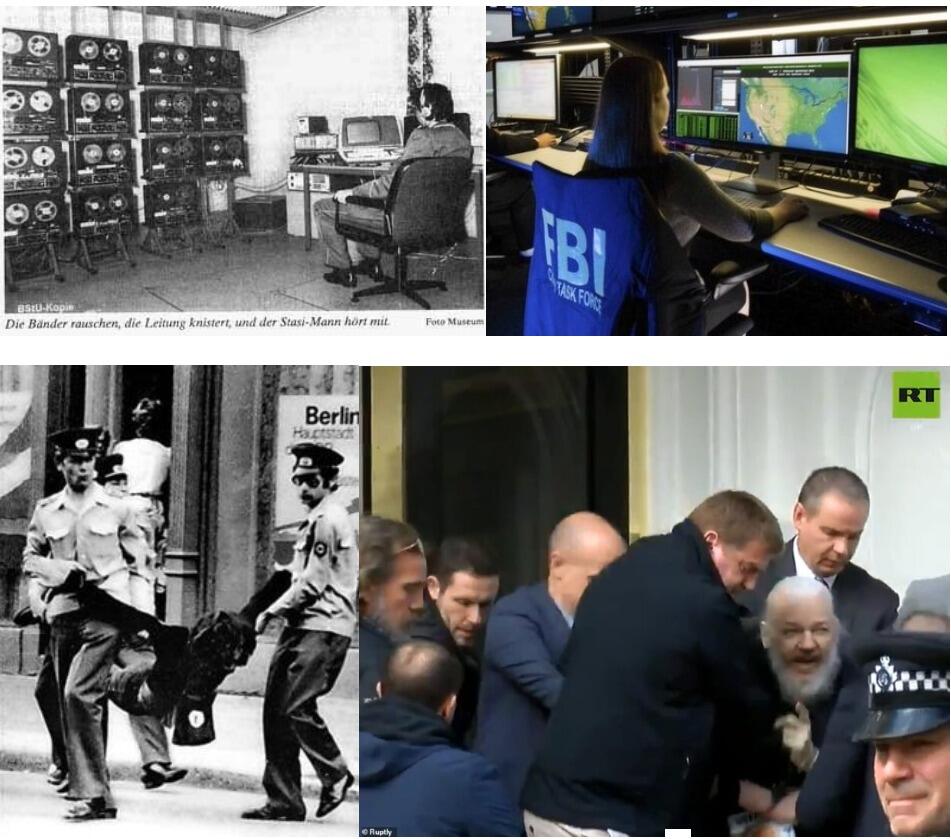
Hey, stop me when you start to notice something that looks like history rhyming.

There’s an inversion afoot.

People in DC claim they cannot see it….

People in DC claim they don’t see the parallels…

People in DC hate my pesky annoyances….

People in DC are our abusers….

Throw sand into the machine whenever possible…

https://www.zerohedge.com/political/oh-irony-congress-passes-fisa-702-extension-allowing-warrantless-document-searches