Search This Blog

Wednesday, June 5, 2024

Law enforcement must verify, report citizenship of detainees in Tenn.

 Local law enforcement in Tennessee now must verify the citizenship of a detainee and report to the Tennessee District Attorneys General Conference if an individual is found to be in the country illegally.

Senate Bill 757 was signed Tuesday by Gov. Bill Lee and goes into effect July 1.

It is one of a pair of bills that Sen. Ferrell Haile, R-Gallatin, said will help the state sue the federal government over the costs of illegal immigration in Tennessee.

The other, House Bill 2774, was previously signed by Lee.

Senate Bill 757 requires local law enforcement to verify the citizenship of a detainee and report the individual to the DAGC if found to be illegally in the country.

Those arrested will need to supply a Social Security card or number, a Tennessee drivers’ license or photo identification, a green card or student visa, a valid passport, United States birth certificate or a certificate of naturalization.

A stipulation was put into the law allowing law enforcement to judge if an individual is a homeless resident of the United States without proper documentation.

https://www.thecentersquare.com/tennessee/article_9ca661ce-1d1f-11ef-a31b-7b1a8c741e22.html

Wall Street Admits Biggest Economic Shocker: All Jobs In Past Year Have Gone To Illegal Aliens

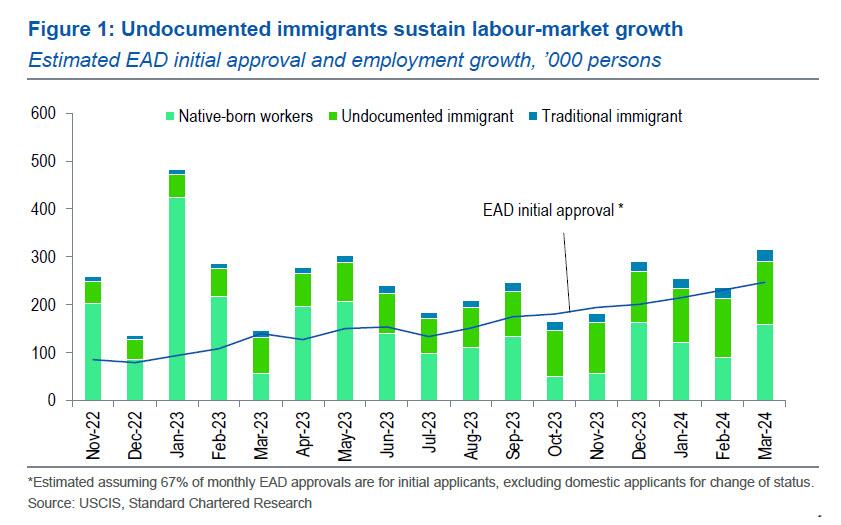
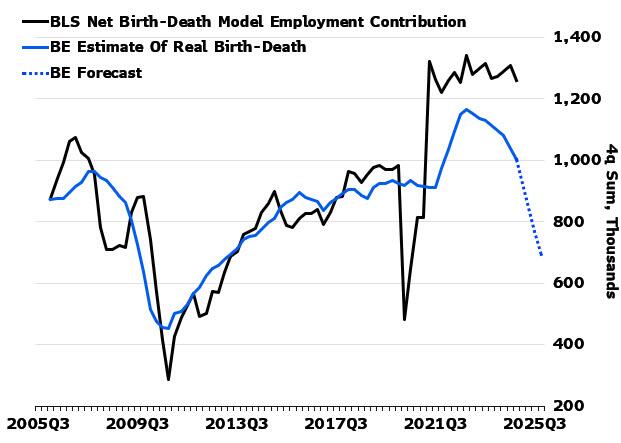
 For much of the past year we had been pounding the table on two very simple facts:  not only has the US labor market been appallingly weak, with most of the jobs "gained" in 2023 and meant to signal how strong the Biden "recovery" has been, about to be revised away (as first the Philly Fed and now Bloomberg both admit), but more shockingly, all the job growth in the past few years has gone to illegal aliens.

We first pointed this out more than a year ago, and since then we have routinely repeated - againagain, and again - yet even though we made it abundantly clear what was happening...

IS ‘OPERATION DUMP JOE’ BACK ON?

 Last fall we noted a number of news features in the mainstream media such as the New York Times gingerly noting Biden’s “age issue.” But then his hopped-up performance at the State of the Union speech in March (I think we now can intuit what happened to Hunter’s White House stash) seemed to put to rest the senility problem.

But it has come back with a vengeance. The Wall Street Journal today has the most brutal take yet on the failing mind of Biden in “Behind Closed Doors, Biden Shows Signs of Slipping.” Here’s the opening:

When President Biden met with congressional leaders in the West Wing in January to negotiate a Ukraine funding deal, he spoke so softly at times that some participants struggled to hear him, according to five people familiar with the meeting. He read from notes to make obvious points, paused for extended periods and sometimes closed his eyes for so long that some in the room wondered whether he had tuned out.

In a February one-on-one chat in the Oval Office with House Speaker Mike Johnson, the president said a recent policy change by his administration that jeopardizes some big energy projects was just a study, according to six people told at the time about what Johnson said had happened. Johnson worried the president’s memory had slipped about the details of his own policy.

Last year, when Biden was negotiating with House Republicans to lift the debt ceiling, his demeanor and command of the details seemed to shift from one day to the next, according to then-House Speaker Kevin McCarthy and two others familiar with the talks. On some days, he had loose and spontaneous exchanges with Republicans, and on others he mumbled and appeared to rely on notes.

“I used to meet with him when he was vice president. I’d go to his house,” McCarthy said in an interview. “He’s not the same person.”

But more interesting than these details is the extent to which the White House attempted to do damage control on this story as the Journal went about reporting it:

This article is based on interviews with more than 45 people over several months. The interviews were with Republicans and Democrats who either participated in meetings with Biden or were briefed on them contemporaneously. . .

The White House kept close tabs on some of The Wall Street Journal’s interviews with Democratic lawmakers. After the offices of several Democrats shared with the White House either a recording of an interview or details about what was asked, some of those lawmakers spoke to the Journal a second time and once again emphasized Biden’s strengths.

“They just, you know, said that I should give you a call back,” said Rep. Gregory Meeks, a New York Democrat, referring to the White House.

Does this sound like a White House confident in the state of things?

Chaser—from Politico:

Joe Biden’s worries grow as Hunter Biden’s trial begins

Over the past few weeks, President Joe Biden has grown consumed by worries over the trial of Hunter Biden. He’s called family members more regularly to check on his son’s mood. The topic of the criminal case dominated the family gatherings in Delaware over the weekend. And when the trial opened on Monday, Biden issued a personal statement offering his support for his son, noting that he was a father in addition to the president.

Maybe the dots will be connected soon, and Biden will drop out of the election, so he can spend more time on family matters.

https://www.powerlineblog.com/archives/2024/06/is-operation-dump-joe-back-on.php

Biden’s border action explained

President Joe Biden may have claimed his new executive order on border security would “bar migrants who cross our southern border unlawfully from receiving asylum,” but in reality, the memo implementing the new regulation maintains all the existing loopholes and even prompts migrants to ask for protection from deportation.

The June 4 memo from Immigration and Customs Enforcement acting Director Patrick Lechleitner to ICE’s Enforcement and Removal Operations director does suspend the entry of noncitizens apprehended for illegally crossing the southern border, but then, it includes a long list of exceptions to the new ban on entry, including:

“Noncitizens who a U.S. Customs and Border Protection (CBP) officer permits to enter, based on the totality of the circumstances, including consideration of significant law enforcement, officer and public safety, urgent humanitarian, and public health interests that warrant permitting the noncitizen to enter; and” 

“Noncitizens who a CBP officer permits to enter due to operational considerations that warrant permitting the noncitizen to enter.”

In other words, migrants arrested for illegally crossing the southern border are not to be admitted unless they qualify under the same loopholes that they are being released into the United States today.

Take, for example, Jose Ibarra, the accused killer of nursing student Laken Riley. Under current law, once Ibarra was apprehended for illegally crossing the southern border in September 2022, Biden was under the legal obligation to detain Ibarra until he was removed from the country.

But instead of removing Ibarra, as required by law, Biden chose to grant Ibarra parole because the Department of Homeland Security had no capacity to detain him. Ibarra went on to get arrested in New York City on charges related to endangering a child before allegedly murdering Riley in Georgia.

Biden’s new executive order keeps the same loophole that allowed him to release Ibarra into the country. Just like before, when DHS paroled Ibarra because DHS had no capacity to detain him, Biden’s new order always allows illegal immigrants to be released “due to operational considerations that warrant permitting the noncitizen to enter.”

There has been no change. The southern border is just as wide open now after Biden’s executive order as it was without Biden’s executive order.

https://www.washingtonexaminer.com/opinion/3028985/bidens-border-action-explained/

Trump’s Trial Violated Due Process

He was denied notice of the charges, meaningful opportunity to respond, and proof of all elements.

Whether you love, hate or merely tolerate Donald Trump, you should care about due process, which is fundamental to the rule of law. New York’s trial of Mr. Trump violated basic due-process principles.

“No principle of procedural due process is more clearly established than that notice of the specific charge,” the Supreme Court stated in Cole v. Arkansas (1948), “and a chance to be heard in a trial of the issues raised by that charge, if desired, [is] among the constitutional rights of every accused in a criminal proceeding in all courts, state or federal.” In in re Winship (1970), the justices affirmed that “the Due Process Clause protects the accused against conviction except upon proof beyond a reasonable doubt of every fact necessary to constitute the crime with which he is charged.” These three due-process precepts—notice, meaningful opportunity to defend, and proof of all elements—were absent in Mr. Trump’s trial.

The state offense with which Mr. Trump was indicted, “falsifying business records,” requires proof of an “intent to defraud.” To elevate this misdemeanor to a felony, the statute requires proof of “intent to commit another crime.” In People v. Bloomfield (2006), the state’s highest court observed that “intent to commit another crime” is an indispensable element of the felony offense.

New York courts have concluded that the accused need not be convicted of the other crime since an “intent to commit” it is sufficient to satisfy the statute. But because that intent is, in the words of Winship, “a fact necessary to constitute the crime,” it is an element of felony falsification. Due process requires that the defendant receive timely notice of the other crime he allegedly intended to commit. It also requires that he have opportunity to defend against that accusation and that prosecutors prove beyond a reasonable doubt his intent to commit it.

Mr. Trump’s indictment didn’t specify the other crime he allegedly intended to commit. Prosecutors didn’t do so during the trial either. Only after the evidentiary phase of the trial did Judge Juan Merchan reveal that the other crime was Section 17-152 of New York’s election law, which makes it a misdemeanor to engage in a conspiracy “to promote or prevent the election of any person to a public office by unlawful means.”

To recap, the prosecution involved (1) a misdemeanor elevated to a felony based on an “intent to commit another crime,” (2) an indictment and trial that failed to specify, or present evidence establishing, another crime the defendant intended to commit, and (3) a jury instruction that the other crime was one that necessitated further proof of “unlawful means.” It’s a Russian-nesting-doll theory of criminality: The charged crime hinged on the intent to commit another, unspecified crime, which in turn hinged on the actual commission of yet another unspecified offense.

To make matters worse, Judge Merchan instructed the jury: “Although you must conclude unanimously that the defendant conspired to promote or prevent the election of any person to a public office by unlawful means, you need not be unanimous as to what those unlawful means were.”

Due process demands that felony verdicts be unanimous, but in Schad v. Arizona (1991), a murder case, the high court indicated that there need not be unanimity regarding the means by which a crime is committed. But a plurality opinion by Justice David Souter cautioned that if the available means of committing a crime are so capacious that the accused is not “in a position to understand with some specificity the legal basis of the charge against him,” due process will be violated. “Nothing in our history suggests that the Due Process Clause would permit a State to convict anyone under a charge of ‘Crime’ so generic that any combination of jury findings of embezzlement, reckless driving, murder, burglary, tax evasion, or littering, for example, would suffice for conviction,” Justice Souter wrote.

Justice Antonin Scalia concurred, observing that “one can conceive of novel ‘umbrella’ crimes (a felony consisting of either robbery or failure to file a tax return) where permitting a 6-to-6 verdict would seem contrary to due process.” Four dissenting justices argued that the In re Winship precedent requires unanimity regarding all elements of a crime, including the means by which it’s committed.

All nine justices in Schad, then, believed unanimity is required to convict when the means by which a crime can be committed are so broad that the accused doesn’t receive fair notice of the basis of the charge. New York’s election law requires that the violation occur “by unlawful means,” so any “unlawful” act—including, in Scalia’s example, either robbery of failure to file a tax return—can qualify. That’s clearly overbroad. Thus, Judge Merchan’s instruction that the jury “need not be unanimous as to what those unlawful means were” was unconstitutional.

That isn’t all. Judge Merchan hand-selected three laws—federal election law, falsification of “other” business records and “violation of tax laws”—as the “unlawful means” by which state election law was violated. Mr. Trump received no notice of any of these offenses, and the prosecutor briefly alluded only to federal election law, during the trial. Mr. Trump tried to call former Federal Election Commission Chairman Brad Smith to explain why this law wasn’t violated, but Judge Merchan ruled Mr. Smith couldn’t testify on whether Mr. Trump’s conduct “does or does not constitute a violation” of federal election law, denying him a meaningful opportunity to be heard.

Judge Merchan’s second “unlawful” means, falsification of other business records, is circular: A misdemeanor becomes a felony if one falsifies business records by falsifying business records. Further, the prosecution never alleged or provided evidence that Mr. Trump falsified “other” business records. The prosecutors likewise neither alleged nor offered evidence that Mr. Trump had violated tax laws, Judge Merchan’s third predicate.

Mr. Trump, like all criminal defendants, was entitled to due process. The Constitution demands that higher courts throw out the verdict against him. That takes time, however, and is unlikely to occur before the election. That unfortunate reality will widen America’s political divide and fuel the suspicion that Mr. Trump’s prosecution wasn’t about enforcing the law but wounding a presidential candidate for the benefit of his opponent.

Mr. Rivkin served at the Justice Department and the White House Counsel’s Office during the Reagan and George H.W. Bush Administrations. Ms. Foley is a professor of constitutional law at Florida International University College of Law. Both practice appellate and constitutional law in Washington.

https://www.wsj.com/articles/trumps-trial-violated-due-process-76fae047

Gunman Captured After Attack, Lengthy Shootout At US Embassy In Beirut

 The American Embassy in the Lebanese capital of Beirut has come under attack Wednesday, and a gunman has been shot by Lebanese security forces after the armed man fired at the embassy. At least one embassy security guard was injured.

The badly wounded suspect was taken into custody following the shootout with soldiers, the military and embassy officials confirmed. Amid still emerging details, it appears to have been an Islamic terror attack, given the assailant had a vest with the words "Islamic State" written in Arabic.

"The Lebanese military in a statement said that soldiers shot an assailant, who they only described as a Syrian national," Associated Press reports. The gunman is currently in a hospital and in policy custody.

According to more details

No motive was immediately clear. However, Lebanese media have published photos that appear to show a bloodied attacker wearing a black vest with the words “Islamic State” written in Arabic and the English initials “I” and “S.”

The attack and shootout with security was significant, given eyewitnesses said it lasted nearly half an hour, and involved the man firing an assault rifle toward the embassy from a parking lot across from the diplomatic compound's entrance.

An embassy spokesperson said of the wounded Lebanese security guard, "With respect to his privacy we cannot say more, but we wish him a full recovery." The embassy also confirmed that all embassy personnel were "safe".

Unverified image of the attacker captured on cell phone of local eyewitness:

According to an additional statement by the Lebanese Armed Forces (LAF):

"The US Embassy in Lebanon in the Awkar area was exposed to gunfire by a person holding Syrian nationality. Army members deployed in the area responded to the sources of fire, wounding the shooter. He was arrested and transferred to a hospital for treatment. Follow-up is underway to determine the circumstances of the incident," the army said.

Harrowing video footage showed the moment the gunman exchange fire with Lebanese soldiers positioned above:

Some commentators have underscored that the US will likely use this terror incident to beef up its military presence inside Lebanon.

Interestingly, even throughout over a decade of the war in Syria, there were no similar terror attacks and shootouts like this specifically targeting the sprawling US Embassy complex in Beirut.

https://www.zerohedge.com/geopolitical/gunman-captured-after-attack-lengthy-shootout-us-embassy-beirut

'Visualizing The Training Costs Of AI Models Over Time'

 Training advanced AI models like OpenAI’s ChatGPT and Google’s Gemini Ultra requires millions of dollars, with costs escalating rapidly.

As computational demands increase, the expenses for the computing power necessary to train them are soaring. In response, AI companies are rethinking how they train generative AI systems. In many cases, these include strategies to reduce computational costs given current growth trajectories.

As Visual Capitalist's Dorothy Neufeld shows in the following graphic, based on analysis from Stanford University’s 2024 Artificial Intelligence Index Reportthe training costs for advanced AI models has surged.

How Training Cost is Determined

The AI Index collaborated with research firm Epoch AI to estimate AI model training costs, which were based on cloud compute rental prices. Key factors that were analyzed include the model’s training duration, the hardware’s utilization rate, and the value of the training hardware.

While many have speculated that training AI models has become increasingly costly, there is a lack of comprehensive data supporting these claims. The AI Index is one of the rare sources for these estimates.

Ballooning Training Costs

Below, we show the training cost of major AI models, adjusted for inflation, since 2017:

Last year, OpenAI’s GPT-4 cost an estimated $78.4 million to train, a steep rise from Google’s PaLM (540B) model, which cost $12.4 million just a year earlier.

For perspective, the training cost for Transformer, an early AI model developed in 2017, was $930. This model plays a foundational role in shaping the architecture of many large language models used today.

Google’s AI model, Gemini Ultra, costs even more, at a staggering $191 million. As of early 2024, the model outperforms GPT-4 on several metrics, most notably across the Massive Multitask Language Understanding (MMLU) benchmark. This benchmark serves as a crucial yardstick for gauging the capabilities of large language models. For instance, its known for evaluating knowledge and problem solving proficiency across 57 subject areas.

Training Future AI Models

Given these challenges, AI companies are finding new solutions for training language models to combat rising costs.

These include a number of approaches, such as creating smaller models that are designed to perform specific tasks. Other companies are experimenting with creating their own, synthetic data to feed into AI systems. However, a clear breakthrough is yet to be seen.

Today, AI models using synthetic data have shown to produce nonsense when asked with certain prompts, triggering what is referred to as “model collapse”.

https://www.zerohedge.com/technology/visualizing-training-costs-ai-models-over-time