Search This Blog

Thursday, June 6, 2024

PHTI backs virtual therapies for musculoskeletal disorders

 A new report from the Peterson Health Technology Institute has concluded that many digital therapies for musculoskeletal (MSK) conditions like low back pain can deliver clinically meaningful benefits in pain and function.

The analysis from the health technology assessment (HTA) organisation concludes that they offer clinical benefits to patients that are comparable to in-person physical therapy (PT) and should be included in medical benefits insurance as they have the potential to “ improve access to therapy, reduce healthcare spending, and offer greater convenience” to patients.

The report covered exercise therapy apps Dario and Kaia, virtual physiotherapist-guided tools Hinge, Omada, RecoveryOne, Sword, and Vori, and Limber, a remote therapeutic monitoring (RTM) physiotherapy programme.

The exercise therapy apps improved pain but did not have much impact on function, and according to PHTI were not substitutable for in-person PT although they could be useful – depending on price – for less serious MSK disorders. Limber scored well and may even outperform in-person PT alone, it said, but its price leads to a net increase in healthcare spending.

The PT-guided solutions were in the sweet spot of improving pain and function and reducing net spending, mainly from avoided care, and PHTI said the evidence supports broader adoption. Purchasers and providers should encourage more PT-first MSK care, it added.

“We know that early and regular use of physical therapy can speed the healing process and avoid other complex MSK care, such as surgery,” said Caroline Pearson, executive director of PHTI.

“Our findings indicate that virtual solutions represent effective treatment options that can expand the number of patients who both start and stick with physical therapy,” she added. “In order to realise their full potential, virtual MSK solutions should be more closely integrated with medical care and insurance benefits.”

The MSK study has a much more positive verdict than PHTI’s earlier report on digital tools to help people with diabetes manage their blood sugar levels, which concluded that they provide little benefit and add to healthcare spending.

The body – which is affiliated with the Institute for Clinical and Economic Review (ICER) that conducts cost-effectiveness assessments on prescription medicines sold in the US market – was set up to test the claim that 80% of digital health products lack clinical evidence.

It is also casting its eye over digital hypertension and depression/anxiety tools, with verdicts expected later this year.

PHTI is running a free webinar next week (13th June) to discuss the MSK report’s findings.

https://pharmaphorum.com/news/phti-backs-virtual-therapies-musculoskeletal-disorders

CDC recommends first post-exposure antibiotic for STIs

 Faced with a dramatic rise in sexually transmitted infections, including syphilis, chlamydia, and gonorrhoea in the US, the US government has, for the first time, backed the use of an antibiotic for post-exposure prophylaxis (PEP).

The doxyPEP regimen is recommended for use in groups at higher risk of contracting the STIs – including gay, bisexual, other men who have sex with men (MSM), and transgender women – within 72 hours of having unprotected sex.

In three large clinical trials, 200 mg of doxycycline taken in that timeframe has been shown to reduce syphilis and chlamydia infections by more than 70% and gonococcal infections by approximately 50%.

DoxyPEP can also be used to prevent malaria infection both before and after exposure, so there is a precedent for its use as PEP.

The Centres for Disease Control and Prevention (CDC) issued the new guidelines today and its decision is believed to be the first national effort to use doxyPEP in this way – and may influence other countries to follow suit.

In its update, the CDC said that there are “no vaccines and few chemoprophylaxis options” for syphilis, chlamydia, and gonorrhoea, which disproportionately affect the MSM and TGW communities.

It recommends that a prescription for doxyPEP be offered to people in this group who present within 72 hours after having oral, vaginal, or anal sex, in the context of a wider sexual health approach that includes risk reduction counselling and screening and treatment for STIs.

For now, the CDC has stopped short of recommending doxyPEP for other groups, including heterosexual and cisgender men and women, because of a lack of data, as well as concerns about the risk for development of antimicrobial resistance (AMR) with more widespread use.

It’s worth noting that GSK has made significant strides in gonorrhoea of late – which has seen the rate of resistance to doxycycline climb – with promising results for a new antibiotic and vaccine, while Sanofi and other groups are working on vaccines for chlamydia.

Syphilis remains an elusive target for vaccination, and earlier this year, the FDA authorised emergency imports of a French antibiotic due to shortages in the domestic market.

CDC figures from 2022 show that there were around 2.5 million cases of chlamydia, gonorrhoea, syphilis and congenital syphilis in the US, with a 17% rise in syphilis cases, chlamydia fairly flat, gonorrhoea slightly down on the prior year.

Gonorrhoea cases had however risen around 11% in the prior five years, and the reduction in 2022 was the first in a decade.

https://pharmaphorum.com/news/cdc-recommends-first-post-exposure-antibiotic-stis

Telix prices $200m IPO in big week for radiopharma financing

 Australian radiopharmaceutical specialist Telix has revealed the terms of its planned initial public offering (IPO) in the US, revealing that it hopes to raise $202 million from a Nasdaq listing.

It was one of three financing announcements in the white hot radiopharma category this week, as AstraZeneca swelled the coffers of US-based Nucleus RadioPharma with an undisclosed addition to its $56 million Series A and Germany’s ITM Isotope Technologies raised €188 million ($205 million) in a new private round.

North Melbourne-based Telix said it is offering 17 million US shares at $11.87 – which matches the value of its Australian shares ahead of the disclosure and would give it a market cap of around $4.2 billion. It first announced plans for the US IPO last month.

It focuses on the development of diagnostic and therapeutic radiopharmaceuticals and has one commercial product, Illucix (gallium Ga-68 gozetotide), which is a PSMA-targeted product for prostate cancer imaging and is used to identify patients eligible for PSMA-directed radioligand therapy with drugs like Novartis’ fast-growing Pluvicto (lutetium [lu177] vipivotide tetraxetan).

Its therapeutic pipeline includes potential Pluvicto rival TLX591 in phase 2/3 trials and TLX250 for advanced kidney cancer in mid-stage clinical testing. Meanwhile, on the diagnostics side, it has filed for FDA approval of Zircaix for kidney cancer and brain cancer (glioma) agent Pixclara.

Turning to ITM, the Munich start-up said the infusion of new capital will be used to advance a pipeline of radiopharma therapeutics headed by ITM-11 for the treatment of gastroenteropancreatic neuroendocrine tumours (GEP-NETs), a potential rival to Novartis’ Lutathera (lutetium [177Lu] oxodotreotide), and expand its manufacturing capacity.

ITM-11 is in a pair of phase 3 trials – COMPETE and COMPOSE – and has been awarded fast-track status by the FDA. ITM’s pipeline also includes ITM-31 for glioblastoma in phase 1 testing and PSMA-directed diagnostic and therapeutic duo ITM-22/ITM-22D for prostate cancer.

Temasek led the financing with participation from funds managed by BlackRock Alternatives, Qatar Investment Authority (QIA), ATHOS, and Carbyne. It comes just a year after ITM raised €255 million featuring many of the same backers.

Finally, Nucleus’s extension to Series A saw AZ join existing investors from GE Healthcare, Mayo Clinic, Eclipse Ventures, Fox Chase Cancer Center, Echo Global Granger Management Mercy Health, and the University of Missouri.

AZ’s head of corporate ventures Tyrell Rivers joined the start-up’s board of directors, with the investment in Nucleus coming a few weeks after AZ agreed a $2 billion takeover deal for radiopharma specialist Fusion Pharma.

Rochester, Minnesota-based Nucleus is a contract development and manufacturing organisation (CDMO) serving the radiopharma sector, operating a 12,000-square-foot research and development site near the Mayo Clinic. It said the new funding will “will facilitate the expansion of our development, supply, and commercial manufacturing capabilities, ultimately enhancing global accessibility to targeted radiotherapies and theranostics for patients worldwide.”

https://pharmaphorum.com/news/telix-prices-200m-ipo-big-week-radiopharma-financing

Long-read RNA sequencing reveals key gene expressions in Alzheimer's

 Researchers at the University of Kentucky Sanders-Brown Center on Aging are working to develop a pre-symptomatic disease diagnostic tool for Alzheimer's disease.

"While the need for better treatments is clear, such treatments will not be very meaningful if they are administered after symptoms have onset. By then, Alzheimer's disease has been ravaging the brain for decades to the point the brain can no longer compensate for the extreme cellular death," said Mark T. W. Ebbert, Ph.D., Sanders-Brown faculty and an associate professor in the Department of Internal Medicine in the College of Medicine with a joint appointment in the Department of Neuroscience.

Ebbert is leading the research team behind the study titled "Mapping medically relevant RNA  diversity in the aged human frontal cortex with deep long-read RNA-seq" that was recently published in Nature Biotechnology.

Ebbert's team includes lead authors Bernardo Aguzzoli Heberle, a Ph.D. candidate at Sanders-Brown, and Jason A. Brandon, Ph.D., a scientist at Sanders-Brown and the Department of Internal Medicine.

The team is using a cutting-edge technique known as long-read sequencing. These technologies allow for a new level of analysis of DNA and RNA, which is the molecule that helps translate genetic code from DNA into proteins.

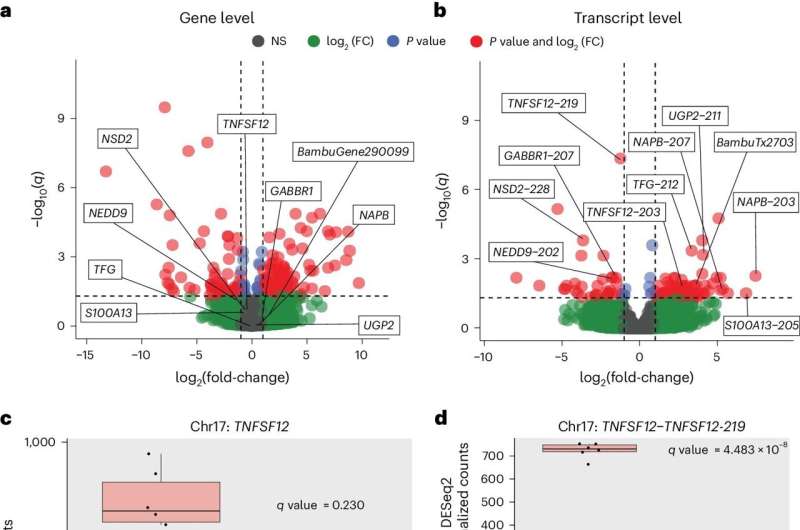
A single human gene can produce multiple different RNA and protein molecules, called isoforms, allowing it to perform multiple functions. Long-read sequencing helps Sanders-Brown researchers identify and measure these RNA isoforms from a  across the entire genome. This also overcomes technical limitations from standard short-read sequencing.

"As a proof of principle, we sequenced aged frontal cortex brain tissue—both healthy brains and brains with Alzheimer's disease. Our team identified 99 RNA isoforms that were either increased or decreased in Alzheimer's brains, even when the overall gene activity didn't change," said Ebbert.

"This shows the importance of understanding isoforms and their unique functions in a gene along with their roles in human health and disease. In fact, we found more than 1,900 genes expressing multiple RNA isoforms related to human disease."

Long-read RNA sequencing reveals key gene expressions in Alzheimer's disease
RNA isoform analysis can reveal disease expression patterns unavailable at the gene level. Credit: Nature Biotechnology (2024). DOI: 10.1038/s41587-024-02245-9

The team at Sanders-Brown found some of those genes are medically relevant in brain-related diseases, including Alzheimer's disease, Parkinson's disease, , and .

"This step in understanding the human genome is exciting, but it is simply not enough. We have so much more to do to understand how individual RNA isoforms are involved in diseases, including Alzheimer's disease, and how to target them therapeutically. There is so much work to do if we are going to defeat Alzheimer's disease," said Ebbert.

The team also discovered five new, complex RNA variants from mitochondrial DNA. Researchers believe this is the first study to identify this genetic material in human tissue.

"Although their expression is low, these genes could serve as biomarkers for mitochondrial function, which play an important role in many age-related diseases. It's crucial to understand the role these new isoforms play in human health and disease," said Ebbert.

Sanders-Brown scientists hope these findings can lead to new and more precise targets for disease treatment and diagnosis across a broad range of complex human diseases.

"With this method, we've shown there's potential to specifically target isoforms that are either promoting cellular health or dysfunction rather than treating a gene as a single entity," said Ebbert. "The analysis can also help us reveal unique signatures in Alzheimer's disease not detectable at the gene level."

Researchers say larger studies are needed to better understand the RNA patterns in complex diseases and deep long-read RNA sequencing will be a necessary tool for that work.

"We are also incredibly grateful to the patients who've donated to the UK Alzheimer's Disease Center Tissue Bank," said Ebbert. "Without their participation, this level of scientific study would not be possible."

This study brought together a team of researchers from the UK College of Medicine's Department of Pharmacology and Nutritional Sciences; Department of Pathology and Laboratory Medicine; and Department of Microbiology, Immunology, and Molecular Genetics; Emory University School of Medicine in Georgia; University College of London in the United Kingdom; Cold Spring Harbor Laboratory in New York; and the Mayo Clinic in Arizona.

More information: Bernardo Aguzzoli Heberle et al, Mapping medically relevant RNA isoform diversity in the aged human frontal cortex with deep long-read RNA-seq, Nature Biotechnology (2024). DOI: 10.1038/s41587-024-02245-9\


https://medicalxpress.com/news/2024-06-rna-sequencing-reveals-key-gene.html

How cancer stem cells spread and resist treatment

 NDORMS researchers have identified a critical axis that controls the formation and behavior of cancer stem cells (CSCs), a subpopulation of cells that influence how lethal the cancer can be, its resistance to chemotherapy, and its ability to spread to other parts of the body.The findings, published in Nature Communications, could pave the way for more effective cancer treatments.

The research, led by Associate Professor and CRUK career development fellow Siim Pauklin from NDORMS, focused on understanding the intricate interplay between cell-autonomous (mechanisms inside cells that function independently of signals coming from outside the cells) and non-cell-autonomous (external signals from outside cells) pathways that govern the stem cell-like characteristics of cancer stem cells (CSCs) in .

CSCs have also been discovered in the brain, breast, colon, esophagus, liver, lung, ovarian, prostate, stomach and thyroid cancers, among others.

Using a quantitative proteomic approach to analyze the set of proteins in the  (the secretome) of pancreatic CSCs, the research reveals how a complex axis involving the retinoblastoma (RB) proteins and the E2F transcription factors controls the production of signaling molecules that promote CSC formation and chemoresistance.

"We were surprised to find that the well-known cell cycle regulators pRb and E2F, which were previously thought to only have cell-autonomous effects, actually have a non-cell-autonomous role in controlling the secretion of key WNT ligands that drive the stem cell-like properties of CSCs," said Siim. "This work provides important insights into the non-cell autonomous mechanisms that allow  to thrive and evade therapy."

The researchers discovered that the E2F1 and E2F4  induce the expression of WNT ligands, such as WNT7A, WNT7B, WNT10A, and WNT4, while the pRb and RBL2 proteins act to reduce their expression. This delicate balance is disrupted in cancer cells harboring KRAS mutations, leading to the aberrant secretion of these WNT ligands and the activation of the WNT/β-catenin signaling pathway in CSCs.

"The interplay between cell-autonomous transcriptional regulators and non-cell-autonomous signaling pathways is a crucial, yet often overlooked, aspect of cancer stem cell biology," Siim said. "Our findings highlight the importance of targeting these extracellular communication networks to effectively eliminate this resilient population of cells."

The study's insights could pave the way for the development of more effective cancer therapies, as targeting the identified pathway could potentially disrupt the self-renewal, chemoresistance, and metastatic potential of CSCs, which are often responsible for treatment failure and disease recurrence.

More information: Chao-Hui Chang et al, The pRb/RBL2-E2F1/4-GCN5 axis regulates cancer stem cell formation and G0 phase entry/exit by paracrine mechanisms, Nature Communications (2024). DOI: 10.1038/s41467-024-47680-z


https://medicalxpress.com/news/2024-06-uncovers-cancer-stem-cells-resist.html

India Has Low-Cost CAR T-Cell Therapy: Can US Follow Suit?

 I'm Dr Maurie Markman, from City of Hope. I wanted to briefly discuss a very provocative news report. I normally don't talk about news reports. I try to focus on data in the peer-reviewed medical literature, but because this report was so provocative and it appeared in Nature, I thought it was worthy of highlighting as a matter of discussion.

This news in focus was published in Nature on March 28, 2024 entitled, "Cutting-Edge CAR-T Cancer Therapy Is Now Made in India – at One-Tenth the Cost." Let me repeat that: at one tenth the cost. 

This report is about a therapy that has been developed by a company in India. It's made in India, and it's been licensed in India. The effectiveness of this strategy, which is a chimeric antigen receptor (CAR) T-cell therapy strategy, was noted in the paper and in an abstract, which I read, at the American Society of Hematology meeting last year. 

There are some novel aspects of this, including the humanization of the approach, instead of in mice, reducing some of the potential side effects. Again, it's somewhat rather technical.

The bottom line is that the cost of this particular product, in US dollars, not Indian Rupee, was $30,000-$40,000 for this CAR T-cell product, in contrast to products in the United States that currently cost ten times this amount, if not more. 

Now, I cannot make any comment about the safety. I certainly cannot comment on the efficacy or relative efficacy. It is notable that these individuals, one of whom was quoted, who currently works at the National Cancer Institute, who is actually involved in the development, and others quoted in the article, who have noted that the number of patients treated is limited, but the data appear to be solid. 

The question is: Can we, in the United States, develop CAR T-cell products that are not 10% cheaper, not 20% cheaper but 50%, 60%, or 70% cheaper? Why? Clearly, the products we're talking about here have the potential to have an enormous impact on patient outcomes, survival, and cure. 

Certainly, CAR T cells are continually being examined in the solid-tumor space, as opposed to right now, where they're essentially exclusively in the hematologic malignancy space. We're talking about a vastly larger patient population that may benefit. 

A cost of $300,000-$600,000, which does not include the actual care you're providing patients, makes this essentially impossible to be used widespread in the solid tumors even if we come up with a strategy that works. 

If we're able to come up with an approach, whether it's from a regulatory or scientific way of doing this, without requiring certain expensive parts so that we can reduce the price by 70%, 80%, or 90% and do it safely and effectively, how many more patients may be able to benefit in the future? 

Again, what I'm quoting here is a news report. I'm not reporting definitive science, but it's highly provocative, and it's food for thought, hopefully for the near future. I thank you for your attention. 

https://www.medscape.com/viewarticle/india-has-low-cost-car-t-cell-therapy-can-us-follow-suit-2024a10009ps

Large Numbers of Patients With MS Stranded in 'Care Deserts'

 Large numbers of patients with multiple sclerosis (MS) who live outside large urban centers have little, or no, access to neurologic care, new research showed.

Funded by the National MS Society (NMSS), the data reveal that "about a quarter of the US population live in what we defined as an MS care desert," said Bari Talente, executive vice president of advocacy and healthcare access for the organization. Talente added that many patients living in "MS care deserts" are also far from a neurologist of any kind.

Conducted in collaboration with Deloitte Consulting, the study was presented as a late-breaker on May 30 at the Consortium of Multiple Sclerosis Centers (CMSC) 2024 Annual Meeting.

Deloitte maintains the US health dataset HealthPrism, which includes 335 million individuals. This study is the first step in characterizing the problem. Talente said the next step is finding solutions.

The database, she said, includes data on economic and social characteristics. For example, access to the internet is a measurable variable, but because some regions of the country still have limited access, telehealth is not a uniform solution, she noted.

In the continental United States, 23% of the population lives in an MS care desert as defined by neurologist density and travel times. The threshold for an underserved area on the basis of neurologists was < 2.32/100,000 individuals in any given county. Drive time thresholds varied, but the definition of an MS desert is defined as more than 60 minutes from an urban center.

The fact that the majority of MS patients have full or partial access to MS care contrasts with a color-coded US map that displays full access, partial access, or MS care deserts. Vast areas of the continental United States are solid orange, indicating an MS care desert. Areas colored in yellow, signaling partial access, or blue, revealing full access, are concentrated in the Northeast, in Florida, and in urban islands across the West.

General Neurologist Gap

A map indicating the availability of general neurologists shows most of the Eastern United States is colored in yellow, indicating partial access. In the Midwest, the map is largely yellow with islands of yellow and blue. The West Coast, like the East Coast, is also predominantly yellow and blue. However, the rural West is predominately orange.

When large central metropolitan counties are compared with rural areas, the mean density of neurologists is nearly five times higher (10.8 vs 2.15/100,000 population). Full access to a neurologist is approximately seven times higher in urban areas relative to rural areas (97% vs 13%).

Evaluated from the opposite perspective, only a small proportion of patients with MS in urban centers have no access to specialty care. According to the data from this study, led by Andreina Barnola, MD, MPH, director of Health Equity Initiatives at the NMSS, the proportions climb steeply with lower population density, reaching 60% in small metro areas and 83% in rural areas.

A chronic illness, MS, requires lifelong attention. Over the past decades, MS specialty centers have been able to provide increasingly sophisticated interventions to sustain the quality of life and reduce some of the risk from medical complications associated with MS-induced organ dysfunction. Talente suggested that the magnitude of the problem will only increase with the growing shortage of neurologists.

In another study published this year, similar data were generated using a different methodology. With data on 2022 practice locations, the study showed that 17,827 (25.2%) of the 70,858 census tracts in the United States had no MS centers within 60 miles.

Among other findings, the study also documented lower access among Hispanic groups relative to other ethnic/racial groups and among individuals with disabilities.

The lead author of that study, which was also presented at the CMSC conference, Marisa P. McGinley, DO, an assistant professor of neurology at the Cleveland Clinic Lerner College of Medicine, Cleveland Clinic, Cleveland, said that the "clear geographic disparities in access to neurologists and MS specialty centers" are an important clinical challenge and that the solutions are not simple.

"Telemedicine has the potential to reduce some of these geographic barriers, but other solutions developed in partnership with people with MS and other healthcare professionals are needed," McGinley said.

Talente also suggested that innovative solutions are needed. Given the impracticality of creating MS specialty centers in rural areas, she suggested that one possibility is to provide tools to general neurologists, or even to primary care physicians, that will enable a higher level of care.

None of the investigators associated with the NMMS study reported any potential conflicts of interest. McGinley reported financial relationships with Biogen, EMD Serono, Genzyme, Genentech, Novartis, and Octave Bioscience.

https://www.medscape.com/viewarticle/large-numbers-patients-ms-stranded-care-deserts-2024a1000anm