Search This Blog

Wednesday, March 19, 2025

UnitedHealth's unit reduces renewal requirements for some prescription drugs

 UnitedHealth Group's pharmacy benefit manager, Optum Rx, said on Wednesday it would ease requirements to get insurance authorization when renewing prescriptions on about 80 drugs, aiming to reduce the paperwork for patients and doctors.

The list, which could be expanded over time, will eliminate up to 25% of these reauthorization requirements and accounts for more than 10% of all such pharmacy authorizations, it said.

The killing of a UnitedHealth executive last December had set off an outpouring of complaints about insurance on social media, including its and other health insurers' requirements to seek their approval on medicines.

In January this year, UnitedHealth said during a conference call with investors that it would work with policymakers to reduce the frequency of prior authorizations required before a patient can access medical treatment in its Medicare business for people aged 65 and older or with disabilities.

Reauthorizations, or certain checks that patients need to go through to continue receiving their medications, are necessary for drugs that have safety concerns, or need ongoing monitoring for adjusting doses, or additional tests, UnitedHealth's unit said.

Newly approved drugs for diseases such as Alzheimer's require ongoing review, whereas with genetic conditions like cystic fibrosis, there is minimal additional value in reauthorizing a treatment, the company said.

https://www.usnews.com/news/top-news/articles/2025-03-19/unitedhealths-unit-reduces-renewal-requirements-for-some-prescription-drugs

Nvidia: working on autonomous medical imaging with GEHC

 GE HealthCare (Nasdaq: GEHC)

 is expanding its AI partnership with Nvidia to include autonomous X-ray and ultrasound applications. 

The Chicago-based medtech giant said the partnership, announced yesterday at GTC 2025 in San Jose, California, is meant to address the radiology staff shortages burdening health systems amid an aging population.

The news was part of a host of medtech AI announcements this week as Nvidia holds its GTC 2025 event in San Jose, California.

GE HealthCare will leverage Nvidia’s new Isaac for Healthcare platform. The Isaac for Healthcare platform is built on Nvidia’s three computers utilized to build physical AI, including Nvidia Omniverse for robotic simulation workflows. Using the Nvidia Cosmos platform for synthetic data generation, physics-based sensor simulation, imitation, and reinforcement learning, GE HealthCare will train, test, and tune autonomous ultrasound and X-ray devices in a virtual environment before actual deployment.

“GE HealthCare has a deep history of firsts in medical imaging, and we continue to build upon our legacy of innovation as a healthcare solutions provider,” Roland Rott, president and CEO of Imaging at GE HealthCare, said in a news release.

“We are excited about our expanded relationship with Nvidia and the potential of autonomous X-ray and ultrasound as we are focused on unlocking smarter, more automated solutions that enhance efficiency, standardize imaging, and help ease the burden of increased volumes and double-digit staff shortages on healthcare professionals.”

The initial focus of the partnership will involve developing an autonomous X-ray system, potentially utilizing the Nvidia Isaac for Healthcare and Jetson platforms. The Isaac for Healthcare platform and synthetic data generation will simulate various scenarios. The goal is to automate repetitive tasks a technologist performs in the patient exam room, enabling care teams to focus more on direct patient care and complex cases. There is also the potential to develop machine-to-patient interactions to lead the patient through the scan journey autonomously.

The work on autonomous ultrasound systems will focus on reducing the work burden for sonographers and radiologists. For sonographers, autonomous ultrasound systems could streamline workflow and reduce demanding physical strain resulting from repetitive motions. In addition, AI has the potential to take on more of the daily workload though advancements in image understanding  and robotic navigation.

GE HealthCare and Nvidia already have a history of partnership. For example, GE HealthCare used Nvidia technology to develop its healthcare-specific research foundation model SonoSAMTracktrained on approximately 200,000 image-mask pairs.

“Artificial intelligence and physical AI offer an incredible opportunity to expand global access to GE HealthCare’s advanced imaging systems,” said Kimberly Powell, VP of healthcare at Nvidia. “Working together to train and test autonomous solutions, we will accelerate the future of medical imaging capabilities, starting with the two most widely used modalities: X-ray and ultrasound.”

https://www.massdevice.com/ge-healthcare-nvidia-working-on-autonomous-imaging/

'Google promises new AI models for drug discovery'

 Google gave an update on various aspects of its health-related R&D at its annual event The Check Up, including a new collection of artificial intelligence (AI) models intended to support drug discovery.

The TxGemma models are – as the name suggests – an offshoot of Google's Gemma family of open-source, generative AI (GenAI) models that are, in turn, based on its Gemini AI platform, the latest iteration of which launched in December.

The toolkit is due to be made available to the scientific community for appraisal and further development later this month through its Health AI Developer Foundations programme, although it's not clear yet whether they can be used and adapted for commercial applications.

According to Google's chief health officer Dr Karen DeSalvo, TxGemma is able to understand regular text and the structures of different therapeutic entities, such as small molecules, chemicals and proteins.

"This means researchers can ask TxGemma questions to help predict important properties of potential new therapies, like how safe or effective they might be," she wrote in a blog post.

"The development of therapeutic drugs from concept to approved use is a long and expensive process, so we're working with the wider research community to find new ways to make this development more efficient," said DeSalvo.

What is clear is that the use of AI has emerged as a transformative force in the life sciences industry thanks to its ability to process large-scale datasets, uncover patterns, and generate predictions, and it is already being used to find drug targets, design new drugs, and repurpose existing therapies, among other applications.

Its rapid adoption prompted the FDA to publish its first guidance on the technology's use in regulatory filings earlier this year, while, in 2024, the EMA also set out its thinking in a reflection paper that discussed how AI can be used in the medicinal product lifecycle.

At The Check Up, Google also provided a rundown of its progress in other health applications, including improved health results in Google search, a new medical records feature in its Health Connect app, and its AI 'co-scientist' – a virtual collaborator designed to help scientists generate novel hypotheses and research proposals – that was announced in February.

"Let's say researchers want to better understand the spread of a disease-causing microbe," said DeSalvo. "They can specify this research goal using natural language, and the AI co-scientist will propose testable hypotheses, including a summary of relevant published literature and a possible experimental approach."

Finally, Google also highlighted an AI tool called Capricorn that uses Gemini models to help physicians speed up the identification of suitable personalised treatments for childhood cancers by combining public medical and de-identified patient data.

https://pharmaphorum.com/news/google-promises-new-ai-models-drug-discovery

Roche Ups ADC Bet With $1B in Biobucks For Oxford BioTherapeutics


Roche’s up to $1 billion investment will provide access to Oxford BioTherapeutics’ antibody-drug conjugate platform for undisclosed cancer targets.

Roche has inked an immuno-oncology partnership with U.K.-based Oxford BioTherapeutics with an eye toward developing best-in-class antibody-based treatments for cancer.

The pharma will pay $36 million upfront and has promised future milestone payments that could potentially go beyond $1 billion, according to a Wednesday announcement. Oxford will also be eligible for royalties on net sales of products that arise from the partnership.

In return, Roche will gain access to Oxford’s OGAP-Verify platform, a proprietary database on membrane protein abundance, with around 7,000 cataloged proteins across solid and hematological cancers and healthy tissues. The library is used to identify cancer targets that Oxford says would have otherwise been missed, as well as to predict a drug candidate’s potential efficacy and toxicity.

The partners will leverage the OGAP-Verify technology to discover and validate potential cancer targets, according to the agreement. Roche will be responsible for further development, as well as regulatory and commercialization activities, for any program that it chooses to take forward. The partners have yet to disclose what their priority diseases are, only revealing in the press announcement that they are going after “multiple selected novel oncology indications.”

With Wednesday’s Oxford partnership, Roche dives deeper into the ADC space. The pharma has two ADCs on the market: Polivy, indicated for specific types of lymphoma, and Kadcyla for the treatment of certain breast cancers.

Roche opened 2025 with an up to $1 billion licensing deal with Innovent, gaining access to the Chinese biotech’s anti-DLL3 ADC, which is in a Phase I study for small cell lung cancer.

A year earlier, in January 2024, Roche likewise turned to China for a cancer ADC, this time from Suzhou-headquartered MediLink Therapeutics. For $50 million upfront and the promise of around $1 billion in future payments, Roche secured rights to YL211, a c-MET-targeting ADC for solid tumors.

The deal with Roche adds to Oxford’s roster of powerhouse partners. The U.K. biotech is also collaborating with Boehringer Ingelheim, which in January this year exercised its option for a fourth novel target in cancer. Oxford also has partnership programs with Agenus and Genmab.

https://www.biospace.com/business/roche-ups-adc-bet-with-1b-in-biobucks-for-oxford-biotherapeutics

Ukraine Quickly & Intentionally Broke Putin-Trump Deal On Energy Targets: Moscow

 During Tuesday's Trump-Putin phone call, which lasted some 90-minutes, the White House said that President Putin committed to a halt of attacks on Ukraine's energy infrastructure for a period of 30-days. The Kremlin readout also appeared to acknowledge and agree to this.

Less than 24 hours later, Russia has accused Ukraine of already breaking the Trump agreement. Russia's defense ministry on Wednesday said Ukraine attack an oil transfer facility in Russia’s Krasnodar Region that services an international pipeline operation partially owned by American investors.

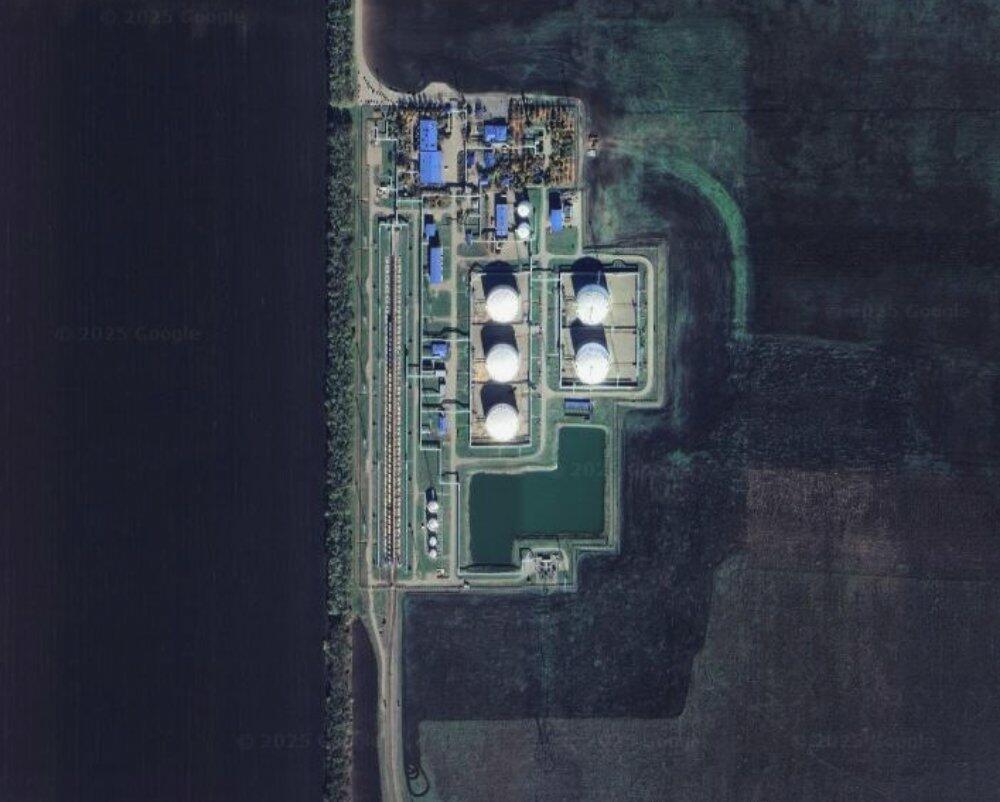
Kavkazskaya oil pumping station in the Krasnodar region

The ministry described that the overnight attack saw three kimikaze drones target the site near the village of Kavkazskaya. The site transfers crude to a pipeline operated by the Caspian Pipeline Consortium (CPC), an international firm which has among its partners US giants Chevron and Mobil, Russia's RT notes.

The drone impact reportedly set fire to an oil reservoir, which has reportedly taken emergency crews a long time to extinguish. Local reports say crews are still battling the blaze.

Moscow is describing the attack as part of an intentional efforts to thwart any advancement of a peace or ceasefire agreement between Russia and the US.

"Clearly, this was a premeditated provocation by the Kiev regime aimed at derailing the US president’s peace initiative," the Russian military stated soon after.

There indeed doesn't appear to be any meaning ceasefire on at the moment, but the concession Trump was able to get from Putin marks a first of the war...

The Russian readout of Tuesday's Trump call included the following: "During the conversation, Trump proposed a mutual agreement between both sides to refrain from striking energy infrastructure for 30 days. Putin welcomed the initiative and immediately instructed the Russian military to comply."

However, Russia has yet to agree to refrain from other attacks, and is likely to continue hitting Ukraine hard so long as drones keep flying across the border.

Ukraine's Zelensky says he soon expects to hold a phone call with President Trump. His position has remained that nothing can be agreed to ceasefire-wise without Kiev's direct participation and input.

Below are more geopolitical developments on Wednesday, via Newsquawk:

* * *

Geopolitics: Middle East

  • Israeli army attacked Khan Yunis and conducted heavy shelling in the southern Gaza Strip, according to Al Jazeera.
  • Hamas leader said continuation of the Israeli bombardment of Gaza will lead to the death of many Israeli prisoners and the movement is communicating with mediators to force Israel to respect its commitments to the ceasefire.
  • US bombed targets in areas east of Hodeidah in Yemen and there were at least 10 US strikes that targeted areas in Yemen, according to Houthi media.

Geopolitics: Ukraine

  • Russia's Medvedev said the Putin-Trump call showed there is only Russia and the US in the 'dining room' eating a 'Kyiv-style cutlet' as a main course.
  • US Special Envoy Witkoff said talks with Russia on the Ukraine war will take place on Sunday in Jeddah.
  • Ukrainian President Zelensky said Russia launched over 40 drones targeting civilian infrastructure and it is precisely such night attacks by Russia that destroy Ukraine’s energy and civilian infrastructure. Zelensky added the fact that Tuesday night attacks were no exception shows the need to continue pressure on Russia for the sake of peace, as well as noted that Russian President Putin de facto rejected the proposal for a complete ceasefire and it would be right for the world to reject any attempts by Putin to drag out the war in response.
  • UK PM Starmer spoke with Ukrainian President Zelensky on Tuesday evening and discussed progress US President Trump had made towards a ceasefire in talks with Russia, according to Downing Street.
  • Regional governor in Russia's Belgorod region said the situation remains difficult, a day after Russia said its forces had thwarted Ukrainian attempts to push across the border in Belgorod. It was separately reported that a drone attack sparked a fire at an oil depot in Russia's Krasnodar region, according to regional authorities.
  • UK Foreign Secretary said the EU and UK are to accelerate shipments of arms to Ukraine ahead of a potential full ceasefire, according to Bloomberg.
  • Russian Defence Ministry says Ukraine attacked Russia's energy infrastructure overnight, according to IFAX; CPC Kropotkinskaya oil pumping station stopped operating after damage, according to Tass.
  • Ukraine State Railways in the Dnipropetrovsk region says Russian forces have attacked its power system on Wednesday morning.
  • Finland President Stubb says if Russia refuses to agree, will need to increase its efforts to strengthen Ukraine and ratchet up pressure on Russia to convince it to come to the negotiating table.
  • Ukrainian President Zelensky says he hopes a ceasefire will eventually be implemented; says Russian President Putin's words are at "odds with reality", in relation to the halt on energy strikes. Will speak to US President Trump on Wednesday.

Geopolitics: Other

  • US Secretary of State Rubio warned unless Venezuela's government accepts a flow of deportation flights, the US will impose new and escalating sanctions, while Venezuela's government said sanctions are an economic war and responsible for hardships.

Arrest Of Erdogan Opponent Sends Turkish Lira To Record Low, Triggers Marketwide Trading Halt

 You can take the banana out of the republic, but you can never take the banana republic out of Turkey.

One day after we pointed out that Erdogan was resorting to ruthless authoritarian practices traditionally reserved for such EU nations as Romania, in which the Turkish dictator was preparing to block his top political challenger from competing against him...

... Erdogan has done just and early Wednesday morning, Erdogan stunned markets when he arrested the popular mayor of Istanbul, Ekrem Imamoglu, 54, who is also the top contender for the presidency. 

The detention of Imamoglu came a day after Turkish authorities revoked his university diploma in a move that could bar him from challenging Erdogan in the next presidential election. He beat Erdogan’s handpicked candidate in last year’s Istanbul mayoral race and was set on Sunday to be named the presidential candidate for the Republican People’s Party, the main opposition group known as the CHP.

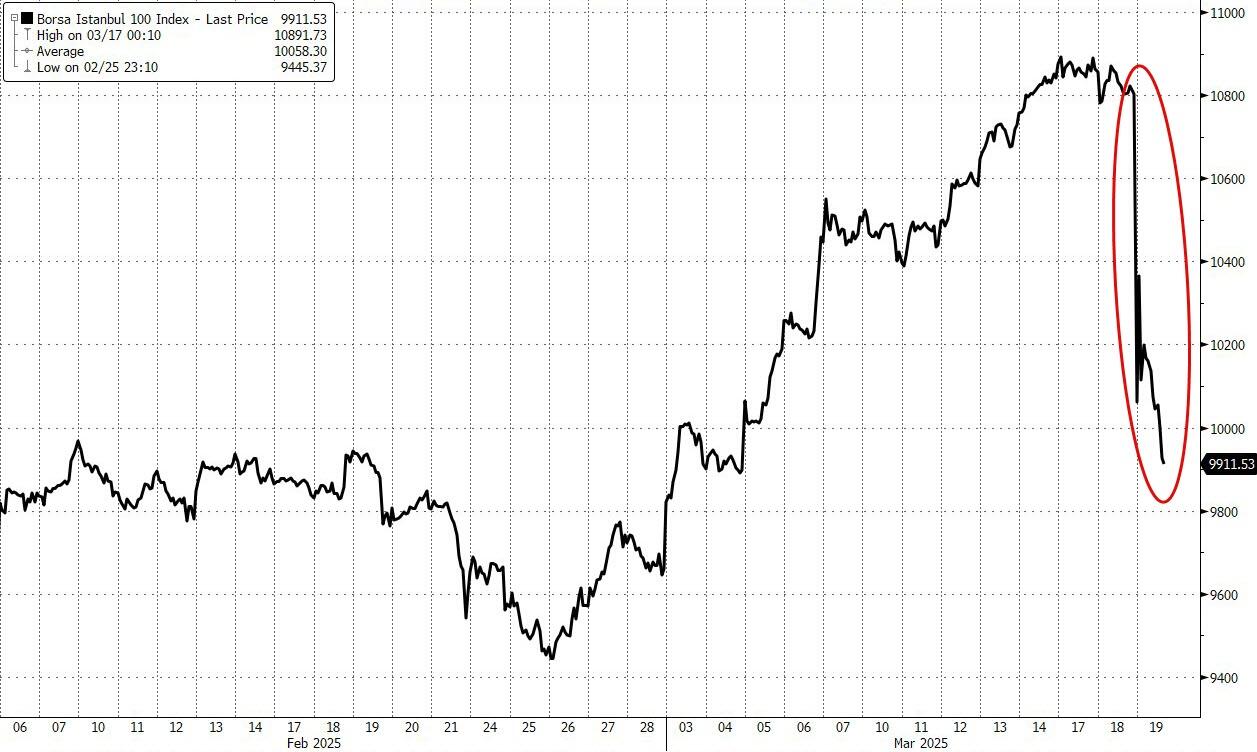
The arrest ignited a historic selloff in the country's markets, sparking a market-wide trading halt after the Borsa Istanbul which plunged 8% amid a wholesale liquidation panic, and sent the lira crashing as much as 11% to record lows.

It served as a stark reminder of the risks involved in investing in this particular Banana republic, where Erdogan’s 22-year rule has been punctuated by periods of political turmoil, recurrent market meltdowns and hyperinflation. 

To arrest the collapse, Bloomberg reported that state lenders sold around $8 billion in FX to support the lira after it tumbled to a record low. The nation’s stocks dropped so abruptly they triggered a trading halt while borrowing costs surged as investors dumped the government’s debt.

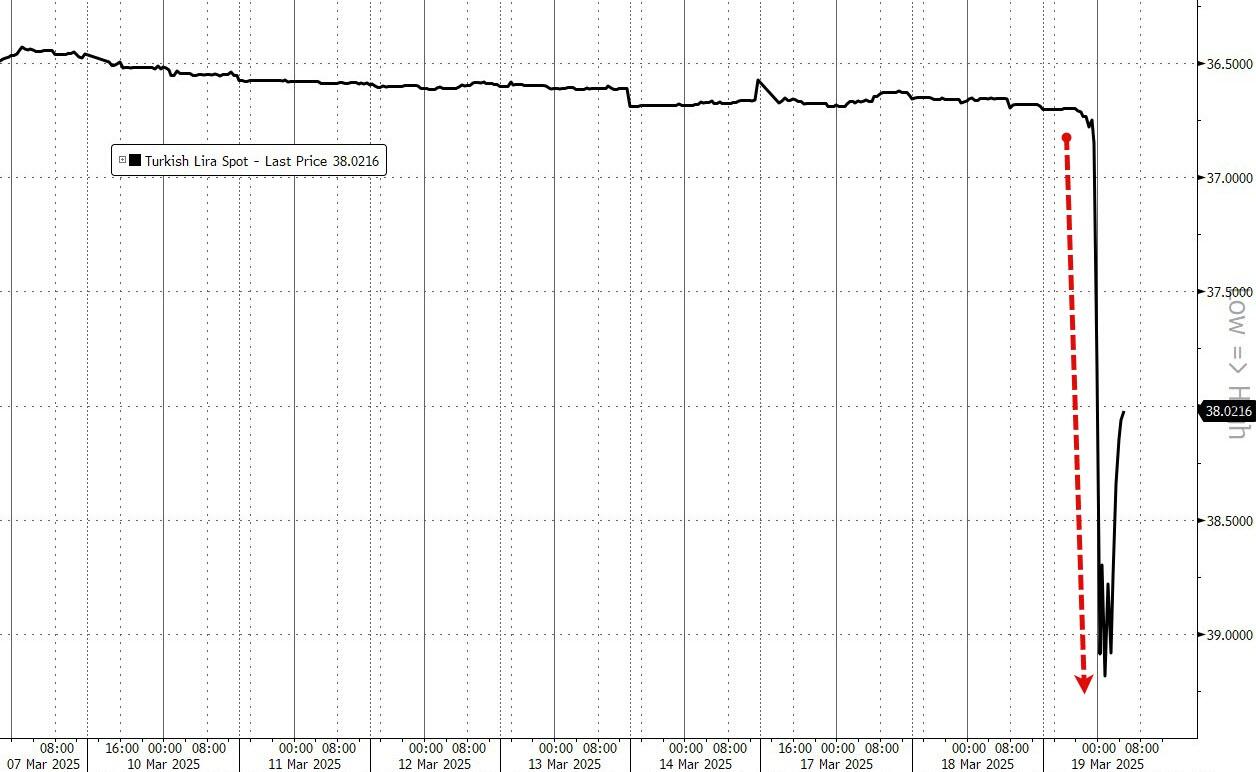
Turkish assets posted the biggest losses worldwide: The lira weakened as much as 11% to trade past 40 mark against the US dollar before trimming losses to 5.5% at 38.8565 per dollar as of 12:45 p.m. in Istanbul after local central bank spent billions in dollars to halt the plunge. The intervention in the lira market was carried out through multiple lenders, the people familiar with the matter said, asking not to be identified given the sensitivity of the matter. The central bank wasn’t immediately available for comment.
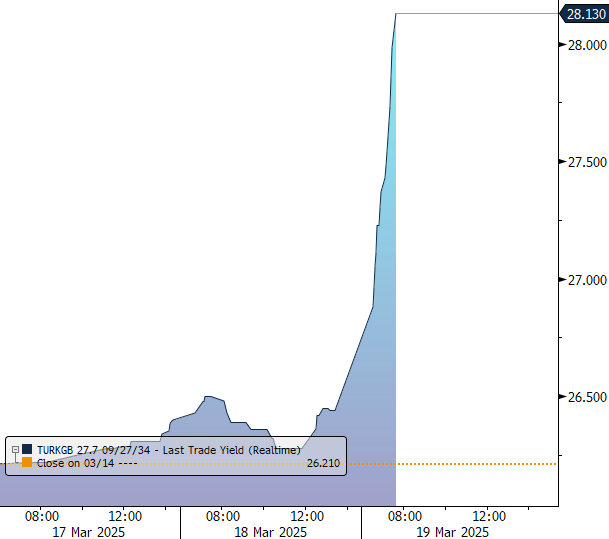
The benchmark Borsa Istanbul 100 Index fell as much as 8% after resuming trading after a marketwide trading halt, and sovereign 10-year bonds tumbled, sending yields 139 basis points higher to 29.58%.
In a desperate attempt to reassure investors that this is the last time the banana republic will be a, well, banana republic
treasury and finance minister Mehmet Simsek stepped in to reassure investors, saying that the government’s economy policy remain unchanged. “The economy program we have been implementing continues in a determined fashion,” he said in a comment on X. Unfortunately nobody believed him.

“This is a bit of a shock to the system,” said Nick Rees, the head of macro research at Monex Europe Ltd in London. “Markets had become increasingly complacent, and that spell has now been broken, with dramatic results as traders reprice Turkey’s political risk premia.”

Coex Partners’ Henrik Gullberg said the magnitude of the move was “surprising,” but the news of the political crackdown less so. “In practice, I’m not sure this will change things much, in terms of economic market sensitive policies.”

IIF strategist Robin Brooks went as far as cautioning that the lira crash "could be a catalyst for major contagion to the rest of EM."

Goldman trader Serdar Caliskan, who was probably long to quite long Turkish assets, sent out a note this morning to clients taken straight out of a Douglas Adams novel: "Please don't panic!" he said, probably targeting his own state of min: "Obviously I am not allowed to give opinions about politics, but I don't expect any economic policy will change soon. With the most naive and neutral explanations, everything seems to me simply nothing more than Erdogan-Imamoglu rivalry, so this should be a kind of state level. If anything, what is going on would make Imamoglu stronger politically. In my experience - I have never seen Turkish authorities fail under emergency and Turkish public acted against authorities under emergencies. I am sure CBRT will do their job at their bests. We should respect the investigation, and follow the official announcements. As usual - I will try to give liquidity and keep market in one piece as much as my mandate allows me. Good Luck!"

Unfortunately luck does not pay margin calls, and that's precisely what all those who were long the Lira, and so many were as it is one of the top EM carry trades. Indeed, as Goldman also noted, positioning wise, "short USDTRY is one of the most-held trades out there right now. There has been some optionalising of positioning recently as Vol dynamics have made it attractive, but still most risk is held in Short USDTRY Fwds."
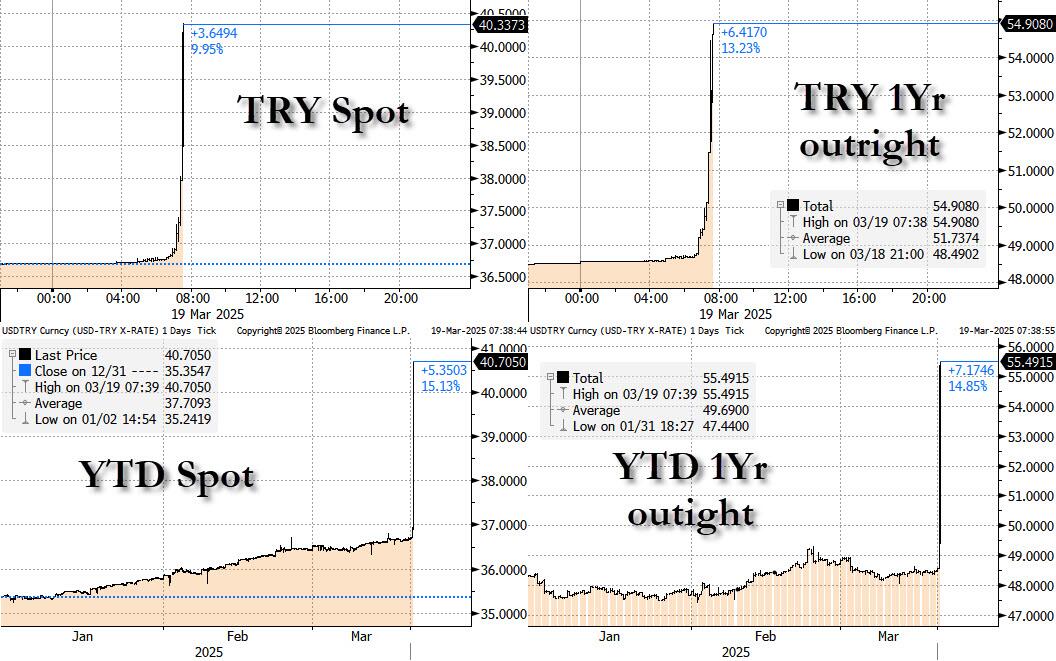
Oops: someone, or rather quite a few someones, had a very bad day this morning.

Here are some more comments from Goldman traders:

  • Serdar Caliskan: Don’t expect any shifts in the economic policy, and think the CBRT is likely to support the lira limiting the impact from the outflows. Positioning is a concern but medium term expect the situation to normalise, though in the near term we could see further pain.
  • Mehmet Pilavci: Spot moving much more aggressively than we expected. Market opened with a 400bps move in rates, 150bp in bonds, 10% depreciation in spot FX. International positioning is 25-30bn which is a big concern. The move in spot of that magnitude could send the wrong signal to the locals. Watching is locals start to dollarize more aggressively as it could extent the moves.
  • Alex Von Knieriem: CDS 30bps wider at the open, the moves are looking excessive as there is unlikely to be any economic policy changes. We’re not seeing any fading interest so far.
  • Pierre Viandaz: a lot of offshore clients were positioned in USDTRY via high prem downside binaries. Turkey is one of the biggest if not the biggest FX positions at the moment. The TRY-induced portfolio rebalance could have spillover effects into the rest of EM and G10 with crowded positions getting trimmed.
  • Christine Tse: The scale of market reaction have exceeded expectations.  Whilst this development is a negative one from sentiment perspective, it does not directly relate to economics policy and investment in the Turkey carry trade. The move was mostly offshore driven for now, and is a good reflection of how heavy positioning is.  We think TCMB has enough ammunition to stabilize the spot move, but will be important to watch whether we see large dollarization driven by this panic.

USDTRY 12m implied fwd
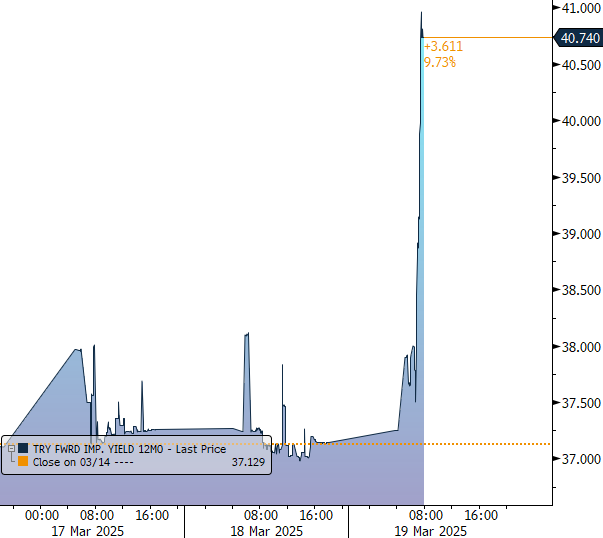
10y TURKGB yield
In a voice message shared by his team, Imamoglu denounced his detention, accusing authorities of weaponizing the police. His party has called the charges baseless and politically motivated.

The moves are part of a broader pressure campaign by the leader of the NATO country against opposition figures, activists, and critical voices. Imamoglu’s detention follows the arrest in January of Umit Ozdag, the leader of a small nationalist party and a vocal critic of Erdogan. Investigations have also ensnared national politicians, journalists, and even a celebrity agent earlier this year. Former Kurdish leader Selahattin Demirtas has been imprisoned for years. 

The next presidential election is officially set for 2028. For a chance at extending more than two decades in power, as prime minister and then president, Erdogan would need to secure enough parliamentary support to change the constitution or call for a snap election.

https://www.zerohedge.com/markets/all-hell-breaks-loose-turkey-arrest-erdogans-top-opponent-sends-lira-crashing-record-low

Duplicitous Hochul Strikes Again. Republicans Must Capitalize

 by Ryan Silverstein via RealClearPolitics,

March Madness still afflicts the Empire State’s politics, as Kathy Hochul has doubled back to Elise Stefanik’s soon-to-be empty congressional seat in upstate New York. Specifically, she has chosen to “slow-walk” the process of holding a special election to replace Stefanik, ensuring the seat is empty for as long as possible. Voters are sick of Hochul’s crony conduct. If Republicans take steps to inform voters of Hochul’s swampy conduct they can gain momentum and potentially retake the Executive Mansion in 2026.

To start, Hochul supported a bill that would have left Stefanik’s seat empty for up to a year once she was confirmed by the Senate. Then, she killed the bill and denied her connection to this undemocratic plot. Now Hochul is again taking steps to deny the residents of New York’s 21st Congressional District their constitutionally mandated representation in Congress by promising to “slow walk” the process to replace her.

This reeks of backroom political dealing. Hochul was using the special election bill as leverage to keep the wildly unpopular congestion pricing alive. Unfortunately for her, President Trump is not as keen to engage in the kind of deals she’s accustomed to, and now that he has killed that measure, Hochul is retaliating. This corrupt politicking has hurt Hochul’s popularity, and Republicans must capitalize.

This is not the first time Hochul has engaged in corrupt behavior to the detriment of average New Yorkers. Her cronyism began early in her tenure as governor when she signed the gerrymandered congressional map into law – maps which greatly benefited the Democratic party. She signed these unconstitutional districts despite the fact that New Yorkers expressly rejected gerrymandered congressional maps when they supported an amendment creating an independent redistricting commission. If Hochul respected New Yorkers, she wouldn’t have so blatantly subverted their will.

Next, she stripped local governments of their ability to regulate local elections by moving elections to even years. While this legislation was found unconstitutional, it’s still being appealed by Democrats. This effort to end local control over elections is an overt attempt at enhancing her party’s electoral prospects down-ballot because they cannot win without the national party platform to drive their voters to the polls. If Hochul respected her constituents, she wouldn’t be trying to nationalize local races.

Third, Hochul signed legislation that stripped trial courts outside of Manhattan, Westchester, Albany, or Erie counties of the ability to hear election law cases. What’s notable is that all four counties are Democratic strongholds and usually only elect Democratic jurists. This law was likely a response to what occurred in 2022 when a trial judge in ruby-red Steuben County found her gerrymandered congressional maps unconstitutional, setting the stage for the Court of Appeals to affirm the ruling. Hochul was clearly unhappy that judges who aren’t beholden to the Democratic establishment were consistently ruling against her party’s interests. Rather than comply with the law going forward, her solution was to ensure that her party’s crony judges were the only judges who would hear challenges to the Albany swamp’s election shenanigans. Hochul’s disdain for average New Yorkers runs so deep that she’d rather limit their ability to gain a legal remedy than adhere to state law.

Voters are sick of the Albany corruption and it has made Hochul vulnerable. A recent Siena College poll shows a majority of New Yorkers view her unfavorably, making her favorability rating only 1% higher than Donald Trump’s. Further, if the election were held today, only one-third of voters would reelect her as governor. On the flip side, her Republican rivals are surging in the polls. Notably, Congressman Mike Lawler, who is rumored to be preparing a run for governor, is trailing Hochul by a mere 8 points in a separate poll. Her polling woes have made her so vulnerable that she is facing potential primary challenges from Rep. Ritchie Torres and her hand-picked Lieutenant Governor Antonio Delgado. While the polling has her winning a Democratic primary, she only wins with a plurality of the vote: Even New York’s Democratic electorate doesn’t like her.

Voters’ disdain for Albany’s backroom dealing has given Republicans the chance to retake the governor’s mansion. This momentum means nothing if Republicans do not find a quality candidate who shines a bright light on Albany’s corrupt practices and mobilizes angry voters to the polls. This is Republicans’ moment – can they seize it?

Ryan Silverstein is a J.D. candidate at Villanova University and a fellow with Villanova’s McCullen Center for Law, Religion and Public Policy. His work has appeared in Fox News, the New York Post, and the Daily Wire.

https://www.zerohedge.com/political/duplicitous-hochul-strikes-again-republicans-must-capitalize