Search This Blog

Monday, May 5, 2025

AI’s (Extreme) Leftist Bias

by Adam Sharp

Using AI can be magical. It has helped me understand obscure investment concepts which aren’t covered well anywhere else.

It has shown my son exactly how to do a geometry problem, so I don’t have to relearn something forgotten 30 years ago.

AI has helped me understand legal contracts which previously would have required paying a lawyer hundreds of dollars per hour.

Magical.

At other times, it becomes painfully obvious that these models were trained on the NY Times, Washington Post, WEF white papers, Berkeley PhD theses, and other neoliberal mainstream garbage…

For example, as an experiment, I asked ChatGPT the following question:

I need help deciding how to invest the energy portion of my portfolio. Give me a breakdown of investing in oil and gas versus solar and wind. Which is a better bet for the long-term?

The AI proceeded to give a detailed breakdown of the pros and cons of each investment option. It even created this nifty table, just for me.
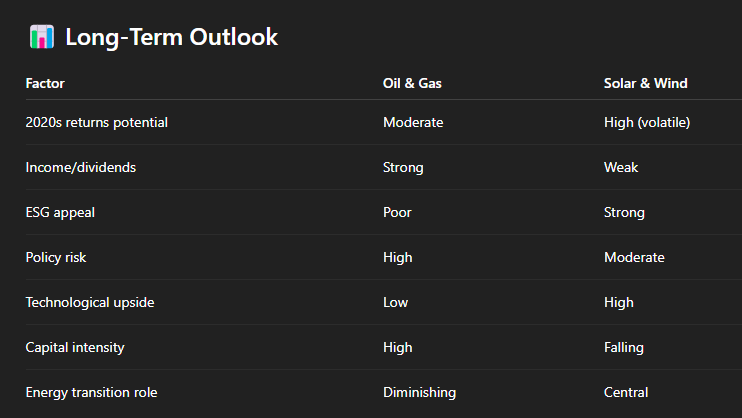
image 1

Hmmm, so the “return potential” for oil and gas is “moderate”, while for solar and wind it is “high”. The entire answer was skewed towards renewables. ChatGPT made it clear that wind and solar are the future, and oil and gas are the past.

So ChatGPT tells me that the potential returns in wind and solar are higher than oil and gas. It then recommends the iShares Global Clean Energy ETF (ICLN).

Well, I looked up the ICLN ETF, and since it launched in 2008 shares have fallen -77%. Over the past 10 years, an amazing period for tech stocks, it has returned an average of 1.45% per year. Over the past 3 years, ICLN has been slaughtered for an average annual return of -17%. Oof.

Meanwhile the largest oil and gas ETF, Energy Select Sector SPDR Fund (XLE), has returned a respectable 6% per year for the past 10 years (enough to turn $10,000 into $20,395 with dividends reinvested), and an average of 8% since it launched in 1998. Over the past 3 years, XLE has returned a juicy 11% per annum.

But wait, ChatGPT told me that renewable energy is the future and oil and gas are relics of the past? This is the AI’s leftist bias leaking through. Because 90% of media and academia lean left, 90% of the data models are trained on are also biased in that direction.

However, I will give the model a bit of credit because it suggested “blending” oil and gas together with renewables to get the best of both worlds. Of course, this advice will be ignored and my portfolio will continue to only hold oil and gas investments for energy exposure.

Wind and solar stocks have incinerated capital for the past 20 years – despite huge government subsidies – and I don’t expect that to change anytime soon.

So while AI can be an incredibly helpful tool for investors, we must be aware of its biases and flaws. All of the major AI models currently lean left.

Evidence of Bias

An independent researcher named David Rozado has studied the political biases of AI models for years.

His latest research can be summed up in the chart below. It shows how 5 top AI models performed in a series of political quizzes. The tested models are xAI’s Grok, OpenAI’s ChatGPT, Google’s Gemini, Meta’s Llama, and DeepSeek’s V3.

David tested the AI models on 4 different political spectrum tests, and averaged them into the chart below:
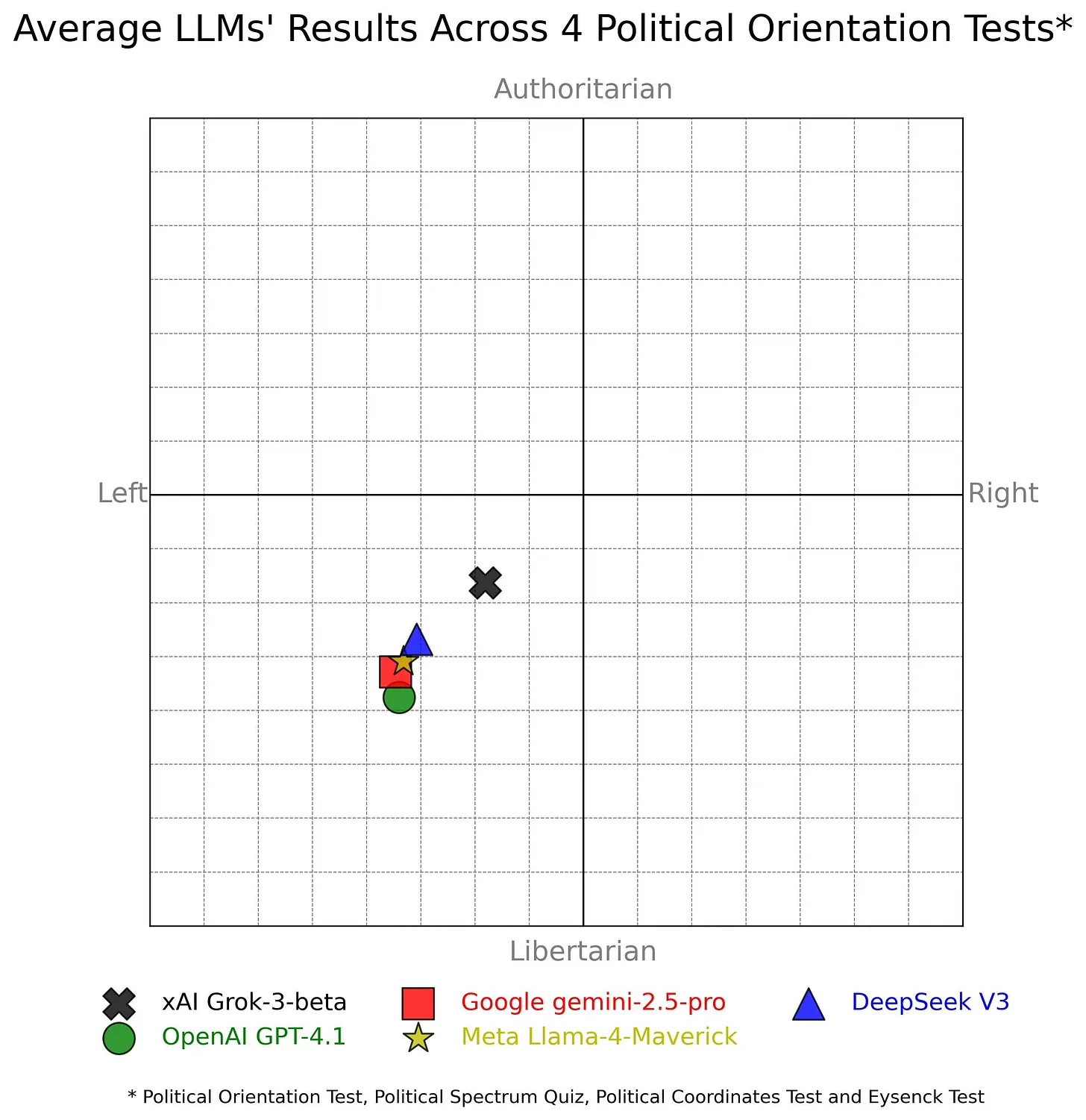
image 2

Source: David Rozado

As you can see, all the major models lean to the left. However, xAI’s Grok model stands out as being the most balanced (marked as an X on the chart).

Grok is the model created by Elon Musk’s X, and I have to say it’s quickly becoming a favorite. You can try it out by visiting x.AI or downloading the app.

Elon has made a determined effort to make his AI model as balanced and neutral as possible. Yet it still skews left. This goes back to the problem we mentioned earlier, the fact that the vast majority of news, media, and academia is biased in one direction. These models are trained on essentially the entire internet, and the internet leans left, so the models will too.

As I said, AI can be an incredibly powerful tool for investors. Just beware going in that when you use these mainstream models, you’re dealing with a biased and flawed technology.

They can be excellent tools for learning, but always double-check any important or actionable information. And always remember that you’re dealing with a leftist machine.

https://dailyreckoning.com/ais-extreme-leftist-bias/

AI specialist Recursion trims pipeline in latest shakeup

 AI drug discovery specialist Recursion Pharmaceuticals is shelving three of its most advanced drug prospects in an effort to cut costs following a merger last year. 

Alongside its latest quarterly earnings report, the company revealed plans to halt development of drugs for cerebral cavernous malformation and neurofibromatosis type II that were in mid-stage testing. Recursion will also pause testing and attempt to license out a therapy it’s been advancing for C. difficile infections. 

The decisions reflect Recursion’s plan to focus on “areas of high unmet need where we believe we can have the greatest impact,” said Najat Khan, the company’s chief R&D officer and chief commercial officer, in a statement.

Following a merger with fellow AI biotech Exscientia last year, the company has been “proactively streamlining” its operations and “making deliberate tradeoffs” to focus resources on its most impactful programs, Khan added.  

Four years ago, Recursion raised $436 million in one of the biotech sector’s most lucrative initial public offerings. The company secured those funds on the promise of AI, which is seen by proponents as a way to speed up drug discovery and increase its odds of success. And in combining with Exscientia in 2024, Recursion touted a sprawling pipeline that would produce 10 near-term clinical readouts and had the potential to deliver multiple blockbusters.

The company hasn’t yet fulfilled its promise, though. Early clinical data for its treatment for cerebral cavernous malformation disappointed investors and, according to the company’s statement Monday, the “totality” of the results accrued since then led it to stop testing. The neurofibromatosis type II therapy is being scrapped for similar reasons, while a changing treatment landscape has reduced the need for the C. difficile drug it’s been developing. 

To Mani Foroohar, an analyst with Leerink Partners, the pipeline cuts were “inevitable” given the company’s “unsustainable cash burn.” The company booked a roughly $464 million net loss in 2024, following a $328 million net loss the year prior. It had $509 million in cash as of the end of March. 

Foroohar added in a research note Monday that Phase 2 data the company released Sunday in a condition that causes the growth of potentially dangerous polyps were “hard to interpret.” The findings do “little to improve confidence in clinical execution, as cash burn and dilution risk are top of mind,” he wrote. 

The company expects to spend as much as $450 million in cash this year, unless new or existing partnerships add more funds. The cuts will help extend its financial runway into the middle of 2027, Recursion said. 

Last year, the combined cash burn of Recursion and Exscientia prior to the merger was roughly $606 million, excluding cash received from partnering and financings.

Shares fell about 13% on Monday and have lost a majority of their value since the company’s public debut.

https://www.biopharmadive.com/news/recursion-pipeline-cuts-first-quarter-earnings/747119/

Zimmer biomet updates 2025 guidance with eps range of $7.90-$8.10 amid product launches

Earnings Call Insights: Zimmer Biomet Holdings (ZBH) Q1 2025

Management View

  • CEO Ivan Tornos highlighted a 2.3% constant currency sales growth for Q1 2025, with strong performance in U.S. Hips, which grew nearly 4%, and mid-single-digit growth in the S.E.T. segment. He emphasized the impact of new product launches, including the Z1 Triple-Taper Hip Stem and OrthoGrid AI surgical guidance system, which have driven competitive account conversions.
  • The company reaffirmed its full-year 2025 organic constant currency revenue growth target of 3% to 5% and expects the Paragon 28 acquisition to contribute 270 basis points to overall sales growth.
  • CFO Suketu Upadhyay reported Q1 2025 adjusted EPS of $1.81 and free cash flow generation of $279 million. He stated, “Net sales were $1.909 million, an increase of 1.1% on a reported basis and 2.3% excluding the impact of foreign currency.”

Outlook

  • Zimmer Biomet updated its 2025 adjusted EPS guidance to $7.90-$8.10 from the previous $8.15-$8.35 range, reflecting the integration of Paragon 28 and anticipated tariff impacts.
  • Management expects stronger growth in the second half of 2025 due to favorable comps from ERP disruptions in 2024, new product uptake, and the absence of selling day headwinds.
  • Full-year free cash flow guidance has been revised to $750 million to $850 million, factoring in tariff-related headwinds and one-time costs from the Paragon 28 transaction.

Financial Results

  • U.S. sales increased by 1.3% in Q1 2025, with nearly 4% growth in Hips and S.E.T.
  • International sales grew by 3.7%, driven by mid-single-digit growth in Knees and high-single-digit growth in S.E.T.
  • Global Hips and Knees grew by 2.4% and 1.9%, respectively, with S.E.T. reporting 4.9% growth, supported by strong performance in CMFT and Sports segments.
  • Adjusted gross margin was reported at 71.5%, while the adjusted operating margin stood at 26.2%.

Q&A

  • Robbie Marcus, JPMorgan: Questioned the impact of tariffs on EPS and mitigation efforts. CFO Upadhyay explained, “We have already taken some early steps to mitigate the impact of tariffs,” citing sourcing optimizations and discretionary spending reductions.
  • David Roman, Goldman Sachs: Asked about confidence in achieving second-half growth targets. CEO Tornos attributed it to new product launches, including Oxford Partial Cementless Knee and Persona OsseoTi, as well as favorable comps from ERP disruptions.
  • Chris Pasquale, Nephron: Inquired about the adoption of Z1 Hip Stem. Tornos confirmed that “50% of Z1 users in the U.S. are conversions from competitive accounts.”

Sentiment Analysis

  • Analysts expressed cautious optimism, with concerns centered around tariff impacts and second-half growth execution. Questions often highlighted uncertainties around new product uptake and operational adjustments.
  • Management maintained a confident tone, emphasizing robust product pipelines and mitigation strategies for external challenges.

Quarter-over-Quarter Comparison

  • Q1 2025 sales growth of 2.3% constant currency was lower than Q4 2024’s nearly 5% growth, reflecting one less selling day and the timing of product launches.
  • Adjusted EPS declined from $2.31 in Q4 2024 to $1.81 in Q1 2025, impacted by higher costs and tariff-related factors.
  • Free cash flow generation was $279 million in Q1 2025, compared to $403 million in Q4 2024.

Risks and Concerns

  • Management noted potential headwinds from global tariffs, which are expected to impact operating profit by $60 million to $80 million in 2025. Mitigation strategies include changes in sourcing and reductions in discretionary spending.
  • Analysts highlighted the slower growth in U.S. Knees at 0.2%, with management attributing it to phasing and product launch timelines.

Final Takeaway

Zimmer Biomet’s Q1 2025 earnings call emphasized the company’s focus on driving growth through new product launches and operational efficiencies. While lower EPS guidance reflects tariff impacts and costs associated with the Paragon 28 integration, management remains confident in achieving its full-year revenue and cash flow targets. Analysts remain watchful of execution risks, particularly around U.S. Knees and tariff mitigation strategies.

https://www.msn.com/en-us/money/companies/zimmer-biomet-updates-2025-guidance-with-eps-range-of-7-90-8-10-amid-product-launches/ar-AA1EcE8Z

BioNTech, gearing up for cancer drug approval filing, works to diversify supply base

 As BioNTech progresses with its goal to grow into a “fully integrated immunotherapy powerhouse,” the German biotech is eying a 2025 regulatory filing for what could become its first approved cancer drug. But with tariffs raising uncertainties around global trade, the company is responding with plans to diversify its long-term supply for the drug. 

As it stands, BioNTech is “reliant on a China-based CDMO” for supply of BNT323, chief strategy officer Ryan Richardson said on the company’s first-quarter conference call Monday. BioNTech licensed the next-gen HER2-targeted antibody-drug conjugate from China’s DaulityBio in 2023, and now it’s plotting an FDA filing in second-line endometrial cancer later this year. 

The drug is being tested in a single-arm trial in second-line endometrial cancer, BioNTech chief medical officer, Özlem Türeci, M.D., said on Monday’s conference call. The study, part of a basket trial in multiple solid tumor indications, is testing the drug “across all HER2-positive scores,” Türeci said, adding that it’s a “broad” second-line endometrial cancer population. 

The company is already in discussions with regulatory authorities to “better understand expectations” for its approval filing, and those discussions are “progressing,” Türeci added. In BioNTech’s first-quarter earnings presentation (PDF), the company said it expects to submit a Biologics License Application for BNT323 before the end of the year.  

Amid the R&D and regulatory updates, BioNTech is also in the process of diversifying its supply base, Richardson said. Over the next few years, the company plans to add multiple BNT323 “supply nodes” to reduce its reliance on the supply coming out of China.

The update comes as President Donald Trump’s announced tariffs—and threated pharma-specific levies—have prompted a wave of Big Pharma investment announcements in the U.S. BioNTech executives, for their part, believe the company is relatively well-positioned to navigate the situation based on the geographic footprint of the company’s manufacturing operations and its revenue base. 

“We don’t anticipate at the current time significant financial impact from the tariffs that have been announced,” Richardson stressed. 

For the company’s Pfizer-partnered COVID-19 vaccine Comirnaty, the firms operate manufacturing facilities on “both sides of the Atlantic,” Richardson said. 

On Monday, BioNTech reported first-quarter sales of 183 million euros and a net loss of 416 million euros. The company is continuing to leverage the enviable financial situation afforded by its COVID-19 vaccine to advance numerous cancer programs. It had a cash pile of 15.9 billion euros as of March 31. 

Besides BNT323 and Comirnaty, BioNTech is spending much of its time lately focusing on two priority oncology programs, the PD-L1xVEGF bispecific antibody BNT327 and its mRNA cancer immunotherapy platform. Both of those programs have “disruptive potential,” BioNTech executives said several times on Monday. 

In another update Monday, the company said its CFO Jens Holstein would retire from the position at the end of June. BioNTech appointed Novartis executive Ramón Zapata-Gomez to serve as its CFO starting in July.

https://www.fiercepharma.com/manufacturing/biontech-gearing-cancer-drug-approval-filing-works-diversify-supply-base

Ocular Therapeutix Inc earnings missed by $0.09, revenue fell short of estimates

Ocular Therapeutix Inc (NASDAQ: OCUL) reported first quarter EPS of $-0.38, $0.09 worse than the analyst estimate of $-0.29. Revenue for the quarter came in at $10.7M versus the consensus estimate of $17.07M.

 https://www.investing.com/news/earnings/ocular-therapeutix-inc-earnings-missed-by-009-revenue-fell-short-of-estimates-4021683

Teva and Alvotech FDA Approval of Interchangeability for SELARSDI with Stelara

The FDA has approved SELARSDI™ (ustekinumab-aekn) as interchangeable with Stelara® (ustekinumab) for Teva Pharmaceuticals (TEVA) and Alvotech (ALVO). The approval, effective April 30, 2025, covers all presentations matching the reference product. SELARSDI is indicated for treating moderate to severe plaque psoriasis, active psoriatic arthritis in patients 6+ years, and moderately to severely active Crohn's disease and ulcerative colitis in adults. The drug is available in multiple presentations: 45 mg/0.5 mL and 90 mg/mL prefilled syringes, 45 mg/0.5 mL single-dose vial, and 130 mg/26 mL IV infusion vial. This marks Teva's second FDA-approved interchangeable biosimilar following SIMLANDI®, with three additional biosimilar candidates under FDA review with BsUFA goal dates in Q4 2025.

Why drop in Twist shares

 Twist Bioscience’s stock has experienced a downturn despite the company announcing a strategic spin-out of its DNA data storage division into Atlas Data Storage, securing $155 million in investments. The spin-out is aimed at allowing Twist to focus on its core operations while maintaining a stake in Atlas for potential future gains. Additionally, Twist reported a record revenue of $92.8 million for Q2 of fiscal 2025, marking a 23% increase from the previous year, along with an improved gross margin of 49.6%. However, analysts have lowered price targets due to ongoing concerns about profitability, cash flow, and valuation issues, particularly a negative P/E ratio. The company remains hopeful about reaching adjusted EBITDA breakeven by the end of fiscal 2026 through continued growth and innovation.

https://www.tipranks.com/news/catalyst/why-twist-bioscience-shares-are-dropping-now