Search This Blog

Wednesday, February 4, 2026

FCC: Space Bureau accepts SpaceX's data center filing

 The United States Federal Communications Commission (FCC) unveiled in a public notice on Wednesday that the Space Bureau "accepts for filing and seeks comment on an application by Space Exploration Holdings, LLC (SpaceX) for a new non-geostationary orbit (NGSO) system of up to one million satellites."

SpaceX submitted the application on January 30. The system is set to operate at altitudes from 500 kilometers to 2,000 kilometers, and will primarily rely on optical intersatellite links. The public can leave comments and petitions by March 23.

https://breakingthenews.net/Article/FCC:-Space-Bureau-accepts-SpaceX's-data-center-filing/65607873

Reconciliation 2.0: The Path to Lower Health Care Costs

Washington is running out of time, and Americans are running out of patience. 

Half of Americans struggle to pay for health care costs, according to the Kaiser Family Foundation. In fact, today, health care costs are rising faster than wages, premiums are swallowing family budgets, and the federal government is barreling toward a debt crisis fueled by exorbitant federal health care spending. 

Tackling these systemic failures is the urgency of this moment, and Republicans have a historic opportunity to use reconciliation to tackle the health care cost crisis that is crushing both our nation’s families and jeopardizing our collective destiny. 

In 1975, the federal government spent $19 billion on health care. Since then, federal health care spending has ballooned 100 times to nearly $2 trillion a year—most of it happening after Democrats enacted Obamacare—accounting for about one-third of the federal budget. On current projections, this burden will nearly double in the next decade.

Here’s another way to think about this: before long, Washington will control more than half of all health care dollars spent in America. Demographics alone do not explain why these costs continue to climb; policy choices and perverse incentives do. If we are serious about reversing the curse of public debt, we must stop treating symptoms and finally confront the underlying disease.

Last year, Republicans passed the One Big Beautiful Bill, proving reform is both possible and responsible. This law locked in and enhanced tax cuts for hardworking families and achieved more than $1 trillion in health care savings by closing loopholes, rooting out fraud, and enforcing common-sense eligibility standards while protecting care for the most vulnerable. And for the first time since Obamacare’s inception, Congress reduced premiums.

That success was not an endpoint. It was a down payment on a more solvent future.

Americans today are facing a genuine health care cost crisis, and too many Democrats would rather defend, double down on, and subsidize a failing system than admit that Obamacare is broken, along with the promise of affordability. 

The Left will tell you the only answer to this problem is more government regulation, more mandates, and more spending. Obamacare’s advocates promised it would bend the cost curve down; instead, premiums and deductibles have doubled and choices have dwindled. This is not reform—it is rationing, dressed up in nice language.

President Trump has laid out a vision for meaningful health care reforms that all Americans can embrace. “The Great Healthcare” plan rests on four pillars: lower drug prices; lower insurance premiums; hold big insurance companies accountable; and maximize price transparency. 

These goals enjoy broad bipartisan support in theory. But, if Democrats are unwilling to work with us in practice, Republicans must use reconciliation to turn those principles into law. With reconciliation, we can rise above the Washington dysfunction and make health care truly affordable for the American people.

To truly lower costs and premiums, we must inject competition, transparency, and personal responsibility back into the system. This means taking on the health care monopolies that profit from the status quo.

Insurers must be held accountable for practices like Medicare Advantage upcoding, which artificially inflates costs at the expense of the program's sustainability. Requiring insurers and providers to publicly post their prices would finally allow patients to see what they’re getting for the cost before they receive the bill—as they do for any other kind of purchase outside of health care. And American patients and taxpayers should no longer subsidize European drug price controls.  

Hospitals, too, must be part of the solution. Hospitals routinely buy up physician practices and jack up rates for routine services that can be safely and effectively provided outside a hospital setting. Site-neutral payment reform would terminate that scam by equalizing Medicare payment rates regardless of where the service is provided—saving taxpayers $150 billion.

And government must do its part by stripping away the mandates and regulations that stifle innovation, instead building a landscape where transparency and competition are the primary drivers of value.
Rather than propping up the failed systems and government-planned markets Democrats created, we should empower Americans to become better informed consumers of their own health care. Health Savings Accounts put families in control of their health care dollars. We've already expanded HSA eligibility in the One Big Beautiful Bill, so its benefits are within the reach of more Americans. Now we should go further, making HSAs the foundation of a patient-centered system, not an afterthought.

The One Big Beautiful Bill was the first step to reverse Democrats’ cost of living crisis. Now we must finish the job. Through reconciliation 2.0, we can save our health care system and our nation’s balance sheet before we bankrupt the American people and our children’s future. 

The choice is simple: we can either pretend things are working, when they are not; continue to point out the failures of Democrats’ government-run health system, while failing to do anything about it; or we can do what the American people expected us to do when they gave us unified Republican leadership: Make Health Care Affordable Again. 

Jodey Arrington is the U.S. Representative for Texas’s 19th Congressional District and serves as the Chairman of the House Budget Committee.

https://www.realclearhealth.com/articles/2026/02/03/reconciliation_20_the_path_to_lower_health_care_costs_1162634.html

Winter Surgeries and the Frail Patient

 With winter here, hospitals across the country are experiencing the annual surge in elective surgeries.

Everyone considering a procedure during this busy season should have a surgery pre-op checklist. This is especially true for seniors, and particularly when it comes to anesthesia. While age is often seen as the main concern for older patients and anesthesia, frailty is the real game-changer.

What is frailty, and how is it measured?

Frailty is a medical concept that describes how vulnerable an older person is to health problems, especially when facing surgery or illness. Unlike age alone, frailty looks at the whole person: how strong they are, how well they move, how sharp their mind is and how well their body handles everyday challenges. Doctors know that frail patients are more likely to have complications after anesthesia or surgery, so understanding frailty helps them plan safer care.

To measure frailty, doctors use special checklists or scales that consider several factors. They look at nutrition (is the patient eating well?), mobility (can they walk or get out of bed easily?), cognitive status (is their memory and thinking clear?) and chronic medical conditions (like diabetes or heart disease). Sometimes, doctors ask questions or do simple tests to see how well a patient can perform daily activities. The results help them decide how risky a procedure might be and what extra steps are needed to keep the patient safe.

If a senior is facing surgery, it’s important they and their families ask their doctor two important questions: “How is my frailty being measured?” and “What can I do to improve my score before surgery?” Small changes, such as eating more protein, staying active or managing chronic conditions, can make a big difference. By understanding frailty and working with the care team, senior patients can help ensure a safer experience with anesthesia and a smoother recovery.

It’s also critical for seniors to protect their brains when heading into a procedure.

Delirium and cognitive dysfunction are types of confusion that can happen to older adults while recovering from surgery, especially after anesthesia. Delirium is a sudden change in thinking and awareness. It can make someone feel disoriented, have trouble focusing, or even see or hear things that aren’t there. Cognitive dysfunction means having problems with memory, attention, or clear thinking, and it can last for days or weeks after surgery. These issues are more common in seniors and can be scary for both patients and families.

There are simple steps seniors can take to lower their risk of confusion after surgery. Keeping the lights on in their hospital room during the day helps their brain know when it’s daytime, which can prevent them from mixing up night and day, which is a common problem in hospitals. Bringing familiar items from home, like photos or a favorite blanket, can make their hospital room feel safer and less stressful, which helps reduce anxiety and confusion. Also, patients should try to minimize narcotic pain medications (like opioids) when possible, because these drugs can make confusion worse.

Before a procedure, seniors should talk to their anesthesiologist about ways to protect their brain and lower their risk of delirium or memory problems. They should ask what steps they can take before and after surgery, and make sure their care team knows about any past issues with confusion.

Seniors and their families should also know that there’s no universal “best” anesthesia for them. Anesthesiologists tailor their approach based on the patient’s health and the specific procedure. Senior patients should ask about regional versus general anesthesia and which is safest for them.

Finally, like any patient working to ensure their best anesthesia experience during surgery, seniors should make sure they eat nutritious, protein-rich foods and stay hydrated ahead of their surgery, making especially certain to follow prescribed diets for conditions such as diabetes or hypertension. They should ask their physician which medications to take or hold on the day of surgery and make sure chronic conditions such as blood pressure and diabetes are well-managed.

This winter, as elective surgeries fill hospital schedules, seniors and their families should put anesthesia preparation front and center. Frailty, not age, is the key risk factor, and there are concrete steps patients can take to improve their outcomes. Patients should ask questions, prepare early and bring an advocate to every appointment. With the right preparation, recovery can be smoother for America’s seniors.

Ronak Desai, M.D., is an anesthesiologist with U.S. Anesthesia Partners in the Dallas-Ft. Worth area. 

https://www.realclearhealth.com/articles/2026/02/04/health_warning_winter_surgeries_and_the_frail_patient_1162807.html

How DTC Drug Sales Undermine the PBM Rebate Machine

 If you wanted to design a health insurance system to keep drug prices high, you’d build exactly what the United States has today: a marketplace where patients never see real prices, can’t compare options, and are steered toward expensive drugs because pharmacy benefit managers (PBMs) profit the most from them. Instead of competition disciplining prices, backroom negotiations determine what medicines people take and how much they pay—and consumers bear the cost.

Drug prices can be inflated by various factors, but the most important today is that most medicines are disconnected from the market forces that would drive prices down. The medicines patients routinely take—and what those medicines cost—are determined not only by doctors, but also by PBMs and pharmaceutical manufacturers behind closed doors. Patients are cut out, often leaving them purchasing more expensive drugs that generate larger rebates for PBMs instead of less expensive generic alternatives. This disconnect prevents consumers from choosing lower-cost medicines.

The reason PBMs favor higher-cost drugs is the rebates manufacturers offer—which PBMs are not required to pass on to patients. If a PBM can facilitate the purchase of a $5 generic or a $50 brand-name that includes a $30 rebate, the PBM has a clear financial incentive to push the latter even though it is not aligned with patients’ best interests. In the first case, the PBM charges a patient’s insurer $5. In the second, it can charge $50 and keep the $30 rebate. When PBMs charge insurers, it increases their costs leading insurers to raise premiums to pay for it.

Obscuring the true price of medicines behind opaque negotiations, insurance cost-sharing, and copays severs consumers from prices and prevents competition from driving costs down. Most prescriptions Americans buy are routine, repeated transactions—the exact type of purchases where markets are most effective at lowering prices. When patients can see that the brand-name drug costs ten times more than an equivalent generic costs and choose accordingly, brand-name manufacturers are pressured to reduce prices, and generics are pressured to compete with each other. The result is competitive prices instead of negotiated high ones.

While it may sound fanciful that patients would shop around for prescriptions, it is exactly what happens in the over-the-counter medicine market all the time, and there is no reason to think it couldn’t work for routinely taken prescriptions. In fact, direct-to-consumer (DTC) pharmaceutical sales are already doing just that. Companies like Eli LillyPfizer, and more have already begun selling some medicines directly online, but the number of drugs offered must grow for DTC to become a viable alternative for more consumers and to encourage insurers to design plans that incorporate it.

Health insurance has taken over so much of routine care that it isn’t real insurance; it is a prepayment system for predictable care and medicines. By moving routine purchasing decisions back into patients’ hands, PBMs lose much of their ability to inflate drug prices, insurers face lower costs, and competitive pressure pushes premiums down. With downward pressure on both drug and insurance prices, patients keep more of their money while still receiving the medicines they need.

Even for those who stay within the current insurance system, the patients who choose lower-cost plans paired with cash purchases of pharmaceuticals help create real prices—benchmarks patients can use hold insurers accountable, and insurers can use to hold PBMs accountable. As in other industries, PBMs will need to justify charging more than a drug’s retail price based on the services they provide. Instead of hiding true prices, PBMs will be forced to operate in a market where everyone knows what a drug should cost, exposing artificial markups.

The rapid expansion of DTC pharmaceutical sales shows that competitive drug pricing emerges when PBMs are removed from the equation. Their central role is not a necessity; it is a consequence of an insurance system stretched far beyond its proper function. As more patients purchase medicines directly—and more insurers redesign plans around transparent, upfront pricing—the PBM model will collapse under its own inefficiencies. Empowering consumers and restoring real market forces is the surest way to lower drug prices and end the rebate-driven distortions that have plagued the system for decades.

Justin Leventhal is a senior policy analyst for the American Consumer Institute, a nonprofit education and research organization that advocates for consumers through evidence-based analysis and data.

https://www.realclearhealth.com/articles/2026/02/04/how_dtc_drug_sales_undermine_the_pbm_rebate_machine_1162878.html

More Bad News for modRNA Vaccines

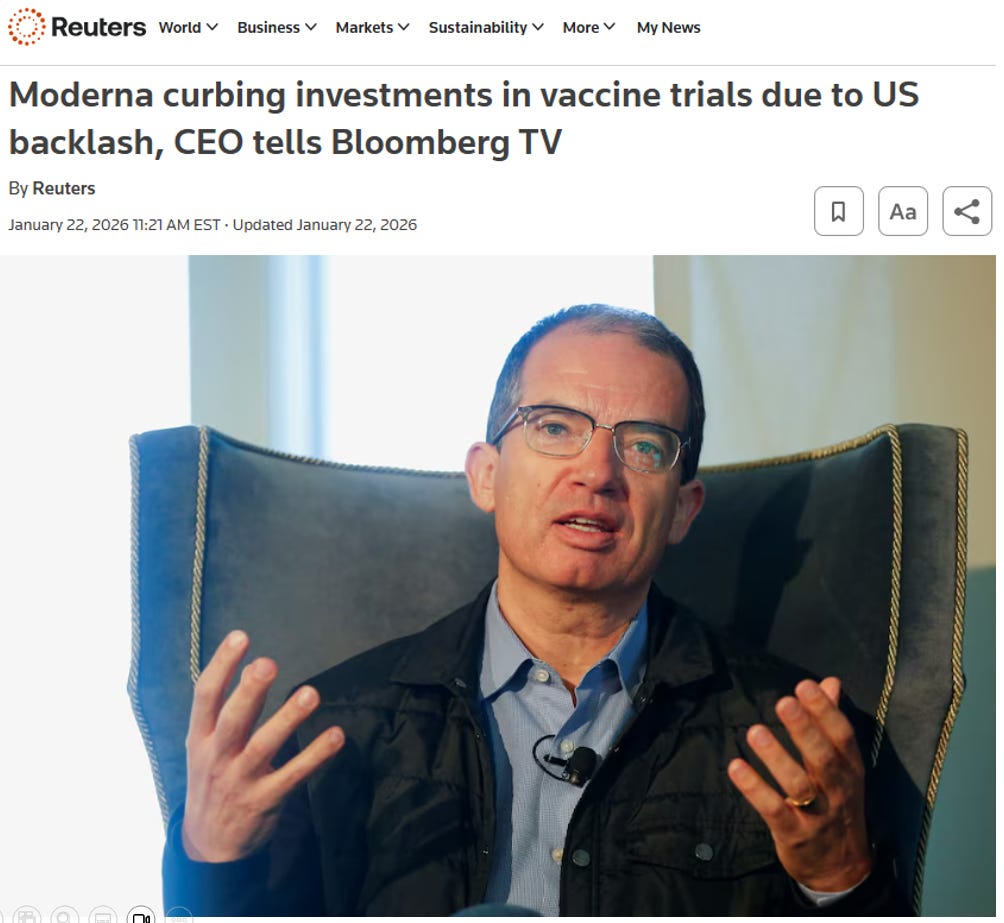
 Lost in the latest news cycle was a stunning report from Reuters that has generated some buzz on X. Speaking from the World Economic Forum in Davos on January 22, CEO Stephane Bancel told Bloomberg TV that “Moderna does not plan to ‌invest in new late-stage vaccine trials because of growing opposition to immunizations from U.S. officials.”

This is a shocking reversal for the once high-flying company and a modified RNA (modRNA) technology that many had predicted would revolutionize biomedicine. What happened?

I wrote in a previous piece in Sensible Medicine about a Pfizer trial for a modRNA influenza vaccine in 18-64 year olds reported as “positive” in the NEJM and lay press, but which had many limitations that negated this conclusion. In addition, the clearly negative trial in subjects over 65 years old was (deceptively) buried in a clinicaltrials.gov website and not published or even mentioned in the NEJM report of the younger cohort.

Moderna trumpeted results of a “successful” trial of its modRNA flu vaccine product in the lay press, but a review of published report of the findings in JAMA showed that the only “efficacy” was in antibody production - no clinical efficacy outcomes at all. The FDA was not impressed.

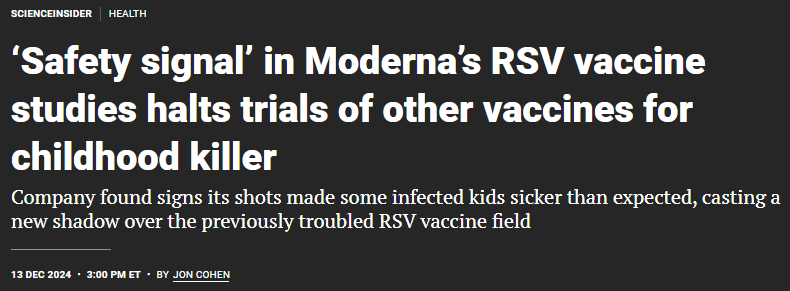
Moderna had previously developed and begun clinical trials of an RSV vaccine, but that did not go well, according to this report in Science from December 2024:

“Safety signal” is a code phrase for “kids were harmed” by the shots. According to the Science report:

“In a trial in Panama that enrolled children ages 5 months to 7 months old, five of 40 who received either RSV vaccine and later became infected with RSV developed severe or very severe cases of lower respiratory tract infections, compared with one of 20 children in the placebo group. Among the 27 infants who got the combo vaccine, three later became seriously ill from human metapneumovirus infections versus none in the placebo group.”

The phenomenon of vaccine-associated enhanced respiratory disease had been seen in previous RSV trials from the 1960s in which 2 children died.

Some commentators on X used the announcement to criticize RFK, Jr. for cancelling a $500 million contract to Pfizer and Moderna to support its trials of novel modRNA products and for perceived “anti-vax” statements made prior to his appointment as HHS Secretary. Yet a sensible observer should ask why any government support for these companies is needed or warranted.

The federal government has already paid for much of the basic science that led to creation of the modRNA technology. It supported the trials of modRNA Covid vaccines through Operation Warp Speed. It then paid the lion’s share of the cost of acquiring, distributing, and marketing the shots, resulting in enormous revenue and profits for the companies. Why should this mature technology require any further corporate welfare? In my view, the US would be better served funding 500 one million-dollar basic science RO1 grants.

Mr. Bancel also implies that modRNA vaccine are facing heightened regulatory scrutiny and a less favorable public reception owing to change in HHS leadership. This is likely true. The previous FDA policies of fawning over these products, fast-tracking their approval based on minimal clinical data, and promoting them in glowing terms to the public are over. They will be treated like other pharmaceutical products and more rigorously scrutinized for efficacy and safety. It is telling that Mr. Bancel seems to believe that Moderna’s modRNA lineup will not be able to survive such evaluation.

There are also risks of the technology which have been noted by critics but minimized or ignored by the FDA in the previous administration. modRNA shots are known to be highly reactogenic – they actually cause an “influenza-like illness” (ILI) in a high percentage of users. This alone makes them questionable as preventive therapies against influenza-like illnesses such as influenza and RSV.

The story of the minimization of risk of myocarditis from covid shots in young males is well known. Thousands of deaths associated with the shots were reported to VAERS, and a rigorous vetting of these reports has not been published, leaving questions in the minds of critics. Other unknowns include how widely the lipid nanoparticles disseminate the modRNA to other organs, and how much antigen is produced. Concerns about DNA contamination have also been raised along with potential for mutagenicity.

Perhaps Mr. Bancel has realized that the current FDA is going to ask them to address these concerns more rigorously. Finally, the modRNA brand was badly damaged during the pandemic by the vaccine mandates and the failure of the shots to deliver the expected herd immunity and long-term protection from severe illness and death. The NIH also failed to disclose the fact that it had a multi-million dollar royalty agreement with Moderna, even as its leaders were heavily promoting their covid shots.

Another point that Mr. Bancel makes in the Reuters interview is worthy of comment: “You cannot ‍make a return on investment if you don’t have access to the U.S. market.” The US constitutes only 4% of the global population.

Why can’t Moderna make an adequate ROI from the 96% of people in the rest of the world, including 500 million Europeans? Mr. Bancel is saying the quiet part out loud: The US public pays nearly all of the profit margin and R+D budget for the global pharmaceutical industry. The Trump administration has declared its intention to level the playing field for the American pharmaceutical consumer. It remains to see how well this initiative will succeed.

What is next for modRNA technology? Time will tell. A recent press release reported that a modRNA cancer treatment given along with pembrolizumab immunotherapy increased the response rate in melanoma patients. Perhaps cancer therapy will prove to be a valuable approach for modRNA, and Moderna has pledged to continue research and trials in oncology.

Safety is a relative phenomenon, and an adverse event profile and unknown risks that would be unacceptable for mass vaccination of healthy young people might be entirely acceptable for patients with metastatic cancer. It might even be useful for vaccination in high-risk populations against high-risk diseases, like Ebola.

But for mass vaccination in healthy populations against relatively low-risk diseases like influenza and RSV, modRNA appears to be at a “dead-end.”’

by
Cardiologist in Baltimore

https://www.sensible-med.com/p/more-bad-news-for-modrna-vaccines