Here are this week’s reading links and fiscal facts:
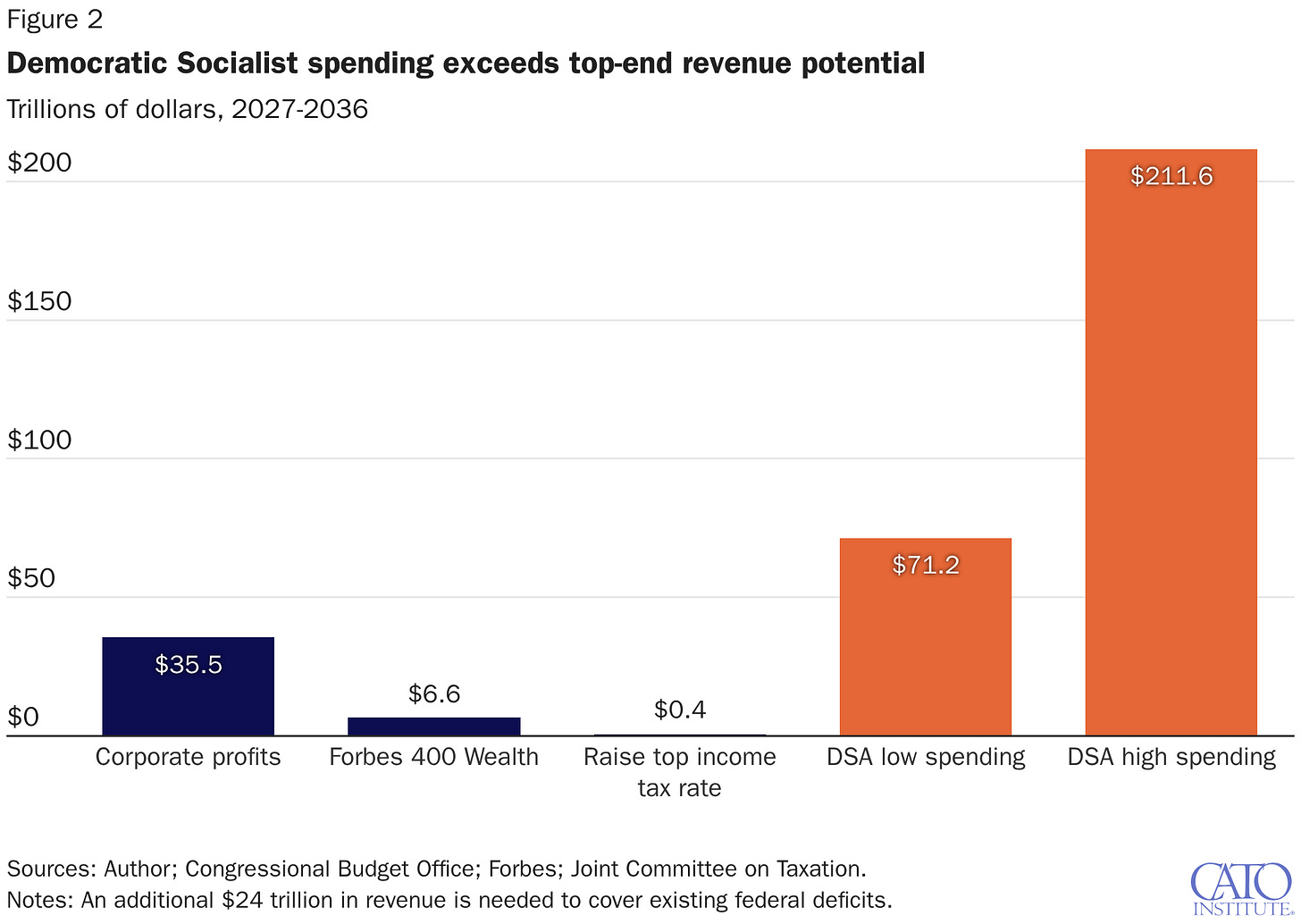
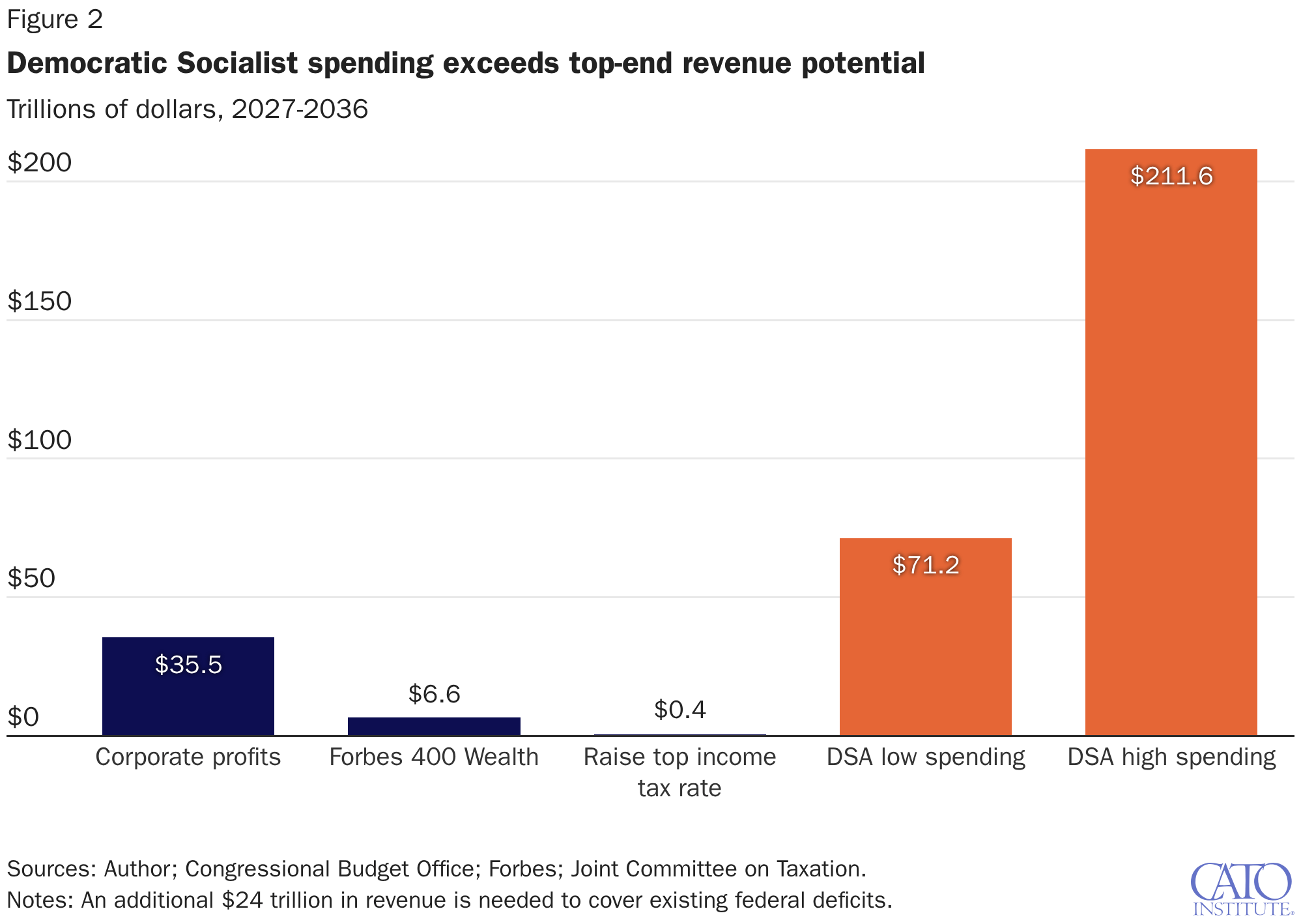
It is impossible to pay for Democratic Socialism. Cato’s Adam Michel tallies the Democratic Socialists of America platform — government-paid health care, housing, higher education, and electricity, plus guaranteed jobs and reparations — and finds that it “ballparks between $71 trillion and $212 trillion in new spending over the next decade.” That would push US government spending from roughly 40 percent of GDP to between 57 and 92 percent. Michel continues, “The DSA suggests that the richest Americans and corporations will pay for all these new outlays.” As the figure below shows, however, the 400 wealthiest Americans were worth $6.6 trillion in 2025, and “confiscating all of their wealth would cover only about 9 percent of the low-end revenue requirement and 3 percent of the high-end estimate.” Even seizing every dollar of corporate profit and raising top rates to their revenue-maximizing level “still leaves the DSA agenda between $29 trillion and $169 trillion short.” He concludes, “there aren’t enough rich people or corporations to pay for Democratic Socialism. Eventually, the bill will come for the rest of us.”
Tax loopholes distort what inequality data actually measures. David R. Henderson of the Hoover Institution writes in Defining Ideas that the 1992 New York Times article that made inequality a top political issue rested on tax data distorted by avoidance: “when the top rate fell to 50 percent, high-income people shifted much of their investment away from tax-exempt municipals to other investments whose income was subject to the federal tax. The income from those investments showed up on their tax forms, making it look as if their income had risen substantially; in many cases, it hadn’t.” Cato’s Adam Michel and Chris Edwards point out that the loophole is still on the books, alongside plenty of others: “The interest on municipal bonds is exempted from tax, with about 90 percent of the benefit accruing to the top income quintile. Green energy, real estate, agriculture, and many other industries enjoy special breaks.” They argue the fix is a cleaner base: “The answer is consumption-based taxation, which can tax much of the same income as the current system, but in a neutral manner without the special breaks that fuel public anger.”
DOGE claimed savings on contracts it never actually cut. The Government Accountability Office finds that DOGE’s “Wall of Receipts,” which reported $110 billion in savings from terminated contracts, grants, and leases, rests on estimates that “are incorrect or lack supporting evidence.” Auditors report that “DOGE did not accurately report actions taken on contracts”: the site listed all 13,476 contracts as terminated, but “no termination action was taken on 2,503 of the contracts, representing $27.4 billion of reported savings.” In one case, DOGE agreed no action should be taken on a $2.4 billion Defense Health Agency IT contract, yet “the Wall of Receipts continued to report savings of more than $1.7 billion.” Cato’s Alex Nowrasteh and Krit Chanwong found the same story in the data: “There is no visible structural break in 2025 spending that coincides with DOGE’s start date. An observer who did not know when DOGE started could not identify it.”
Most seniors already pay little tax on their Social Security benefits. According to a new Committee for a Responsible Federal Budget (CRFB) paper, “less than half of seniors currently pay any income taxes on benefits, and of those who do, many pay little in overall taxes.” Between the standard deduction, the senior deduction, and OBBBA’s temporary additional deduction, “most seniors enjoy an effective ‘zero rate’ on their first $24,150 ($47,500 for couples) of income […] The next $50,400 ($100,800) is taxed at 10% or 12% — meaning most Social Security income that is taxed faces an effective rate of 5% to 10.2%.” CRFB argues that the Social Security Administration once estimated “that an average of 93% of benefits had never been taxed among all seniors,” so “taxing 93% of all benefits would thus maximize tax neutrality, on average, ensuring that on average all income is taxed once and only once.” As Boccia writes, “Policymakers should treat Social Security benefits as other income and remove income thresholds that exempt many of the current beneficiaries [from benefit taxation].”
Health expenditures grow faster than the economy and inflation. A new Committee for a Responsible Federal Budget blog breaks down Centers for Medicare & Medicaid Services’ latest projections: “of the largest sources of health coverage — private health insurance, Medicare, and Medicaid — Medicare will grow the fastest over the decade at 7.7% due to both higher enrollment and faster per-person spending growth, while Medicaid and private insurance will grow at 5% each.” The trend line is no better: “[National Health Expenditures] continue to grow faster than both inflation and the economy, growing 7.3% from 2024 to 2025 and projected to grow an average of 5.4% annually from 2025 to 2034. CMS attributes much of the near-term growth in NHEs to estimated increases in utilization and prescription drug spending rather than growth in health care prices.” Boccia and Thakur explain why the program outpaces everything else: “If policymakers keep Medicare on autopilot—covering every new medical innovation, shielding seniors from price signals, and expanding relentlessly as the population ages—faster economic growth will only speed up the Medicare-driven debt crisis.”

No comments:
Post a Comment
Note: Only a member of this blog may post a comment.