Search This Blog

Saturday, May 12, 2018

WHO hopes to use Ebola vaccine to stem outbreak in remote area of Congo

The World Health Organization said on Friday it hopes to deploy an experimental Ebola vaccine to tackle an outbreak in a remote area of Congo to prevent it spreading, particularly to the provincial capital of 1 million people.

Congo reported the outbreak on Tuesday, with 32 suspected, probable or confirmed cases of the disease since April 4, including 18 deaths. A new suspected case was reported on Friday.
The WHO is moving quickly, having been criticized for bungling its response to a 2014-2016 outbreak that killed more than 11,300 people in Guinea, Sierra Leone and Liberia.
“We are very concerned and planning for all scenarios, including the worst case scenario,” Peter Salama, WHO’s Deputy Director-General of Emergency Preparedness and Response, told a regular U.N. briefing in Geneva.
The outbreak area is 15 hours by motorbike from the closest town and has “absolutely dire” infrastructure, Salama said, so the WHO wants to send in 20-40 experts by helicopter this weekend and then clear an airstrip for more supplies.
“This is going to be tough and it’s going to be costly to stamp out this outbreak,” he said.
The immediate risk was to the provincial capital Mbandaka, with about 1 million inhabitants, but Congo’s nine neighbors have also been put on high alert in case the disease crosses a border, especially by river to the Republic of Congo or Central African Republic.
Gambia, Guinea and Nigeria have already said they are taking steps to ensure the virus does not spread, and Kenya’s Health Ministry said on Friday it would bolster screening of travelers with thermo scanners at airports.
Normally a remote setting would reduce the chance of the disease spreading. But already there are three separate locations covering 60 km (37 miles) or more, and some of the victims were healthcare workers, potentially “an amplification factor” for outbreaks, Salama said.
The local culture, with traditional healers and communal burials where there was close contact with the deceased, could cause “super-spreading” of Ebola, which kills up to 90 percent of sufferers, he said.
SUB-ZERO
Salama said he spoke to Congo’s Health Minister Oly Ilunga on Thursday and hoped to get approval within days to use a vaccine developed by Merck in 2016.
Although highly effective, it is still experimental, has not been licensed, and must be kept at -60 to -80 degrees Celsius (-76°F to -112°F).
“This is a highly complicated, sophisticated operation in one of the most difficult terrains on earth,” Salama said.
It can be used to protect people who have had contact with Ebola victims, stopping the spread of disease, but that requires intensive contact tracing, which Salama said could take a week or two just for the cases already documented.
Ilunga said on Thursday that the risk to urban areas and cases among healthcare workers made the outbreak worrisome, and that health workers might be the priority for vaccination.
Salama said that WHO was preparing for the green light and hoped to have a mobile laboratory operational over the weekend, and that both WHO and the medical charity Medecins Sans Frontieres already had a team on the ground.
“The cold chain is on standby, the stockpile is on standby, the teams have been put on standby including up to 40 people that conducted the initial ring vaccination trial in Guinea.”
Salama also said there was no evidence of a link between the outbreak and eight deaths that occurred in January and February in the same area, which had not been confirmed as Ebola.

Primary care providers have mixed views on genetic tests

Primary care providers view tests for genetic risks of common diseases as useful, but lack confidence in interpreting results, according to a study published in the May issue of Health Affairs.
Diane Hauser, from the Icahn School of Medicine at Mount Sinai in New York City, and colleagues surveyed 488 primary care providers in community and academic practices in New York City (2014 to 2016) about their views on  for chronic diseases.
The researchers found that the majority of respondents, most of whom were current or recent physicians in training, had had formal genetics education and had positive views of the utility of genetic testing. However, respondents reported feeling unprepared to work with patients at high-risk for genetic conditions. Furthermore, they were not confident about interpreting  results. Many participants expressed concern that genetic testing might lead to insurance discrimination and also lacked trust in genetic testing companies.
“Enhanced training, guidelines, clinical tools, and awareness of patient protections might support the effective adoption of genomic medicine by primary care providers,” the authors write.

Tobacco cessation support lacking in mental health facilities

Many patients in mental health and substance abuse treatment facilities are not screened for tobacco use or offered treatments to facilitate tobacco cessation, according to research published in the May 11 issue of the U.S. Centers for Disease Control and Prevention’s Morbidity and Mortality Weekly Report.
Kristy Marynak, M.P.P., from the CDC in Atlanta, and colleagues analyzed data from the 2016 National Mental Health Services Survey and the 2016 National Survey of Substance Abuse Treatment Services to examine tobacco-related policies and practices in mental health and  facilities.
The researchers found that 48.9 percent of  treatment facilities reported screening patients for tobacco use in 2016; 37.6, 25.2, and 21.5 percent offered  counseling, , and non-nicotine tobacco cessation medications, respectively; 48.6 percent prohibited smoking in all indoor and outdoor locations. Overall, 64.0 percent of substance abuse treatment facilities reported screening patients for tobacco use in 2016; 47.4, 26.2, and 20.3 percent offered tobacco cessation counseling, nicotine replacement therapy, and non-nicotine tobacco cessation medications, respectively; 34.5 percent had smoke-free campuses.
“Full integration of tobacco cessation interventions into behavioral health treatment, coupled with implementation of tobacco-free campus policies in behavioral health treatment settings, could decrease tobacco use and tobacco-related disease and could improve behavioral health outcomes among persons with mental and substance use disorders,” the authors write.
More information: Abstract/Full Text

What should you eat when you are sick?

When a person is sick, they may find it difficult to develop an appetite. However, it is important to receive nourishment and stay hydrated, especially when feeling unwell.
Different types of food can combat different types of illness. A person with a sore throat may benefit from foods that would not help someone who feels nauseous.
In this article, we provide a list of foods to eat and avoid for people with common illnesses.

Colds and flu

What to eat when you're sick herbal tea
Herbal teas provide hydration, and breathing in their steam can help to clear mucus from the sinuses.
A blocked nose, a cough, and a sore throat are common symptoms of colds and flu. The following foods can help to ease congestion and inflammation and boost the immune system.
1. Herbal teas
When experiencing cold and flu symptoms, it is important to stay hydrated. Herbal teas are refreshing, and breathing in their steam can help to clear mucus from the sinuses.
Adding ground turmeric to a cup of hot water may help to relieve a sore throat. Research suggests that turmeric has both anti-inflammatory and antiseptic properties.
Tea leaves are abundant in natural plant compounds, such as polyphenols, flavonoids, and catechins. These stimulate the immune system. Catechins, in particular, may protect against certain types of influenza virus.
Some people recommend drinking Echinacea tea to shorten the duration of cold and flu symptoms. However, this effect has yet to be proven by scientific research.
2. Honey
A sore throat can be caused by a bacterial infection. Honey is rich in antimicrobials that help to clear these types of infection.
Honey may also be effective in treating children’s coughs, though it should not be given to infants under 12 months of age.
review published in 2018 compared honey with common over-the-counter children’s cough remedies, a placebo, and no treatment.
The authors found that honey appeared to be more effective than diphenhydramine and salbutamol, which are drugs often used in cough medicines. Honey also produced similar results as dextromethorphan, another common ingredient.
The results were limited, however, as most studies in the review only looked at 1-night acute coughs.
3. Citrus fruits and berries
Citrus fruits, such as oranges, lemons, and grapefruits, contain high levels of flavonoids and vitaminC. These decrease inflammation and boost immunity, which may help to fight a fever.
Some studies suggest that a flavonoid called quercetin, which is also found in berries, may help to treat rhinovirus infections. This virus is responsible for the majority of common colds.
Frozen, slushy fruit juices can often help to soothe a sore throat.

Foods to avoid

Dairy is believed by many to increase mucus production, although there is little scientific evidence to support this. Dairy may make mucus thicker, however, which can worsen sinus congestion.
Caffeine can cause dehydration, which makes congestion worse. However, some caffeinated drinks, such as tea and coffee, contain immune-boosting antioxidants, and they may be helpful in moderation.
Alcohol can dehydrate and trigger an inflammatory response, which may aggravate cold and flu symptoms.

Nausea, vomiting, and diarrhea

What to eat when you're sick ginger
Ginger may help to reduce the effects of nausea and vomiting.
When someone has one or more of these symptoms, the key is to eat foods that settle the stomach. Doing so should help people to regain their appetite.
1. Ginger
Research suggests that ginger could help to reduce the effects of nausea and vomiting, although more studies are required to confirm these findings.
A person can make ginger tea by adding 1–2 teaspoons of fresh ginger to a cup of hot water. Steep the ginger for 5 minutes before straining the mixture and sweetening it with a little honey.
Crystallized ginger should be eaten in moderation, due to its high sugar content.
Avoid fizzy ginger ale, as this can further irritate an upset stomach.
2. BRAT foods
BRAT stands for: bananas, rice, applesauce, and toast. These foods are bland and gentle on the stomach.
The diet is rich in starch and contains little fiber, which can have a binding effect on loose stools and speed up recovery from diarrhea.
Other bland foods that can be added to a BRAT diet include:
  • crackers
  • oatmeal
  • watermelon
  • boiled potatoes
A person should start slowly, sipping water regularly for the first few hours, before gently introducing other liquids, such as apple juice or broth.
If the stomach remains settled, it may be safe to try more solid BRAT foods.
Those sensitive to gluten should make sure to choose gluten-free options.
It will usually be safe to return to a more regular diet after around 48 hours.
3. Coconut water
An upset stomach occurs when the stomach lining becomes inflamed. Compounds called tannins that are present in coconut water may help to reduce this inflammation.
Coconut water is also high in minerals such as sodium and potassium. They can help the body to rehydrate quickly after diarrhea or vomiting.
One study found that coconut water may provide the same level of hydration as a sports drink. It is also more healthful, containing no added sugar. However, it is worth noting that this study only included 12 participants.

Foods to avoid

Greasy foods contain high levels of fats, which are difficult to digest and can irritate the stomach, worsening nausea.
Chilies contain capsaicin, a chemical that can irritate the lining of the stomach, causing pain and discomfort.
Caffeine acts as a muscle stimulant that can cause stomach cramps and increase bowel movements.
Dairy products contain a sugar called lactose that can be difficult to digest after diarrhea, causing bloating and nausea.
Artificial sweeteners can have a laxative effect.

Constipation

What to eat when you're sick oatmeal can help constipation
Oatmeal is an excellent source of fiber, which can help to relieve constipation.
The key to relieving constipation is to increase fiber intake.
Fiber is either soluble or insoluble. Soluble fiber traps water in the stools, making them softer and easier to pass. It also helps to nourish gut bacteria. Insoluble fiber adds bulk to stools, helping to clear the intestines.
Be aware that eating more dietary fiber can cause excess gas. A person should increase their intake gradually to avoid bloating.
Soluble fiber also absorbs a lot of water, so be sure to drink plenty.
1. Oatmeal and oat bran
A single cup of oatmeal made with water contains about 4 grams of fiber, around 16 percent of an adult’s recommended daily intake.
While oatmeal only contains the germ of the oat, oat bran contains the fibrous husk as well. Because of this, it provides 5.7 grams of fiber per cup, so bran is even better for digestion.
Raw oats contain more fiber per serving than cooked oats and make an excellent addition to smoothies. Rolled oats are digested more easily than steel-cut oats when in the raw form.
It is important to stay hydrated when eating dry oats. The extra fiber from blended fruits will also help to relieve constipation.
2. Dried fruits
All fruits are good sources of fiber, but dried fruits, such as apricots, figs, and prunes, typically contain the highest levels.
These fruits also contain a natural laxative known as sorbitol, which promotes bowel movements by drawing water into the intestines.
Prunes and apricots also contain polyphenols, which can increase the amount of healthful gut bacteria, such as Lactobacillus and Bifidobacterium. These bacteria help to stimulate the intestines.
3. Flaxseed
Due to its high soluble fiber content, flaxseed is particularly good at supporting regular bowel movements.
It is also an excellent source of omega-3 essential fatty acids. There is some evidence that omega-3 acids reduce bowel inflammation, which can occur after prolonged constipation.
The outer shell of the seed cannot be digested, so people should eat pre-ground flax. This will allow the body to absorb the beneficial nutrients.
Ground flaxseed can be added to porridge and smoothies or used in baking.

Foods to avoid

Processed foods tend to be high in fats and salt, and low in fiber. Fats are difficult to digest, while salt decreases levels of moisture in stools.
Processed grains, such as white bread and white rice, have been stripped of the bran and germ. These are the parts that provide the highest levels of fiber.
Caffeine and alcohol can both cause dehydration, depleting the water needed to soften stools.

Summary

Dietary changes can provide some relief when an individual feels sick. A person should try to follow the recommended diet for their symptoms while avoiding foods that will worsen them.
It is important to remember that prevention is better than a cure. Staying hydrated and eating a healthful diet rich in nutrients will help to stave off many of the ailments listed above.

Does Parkinson’s Begin in the Gut?

The earliest evidence that the gut might be involved in Parkinson’s emerged more than 200 years ago. In 1817, the English surgeon James Parkinson reported that some patients with a condition he termed “shaking palsy” experienced constipation. In one of the six cases he described, treating the gastrointestinal complaints appeared to alleviate the movement-related problems associated with the disease.
Since then, physicians have noted that constipation is one of the most common symptoms of Parkinson’s, appearing in around half the individuals diagnosed with the condition and often preceding the onset of movement-related impairments. Still, for many decades, the research into the disease has focused on the brain. Scientists initially concentrated on the loss of neurons producing dopamine, a molecule involved in many functions including movement. More recently, they have also focused on the aggregation of alpha synuclein, a protein that twists into an aberrant shape in Parkinson’s patients. A shift came in 2003, when Heiko Braak, a neuroanatomist at the University of Ulm in Germany, and his colleagues proposed that Parkinson’s may actually originate in the gut rather than the brain.
Braak’s theory was grounded in the observation that in post-mortem samples of Parkinson’s patients, Lewy bodies, clumps of alpha synuclein, appeared in both the brain and the gastrointestinal nervous system that controls the functioning of the gut. The work by Braak and his colleagues also suggested that the pathological changes in patients typically developed in predictable stages that starts in the gut and ends in the brain. At the time, the researchers speculated that this process was linked to a “yet unidentified pathogen” that travels through the vagus nerve—a bundle of fibers connecting major bodily organs to the brainstem, which joins the spinal cord to the brain.
The idea that the earliest stages of Parkinson’s disease may occur in the gastrointestinal tract has been gaining traction. A growing body of evidence supports this hypothesis, but the question of how changes in the intestines drive neurodegeneration in the brain remains an active area of investigation. Some studies propose that aggregates of alpha synuclein move from the intestines to the brain through the vagus nerve. Others suggest that molecules such as bacterial breakdown products stimulate activity along this channel, or that that the gut influences the brain through other mechanisms, such as inflammation. Together, however, these findings add to the growing consensus that “even if the pathology [of Parkinson’s] is very much driven by brain abnormalities, it doesn’t mean that the process starts in the brain,” says Michael Schlossmacher, a physician-scientist at the Ottawa Hospital Research Institute.

THE GUT-BRAIN HIGHWAY

The vagus nerve, a bundle of fibers that originates in the brain stem and innervates major organs, including the gut, may be the primary route through which pathological triggers of Parkinson’s travel from the gastrointestinal tract to the brain. Recent epidemiological examinations of vagotomy patients whose vagus nerves were severed show that they have a lower risk of developing Parkinson’s. Researchers have also demonstratedthat alpha-synuclein fibers, injected into the gastrointestinal tracts of rodents, can traverse through the vagus into the brain.
If alpha-synuclein does travel from the intestines to the brain, the question still arises: why does the protein accumulate in the gut in the first place. One possibility is that alpha-synuclein produced in the gastrointestinal nervous system helps fight off pathogens. Last year, Michael Zasloff, a professor at Georgetown University, and his colleagues reported that the protein appeared in the guts of otherwise healthy children after norovirus infections, and that, at least in a lab dish, alpha-synuclein could attract and activate immune cells.
Microbes themselves are another potential trigger for promoting the build-up of intestinal alpha-synuclein. Researchers have found that, in mice, bacterial proteins could trigger the aggregation of the alpha-synuclein in the gut and the brain. Some proteins made by bacteria may form small, tough fibers, whose shape could cause nearby proteins to misfold and aggregate in a manner akin to the prions responsible for mad cow disease, explains Robert Friedland, a neurologist at the University of Louisville who coauthored that study.
The microbiome, the totality of microorganisms in the human body, has spurred intense interest among Parkinson’s researchers. A number of reports have noted that individuals with the disease harbor a unique composition of gut microbes, and scientists have also found that transplanting fecal microbes from patients into rodents predisposed to develop Parkinson’s can worsen motor symptoms of the disease and increase alpha-synuclein aggregation in the brain.
But rather than bacterial proteins triggering misfolding, Sarkis Mazmanian, a Caltech microbiologist, believes that these microbes could be acting through the metabolites they produce, such as short-chain fatty acids. Mouse experiments from his lab have shown that these molecules appear to activate microglia, the immune cells of the brain. The metabolites, Mazmanian adds, may send a signal through the vagus nerve or bypass it completely through another pathway such as the bloodstream. Because epidemiological studies find that vagus nerve removal does not completely eliminate the risk of Parkinson’s, other brain-gut routes may also be involved. “We’re currently testing [that] question,” Mazmanian says.

A ROLE FOR INFLAMMATION?

Yet another idea holds that that intestinal inflammation, possibly from gut microbes, could give rise to Parkinson’s disease. The latest evidence supporting this idea comes from a large epidemiological study, in which Inga Peter, a genetic epidemiologist at the Icahn School of Medicine at Mount Sinai, and her colleagues scanned through two large U.S. medical databases to investigate the overlap between inflammatory bowel diseases and Parkinson’s.
Their analysis compared 144,018 individuals with Crohn’s or ulcerative colitis and 720,090 healthy controls. It revealed that the prevalence of Parkinson’s was 28 percent higher in individuals with the inflammatory bowel diseases than in those in the control group, supporting prior findings from the same researchers that the two disorders share genetic links. In addition, the research team discovered that in people who received drugs used to reduce inflammation—tumor necrosis factor (TNF) inhibitors—the incidence of the neurodegenerative disease dropped 78 percent.
This study further validates the theory that gut inflammation could drive Parkinson’s pathogenesis, says Madelyn Houser, a graduate student in neuroscientist Malú Tansey’s lab at Emory University. The anti-TNF finding in particular, she adds, suggests that the “overlap between the two diseases might be primarily mediated by inflammation.”
Intestinal inflammation might give rise to Parkinson’s in several ways, Houser explains. One possibility is that a chronically inflamed gut might elevate alpha-synuclein levels locally—as Zasloff’s investigation in children suggests—or else it may give rise to inflammation throughout the body, which in itself could increase the permeability of the gut and blood-brain barriers. Or else it could increasecirculating cytokines, molecules that that can promote inflammation. Tansey adds that changes in the microbiome could also be influencing gut inflammation.
“There’s probably multiple pathways that lead the gut to the brain,” Peter says, explaining that it is too early to rule out any hypotheses. For now, her team is focused on determining whether the protective effect of anti-TNF compounds is due to the lowering of inflammation throughout the body, which could result from other conditions, or whether they only benefit individuals with bowel disorders. Peter plans to investigate the prevalence of Parkinson’s in other patients who take these drugs, such as those with psoriasis or rheumatoid arthritis.
Because not all Parkinson’s patients will have inflammatory bowel disorders, findings from the investigations into the co-occurrence of the two conditions might not generalize to everyone with the neurodegenerative disease, Mazmanian says. Still, these studies and many others that have emerged in recent years support the idea that the gut is involved in Parkinson’s is correct, he adds. “If this is indeed true, it allows us to now devise interventions that target the gut instead of the brain.”
Already, some researchers have started to test such interventions. In 2015, Zasloff and his colleagues launched a company, Enterin, that is currently testing a compound that slows alpha-synuclein aggregation in the gut. Although the treatment is intended to reduce non-motor symptoms of Parkinson’s, such as constipation, the researchers hope that by targeting early gut pathology, they will be able to restore—or prevent—the disease’s effects on the central nervous system.
While many lines of evidence support the gut origins of Parkinson’s, the question of how early the gastrointestinal changes occur remains, Tansey says. In addition, other scientists have suggested that it is still possible that the disease begins elsewhere in the body. In fact, Braak and his colleagues also found Lewy bodies in the olfactory bulb, which led them to propose the nose as another potential place of initiation. “I think there’s likely multiple sites of origin for Parkinson’s disease,” says Viviane Labrie, a neuroscientist at the Van Andel Research Institute in Michigan. “For some individuals, it might be the gut, for others it might be the olfactory system—or it might just be something that occurs in the brain.”

Allergan: Could Break-Up Be The Solution?

Aesthetics franchise is a key franchise for Allergan.
I have run few DCF analyses to show what is a potential valuation of Allergan’s aesthetics franchise.
The outcome of my analysis is that this business alone is worth more than the current valuation of the entire company.
Thus, I think Allergan is strongly poised to outperform because the market is totally missing the quality of Botox and Aesthetics franchises.

Aesthetics franchise is a key franchise for Allergan (AGN), accounting for around $6B in sales in 2018 and still growing at low double-digit rate, thanks to a solid outlook for Botox, fillers, and breast implants.
I like the company’s long-term strategy and its business model, and I think Allergan is strongly poised to outperform from the current valuation of 9x 2018 P/E because the market is totally missing the quality of Botox and aesthetics franchises.

Allergan’s Strategic Review

At Q1/2018 results, Allergan’s management announced that they are not far from announcing the results of the strategic review of the company, where they are evaluating the merits of a potential spinoff of the aesthetics franchise.
Thus, in this article, I have run few DCF analyses to show what is a potential valuation of Allergan’s aesthetics franchise, assuming that the management will pursue a spinoff of this great business, and the outcome of my analysis is that this business alone is worth more than the current valuation of the entire company.
I think that a DCF analysis is the best tool to analyze the intrinsic value of AGN’s aesthetics franchise because it allows to take into account the long-term strengths and threats of this key therapeutic area.
On one hand, this franchise is likely to benefit from the lack of patent expirations compared to the pharmaceutical environment, but on the other hand, it is likely to face biosimilars competition on Botox therapeutic in 2025.
This analysis is based on my own assumptions related to the long-term outlook for this area. I assumed a progressive moderation of the growth rate for these franchises from low double-digit to high single-digit. Lastly, I assumed that the biosimilars competition will put some pressure on the growth outlook for Botox Therapeutics in 2025 and beyond.

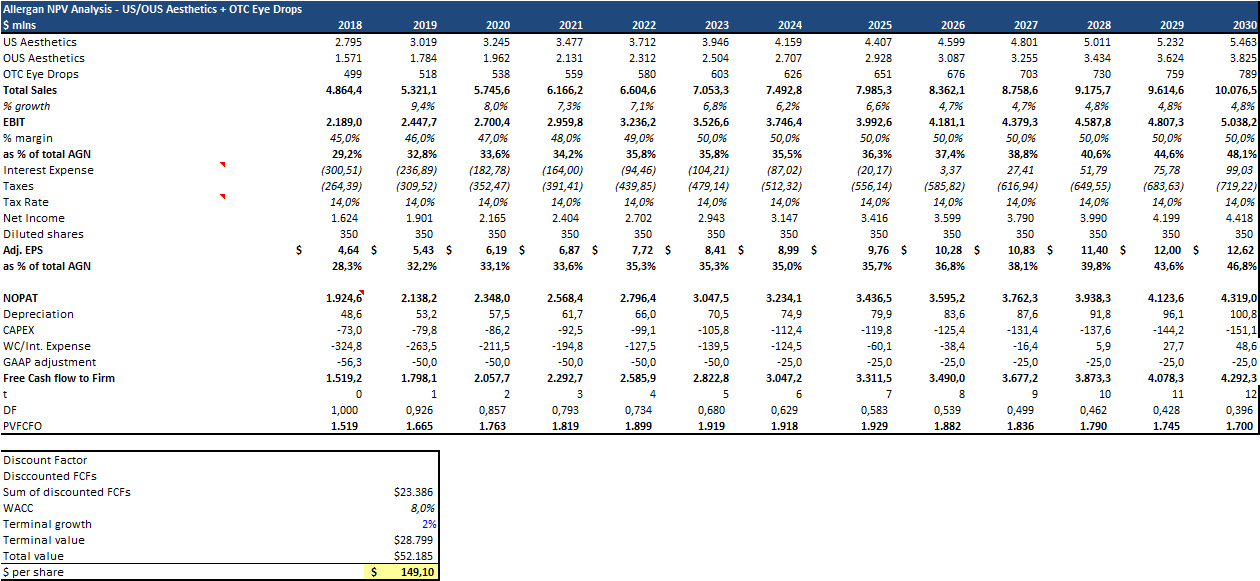
Aesthetics Franchise: NPV Valuation

Source: My Own valuation model
The main takeaway from this analysis is that the NPV valuation of the US/OUS aesthetics franchise is $149 per share.
It’s worth noting that I have assumed a WACC of 8% while the Terminal growth of this franchise is 2%, to reflect that the aesthetics franchise will not face pricing pressure and biosimilar competition over the long term. Lastly, I have assumed a 50% operating margin and a tax rate of 14%.

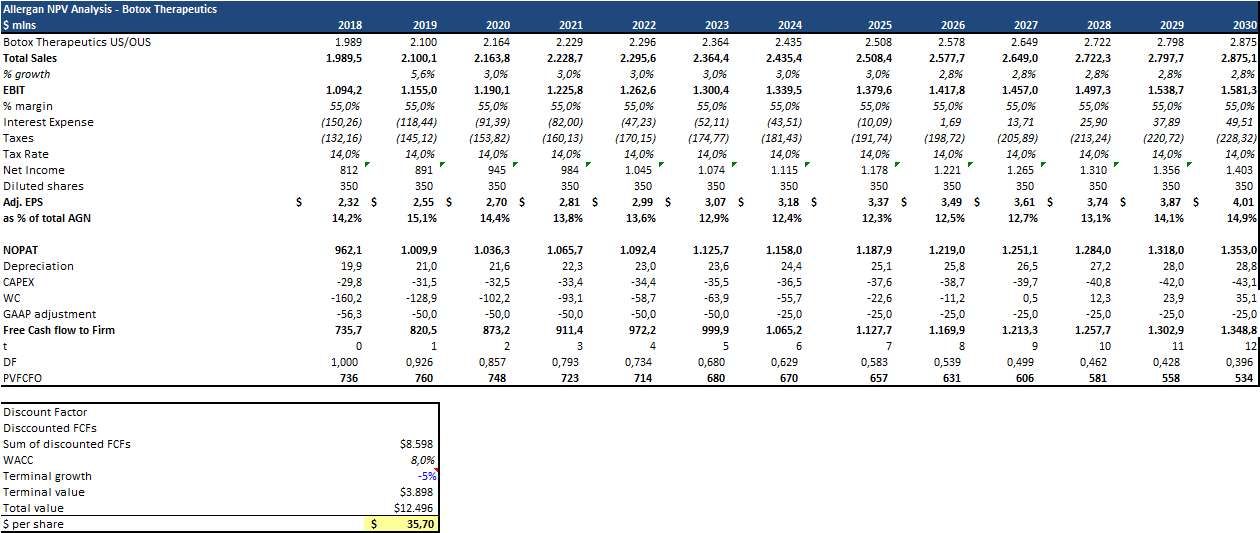
Botox Therapeutics: NPV Valuation

The main takeaway from this analysis is that the NPV valuation of the Botox Therapeutic franchise is $35 per share.
It’s worth noting that I have assumed a WACC of 8% while the Terminal growth of this franchise is -5%, to reflect that this business is likely to face biosimilar competition beyond 2023. Lastly, I have assumed a 55% operating margin and a tax rate of 14%.

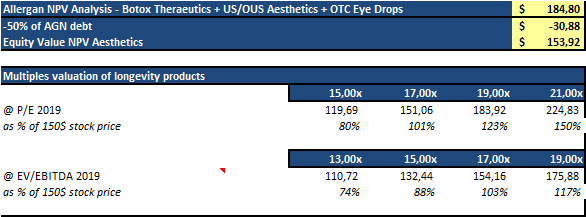
Multiples Valuation

The main argument for a potential spinoff of the aesthetics business is that Allergan should re-rate after the spinoff because the Newco will be focused exclusively on consumer franchises, with less reliance on price increase and limited pressure from biosimilars.
Source: My Own valuation model
The main takeaway from this analysis is that Allergan looks strongly undervalued on any metrics, taking into account a potential spinoff of the aesthetics franchise. Assuming that the Newco will trade at a premium to the pharmaceutical sector (e.g. 17x P/E 2018 or 15x EV/EBITDA 2018) and assigning around $10B of net debt to this Newco, I estimate a valuation of $130/150 per share for the Aesthetic franchise alone, which is approximately equivalent to the current market capitalization of the entire Allergan.

What Is The Value Of Allergan If The Break-Up Does Not Happen?

Even assuming that the management will not pursue a breakup of the company, the outlook for this company is healthy. You can see here a more comprehensive analysis of Allergan and few analyses of the intrinsic value of the whole company.
The main arguments behind my bullish thesis on Allergan are:
  • Estimates for 2018 seem conservative.
  • I don’t believe that Revance’s (RVNC) RT002 will have a meaningful impact on Allergan’s Botox franchise.
  • At 9x 2018 P/E, shares trade at the low end of the diversified biopharma group, despite a highly attractive portfolio of assets.
  • Allergan could benefit from a broad and underappreciated pipeline with more than ten assets with >$500 mln peak sales in Phase II/III.
  • Allergan could benefit from the divestments of few non-core franchises, as women’s health or antibiotics. The company could use the proceeds from these divestments to pay-down debt or to do some bolt-on acquisitions in the aesthetics franchise. This strategy could be the right way to re-focus the company on their leading therapeutic areas (e.g. aesthetics franchise, CNS, GI, and Eye Care), without having to break-up the company.

Risks

Over the next 12 months, Allergan will report the results from some Phase II and III trials:
  • Few more Phase III data for Ubrogepant in acute migraine in H1/2018.
  • Phase IIb data for Atogepant in migraine prevention in H1/18.
  • Phase III data for Abicipar in wet AMD in H2/2018.
  • Phase III data for Rapastinel in depression in H1/2019.
Each of these assets is a potential blockbuster opportunity, but if all these trials will fail, the market will question the ability of management in doing research and discovery.
I think this is the biggest risk factor, which could prevent a meaningful re-rating of Allergan from the current depressed valuation.

Conclusion

Despite a beat and raise at Q1/2018 results, Allergan’s shares have been pressured by the uncertainties on the outcome of the strategic review. I do not understand the logic behind these worries, and I think that the investors’ patience will be finally rewarded.

This ‘cure’ only makes the opioid crisis worse

Attorney General Jeff Sessions says the Justice Department is striving to “bring down” both “opioid prescriptions” and “overdose deaths.” A study published the following day suggests those two goals may be at odds with each other, highlighting the potentially perverse consequences of trying to stop people from getting the drugs they want.
Columbia University epidemiologist David Fink and his colleagues systematically reviewed research on the impact of Prescription Drug Monitoring Programs, which all 50 states have established in an effort to prevent nonmedical use of opioid analgesics and other psychoactive pharmaceuticals. Reporting their results in the Annals of Internal Medicine, Fink et al. say the evidence that PDMPs reduce deaths involving prescription opioids is “largely insufficient,” adding that “implementation of PDMPs may have unintended negative outcomes — namely, increased rates of heroin-related overdose.”
The review covers 17 studies, 10 of which looked at the relationship between PDMPs and deaths involving narcotic pain relievers. Three studies “reported a decrease,” six “reported no change,” and one “reported an increase in overdose deaths.”
The picture looks worse when you take into account deaths involving illegally produced drugs, which now account for a large majority of opioid-related fatalities. Fink et al. found six studies that included heroin overdoses, half of which reported a statistically significant association between adoption of PDMPs and increases in such incidents.
To the extent that PDMPs succeed in making pain pills harder to obtain, they encourage nonmedical users to seek black-market substitutes. “Changes to either the supply or cost of prescription opioids after a PDMP is instituted,” Fink et al. observe, “might reasonably drive opioid-dependent persons to substitute their preferred prescription opioid with heroin or nonpharmaceutical fentanyl.”
Restricting access to pain pills also seems to be increasing the percentage of opioid users who begin with heroin. A 2015 survey of people entering treatment for opioid-use disorder found 33 percent had started with heroin, up from 9 percent in 2005.
If the aim is preventing drug-related deaths, this shift is counterproductive, to say the least. Because their purity and potency are inconsistent and unpredictable, illegally produced opioids are much more dangerous than pain pills.
Comparing deaths counted by the federal government to its estimates of users suggests that heroin is more than 10 times as lethal as prescription opioids. Policies that drive people toward more dangerous drugs help explain why deaths involving heroin and illicit fentanyl have skyrocketed in recent years, even as opioid prescriptions have declined.
A report published last month by the health care consulting firm IQVIA shows that the total volume of opioids prescribed in the United States fell by 29 percent between 2011 and 2017, from 240 billion to 171 billion morphine-milligram equivalents. According to data from the US Centers for Disease Control and Prevention, deaths involving pain pills nevertheless rose by 24 percent from 2011 to 2016, while total deaths involving opioids rose by 85 percent.
That trend includes a 252 percent increase in heroin-related deaths and an astonishing 628 percent increase in deaths involving the opioid category that consists mainly of fentanyl and its analogues. Final CDC figures for 2017 are not available yet, but the provisional numbers indicate there will be more increases.
In addition to magnifying the risks that nonmedical users face, the crackdown on pain pills is hurting patients. Many people who have successfully used opioids to treat severe chronic pain for years now find it difficult or impossible to obtain the medication they need to maintain a decent quality of life.
Since the current strategy is manifestly not working, drug warriors are, as usual, redoubling their efforts. The Drug Enforcement Administration, which sets annual quotas for opioid production, reduced the limit by 25 percent in 2017 and 20 percent this year.
Sessions plans to squeeze the supply even more, because “we are facing the deadliest drug crisis in American history.” He seems determined to make it deadlier.