Search This Blog

Monday, May 14, 2018

J&J rebuts asbestos claim in talcum powder suit

A trial for a lawsuit alleging that Johnson & Johnson Baby Powder was responsible for the death of a woman due to her exposure to cancer-causing asbestos began in South Carolina on Monday in the latest case against the healthcare conglomerate and a supplier over their talc-based products.

J&J said that its widely-used baby powder never contained asbestos, a known carcinogen linked to mesothelioma.
The case also names as a defendant a local unit of Rite Aid, one of the largest U.S. drugstore chains, which allegedly sold the baby powder used by the woman.
The case marked the first time a drugstore was involved in a talcum powder liability trial and a lawyer for the company, Sarah Johnston, said there was no reason for Rite Aid to be part of the suit.
In opening statements, a lawyer for the family of Bertila Boyd-Bostic, who died of a rare form of cancer in 2017 at the age of 30, told a jury in the Darlington County Court of Common Pleas that J&J had known for decades that its baby powder contained asbestos.
J&J and its supplier, a unit of Imerys SA, deny the allegations, and their lawyers said their talc product did not cause any form of cancer, according to an online broadcast of the trial by Courtroom View Network.
The case is one of several in recent months that alleged asbestos in talc products caused mesothelioma..
A New Jersey state court jury in April ordered J&J and Imerys to pay $117 million to a man who alleged he developed mesothelioma due to asbestos exposure from J&J Baby Powder. An appeal is pending.
J&J has also been battling some 6,000 cases claiming its baby powder caused ovarian cancer.
Boyd-Bostic used baby powder nearly all her life, her family’s lawyer, Christopher Swett, said on Monday. In 2016, she was diagnosed with pericardial mesothelioma, an extremely rare form of cancer that develops in the lining around the heart.
“J&J’s choices are why we’re here,” Swett said. He accused the company of concealing knowledge of asbestos contamination since the 1970s and choosing not to warn consumers of the risks.
Bruce Bishop, a lawyer for J&J, said there was no evidence in Boyd-Bostic’s medical records that her mesothelioma was in any way related to asbestos exposure.
Michael Brown, another J&J lawyer, said millions of people had used Johnson & Johnson Baby Powder without developing any diseases. “And that’s because it does not contain asbestos,” he said.

Morphosys Well-Positioned To Continue Antibody Discovery Platform Gains: JMP

Morphosys AG/S ADR MOR 1.28% is a German biotech company that specializes in antibodies research. With the expiry of the IPO quiet period, analysts began coverage on U.S.-listed shares.

The Analyst

JMP Securities analyst Konstantinos Aprilakis initiated coverage of Morphosys with a Market Perform rating and $38 price target.

The Thesis

Morphosys has a “broad pipeline,” and two distinct businesses, namely proprietary development and partnered discovery, wherein it works with partners on targets identified by the latter, Aprilakis said in a note. The company’s proprietary unit focuses on oncology and inflammation.
Aprilakis noted the company is developing MOR208, its most advanced proprietary asset, which has been tested in combination of lenalidomide for treating relapsed or refractory diffuse large B cell lymphoma. The candidate has received breakthrough designation status from the FDA due to it targeting an unmet medical need.
The analyst expects a commercial launch for MOR208 in 2020, and estimates peak U.S. sales of $1 billion in 2026.
Tremfya, developed by Johnson & Johnson JNJ 0.93%‘s Janssen unit and generated by Morphosys’ technology platform, was approved to treat moderate-to-severe plaque psoriasis in both the U.S. and EU in 2017. The analyst said Morphosys stands to gain about 4.5 percent in royalties on potential U.S. sales of $3.2 billion in 2026.
“In possession of one of the most prolific antibody platforms in all of biotech, Morphosys boasts an expansive and robust pipeline,” JMP said.

2 Canada Growers to Merge in Biggest Marijuana Deal Ever

  • Canada’s Aurora Cannabis to buy MedReleaf in all-stock merger
  • Industry consolidation heats up as Canadian legalization looms
Employees tend to marijuana plants at the Aurora Cannabis Inc. facility in Edmonton, Canada.
Photographer: Jason Franson/Bloomberg
Consolidation in Canada’s nascent marijuana industry is heating up, with two of the largest players agreeing to the biggest merger seen so far in the sector.
Aurora Cannabis Inc. agreed to buy rival MedReleaf Corp. for about C$2.9 billion ($2.3 billion) in stock, the companies said Monday in a statement. The deal will create a producer with the capacity to grow 570,000 kilos (1.26 million pounds) a year of cannabis at nine facilities in Canada and two in Denmark. The merged company will also have distribution networks at home as well as in Europe, South America and Australia.
Canadian marijuana growers are racing to gain market share as Prime Minister Justin Trudeau pushes to legalize recreational use this year. Aurora is leading the effort to consolidate the industry, having acquired more than 10 targets in the past two years.
Aurora Chief Executive Officer Terry Booth said there will be more consolidation in the industry.
Terry Booth speaks at the Toronto Stock Exchange on May 14.
Photographer: Cole Burston/Bloomberg
“We’re not done,” he told reporters in Toronto. “Over the next couple weeks you’ll see some more activity from Aurora,” but nothing on the scale of the MedReleaf deal, he added.
Chief Corporate Officer Cam Battley said Aurora’s goal is to “become nothing less than the world’s largest cannabis company.” Aurora sees particular growth opportunities in the European Union.
Aurora’s stock rose 1 percent to C$8.15 at 0:40 a.m. in Toronto, while MedReleaf’s gained 2.6 percent to C$25.44.

Global Growth

“The likelihood of another bidder emerging with a superior offer is low in our view, given the size of the transaction and the overwhelming support of MedReleaf’s shareholders,” GMP Securities analyst Martin Landry said in a note. He added Aurora may find it challenging to swallow another large deal so soon after its acquisition of CanniMed, which closed earlier in May.
In another Canadian deal announced Monday, Canopy Growth Corp. said it agreed to buy the 33 percent stake in greenhouse operator BC Tweed Joint Venture Inc. that it doesn’t already own. Canopy said separately it plans to list on the New York Stock Exchange.
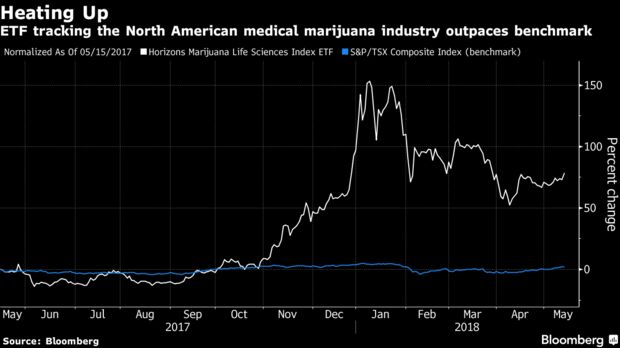
Weed companies are also seeking to capitalize on investor enthusiasm. Share prices for producers have soared over the past year: the Bloomberg Intelligence Canada Cannabis Competitive Peers Index, which comprises 54 companies, has almost doubled in the period and has a market capitalization of $65.4 billion.
For the growers that emerge as industry leaders, the prize isn’t just a legal Canadian market — where sales could reach C$6 billion by 2021, according to a report from Canaccord Genuity Corp. Governments in other parts of the world, particularly Europe, are heading in a similar direction to Ottawa, and several Canadian growers have been keen to advertise their ambitions to grow and distribute cannabis overseas.
Monday’s deal eclipses what had previously been the industry’s biggest deal: Edmonton-based Aurora’s C$775 million acquisition of CanniMed Therapeutics Inc., which was completed earlier this month. Aphria Inc., another Canadian grower, bought Nuuvera Inc. for about C$444 million in March.
Many Canadian growers eke out little or no profit as they push to expand production and revenue. Aurora, which has a market capitalization of C$4.59 billion, had a loss of C$13 million on sales of C$18.1 million in the year through June 2017.
According to its most recent annual income statement, Markham, Ontario-based MedReleaf had a net profit of C$11 million on revenues of C$40.3 million in the year through March 2017. Aurora’s takeover values MedReleaf at about 163 times earnings before interest, taxes, depreciation and amortization for that period, according to data compiled by Bloomberg.
  • MedReleaf holders will receive 3.575 shares of Aurora for each share they own. Based on May 11 closing prices, that values MedReleaf at C$28.85 per share, or a 16 percent takeover premium.
  • After completion of the deal, existing Aurora and MedReleaf holders will own about 61 percent and 39 percent of the combined company, respectively.
  • BMO Capital Markets is Aurora’s financial adviser, while McMillan LLP is legal counsel. Canaccord Genuity is advising the special committee of MedReleaf’s board, which also received an independent fairness opinion from GMP Securities and an independent financial diligence report from Deloitte LLP. Stikeman Elliott LLP is legal counsel to MedReleaf and Davies Ward Phillips & Vineberg LLP is legal counsel to shareholders of MedReleaf.
  • MedReleaf was 7.9 percent higher at C$26.80 at 9:02 a.m. in pre-market trading in Toronto while Aurora was 0.9 percent higher at C$8.14.

U.S. to consider expanding Medicare drug price negotiation

The Trump administration is considering expanding Medicare’s ability to negotiate the cost of drugs by giving private payers a role in setting the price of medicines administered in hospitals and doctors’ offices, Health and Human Services Secretary Alex Azar said on Monday.
Azar’s comments provided more details on the plan to lower prescription drug costs for Americans announced on Friday by President Donald Trump.
While Trump assailed “middlemen,” an apparent reference to health insurers and pharmacy benefit managers (PBMs), for pocketing negotiated rebates on drugs rather than passing savings to consumers, the proposal discussed on Monday appears to see them as part of the solution to high prices.
Shares of leading PBMs and insurers rose on Monday. CVS Health Corp (CVS.N) shares climbed 3.7 percent with Express Scripts Holding EXRX.O up 1.2 percent, while Humana Inc (HUM.N) shares rose 1.7 percent and Cigna Corp (CI.N) closed up 2.2 percent.
“On the one hand we are talking about banning rebates, but on the other we are talking about how great the private market is at controlling costs,” said Craig Garthwaite, director of the healthcare program at Northwestern University’s Kellogg School of Management. “Where exactly do we think those price reductions come from?”
Trump has vowed to tackle rising drug prices since running for office, but his plan spared the pharmaceutical industry from direct government negotiations to control costs, a proposal he endorsed during the 2016 presidential campaign. Shares of drugmakers rose for a second day on Monday as Wall Street analysts said the new policies were unlikely to hurt industry profits.
Medicare is the national health insurance plan run by the federal government for Americans over the age of 65 and the disabled.
Azar, a former pharmaceutical company executive, said Trump views tougher negotiation as key to the plan. Azar said his agency will consider an alternative system for buying Medicare Part B drugs, which are administered by a healthcare provider and covered directly by the government, such as many cancer treatments and infused biotech drugs.
The administration would seek to allow private payers to negotiate the price of those medicines, as health insurers and PBMs already do in Medicare Part D, which covers drugs patients get at the pharmacy.
“We believe there are more private sector entities equipped to negotiate these better deals in Part B, and we want to let them do it,” Azar said. “More broadly, the President has called for me to merge Medicare Part B drug payments into Part D, where negotiation has been so successful.”
CVS.NNEW YORK STOCK EXCHANGE
+2.41(+3.74%)
CVS.N
  • CVS.N
  • HUM.N
  • CI.N
  • UNH.N
  • ANTM.N
Health and Human Services senior officials said at a briefing with reporters on Monday that they could experiment with moving some drugs from Medicare Part B to Part D in a pilot program, but did not say when that might begin.
HHS likely has authority to pilot or experiment with limited programs, health policy experts said. But Joe Antos, of the conservative American Enterprise Institute, said the bulk of expensive drugs will likely remain in Part B, limiting the proposal’s ability to significantly lower drug prices.
“These are sophisticated drugs for complicated diseases,” Antos said. “It’s a relatively small part of the Medicare population, but it’s a big chunk of spending.”
Under the current system, drugmakers and physicians are incentivized to keep prices high in Medicare Part B, Leerink analyst Ana Gupte said.
She said companies best positioned to participate in the new proposal would be insurers that have their own PBMs, Part D plans and Medicare Advantage business, such as UnitedHealth Group (UNH.N), Humana, Anthem Inc (ANTM.N) and Cigna if the Trump administration approves its merger with Express Scripts.

New IPO: Inspire Medical Systems

Inspire Medical Systems, Inc. (INSP)

Sleep apnea is a condition that affects a growing number of Americans each year. Traditionally, the treatment for sleep apnea has been a so-called Continuous Positive Airway Pressure (CPAP) device. It’s basically a giant face mask that you wear while sleeping to help keep airways open. They are cumbersome, hot and incredibly uncomfortable. Because of that, many patients with sleep apnea forgo treatment and skip wearing the device. This leads to other medical issues.
That’s where Inspire Medical Systems, Inc. (NYSE:INSP) comes in.
Originally a spin-off from device giant Medtronic (NYSE:MDT), INSP makes an implantable device that delivers mild stimulation to the hypoglossal nerve. This nerve controls the movement of your tongue and other key airway muscles. By stimulating these muscles, the airway remains open during sleep and apnea is controlled. It basically builds off of MDT’s expertise in pacemakers and other similar heart devices. Sales of Inspires device have continued to grow and it’s the only device of its kind.
With a huge market for sleep apnea patients — including rising incidences due to obesity as well as in children — INSP has a long runway to grow its already robust sales and eventually profits. Moreover, there’s a good chance that Inspire becomes a buyout candidate as sales of its device catch on.

Clover launches in-home primary care with genomic testing

  • Medicare Advantage (MA) payer Clover Health is starting an in-home primary care program that includes genomic testing integration to help with medication therapy management.
  • YouScript will provide a clinical decision support tool to help Clover’s most vulnerable members while reducing emergency department (ED) visits and hospitalizations.
  • About 500 Clover Health members in New Jersey have joined the program.

Clover said the voluntary program is being offered at no cost. It includes a physician-led team with primary care physicians, nurses, social workers, medical assistants and care coordinators. The program identifies and addresses “all outstanding and incipient patient concerns, including those related to medication management.”
Five percent of Medicare fee-for-service beneficiaries in 2013 drove 42% of annual Medicare FFS spending.
Care team members interact with Clover’s technology platform, which uses pharmacogenomic testing to help personalize drug regimens.
The program includes regularly scheduled personal check-ins, monitoring and home-based lab and radiology testing.
The bid is the latest example of an MA payer and healthcare organization looking to reduce hospitalizations and costs for the most vulnerable patient populations. Humana, the second largest MA payer, is buying a piece of Kindred Healthcare, a home health, hospice and community care businesses.
CMS is giving MA plans more flexibility to offer supplemental benefits to certain beneficiaries. This greater flexibility lets plans design offerings that go beyond traditional MA benefits and can include meal delivery and transportation to non-medical appointments.
Clover Health, who has received funding from Alphabet, recently reported that it lost $22 million in 2017, an improvement over the previous year. Clover also increased its revenue from $184 million to $267 million and expects revenue in the $330 million range this year.

Health sector’s share of US jobs hits new high

  • The healthcare sector added 24,000 new jobs in April, and represented nearly 11% of all U.S. jobs, a new high, Altarum reported.
  • April’s healthcare job gains were close to the 25,500 monthly average over the past year. Hospitals added 8,000 jobs in the month and ambulatory settings picked up 16,900 jobs.
  • During the first quarter, health spending growth increased by 5%. That eclipsed the growth of the three previous quarters (4.2%, 4.7% and 4.6%, respectively).

Job growth remains steady and the health sector continues to help drive the U.S. economy and monthly job gains. Altarum said job growth has stabilized at about 2%, which is better than the 1.5% growth for non-healthcare jobs.
Issues could be on the horizon with finding qualified employees. The health sector is now roughly at full employment. “Notably, this does not resolve the continuing tension over whether the U.S. economy is too reliant on the health sector for employment stability and growth,” according to the report.
Hospitals added 8,000 jobs in April, which is generally consistent with the 7,900-job average in 2017 and continues the growth in hiring seen in recent years.
National health spending remained at 18.1% GDP, about $3.62 trillion, as of March.
Spending growth is an area of concern, especially since it comes at the same time that fewer people are insured. Gallup recently reported that the uninsured rate rose significantly in 17 states in 2017. That was the first time any state saw such an increase since the federal government implemented the major pieces of the Affordable Care Act in 2014, Altarum said.
“While [the spending growth] is only a mild acceleration from the 4.6% growth in 2017, it comes even as healthcare coverage has declined, Altarum Fellow Charles Roehrig said in a statement.
Altarum found the Health Care Price Index increased by 2.2% in April compared to a year ago. That was the highest rate since January 2012.
Hospital price growth was the main driver, especially Medicare, which was at 4.6%, its highest rate since November 2009. Another factor was private hospital price growth at 3.8%. That was the highest rate since the private-only data series was created in June 2014.
That spending growth is helping Americans rethink how they interact with the healthcare system.
recent Commonwealth Fund survey found that two-thirds of U.S. adults are very or somewhat confident that they could afford healthcare if they came down with a serious illness. That’s down from 70% in 2015. Confidence is lower for younger people, women, people with lower incomes, people with existing health problems and those between the ages of 50 and 64, according to the Commonwealth Fund report.