Gemphire Therapeutics downgraded to Market Perform from Outperform at Raymond James
Tuesday, August 7, 2018

GlaxoSmithKline names HSBC exec Iain Mackay as CFO
GlaxoSmithKline (GSK) announced that Iain Mackay has been appointed GSK’s next CFO. He has also been appointed as an Executive Director to the GSK Board. Mackay will join the company on January 14, 2019. Mackay joins GSK from the global bank HSBC (HSBC), where he has been Group Finance Director for the last 8 years. GSK announced in May that the Company’s CFO, Simon Dingemans, is to retire from the company in May 2019. Simon Dingemans will continue to be accountable as CFO for GSK’s financial governance through March 2019. There will be a transition period from January 14 when Mackay is CFO Designate, with him taking formal accountability as CFO from April 1. Mackay will join the Corporate Executive Team and the Board from January 14.
Mallinckrodt (MNK) Tops Q2 EPS by 30c, Revenues Miss; Lifts FY18 EPS Outlook
Mallinckrodt (NYSE: MNK) reported Q2 EPS of $1.78, $0.30 better than the analyst estimate of $1.48. Revenue for the quarter came in at $600.1 million versus the consensus estimate of $620.42 million.
“We are pleased with our overall results for the quarter, which built on a solid first quarter performance. With this, and with continued strong execution, our confidence has increased on the outlook for 2018 and we are raising guidance for the fiscal year,” said Mark Trudeau, President and Chief Executive Officer, Mallinckrodt. “We continue to see good performance across our hospital products, especially INOMAX® and OFIRMEV®. H.P. Acthar® Gel performed essentially as expected in the quarter, and we were pleased with the positive preliminary data related to the drug in rheumatoid arthritis and multiple sclerosis presented in the quarter. Additionally, we are making strong progress and are ahead of our expectations in reducing debt.”
Trudeau continued, “We look forward to further H.P. Acthar Gel data updates in coming quarters supporting our efforts to ensure appropriate patient access. Likewise, across our development portfolio we continue to make progress and look forward to other upcoming data reports, including the anticipated readout of VTS-270 top-line results in the near term.”
GUIDANCE:
Mallinckrodt sees FY2018 EPS of $6.50-$6.90, versus the consensus of $6.23
Monday, August 6, 2018
Recognizing early childhood speech problems
You eagerly await baby’s first words and delight at his growing vocabulary. But that excitement may cause you to miss speech problems that should be corrected quickly.
According to the American Speech-Language-Hearing Association (ASHA), many parents don’t know common warning signs of speech problems or that they’re easier to correct before age 4.
At 12 to 24 months, signs of a speech sound disorder include saying p, b, m, h and w incorrectly in words. At 24 to 36 months, signs include saying k, g, f, t, d and n incorrectly and producing speech that sounds unclear.
Stuttering affects many youngsters temporarily and often stops on its own. But look for worrisome signs between 30 to 36 months, such as repeating the first sound of words, like “b-b-b-ball” (buh-buh-buh-ball) for ball and stretching out sounds like f-f-f-f-farm (fffffharm) for farm.
Early signs of stuttering:
- Struggling to say sounds or words.
- Repeating the first sound of words.
- Stretching out sounds.
- Pausing noticeably between words.
Signs of a language disorder can start even earlier: For instance, a baby who doesn’t babble between 4 and 7 months or doesn’t understand what others are saying after 7 months. Later signs include speaking only a few words or words that aren’t easily understood.
What should you expect? Between 18 and 36 months, your child should be putting words together to make sentences, playing and talking with other children, and then developing early reading and writing skills.
Early learners may make mistakes. Be sure to say sounds correctly when you talk, but don’t correct speech sounds or interrupt or stop your child while he or she is speaking. If you’re concerned, see a certified speech-language pathologist for an evaluation. Ask your doctor for a referral, use the ASHA ProFind tool at www.asha.org/profind/ or contact your state’s early intervention program.
 Explore further: Baby talk words build infants’ language skills, study shows
More information: The Early Childhood Technical Assistance Center has state-by-state listings of early intervention coordinators and websites to help you find resources in your area.
Red blood cells contribute to cardiovascular diseases in type 2 diabetes
Harmful effects of substances secreted from red blood cells could explain the increased risk of cardiovascular diseases in patients with type 2 diabetes, the results of two new studies conducted at Karolinska Institutet in Sweden indicate.
It is a known fact that patients with diabetes are at considerable risk of developing cardiovascular diseases caused by organ-vessel damage that leads to heart attack, stroke, kidney disease, eye damage etc. Patients with diabetes also have a worse prognosis following a heart attack. However, the underlying causes of cardiovascular injury in diabetes are largely unknown, and there is no specific treatment to prevent it.
Research suggests that the red blood cells that transport oxygen to the body’s tissues are more inclined to adhere to the vessel wall in diabetes. Researchers at Karolinska Institutet have now studied how red blood cells change in type 2 diabetes and if they contribute to the cardiovascular injury occurring. Their results are presented in The Journal of the American College of Cardiology and JACC: Basic to Translational Science.
“We found that healthy blood vessels exposed to red blood cells from patients with type 2 diabetes suffer damage to their innermost cell layers, the endothelial cells,” says Professor John Pernow at Karolinska Institutet’s Department of Medicine in Solna who led both the studies. “This phenomenon, which is called endothelial dysfunction, appears early on in the development of diabetes-related vessel injury and greatly reduces the ability of the vessels to dilate while aggravating the inflammation.”
Using an experimental model, the team was also able to show that red blood cells from diabetic patients or diabetic mice impair heart function and cause greater myocardial injury in the event of a heart attack than red blood cells from healthy individuals. Their detailed analyses of rat and human blood vessels also demonstrate that the harmful effects are caused by elevated activity of the enzyme arginase, reduced production of the vasodilating molecule nitric oxide and increased formation of harmful oxygen-derived free radicals in the red blood cells.
“We also found that treatment that targeted arginase or oxygen-derived free radicals normalised red blood cell function, which meant that their harmful effect on cardiovascular function could be prevented,” explains Professor Pernow. “Our hope is that this knowledge will give rise to new treatments, specifically targeted at red blood cells, that prevent vascular injury and protect the heart in the event of heart attack in patients with type 2 diabetes.”
Marijuana detection using a breath-analyzer
Marijuana is being increasingly legalized across several states and its use is also on the rise. While 9 states and District of Columbia have legalized recreational marijuana, 30 states and D.C. have legalized medicinal marijuana use.
This has worried law makers about stoned drivers on the roads and highways putting lives of other people in danger. There are however very few tools that could be used roadside to detect a person under the influence of marijuana. Field tests can be escaped using breath mints and thus many drivers under the influence escape the law.
In a new development, a company from California – Hound Labs, has created a marijuana breathalyzer. CEO Mike Lynn in his Oakland, office has said, “We are trying to make the establishment of impairment around marijuana rational and to balance fairness and safety.” Lynn is a practicing emergency room trauma physician in Oakland and is also a SWAT team deputy reserve sheriff for Alameda County and is thus close to the effects of drunk driving and driving under the influence.
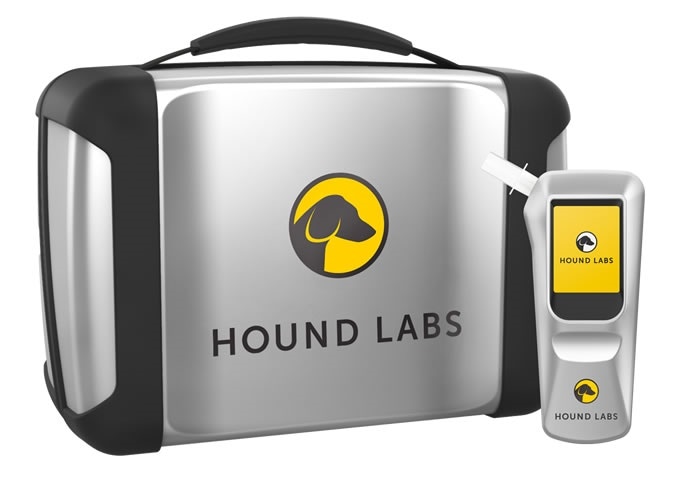
Hound Labs is a scientific research and device company that has developed ultra-sensitive technology for non-invasive breath measurement. The Hound® marijuana breathalyzer is the world’s first breathalyzer to rapidly, accurately, and inexpensively measure recent marijuana use and alcohol in a person’s breath.
Lynn demonstrated the use of his device. It looks like a small plastic box that contains a disposable cartridge. The device is around as big as a mobile phone and has a small plastic tube sticking out at one end. The person has to blow into the plastic tube for the necessary 30 seconds. There are indicator bars that show if the machine can detect any THC (Tetrahydrocannabinol – active ingredient of marijuana) in the breath. THC is the component of pot that provides the high. The results come in within 4 minutes after Lynn blows into the device.
The device can detect a person who has smoked marijuana within the previous two hours accurately. These two hours is considered to be the “peak impairment time frame”. Lynn said, “When you find THC in breath, you can be pretty darn sure that somebody smoked pot in the last couple of hours… And we don’t want to have people driving during that time period or, frankly, at a work site in a construction zone.” He explained that the device needs to be kept at a fixed temperature to provide accurate results. It is kept within a small base station at consistent temperatures. This device can also detect alcohol in breath and thus can be used as a convenient hand-held tool that the police can use on roadsides to detect offenders who are driving under the influence of either of the two intoxicants.
Lynn explains the main requirement is a roadside device to detect the intoxication at hand. At present the tools used to detect marijuana use samples of saliva and urine and may take days to detect THC. Further the lab tests cannot detect if a person has smoked marijuana half an hour ago or a week ago. THC is a highly fat-soluble compound and thus stays dissolved within the fat cells of the body for up to a month after it has been used.
According to Lynn this new device has overcome the hurdles and can accurately detect THC in breath molecules in parts per trillion (alcohol in breath is detected in parts per thousand on the other hand). He explained how little THC remains in the breath and the science behind its detection using the breath-analyzer. He said that this device took five years to develop to overcome the practical hurdles.
Lynn added that the machine cannot calculate the amount of THC consumed however. The purpose of the device is to detect a driver who is impaired and this device can help do that. Some of the police departments would start testing the Hounds Lab device from this fall. Lynn said that this would provide the makers real-life data.
There are a few other companies that are also in the race to develop a hand-held breath analyzer device to detect cannabis use on the road sides.
Allergan, Editas to Jointly Develop Genome Editing Experimental Med
Allergan plc (NYSE: AGN), a leading global pharmaceutical company, and Editas Medicine, Inc. (NASDAQ: EDIT), a leading genome editing company, today announced that Allergan’s wholly-owned subsidiary, Allergan Pharmaceuticals International Limited (Allergan), has exercised its option to develop and commercialize EDIT-101 globally for the treatment of LCA10. Additionally, the two companies announced that Editas Medicine has exercised its option to co-develop and share equally in the profits and losses from EDIT-101 in the United States. Under the terms of the option agreement signed in March 2017, Allergan has paid Editas Medicine a fee of $15 million in conjunction with the exercise of its option. Editas Medicine is eligible to receive an additional $25 million from Allergan upon acceptance of an investigational new drug (IND) application for EDIT-101 by the Food & Drug Administration (FDA).
“CRISPR-based medicines have the potential to be game-changers for patients with both genetically-defined and genetically-treatable diseases of the eye,” said David Nicholson, Ph.D., Chief Research and Development Officer, Allergan. “The Allergan team is excited to work with colleagues at Editas Medicine to develop EDIT-101 and potentially deliver a transformative medicine for LCA10 patients.”
“Today marks a significant milestone in our collaboration with Allergan and in our work to develop genomic medicines to treat eye diseases,” said Katrine Bosley, President and Chief Executive Officer, Editas Medicine. “Allergan is a long-time innovator in ophthalmology, and their deep experience in developing, manufacturing, and commercializing medicines globally will meaningfully advance the EDIT-101 program and maximize our ability to bring this transformative medicine to people living with LCA10.”
In March 2017, the two companies entered a strategic alliance and option agreement under which Allergan received exclusive access and the option to license up to five of Editas Medicine’s genome editing programs for ocular diseases, including EDIT-101. Under the terms of the agreement, Allergan is responsible for development and commercialization of optioned products, subject to Editas Medicine’s option to co-develop and share equally in the profits and losses of two optioned products in the United States. Editas Medicine is also eligible to receive development and commercial milestones, as well as royalty payments on a per-program basis where the parties are not sharing profits and losses. The agreement covers a range of first-in-class ocular programs targeting serious, vision-threatening diseases based on Editas Medicine’s unparalleled CRISPR genome editing platform, including CRISPR/Cas9 and CRISPR/Cpf1.
Subscribe to:
Posts (Atom)