Search This Blog

Saturday, September 15, 2018

10 best ways to make exercise an unbreakable habit


Exercising regularly is surely one of the most commonly made New Year’s resolutions. And surely one of the most commonly broken. Gyms around the world fill up with freshly-minted members in January . . . who are almost all gone by February.
If you’ve resolved and failed, and resolved and failed to start working out consistently, you know it can be a really discouraging cycle. Cementing the exercise habit can seem like an impossible task.
But it truly doesn’t have to be, as long you take the right approach. Below we share 10 key tactics that will help you make exercise an unbreakable habit.

#1: Do something you enjoy doing. 

I’ve been barbell training for the past two years, and during that time I’ve missed just a handful of workouts, and only when stricken with an extreme illness (I still work out if I’m just a little sick). I’ve trained on Thanksgiving. I’ve trained on Christmas. I’ve trained on vacation. But I don’t have this streak going because I’m super dedicated and disciplined and force myself to work out even when I don’t want to.
I merely enjoy barbell training. A lot! I don’t work out so regularly because I’m a hard-as-nails badass, but because I want to. Because I like it.
When it comes to exercise, people tend to think that for it to work, it has to be unpleasant. They think exercise is like eating Brussels sprouts; you may not like the taste, but you’ve got to get ‘em down because they’re good for you. Yet while these folks can flog themselves to exercise for a few weeks or even a few months out of a sense of dour obedience, they’re ultimately kicking against the pricks. Eventually, their dislike for their chosen regimen overpowers their will, and they stop working out altogether.
It’s true that to be effective all exercise will involve some discomfort. And it’s true that certain kinds of exercise are more or less effective than others. But all exercise is good for you, any exercise is better than none, and if you choose the right form of it — the form that’s right for you — it can in fact hurt so good and be a source of great pleasure.
Lots of people will say you should do CrossFit; that you should run; that you should do barbell training. These people mean well. They likely enjoy those activities and have gotten results from them and want you to experience the same benefit. But if you don’t like what they think you “should” be doing, you’re not going to do it.
Instead of should-ing on yourself by exercising the way some person or some magazine told you to, find something that you enjoy doing. This will take some time and experimentation. If you don’t like road running, try trail running. If you don’t like running at all, try rucking. If you don’t like lifting weights, try a bodyweight program. If you don’t like working out by yourself, try joining a CrossFit class, or a martial arts school, or a team sport.
I spent nearly ten years begrudgingly doing cardio-heavy and CrossFit-like workout programs before I discovered my love for barbell training. I recently found that I also enjoy rucking and MovNat as well, so that’s part of my exercise routine, too. Exercise is now something I look forward to — it in fact feels like one of the best parts of my life; consequently, it would take more discipline for me not to do a workout than to do one!
Bottom line: if you want to make exercise a habit, start off by picking an activity you enjoy. If you do that, you’ll be 90% there to becoming a man who exercises religiously.

#2: Put your training schedule on your calendar.

Besides picking an activity that they don’t enjoy doing, the other thing that keeps people from regularly exercising is not setting aside time for it on their calendar. For these folks, exercise is one of those things that they’ll get to . . . if they have time for it. But, of course, they never do, because something else always comes up.
If you want time to exercise, you have to make time for it. And the best way to do that is to schedule your workouts on your calendar and treat them like doctor’s appointments. Just as you’d tell someone you were busy if they wanted to do something at the same time you were scheduled to see a doc, you’re going to inform people you’re busy when they ask you to do something during your workout “appointment.”

#3: Experiment to find the workout time that’s best for you.

At what time should you schedule your workout “appointments”? That’s up to you.
Many people find that it’s best to exercise first thing in the morning; that way, when they get tired and stressed, or “urgent” to-do’s pile-up as the day goes on, their workout doesn’t end up getting pushed off the schedule. When you put the big rocks in first, all the small rocks can fit too.
However, that’s not an inviolable rule for everyone. Everybody’s got different work/life schedules and different rhythms to their daily energy and motivation. Maybe you’ll love working out at lunchtime or at night. You’ll never know unless you try. Experiment with different options and see what works best for you.

#4: Remove obstacles with a pre-workout checklist.

When I interviewed bodyweight training coach Anthony Arvanitakis for the podcast, he told me that one thing he does to ritualize his workouts is to use a pre-workout checklist. His checklist includes making sure his phone is charged so it won’t quit playing music in the middle of his workout, putting the phone in airplane mode so calls and texts won’t create distractions, filling up his water bottle, preparing equipment in his gym so nothing’s missing and everything’s right at hand, and changing into certain workout clothes.
Arvanitakis keeps this checklist on an index card and reviews it each day, as he says he finds doing so “comforting.” As he observes, “The most difficult part in a workout is getting started,” and “Having that list gets you in the flow.” It eliminates decision-making and friction, so there’s less standing in the way of you getting your sweat on.
Listen to my podcast with Anthony about making exercise a habit: 

#5: Have clothes specifically dedicated to working out.

Another thing Arvanitakis recommends is having sets of clothes you specifically designate as your workout clothes. He thinks of his workout gear as his “uniform” and feels that donning it helps him get in the mindset to exercise.
When you put on clothes you don’t associate with anything other than exercise, this “uniform” does indeed help you get into workout mode and feel ready to go out to “battle” at the gym. 

#6: Have a plan for your workout.

Don’t just plan your pre-workout ritual, but know exactly what you’ll be doing once you hit the gym as well.
When most people take a first stab at working out, they just show up at the gym and do whatever exercise the gym spirits move them to do. A few bicep curls here, maybe some medicine ball action, followed by some leg presses. Thirty minutes after aimlessly wandering around the gym, they get bored and hit the sauna. After a few weeks of unproductive “workouts” like that, and unsurprisingly seeing no results, they stop going altogether.
Uncertainty is a big motivation killer. It causes paralysis by analysis so you end up doing nothing. And when you do nothing, your body and health don’t change. And when your body and health don’t change, you lose motivation to exercise.
To avoid this fate, have a workout plan for yourself before you head over to the gym. Know exactly which exercises you’re going to do and for how many sets and reps. Write your plan down, bring it with you to the gym, and refer to it frequently throughout your session so you stick to it. If you’re running, have a weekly running plan for yourself so you know that you’ll be working on speed one day and endurance another.
You’d be surprised at how much having a plan can keep you motivated to work out. It removes motivation-sapping uncertainty and ensures you actually see motivation-boosting results.
Not sure what your workout plan should be? I’d highly recommend not trying to come up with it willy-nilly on your own, but instead committing to a set program that’s been designed by experts. Here’s a list of programs I recommend which suit a variety of fitness goals. I, of course, heartily suggest Starting Strength above all, but if that’s not your thing, that’s fine. Just pick a plan you think you’ll enjoy, and then work that plan.

#7: Just get moving, even when you don’t feel like it.

As mentioned above, the hardest part of working out for a lot of folks is simply getting started. Oftentimes, you just don’t feel like exercising. You don’t feel like getting out of bed or off the comfy couch. You don’t feel like leaving the house. The pull of inertia is strong.
Fortunately, one of the great truisms of life, is that if you take action without feeling like it, the feelings will follow. If you don’t feel like working out, but get after it anyway, you’ll almost always get into the flow and start to enjoy it.
Of course, this sets up a catch-22: you’ll feel like working out if you start working out, but how do you start if you don’t feel like it?
Try making a deal with yourself. Decide that all you have to do is go to the gym and work out for 10 minutes; if after 10 minutes you don’t want to do any more, then you can go home. It’s an easy deal to commit to. Of course, what happens 9 times out of 10 is that once you’re at the gym, and moving your body, you get into an exercise-positive mindset and want to continue on and do a full workout.

#8: Aim for consistency in frequency, rather than consistently A+ workouts.

A key to making something a habit is putting together a chain of successes, which is, at least at first, rarely or never broken. To lay down a new groove in your life, you’ve got to etch away at it without interruption.
So always err on the side of doing something, even when circumstances prevent you from doing a “perfect” workout. Feeling just a little sick? Still work out, but go a little easier. Have a crazy busy day? Still work out, but make it a little shorter. Traveling?Still work out, even if you have to improvise with the equipment available in the hotel gym. Sluggish and grouchy and can’t get into the mood to exercise even after you’ve tried? Still move, however tepidly, through your planned workout.
Even if 9 times out of 10 when you start a workout without feeling like it, you end up getting into it, there’s still that one time where you don’t. Try to at least go through the motions anyway. My strength coach Matt Reynolds calls these times “blue collar days.” You’ve just got to put on your hardhat, put on your coveralls, and do the work. You simply punch the clock and get the job done. You don’t clock out having made big gains with your physique, but that’s okay — you still strengthened the “muscle” of your exercise habit.
Of course, listen to your body (and be sure you’re doing recovery right), but also don’t take an all-or-nothing approach to your workouts. When conditions aren’t perfect, it’s better to continue the habit chain, and do something, than to decide it’s all a wash and do nothing at all.
When it comes to habit formation, consistency is king.

#9: Exercise for something.

Motivation research shows that when we have a clear purpose for a task, we’re more likely to do that task regularly. So have a why for your workouts. It could be something high-minded like being ready for emergencies or living a long time for your kids and/or grandkids, but it could also be something vain like just wanting to look good with your shirt off. Whatever it is, write it down and refer to it every day. When you don’t feel like going to the gym, read your purpose to remind yourself of why you’re trying to exercise regularly.
For me, competitions serve as a big motivator for training. Signing up for a barbell meet gives me something very concrete and date-specific to train for, and knowing that I will be performing my lifts in front of lots of people lights a fire under my rear to keep up my training.
If you’re looking to run more this year, sign yourself up for a 5K or an obstacle race a few months from now. Your goal might not be to win the race, but just not to look like an out-of-shape schlub hoofing through the course like an asthmatic water buffalo. Shame is a powerful motivator.

#10: Get accountability.

Some people find it useful to get an accountability partner for their workouts. This could be a personal trainer or a coach, or it could be a friend. Getting a barbell coach was a game changer for me and my training. Besides the feedback on my lifts, the accountability factor has played a huge role in my compliance with the programming. I don’t want to let my coach down by wussing out on a session. Again, shame can be a powerful motivator.
If you want to take the accountability up a level, then put some stakes on the line. Paying for a coach or trainer is one way to do this. Knowing that you’re putting your money in a metaphorical paper shredder every time you miss a session can motivate you not to miss a workout. Join The Strenuous Life, where you’ll have to do 60 minutes of physical activity on most days for 12 weeks to complete the TSL Challenge. Or use something like stickK to set up a wager with a friend that says if you miss more than two workouts in a row, you have to pay him or even some organization you detest a certain amount of money. The amount needs to be large enough so that it hurts if you fail to meet your end of the bargain.

Conclusion

Making exercise a habit doesn’t need to be hard. Find something you enjoy, plan for it, prioritize it, and point it towards a purpose. Keep adding one link after another to the chain of your new habit, and soon you’ll find yourself becoming the kind of man who finds it difficult not to exercise.

Patients blame hospitals for high medical bills


When asked which groups are most responsible for surprise medical bills, 82% said hospitals were ‘very’ or ‘somewhat’ responsible.

Patients are nearly as likely to blame hospitals for their surprise medical bills as their insurance company, finds a new survey from NORC at the University of Chicago.
When asked which groups are most responsible for surprise medical bills, 82% said hospitals were “very” or “somewhat” responsible.
Eighty-six percent of respondents said insurance companies are “very” or “somewhat” responsible.
This hospital blame game played out in real life recentlywhen St. David’s Medical Center in Austin, Texas, got slammed in the media over a teacher’s $109,000 heart attack bill.
The bill was featured in Kaiser Health News’ and NPR’s “Bill of the Month” series, which scrutinizes high or confusing medical bills.
Several factors reportedly stacked up against the teacher, including his insurance coverage and visiting an out-of-network hospital. Indeed, the NORC survey shows 20% of respondents’ surprise bills were a result of a doctor not being part of their insurance network.
However, it was St. David’s Medical Center that got the brunt of the blame in the media.
They also eventually ate the original bill: NPR reported that after its story, the hospital reduced the patient’s responsibility to just $332.
The NORC survey shows that getting surprised by a medical bill is fairly common: 57% of respondents have experienced this kind of healthcare sticker shock.
“Most Americans have been surprised by medical bills that they expected would be covered by their insurance,” Caroline Pearson, senior fellow at NORC at the University of Chicago, said in a statement. “This suggests that consumers may have difficulty understanding their insurance benefits or knowing which providers are included in their plan’s network.”
Of course, the “surprise bill” is only the tip of the nonpayment iceberg, though: A Commonwealth Fund survey from May showed that 46% of people would not have the money to pay a $1,000 medical bill within 30 days in the case of an unexpected medical event.
That’s why some hospitals are turning to a consumerist approach to pricing and billing, including competitively pricing their services, publicly publishing their prices, and giving consumers ways to pay their hospital bill upfront.

Circulation Article Paints Positive Risk Benefit for Alnylam’s Onpattro – Cowen


Cowen analyst Ritu Baral weighed in on Alnylam Pharmaceuticals (NASDAQ: ALNY) after Onpattro APOLLO cardiac subpopulation data was published

Morgan Stanley: ‘Street Is Overestimating Weight Watchers’ Addressable Market’


Weight Watchers International, Inc. WTW 1.58%‘s turnaround story remains compelling, but the company’s growth trajectory precludes a bullish stance, according to Morgan Stanley.

The Analyst

Morgan Stanley’s Vincent Sinisi initiated coverage of Weight Watchers International with an Equal-weight rating and $76 price target.

The Thesis

One of the biggest disconnects between the Street’s expectations for Weight Watchers and reality is the total addressable market, Sinisi said in the initiation note. (See his track record here.)
The market is assuming the the $66-billion U.S. commercial weight loss market is fully applicable to Weight Watchers, the analyst said. A more realistic view of Weight Watchers’ addressable market is around $18 billion and based on an addressable market of 31 million people in the U.S. and 50 million globally, he said.
While the Street is assuming the company has a “long expansion runway ahead,” investors should be cautious on the opportunity until Weight Watchers demonstrates an ability to significantly expand into new demographic groups, Sinisi said.
The company could rebrand itself from a dieting and weight loss platform to an all-inclusive, health and wellness lifestyle platform, which would give it better exposure to the $3.7-trillion global health and wellness market, according to Morgan Stanley. Yet a radical shift to better target the larger market will take “considerable time” and may not even be feasible given its decades-long image as a weight loss company, Sinisi said.
Weight Watchers’ digital focus is flashing some concerning signs, including “very low” user engagement of 2 minutes per user per day on its app, the analyst said. The app is in direct competition with social media giants with an established organic Weight Watchers group that includes hundreds of thousands of people, he said.
Morgan Stanley’s $76 price target implies minimal upside from current levels and is based on a 19 times multiple on 2019 estimated EPS, which is already a slight premium to its three-year average.
A more constructive stance on the stock would be appropriate if the company improves retention at a faster-than-expected rate and shows material expansion in smaller demographic groups like younger males.

7 Simple Exercises That Undo the Damage of Sitting


If you’re like most men living and working in a techno-service economy, you probably spend a good deal of your day sitting down. You go from the kitchen table to your desk at work to your chair in front of the TV. But as we’ve discussed before, spending most of your waking hours planted on your keister is terrible for your health.
You’ve probably experienced those moments when you get up from a sitting position and your butt feels numb and your hips feel so tight that you have to lean forward at the waist just to walk. Excessive sitting leaves your hips and legs tight and your glutes inactive. Even after you stand up, the ill effects of sitting stay with you and may prevent your butt muscles from firing at an optimal level when you really need them – like when you suddenly need to chase down a purse snatcher!
Some fitness experts argue that sitting causes muscles in the hip area to physically shorten (and stay shorter), even after you stand up. While there are no scientific studies to back that claim, from my own personal experience, sitting for lengthy periods of time definitely makes everything feel tight in the groin/butt area.
If you’re an athlete (or fancy yourself one), tight hips and inactive glutes can hamper physical performance in a variety of activities, such as sprinting, squatting, and — my favorite — deadlifting. If you want to perform at your best, you need to make sure that your hips stay limber and that your butt muscles are firing on all cylinders. Even if you’re not interested in deadlifting 600 lbs. (though I hope to change your mind on that someday), keeping your hip flexors loose and glutes active can improve your life on other fronts.
First, having limber hips just feels good, plain and simple. Second, having a healthy range of motion in your hips can help prevent injury when you pursue more recreational physical activities and do household chores. For example, loose hips keep your IT band loose as well, which can ward off knee pain. Finally, taking care of your hips may help improve your posture, which can in turn alleviate back or neck pain. (Not to mention the role of limber hips in doing a mean mambo.)
Below, we provide some simple stretches and exercises that will undo the damage to your hips and butt caused by sitting.

Prevention Is the Best Remedy: Sit Less and Move More

As the saying goes, “an ounce of prevention is worth a pound of cure.” The best thing you can do for your hip mobility and glute activation is to simply sit less and move more during the day.
If your employer will allow it, try using a standing desk, which keeps your muscles activated at the office. Keep in mind that, just as with sitting, standing should be done in moderation (doing it for an extended period of time isn’t that great for you, either).
If a standing desk isn’t an option, take five-minute breaks from sitting every 30 to 45 minutes. Stand up and walk around a bit. Maybe even perform a few of the exercises below. Even if you have a standing desk, you should still take breaks every now and then for some movement.

Stretch Out Those Hips

These dynamic stretches and exercises are designed for loosening tight hips that come from sitting too much. I try to incorporate a few of them in my daily workout warm-ups or even sneak some in when I’m hanging out with the kids (who think their dad is pretty odd). Every now and then I also dedicate an hour on Saturdays to just hip and glute work, along with some intense foam rolling.
If you’re really tight, take it nice and easy. As physical therapist Kelly Starrett says, “Don’t go into the pain cave. Your animal totem won’t be there to help you.”

Leg Swings

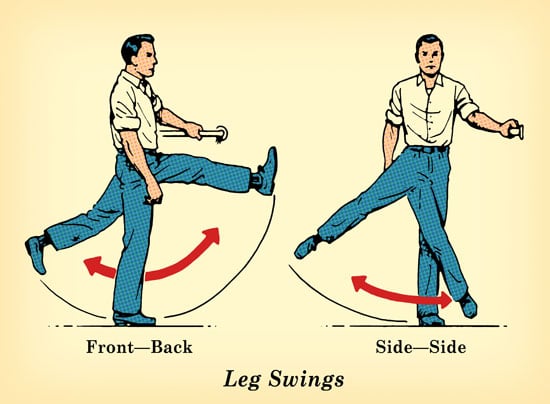
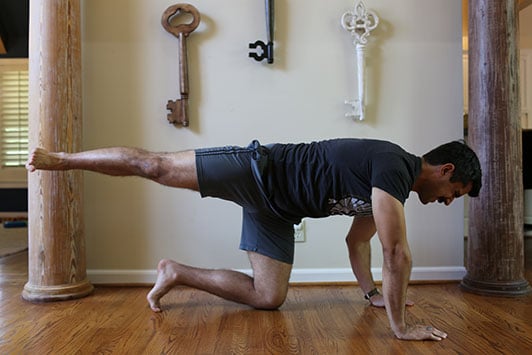
leg swing exercise undo damage of sittingThis is a great dynamic stretch that I do before every workout. It loosens up the hips, hamstrings, and glutes.
Begin with forward leg swings. Find something to hold for balance. Start off swinging your right leg backwards and forwards as high and as far back as you comfortably can. Do 20 swings and then switch legs.
Next are side-to-side swings. Again, find something to hold for balance. Swing your right leg out to the side as high as possible and then in front of you towards your left as far as you can go. Perform 20 swings and then switch legs. Depending on how tight you feel, you may need another set.

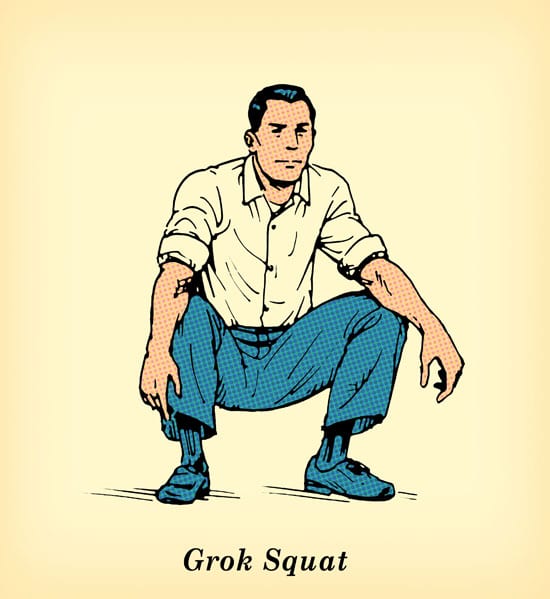
Grok Squat

grok squat exercise undo damage of sittingThe Grok Squat is very similar to a catcher’s stance in baseball. Simply squat down until your butt touches your ankles. Keep your heels firmly on the ground and your back straight. Hold that position for 30-60 seconds. You should feel your hamstrings, quads, Achilles tendons, lower back, and groin gently stretching. If you’re super stiff, it may take a few days of practice to sink into a full squat. Keep at it. Your back and hips will thank you.
Intersperse a few short squatting sessions into your daily routine.

Table Pigeon Pose

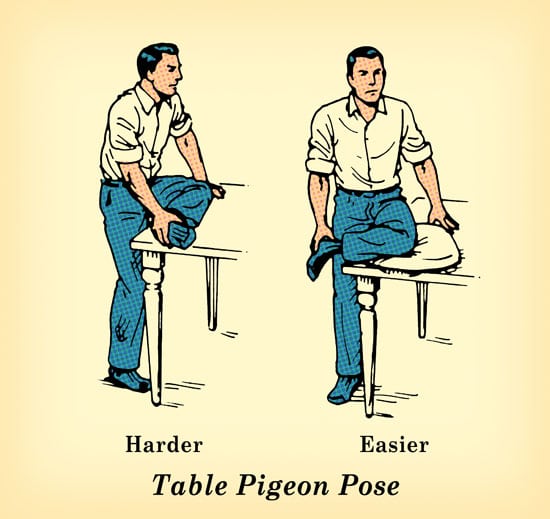
pigeon pose exercise undo damage of sittingIf you’ve done yoga, you’re probably familiar with the pigeon pose. This stretch is the same thing, except you use a table, which makes it a bit easier to perform and allows you to stretch out your muscles from different angles. Start by placing your leg on a tabletop (you could also use your bed) with the knee bent at 90 degrees. Place one hand on the table and one hand on your foot for support. Lean forward and hold for 60-90 seconds. Then lean left to the 10 o’clock position and hold for 60-90 seconds. Lean right to the 2 o’clock position and hold for 60-90 seconds. Repeat on the other leg.
If you have knee problems, rotate your body so that your ankle hangs off the table and place a pillow underneath your knee. Aim to do two pigeon poses a day (I personally do one during my workout and another at a random time).

Couch Stretch

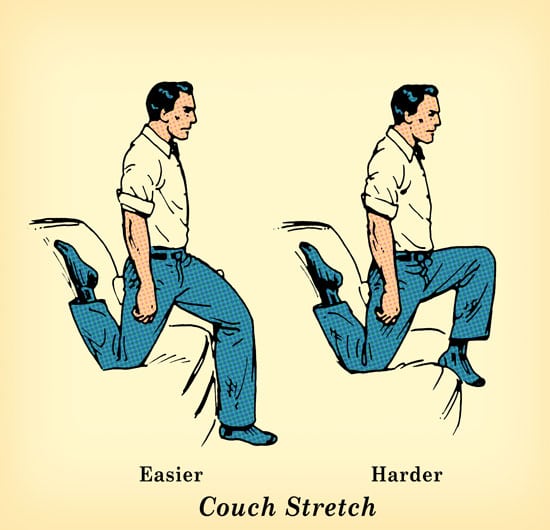
couch stretch exercise undo damage of sittingThis stretch is a killer. I didn’t realize how unlimber I was until I tried doing the couch stretch. It’s basically a quad stretch ratcheted up a few notches. Starrett argues that this will undo years of sitting.
You actually don’t need a couch for this stretch, it just makes it a bit more comfortable (if that’s even possible). You can also do it on the floor by putting your knee against a wall.
For the “easy” version, place the knee of the leg you’re stretching against the back of your sofa. Place the foot of your other leg on the floor. Slowly raise your torso to a neutral spine position (i.e. standing straight and tall). As you raise your torso, squeeze your butt and abs. Hold the position for up to four minutes. Switch and repeat on the other leg. You should feel things really stretch in your hip flexor area — just don’t push yourself too hard.
To up the ante, bring your non-stretching leg up onto the seat of the couch. Keeping a straight, neutral spine, squeeze the butt and abs and work your way up to holding the position for four minutes. Keep in mind that it may be awhile before you can get your torso to a straight position. When I first started doing this stretch the “hard way,” I could only raise my torso to a 45-degree angle and I’d have to support myself with my hand on the floor. I was eventually able to move to a straight position after two weeks of dedicated stretching. The difference in the mobility of my hips was (and continues to be) significant.
This stretch is so good that I try to do it every day, sometimes before a workout, sometimes when I’m just hanging out while Gus watches Paw Patrol.

Activate Those Glutes

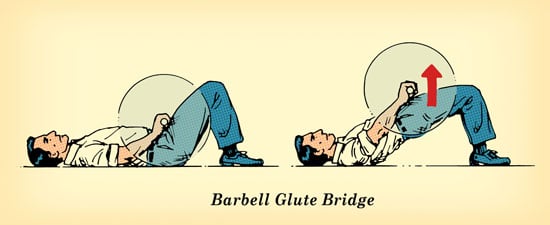
Barbell Bridges

barbell bridge exercise undo damage of sitting
This is another exercise that makes you look goofy but does wonders for your glutes and hips. It has been a great support exercise for the deadlift.
Lay on the ground with your knees bent and feet flat on the floor. Put a padded barbell across your hips and grab it with an overhand grip about shoulder-width apart. Raise your waist off the ground while squeezing your glutes until your hips are aligned with your body. Return to the starting position, and complete three sets of 10 reps.
Aim to do this exercise one to two times a week. You can add weight as you get stronger. If you can’t do it with the weight of the barbell, try un-weighted bridges.

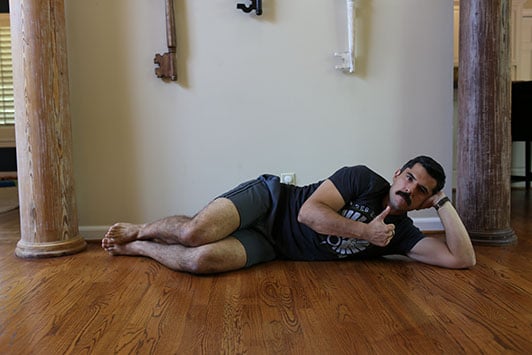
Clamshells

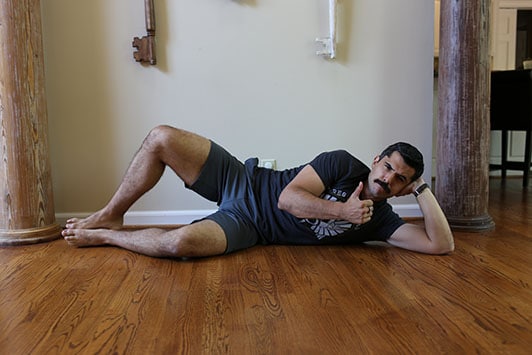
Fair warning: You’re going to feel a bit ridiculous doing this exercise. But it’s one of the best for activating your glutes. If you’re self-conscious, do this at home before you go to the gym so no one sees you.
clam shell exercise undo damage of sitting

Fire Hydrants

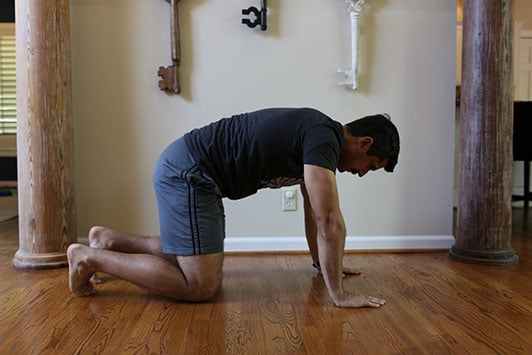
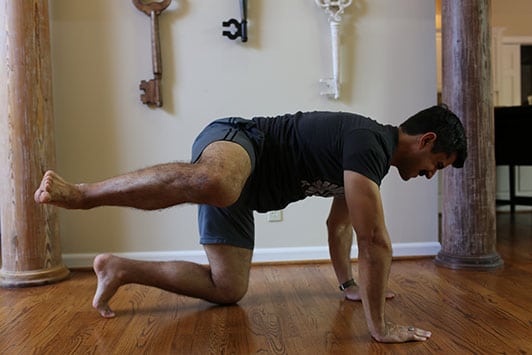
Hey, look! Another glute activation exercise that makes you look goofy! It’s called the fire hydrant because you’re going to mimic how a dog pees on a fire hydrant. For real.
fire hydrant leg exercise undo damage of sitting
__________________________
I learned these moves from a few sources: Becoming the Supple Leopard by physical therapist Kelly Starrett, paleo guru Mark Sisson of Mark’s Daily Apple, and weightlifter Medhi from Stronglifts. If you’re looking to increase not only your hip mobility, but your all-around limberness, Starrett’s book and website are especially helpful.
Illustrations by Ted Slampyak

How to raise emotionally intelligent kids


Dealing with kids ain’t easy. They need an exhausting amount of attention and help.
Behavioral psychologists have observed that preschoolers typically demand that their caretakers deal with some kind of need or desire at an average rate of three times a minute.
Most advice on parenting focuses on how to deal with misbehavior. While helpful, this is also akin to only offering advice on how to survive after a nuclear holocaust and not talking about how to prevent one. What’s the secret to making sure your living room doesn’t resemble a scene from “Mad Max: Fury Road”?
What usually underlies bad behavior is how the child handles negative emotions. And this is something we rarely teach deliberately and almost never teach well. Showing kids how to recognize and deal with feelings prevents misbehavior — and it’s a skill that will serve them their entire lives. It prevents tantrums at age 4 but it’s also the difference between saving college money and saving bail money later on. Look at it as potty training for feelings.
But how do we do that?
Professor John Gottman is the guy who revolutionized the study of relationships, getting it to the point where he could listen to a couple for just a few minutes and determine with a frightening amount of accuracy whether or not they’d divorce. Well, luckily, Gottman also analyzed parenting. And this wasn’t the latest parenting theory-of-the-week that somebody came up with over lunch — this was a truly epic study of mind-bending proportions.
He took over 100 married couples with kids ages 4 or 5 and gave them questionnaires. Then conducted thousands of hours of interviews. He observed their behavior in his lab. Taped sessions of the kids playing with their best friends. Monitored heart rates, respiration, blood flow and sweating. Took urine samples — yeah, urine samples — from the kids to measure stress-related hormones. And then followed up with the children and families all the way through adolescence, conducting more interviews, evaluating academic performance and…
Okay, enough. You get it. The plans of Hollywood Bond Villains aren’t this thorough. And when it came to dealing with emotions, Gottman realized there are 4 types of parents. And three ain’t so hot:
  • Dismissing parents: They disregard, ignore, or trivialize negative emotions.
  • Disapproving parents. They’re critical of negative feelings and punish kids for emotional expression.
  • Laissez-Faire parents: They accept their children’s emotions and empathize with them, but don’t offer guidance or set limits on behavior.
Children of these parents didn’t do as well over time. They misbehaved more, had trouble making friends or had self-esteem problems. One of them may be breaking into your car right now.
And then there were the Ultra-Parents. These mothers and fathers unknowingly used what Gottman calls “emotion-coaching.” And this produced emotionally intelligent kids. These parents accepted their children’s feelings (but not all of the children’s behavior), guided the kids through emotional moments, and helped them problem-solve their way to a solution that didn’t involve putting the neighbor’s kid in the emergency room. How did these tykes end up?
The children were better at soothing themselves when they were upset. They could calm down their hearts faster. Because of the superior performance in that part of their physiology that is involved in calming themselves, they had fewer infectious illnesses. They were better at focusing attention. They related better to other people, even in the tough social situations they encountered in middle childhood like getting teased, where being overly emotional is a liability, not an asset. They were better at understanding people. They had better friendships with other children. They were also better at situations in school that required academic performance. In short, they had developed a kind of “IQ” that is about people and the world of feelings, or emotional intelligence.
And it all came down to how the parents handled the child’s negative emotional outbursts. These parents did five things that the other types rarely did.
Alrighty, let’s get to it…

1) Be Aware Of Emotions

Parenting is stressful and can feel non-stop. Often it’s not like running a marathon — it’s like running until you die. So there’s a natural tendency to look around when things are (finally) calm and think, “Nothing is currently on fire. Okay, life is good.”
But this can be like standing in a coal mine ignoring the thousands of dead canaries. Usually emotions precede outbursts. So noticing the child’s emotions early — and not just the resulting bad behavior — is critical.
“Not misbehaving” doesn’t mean “not upset.” When a passive-aggressive spouse crosses their arms, scowls and says, “I’m fine,” at least you know they’re definitely not fine. Kids may not even understand what they’re feeling or how to best express it. So being aware and noticing early can prevent Tonka trucks from taking flight without FAA approval.
But the problem many parents have here is noticing their own emotions. If you’re not aware of your feelings and moods you’ll have trouble noticing and relating to those of others.
Our studies show that for parents to feel what their children are feeling, they must be aware of emotions, first in themselves and then in their kids… Emotional awareness simply means that you recognize when you are feeling an emotion, you can identify your feelings, and you are sensitive to the presence of emotions in other people.
Don’t be afraid to show emotions in front of your kids. Gottman found that even anger (as long as it’s expressed respectfully and constructively) has its place. If parents hold back from showing feelings then kids can learn “Mom and dad don’t have these emotions and neither should I.”
Seeing arguments and then seeing them resolved amicably is far better than never seeing them at all. Kids need a role model not just for values, but also for feelings.
Such moms and dads may try to compensate for their fear of losing control by being “super-parents,” hiding their emotions from their children… The irony is that by hiding their emotions, these parents may be raising youngsters who are even less capable of handling negative emotions than they would have been if their parents had learned to let their feelings show in a nonabusive way. That’s because the kids grow up emotionally distant from their parents. Also, the children have one less role model to teach them how to handle difficult emotions effectively.
Shielding kids from emotional situations and then sending them out into the world is like sending an athlete to the Olympics with no training. Kids need those moments in order to learn how to regulate their feelings.
(To learn more about the science of a successful life, check out my bestselling book here.)
Notice feelings now and avoid a crisis later. But what perspective did the smart parents take when outbursts did occur?

2) Emotion Is An Opportunity For Intimacy And Teaching

It’s understandable to see a tantrum as an irrational inconvenience that should be eliminated ASAP. But the parents whose children thrived saw outbursts as teaching moments and a time to bond with their kid. Yeah, that doesn’t always feel natural when a child is angrily throwing things.
Does saying anything resembling, “You should not feel this way” ever work with emotional adults? Exactly. Then it sure as hell isn’t going to work with your kid. Saying “There’s nothing to be afraid of,” or “Oh, it’ll be fine” is dismissive. This is how kids learn to doubt their own judgment and lose confidence. The Emotion-Coaching parents realized that a tantrum was the best time to connect with their child and teach them a valuable skill.
Yes, you need to stop misbehavior immediately. But you want to do it in a way specific to the child’s actions and not make it about their identity. So you want to say, “We don’t paint Grandma’s couch purple,” instead of, “Stop being a nightmare!” The children who consistently heard the latter did not fare as well in Gottman’s follow ups.
When we checked in with these same families three years later, we found that the children who experienced such disrespectful, contemptuous behavior from their parents were the same kids who were having more trouble with schoolwork and getting along with friends. These were the kids who had higher levels of stress-related hormones in their bodies. Their teachers reported they were having more behavior problems, and their moms reported they had more illnesses.
It takes practice but you want to see kids’ emotional pain like you’d see their physical pain. It’s not their fault. It’s a challenge they’re facing. And one you can help them with.
(To learn the two-word morning ritual that will make you happy all day, click here.)
Okay, so you’ve got the right perspective. You’re an emotional mentor, not a corrections officer. But what do you actually do to help?

3) Listen Empathetically And Validate Feelings

Don’t argue the facts. Feelings aren’t logical. You wouldn’t expect the new employee to know how to find the bathroom and you shouldn’t expect a child to know how to handle emotions that, frankly, you still have problems dealing with after decades of experience.
Don’t immediately try to fix things. You need to establish you’re a safe ally before you can solve anything. Understanding must precede advice, and, just as with adults, they decide when you understand.
The critical distinction Gottman realized is that it’s important to accept all feelings — but not all behavior. If you skip immediately to problem-solving, the kid never learns the skill of how to deal with those uncomfortable emotions.
You want to use “empathetic listening.” Get them to talk. Help them clarify. Validate their feelings (but, again, not necessarily their behavior). They need to feel you really understand and are on their side.
Take a deep breath, relax and focus on them. They’ll notice if you’re impatient or frustrated and just going through the motions.
In this context, listening means far more than collecting data with your ears. Empathetic listeners use their eyes to watch for physical evidence of their children’s emotions. They use their imaginations to see the situation from the child’s perspective. They use their words to reflect back, in a soothing, noncritical way, what they are hearing and to help their children label their emotions.
Relate their child problems to adult problems in your head to help you empathize. “But why is she freaking out about her new baby brother?! It makes no sense!” Really? How would you like it if your spouse brought home a new lover and expected you to welcome them into the home? Get out of your head and into theirs. Relate. Empathize.
Probing questions may be too much for a little kid. It can feel like interrogation. They may not even know why they’re sad. Try sharing simple observations. Say, “I noticed that you frowned when I mentioned going to the party” and then wait for a response.
(To learn the 4 rituals neuroscience says will make you an awesome parent, click here.)
Alright, they’re opening up. How do you calm them down and teach them how to cope?

4) Help Them Label Their Emotions

A young child is not going to be able to say, “Dearest mother, I apologize for my unnecessary irritability. My transition to the new kindergarten class has caused me an unexpected amount of stress. My future academic adjustments will be conducted with a level of grace heretofore unseen in our lovely household.”
You’ve got the words; they don’t. Help them get a handle on what’s going on by labeling what they feel.
Providing words in this way can help children transform an amorphous, scary, uncomfortable feeling into something definable, something that has boundaries and is a normal part of everyday life. Anger, sadness, and fear become experiences everybody has and everybody can handle. Labeling emotions goes hand in hand with empathy. A parent sees his child in tears and says, “You feel very sad, don’t you?” Now, not only is the child understood, he has a word to describe this intense feeling. Studies indicate that the act of labeling emotions can have a soothing effect on the nervous system, helping children to recover more quickly from upsetting incidents.
Don’t gloss over this. Labeling is absurdly powerful. Neuroscience has repeatedly demonstrated its ability to soothe emotions. It’s one of the main techniques hostage negotiators use to keep the most dangerous situations calm.
So when a child is crying because their sister got a better gift than they did, you don’t want to be dismissive and say, “I’m sure you’ll get a better present next time.” You want to validate and label the feeling with something like, “You wish you’d gotten something more fun. I bet that makes you feel kind of jealous.”
Now the kid is thinking, “They understand me.” And they’ve learned something about how to cope by talking it out and labeling the emotions to get a handle on them. And Gottman found this leads to really good things.
As we have discussed earlier, the implications of teaching a child to self-soothe are enormous. Kids who can calm themselves from an early age show several signs of emotional intelligence: They are more likely to concentrate better, have better peer relationships, higher academic achievement, and good health. My advice to parents, then, is to help your kids find words to describe what they are feeling. This doesn’t mean telling kids how they ought to feel. It simply means helping them develop a vocabulary with which to express their emotions.
(To learn how to make sure your kids are resilient, click here.)
They’re more calm. The storm has passed. They’re learning about emotions. But how do you teach them better behavior and how to fix the actual problem?

5) Set Limits And Help Them Problem-Solve

Again, all feelings are acceptable — but all behavior isn’t. You need to set limits. The parent-child relationship is not a democracy. Once the emotions are dealt with, you can be firm.
After the parent acknowledges the emotion behind the misbehavior and helps him to label it, the parent can make sure the child understands that certain behaviors are inappropriate and can’t be tolerated. Then the parent can guide the child into thinking of more appropriate ways to handle negative feelings. “You’re mad that Danny took that game away from you,” the parent might say. “I would be, too. But it’s not okay for you to hit him. What can you do instead?”
After you’ve listened empathetically, labeled feelings, and set limits on any bad behavior, it’s time to fix things. Someone needs to lead the problem solving. And that person is not you.
This is another skill you want to help them develop. You won’t always be there to tell them what to do. So encourage them to come up with ideas, guide them to a solution in line with your values that is effective and takes other people’s feelings into consideration. This is how emotionally intelligent kids become resourceful, responsible children.
(To learn how to be a better parent, from Wharton professor Adam Grant, click here.)
Okay, we’ve learned a lot. Let’s round it up and address the question every realistic parent has been thinking from the start: How the heck am I supposed to do all of this stuff when I’m stressed to the gills, we’re in the middle of the mall, and already 15 minutes late for a doctor’s appointment?
Yes, there is an answer…

Sum Up

This is how to raise emotionally intelligent kids:
  • Be aware of emotions: Canaries. Coal mines. Sometimes you can ignore the words but if you ignore the underlying feelings you’re going to be cleaning spaghetti off the walls.
  • Emotion is an opportunity for intimacy and teaching: The best lessons about dealing with emotions are learned when things get emotional. Yes, this is inconvenient.
  • Listen empathetically and validate feelings: Accept all feelings but not all behavior. Don’t interrogate, validate.
  • Help them label their emotions: You’ve got the words; they don’t. It works for hostage negotiators so use it to make sure your kids don’t end up talking to hostage negotiators.
  • Set limits and help them problem-solve: “We don’t stab Timmy. Now how might we be able to exact revenge in a way that doesn’t leave evidence?”
You don’t always have time to do all of the above when a meltdown happens… Or, more accurately, it’s extraordinarily rare when you ever have time to. Understood.
Don’t worry. Gottman says you don’t have to do it when the problem occurs. That would be preferable, but as long as you set aside time to sit down and have the conversation, you can help your kid become more emotionally intelligent.
In an ideal world, we’d always have time to sit and talk with our kids as feelings come up. But for most parents, that’s not always an option. It’s important, therefore, to designate a time—preferably at the same period each day—when you can talk to your child without time pressures or interruptions.
Emotion-coaching is not a panacea. It doesn’t have Harry Potter magic powers to turn your little devil into a little angel. There will still be outbursts. You’ll still need discipline and limits. But with time it’ll build a tighter bond with your child and help them develop a skill that will benefit them the rest of their life.
What most parents want more than anything is for their kids to be happy. What’s happiness? An emotion.
So you’ll teach them to go potty. And school will teach them how to think.
But more than anything, don’t forget to teach them how to feel.