Tuesday, January 15, 2019
Incyte upgraded to Conviction Buy from Buy at Goldman Sachs
Goldman Sachs analyst Salveen Richter added Incyte to his firm’s Americas Conviction List and boosted his price target for the shares to $111 from $102. He keeps a Buy rating on the name. At current share levels, Incyte provides “pipeline and M&A optionality in the context of a solid commercial franchise,” Richter tells investors in a research note. He points out the company’s pipeline consists of 21 drugs across the verticals of oncology and inflammation/autoimmunity. https://thefly.com/landingPageNews.php?id=2848644

Monday, January 14, 2019
CellMax Life blood test study for precancer colorectal polyps 90% accurate
A study by CellMax Life found that the company’s blood-based test was able to detect the small, precancerous colon polyps known as adenomas with close to 90% accuracy.
By filtering out and counting precancer and cancer cells in the bloodstream using its CMx platform, CellMax Life’s FirstSightCRC test also found that increases in cell counts correlated with increases in disease severity.
The early removal of adenoma polyps from the colon can lower the mortality rate of colorectal cancer by 53%, according to the Sunnyvale, California-based company, which plans to present the study’s findings at the ASCO Gastrointestinal Cancer Symposium in San Francisco later this week.
“Colon cancer screening is essential to detect and remove precancer polyps,” said Shai Friedland, chief of gastroenterology at the Stanford Veterans Administration and lead investigator of the company’s separate, ongoing study aimed at obtaining FDA approval for the FirstSightCRC test.
“These results are very exciting, as for the first time my patients who are reluctant to undergo a colonoscopy may have a highly sensitive noninvasive testing option for precancer,” Friedland added.
According to CellMax Life, colorectal cancer is the second deadliest cancer in the U.S. with 150,000 new cases and $14 billion spent on treatment annually, and rising incidence of the disease among younger adults.
The company’s test employs a microfluidic chip that ensnares cells alongside high-affinity antibodies, as well as an air-foam release mechanism that isolates and preserves the captured cells for better detection.
The expanded study included 737 participants 50 years of age or older, including 301 healthy adults, 111 with precancerous adenomas and 325 with confirmed cancers. The test demonstrated 90% accuracy for detecting precancer and 95% for cancer itself. Previous results from the study had been presented at ASCO’s GI cancer symposium in 2018.
FDA Approves Record-Breaking 59 Novel Drugs in 2018
The past year proved to be a big one for the U.S. Food and Drug Administration (FDA) and the approval of novel drugs.
Over the course of 2018, the FDA approved 59 different novel drugs that range for the treatment of various cancers, chronic obstructive pulmonary disease (COPD), traveler’s diarrhea, migraine headaches and more. Over the past 190 years, the FDA has averaged an approval of 33 novel drugs each year, with 2018 having the highest number. In 2017, the FDA approved 46 novel drugs, but only 22 in 2016.
Source: FDA.gov
Novel drugs are classified as new molecular entities. In its classification, the FDA said: “many of these products contain active moieties that have not been approved by FDA previously, either as a single ingredient drug or as part of a combination product.”
In a report issued on its drug approvals for 2019, the FDA noted that many of the novel drugs approved over the past year were notable due to their “positive impact and unique contributions to quality medical care and patient treatment.” Of the 59 novel drugs approved in 2018, 19 of them, 32 percent, were considered first-in-class. The FDA noted that this designation is a strong indicator of a drug’s potential positive impact on healthcare. Novel drugs approved in 2018 that FDA identified as first-in-class include Aimovig, Galafold and Vitrakvi.
Amgen’s Aimovig, a preventative migraine treatment was approved in May 2018. The medication developed by Amgen and its partner Novartis is the only FDA-approved treatment specifically developed to prevent migraine by blocking the calcitonin gene-related peptide receptor (CGRP-R). The medication was approved after Phase III results showed the medication reduced monthly migraine attacks in half.
New Jersey-based Amicus Therapeutics’ Galafold (migalastat) was the first oral medication for the treatment of adults with Fabry disease. Fabry disease is a rare and serious genetic disease that results from the buildup of a type of fat called globotriaosylceramide (GL-3) in blood vessels, the kidneys, the heart, the nerves and other organs.
Loxo Oncology’s recently-approved Vitrakvi (larotrectinib), an oral TRK inhibitor, was approved under priority review for the treatment of pediatric and adult patients who have solid tumors that have a neurotrophic receptor tyrosine kinase (NTRK) gene fusion without a known acquired resistance mutation, are metastatic or where surgical resection is likely to result in severe morbidity, and have no satisfactory alternative treatments or that have progressed following treatment.
The majority of the novel drugs approved in 2018, 34, were for rare or orphan diseases. Among those approved is Poteligeo (mogamulizumab-kpkc) injection for intravenous use for the treatment of adult patients with relapsed or refractory mycosis fungoides or Sézary syndrome, two types of non-Hodgkin lymphoma. The treatment is intended for patients who have had at least one prior systemic therapy.
Also among the treatments for rare diseases was Diacomit (stiripentol). Developed by France-based Biocodex, Diacomit was approved for the treatment of seizures associated with Dravet syndrome in patients two years of age and older who are already taking clobazam. Dravet syndrome is an early onset epileptic syndrome that is thought to affect approximately 2,000 to 8,000 patients in the U.S.
Italy-based Dompe secured approval for Oxervate, a treatment for neurotrophic keratitis (NK), a rare and progressive eye disease that can lead to corneal scarring and vision loss. The rare orphan disease affects fewer than 65,000 people in the United States.
One novel drug approval in 2018 that received quite a bit of attention was Epidiolex, developed by U.K.-based GW Pharmaceuticals. In June the FDA approved Epidiolex as a treatment for seizures associated with two rare forms of epilepsy, Lennox-Gastaut syndrome (LGS) and Dravet syndrome. The approval marked the first time the FDA approved a drug that contains a purified drug substance derived from marijuana. That approval then forced the U.S. Drug Enforcement Agency to reclassify the medication, in order to allow GW to finalize the medication’s product label.
Another first for the FDA was the approval of Alnylam’s Onpattro (patisiran). The medication was approved Aug. 10 for the treatment of the polyneuropathy of hereditary transthyretin-mediated (hATTR) amyloidosis in adults. The FDA gave the green light for this revolutionary treatment on Aug. 10. Not only was Onpattro the first novel drug of August, but it is also the first and only RNA interference (RNAi) therapeutic to ever be approved. The drug was approved with a priority review status. RNAi is designed to prevent the production of problematic proteins that are the basis for many diseases.
Mass Fentanyl Overdose In Cal. Kills 1 Person, Leaves 12 More Hospitalized
One person is dead and a dozen others hospitalized after a mass fentanyl overdose in Chico, California, over the weekend.
The overdose was reported to law enforcement at 9:12 am Saturday morning, CBS/CW+-affiliate KHSL-TV (Action News Now) reported.
Chico Fire Department Division Chief Jesse Alexander told Action News Now on Facebook Live that it was the most significant mass casualty incident he had ever seen.
Alexander described the horrifying scene with as many as six people undergoing CPR at the same time.
Four of those rushed to the hospital are still in critical condition. Police called the 13 people “friends and acquaintances,”but did provide further details on who owned the home. The victims were mostly millennials, aged 19 to about 30.

Police did not provide any details of the deceased individual but said he was an adult male who overdosed and died inside the home.
Two officers who arrived at the scene first were taken to the hospital after reporting symptoms of possible fentanyl exposure. They were treated and released from the hospital, police said.

Chico Police Chief Mike O’Brien gave an update to reporters about the mass causality incident on Saturday afternoon.
O’Brien said the overdoses were caused by ingestion of some fentanyl analog and another substance that has not yet been identified.
“As tragic as this event is, and certainly there is potential for additional fatalities — I want to emphasize that — it certainly would have been far worse without the response and dispensing of Naloxone by Chico police officers, the life-saving efforts of Chico firefighters and Butte EMS and the emergency care of course received by Enloe Hospital staff,” O’Brien told reporters.
The site of the overdose was in a residential home about 2 hours north of Sacramento.
The opioid epidemic has violently spread across the country in the last several years.
A new report published by the Centers for Disease Control and Prevention said there were 70,237 drug overdose deaths in 2017. Opioids were involved in 67.8%, or 47,600 of those deaths. Of those opioid-related overdose deaths, 59.8% of them, or 28,466, were due to synthetic opioids.
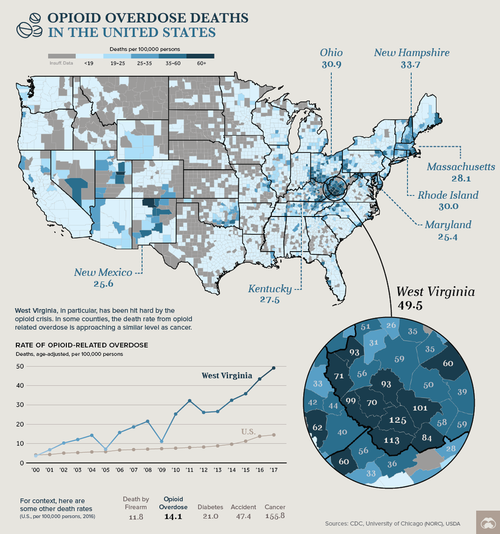
“We were waiting and have been waiting, unfortunately, for this to happen in the sense that we knew fentanyl had been moving west and in other parts of the country they’re really seeing the greatest impact of this drug,” O’Brien said. “That is changing, unfortunately, and now we’ve had this mass casualty incident. … That should concern us all.”
As we have warned before, “the third wave of the opioid epidemic is here,” which is driven by new opioid synthetics that are 10,000 times as potent as morphine and used to tranquilize elephants are attributing to the latest surge in deaths. Expect more mass casualty events, like the one in California, as the opioid crisis continues to accelerate.
‘Extreme baby monitors’ claim to track breathing, heartbeat, every move
Good news for all those parents on the look-out for new gadgets to keep their beloved infants safe. We have come a long way from the radio baby monitors of the past.
The first baby monitor, called the “radio nurse,” was invented in 1937 and worked using radio waves. You may have been just as likely to pick up sounds from nextdoor’s baby. Today, there are many ways to keep your baby under supervision when you aren’t in the nursery. With the rise of “extreme baby monitoring,” parents can keep a closer eye on their children than ever before, tracking breathing, heartbeat, and a child’s movement through many mediums.
Devices don’t have to use video or audio recording to monitor a child’s every movement. Raybaby ($244) says it’s a “non-contact” baby monitor that uses ultrasound-like technology to monitor a child’s breathing. The company claims to offer an accuracy rate of 98% while not requiring a child to wear any devices. While the app allows parents to take photos and videos of the baby, the alerts come largely from the ultrasound technology.
One review said the device could lead to “needless panic” because of the level of detail it collects. “It’s worth remembering that babies have their own built-in technology for telling you they’re awake or need need your attention — it’s called screaming,” wrote Mashable. (Raybaby did not respond immediately to a request for comment.)
Here are some of the newest technologies to track and care for your infant:
Video and audio monitors
The classic audio-based baby monitor has been upgraded through enhanced sound quality and range. The Motorola audio baby monitor ($99) works in a range of up to 50 meters and uses sound to activate alerts that light up based on what sound is being heard when a child awakes. The baby’s device comes with a night light feature and the signal transmitted between units is secured through encryption, eliminating the risk of picking up on other nearby radio frequencies, which was a problem in earlier monitors.
Video-based baby monitors have gotten an upgrade, too. Cocoon Cam ($150) claims to monitor breathing in real time without the use of wearables — that is, a device that needs to be worn by your child. It works by focusing a camera that can detect breath movement on a child and the company says it can send an alert if the child stops breathing. Parents can also access the live feed of a child through the accompanying app.
“While I initially thought this was going a bit overboard in the ‘paranoid parent’ department, I found I actually did feel reassured by the breathing graph as I checked on my baby in the middle of the night,” wrote a reviewer on the parenting product review site Lucie’s List. That reviewer noted that the Cocoon Cam was “initially a little buggy,” but that the company’s customer service department was very helpful in resolving the issue. Cocoon Cam did not respond immediately to a request for comment.
Other video-based monitors, though they do not track breathing, work in a similar way. Parents can use classic “home monitor” cameras (not specific to babies) to monitor a child. The motion-activated HawkCam Pro Home Security Camera ($129) follows a child’s activity and can be watched through the accompanying app. It was named a top 10 nanny camera by independent review site SafeWise.
Infant wearables
Some monitors have wearable options so a parent can move around the housewhile still keeping an ear on their child. The Summer Infant Babble Band Wearable Audio Monitor ($25) has a range of 800 feet. MadeForMums, a parenting review site, gave it four out of five stars.
A new generation of baby devices connects directly to a child’s body for close monitoring. Owlet, a $300 “smart sock” that wraps around a child’s foot, claims it can monitor the infant’s heart rate and oxygen levels while they sleep. Parents can use the accompanying app for sleep data on their child and sounds and lights alert them if anything is out of the ordinary with a child’s vitals, according to the list of uses on the device. A review on parenting site What To Expect noted that the sock isn’t a medical device that’s been approved by the FDA, but that it could be useful for parents of premature infants. However, it’s one of the most expensive monitors out there.
 Courtesy of Owlet
Another device, Snuza Hero, attaches to a child’s diaper and monitors the baby’s abdominal movements to track breathing. If a child does not move for 15 seconds, the company says the device will vibrate in an effort to rouse the baby. If movement has stopped for 15 seconds on three occasions, the parent will be alerted through an alarm, according to the company.
The device retails for $110 and, according to the manufacturer, aims to help prevent Sudden Infant Death Syndrome — which happens when babies suddenly stop breathing without warning — and give parents peace of mind. It has, however, not been proven to prevent SIDS and has no medical use for that purpose.
Mimo ($144), a baby onesie fitted with a sleep tracker, says it monitors a child’s breathing through subtle rises and falls in the infant’s chest. Parents can access data collected from the baby using the accompanying app on iPhoneAAPL, -1.50% and Android.
Wearables don’t come without some complications. Sproutling ($250), a Fisher-Price MAT, +0.82% monitor, can be strapped to a baby’s leg. Reviewing the product on Engadget, Terrence O’Brien alleged that the gadget left his baby with an outbreak of eczema, despite washing the monitor and trying it on alternate legs. He said his son was prone to eczema, but wrote that it kept happening when the gadget was attached. (The company did not respond to request for comment on O’Brien’s review.)
The reviewer added, “Arguably the most important feature of the Sproutling is its ability to alert you when your child falls asleep, wakes up, stirs or rolls over. None of these alerts ever went off with any predictability. Often notifications that my son fell asleep came in 15 minutes or more after the fact. And notifications that he woke up would arrive long after he was out of his bassinet and already getting his morning feeding.
Make sure you always change the password
Like all “smart home” devices, oarents should proceed with caution when using these monitors. For any brand or variety of baby monitor, security should be a priority. Because of the intimate nature of the devices, hacks can be particularly violating. In June, one woman in South Carolina claimed her Wi-Fi connected baby monitor had been hacked. (The manufacturer did not respond to request for comment).
In worst-case scenarios, such connected devices can also be co-opted and turned into “botnets,” giant networks of devices used to power major hacks on different service providers by flooding them with traffic. Most connected devices off the shelf can be hacked within 30 minutes, a 2018 study from Ben-Gurion University in Israel claimed.
“We’ve already seen multiple examples of cameras, including baby monitors, hacked to display their feeds on the internet, or re-purposed for botnets,” said David Ginsburg, vice president of marketing at Cavirin, a Santa Clara, Calif.-based provider of cybersecurity. “As more devices are cloud-connected, the potential for compromise only increases.”
Other tips before choosing a baby monitor: Be sure to research the brand of your monitor online to find out if it has ever been the subject of a hack or a breach in the past, Ginsburg added. Avoid products that are ridiculously cheap, and only buy from established brands, particularly those based in the U.S., and never use the default password on your baby monitor or Wi-Fi router, he added.
China signals more stimulus as economic slowdown deepens
China will aim to achieve “a good start” in the first quarter for the economy, the state planner said on Tuesday, signaling authorities could roll out more stimulus measures in the near term to counter slowing growth.
China will strengthen monitoring of its economic situation and improve its “reserve” of economic policies, the National Development and Reform Commission (NDRC) said in a statement.
The world’s second-biggest economy slowed in 2018 as Chinese authorities carried out painful long-term structural adjustments to transition to a more gradual but sustainable growth trajectory.
A trade war with the United States has also heaped uncertainty on China’s near-term outlook. Exports unexpectedly fell the most in two years in December in a sign of mounting pressure on the economy.
Premier Li Keqiang said China achieved its key 2018 economic targets, which were “hard-won”, and seeks a strong start to the economy in the first quarter to establish conditions helpful to meeting this year’s goals, according to state television on Monday.
Sources told Reuters last week that Beijing was planning to lower its growth target to 6-6.5 percent this year after an expected 6.6 percent in 2018, the slowest pace in 28 years.
The proposed target, to be unveiled at the annual parliamentary session in March, was endorsed by top leaders at the annual closed-door Central Economic Work Conference in mid-December, the sources told Reuters.
Annual growth of about 6.2 percent is needed this year and in 2020 to meet the ruling Communist Party’s longstanding goal of doubling gross domestic product and incomes in the decade to 2020, and to turn China into a “modestly prosperous” nation.
China has lowered the level of reserves that commercial banks need to set aside for the fifth time in a year, to spur lending, particularly to small and medium-sized firms. Beijing has also cut taxes and fees, and stepped up infrastructure investment to shore up the economy.
This year, China will step up fiscal expenditure and implement larger tax and fee cuts. The cuts will focus on reducing burdens for small firms and manufacturers, the finance ministry said in a statement on Tuesday.
Stabilizing employment is the government’s top priority, NDRC Vice Chairman Lian Weiliang said at a press conference on Tuesday.
NO FLOOD OF STIMULUS
China will speed up investment projects and local government bond issuances, but will not resort to “flood-like” stimulus, Lian said.
The central bank, in a separate statement, said it will maintain prudent monetary policy, keeping it neither too tight nor too loose, and strengthen the counter-cyclical adjustments.
Monetary policy will be made more forward-looking, flexible and targeted, the People’s Bank of China (PBOC) said.
A prudent monetary policy does not mean that there will be no changes, PBOC Deputy Governor Zhu Hexin said at the press conference.
When asked if the PBOC should cut benchmark interest rates, Zhu said existing monetary policy measures should be improved.
A few analysts believe interest rate cuts are a possibility, but most expect Beijing will refrain from massive stimulus measures like those deployed in the past, due to worries that it could add to a mountain of debt and weaken the yuan.
“Both fiscal and monetary policy have been loosened over the past few months and this should start to feed through to the real economy by the second half of this year,” analysts at Capital Economics said in a note.
“However, the scale of the stimulus so far has been more limited than in 2015-16, and the effect on activity is likely to be correspondingly smaller.”
Chinese banks extended 16.17 trillion yuan ($2.40 trillion) in net new yuan loans last year, the PBOC said in its statement, blowing past the previous record of 13.53 trillion yuan in 2017.
Outstanding yuan loans were up 13.5 percent at the end of 2018 from a year earlier, according to the central bank.
No clear path for California as massive PG&E utility nears bankruptcy
PG&E Corp’s announcement that it will file for bankruptcy, citing massive potential liability from deadly wildfires, puts California politicians in quandary, whether to offer a bailout or risk allowing the state’s largest private utility to fail.
Governor Gavin Newsom, a Democrat, told reporters late on Monday his team was discussing the possibility of helping PG&E stay solvent, but no decisions had been made.
And lawmakers in the state legislature, who last year approved a bill making it easier for PG&E to bill ratepayers for the costs of wildfires sparked by its equipment in 2017, said that there was less support this year for extending additional financial assistance to the company.
“We would like to see it (bankruptcy) avoided, but we are not naive,” Newsom said. “I’m cognizant of the taxpayers, and I’m cognizant of the ratepayers, and I’m absolutely cognizant of those who lost everything.”
PG&E’s announcement on Monday that it intends to file for Chapter 11 bankruptcy protection as early as this month, citing potential liability exceeding $30 billion due to wildfires, came a day after its chief executive officer, Geisha Williams, was ousted from her post [nL3N1ZE3BV].
PG&E, which ranks as the largest U.S. power utility by number of customers, supplies electricity to 40 percent of Californians. The state, Newsom said, is determined to keep service running to those customers.
But the utility’s power equipment has been linked to the ignition of more than a dozen wildfires in the past two years, and is a suspected cause of the deadliest fire in state history, which swept through the town of Paradise in November, killing 86 people and destroying 90 percent of homes and businesses there.
Mark Toney, executive director of consumer advocate group the Utility Reform Network, said the atmosphere had cooled considerably toward PG&E in recent months, making a bailout politically more difficult for lawmakers.
“PG&E is going to have a much harder time because it doesn’t appear that they’ve learned any lessons,” Toney said.
MIXED SIGNALS
The legislature and the governor could decide to allow PG&E to pass along the costs associated with victim lawsuits and other fire losses to ratepayers, as they did last year for a series of deadly northern California blazes in 2017.
Such legislation would also let utilities shift some future fire-related costs to consumers so long as regulators find no negligence on the companies’ part.
But state lawmakers have given mixed signals about what they might do about liability stemming from the deadly Camp Fire of November 2018 that incinerated most of Paradise.
Legislators representing areas devastated by wildfires have opposed any bailout for PG&E, saying its investors should absorb the costs – even if that means the company is bankrupted.
PG&E’s safety record has come under sharp scrutiny before.
State Senator Jerry Hill, whose district includes the site of the deadly 2010 San Bruno gas pipeline explosion determined to have been caused by PG&E’s criminal negligence said support for the utility was softer this year.
“I think there’s less chance, less thought of a bailout this year than we saw last year, certainly,” said Hill, who has the names of the nine people killed in the San Bruno blast framed in his office.
Subscribe to:
Posts (Atom)