New research has demonstrated the presence of S. aureusin 40% of the cell phones of students sampled at a university. S. aureus is a common cause of hospital and community-based infections and is currently considered an important pathogen because of its level of antibiotic resistance. The research, conducted at the Western University of São Paulo, Brazil, is presented at ASM Microbe, the annual meeting of the American Society for Microbiology.
Of the bacteria isolated, 85% were resistant to the antibiotic penicillin and 50% had the ability to adhere to surfaces. In addition, the presence of genes related to adhesion, antimicrobial resistance and toxins were present a high level. Samples were collected from 100 cell phones of students from the Biomedicine (20), Pharmacy (20), Dentistry (20), Nutrition (20), and Nursing (20) courses. The vast majority of the bacteria isolated belonged to students of the nursing course.
Nursing students are very likely to become carriers of S. aureus since clinical practice in hospital settings is part of their coursework and exposure to occupational hazards is inherent to this setting, which could favor the colonization and contamination of the surface of cell devices. Cell phones used in healthcare environments allow for the transmission of bacteria that harbor genes of virulence and resistance, contributing to increasing the infection rates as well as an increase in the morbidity/mortality from these infections.
“The widespread use of cell devices in hospitals and healthcare settings has raised major concerns about nosocomial infections, especially in areas requiring the highest standards of hygiene, such as the operating room,” said Lizziane Kretli, Professor at the Western University of São Paulo, Brazil. Students in the health area attend practical classes and clinical stages where they have direct contact with samples, objects, and clinical environments containing pathogenic microorganisms.
Cell phones are an indispensable accessory in the professional and social life of a large part of the population. In the medical field they are considered an integral part of the life of health professionals and have improved communication, collaboration, and information sharing.
“In this context, cell phones may thus serve as a reservoir of bacteria known to cause nosocomial infections and could play a role in their transmission to patients through the hands of health professionals,” said Kretli.
###
This study was supervised by Professor Lizziane Kretli Winkelstroter Eller in Western University of São Paulo/ Brazil. This work was supported by the São Paulo Research Foundation – FAPESP (2018/08097-7). The complete results presented in ASM Microbe 2019 at San Francisco, California at Friday, June 21, 2019: 11 am – 12 pm and 4 pm – 5 pm in the Poster Session.
Swimming in the ocean alters the skin microbiome and may increase the likelihood of infection, according to research presented at ASM Microbe 2019, the annual meeting of the American Society for Microbiology.
“Our data demonstrate for the first time that ocean water exposure can alter the diversity and composition of the human skin microbiome,” said Marisa Chattman Nielsen, MS, a PhD student at the University of California, Irvine, the lead author on the study. While swimming normal resident bacteria were washed off while ocean bacteria were deposited onto the skin.”
The researchers detected ocean bacteria on all participants after air drying and at six and 24 hours post-swim, but some participants had acquired more ocean bacteria and/or had them persist for longer.
The research was motivated by previous studies which have shown associations between ocean swimming and infections, and by the high prevalence of poor water quality at many beaches, due to wastewater and storm water runoff. Recent research has demonstrated that changes in the microbiome can leave the host susceptible to infection, and influence disease states. Exposure to these waters can cause gastrointestinal and respiratory illness, ear infections, and skin infections.
The investigators sought 9 volunteers at a beach who met criteria of no sunscreen use, infrequent exposure to the ocean, no bathing within the last 12 hours, and no antibiotics during the previous six months. The researchers swabbed the participants on the back of the calf before they entered the water, and again after subjects had air dried completely following a ten-minute swim and at six and 24 hours post swim.
Before swimming, all individuals had different communities from one-another, but after swimming, they all had similar communities on their skin, which were completely different from the “before swim” communities. At six hours post swim, the microbiomes had begun to revert to their pre-swim composition, and at 24 hours, they were far along in that process.
“One very interesting finding was that Vibrio species–only identified to the genus level–were detected on every participant after swimming in the ocean, and air drying,” said. Nielsen. (The Vibrio genus includes the bacterium that causes cholera.) At six hours post swim, they were still present on most of the volunteers, but by 24 hours, they were present only on one individual.
“While many Vibrio are not pathogenic, the fact that we recovered them on the skin after swimming demonstrates that pathogenic Vibrio species could potentially persist on the skin after swimming,” said Nielsen. The fraction of Vibrio species detected on human skin was more than 10 times greater than the fraction in the ocean water sample, suggesting a specific affinity for attachment to human skin.
Skin is the body’s first line of defense, both physically and immunologically, during exposure to contaminated water. “Recent studies have shown that human skin microbiome plays an important role in immune system function, localized and systemic diseases, and infection,” said Nielsen. “A healthy microbiome protects the host from colonization and infection by opportunistic and pathogenic microbes.”
My love affair with loud music started in earnest in my sophomore year of high school, when I got an iPod for my birthday and immediately started blasting Black Mages albums and anime theme songs. Fast forward fifteen years, and my morning commute neatly illustrates just how bad my hearing has gotten. I get dressed, walk to the subway, pop in my AirPodsand crank up the volume to 100 percent. That’s the only way I can really hear my podcasts over the cacophony of the Q train as it winds through Brooklyn and chugs along over the Manhattan Bridge.
The end result of all this is that I’m now the guy in most conversations who says “huh?” or “come again,” because I struggle to make out the contours of a chat even in relatively quiet conditions. Statistics indicate I’m hardly the only one: According to the Centers for Disease Control and Prevention, some 12.5 percent of children between the ages of 12 and 19, and 17 percent of adults between the ages of 20 and 69, suffer from some degree of noise-induced hearing loss.
While sudden, shocking bursts of noise can be enough to permanently alter a person’s hearing, that’s not always how it goes. Frequently, deterioration happens over time and can be mitigated (if not avoided entirely) with a healthy dose of awareness. With new versions of its watch and smartphone software, Apple is trying to give its users just that.
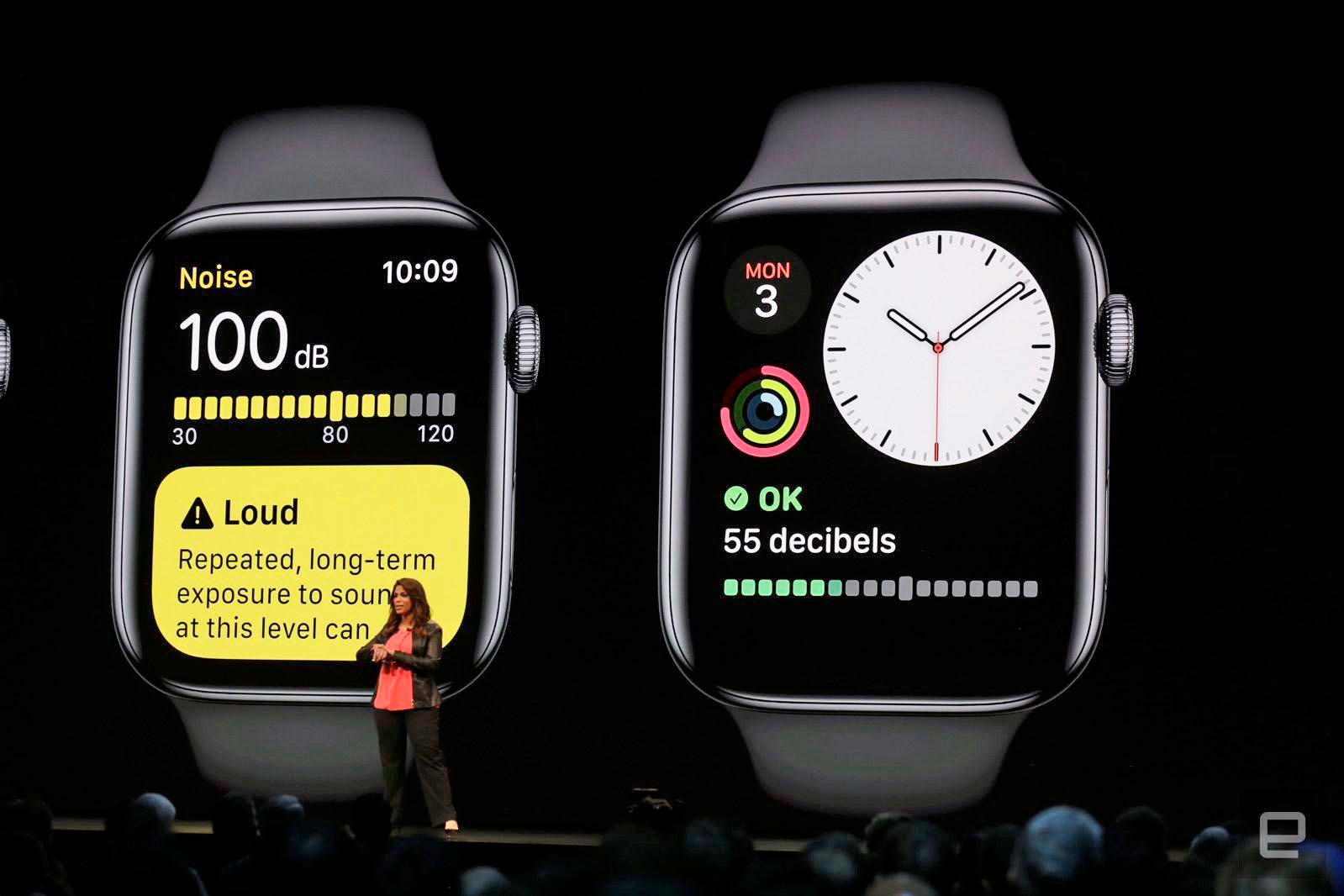
It’s a little weird to think of something you wear on your wrist as a tool to help your ears, but that’s exactly what’s coming in watchOS 6. As Dr. Sumbul Desai, Apple’s VP of Health, explained during the WWDC keynote earlier this month, the Apple Watch will gain the ability to gauge the volume of sounds around you, and warn you when your surroundings get dangerously loud. It happens more often than you think: The World Health Organization characterizes noise as an “underestimated threat,” and it’s especially problematic in cities like New York. A 2012 study conducted by the NYC Department of Health suggests that the average volume of certain outdoor locations “exceed federal and international guidelines set to protect public health.”
Those concerned about privacy can take some solace in the fact that your watch won’t be listening all the time. Apple says that, if you choose to use the feature, the Watch will record one-second snippets of audio every few seconds to check ambient sound volume.
My first go-around with the feature in a private demo was surprisingly illuminating. Most conversations held at normal volume hover around 60dB, and sounds over 85dB have the potential to degrade your hearing after prolonged exposure. To test things, I start speaking very loudly — it was uncomfortable, but not too far off from the way I speak at particularly loud bars. Almost immediately, a warning popped up on the test device a spokesperson was wearing; I had exceeded 80dB without trying particularly hard.
My first thought: God, I am truly obnoxious sometimes. My second thought was somewhat more constructive: If that’s how loud I had to be to have a conversation with one other person at our local karaoke bar, I might have to consider spending less time there. Whether I actually make good on that idea remains to be seen (I haven’t yet), but the fact that I even momentarily started rethinking my habits speaks to the kind of help this proactive watchOS feature could provide.
Not everyone has an Apple Watch, though, and fewer still wear them everywhere. That’s why it’s so important that Apple makes hearing health tools available directly on people’s iPhones: There are, after all, something like 900 million iPhones in use around the world.
In fairness to Apple, some such tools already exist. iPhone users, for instance, have been able to limit the maximum volume on their devices for years now. That said, the volume-limit feature is only really helpful to people who are already concerned about their hearing health; it does little for those who are at risk but don’t realize it (or don’t care).
iOS’s volume indicator will also visually warn you when you crank your music up over a certain threshold, though I wouldn’t be surprised if many of you reading this have never seen that. As far as I can tell, the warning indicator is only available on iPhones sold in the EU as a result of regulations specific to that economic bloc.
Some users find the flourish annoying, but if nothing else, it forces them to think (even just momentarily) about how loud their audio really needs to be. Thankfully, this feature is much more prevalent on Android devices, which often warn users when they crank up the volume too high while headphones are connected. That said, I’m told that while the volume warning is built into Android’s open-source code, the feature is usually left up to smartphone makers to implement.
In any case, Apple is paying much closer attention to your hearing in iOS 13. It all happens in the new Health app: In addition to providing articles on how to nurture your hearing and showing you ambient volume levels from your Apple Watch, the software also tracks how loud your audio is while listening through AirPods and other MFi-certified headphones.
Chris Velazco/Engadget
Each of those data points is effectively lumped into one of two categories: “OK” and “Loud.” You’ll also get to see your volume levels plotted over time, so if you start to see your average headphone volume skew upward considerably, you’ll know you should probably consider seeing your doctor.
And there’s more. Since the updated Health app is at least partially powered by Apple’s machine learning algorithms, you’ll see your hearing health statistics near the top of your feed if you use your headphones frequently. As a result, you don’t really have an excuse for ignoring the moments when you were listening to your music louder than you probably should have.
And really, that’s all this feature is about: Highlighting those instances where you could’ve made a different decision. Those moments matter. Each time you blast music through your headphones for hours, you run the risk of permanently damaging the thousands of fine, hair-like cells that make hearing possible in the first place. No one is saying you should nevercrank up the proverbial dial and enjoy your media — overdoing it isn’t smart, though, and seeing your listening habits splayed out across a pretty graph makes it easy to understand when you’re going overboard.
Ultimately, Apple can’t force anyone to take their hearing health more seriously, and even after all I’ve put my ears through, there will still be times when I insist on turning up the volume. Whether it’s out of necessity or in pursuit of sheer sonic pleasure, I can’t see myself rewriting the rules of my life to completely avoid loud sounds. Between the new tools available in watchOS 6 and iOS 13, though, we’ll have fewer excuses to cavalierly ignore the toll our world takes on our ears. That’s a start.
A decade ago, Neurocrine was reeling from three rounds of layoffs, back-to-back rejections of its main drug candidate and a persistent funding problem.
The San Diego, California-based biotech had bottomed out by late 2009. Its workforce had shrunk to 67 employees, down from nearly 600 four yearsearlier. After going public in the 1990s biotech boom and rising to command a valuation north of $2 billion, Neurocrine’s stock price was worth less than a gallon of milk.
Today, the company has two commercialized drugs and sports a market value of roughly $7.8 billion, more than buzzier biotechs like Alnylam Pharmaceuticals and Bluebird bio.
Boom-and-bust stories are common in the high-risk venture of drug development, but few have fallen as far as Neurocrine.
The company’s rise, crash and reemergence track with the biotech industry’s evolution, from its birth in the late 1980s to an industry that can stand apart from drugmaking behemoths such as Pfizer and Merck & Co.
One recent report showed small biotechs were responsible for nearly two-thirds of newly approved drugs in the U.S. last year, despite much smaller R&D budgets than their pharma counterparts.
“Biotechs can take things now, with the way the industry has matured, from beginning to end,” Neurocrine CEO and co-founder Kevin Gorman said in an interview. “We don’t always have to go looking for pharma.”
But the company is now facing a new set of challenges. It will have to battle for market share with industry leaders, and investor skeptics also doubt its pipeline can keep delivering new therapies to drive revenues.
Credit: Andrew Dunn / BioPharma Dive, market data
But Neurocrine has failed before in epic fashion. Navigating ahead, Gorman pointed to the growing pains for the biotech, and the industry at large, as necessary in getting to where it is today.
Early growth
Gorman joined Neurocrine in 1993 as head of business development, coming on staff after working on the biotech’s launch at a venture capital firm.
When Neurocrine went public in 1996, it followed a familiar path of clinical-stage growth and rode a wave of biotech buzz.
By 2005, it employed nearly 600, was worth $2.4 billion and built a headquarters on a sprawling campus in southern California. Employee perks included a 24-hour onsite workout room and once-a-week subsidized massages.
Kristen Harrison joined the company in 1999 as a receptionist — calling it her first “real adult job” after being placed there from a temp agency.
“I thought I hit the jackpot,” Harrison said, who grew into new roles to coordinate recruiting as the company hired hundreds of new employees.
Around that time, Pfizer partnered on Neurocrine’s experimental sleep drug, building blockbuster hype as it neared a regulatory decision.
“A lot of us were thinking, ‘Okay, here we go. This is the big opportunity for Neurocrine,'” said Haig Bozigian, who joined in 1997 in a research role. “We were very confident this was going to happen.”
Rejection, two times
And then, rejection struck. The Food and Drug Administration raised issues with the insomnia drug’s application in 2006, declining to approve the compound and sending Pfizer running from the agreement.
Suddenly, Harrison’s duties were flipped on their head, from hiring to laying off dozens of people. The salesforce that was just brought on was largely let go, and Neurocrine worked to re-submit the application without Pfizer as a partner.
That second regulatory decision came back in December 2007. Neurocrine workers gathered in a seminar room to hear the result.
“We knew going into that, that this was kind of all the eggs were in one basket,” Harrison said, who had created layoff packets ahead of time for every single employee to be able to act quickly. “We needed that news to be good.”
Gorman delivered the news: The FDA had rejected the insomnia drug again. When an employee asked what that means for them, the exec said half of them will be gone. Layoffs left only about 135 people.
A month later, Gorman was tapped as CEO after the former leader stepped down amid the struggles.
Credit: Andrew Dunn / BioPharma Dive, SEC filings
But the layoffs weren’t enough on their own. Wall Street was closed to them, and the executive team decided to sell its headquarters and lease it back to net $61 million. Just six weeks after the sale closed, the real estate market crashed, slashing the building’s value in half.
“We never would have survived,” if the deal took just a few weeks longer, Gorman said.
Without the insomnia drug, Gorman sketched a plan forward with an experimental endometriosis drug. If Neurocrine could get positive Phase 2 data, it could make it through by inking a licensing partner.
‘We didn’t listen’
In a needed respite, the biotech got some good news. That endometriosis drug, called elagolix, succeeded in Phase 2b studies at reducing pain.
But that high was short lived. The FDA raised issue with the trial’s endpoint used to measure pain and proposed a new metric. Neurocrine had to go back to Phase 2 testing with this new measure.
Those studies kicked off in 2008 and failed on the FDA-proposed measurement the following year. Looking back, Gorman said the company saw the agency as more an antagonist at that point, particularly after regulators had twice-rejected its previous potential blockbuster.
“We didn’t listen carefully to the FDA. We did not engage the FDA as actually a partner in drug discovery and development.”
By this point, investors sent Neurocrine to its lowest point. Shares traded around $2 in late 2009, a drop of about 97% from its 2005 peak of more than $70.
And, once again, Neurocrine had to shrink to stay alive, bringing its headcount down to 67 people through a third round of layoffs in a four-year span.
By the end of 2009, the company held about $53 million in cash, cash equivalents and short-term investments, a steady decrease from a high of more than $450 million at the end of 2003.
The company vacated the front building it was leasing, moving to rent just the back building that the company had once owned. Workers sold off excess office and lab supplies in the parking lot. Employees turned off every third bulb in the light units throughout the building to stretch the few dollars the company had left.
Climbing back
Things finally turned around two years later. In May 2010, the company announced the latest study for elagolix worked, using an endpoint that the biotech had jointly developed with the FDA.
The next month, the biotech landed a much-needed licensing deal with Abbott, paying $75 million upfront and outlining $500 million in potential milestone payments. When the drug business of Abbott spun off into AbbVie, that spin-off stayed as Neurocrine’s partner.
The multiple clinical failures and frustrations with the FDA led to another takeaway for Gorman and Neurocrine on the arduous saga of drug development.
“You ultimately get success by spending a lot of time in Phase 2,” he said. “That’s where you learn about your patients, you learn about your endpoints, you learn about your drug.”
From there, AbbVie ran a pivotal Phase 3 program that brought success in 2015. And in July 2018, elagolix turned into Orilissa with an FDA approval.
While Orilissa may have proven critical in securing the 2010 deal and keeping two-thirds of the lights on, another Neurocrine compound wound up beating it to market, winning FDA approval in 2017.
Before the rapid descent began, Nicole Harriott joined the company in early 2006 as a chemist, calling the atmosphere comfortable on the campus.
After the layoffs, she felt a sense of urgency in her work that wasn’t there before. By late 2009, she had gone from chemist No. 70 to No. 4, she said.
It was after the first round of layoffs that Harriott helped create the compound that would eventually be known as Ingrezza.
The future
Last year, Neurocrine recorded more than $400 million in sales. Despite an accumulated deficit standing at more than $1 billion, Neurocrine is making money.
“It’s probably uncontroversial to say they’ve done an outstanding job launching Ingrezza,” said Paul Matteis, a biotech analyst at Stifel, in an interview.
As Neurocrine developed, so has the industry at large, leading to improved appetites for funding and independence for smaller companies now.
“Like Neurocrine, if you’ve got a great drug, Wall Street is going to give you the rope to monetize it as best as you can on your own,” Matteis said.
Even with two approved drugs, Neurocrine has faced the challenge all biotechs encounter in moving from the clinical to commercial stage, essentially starting over to sell drugs instead of just develop them.
Further challenges loom, with Ingrezza facing stiff competition from a rival medication being sold by Teva, a pharma giant with a track record of commercial chops in central nervous system therapies.
And Neurocrine has faced recent failures. Ingrezza failed a study in Tourette’s syndrome last year, and shares have dropped by about one-third since then. Some skeptics doubt Neurocrine can elbow out market share against Teva and also raise questions on if its pipeline will keep delivering.
In building out that pipeline, Neurocrine struck a deal with Voyager Therapeutics earlier this year, paying $165 million upfront and outlining more than $1 billion in potential milestones to gain rights to four gene therapy programs, with the most advanced in ongoing Phase 2 testing for Parkinson’s disease.
For a company that was down to 60-some employees a decade ago, it’s been constant growth since then, with a headcount of 636 as of last month, according to the company.
Harriott, the chemist who helped develop Ingrezza, is now Neurocrine’s research director. And while she found a sense of ownership in the biotech through its struggles, she said the test now will be keeping that urgency as the biotech scales up.
“That is a feeling that is going to be our challenge going forward as we’re growing,” she said.
As Teva’s financial problems have continued to mount, one Wall Street investment research firm slashed its stock price target Wednesday by more than one-third, flagging concerns with the Israeli giant’s financial health.
Ronny Gal, an analyst for Bernstein, cut his target on Teva from $17 to $11 after forecasting plateauing cash flow levels for the future. Shares closed Wednesday down 2% at roughly $8, reflecting a stock decline of nearly 50% since the beginning of 2019 and an 88% fall from its 2015 peak.
Investor concerns in Teva have recently peaked with an emerging financial threat from opioid and price fixing lawsuits, added on top of a tumbling market capitalization, significant debt levels and flatlining cash flow. “The litigation risk is material, but it is really the much lower cash flow generation for the next few years that concerns us,” Gal wrote.
Teva is facing a multitude of problems that have caused its stock to collapse since 2015, going from trading at about $70 to $8 per share.
Taking over in 2017, CEO Kåre Schultz and chairman Sol Barer rolled out a restructuring plan in December 2017 in response to these financial concerns. Through a variety of cost-cutting measures including layoffs and plant closures, the company aims to reduce its total cost base by $3 billion by the end of 2019.
Even with that plan, the company still faces nearly $24 billion in long-term debt, which is poised to test its financial wherewithal in the next few years. The company did not respond to requests for comments on that plan’s progress.
Teva’s decision in 2015 to buy Allergan’s generic business for $40.5 billion ballooned the Israeli company’s debt levels from roughly $10 billion to $35 billion at the time.
Now, Gal honed in on cash flow as a critical problem. After Teva disclosed a lower-than-expected cash flow for the first three months of 2019, Gal crunched the numbers for future expectations. He forecasted 2019 cash flows at $1.9 billion, more than $1 billion less than cash generation from last year.
And the analyst then expects that figure to flatline around $2.3 billion per year through 2023. A key reason for the plateau comes from Teva’s newer drugs being unable to cover for declining sales from brands now facing competition.
The blockbuster multiple sclerosis drug Copaxone (glatiramer acetate injection), for instance, has seen sales crater from generic competition. Net sales for the drug have fallen from $4.2 billion in 2016 to $3.8 billion in 2017 to $2.4 billion last year.
Legal troubles compound the cash flow worries. Teva is facing a variety of lawsuits that could create more financial liabilities. About 1,500 complaints have been filed against the company for its role in marketing and selling opioids, and most of those have been lumped into a critical multi-district litigation set for a jury trial to begin in October.
Key creditors have taken note of the legal liability, particularly after the pharma paid $85 million to settle a lawsuit from the state of Oklahoma related to opioids.
“The potential exposure to cash outflows is probably the primary concern, because they have some litigation exposures both to opioids and price fixing,” Morris Borenstein, a senior analyst at Moody’s, said in an interview. “Those are wildcards that are very uncertain at this point.”
Earlier this month, Fitch Ratings downgraded Teva to BB- from BB. A BB rating indicates low expectations of default but that negative events are more likely to hurt their ability to pay out their commitments.
Fitch also maintained a negative rating outlook on the company, putting them at potential risk of further demotion. The subsequent rating of B translates to a material risk of default with a limited margin of safety, according to Fitch.
One credit-monitoring metric that takes into account all these financial and stock metrics has also reflected a stark deterioration in Teva’s financial health in 2019.
CreditRiskMonitor analyzes financial risks facing public companies through its primary metric called a FRISK score, which measures the likelihood of bankruptcy on a 1-10 scale.
With 10 being the strongest financial position, Teva’s rating has fallen from a 7 at the beginning of 2019 to a 3 this month. The current rating translates to roughly a 3% probability of bankruptcy happening in the next 12 months.
“This company is being battered, and its ability to save itself is contracting,” said Jerry Flum, CEO of the credit monitoring firm, flagging a rising leverage ratio between its liabilities and collapsing market capitalization.
New research has found that six probiotic Bacillus strains are resistant to several antibiotics. Genetic analysis of other Bacillus strains has shown genes that contribute to antibiotic resistance towards various types of drugs and methods in which they can still grow in their presence. The research is presented at ASM Microbe, the annual meeting of the American Society for Microbiology.
“This data can provide us with insights into what genes are contributing to antibiotic resistance and whether they can be transferred to other bacteria that cause harm to humans and domesticated animals,” said Emmanuel Flores, a Masters student at CSU Fresno. “This work can be used as a form of monitoring antibiotic resistance and make accurate predictions in potential antibiotic resistance threats found in functional foods and livestock feed,” he said.
Bacillus is a group of bacteria that has been commonly used in probiotic products. These products are claimed to have some health benefit to the gut of those who consume these products. This research aimed to determine if any Bacillus bacteria used in probiotics are resistant to antibiotics that are commonly used in health clinics.
“Since bacteria have shown to be capable of transferring antibiotic resistance to other bacteria, we aim to determine if probiotic Bacillus are capable of transferring their own antibiotic resistance to bacteria that cause illnesses such as food poisoning,” said Flores.
Their results thus far have shown us that probiotic Bacillus has the potential to transfer antibiotic resistance. However, further tests need to be performed to determine what types of harmful bacteria are likely recipients of antibiotic resistance. The researchers plan to run a test that will facilitate the transfer of antibiotic resistance bookended by a test that will determine which antibiotics the harmful bacteria have gained resistance against.
Probiotics are available to the general public and come in the form of many functional foods and livestock feeds. “Monitoring the spread of antibiotic resistance by focusing on probiotics has been overlooked and should take place since the global impact of antibiotic resistance is increasing,” said Flores.
Laboratory work was performed by Emmanuel Flores who is a Masters student in Dr. Van Laar’s laboratory at CSU Fresno. He has worked under the guidance of Dr. Van Laar, Dr. Sistrom (UC Merced), and Mo Kaze (PhD student, UC Merced). Funding for this study was provided by the Bridge to Doctorate program and the CSU Fresno Graduate Net Initiative’s Graduate Research Grant awarded to Emmanuel. This work will be presented at ASM Microbe 2019 at the Moscone Center in San Francisco, California on Friday, June 21st, 2019.
U.S. health regulators approved a second drug to treat low sexual desire in women, adding another option to an area of medicine that’s become better known for controversy than for blockbuster sales.
The drug, bremelanotide, will be marketed by Amag Pharmaceuticals Inc.under the brand name Vyleesi, the FDA said in an email. It’s a shot that comes in an auto-injecting pen that premenopausal women would use about 45 minutes before sex. Sprout Pharmaceuticals Inc.’s Addyi, a pill taken daily, became the first female libido drug to gain Food and Drug Administration clearance in 2015.
Palatin Technologies Inc., which developed the new drug, will receive as much as $300 million from an agreement that gives Amag the rights to sell it. Amag shares gained as much as 12% in late trading after the market closed in New York. Palatin rose as much as 65%.
Amag says Vyleesi will appeal to women who don’t want to take a drug every day. Women in clinical trials used the shot on average three times a month, according to Chief Executive Officer William Heiden. A spokeswoman for the company said it plans to start selling the drug in September and will announce its price closer to the launch.
Vyleesi’s path to market was smoother than Addyi’s, which has a modest effect on sexual desire and faced public detractors who doubted whether women need a drug for the condition.
In clinical trials, the FDA said about 25% of patients treated with Vyleesi benefited from an increase in sexual desire score, compared with about 17% who took a placebo. About 40% of patients in clinical trials experienced nausea, most commonly in those who used the drug, and 13% needed medications to treat the side effect, the FDA said in a statement.
“There was no difference between treatment groups in the change from the start of the study to end of the study in the number of satisfying sexual events,” according to the FDA statement.
The FDA didn’t call on its advisers to debate the drug’s merits publicly, and Amag hasn’t yet published full clinical trial results. The agency often holds advisory meetings when a new type of drug like Vyleesi is coming to market, but not always.
Vyleesi aims to treat a condition known as hypoactive sexual desire disorder, which is low libido that causes distress. About 6% to 10% of women of child-bearing age could be characterized as having HSDD, said Sharon Parish, a professor of clinical psychiatry at Weill Cornell Medical Center who treats women with the condition.
The shot works by increasing dopamine, a chemical in the brain related to sexual responsiveness, said David Portman, director emeritus at the Columbus Center for Women’s Health Research in Ohio, who helped Amag with studies of the drug.
“A significant number of women haven’t sought treatment,” Portman said. “Having more options is a way for women to come in to providers and ask what treatment is right for them.”
Not Enough
In clinical trials, Sprout’s Addyi offered meaningful help for about 10% more patients than a placebo. Some women’s health advocates said that wasn’t enough, given that side effects include fainting and extreme sleepiness. Addyi originally carried a ban on alcohol consumption, which has since been eased. Vyleesi doesn’t carry any similar limits on alcohol.
It’s unclear how many women could be helped by Vyleesi without the full clinical trial results being published. About 20% of women dropped out of trials, Portman said, including 8% who discontinued due to nausea.
Addyi has seen a jump in its sales this year as startups selling sexual-wellness drugs online, including Hers, take off. Total prescriptions for the pill increased more than 400% in May compared with the same month last year, totaling 3,000, according to data compiled by Bloomberg Intelligence. By contrast, a million Viagra prescriptions for men are sold every month.
“That market was totally created by marketing beforehand and women didn’t flock to that at all,” said Adriane Fugh-Berman, director of PharmedOUT at Georgetown University Medical Center, a program that supports evidenced-based prescribing. “I don’t think they’ll flock to this either. They’re smarter than that.”
Facing Backlash
After the FDA rejected Addyi for its modest effect in 2013, the agency faced a backlash from doctors and researchers who claimed the agency was sexist. Women, many brought in by the pill’s maker, Sprout, flocked to the FDA’s headquarters two years later to argue for Addyi’s approval as the agency gathered outside experts in a public meeting to consider the drug.
“In this case specifically, I think women really need the FDA not only to do a careful vetting but to share the summary of that vetting with them,” said Cindy Pearson, executive director of the National Women’s Health Network. The group urged women not to use Vyleesi until more is known about its safety and effectiveness.
Amag started an unbranded social media campaign called “unblush” on Instagram and Facebook earlier this year to talk about hypoactive sexual desire disorder. Heiden, the CEO, said one of its promoted posts had 2.8 million views and that 80,000 people clicked through to get more information. The campaign will transition to a branded one now that Vyleesi is approved, Heiden said.
The Waltham, Massachusetts-based company doesn’t plan to do television ads because its target audience isn’t watching much TV, he said.