Search This Blog

Friday, July 12, 2019

Genmab and BliNK Biomedical Enter into Commercial License Agreement

  • Genmab and BliNK Biomedical have entered into a commercial license agreement to develop novel bispecific therapeutics based on BliNK Biomedical’s CD47 antibodies and Genmab’s DuoBody® Platform technology.

Genmab A/S (Nasdaq Copenhagen: GEN) announced today that it has entered into an agreement with BliNK Biomedical for an exclusive commercial license to certain antibodies targeting CD47, for potential development and commercialization into novel bispecific therapeutics created via Genmab’s proprietary DuoBody Platform technology. 
This agreement supports Genmab’s established product pipeline strategy. Under the terms of the agreement, Genmab will pay BliNK Biomedical an upfront fee of USD 2.25 million. BliNK Biomedical is also eligible to receive up to approximately USD 200 million in development, regulatory and commercial milestone payments for each product, as well as tiered royalties on net sales.
“With this agreement the scope of product concepts under development at Genmab has been expanded. CD47 has shown potential as a target for cancer and we believe that a bispecific approach may open up potential for differentiated therapies. We are always looking to use our in-house expertise in novel ways; we look forward to seeing the results from the combination of Genmab’s DuoBody technology with a CD47 antibody from BliNK Biomedical,” said Jan van de Winkel, Ph.D., Chief Executive Officer of Genmab.
BliNK Biomedical is a privately-owned biopharmaceutical company based in Marseille, France, focused on discovery and development of therapeutic antibodies in oncology and immuno-oncology.

Apple Watch glitch creates eavesdropping vulnerability

Apple (NASDAQ:AAPL) has disabled the Walkie-Talkie app on Apple Watches after finding a security flaw that could allow a person to listen in on someone else’s iPhone conversation without consent.
It’s the second eavesdropping-related glitch the company has moved to address in recent months as scrutiny of tech giants intensifies.
“We apologize to our customers for the inconvenience and will restore the functionality as soon as possible,” the company said in a statement.

SC Health Corporation Announces IPO Pricing

SC Health Corporation (“SC Health”) announced today the pricing of its initial public offering and committed capital raise of up to $222.5 million in the aggregate, comprised of a $150 million initial public offering (up to $172.5 million if the Underwriters (defined below) exercise their over-allotment option in full), plus $50 million in committed capital to complete an initial business combination. The initial public offering of 15,000,000 units priced at $10.00 per unit. SC Health has granted the Underwriters a 45-day option to purchase up to 2,250,000 additional units at the initial public offering price to cover over-allotments, if any. The units will be listed on the New York Stock Exchange (“NYSE”) in the United States and trade under the ticker symbol “SCPE.U” beginning July 12, 2019. Each unit consists of one Class A ordinary share and one-half of one redeemable warrant, with each warrant entitling the holder thereof to purchase one Class A ordinary share at a price of $11.50 per share. Once the securities comprising the units begin separate trading, the Class A ordinary shares and warrants are expected to be listed on the NYSE under the symbols “SCPE” and “SCPE WS,” respectively. The initial public offering is expected to close on July 16, 2019, subject to customary closing conditions.
Credit Suisse Securities (USA) LLC is acting as sole book running manager in the offering and I-Bankers Securities, Inc. is acting as co-manager (together, the “Underwriters”).
SC Health Group Limited has agreed to provide $50 million in the form of committed capital in a private placement to occur concurrently with SC Health’s initial business combination. SC Health intends to use the net proceeds of the initial public offering and forward purchase agreement for an initial business combination with a target with operations or prospects in the healthcare sector in the Asia Pacific region, which may be a platform in the Asia Pacific region or a global platform with a meaningful Asia Pacific growth thesis and to cover operating expenses and working capital requirements.
SC Health is a special purpose acquisition company formed by SC Health Group Limited, an affiliate of SIN Capital Group Pte. Ltd. (“SINCap”), for the purpose of effecting a merger, share exchange, asset acquisition, share purchase, reorganization or similar business combination with one or more businesses. SINCap is a Pan-Asia multi-asset professional investment firm with a differentiated investment approach centered around several key tenets: a long-term investment horizon and close partnership with management; building platforms in under-invested but high growth industries; and employing an ‘‘Investor-Operator’’ model focused on comprehensive operational value-add.

Thursday, July 11, 2019

Steps Toward Healing Brain and Spinal Cord Injuries

Recently, researchers have investigated a nerve repair process that could potentially be activated to heal injuries to the brain and spinal cord. This discovery came from investigating an existing peripheral nerve regeneration pathway and applying similar concepts to central nervous system cells. This research team was led by Claire Jacob, Professor at Johannes Gutenberg University Mainz (JGU) and at the Swiss University of Fribourg. Their findings were published in a recent edition of Cell Reports.
Damaged peripheral nerves regenerate after an injury, allowing sensation and function to be retained. Axons, the long portions of neurons that send electrical signals, must regrow after such injuries to properly recover function.
“An injury in the peripheral nervous system quickly triggers the activation of a fascinating repair process that allows the injured nerve to regenerate and regain its function,” explains Claire Jacob, Head of Cellular Neurobiology at JGU. “There is no such repair process in the central nervous system, thus injuries often lead to permanent damage such as paraplegia.” Strategies to improve axon regeneration in the central nervous system must therefore be developed to enable healing.
Certain axons are covered in a protective, insulating layer known as myelin. This myelin sheath serves not only to protect the axon, but to increase the speed of signaling between nerves and their targets.
“Myelin is extremely important for the function of the entire nervous system, however it also hinders the repair process in case of an injury,” noted Jacob.
The myelin sheath is created by Schwann cells in the peripheral nervous system and oligodendrocytes in the central nervous system (the brain and spinal cord). One major difference between the two is that the Schwann cells have a unique repair process in response to axonal injury.

Action of the Schwann Cell

In the peripheral system, Schwann cells rapidly induce disintegration of injured axonal pieces into fragments. These fragments are ultimately digested either by Schwann cells or macrophages. Clearing these axon fragments after injury is essential in the repair process in the peripheral nervous system.

“Schwann cells can do everything,” noted Jacob. “We discovered that they not only digest myelin following injury, but they also induce the disintegration of the long axon segments that are separated from their cell bodies due to the injury.”
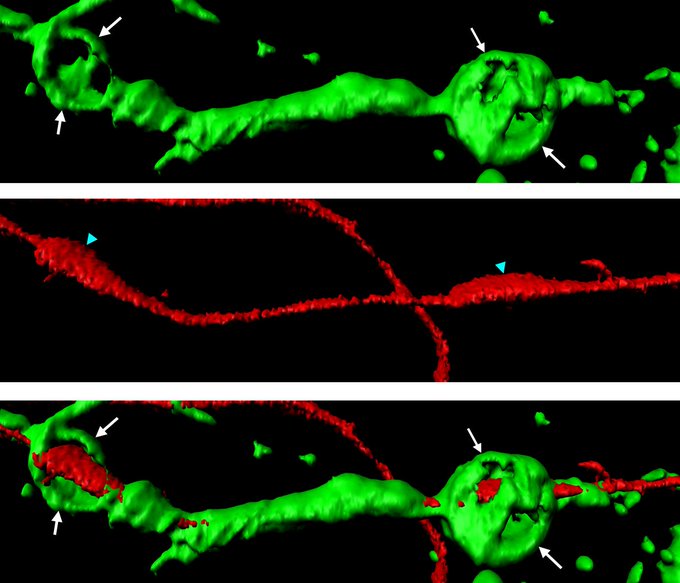
For this to occur, the Schwann cell forms small spheres of the protein actin. Actin spheres put pressure on the isolated segments of axons until they are fragmented. For the intact region of the axon to grow back, it is key that this targeted degradation of cell debris occurs. This axon must remain attached to the neuron’s cell body and regrow towards its target once more.
The researchers found that these injured axon fragments send a signal to the Schwann cells that initiates this actin sphere formation and axon disintegration. Jacob and her team noted that this process is extremely coordinated and sensitive, with disruptions causing impaired regeneration.

Action of the Oligodendrocyte

After carefully studying this process in the peripheral nervous system’s Schwann cells, the researchers shifted focus to the oligodendrocyte function in the central nervous system.
“After an injury, oligodendrocytes either die or remain apparently unresponsive,” explained Jacob.
Unlike the versatile Schwann cell, the oligodendrocyte lacks the ability to form actin spheres and disintegrate damaged axons. This is because these cells do not express vascular endothelial growth factor receptor 1 (VEGFR1) like the Schwann cells do. This receptor is needed for producing the actin spheres and is inherently crucial in axonal repair.
Jacob and colleagues decided to induce VEGFR1 expression in the oligodendrocytes to see if the cells would begin to act as the Schwann cells do. The team found that the oligodendrocytes began to produce the actin spheres and disintegrate damaged axon fragments in the same repair process as the Schwann cells.

Going Forward With this Work

They are now working to identify the biological pathways associated with myelin removal at the injury site in the central nervous system. This is the next step required for the full rebuilding of damaged neurons.
“We have discovered a pathway that accelerates myelin degradation in the peripheral nervous system and are now trying to determine whether this can also trigger myelin removal in the central nervous system,” concluded Claire Jacob.
View image on Twitter
unifrBiology@unifrBiology
 ðŸ—ž️ | First step to induce self-repair in the central nervous system. The research team led by Prof. Claire Jacob @uni_mainz@unifrBiology have been published in @CellReports . http://www.unifr.ch/webnews/content/40/attach/9991.pdf?&p=1 

Israeli medical aesthetics company InMode files for a $75 million US IPO

InMode Limited, which develops and markets minimally-invasive medical aesthetic products, filed on Thursday with the SEC to raise up to $75 million in an initial public offering.
The Yokneam, Israel-based company was founded in 2008 and booked $110 million in sales for the 12 months ended March 31, 2019. It plans to list on the Nasdaq under the symbol INMD. Barclays and UBS Investment Bank are the joint bookrunners on the deal. No pricing terms were disclosed.

Biophytis boosts size of U.S. IPO

In a quick amendment to its registration filing from earlier this week, France’s Biophytis (BPTS) says it will now offer 15M shares (including 10M ordinary shares in the form of American Depositary Shares) through H.C. Wainwright.
That’s up from 13.1M ordinary shares, 8.75M of those in the form of ADS.
It still expects to price the offering at $7-$9/ADS (about €0.62-€0.80 per ordinary share). Yesterday, the last reported sale price of ordinary shares in Paris as €0.80, currently corresponding to a price of $8.98 per ADS.

New Insights into the Vagus Nerve Could Change the Way Diabetes is Treated

A new discovery at the Feinstein Institutes for Medical Research could have implications in the way diabetes is treated in the future.
A research team helmed by Theodoros Zanos, head of the Neural & Data Science Lab, discovered how the vagus nerve relays signals from the periphery to the brain to help regulate glucose. Previous research has revealed that the vagus nerve, which connects to numerous organs throughout the body and communicates changes in the body to the brainstem, plays a role in regulating metabolism. However, how the vagus nerve did this was not understood. Zanos and his research team set out to identify the specific signals relayed from the periphery to the brain that responded to changes in glucose levels. And that was just what they did. Now, this discovery could have implications in revealing a new way to measure blood glucose levels in people. Zanos’ findings were published in the Springer Nature journal, Bioelectronic Medicine.

In a statement, Zanos said they believed that listening to and stimulating the vagus nerve would open new possibilities to the diagnosis and management of various diseases.
“The vagus nerve is one of the major information conduits of the body with an average of 100,000 nerve fibers, making this code difficult to pick up and decipher, so we have a lot to learn,” Zanos said. “We’re excited to demonstrate in this most recent study that the vagus nerve of a mouse transports important signals from the periphery to the central nervous system related to glucose homeostasis – this discovery gets us closer to new technologies that will have the potential of helping many patients living with various metabolic diseases.”
In addition to serving as a highway for sensory information from organs to the brain, the vagus nerve also plays a role in regulating the heart rate and keeping the gastrointestinal tract in working order.
Feinstein Institutes President and Chief Executive Officer Kevin J. Tracey was a co-author of the paper, “Identification of hypoglycemia-specific neural signals by decoding murine vagus nerve activity.” The discovery made by Zanos and his team, Tracey said, “gives us new understanding of the body’s neural signaling and offers hope for diabetes management.”

This was not the first discovery that Zanos and his team have made with a potential to change the way a disease is treated. Last year, Zanos and team were the first to decode specific signals the nervous system uses to communicate immune status and inflammation to the brain. The identification of these neural signals and their role in the body’s health was a step forward in bioelectronic medicine, the Institute said. It provides provided insight into diagnostic and therapeutic targets, and device development. Bioelectronic medicine is a new approach to treating and diagnosing disease and injury that has sprung from the Feinstein Institutes’ labs. It uses new technology to read and modulate the electrical activity within the body’s nervous system, opening new doors to real-time diagnostics and treatment options for patients, the Feinstein Institute explained.