Search This Blog

Tuesday, January 19, 2021

French Workers Angrily Reject Social Distancing 'Collars'

 Factory workers in France have labeled social distancing ‘dog collars’ as an “attack on individual liberty” as employers are trying to make them wear the devices to enforce restrictions while working.

The alarm devices emit a noise and light up if workers get closer than two metres together, but have been slammed by a worker’s union for “infantilising” employees.

The alarms are scheduled to be introduced by hygiene company Essity, which wants it’s factory workers to wear them around their necks.

The CFDT union told AFP that it is “a system comparable to ones that try to dissuade dogs from barking.”

Christine Duguet, a union representative from the CFDT, suggested that the devices will “finish in the rubbish bins or stay in a cupboard,” adding “This is complete nonsense.”

Duguet also expressed concerns that the company would attempt to keep the system in place as a ‘security measure’ even after the pandemic ends.

The device is manufactured by a Belgian company called Phi Data, which also offers a similar device that can be activated by the wearer if they feel someone comes too close to them.

Imagine that hell. Karens everywhere emitting bleeping blaring alarms if you dare to walk past them on the street.

Other similar devices have been developed by tech companies and researchers seeking to cash in on the pandemic panic:

There are also scores of videos on YouTube detailing how to make DIY versions of the devices:

This is not normal. What has happened to humans?

Where does this end up? Electronic collars that administer a shock if you break distancing restrictions?

Aside from the imprisonment of everyone inside pods, this weird technology is being embraced with the social distancing justification.

Amazon is reported to have experimented with such technology in their warehouses:

As we highlighted back in October, Hitachi has developed similar technology, which includes cartoon fish swimming around inside a bubble. When a person violates social distancing, the fish escape.

The promo video brags that the technology “can even be deployed inside elevators” and Hitachi is “hoping to get the technology commercialized quickly.”

Given that numerous prominent people are insisting that social distancing and other coronavirus restrictions are here to say, it’s perfectly feasible to imagine a near future in which this technology is widely adopted.

China is already linking coronavirus rules to its onerous social credit score system, in addition to using AI to discipline its slave labor workforce, so the idea that people could be publicly shamed or punished for getting too close to others is a very real possibility.

Asco-GI 2021 round-up – Cardiff disappoints, Arcus intrigues

 Enhertu’s additional approval this morning for Her2-positive gastric cancer coincided with the Asco-GI conference, which featured a front-line gastric cancer study of Five Prime’s bemarituzumab as a late-breaker. The green light, the first for a Her2-directed therapy for this cancer since Herceptin, will also remind investors what the Astra/Daiichi drug has to do to meet expectations: EvaluatePharma consensus forecasts see 2026 sales of $4.1bn, mostly in breast cancer. Meanwhile, much of Five Prime’s data was a retread of that toplined last November, and with continuing doubts about bemarituzumab’s relevance beyond FGFR2b-overexpressing cancers the stock fell 11%. Also off on Asco-GI data was Cardiff Oncology, down 31% after reminding the markets that, with four more Kras-mutant colorectal cancer subjects treated, the overall response rate to onvansertib was still around 40%. Bridgebio Pharma’s infigratinib showed a 23% ORR in FGFR2-positive cholangiocarcinoma, underperforming the 36% on the approved label of Incyte’s similarly acting Pemazyre. Perhaps the most intriguing dataset came from Arcus’s AB680 in front-line pancreatic cancer: 41% ORR in 17 subjects could give the company a focus beyond Tigit inhibition. Still, the study also included chemo and an anti-PD-1, so AB680’s effect is hard to tease out.

https://www.evaluate.com/vantage/articles/news/snippets/asco-gi-2021-round-cardiff-disappoints-while-arcus-intrigues

Clinical activity of AB680 + zimberelimab in 1st-line pancreatic adenocarcinoma. Source: Dr Gulam Abbas Manji & Asco.
Selected data presented at the 2021 Asco-GI meeting
ProjectCompanyMechanismSettingDetail
BemarituzumabFive PrimeAnti-FGFR2bFight study: a 1L gastric/GEJ (chemo combo)In FGFR2b ≥10% expressers (n=96) mPFS 14.1 vs 7.3 mth, mOS NR vs 11.1 mth
InfigratinibBridgebio PharmaAnti-FGFR1-32L FGFR2+ve cholangio1 CR & 24 PRs in 108 evaluable pts, mPFS 7.3mth, mOS 12.2mth
TibsovoAgiosAnti-IDH1Final Claridhy study data: 2L IDH1-mut cholangioHR 0.37 for PFS, and 0.49 for OS, both highly stat sig
AB680 + AB122ArcusAnti-CD79 + anti-PD-1Arc-8 study: 1L pancreatic adenocarcinoma7/17 PRs
OnvansertibCardiff OncologyAnti-PLK12L Kras-mut colorectal (Avastin + chemo combo)5/12 PRs
CYAD-101CelyadAllo (TIM-expressing) Car-T vs NKG2D ligandsAlloshrink study: metastatic colorectal2/15 PRs, including 1 Kras-mutant

Blockbuster sales seen for several projects near approval, from Biogen, Argenx, Fibrogen

 The US FDA’s verdict on Biogen’s aducanumab is one of the biggest events on biopharma’s 2021 calendar. And the Alzheimer’s antibody owns another accolade: of the novel projects slated to reach the market this year, aducanumab attracts the sellside's highest revenue forecasts.

With the outcome far from certain, numbers are likely to be heavily risk-adjusted, but for now consensus sits at $4.9bn for 2026. That puts aducanumab way out in front of the other potential new arrivals: Argenx’s efgartigimod, in second place, boasts a consensus of $2.5bn.

It is important to note that the $4.9bn figure for aducanumab is combined sales being allocated to Biogen and Eisai, which will co-promote the project – if approved. A collaboration sees the companies share different proportions of profits, depending on the region.

For the antibody to reach the market in 2021 the FDA must rule against its advisory committee, which voted almost unanimously against approval. The agency typically sides with these panels; however, supportive FDA documents and the high-profile nature of the decision makes the outcome hard to call.

Some considered news last week, that the Biden administration had asked Janet Woodcock to step in as interim FDA commissioner, as a good omen. Ms Woodcock had made the controversial decision to approve Sarepta’s Exondys 51 despite concerns about lack of evidence of its effectiveness.

Waiting in the wings: biggest potential new launches in 2021
Project Setting CompanyStatus2026e sales ($bn)
AducanumabAnti-beta amyloid MAb for Alzheimer's diseaseBiogen/EisaiPDUFA 7 Mar 20214.92*
EfgartigimodAnti-FcRn MAb for IgG-mediated autoimmune diseasesArgenxBLA submitted in myasthenia gravis2.52
Evrenzo (roxadustat)HIF-PH inhibitor for anaemiaAstrazeneca/Astellas/FibrogenPDUFA 20 Mar; EU approval Q1 2021; approved in Japan2.30
Leqvio (inclisiran)siRNA-based anti-PCSK9 for high cholesterolNovartisApproved in EU, CRL in US, as of Dec 20202.01
BimekizumabAnti IL-17A&F MAb for psoriasisUCBUS and EU approvals expected mid-20211.62
TransCon Growth HormoneLong-acting human growth hormoneAscendis PharmaPDUFA Apr 20211.47
Ide-celAnti-BCMA Car-T therapy for myelomaBristol Myers Squibb/BluebirdPDUFA 27 Mar 20211.34*
AXS-05NMDA receptor antagonistAxsome TherapeuticsNDA for depression due Jan 2021 (US breakthrough status)1.14
Liso-celAnti-CD-19 Car-T therapy for lymphomaBristol Myers SquibbNov 2020 PDUFA missed; no new date set1.11
VoclosporinCalcineurin inhibitor for lupus nephritisAuriniaPDUFA 22 Jan 20211.09
Source: EvaluatePharma. *Combined partner sales.

Approval is far from guaranteed for any of these projects, with the pandemic adding an extra element of risk. Covid-19-related delays are a reality, hence the inclusion in this list of Novartis’s inclisiran, which should technically have been a 2020 approval.

In December Novartis received a complete response letter from the FDA because travel restrictions prevented the agency from inspecting a third-party manufacturing plant in time. New timelines have yet to be disclosed, but for now the sellside expects US launch this year; in December approval was won in Europe, where the product is now branded Leqvio.

Another rollover from 2020 is Astrazeneca and Fibrogen’s roxadustat, although the companies were unable to blame the pandemic for the three-month delay to its US decision. The FDA cited “clinical data analysis issues”. 

Safe hands?

The number of smaller developers on this list is notable this year. Access to capital and punchy valuations mean that many late-stage projects remain in the hands of their originators. 

Of these, Argenx holds the most valuable asset, according to the sellside. The Belgian developer submitted a BLA for efgartigmod in myasthenia gravis in December, although the FDA has yet to officially accept the filing, a company spokesperson confirmed; this typically happens within 60 days of the filing. 

Efgartigimod will enter a fiercely competitive space, and many might consider these forecasts highly optimistic. It goes without saying that none of these numbers is set in stone, of course, even if approval does arrive. It is probably also worth bearing in mind that biotech analysts covering smaller stocks are typically more bullish than big pharma analysts.

A case in point is mavacamten, which was bought by Bristol last year from Myokardia in a $13.1bn deal, and featured in this same analysis only a month ago. At that time Myokardia analysts were driving the 2026 consensus, which sat at almost $2bn. Now that Bristol analysts have taken over forecasting the figure has dropped to $903m.

While this might be a more realistic projection for mavacamten, the sellside tracking Bristol is certainly not afraid of big numbers. Expectations for the two Car-T therapies that the company has up for approval this year look very optimistic, given the crowded fields that they are targeting – assuming they get to market in the first place.

https://www.evaluate.com/vantage/articles/news/policy-and-regulation/aducanumab-tops-2021s-biggest-potential-launches

'One village, one policy': China keeps it local to battle COVID wave


China is using localised tactics to battle a wave of COVID-19 outbreaks, an approach that avoids the sort of widespread shutdowns that devastated the economy last year but is also sowing uncertainty ahead of the Lunar New Year travel season.

In the province of Hebei, which surrounds Beijing and has seen hundreds of infections in the last two weeks, officials were told in a Monday meeting to adhere to the principle of "one village, one policy" and draw up individual plans for each community.

After keeping confirmed new COVID-19 infections to just a handful a day for months, China has seen a spike in cases since the beginning of the year, with more than 100 a day recently, raising fears of a large-scale outbreak.

Addressing new clusters in Hebei and elsewhere, the National Health Commission (NHC) said last week that local officials needed to be on their guard and avoid "one size fits all" solutions.

Beijing, for example, has left it to provincial authorities and employers to urge or incentivise people not to travel during the upcoming holiday, which begins on Feb. 12 and is usually the busiest travel time of the year.

More than 20 provincial-level regions have asked people to stay put during the holiday but stopped short of bans, to the frustration of would-be travellers.

"I originally wanted to book my ticket on Jan. 25 but I was informed by my hometown community that they didn't know what will happen several days later and they couldn't 100% guarantee that I could go back without the need of quarantine," said a user of the Weibo social media platform who goes by the name Yijin Jiajin.

Rules and guidelines vary and frequently shift, even within cities, creating uncertainty.

Though they have been urged not to act excessively, local governments in the worst-hit regions have introduced often draconian measures to shut COVID-19 transmission routes.

"The specifics of restrictions are left to the local officials to flesh out, which means that if anything goes wrong, they will bear the brunt of the people's and the central government's wrath," said Yifei Li, a professor at New York University Shanghai who studies China's environmental and public health policies.

DON'T CALL IT A LOCKDOWN

On Tuesday, Qiqihar in northeastern Heilongjiang province became the latest city to order some residents to stay indoors.

In Beijing, some residential compounds were also sealed off.

About 30 million people in the north and northeast are now under various types of curfew, though cities appear to be avoiding the word "lockdown", or "fengcheng" in Chinese, which was widely used to describe measures to respond to the outbreak last year in Wuhan and its surroundings, where the virus emerged in late 2019.

In the absence of central directives, cities and local government bureaus have published dozens of rules in recent days on controlling the outbreak over the holiday.

Though there have been no new recent local cases in Shanghai, many residential buildings have tightened entry restrictions for couriers and rebuilt the control stations that were in place outside every compound early last year.

Hebei has introduced the toughest measures, including bans on weddings and funerals, but it also ordered grassroots officials to refrain from the sorts of crude village blockades seen last year. Any attempt to seal off national roads, erect barricades or dig trenches would be punished, the provincial government said on Tuesday.

"I am not sure we can fault local officials for being overly cautious. The real problem seems to be that they're being unpredictable," said Li.

https://www.marketscreener.com/quote/stock/WEIBO-CORPORATION-16300127/news/One-village-one-policy-China-keeps-it-local-to-battle-COVID-wave-32225128/

Doctors cast doubt on South Korea's coronavirus herd immunity goal

 Medical experts say the South Korea governent is not taking the steps necessary to achieve its goal of reaching herd immunity to the coronavirus through mass vaccinations by November.

They say the government has failed to secure enough vaccines and has also been slow to train staff for storage, distribution and inoculation. It has also lagged in making decisions over vaccination sites, they said.

The government’s timeline - which calls for vaccinations of key individuals to begin in February, with 32 million-36 million people vaccinated by September - is unlikely to succeed at its current pace, the experts said.

To reach the September target, the government would need 4,000 doctors to see at least 400,000 people a day, said Jun Byung-yool, a former director of the Korea Centers for Disease Control and Prevention.

“The government has ordered each local government to secure their own manpower, but rural areas would significantly lack medical staff and infrastructure to carry out the vaccinations,” Jun said.

“It is just realistically impossible to vaccinate 400,000 people a day.”

Facing public criticism that the vaccination procurement plans have been too slow as the country struggled to contain a third wave of the pandemic, President Moon Jae-in on Monday sought to reassure residents.

“I think we will reach a full herd immunity by November at the latest,” he told a news conference.

South Korea has secured 106 million doses to allow for coverage of 56 million people, more than its 52 million population, from four drugmakers - AstraZeneca, Pfizer Inc, Johnson & Johnson’s Janssen, Moderna Inc - and the WHO’s vaccine-sharing scheme COVAX.

Health authorities acknowledge there are major hurdles but said their timeline was based on a need to learn from vaccine programmes in other countries. In the end, South Korea would complete its vaccination efforts as fast or faster than many other places, they said.

“The estimated size of the vaccination centres and the manpower may vary depending on the population size of the city, county or district,” KDCA director Jeong Eun-kyeong told a briefing. “We are making detailed guidelines for operation of the sites.”

Doctors said it would require 30 minutes to an hour for every person to sign up, be examined and wait for any anaphylactic reaction after the shot.

Choi Jae-wook of the Korean Medical Association said he is sceptical that herd immunity will be reached by November because of the vague vaccine arrival timeline and because the roughly 250 public health clinics across the country will not be enough to administer the shots.

“The government has only put out an ambiguous timeline of quarterly arrivals. Vaccines that need cold chain storage need specific ways of handling, but the preparations cannot be done,” Choi said.

Vaccinating the elderly with underlying conditions is another problem as special measures must be taken, said Eom Joong-sik, a professor of infectious diseases at Gachon University Gil Medical Center.

https://www.reuters.com/article/us-health-coronavirus-southkorea-vaccine/doctors-cast-doubt-on-south-koreas-coronavirus-herd-immunity-goal-idUSKBN29O0QE

Around 1 in 8 people in England had COVID-19 antibodies last month

 An estimated 1 in 8 people in England had antibodies against the coronavirus during December, suggesting they have had COVID-19 previously, an official estimate based on samples of the population showed on Tuesday.

The Office for National Statistics said an estimated 12.1% of people aged 16 years and over in England had antibodies last month.

The figure was 8.9% in Scotland, 9.8% in Wales and 7.8% in Northern Ireland, the ONS said.

https://www.reuters.com/article/us-health-coronavirus-britain-antibodies/around-1-in-8-people-in-england-had-covid-19-antibodies-last-month-ons-idUSKBN29O0WR

Monday, January 18, 2021

Goldman Sachs: Here Is What Bidencare Will Look Like

 Last week, Goldman published its preview of what political life would look like for at least the next two years under a Democratic "blue sweep" of Washington. Today, in a follow up to that widely-read report, Goldman's chief economist Jan Hatzius assesses the macroeconomic implications of Biden’s campaign proposal to modify and expand the Affordable Care Act (ACA), which Goldman's economists believe has a good chance of enactment through the reconciliation process later this year. Below, we except from the key parts of Goldman's report providing a preliminary view of the macroeconomic impact of Biden’s expanded healthcare platform, which Goldman calls Bidencare.

* * *

The Biden-Harris healthcare platform proposes to expand healthcare coverage and reduce costs, in part by providing more generous health insurance subsidies to consumers and by lowering the Medicare eligibility age from 65 to 60. The proposal would boost gross government spending on healthcare by roughly $1.5tn over 10 years (0.6% of GDP).

The most straightforward effect of the plan would be an increase in healthcare coverage, on the order of 14 million people by the mid-2020s according to the Penn-Wharton model. This expansion would be roughly half as large as the 29.6 million people who gained coverage during the ACA’s implementation from 2010 to 2015, 24 million of whom joined government-sponsored or direct-purchase programs. Accordingly, many of the macroeconomic effects of the ACA during the 2010s would likely recur on a smaller scale in the 2020s.

To complement Goldman's review of the academic literature studying the ACA, the bank analyzed the state-level cross section of macro outcomes in the 2010s (the ACA was passed in 2010 and for the most part implemented over 2012-2017).

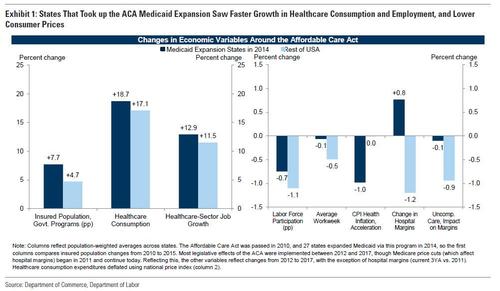
The left panel of Exhibit 1 compares states that expanded their Medicaid programs under the ACA in 2014 to those that didn’t. In expansion states on average, the publicly insured population share rose an additional 3% over five years, healthcare employment rose an additional 1.4%, and healthcare consumption rose an additional 1.6% on a nominal basis—and probably quite a bit more in real terms due to lower healthcare inflation in the MSAs of those states.
As with the original ACA, coverage expansion in the 2020s would likely be financed by some combination of Medicare reimbursement rate cuts (lower healthcare prices paid by the government to healthcare providers), tax increases, and efficiency gains.

In terms of labor supply effects, labor force participation fell almost everywhere during 2012-2017, but it surprisingly fell by less on average in Medicaid expansion states (-0.7pp vs. -1.1pp in non-ACA states over the full period). Similarly, the average workweek fell in most of the country, but by less so in expansion states on average (-0.1% vs. -0.5% over the full period).

The academic literature on the healthcare sector implications of the ACA generally arrives at the same conclusions using considerably more detail in order to isolate the ACA’s causal effects. As shown in Exhibit 2, these studies generally find that the ACA lowered healthcare prices and costs, increased healthcare consumption, and generally improved quality of care, particularly for lower-income consumers. However, some studies found a reduction of physician time spent with each patient, and the potential consequences of this trend on quality of care warrant further study; meanwhile deductibles soared. Additionally, some studies suggest improvements in health outcomes or labor productivity are concentrated or skewed towards specific subgroups, such as lower-income households or minorities.
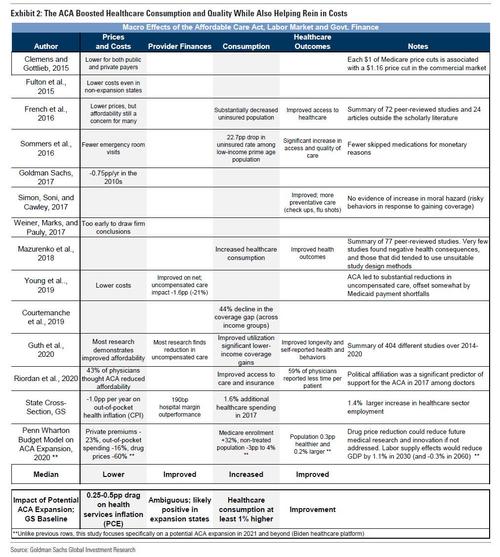
Based on the median results of these studies, Goldman's state cross-sectional results, and an assumption that the 2020s coverage expansion would be roughly half as large as that of the ACA itself (discussed earlier), the bank offers tentative estimates of the implications of a possible ACA expansion on these macro variables in the final row of Exhibit 2. Taken together, Biden’s proposed ACA expansion would ultimately boost healthcare consumption by at least 1%. If such legislation is partially financed by Medicare reimbursement rate cuts — as was the original ACA — it would likely lower PCE healthcare inflation by 0.25-0.5% per year for several years. These inflation effects would be additive to the continued drag from annual Medicare cuts legislated by the original ACA (worth roughly -0.5%) and to the temporary changes in healthcare price levels in 2020-22 related to the coronavirus. The literature also suggests that ACA expansion would likely improve health outcomes as well, most obviously for those gaining coverage.

In terms of the effect on the medical sector’s financial health, Goldman writes that hospital margins actually rose during ACA implementation, despite the legislated cuts to Medicare prices paid to hospitals and negative price spillovers to private-payer reimbursement rates (e.g. what health insurance companies pay to hospitals). And both in the state cross-section and the academic literature (“Provider Finances” column of Exhibit 2), ACA implementation appeared to be neutral or even positive for the financial health of providers (190bp of margin outperformance among hospital systems in expansion states, population-weighted, based on data from the American Hospital Association).

The outperformance of hospital margins in expansion states likely in part reflects the fact that Medicare reimbursement cuts affected providers in all states, whereas the benefits of the ACA’s Medicaid expansion (primarily increased volumes and less uncompensated care) were better enjoyed by states that participated in the program. As shown in Exhibit 3, expansion states saw slower growth of uncompensated care (relative margin impact of +0.8pp on average versus 2011), which for example includes uninsured individuals going to the emergency room and not always paying the full bill.
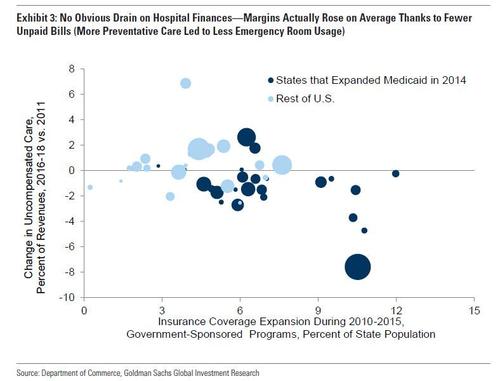
Given the magnitude of the Medicare cuts, it is somewhat surprising that margins increased at all over this period. At a minimum, the absence of margin contraction in expansion states in the 2010s suggests scope for additional increases in healthcare coverage and consumption that are financed in part by lower prices—and that need not overburden the healthcare system itself.
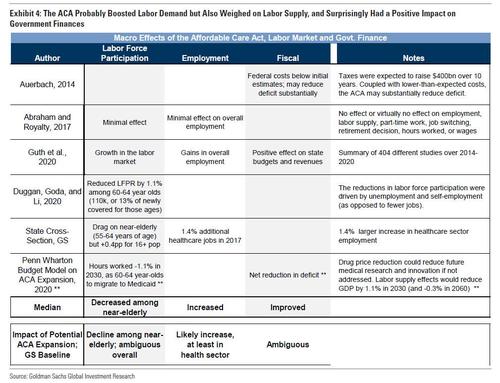
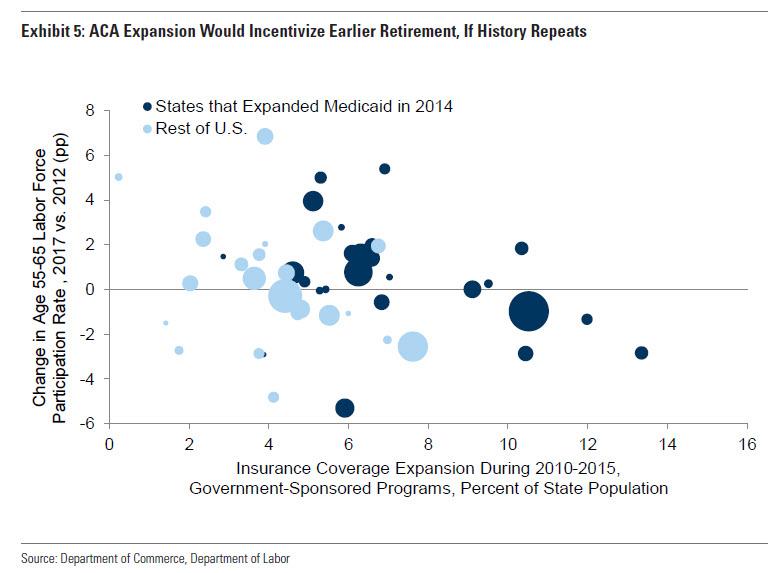
In terms of the impact on the labor market (first two columns, exhibit 4), the literature is more mixed, with some evidence of a boost to employment levels, but ambiguous effects on labor force participation. In the strongest evidence of a negative effect, Duggan, Goda, and Li (2020) analyze a sample of near-elderly individuals, finding that the expanded coverage options in the ACA reduced participation by 1.1% among this group (or 110k individuals exiting the labor force). Using microdata from the Current Population Survey, Goldman also finds that larger increases in insurance coverage were associated with larger participation declines among those close to retirement age (55-65 years old), both in states that expanded Medicaid and in those that had larger increases in coverage, as shown in Exhibit 5.
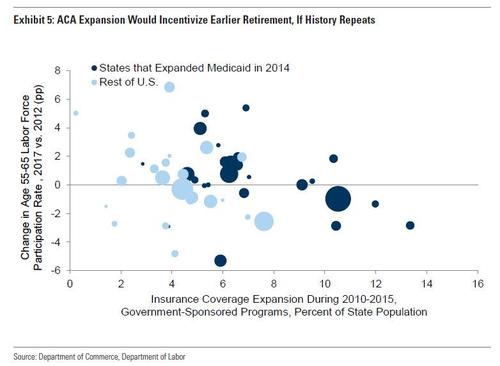
Given this and the likelihood that Biden’s plan to lower the Medicare eligibility age would amplify this incentive, Goldman believes that implementation would likely reduce labor force participation — at least among the near-elderly — but this labor supply effect would only partially offset the boost to employment levels from other channels in the medium term.

The GDP effects of an ACA expansion are less clear cut, given so many moving parts and uncertainty around the details of the program. That said, based on the bank's analysis and literature review, Hatzius says that he believes the GDP effects are likely to be positive over the medium term, unless they are financed by large tax increases on lower- and middle-income consumers. In summary, Goldman believes that the combined GDP boost from higher healthcare consumption, increased healthcare labor demand, and a more productive workforce could more than offset the drag from reduced labor force participation among the near-elderly.

* * *

Bottom line: Bidencare will be just the "virtuous wrapper" the doctor ordered so speak, to transfer $1.5 trillion in debt-funded deficit spending into the broader economy, while enabling tens if not hundreds of billions of government inefficiencies (read waste, corruption and embezzlement) along the way, while banks get to pocket their 5-10% advisory fees along the way, making everyone - except future generations of course, which will be saddled with even more insurmountable debt - better off. That last bit, by the way, was from us and not from Goldman for obvious reasons.

https://www.zerohedge.com/medical/goldman-here-what-bidencare-will-look