Search This Blog

Tuesday, January 19, 2021

Gilead, Galapagos Pipeline Opportunities Turning Morgan Stanley Bullish

 Gilead Sciences, Inc. 

GILD 5.91% and its R&D partner Galapagos ADR Representing Ord Shs GLPG 7.72% received an upgrade each from Morgan Stanley.

The Gilead, Galapagos Analyst: Matthew Harrison upgraded Gilead from Equal-weight from Overweight and increased the price target from $67 to $83.

Harrison also upgraded Galapagos from Equal-weight to Overweight and reduced the price target from $159 to $129.

Gilead's HIV, Oncology Sales Opportunity: The optimism on Gilead stems from the prospects for Gilead's Trodelvy in hormone-receptor-positive metastatic breast cancer and the opportunity provided by a combo therapy for HIV, Harrison said in a Tuesday upgrade note.

Trodelvy in HR-positive breast cancer represents a significant commercial opportunity, the analyst said.

Morgan Stanley expects success in the ongoing Phase 3 study in third-line-plus patients.

"Positive data could result in billions in additional peak sales and see a positive change to investors' view of mgt.'s capital allocation strategy," Harrison said. 

The combination of Gilead's long-acting HIV capsid inhibitor lenacapavir with another long-acting HIV drug represents a real opportunity to extend HIV cash flows for potentially another 10 years, into the 2040s, the analyst said.

Even if Gilead scouts an external partner for the combo therapy option and would have to share the economics, such a deal would be highly meaningful to long-term cash flows and could add over $15/share in discounted cash flow value, he said. 


How Pipeline Updates Could Drive Galapagos Shares: The market is heavily discounting the risks associated with Galapagos' European filgotinib launch and has overlooked multiple potential upside drivers in 2021, Harrison said.

Although the peak sales opportunity for filgotinib in Europe is modest, Galapagos will be disciplined with expenses, facilitating a net present value positive opportunity, the analyst said.

With Galapagos' current cash balance greater than the market cap of its shares, the market is overlooking the upside optionality from the idiopathic pulmonary fibrosis futility analysis and the Toledo program, he said. 

"We believe positive evidence of activity from either study can drive GLPG substantially higher." 

The downward adjustment of the Morgan Stanley price target comes as a result of the removal of U.S. filgotinib sales and alower probability of success for ulcerative colitis/Crohn's, Harrison said. 

https://www.benzinga.com/analyst-ratings/analyst-color/21/01/19215932/the-gilead-galapagos-pipeline-opportunities-that-are-turning-morgan-stanley-bullish

Lilly Awash In Catalysts, Pipeline Updates, Mizuho Says In Upgrade

 Eli Lilly And Co 

LLY 4.07% received an upgrade from a Mizuho Securities analyst ahead of a key data readout in March.

The Lilly Analyst: Vamil Divan upgraded Lilly shares from Neutral to Buy and increased the price target from $164 to $222.

The Lilly Thesis: Lilly has navigated through a catalyst-heavy period and macroeconomic uncertainties that were mainly related to the U.S. presidential election, Divan said in a note.

Added to that, the company impressed with the initial top-line data from its Alzheimer's antibody donanemab, which was released last week, the analyst said.

Mizuho sees the potential for the drug to add significant upside to the Lilly story. 

Lilly has not only potentially found an effective drug, but also understood how to properly design its clinical trials to demonstrate that effect in the right patient population, Divan said. 

The fact that Lilly was able to generate statistically significant results on the primary endpoint in a relatively small trial bodes well for the absolute differences when the full data is released, as well as the clinical meaningfulness of those results, the analyst said.

The full data is set to be released March 13 at the 2021 International Congress on Alzheimer's and Parkinson's Disease, he said.

Related Link: The Week Ahead In Biotech: FDA To Issue Decisions On Merck And Aurinia Drug Applications

The Lilly story is already robust with multiple recent positive developments in the areas of diabetes and oncology, Divan said.

Additionally, there are a number of additional pipeline data releases this year, including pivotal data from lebrikizumab and mirikizumab and additional clinical data from tirzepatide and Jardiance, the analyst said.

Since expectations from these data releases, especially lebrikizumab and mirikizumab, aren't too high, Divan sees the possibility for further upside.

Lilly is also expected to release additional Phase 2 Alzheimer's data from its tau antibody zagotenemab, the analyst said.

https://www.benzinga.com/analyst-ratings/analyst-color/21/01/19217446/lilly-awash-in-catalysts-pipeline-updates-mizuho-says-in-upgrade

India to start COVID vaccine exports on Wednesday


India will start exporting COVID-19 vaccines from Wednesday, paving the way for many mid- and lower-income countries to get supplies of the easy-to-store Oxford/AstraZeneca drug, of which it said it plans to ship millions of doses within days.

Serum Institute of India (SII), the world's largest vaccine producer, told Reuters last week it soon expected emergency use authorisation from the World Health Organization (WHO) for that vaccine, which SII has been licensed to make.

The foreign ministry said shipments would start on Wednesday following requests from "neighbouring and key partner countries". Officials said the first doses would go to Bhutan and Maldives.

Bangladesh, Nepal, Myanmar and the Seychelles will also get supplies in this week's first phase, the ministry said.

The Bangladesh foreign ministry said it expected to receive a gift of two million doses on Thursday. The country of 160 million, which has yet to start its vaccination programme, has ordered a further 30 million doses, officials said.

The vast majority of the production of the three most widely approved COVID vaccines globally has so far been hoovered up by developed nations, raising concerns at the WHO and elsewhere that poorer countries could face a long wait for supplies.

The Oxford/AstraZeneca vaccine is widely viewed as their best option because the other two, manufactured by Pfizer/BioNTech and by Moderna, need to be stored at very low temperatures.

WHO emergency authorisation for the Astra-Oxford vaccine would additionally allow SII to begin supplying it to the WHO-backed COVAX initiative aimed at fairly distributing COVID-19 shots across the world.

India, which has the world's second highest COVID caseload, has said it needs to balance its domestic requirements with international demands.

It began giving shots of the Oxford/AstraZeneca vaccine, as well as another developed by Bharat Biotech, to domestic health workers on Saturday.

The country plans to start exporting Bharat Biotech's vaccine at a later stage.

The foreign ministry said Astra-Oxford vaccine supplies to Sri Lanka, Afghanistan and Mauritius would begin soon after those countries' regulators cleared the drug.

Pakistan is alone among India's neighbours where it has no plans to send vaccine doses, and a government in New Delhi source said no request had come from there.

https://www.marketscreener.com/quote/stock/ASTRAZENECA-PLC-4000930/news/AstraZeneca-India-to-start-COVID-vaccine-exports-on-Wednesday-32225991/

Sputnik-AstraZeneca vaccine trials to start in February

 Human trials of a coronavirus vaccine combining Russia’s Sputnik V shot with that developed by Britain’s AstraZeneca and Oxford University are expected to start in early February, the chairman of Russian drugmaker R-Pharm told Reuters.

AstraZeneca first announced plans to explore the possibility of working with Russian scientists on a combined vaccine in December, interpreted by Moscow as a vote of confidence in its vaccine.

There have been few details on where and how the trials will be run, but R-Pharm Chairman Alexei Repik, whose company will produce both Sputnik V and AstraZeneca shots, said human trials of a combined vaccine are expected to begin early next month.

The trials will take place in Azerbaijan, Argentina, Saudi Arabia, the UAE, Belarus, Russia and elsewhere, he said.

A source close to Sputnik developer Gamaleya Institute also said the trial’s first inoculations will be in early February, adding that Ukraine will be among the countries taking part.

Kirill Dmitriev, head of the Russian the sovereign wealth fund responsible for marketing Sputnik V abroad, has previously said that combining the two vaccines would boost the efficacy of the AstraZeneca shot.

Its average efficacy rate was 70.4% in interim late-stage data, compared with more than 91.4% in trials of Sputnik V, which prompted Russian vaccine developers to suggest an attempt to combine the two.

Both vaccines employ two doses, an initial shot and a booster, and are based on a similar scientific approach using common cold viruses as vectors.

Mixing or switching between COVID-19 vaccines is largely driven by the aim of vaccinating as many people as possible as the pandemic rages on.

ClinicalTrials.Gov ClinicalTrials.Govct2/show/record/NCT04684446?term=AZD1222&draw=2, a database of clinical studies conducted around the world, gives an estimated study start date of March 16 and primary completion date of Nov. 16.

There will be an estimated 100 participants in Phase 1-2 of the trials. They will first receive the AstraZeneca vaccine and then the Sputnik V shot 29 days later.

https://www.reuters.com/article/us-health-coronavirus-astrazeneca-russia/sputnik-astrazeneca-vaccine-trials-to-start-in-february-says-r-pharm-idUSKBN29O1BA

Supermarket chain Aldi to pay U.S. workers who get COVID-19 vax

 German supermarket chain Aldi on Tuesday became the latest firm in the grocery sector to offer incentives for U.S. employees getting a COVID-19 vaccine, saying it would give up to four hours of pay to those who choose to receive inoculations.

The retailer, which has more than 2,000 stores in 37 U.S. states, said it would cover costs associated with vaccine administration and implement on-site vaccination clinics at its warehouse and office locations.

Dollar General Corp last week offered frontline employees a similar incentive after they get the vaccine, while grocery delivery company Instacart said it would pay $25 to more than half-a-million gig workers if they chose to take time off to get vaccinated.

Aldi said it was working with officials across the United States to get workers priority access to the vaccine, joining other companies including Amazon.com Inc and Uber Technologies Inc lobbying to move workers closer to the front of the line for vaccinations.

However, conflicting state and local guidelines on how shots will be administered and to which workers have made the process of navigating the vaccine rollout confusing for corporations and industry bodies.

Most corporations globally have so far been quiet on whether they would try securing doses for employees, even as some Indian firms are considering buying COVID-19 shots outright for their employees, once the vaccines become available commercially.

https://www.reuters.com/article/us-health-coronavirus-aldi/supermarket-chain-aldi-to-pay-u-s-workers-who-get-covid-19-vaccination-idUSKBN29O1GN


Moderna: Probing possible allergic reactions to COVID-19 vaccine

 Moderna Inc said on Tuesday it had received a report from California’s health department that several people at a center in San Diego were treated for possible allergic reactions to its COVID-19 vaccine from a particular batch.

The company’s comments come after California’s top epidemiologist on Sunday issued a statement recommending providers pause vaccination from lot no. 41L20A due to possible allergic reactions that are under investigation.

"A higher-than-usual number of possible allergic reactions were reported with a specific lot of Moderna vaccine administered at one community vaccination clinic. Fewer than 10 individuals required medical attention over the span of 24 hours," the epidemiologist said in a statement here.

The vaccine maker said it was unaware of comparable cases of adverse events from other vaccination centers which may have administered vaccines from the same lot or from other lots of its vaccine.

A total of 307,300 doses from the lot remain in storage, Moderna said, of the total 1,272,200 doses that were produced in the batch.

Moderna said it was working closely with U.S. health regulators to understand the cases and whether pausing the use of the lot was warranted.

Nearly a million doses from the lot have already been distributed to about 1,700 vaccination sites in 37 states, Moderna said. (bit.ly/39MPtlF)

https://www.reuters.com/article/us-health-coronavirus-moderna/moderna-says-possible-allergic-reactions-to-covid-19-vaccine-under-investigation-idUSKBN29O2C5

Why Hardly Anyone Trusts The Virus 'Experts'

 Early in the pandemic, “trust the science!” could actually be used in a debate without attracting derisive laughter. But as the flip-flops, mistakes and, yes, lies have accumulated, a consensus seems to be forming that the health care authorities are no more trustworthy than the people running Congress or the Fed.

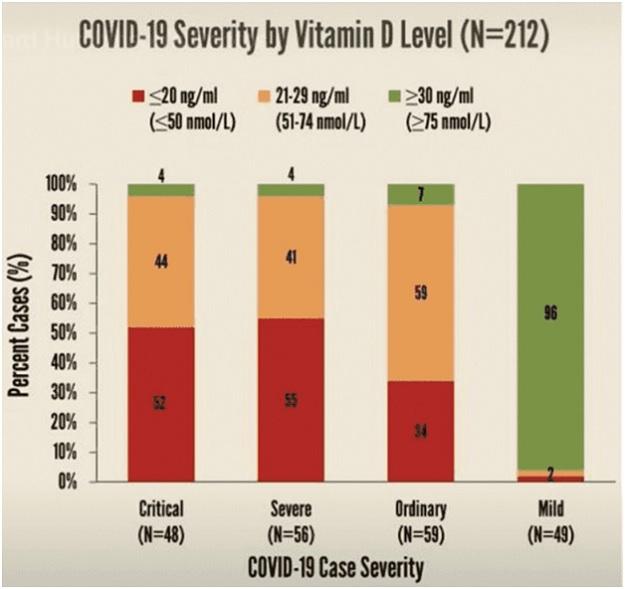
For proof, let’s start with vitamin D, which sure seems to lessen the severity of coronavirus infections. As the chart below illustrates (couldn’t find the source, but google “covid vitamin D” and you’ll find lots of studies that track with this data), people with higher levels of vitamin D in their bloodstream tend to experience covid-19 as a non-event while people low levels found the infection life-threatening.

There are obvious questions about causality here, so calling vitamin D a “cure” is going way too far. But if it has even a marginal effect – and the data suggest considerably more — a rational government would, you’d think, be handing out vitamin D like Halloween candy. In fact, since we’re mandating/prohibiting all kinds of other behaviors, we might expect vitamin D consumption to be required along with masks and social distancing.

Even covid-czar Anthony Fauci recently said:

“If you are deficient in vitamin D, that does have an impact on your susceptibility to infection. So I would not mind recommending — and I do it myself — taking vitamin D supplements.”

So why aren’t family-sized bottles of vitamin D arriving in the mail from the CDC? A cynic might wonder if the fact that Big Pharma doesn’t make much money from cheap, widely available supplements plays a role in the government’s apparent lack of interest.

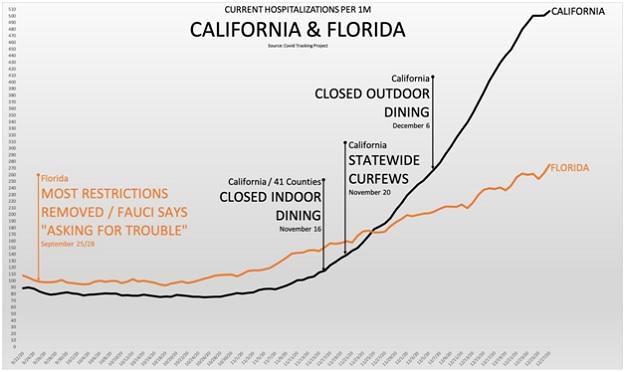
Now about those lockdowns. Tom Woods has been producing charts that appear to show virtually no difference in virus outcomes between US states with aggressive lockdown policies and those without. California, for instance, has shuttered most of its small businesses and imposed widespread curfews, while Florida hasn’t. Here’s the result:

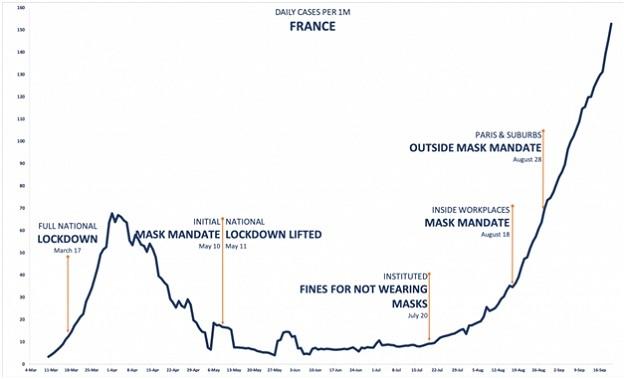
As for the rest of the world – where they’re supposedly doing better than the US – the pattern of zero correlation between lockdowns and virus spread seems to be holding. France imposed a full national lockdown in March – after which the virus spiked. Then they added mask mandates (indoor and outdoor), with fines attached. And daily new cases soared.

Then of course there’s the lying. Dr. Fauci first claimed that masks don’t help – when he believed they did help — because he feared mask shortages for health care workers. He also admits to changing the official line on herd immunity according to what he thinks we’re ready to hear.

And, in what sounds more like incompetence than dishonesty, he’s apparently been answering the question “when will life go back to normal?” with whatever pops into his head at the time. In early 2020, it was the coming Autumn. In July, it was “a year or so.” More recently it’s “well into 2021.”

But the biggest and by far the most outrageous reason for this growing mistrust has to be the World Health Organization which, well, read for yourself:

WHO official urges world leaders to stop using lockdowns as primary virus control method

The World Health Organization’s special envoy on COVID-19 urged world leaders this week to stop “using lockdowns as your primary control method.”

“We in the World Health Organization do not advocate lockdowns as the primary means of control of this virus,” Dr. David Nabarro said to The Spectator’s Andrew Neil. “The only time we believe a lockdown is justified is to buy you time to reorganize, regroup, rebalance your resources, protect your health workers who are exhausted, but by and large, we’d rather not do it.”

Nabarro went on to point out several of the negative consequences lockdowns have caused across the world, including devastating tourism industries and increased hunger and poverty.

“Just look at what’s happened to the tourism industry in the Caribbean, for example, or in the Pacific because people aren’t taking their holidays,” he said. “Look what’s happened to smallholder farmers all over the world. … Look what’s happening to poverty levels. It seems that we may well have a doubling of world poverty by next year. We may well have at least a doubling of child malnutrition.”

In the United States, lockdowns have been tied to increased thoughts of suicide from children, a surge in drug overdoses, an uptick in domestic violence, and a study conducted in May concluded that stress and anxiety from lockdowns could destroy seven times the years of life that lockdowns potentially save.

The health care establishment could have saved a lot of time — and embarrassment — by just asking regular people about this stuff.  But then they would have made a lot less money.

https://www.zerohedge.com/covid-19/why-hardly-anyone-trusts-virus-experts