Search This Blog

Wednesday, January 20, 2021

Amazon offers to help U.S. with vaccine in letter to Biden

 Amazon.com Inc on Wednesday offered to help with the United States' efforts involving the COVID-19 vaccine, according to a letter addressed to President Joe Biden, seen by Reuters.

The world's largest online retailer has an agreement with a healthcare provider to administer vaccines at its facilities, Dave Clark, chief executive of Amazon's worldwide consumer business, said in the letter. He added, "We are prepared to leverage our operations, information technology, and communications capabilities and expertise to assist your administration's vaccination efforts." 

https://finance.yahoo.com/news/amazon-offers-help-u-vaccine-184745994.html

NYC Delays 23K COVID Vaccinations As McKesson "Logistical Error" Leaves Moderna Jabs Too Cold

 Following comments from a top Israeli public health official who said that Pfizer's vaccine hasn't been quite as effective as they hoped according to the initial data, with the efficacy rate closer to 50% than the 95% that had been advertised, we're now learning that NYC was forced to cancel 23K scheduled vaccinations after a McKesson "logistical error" forced them to recall 21 shipments of the Moderna jabs.

Appointments at all 15 of the city's vaccination centers have been canceled on Wednesday.

The world seemed to be too preoccupied with President Joe Biden's inauguration to notice, as global stocks celebrated the new administration as the Bushes, the Clintons and all their establishment pals showed up for Biden's speech and inauguration in front of 20K flags.

First, on Wednesday, McKesson confirmed that it had recalled several shipments of the Moderna vaccines after a logistical error caused them to be delivered too cold. It echoed an earlier logistical error involving Pfizer jabs that were delivered too hot.

McKesson was simply confirming news that was reported yesterday by a Lansing, Mich.-area TV station, which reported that 21 shipments of the vaccine had spoiled, and that McKesson had notified Moderna about the issue.

Shortly thereafter,  NYC Mayor Bill de Blasio and one of the city's top health officials confirmed Wednesday that the city had been forced to reschedule 23K vaccinations due to supply shortages caused by these delays.

Health Commissioner Dave Chokshi said he was informed about the delays in the Moderna shipments by the city’s partners at the federal government, and added that the delays weren't related to side effects or vaccine performance.

“This is purely a shipment issue, a logistical issue,” Chokshi said.

“We anticipate that the vaccines are intact and we will get them in the course of delivery today and tomorrow.”


About half of the delayed supply was intended to be given as second doses. The rescheduled appointments, though, are for people getting their first doses, who will be offered new appointments in the next week."

It appears the delays in New York are a direct result of the shipments being delivered too warm. About half of the delayed supply was intended to be given as second doses, according to Bloomberg. Most of the rescheduled patients were set to receive their shot for the first time as people who had already received their first shot and were due for their booster took precedence.

Of course, temperature issues haven't been the only problems with the vaccine rollout. Moderna recalled a batch in California after a higher-than usual number of patients had "adverse" reactions. And, of course, many have died, and many others been sickened around the world. Though admittedly still a small fraction of the 40MM+ people who have purportedly received the vaccine worldwide.

McKesson and Moderna have, so far, been vague about the nature of the logistical issue that caused this - and we could understand vaccines being shipped too hot, but it seems like shipping something too cold would take more deliberate effort.

While logistical issues have seemingly been rare, the US is finally getting over a problem where hospitals couldn't manage to distribute vaccines quickly enough. This was blamed, in some places, on too-restrictive requirements on who qualified to receive the vaccine, as huge numbers of health-care workers, and a surprising number of long-term care home residents, have passed on taking it.

Fortunately, it looks like the shipments were recalled before any of the spoiled doses could be distributed. But if nothing else, it's  an example of the fraught logistical process used to transport the vaccines. And that's presumably in addition to the reactions that we've seen around the world, which have caused some health authorities to consider pausing distribution.

https://www.zerohedge.com/markets/nyc-delays-23k-covid-vaccinations-mckesson-logistical-error-leaves-moderna-jabs-too-cold

90% Of Illinois' COVID Victims Were Over 60, Half in Long-Term Care


Want to save more Illinoisans from COVID? Vaccinate the elderly first.

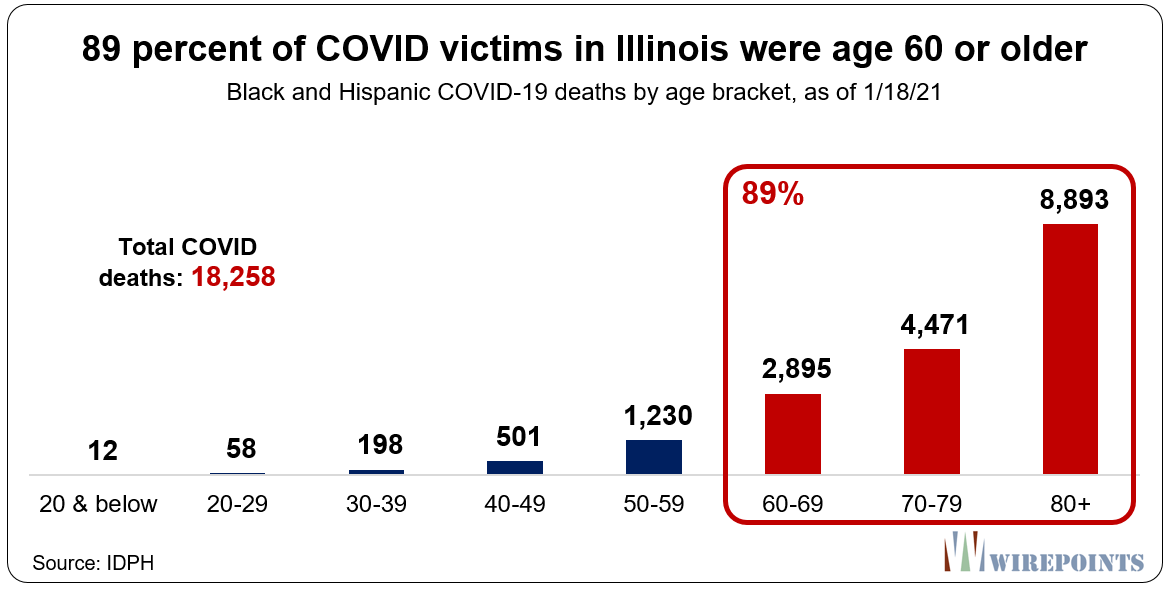
For months, Gov. J.B. Pritzker has used lockdowns as his main way to handle the COVID pandemic, ignoring calls for him to focus on the elderly instead. The governor’s approach has been a major policy failure, resulting in far too much tragedy. Nearly 90 percent of the state’s 18,000 COVID victims were over the age of 60, with nearly 50 percent of all COVID deaths tied to long-term care facilities. 

Now that vaccines are finally available, Pritzker is repeating the same mistake again. Rather than make the elderly and the frontline staff that take care of them his number one priority for vaccinations, the governor is including a host of “essential workers” – and prisoners, even – at the same level of priority. He’s calling it an “equity-centric vaccination approach.”

It’s a huge mistake to give all those groups equal priority. Unless they happen to be elderly, every vaccine given to the 1.3 million “essential” workers will be one that can’t be given to one of the 1.9 million Illinoisans over age 65 – the group by far most at risk from dying.

Pritzker’s inoculation approach is similar to those used in other states, where other factors like occupation only add more bureaucratic rules that slow the vaccination process down. In New York, that’s led to doses going to waste or sitting idly on shelves. Overall delays have been so significant across the nation that the Wall Street Journal reported last week “only 9.3 million of the 27.7 million vaccine doses that have been shipped to states have been administered.”

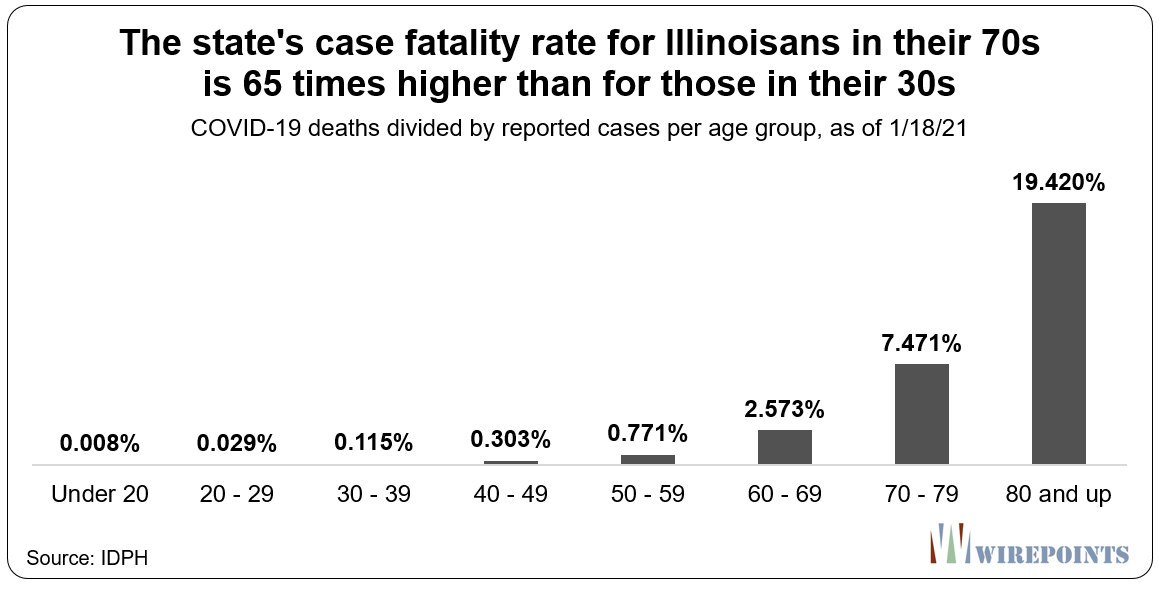
The vaccination process shouldn’t be that complicated. Illinois state officials have known for months who should be first in line: the elderly. The simplest and most effective way to save lives is to administer the vaccine based on age: the older or more infirm the person, the more priority they should receive. After all, the state’s case fatality rate for Illinoisans in their 70s is 65 times higher than for those in their 30s (7.47% vs 0.115%).

For sure, if a teacher, a cashier or a prisoner is elderly, give them the vaccine. Or if they have a serious pre-existing condition – diabetes or obesity, for example – vaccinate them. But overall, Illinoisans in nursing homes, their caregivers and other key frontline workers, people with severe pre-existing conditions, and all residents over 65 should all take first priority in getting vaccinated. 

(To get the full story on Illinois’ vaccine rollout, read The Pantagraph’s “Can Illinois pick up the pace of vaccinations as it moves to the next phase?”)

Illinois’ flawed rollout

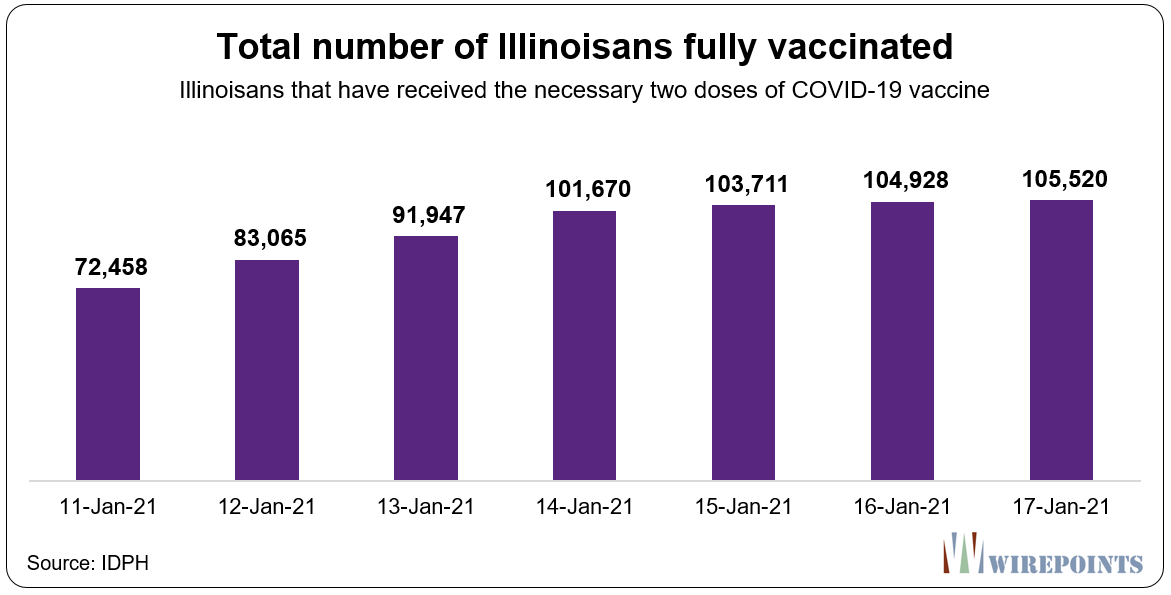
Illinois is still in Phase 1A, the initial vaccination rollout that includes inoculating frontline healthcare workers as well as residents of long-term care facilities. As of Jan. 14, the state ranked 19th in the country for percentage of doses administered. Overall, the state has administered 403,000 of the 958,000 doses (42 percent) already distributed to Illinois. And just over 105,500 Illinoisans, or 0.83 percent of all Illinosans, have been fully vaccinated as of Jan. 17.

Phase 1B, which Pritzker has said Illinois will move to on January 25th, will finally authorize all seniors 65 and above, about 1.9 million people, to get the vaccine. The phase also prioritizes “essential workers,” about 1.3 million people, and now prisoners, to receive the vaccine as well. 

Trying to distribute a limited number of vaccines among those millions of people will likely hurt Pritzker’s goals for equity. Vaccinating all teachers, for example, would actually hurt the governor’s goal because 82 percent of educators in Illinois are white – plus it would deprive the elderly of desperately needed vaccines.

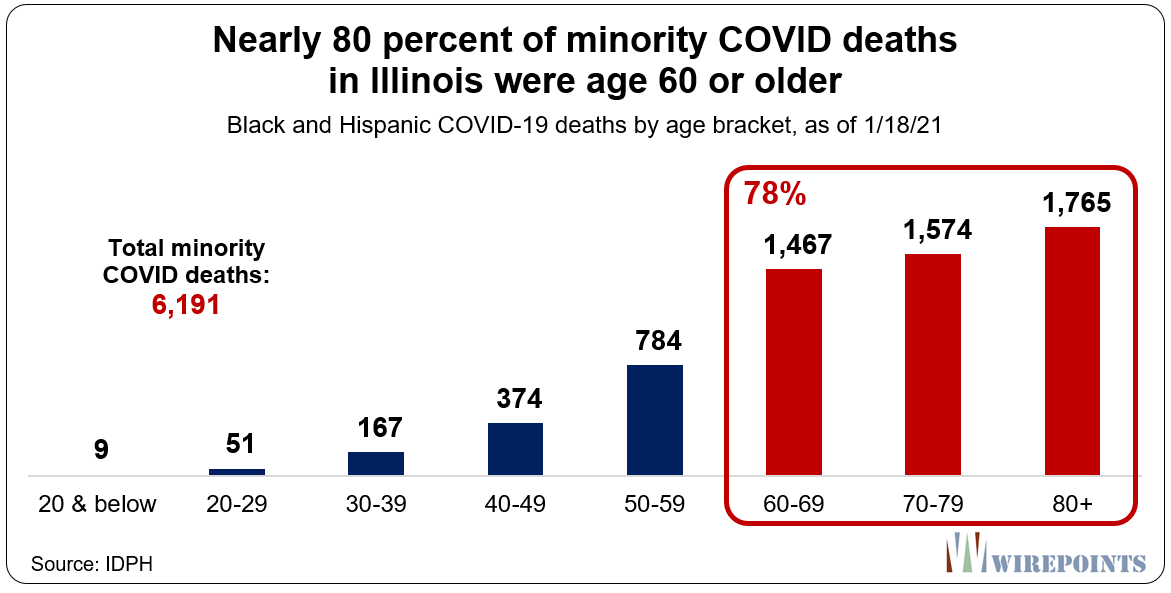
In contrast, both elderly Hispanic and black Illinoisans suffer from far higher case fatality rates than white residents. Protect the elderly first and you necessarily protect minorities first, too. Nearly 80 percent of all minority COVID deaths have occurred in the 60-and-over age bracket. 

Of course, setting up vaccination centers as close as possible to the most impacted minority communities in Illinois is critical to making vaccination there a success.

No plan

The state’s failure to prioritize vaccinations for the elderly can be represented by a simple anecdote of mine: My mother, an 81 year-old cancer survivor, continues to be frustrated by the vaccination process. She, like every other Illinoisan in her age range, should already be targeted for vaccination. But it’s been impossible for her to find out any information about when or where a vaccine will be available for her.

She called her doctor’s office and was told they had no information or timelines for when she could get vaccinated. She also called her hospital network and got the same answer: no info. I received the same response today when I called the hospital myself. My mother would have to wait anyway, I was told, because the hospital group hadn’t yet finished vaccinating its own staff yet.

I hear similar stories from friends whose parents are in nursing homes. They are still waiting.

You’d think by now the state’s health officials would be loath to fail Illinois’ elderly again, but that seems to be exactly what they’re doing.

Infinity Pharma at B. Riley Virtual Oncology Investor Conference

Infinity Pharmaceuticals, Inc. (NASDAQ: INFI) will participate in a Fireside Chat with Andrew D’Silva of B. Riley Securities on Wednesday, January 20, 2021 at 10:30 am ET.

B. Riley is limiting the live audience to institutional investors, investor relations, and employees of each presenting company. Private investors will not be given access to the live conference, but a replay will be available on the Events and Presentations page of the Infinity Pharmaceuticals website following the conference.

https://finance.yahoo.com/news/infinity-pharmaceuticals-participate-b-riley-133500493.html

Adamis Submits Covid Drug to FDA

 Shares of Adamis Pharmaceuticals  (ADMP)  skyrocketed Wednesday after the biopharmaceutical company announced a request to the Food and Drug Administration for investigational use of its Covid-19 treatment drug Tempol.

The request followed a meeting with the FDA in which it gave specific recommendations on chemistry, manufacturing and controls and clinical aspects to be included in the drug, Adamis said. It plans to seek government and/or non-government funding to study the treatment and prevention of Covid-19, the disease caused by the coronavirus, with Tempol.

https://www.thestreet.com/investing/adamis-admp-covid-drug-fda

One in 11 over-65s unwilling to take COVID-19 shot

 One in 11 adults aged over 65 have reported a lack of willingness to receive a COVID-19 vaccine, according to a US-based survey.

The findings are concerning given that adults in this group are at highest risk for complications from the disease.

Findings from part of the Heartline clinical study, sponsored by Johnson & Johnson and Apple, have been published online on a preprint server and have yet to be peer-reviewed.

Recruitment to the study began in February last year and it was initially set up to test whether wearable and custom-built mobile apps could enable earlier detection and better treatment of atrial fibrillation in patients aged 65 and older.

Willingness to vaccinate against COVID-19 was assessed through an optional survey through the Johnson & Johnson app between 6th and 20th November last year,

The assessment included questions on beliefs about vaccines in general, beliefs about COVID-19 and the COVID-19 vaccine, and opinions on vaccine dosing and potential side effects.

Shortly after the survey was offered, Pfizer announced first interim analysis results showing the vaccine it developed with BioNTech had an efficacy of around 90% and authors compared answers before and after this event to gauge its impact on opinions.

Of the 7,402 people who responded, 63.6% of participants reported they were very willing to receive a COVID-19 vaccine, 27.8% were somewhat willing, 6.0% were not very willing, and 2.6% were not at all willing.

Overall, authors said that 91.3% were “willing” to be immunised and 8.7% were “unwilling”.

Analysing different demographic groups, the study found participants identifying as Black or African American were least likely to want to take COVID-19 vaccines.

A total of 26.8% of Black or African American participants noted they were not very willing or not at all willing to vaccinate, compared with 8.0% of white participants.

Study author Janeta Nikolovski, director of the World Without Disease Accelerator at Johnson & Johnson’s Janssen pharma unit, told pharmaphorum in an emailed interview that she not surprised about vaccine hesitancy in older age groups.

“Several prior published studies have shown those trends as well,” said Nikolovski, who said further work is being done to understand why older people are more likely to be sceptical about vaccines.

She added: “Among those who said they were unwilling to get vaccinated, the majority stated that they would discuss their decision with their healthcare provider, providing an important opportunity for education.”

Further work is also needed to identify why different demographic groups have differing attitudes to the vaccine.

She added: “We agree that further study is needed and a one-size-fits all approach in communication will not be ideal to address specific concerns.”

Nikolovski is hopeful that as vaccine campaigns are rolled out, attitudes to vaccines could change for the better.

“Given that we found vaccine safety and efficacy to be a strong predictor of willingness to vaccinate, I think as people get vaccinated and share their experience with others, trust will grow.

“We saw an increased vaccine willingness after the trial results were released, suggesting that public willingness to vaccinate may continue to rise as additional positive data are released.”

Conversely, negative news stories about vaccines, including reports about adverse events, may have a negative impact.

“In general however, I believe transparency with research results is important, whatever the results, as it is important to realistically manage expectations, “ she concluded.

Janssen is working on a single shot COVID-19 vaccine, which has shown promise in early trials with phase 3 data possibly due by the end of the month.

https://pharmaphorum.com/news/one-in-11-older-patients-unwilling-to-take-covid-19-shot/

Mexico says illicit labs are making fake COVID-19 vaccines

 Mexico says that organised criminal networks have set up laboratories to manufacture falsified vaccines for COVID-19, and are also planning to steal supplies during distribution.

Just today, the Mexican army said it is investigating the theft of coronavirus vaccines from a public hospital in central Morelos state. There are concerns crime syndicate, such as the Familia Michocana and Cartel Jalisco Nueva Generación, intend to cash in on the crisis.

The Mexican government has promised to make vaccinations available free of charge across the country of almost 129m people, but with lawlessness and cargo theft a massive problem in the country that looks like a major challenge.

report in InsightCrime.com cites Mexico’s Consejo Nacional de Seguridad Privada (CNSP) whose president – Raúl Sapién Santos – also says illicit production facilities have been discovered Jalisco, Tamaulipas, Chihuahua, and Mexico City.

The article suggests Mexico may be becoming an epicentre for criminal activity surrounding COVID-19 vaccines, although it other Latin American countries, including Colombia, Ecuador, Peru, Brazil and Panama, also seem to be getting involved.

Last month, Interpol issued an Orange Notice to police forces in its 194 member countries, warning them to prepare for falsification, theft and illegal advertising of COVID-19 as well as flu vaccines this winter and beyond.

So far, only the Pfizer/BioNTech COVID-19 vaccine has been approved for use in Mexico, and while there is a limited supply of the shots, the government says it has administered almost 4.5m doses. It has also ordered vaccines developed by University of Oxford/AstraZeneca and Chinese biotech CanSino.

InsightCrime.com says that the role Mexican cartels have played a role in providing pandemic assistance to local communities, and that means the public may trust vaccines they supply are authentic.

Latin America – and Mexico in particular – has become a focal point of the pandemic, as a result of social inequality, large informal work forces, dense population in cities and disorganised health systems.

Adding to the problems facing the country, the head of its COVID-19 vaccination strategy, Miriam Veras Godoy, has just resigned, citing personal reasons although there have reportedly been disagreements about the rollout in government.

At last count, Mexico had recorded almost 1.7m cases of coronavirus, with more than 142,000 fatalities, the fourth highest death toll worldwide in absolute numbers. The country also currently has one of the highest daily rates worldwide in new cases and deaths.