Search This Blog

Monday, February 8, 2021

Moderna's COVID-9 vaccine effective against emerging variants

 Researchers in the United States have conducted a study showing that the Moderna mRNA-1273 vaccine effectively protects against recently emerged variants of severe acute respiratory syndrome coronavirus 2 – the agent that causes coronavirus disease 2019 (COVID-19).

The team compared the neutralization activity of blood taken from infected and vaccinated individuals against a panel of SARS-CoV-2 variants, including the B.1.1.7 that emerged in the UK.

The team – from Emory University School of Medicine in Atlanta, the University of Texas Medical Branch, and the COVID-19 Neutralization Study Group – found that antibodies generated by both infected and vaccinated individuals effectively neutralized all of the variants.

“These findings support the notion that in the context of the UK variant, vaccine-induced immunity can provide protection against COVID-19,” says Mehul Suthar and colleagues.

However, as further variants continue to emerge, it will be essential to assess their impact on the potency of neutralizing responses following both infection and vaccination, warns the team.

A pre-print version of the research paper is available on the medRxiv* server, while the article undergoes peer review.

The SARS-CoV-2 infection process

In order to infect cells, SARS-CoV-2 uses a surface viral structure called the spike protein to bind to the host cell receptor angiotensin-converting enzyme 2 (ACE2).

The spike protein is the primary target of neutralizing antibodies and levels of these antibodies correlate with protection against COVID-19.

Neutralizing antibodies are generated within 10 days of symptom onset and studies have shown that they are maintained for at least 8 months.

Similarly, Moderna’s mRNA-1273 vaccine generates neutralizing antibodies that are detectable for at least 119 days.

However, the recent emergence of SARS-CoV-2 variants, including the B.1.1.7 strain that has arisen in the UK, has sparked concerns regarding the breadth of these neutralizing antibody responses.
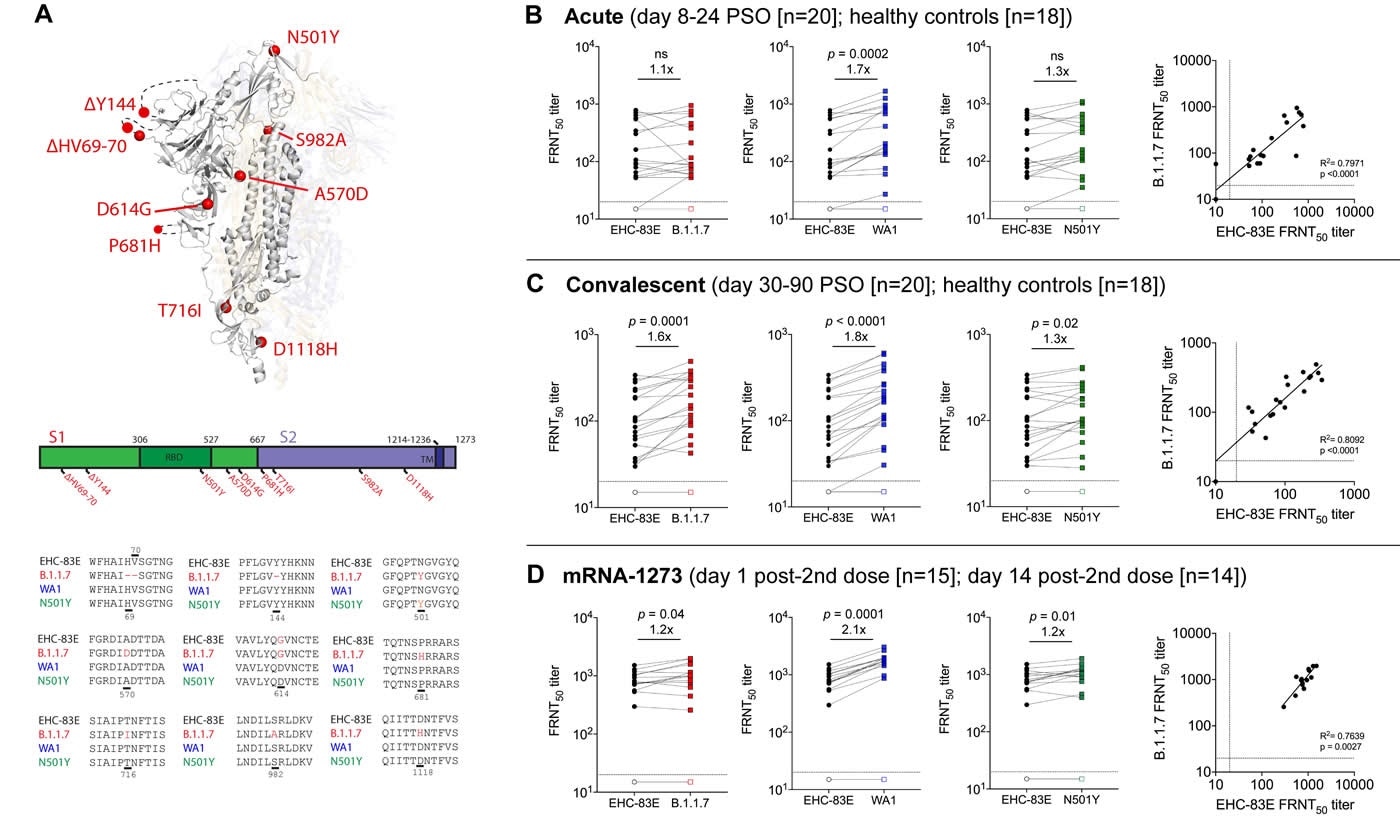
Neutralizing antibody responses against the SARS-CoV-2 B.1.1.7 viral variant. Shown are data from the following cohorts based on natural infection: 20 acutely infected COVID-19 patients (8-24 days PSO; closed symbols), 20 convalescent COVID-19 individuals (30-90 days PSO, closed symbols) 18 healthy controls (open symbols); and individuals that received 100 ug of mRNA-1273 (18 to 55 years old) on day 1 post-2nd dose (15 participants; open symbols) and day 15 post-2nd dose (14 participants; closed symbols). A schematic of the amino acid changes within the spike protein are shown between the SARS-CoV-2 variants (Panel A); The 50% inhibitory titer (FRNT50) on the focus reduction neutralization (FRNT) assay for the EHC-83E (black), B.1.1.7 (red), WA1 (blue) and N501Y (green) SARS-CoV-2 variants and correlation plots between EHC-83E and B.1.1.7 viruses are shown for the acutely infected COVID-19 patients (Panel B), convalescent COVID-19 individuals (Panel C), and mRNA-1273 vaccinated individuals (Panel D). Statistical significance was determined using a Wilcoxon paired t-test. The GMT fold change for the respective isolates relative to EHC-83E is shown in each of the plots.

What did the researchers do?

Suthar and colleagues compared the neutralization potency of sera from 20 patients with acute infection, 20 recovered individuals, and 14 healthy vaccinees, against a panel of SARS-CoV-2 variants.

Symptom onset had occurred between 8 and 24 days previously among the 20 acutely infected patients and between 30 and 90 days previously among the convalescent patients.

The immunized participants (aged between 18 and 55 years) had received two injections of Moderna’s mRNA-1273 vaccine at a dose of 100µg, with the second dose administered 14 days previously.

The panel of SARS-CoV-2 variants included an early variant isolated from an individual in Washington (WA1); a later D614G variant isolated from a patient in Georgia in March 2020 (EHC-083E), and a B.1.1.7 variant isolated from a patient in California.

The team also included a recombinant SARS-CoV-2 virus containing a single point mutation within the spike protein at position 501 (N501Y).

Levels of neutralizing antibodies were measured using a live-virus Focus Reduction Neutralization Test.

What did they find?

The findings showed that antibodies were effective at neutralizing all variants, whether they were generated following natural infection or vaccination.  

The team observed no significant reduction in levels of neutralizing antibodies against any of the variants.

“These results show that neutralizing antibody titers following natural infection or vaccination are effective against the UK variant (B.1.1.7) and viral strains containing single point mutations at positions 501 and 614 within the spike protein,” writes the team.

The researchers say the findings suggest that in the context of the UK variant, vaccine-induced immunity can provide protection against COVID-19.

“As additional SARS-CoV-2 viral variants continue to emerge, it is crucial to monitor their impact on neutralizing antibody responses following infection and vaccination,” they conclude.


https://www.news-medical.net/news/20210208/Modernas-COVID-9-vaccine-effective-against-emerging-variants.aspx 

Some coronaviruses steal hosts' genes to elude their immune system

 Some coronaviruses can add to their genetic pool some genes belonging to the host they infected. In this way, they can blend in and be less detectable to the immune system. This discovery was published in the journal Viruses by an Italian research team from the IIS (Italian Healthcare Institute), ISPRA (Institute for Environmental Protection and Research), IZSLER (Italian health authority and research organization for animal health and food safety of Lombardy and Emilia-Romagna) and the University of Bologna.

The outcome of this study demonstrates that coronaviruses encompass a sophisticated  and therefore puts increasing emphasis on the importance of studying wildlife diseases. Research in this field is fundamental to understand the functioning of illnesses that can spread from animals to humans so that we can efficiently manage ecosystems and provide a balance between the species inhabiting them," says Mauro Delogu, a researcher at the University of Bologna and one of the authors of this study.

Researchers discovered this while analyzing coronaviruses found in specimens of European hedgehogs (Erinaceus europaeus). They classified this strain as EriCoV. These viruses belong to the same strain of Beta-CoV responsible for COVID-19 as well as MERS. However, there is no evidence that they can spread to humans.

These hedgehog coronaviruses are able to steal a gene (CD200) that belongs to the host. When combine with its receptor, this gene allows to prevent an excessive inflammatory response. By incorporating this gene, the virus can hinder the immune defense of the host.

Events like this have never been observed before in coronaviruses. With this , coronaviruses can influence the duration of the infection and therefore prolong the time necessary to eliminate the virus, eventually leading to chronic infections. These process goes to the advantage of the virus, as it multiplies its ability to propagate and spread thanks to a specific evolutionary strategy.

"These results pave the way for further investigations into the ability of coronaviruses of interfering with the inhibitory signals of immune cells," continues Delogu. "In this way, coronaviruses can disguise themselves so that it is harder for the  of the host to detect, recognize and destroy them."

More information: Luca De Sabato et al, Can Coronaviruses Steal Genes from the Host as Evidenced in Western European Hedgehogs by EriCoV Genetic Characterization?, Viruses (2020). DOI: 10.3390/v12121471

https://medicalxpress.com/news/2021-02-coronavirus-hosts-genes-elude-immune.html

Plastic film can suppress coronavirus

 A consortium comprised by companies Braskem, AplFilm and Nanox and the UFSCar (Brazil) and Jaume I of Castellón (Spain) universities have released a plastic film capable of deactivating 99.99% of the new coronavirus in 15 minutes. The new product called AlpFilm Protect PVC is already available on the market.

The  initiated 15 years ago between the UFSCar and UJI with company Nanox had already developed in 2014 a product with antifungal and bactericidal properties: a transparent PVC film with silver microparticles which has now given way to the technology patented by Nanox wih the support of the Vinyl Application Engineering team of Braskem and AlpFilm.

Silica is a semiconductor that becomes active with metallic silver to generate highly oxidative molecules capable of deactivating 79.9% of the new coronavirus in three minutes and 99.99% in just 15 minutes. The product is already available on the market and is commonly used to pack  such as meat, fruit, vegetables and cold meats, and could now also be used to protect surfaces.

The tests to verify the power of the new plastic packages to suppress SARS-CoV-2, the virus that causes COVID-19, were conducted at the level 3 biosecurity laboratory of the Institute of Biomedical Sciences of the University of São Paulo (ICB-USP) in compliance with ISO 21702:2019, the technical standard to measure the antiviral activity in plastics and other non-porous surfaces. Companies Braskem and AlpFilm improved the film's formula, maximising the protection potential against fungi and bacteria, achieving the virucidal effect.

The technology developed by Nanox, managed by doctor Gustavo Simões, had the support of the Innovative Research Programme for Small Companies (PIPE) of the FAPESP, and the scientific guidance of professor Elson Longo from the Centre for the Development of Functional Materials (CDMF), the Federal University of São Carlos and professor Juan Andrés Bort, head of the Laboratory of Theoretical and Computational Chemistry of the Jaume I University of Castellón.

For Braskem, the efficiency of the material strengthens the relevance of plastic in initiatives aimed at the health and safety of society. "Plastic has been a great ally against the coronavirus pandemic. PVC solutions enable the production of a series of essential products ranging from medical and hospital products to packages, which ensure food safety, hygiene and cleanliness, among other factors, bolstering the fight against COVID-19," explains Almir Cotias, Vinyls director at Braskem Business, department responsible for the production of the raw material for PVC film AlpFilm Protecto.

"The product existed since 2014 with antifungal and bactericidal properties thanks to the presence of silver microparticles," explains Alessandra Zambaldi, director of Foreign Trade and Marketing of AlpFilm, "but with the pandemic, we subjected it to a series of studies to adapt its composition in order to ensure its antiviral efficiency. Faced with the challenges imposed by COVID-19, we decided to focus our attention on researching and developing this product evolution to deactivate the new coronavirus by contact."

AlpFilm is one of the main manufacturers of PVC plastic films in Brazil, with a monthly production of 450 tonnes of material. Since 2014, the company sells plastic films with silver microparticles for the packaging of foods in supermarkets and for home use, in order to provide protection against fungi and bacteria. It is a Brazilian family company, created in 1998 under the name Alpes Indústria e Comércio de Plásticos Ltds, which in 2002 took on the name it gives to its products: AlpFilm.


Explore further

Plastic film used to protect foods and surfaces inactivates novel coronavirus
https://phys.org/news/2021-02-plastic-suppresses-coronavirus.html

Goldman Brings Forward First Rate Hike Estimate

 How quickly things change.

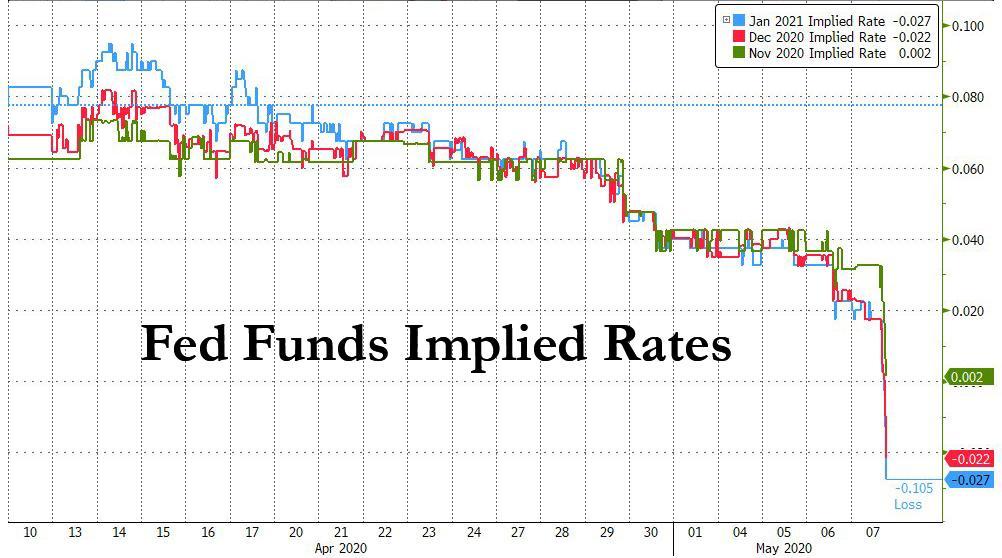
Just nine short months ago, in May 2020, the market did something it had never done before: it pushed Fed Fund futures for January 2021 negative, meaning that last spring bond traders were betting that sometime around today, overnight rates in the US would be negative as the US economy entered the final stretch of its Japanification implosion.

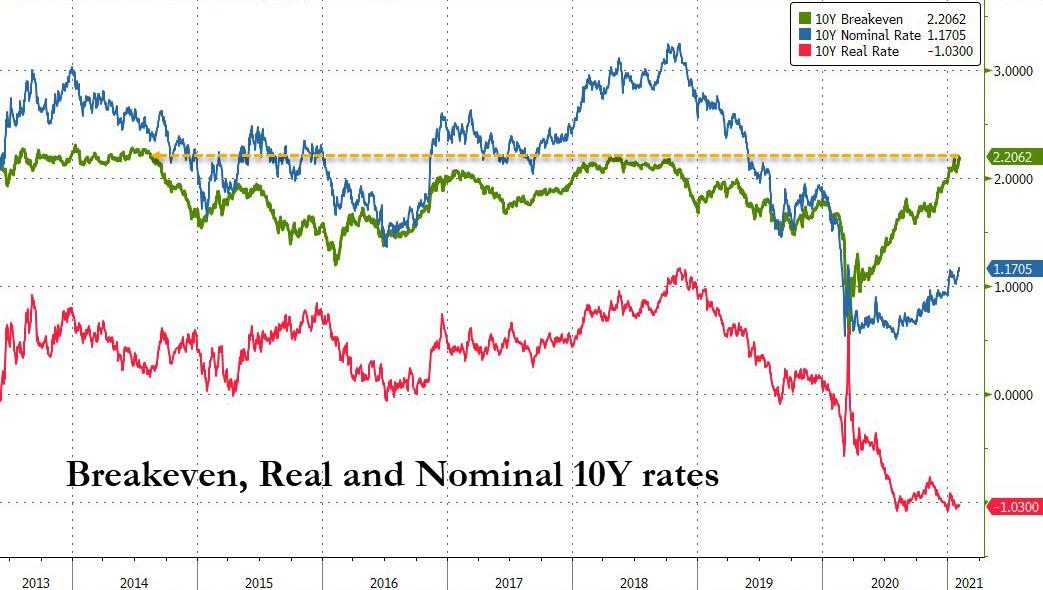
Since then things haven't quite worked out as expected, with long rates rising sharply and the 30Y today briefly breaching 2% for the first time since February 2020, on the back of surging breakeven rate, which rose by 1bp point to touch 2.21%, eclipsing a 2018 high of 2.2078%, and rising to the highest level since 2014 as markets increasingly price in far higher inflation over the next decade.

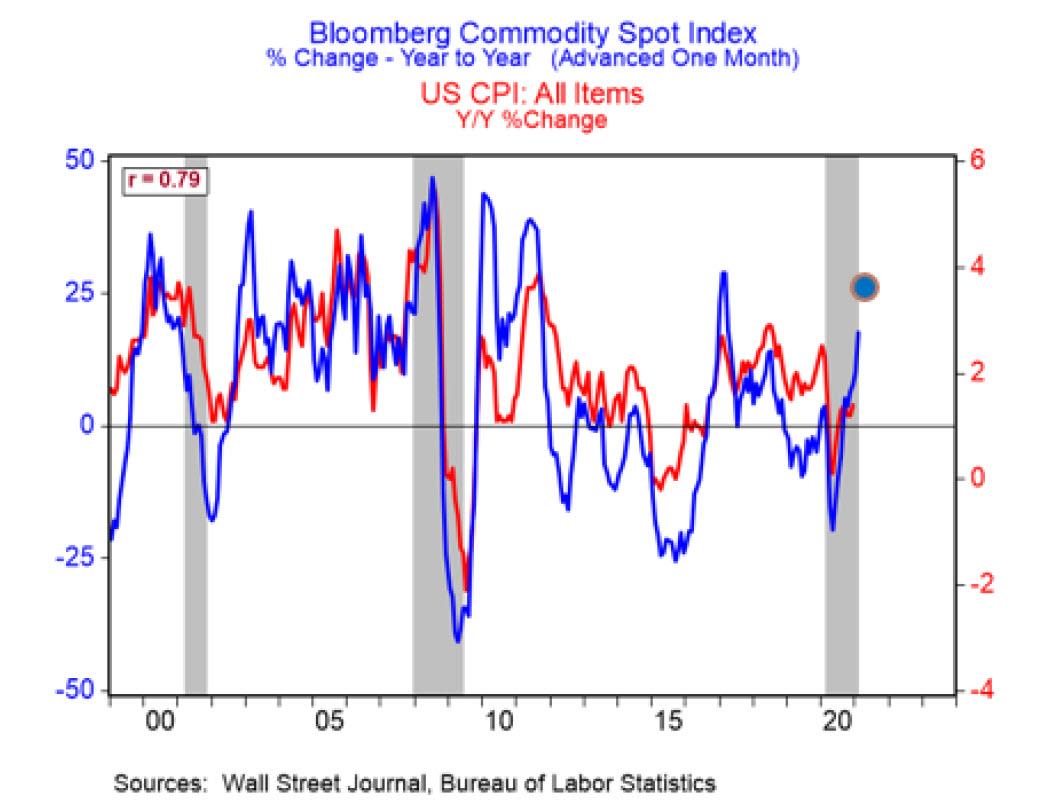
And while the market would love to have its bubble-blowing zero-interest rate cake and eat it too for the next several years - as the Fed refuses to hike rates for the foreseeable future now that it is prepared to let the economy "run hot" indefinitely - that is unlikely to be the case especially with BMO calculating that just the surging price of commodities is already tantamount to a 4% headline inflation.

And sure enough, already we are getting the first rumbling of what could be the next market crisis (which, recall, will be catalyzed by sharply higher inflation which will force the Fed to taper QE first and eventually to hike rates).

In a note published this afternoon, Goldman hiked its assumption for additional fiscal measures to $1.5 trillion...

With the passage of the budget resolution (Feb. 5), Congress has completed the first of two steps to provide additional COVID-relief funding along the lines of President Biden’s proposal.Next, committees will draft and vote on legislation. We expect this late in the nweek of Feb. 8. At this stage, we will learn much more about the details, size,and timing, of particular provisions.However, the key decision might not be made for another few weeks, when the Senate is likely to take up its version of the COVID-relief bill. By that point,centrist Democrats who have been the limiting factor on the size of the bill will need to decide how large a bill they are willing to support. We think this amount is likely to be higher than the $1.1 trillion (5% of GDP) wenhad previously assumed, and we are raising of assumption for additional fiscal measures to $1.5 trillion (6.8% of GDP)

This is a sizable increase - Goldman estimates that the extra $400bn in stimulus is equivalent to nearly 2% of GDP - one which bumps the bank's Q2 growth forecast from 10% to 11% and taking annual growth in 2021 and 2022 up by about 0.2% each year, to 6.8% and 4.5%respectively.

At this point, it becomes clear that last week's warnings from Larry Summers and Olivier Blanchard that the US economy is set to overheat are clearly coming true, which is also why Goldman has to anticipate how the Fed will response to this outlier growth, and inflation.  And it does so in a way that is unlikely to be welcome by the market, because whether it wants to or not, Goldman has to concede that such scorching GDP growth will inevitably mean an earlier tightening by the Fed, and sure enough this is what the bank's chief economist Jan Hatzius has forecast:

In light of the upgrade to our growth forecast, the larger-than-expected decline in the unemployment rate in January, and signs of a firmer inflation outlook, we have brought forward our forecast for the first rate hike from the second half of 2024 to the first half.  We expect the FOMC to start tapering its asset purchases in early 2022.

Since every other banks tends to immediately imitate anything that Goldman's econ department proposes, we expect that in the coming days we will see a barrage of sellside reports predicting that the first rate hike will be pulled back to early 2024 (or even late 2023 by those banks who really want to impress their clients with their originality), and while stocks will likely ignore this truncated tightening calendar for now, it is only a matter of time before trader euphoria pops once the realization that the Kool-aid is coming to an end starts becoming the dominant narrative.

The only caveat is that since nobody really knows how long the Fed will allow the economy to "symmetrically" overheat as per its recent Average Inflation Targeting adjustment, those betting that the bubble bursting comes any time soon will likely end up facing substantial losses. Our advice: wait for the Fed to start leaking trail balloons of "first rate hikes." That will be the hawkish signal that it's finally time to get out of Dodge.

https://www.zerohedge.com/markets/scorching-economy-set-overheat-goldman-brings-forward-first-rate-hike-estimate

No Safety Concerns Seen In Uniqure's Early-Stage Huntington's Gene Therapy Study


  • Independent Data Safety Monitoring Board (DSMB) has reviewed the six-month safety data from the first two enrolled patients and 90-day safety data from the next two enrolled patients from Phase 1/2 trial evaluating Uniqure N.V.'s (NASDAQ: QURE) AMT-130 candidate in Huntington's disease.

  • IDSB did not observe safety concerns to prevent further dosing, and the final six patients in the first cohort are now cleared for enrollment. Full enrollment in cohort one is expected to complete by mid-year 2021. The 26-subject trial explores the safety, tolerability, and efficacy signals in patients with early manifest Huntington's disease, a rare, inherited neurodegenerative disorder that leads to motor symptoms including chorea, and behavioral abnormalities, and cognitive decline.

  • The company looks forward to sharing initial biomarker and imaging data by the end of the year.

Opiant Starts Study of Nasal Nalmefene for the Treatment of Opioid Overdose

 Opiant Pharmaceuticals, Inc. (“Opiant”) (NASDAQ: OPNT) today announced the dosing of the first patient in a confirmatory pharmacokinetic (“PK”) study for OPNT003, nasal nalmefene, for the treatment of opioid overdose. Results from the study are anticipated June 2021.

Deaths resulting from opioid overdose are at record levels, driven in large part by high-potency synthetic opioids, such as fentanyl. In 2017, the National Institutes of Health’s (“NIH”) leadership called for longer lasting and stronger opioid overdose reversal agents in response to this escalating public health crisis¹.

“OPNT003 represents a potentially promising new approach for treating opioid overdoses,” said Roger Crystal, M.D., CEO and President, Opiant. “In our initial pilot PK study, OPNT003 demonstrated its potential to work quickly, while offering a longer duration of action compared to currently available opioid overdose rescue medicines. The availability of another therapeutic option that has the potential to act more quickly and last longer could provide a valuable tool in the fight against opioid overdose at a time when deaths continue to increase to historic proportions."

The open label, randomized, crossover study will enroll 68 healthy volunteers and determine the pharmacokinetic profile of intranasally administered nalmefene compared to intramuscularly administered nalmefene. Opiant also intends to conduct a separate pharmacodynamic study in healthy volunteers later this year. The development of OPNT003 is supported by grants from the National Institute on Drug Abuse (“NIDA”), part of the NIH, and the Biological Advance Research and Development Agency (“BARDA”).

The Company plans to file a 505(b)(2) New Drug Application for OPNT003 with the U.S. Food and Drug Administration by the end of 2021.

https://finance.yahoo.com/news/opiant-pharmaceuticals-announces-first-patient-210100363.html

FDA Announces New Resource for Veterinarians, Pet Owners on Clinical Field Studies

 Veterinary regenerative medicine is a rapidly growing area of product development that offers great promise in the development of novel therapies for animals. These products, which include animal cell-based therapies such as stem cells, have the potential to repair diseased or damaged tissues in animals through regeneration and healing.

Today, the U.S. Food and Drug Administration (FDA) is announcing a listing of clinical field studies that are investigating Animal Cells, Tissues, and Cell- and Tissue-Based Products (ACTPs) in veterinary patients. The webpage provides animal owners, veterinarians, researchers and the public with information on clinical field studies that are being investigated for the use of ACTPs in veterinary patients.

We are offering this webpage as a resource because we've heard from veterinarians and pet owners who are eager to take part in clinical studies and avail their patients and pets of the potential that veterinary regenerative medicine may offer. Connecting interested pet owners and their veterinary teams with relevant clinical studies also helps sponsors in generating data toward potential FDA approval.  

Generally, the FDA regulates ACTPs as animal drugs if they are intended for use in the diagnosis, cure, mitigation, treatment, or prevention of disease (e.g., osteoarthritis and tendon injuries in animals) in animals, or intended to affect the structure or any function of the body (e.g., improving animal fertility) of animals. The FDA's Center for Veterinary Medicine provides regulatory oversight of clinical field studies for ACTPs, provides veterinary medical researchers with information to address scientific challenges and provides guidance on the regulatory process for their products. We also offer the Veterinary Innovation Program (VIP) to certain sponsors of ACTPs, which helps facilitate advancements in the development of innovative animal products by encouraging development and research, and supporting an efficient and predictable pathway to approval for these products.

Clinical field study information on the webpage includes study name, species, condition, product type, recruitment period, study period, country or state and phone number and/or email address of the sponsor. Clinical field studies evaluating ACTPs are listed on the webpage when the sponsor has provided specific information to the FDA about the study and the sponsor consents to having their study information listed on the webpage. At the time of listing, the information is intended to disclose clinical field studies in support of product development and FDA approval.

Participation is voluntary in clinical field studies for investigational ACTPs, and sponsors must voluntarily consent to having the FDA list their study information on the webpage. The studies listed on the webpage are investigational, and the ACTPs are not FDA-approved. This means the safety and effectiveness of the ACTP is not yet determined. The webpage will be updated with new clinical studies on a quarterly basis, and we expect the list of studies to grow.

We welcome the opportunity to continue working with ACTP sponsors to discuss innovative approaches in developing treatments needed to support safe and effective animal therapies. Our ultimate objective is to obtain interpretable data from well-conducted, well-designed scientific studies. We look forward to working with individuals, universities and drug companies who develop this information and to gain a fuller understanding of the potential benefits and risks associated with ACTPs.

As scientists continue to research new and innovative therapies for animal health using animal cells and tissue, we encourage sponsors to develop the data needed to seek potential FDA-approval for their ACTPs. At the same time, we remain committed to taking action as necessary to protect public health against companies that illegally market ACTPs. 

Sponsors of ACTPs that are interested in having their clinical trials listed on the FDA's webpage can contact their FDA project manager.

Additional Resources: