Search This Blog

Sunday, April 11, 2021

NYers flock to plastic surgeons as COVID-19 pandemic winds down

 New Yorkers are facing the light at the end of the pandemic tunnel, and it isn’t pretty — prompting them to flock to plastic surgeons to get ready for a summer of fewer masks, more socializing and a return to the office.

“Double the demand is a reasonable statement,” Upper East Side plastic surgeon Dr. Melissa Doft said of her increased bookings in $25,000 facelifts, $12,000 breast augmentations and $15,000 nose jobs.

Dr. Evan Rieder, a dermatologist and psychiatrist added, “They’re coming back [from the Hamptons, Florida and the Berkshires] for procedures they wanted to do but were too scared to come in for” at the height of COVID-19.

The Manhattan doctor said “injectables, Botox, soft-tissue fillers” are the most popular procedures at the moment — with patients especially focused on their soon-to-be-revealed lower faces.

“People have lost their jobs, homes and confidence” over the past year, Rieder said. “Internal stress can manifest, especially on the skin.”

It is much better to return to the world of travel and socializing looking good, including with “new boobies,” East Harlem resident Alexis Williams said.

She told The Post she had $15,000 breast-augmentation surgery as a 30th birthday present to herself last month.

Alexis Williams after surgery.
Alexis Williams

“I’m a whole new woman,” the marketing exec said after the procedure at Rowe Plastic Surgery on the Upper East Side in Manhattan.

“I am very excited after being inside for so long — it makes you appreciate everything: being able to go to the gym … being around people. I am a socialite, it’s a rebirth with a new look,” she said.

 “I’m ready to show these things off. I don’t care.”

A “vampire facial” — in which patients’ blood plasma is reinjected using micro-needles to tighten the skin — was the perfect pre-summer pick-me-up for one West Village woman in her early 30s.

The Manhattan woman told The Post that her $1,400 government stimulus check paid for most of the $2,000 procedure.

“People are going to see my face for the first time in like 18 months. Faces are the new cleavage after so much mystery,” she said.

“The only reason I could do this was the stimulus, honestly,” said the woman, who didn’t want her name used.

A patient undergoes a non-surgical nose job.
Injectables top the list of New Yorkers’ must-haves.
Annie Wermiel/NY Post

“I know there are better uses of my money, but I just couldn’t go into summer looking like, well, looking like I’d lived through a plague.” 

Sharon G., 52, of Huntington, LI, came into the city last month for a mini-facelift, liposuction and breast implants — at a total price tag of $29,000.

“I have been hiding my face with a mask,” she said after the procedure at Greenberg Cosmetic Surgery and Dermatology on the Upper East Side. “For me, this is self-esteem, truly done for myself and how I feel.

“It makes such a difference in how I feel in the world.”

Another patient — a 36-year-old Murray Hill resident — had a tummy-tuck two weeks ago, after a second baby. 

“I need to get my confidence back,” the Manhattan woman explained. 

“After spending a year inside, I needed to feel better about myself. Being depressed, gaining weight — not seeing my family in California is a downer. I want to look good, to feel good about myself.”

With summer looming just as masks may be lowering — at least for some gatherings among the safely vaccinated — it’s now last call for discreet operations, plastic surgeons said.

Timing is everything, noted Manhattan Dr. Lara Devgan, who said most of her patients feel “restaurant ready” about two weeks after facial plastic surgeries — and prepared for anything after four to six weeks.

“So the next two months are an ideal window for recovery in time for socializing this summer,” Devgan said.

Woman wearing a bra and covering her breasts.
One plastic surgeon says the COVID-19 vaccine rollout is bringing in an uptick of new business.
Getty Images

She said she is seeing many more requests for facelifts, neck lifts and “facial optimization–” a combination of subtle surgery and injectable facial contouring.

“Real life happens face-to-face, not behind a filtered selfie, and I think all of us are thinking about how we want to feel when we see other people again,” she said.

“We’ve watched our hairs turn gray, our anxiety levels rise, and our facial furrows deepen — the combination of that, plus unflattering Zoom angles and the desire to recapture what we lost, is also fueling this trend,” she added.

Dr. Haideh Hirmand, another city-based plastic surgeon enjoying an increase in business, said, “With the vaccines now, we see even more of an uptick and urgency to get procedures done.

“Patients are calling saying, ‘I don’t look great, and I haven’t done anything in a long time — I’m used to always having my mask on,’ ” she said.

One of her Baby Boomer patients, who is going through a divorce, recently burst into tears during an eyelift, Hirmand said, crying, “Oh my God, how do people age? This is so hard! How do people reconcile losing what they see in the mirror?”

https://nypost.com/2021/04/11/new-yorkers-flock-to-plastic-surgeons-as-pandemic-ends/

Morgan Stanley: 'Breakdown Of Small Caps Warning That Reopening Will Be More Difficult'

 by Michael Wilson, Morgan Stanley chief US equity strategist

The Grand Reopening (for Real)

At long last, we appear to be on the cusp of reopening the economy and getting our lives back to normal. While living digitally has been an interesting experience, and miraculous in many ways, it’s not a sustainable existence. Human beings need real interaction with each other to thrive. As a result, people are excited to re-engage, with many already pursuing normalcy where they can.

Financial markets are excited too, with many stocks and other asset prices reflecting the inevitable reopening that is now at our doorstep. But, stock markets are discounting machines. In fact, they represent one of the best leading indicators for economic activity and company performance we track. It’s also the reason why technical analysis is so important to our investment strategy process. To ignore it would be like fighting with one hand tied behind your back.

Over the past few weeks, the S&P 500 has continued to make new all-time highs. However, underneath the surface, there has been a noticeable shift in leadership which could be telling us something about the reopening that may not be obvious. More specifically, the Russell 2000 small cap index has underperformed the S&P 500 by 8% since peaking on March 12. While this follows a period of historically strong outperformance, when relative strength like this breaks down, we take notice. Furthermore, some of the cyclical parts of the equity market we have been recommending for over a year are starting to underperform, while defensives are doing a bit better. If that weren’t enough, indices of IPOs and SPACs have underperformed by 20% and are both down for the year.

So what are all these technical signals telling us?

In my view, the breakdown of small caps and cyclicals is a potential early warning sign that the actual reopening of the economy will be more difficult than dreaming about it. Small caps and cyclicals have been stellar outperformers over the past year. In essence, they were discounting the recovery and reopening that we are about to experience. However, now we must actually do it and with that comes execution risk and potential surprises that aren’t priced.

While policymakers have provided tremendous support for the economy with both monetary accommodation and fiscal stimulus, the lockdowns have reduced supply, destroying it in some cases. As a result, we are now seeing evidence of supply shortages in everything from materials and logistical support to labor. The punchline is that 1Q earnings season may bring bad news on costs and margins, particularly with respect to 2Q outlooks. We’ve been writing about this risk for weeks and believe it will be idiosyncratic in how it plays out, with some companies executing well while others don’t.

Meanwhile, the underperformance in IPOs and SPACs is a signal that the excessive liquidity provided by the Fed is finally being overwhelmed by supply. My experience is that when new issues underperform this much, it’s generally a leading indicator that equity markets will struggle more broadly. When combined with the fact that leverage in the system is very high, it could spell more trouble for riskier, more speculative investments.

From an investment standpoint, we have made some changes to our recommendations to avoid these risks while taking advantage of some underloved areas.

  • First, we downgraded small caps four weeks ago. Not only are small caps rich (Russell 2000 at 32.5x NTM EPS) and vulnerable to the move higher in interest rates, but they are also likely to suffer disproportionately from the supply shortages and subsequent higher costs we foresee.

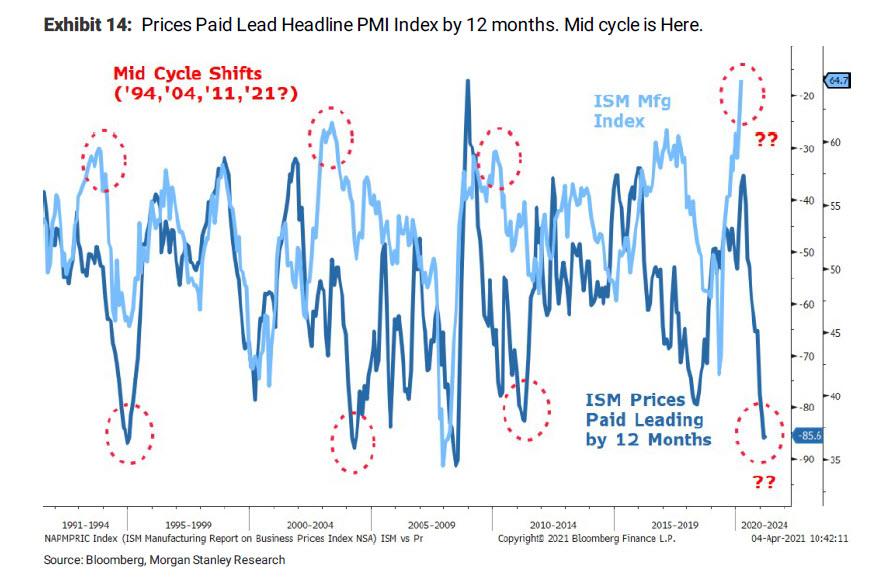
  • Second, two weeks ago we recommended investors upgrade their portfolios by adding higher-quality stocks that have a better chance of managing through this reopening transition.  If there’s one thing we’ve been surprised about over the past year, it’s the speed with which our recovery thesis has played out. That means we are likely to move to mid-cycle from early-cycle sooner than usual, and quality should benefit.

In line with that view, we also downgraded Consumer Discretionary to Underweight, a classic early-cycle winner, and upgraded Staples to Neutral as a means of increasing quality while reducing portfolio beta.

https://www.zerohedge.com/markets/morgan-stanley-breakdown-small-caps-warning-sign-reopening-will-be-more-difficult

40% Of Marines Refuse COVID-19 Vaccine

 Just under 40 percent of US Marines are refusing to take the COVID-19 vaccine, according to data obtained by CNN.

According to the report, 38.9% of Marines - with an average age of 25, putting them at roughly 0.18% risk of death, are refusing to take the jab - which doesn't prevent one from getting COVID-19, falling ill, or transmitting it. Who could have guessed that extraordinarily fit people with a minimal chance of death don't want to inject the most rushed vaccine in history.

"The Navy and Marine Corps are providing substantial educational information broadly, and working with commands to ensure Marines, Sailors, and beneficiaries have accurate information regarding the safety and efficacy of the vaccines to encourage individuals to get immunized," said Marines spokesman, Capt. Andrew Wood, in a statement to The Hill, adding "We continue to make the vaccine available to Marines, Sailors, civilians, contractors and authorized beneficiaries based on the prioritization schedule listed in the [Department of Defense] population schema."

According to the data, approximately 75,500 marines have been vaccinated, while 48,000 have declined. The overall acceptance rate is 61.1%. The figures include active-duty, reserves, and the Individual Mobilization Augmentee Marines, according to the CNN report.

The rate of declined vaccines was as high as 57% at Camp Lejeune in North Carolina.

Due to the vaccine's emergency use authorization by the Food and Drug Administration (FDA), the military can't force service members to get vaccinated.

https://www.zerohedge.com/covid-19/40-marines-refuse-covid-19-vaccine

Italian diagnostics group DiaSorin to buy Luminex for $1.8B

 Italian diagnostics group DiaSorin SpA said on Sunday it will acquire U.S. based Luminex Corp for $1.8 billion in an all-cash deal that will strengthen DiaSorin’s molecular diagnostics technology.

Luminex shareholders will receive $37 for each of Luminex share, DiaSorin said in a statement.

The transaction, which will be funded through a mix of cash and external financing, will be immediately accretive to DiaSorin’s earnings per share, it said.

Following the deal, the combined entity will have 2020 revenues of about 1.25 billion euros ($1.49 billion), DiaSorin said.

Luminex, whose technology is used to detect presence of COVID-19 antibodies in people, manufactures and sells proprietary biological testing technologies and products.

The transaction is expected to close within the third quarter of 2021, creating synergies of about $55 million within 3 years after closing.

https://www.reuters.com/article/us-luminex-m-a-diasorin/italian-diagnostics-group-diasorin-to-buy-luminex-for-1-8-billion-idUSKBN2BY0R2

English shops and pub gardens reopen in 'major step' to freedom

 England’s shops, hairdressers, gyms and pub gardens will reopen on Monday in what Prime Minister Boris Johnson said was a “major step” towards freedom from the restrictions of the COVID-19 pandemic.

Hundreds of thousands of businesses have been closed since early January when England entered a third lockdown to stem surging infections driven by the “Kent” variant of the virus.

A vaccination campaign that has delivered a first shot to well over half of adults and lockdown measures have cut deaths by more than 95% and cases by over 90% from the January peak.

Sunday’s seven deaths within 28 days of a positive COVID test is the lowest daily death toll by this measure since Sept 14.

That progress would allow a staged easing of lockdown to proceed, Johnson said earlier this month, adding that he was looking forward to a pint in a pub garden.

“I’m sure it will be a huge relief for those business owners who have been closed for so long, and for everyone else it’s a chance to get back to doing some of the things we love and have missed,” he said in a statement on Sunday.

“I urge everyone to continue to behave responsibly and remember ‘hands, face, space and fresh air’ to suppress COVID as we push on with our vaccination programme.”

With more than 127,000 fatalities, the United Kingdom has the fifth highest death toll in the world from COVID-19.

Persuading people to return to some kind of normality and start spending again is key to Britain’s recovery after official data last month showed that 2020 was the worst year for its economy in more than three centuries.

UK retailers, which have lost an estimated 27 billion pounds ($37 billion) in sales during lockdowns, are hoping pent-up demand will fuel a trading boom.

Non-essential stores, such as home and fashion chains, will reopen in Wales as well as England on Monday, although those in Scotland need to wait until April 26.

Pubs and restaurants will only be able to serve outdoors from Monday, although early rules requiring meals to be served with drinks and curfews have been scrapped.

Indoor service will not be allowed until May 17 at the earliest.

https://www.reuters.com/article/us-health-coronavirus-britain/english-shops-and-pub-gardens-reopen-in-major-step-to-freedom-idUSKBN2BY0RW

Chile defends Sinovac use amid fresh efficacy questions

 Chilean authorities on Sunday backed the country’s widespread use of the COVID-19 vaccine manufactured by Chinese firm Sinovac after China’s top disease official appeared to make conflicting statements about its efficacy.

Gao Fu, the director of the Chinese Centers for Disease Control and Prevention, told a conference in the Chinese city of Chengdu on Saturday that the country was considering mixing COVID-19 vaccines since currently available vaccines “don’t have very high rates of protection.”

He later said in an interview with state media that his comments were “completely misunderstood.”

Available data shows Chinese vaccines lag behind others including Pfizer and Moderna in terms of efficacy, but require less stringent temperature controls during storage.

The COVID-19 vaccine developed by China’s Sinovac was found to be just over 50% effective in reducing infection in Brazilian clinical trials. A real-world study of vaccination and contagion data by the University of Chile suggested last week the vaccine was 54% effective in reducing infection.

Chile paid $3.5 million to host a clinical trial of the vaccine and has also ordered 60 million doses to be administered to its 18 million-strong population over three years.

The country has largely relied on the Sinovac vaccine, along with smaller numbers of Pfizer’s equivalent drug, to roll out one of the world’s fastest vaccination campaigns, so far inoculating 4.6 million people with two doses and 7.2 million with one.

Chile also signed deals for the supply of vaccines from western drugmakers Johnson & Johnson and AstraZeneca but these are yet to materialise because of supply bottlenecks.

On Sunday, Chilean science minister Andres Couve said it was important to focus on the data and the vaccine’s effectiveness in reducing illness that required medical treatment or being hospitalized or dying, which it achieved in the Brazilian study in 83.7% and 100% of cases respectively.

He said Chile’s health ministry will shortly publish a real world study on the effectiveness of both vaccines rolled out in its population and appealed to Chileans to continue to participate in the vaccination programme.

Heriberto Garcia, director of Chile’s Public Health Institute which greenlighted CoronaVac’s emergency roll-out, said people should not pay attention to headlines.

“The University of Chile study and the study the health ministry will release say the same thing: the number of people who fall ill and are hospitalized has decreased,” he told local newspaper La Tercera. “We are going down the right path.”

https://www.reuters.com/article/us-health-coronavirus-sinovac-chile/the-right-path-chile-defends-sinovac-use-amid-fresh-efficacy-questions-idUSKBN2BY0SH

Blinken criticizes China, says 'need to get to the bottom' of COVID-19 origin

 China’s failure to provide access to global health experts made the COVID-19 pandemic worse than it had to be, U.S. Secretary of State Anthony Blinken said on Sunday, and it was important to “get to the bottom” of the origin of the novel coronavirus.

The top U.S. diplomat’s sharp words underscored criticism from other members of the Biden administration over Beijing’s lack of transparency in the crucial early days of the pandemic.

China did not give access to international experts or share information in real time to provide true transparency, Blinken said in an interview with NBC’s “Meet the Press.”

As a result, the virus “got out of hand faster and with, I think, much more egregious results than it might otherwise,” Blinken said.

The World Health Organization director-general, Tedros Adhanom Ghebreyesus, said on March 30 that data was withheld from WHO investigators who traveled to China to research the origins of the pandemic.

A WHO report, written jointly with Chinese scientists, released at the time said the virus had probably been transmitted from bats to humans through another animal, and that a lab leak was “extremely unlikely” as a cause.

Tedros said the issue required further investigation.

The events highlight why there needs to be a stronger global health security system to ensure this doesn’t happen again, Blinken said. Reforms must include a commitment to transparency, information sharing and access for experts “and China has to play a part in that,” he said.

Blinken said it was important to reach a more conclusive accounting of how the pandemic began.

“We need to do that precisely so we fully understand what happened, in order to have the best shot possible preventing it from happening again,” he said. “That’s why we need to get to the bottom of this.”

When the WHO report was issued in March, the United States, the European Union and other Western countries called for China to give “full access” to independent experts to all data about the original outbreak in late 2019.

https://www.reuters.com/article/us-health-coronavirus-blinken/top-u-s-diplomat-criticizes-china-says-need-to-get-to-the-bottom-of-covid-19-origin-idUSKBN2BY0OQ