Search This Blog

Tuesday, September 28, 2021

England’s cancer therapy backlog ‘could take more than a decade to shift’

 A new report has suggested it could take until 2033 to clear the backlog of cancer treatment in England caused by the pandemic.

The analysis by the Institute for Public Policy Research (IPPR) and Carnall Farrar (CF) consultancy suggests that timeline will be the result if hospitals can operate at a level 5% above what they were achieving before COVID-19.

Raise that to 15% however, and the backlog could be wiped out next year, according to the study, which estimates that 15% fewer people than expected – 369,000 individuals – had been referred to a cancer specialist since the start of the pandemic.

It also calculates that 19,500 people who should have been diagnosed with cancer had not been as a result of missed referrals, and for some of them it will now be too late to hope for a cure. There were also 7% fewer chemotherapy courses delivered, and 13% fewer radiotherapy procedures.

The IPPR and CF argue that the rise in cancer care activity that is needed can only be achieved with a new policy to increase the cancer workforce and investment in diagnostic equipment – beyond the £5.4 billion in new funding for NHS England announced earlier this month by the government.

Returning merely to pre-pandemic levels should not be the objective, they maintain, as the UK had poor cancer outcomes compared to similar countries, including relatively low numbers of CT and MRI scanners per head and workforce shortages across all cancer-related services.

“The pandemic has severely disrupted cancer services in England, undoing years of progress in improving cancer survival rates.” Said IPPR research fellow Dr Parth Patel.

“Clearing the cancer care backlog before the next general election looks unlikely with the way the NHS is currently resourced, staffed and organised,” he added.

The authors are calling for measures to increase staffing levels – including a revision of pension tax rules to swell the number of oncology consultants – as well as investment in more diagnostic machines and  mobile/community diagnostic units.

Expanding MRI scan capacity by 10% could clear the full MRI backlog in the NHS by 2024 instead of 2040, according to the report.

“The impact of the pandemic on cancer services cannot be disassociated from the political and policy decisions that came before it,” said Chris Thomas, senior research fellow at IPPR. “Years of austerity ripped the resilience out of cancer care.”

In the last 6 years, almost 55,000 cancer patients should have been diagnosed quicker or started their treatment sooner, according to calculations from Cancer Research UK.

This is because, in England, the NHS has continued to miss its target to treat 85% of cancer patients within two months of their urgent suspected cancer referral. A target that exists to ensure that patients are seen, diagnosed and treated quickly, according to the charity.

https://pharmaphorum.com/news/englands-cancer-therapy-backlog-could-take-more-than-a-decade-to-shift/

Pfizer submits trial data for kids COVID-19 vaccine to FDA; November OK eyed

 Pfizer and BioNTech announced Tuesday that they have submitted clinical trial data to the Food and Drug Administration for their COVID-19 vaccine in children ages 5 to 11.

Last week, the drugmakers announced that their vaccine is safe and generated "robust neutralizing antibody responses" in that age group. 

The data are being shared with the FDA for the agency’s initial review. The companies said they plan to formally request in the coming weeks that regulators expand the vaccine’s emergency use authorization to include children 5 to 11.

The Pfizer-BioNTech vaccine received emergency use authorization for people 16 and older in December and was given full FDA approval in August. The vaccine has been authorized for emergency use in 12- to 15-year-olds since May.

It took the FDA about a month to approve the companies’ request to authorize the vaccine for ages 12 to 15. If the process follows a similar timeline, the shots could be available to children 5 to 11 sometime in November.

Pfizer and BioNTech said the clinical trial has shown that the lower dosage of the vaccine in 5- to 11-year-olds generates antibody levels just as strong as in teenagers and young adults after the second dose.

Side effects — such as fever, achiness or sore arms — were similar to those observed in people ages 16-25.

Nearly 928,000 cases of COVID-19 have been reported in children over the past four weeks, according to the American Academy of Pediatrics. While pediatric cases are on the decline, children and adolescents accounted for 26.7% of reported infections in the week ending on Sept. 23.

https://www.ny1.com/nyc/all-boroughs/health/2021/09/28/pfizer-submits-trial-data-for-kids-covid-19-vaccine-to-fda

Initial Clinical Data from Editas Medicine Retinal Disorder Trial Due Sept. 29

 Data to include patient safety assessments and a preliminary analysis of secondary endpoints to evaluate biological activity

Abstract selected for oral presentation on September 29

Company to host webcast investor event following the presentation on September 29 at 11:00 a.m. ET

Editas Medicine, Inc. (Nasdaq: EDIT), a leading genome editing company, today announced that an abstract featuring initial clinical data from the BRILLIANCE clinical trial of EDIT-101 has been selected for an oral presentation at the XIXth International Symposium on Retinal Degeneration (RD2021) being held in Nashville, Tenn., and virtually September 28 – October 2, 2021. EDIT-101 is under development for the treatment of Leber congenital amaurosis 10 (LCA10), a CEP290-related retinal degenerative disorder.

“We look forward to sharing our Company’s first clinical data at RD2021 and our progress towards developing a transformative gene editing medicine for people living with CEP290-related retinal degeneration. The presentation will include an evaluation of clinical data from the first two adult cohorts as the study continues into the pediatric mid-dose and adult high-dose cohorts,” said Lisa Michaels, M.D., Executive Vice President and Chief Medical Officer, Editas Medicine. “I would like to thank all of the patients who have and will participate in this landmark gene editing medicine clinical trial.”

The presentation will include patient safety assessments and a preliminary analysis of secondary endpoints relating to signals of gene editing and clinical benefit. Cumulative data from patients in the adult low-dose and mid-dose cohorts and will be presented by one of the study’s Principal Investigators, Dr. Mark Pennesi, M.D., Ph.D., Professor of Molecular and Medical Genetics, Kenneth C. Swan Endowed Professor of Ophthalmology, Paul H. Casey Ophthalmic Genetics Division Chief, Casey Eye Institute, Oregon Health & Science University.

Full details of the Editas Medicine presentations can be accessed on the RD2021 website at http://www.rdmeeting.net/RD2021Program.pdf.

Oral Presentation:
Title: BRILLIANCE: A Phase 1/2 Single Ascending Dose Study of EDIT-101, an in vivo CRISPR Gene Editing Therapy, in CEP290-Related Retinal Degeneration
Session Title: Platform Session V: Clinical Trials
Date and Time: Wednesday, September 29, 2021, 9:05 – 9:35 a.m. ET
Presenter: Dr. Mark Pennesi, M.D., Ph.D., Professor of Molecular and Medical Genetics, Kenneth C. Swan Endowed Professor of Ophthalmology, Paul H. Casey Ophthalmic Genetics Division Chief, Casey Eye Institute, Oregon Health & Science University.

Investor Event and Webcast Information
Editas Medicine will host a live webcast on Wednesday, September 29, 2021, at 11:00 a.m. ET to review the presented data. To join the webcast, please visit this link or visit the Events & Presentations page of the Investor section of the Company’s website on September 29. A replay of the webcast will be available on the Editas Medicine website for 30 days following the call.

https://finance.yahoo.com/news/initial-clinical-data-editas-medicine-200000939.html

JPMorgan Concludes That Delta Variant Was 'Less Infectious Than Feared'

 Now that the Delta variant in the US has peaked in terms of new cases, hospitalizations and deaths, media fearmongering surrounding the latest round of the covid pandemic has understandably been quietly pulled from the front pages at least until such time the mu variant, or some other virulent strain du jour, makes a triumphant appearance and Fauci is again trotted across the mainstream media to distill a fresh round of fear and set the scene for a new round of restrictions and lockdowns, a cycle that will repeat at least until the mid-term elections which predictably will have to be conducted largely by mail.

And while we wait we wanted to remind readers that last week, JPMorgan made a remarkable discovery: looking at the number of delta variant infections in emerging markets, JPMorgan policy research analyst David Mackie found that "the Delta wave was much milder than expected: none of these countries saw the gains in Re that we anticipated."
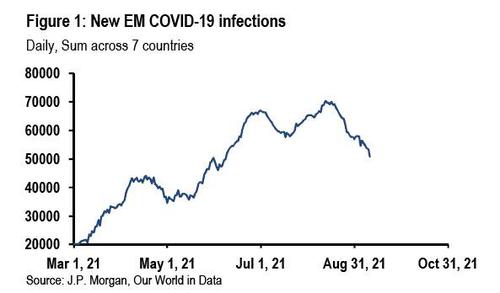
This prompted JPMorgan to wonder if "the Delta variant may be less infectious than initially assumed."

Needless to say, such a finding would blow up the carefully scripted narrative promulgated by the likes of Anthony Fauci, that Delta was far more contagious and "potentially" more deadly than previous variants.

So fast forward to today when JPMorgan completes its analysis by looking at the Ro or - basic reproduction number (R0) for the Delta variant of SARS-CoV-2 - for all countries, not just a handful of emerging nations. As JPM explains, R0 is important "because it is R0 that determines the underlying infectiousness of the virus, and thus what level of immunity in the population, or what manner of changes in behavior, are needed to stabilize new infections as the variant spreads."

In the note which could have tremendous implications for public health policy - assuming it ever sees the light of day - JPM's Mackie estimates what has happened to R0 in a number of countries over the period 1 May to 15 September, except for India and the UK where we started the analysis on 1 February and 1 April respectively due to the earlier arrival of the Delta variant in those two countries, as a way of gauging the pressure coming from the Delta variant.

Our method is to see how much of the change in Re over this period we can explain by developments in mobility, vaccinations and acquired immunity. What’s left unexplained is attributed to a change in R0 due to the spread of the Delta variant. These calculations are very approximate. They don’t take account of changes in non-pharmaceutical interventions, such as mask wearing, which probably eased over this period. If so, this would suggest that the increase in R0 due to the Delta variant is lower than our estimates.

The stunning results are presented in Table 1.
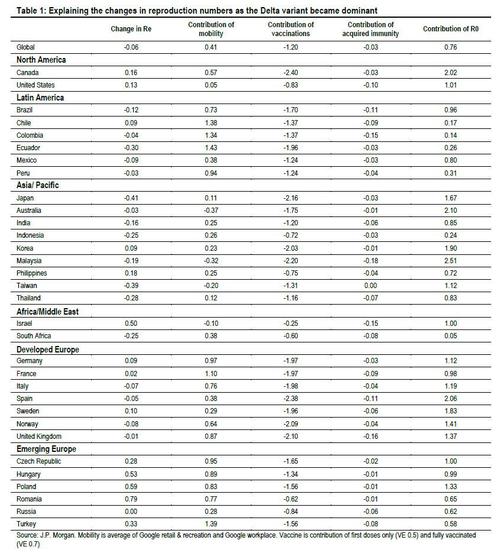
They show that at the global level, "the message is clear": as JPM puts it, "the increased infectiousness of the Delta variant as expressed in the implied change in R0 is very low, below the bottom end of the widely accepted range. An estimated increase in R0 of 0.76 due to the spread of the Delta variant would put the level of R0 for the Delta variant at 4.76, assuming that R0 for the Alpha variant is 4.0."

Such a "modest increase" in R0 explains why the Delta wave of infection has been so benign on average around the world. Global daily new infections picked up from around 360,000 in mid-June to around 660,000 in late August, but this wave faded fairly quickly and new infections now stand at around 380,000.

It also flies in the face of any and all previous claims that Delta was much more "contagious" than previous variants.

Looking across the world, JPMorgan finds that the modest estimated increase in R0 is not evenly distributed. On average the estimated increase in R0 in developed markets has been around 1.5, towards the bottom end of the range of 1.0  to 4.0 estimated by academics. However, across emerging markets the increase has generally been smaller on average, especially in Latin America.

According to JPM, "it is hard to fully understand the DM/EM difference." One explanation proposed by JPM is that it is "possible that under-reported infections are larger in EM. Take Brazil, for example, where the estimated increase in R0 due to the Delta variant is 0.96. If actual infections had been five times larger than reported infections, then the implied increase in R0 in Brazil would be 1.5, the same as the average increase in the US, Western Europe and Japan."

Other countries are harder to rationalize in this way. Take Indonesia, for example, where the estimated increase in R0 due to the Delta variant is 0.24. Actual infections would have to have been forty-two times greater than reported infections in order to get an implied increase in R0 in Indonesia of 1.5.

And here another stunning observation from JPM, one which also trounces the Biden admin's feverish attempts to downplay natural immunity. As JPMorgan writes, "If under-reporting of infections explains why estimates of the increase in R0 are small in some EM countries, then this is good news looking forward if we assume that immunity from infection and recovery is the same as that from vaccination."

JPMorgan concludes with the provocative observation that "the infectiousness of the Delta variant is at the lower end of the range  estimated by academics early in the summer" a range which was estimated to be between 1.0 and 4.0 but in reality the number was around 1.5!

And so, with the global Re currently at close to 1.0 and falling, and the Delta variant fully absorbed, the largest US bank, "the world looks well placed to see a steady pace of infections in the coming months" JPM says, adding that "overall, the global Delta infection wave has been modest thus far and is expected to remain so."

Now if only one of the numerous "impartial", "objective" TV anchors would ask media celebrity Dr. Fauci during any of his upcoming TV appearance about the finding of this study.

https://www.zerohedge.com/markets/jpmorgan-concludes-delta-variant-was-less-infectious-feared 

Altimmune slims down on side-effect concerns

 The impressive weight loss seen with Altimmune’s GLP-1/glucagon dual receptor agonist pemvidutide today was not enough to distract investors from a case of liver enzyme elevations in the project’s phase 1 obesity study. Rates of nausea and vomiting were also on the high side; however, these issues were most apparent at the highest dose tested, 2.4mg, and looked more manageable with 1.8mg, now Altimmune’s focus. The group stressed that most of the adverse events were mild, and no patients dropped out owing to side effects. The 1.8mg dose led to a mean 10% weight loss in nine patients after 12 weeks – up from 5% in June, when six-week data from the same study were reported. Altimmune hopes that this rate of weight loss will continue, and this will be put to a test in a 48-week phase 2 obesity trial slated to start next year; a phase 2 study in Nash is also planned. Still, the liver enzyme elevations occurred in a patient in the 1.8mg cohort, and the group’s stock opened down 25% this morning. If Altimmune is to gain a foothold in this competitive space it will have to hope that this is an isolated case.

Cross-trial comparison of Altimmune's pemvidutide vs Novo Nordisk's Wegovy
 Pemvidutide 1.2mgPemvidutide 1.8mgPemvidutide 2.4mgWegovy*
Weight loss (percentage points)3.38.77.46.2-12.4
Nausea (%)14564644
Vomiting (%)14114624
Diarrhoea (%)001830
Discontinuations due to AEs (%)0007
Note: weight loss numbers all placebo-adjusted. *Wegovy data at 68wk, vs 12wk for pemvidutide. Source: company release & Wegovy label.

https://www.evaluate.com/vantage/articles/news/snippets/altimmune-slims-down-side-effect-concerns

Eisai files, and the sellside endorses the Alzheimer’s opportunity

 Eisai and Biogen’s lecanemab (BAN2401) looks to become the next test of the FDA in Alzheimer’s disease. The Japanese firm, which is leading development of the amyloid beta MAb, confirmed yesterday that it had started a rolling submission. Accelerated approval will be sought on the back of Study 201, a phase 2b trial that failed but which the partners believe yielded signals of efficacy. The FDA will decide whether to accept lecanemab’s filing when the submission is complete, which could happen by year end. Importantly, however, a final decision is unlikely before lecanemab's phase 3 Clarity AD study yields data towards the end of 2022. Meanwhile, a very slow Aduhelm launch has not dimmed the sellside’s optimism for the Alzheimer’s opportunity. Consensus forecasts show all four leading MAbs hitting blockbuster status by 2026, according to Evaluate Pharma, an outlook that feels ambitiousThe outcome of Medicare’s National Coverage Determination, due early next year, remains hugely important for this outlook. The agency will decide whether the US government should reimburse Aduhelm or restrict its use, a decision that could apply to other antibodies that reach the market. A weak third quarter from Biogen could also send numbers down; second-quarter Aduhelm sales amounted to only $2m.

$mBlockbuster dreams? Outlook for the Alzheimer's antibodies(Sellside consensus)Donanemab (Eli Lilly)Aduhelm (Biogen sales only)Gantenerumab (Roche)Lecanemab/BAN2401 (Eisai/Biogen)20212022202320242025202605k10k15k20kEvaluate Pharma2022 Gantenerumab (Roche): $11m

Over 400,000 in US got Covid booster at pharmacies over the weekend: Zients

 More than 400,000 Americans received a Covid-19 booster shot at pharmacies over the weekend after the CDC cleared third doses of Pfizer and BioNTech’s vaccine to a wide array of Americans, White House coronavirus response coordinator Jeff Zients said Tuesday.

Nearly 1 million people have scheduled to get their extra dose at a pharmacy over the coming weeks, he told reporters at a press briefing, adding that the state and federal preparations for boosters have “propelled a strong start.”

“At the same time, our top priority remains first and second shots,” he said.

Overall, roughly 2.8 million Americans have received an extra dose since health officials authorized the third shots of Pfizer or Moderna’s vaccines to people with weakened immune systems in August, according to data compiled by the Centers for Disease Control and Prevention.

Zients’ comments come as federal health officials say they are seeing a decline in protection against infection several months after people received their first two doses. The shots remain highly effective against severe disease, hospitalizations and deaths, they said.

CDC Director Dr. Rochelle Walensky on Friday signed off on a series of recommendations, including distributing the shots to older Americans and adults with underlying medical conditions at least six months after their first series of shots.

Walensky also approved booster shots for those in high-risk occupational and institutional settings, a move that overruled the agency’s Advisory Committee on Immunization Practices after it rejected the same proposal hours earlier.

President Joe Biden received a booster shot on Monday since his age at 78 made him eligible for a booster under the CDC’s latest guidance. 

Walensky said last week that officials will move “with the same sense of urgency” on recommendations for Moderna and Johnson & Johnson boosters as soon as that data is available.

Moderna submitted its application for booster shots on Sept. 1 and J&J said Wednesday that it also submitted its data showing that an extra dose of its single-shot vaccine raises protection against infection to 94%.

https://www.cnbc.com/2021/09/28/covid-booster-shot-white-house-says-more-than-400000-americans-received-doses-at-pharmacies-over-the-weekend.html