Search This Blog

Sunday, January 29, 2023

English health service sets out two-year recovery plan for emergency care

 England's National Health Service (NHS) on Monday announced a two-year recovery plan to help restore emergency care and frontline services, currently struggling through one of their toughest winters.

The state-funded NHS said it sought to reduce waiting times and improve patient experience under the plan, which includes 800 new ambulances and 5,000 new beds backed by a 1 billion pound ($1.2 billion) fund.

"Urgent and emergency care is facing serious challenges but we have an ambitious and credible plan to fix it," Prime Minister Rishi Sunak said.

Sunak, in office for just three months, has said cutting hospital waiting times is one of his major priorities.

The circulation of COVID-19 and flu has increased winter pressures when hospitals are already trying to deal with huge backlogs bequeathed by the pandemic.

To make matters worse, ambulance workers and nurses have been on strike over pay, staffing, and investment levels that frontline staff say leave them ill-equipped to cope with record demand.

Patients have faced waits of many hours in ambulances stuck in queues outside hospitals, unable to discharge patients due to a lack of available beds.

The government on Sunday announced that more elderly and vulnerable patients would be treated at home to avoid unnecessary trips to hospital, while the NHS said same-day emergency care units would try to reduce the number of people staying in hospital overnight.

"The front door to the NHS is often where we can see the pressures build up," NHS England Chief Executive Amanda Pritchard said.

"To relieve that pressure, we will continue to work with social care colleagues to free up space in hospitals so that people who are well enough to leave can be discharged and get the care they need at home or in the community."

https://www.yahoo.com/now/english-health-sets-two-recovery-000259389.html

As ResMed tops $1B revenues in Q2, CEO says Philips' return to CPAP market 'not a big perturbation'

As Philips’ recall of many of its CPAP and BiPAP machines and other respiratory devices grew to include more machines and sparked tens of thousands of patient complaints, ResMed stepped up to fill that gaping hole left in the market.

So far—despite some supply constraints that kept ResMed from churning out quite as many CPAP machines as it would’ve liked—that’s been an overwhelmingly successful move for the company.

ResMed’s revenues reached new heights in fiscal year 2022, which ended June 30, when it raked in nearly $3.6 billion for the year. And the trend is only continuing: For the second quarter of its fiscal year 2023, the company reached $1.03 billion in revenues, marking its highest-ever quarterly haul. That’s 16% higher than the same period the previous year and also tops the previous record—which was set just one quarter earlier and clocked in at $950 million—by about 8.8%.

The devicemaker’s profits also continued to climb. According to Thursday’s earnings report, ResMed took home a net income of nearly $225 million for the quarter, representing an 11% year-over-year jump in profits.

ResMed attributed its fast-growing fortune largely to Philips’ recall: “Revenue growth reflected increased demand for our sleep products across our portfolio and ongoing increased device demand generated by our competitors’ product recall,” CEO Mick Farrell told investors on a call discussing the quarterly results.

And the company isn’t especially concerned about Philips’ impending resurgence in the market. The Dutch devicemaker is now 90% through its repair-and-replace program for the 5.5 million recalled products, but as Farrell said on Thursday’s call, while the return of ResMed’s biggest competitor is “not irrelevant,” it’s also “not a big perturbation of our long-term strategy and our long-term business.”

Farrell said ResMed has “run scenarios” gaming out the impact on the company if Philips returns next month, this summer or not until next year—“and actually, in all those scenarios, ResMed grows, and ResMed does really well, and ResMed does a really good job of taking care of the unmet patient need,” the CEO said.

He predicted that ResMed will continue to widen the gap between the competitors even after Philips resumes sales of its CPAP machines—whenever that may be—since Philips will have to play quite a bit of catch-up first against “the OK players” before clawing its way to a fight against ResMed, “the market leader,” per Farrell.

That confident outlook comes even as the slow-moving supply chain remains a point of concern for ResMed. To battle those challenges, the company opened a new manufacturing facility in Singapore last fall and has doubled down on its output at other facilities and in its partnerships with suppliers, with an aim of leaving behind those supply constraints by the end of 2023, Farrell said on Thursday’s call.

“We see the supply environment improving every week, every month and every quarter, and our access to the specific electronic components we need has increased,” he said. “We are confident in our ability to fulfill all customer demand before the end of calendar year 2023 and we expect to see steady ongoing incremental device revenue growth in the third and fourth quarters of our fiscal year 2023.”

https://www.fiercebiotech.com/medtech/resmed-tops-1b-revenues-q2-ceo-says-philips-return-cpap-market-not-big-perturbation-longn'

Raise The Social Security Age To (At Least) 75

 by Ryan McMaken via The Mises Institute,

On January 10, the French government announced plans to raise the retirement age from 62 to 64.

The change would mean that after 2027, workers in France would have to work 43 years to qualify for a government pension, instead of 42 years. French workers promptly took to the street in protest decrying even this very small reduction government welfare.

Like many countries in Western Europe and North America, France faces a major demographic problem in that its population is aging and demanding ever larger amounts of public pension funds.

Meanwhile, the younger working-age population is shrinking as birth rates continue to fall. So, the French state is looking for ways to stay relatively solvent.

For Americans who follow our own old-age social benefits systems, this problem will seem quite familiar. Although the US regime is not in as dire fiscal straits as the French one, the US's federal government nonetheless faces huge and growing obligations to current and future pensioners. This will only grow more urgent as the population continues to age and as the numbers of prime-age workers stagnates. 

Indeed, the Social Security scheme is an excellent example of how government programs, once established, gradually become far more costly—in real per capita terms, not just aggregate terms—as time goes by.  Many recipients now spend decades collecting benefits on a program that had been sold as a program only for people who were too old, exhausted, and injured to work at all. Meanwhile, fewer and fewer workers are called upon to foot the inflated bill. 

At the center of this mission creep for Social Security is the fact that Social Security benefits originally began at age 65. Yet, at that same time, the life expectancy at birth was below 65. (It's much higher now.) Many people lived well past 60 back then, of course, but not nearly as many as do today. In other words, a far smaller fraction of the work force collected Social Security, and for a shorter period. Today, however, more workers live long enough to collect Social Security, and they now receive payments for longer. That's a sure way to inflate the cost to taxpayers of old-age benefits. (It's also a sure way to encourage able-bodied workers to leave the workforce, thus tilting the economy more toward consumption rather than production.) 

Even if we ignore the moral problems presented by transferring huge amounts of income from current workers to pensioners, the realities of demographics in the twenty-first century mean the minimum "retirement age" should really be at least 75.  Too long has a shrinking pool of workers been forced to fund pensioners who start collecting government benefits in their 60s and can now expect to be on the dole for 20 years or more.  Moreover, this phenomenon is growing. Social Security increasingly forces today's workers to shoulder an ever-greater burden on their ability to earn a living and support their families. The days of subsidized extended vacations for able-bodied 65-year olds must come to an end, but until that day comes, the damage can at least be limited by raising the age of eligibility. 

The Original Justification for Social Security 

When it was being sold to the public in 1935, those promoting Social Security took advantage of sentiments that people over age 65 were essentially too old to work, and thus would soon fall into poverty. This certainly would have seemed plausible at the time. Most jobs in 1935 involved significant amounts of physical labor whether we're talking about cleaning laundry, waiting tables, farming, mining coal, or building houses. Work was also more dangerous—as historical work injury data makes clear—and workers were more likely to sustain injuries that would render one unable to work. For example, a 65-year-old simply could not safely perform much of the work required at a steel mill. (As shown in this 1944 video on the steel industry.) 

Especially important to efforts at presenting Social Security as fiscally prudent was the fact that with a minimum age of 65, the number of Social Security beneficiaries would also be limited by the realities of life expectancy. In 1940, for example—the first year that pensioners could receive benefits—life expectancy at birth was only 61 for men and 65 for women. Indeed, even if we eliminate the toll of childhood diseases on life expectancy, the numbers do not change dramatically. In 1940, total life expectancy for persons over 15 years of age was 68. Moreover, in 1940 the percentage of the population surviving from age 21 to 65 was only 54 percent for males and 61 percent for females. But what about those who actually made it to age 65? In 1940, a male at age 65 would, on average live another 13 years. A female would live another 15 years. So, when looking at the work force in 1940, we can eliminate nearly half of the men and about 40 percent of the women as likely future Social Security recipients. About half of those who actually made it to 65 would then collect benefits for no more than 15 years.

Now let's contrast that with life expectancy realities in our own time. 

Life expectancy at birth today is 78 years, and for those who reach age 15, it is 80. for both men and women, more than 75 percent of the population reaching 21 will survive to age 65. That's an increase of 50 percent for men, and around 30 percent for women. For those reaching age 65 in 2022, males will live another 18 years on average, while females will live another 20 years

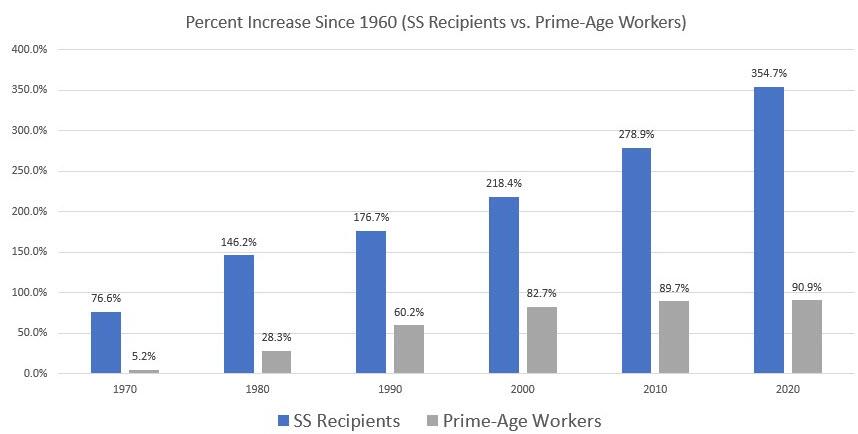
These growing commitments from Social Security are further aggravated by the fact that while the retiree population is growing, growth in the work force is stagnating. Since 1960, the total number of Social Security recipients has increased by 364 percent. Meanwhile, the prime age population (age 25-54) has grown by only 90 percent. Put another way, in 1960, there were 4.6 prime age workers per Social Security recipient. In 2020, that number was 1.9. 
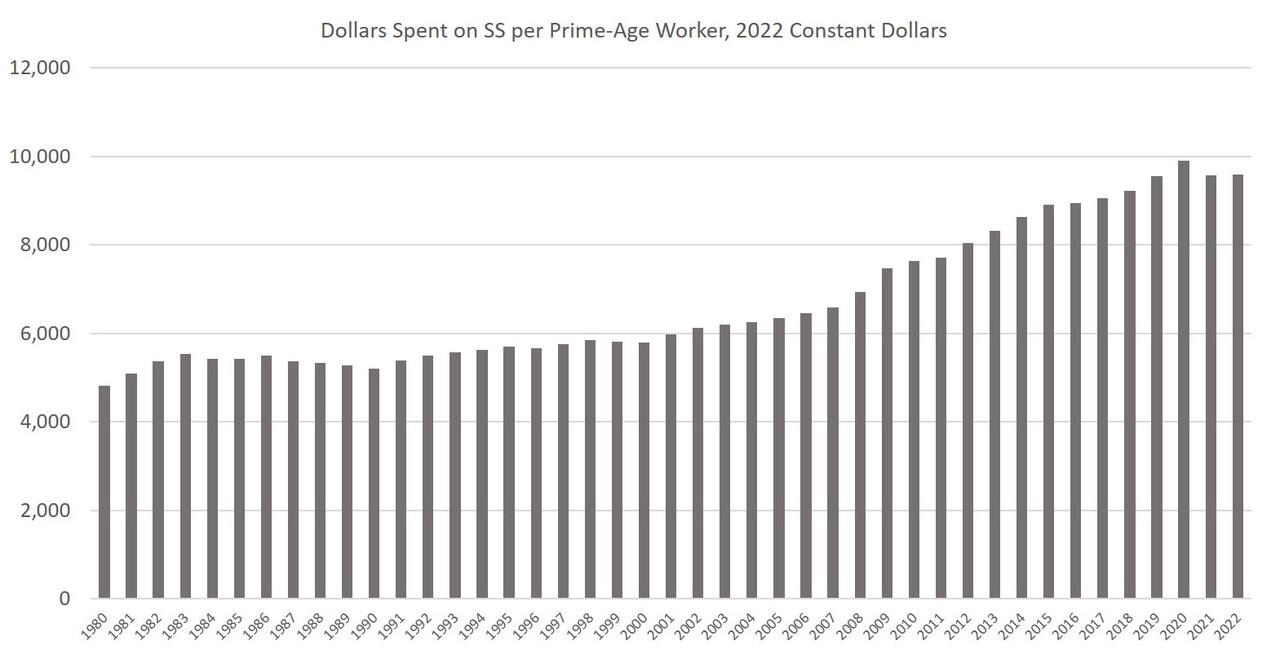
Now let's look at this in dollar terms. Per prime-age worker, inflation-adjusted dollars spent on SS amounted to $9,590 in 2022. That's up from $4,814 in 1980, or an increase of 99 percent over the period. During the same period, inflation-adjusted weekly earnings for workers increased 16 percent. Part of this discrepancy is due to the fact SS payments are consistently—as mandated by law—bumped up by cost-of-living adjustments to account for price inflation. Wage workers enjoy no such guarantees. 
Social Security benefits are rapidly outpacing both population growth and earnings growth. In the aggregate, the program is more generous (toward pensioners) than ever. 

To stanch some of the bleeding from today's workers who get an increasingly raw deal on this, the time has come to stop the ever-upward creep in how much Social Security recipients collect. 

As noted above, we see that, on average, men and women collect Social Security for a period that has grown by five years since 1940—an increase of 38 percent for men, and 33 percent for women.  To even put a dent in this, the minimum age for SS needs to rise to 70. Yet, even this is much too low given how turning 65 in 2022 is nothing like what it was in 1940. Ever since it was first put forward, Social Security has assumed that reaching the age of 65 is also closely associated with disability. That may have been a good assumption in 1935 when work was more often dangerous, likely to produce disability, and medical care was much less adept at addressing these disabilities. 

In 2022, however, the word "disabled" hardly describes the majority of Americans in the 65-74 age range. Indeed, only one quarter of this population reports having any disability at all. The share of Americans from 65-74 who report poor health has been declining, as has the proportion of workers in physically demanding jobs. It's unclear why 100% of these workers would require government income subsidies. In any case, workers who are actually disabled would qualify for disability benefits even if the age is raised. Moreover, a male worker today who reaches age 75 can still expect to live another 11 years. A female can expect to live even longer. Raising the age to 75 still wouldn't eliminate a taxpayer-subsidized "official" retirement, but the change certainly would reduce the length of time today's workers toil in a state of indentured servitude to today's pensioners.

One thing raising the age has going for it is that it's been done before. A 1983 change very gradually increased the full-benefits age from 65 to 67. That's much too little, and even an increase to age 75 would be a mild reform. Other reforms, up to and including abolition, should include means-testing pensions and totally defederalizing and decentralizing the program. But it's also easy to imagine the tidal wave of opposition from activists who vehemently oppose even a very mild reduction in Social Security payouts. Raising the age won't make Social Security just, prudent, or wise. But cutting federal spending is always the right thing to do.

https://www.zerohedge.com/personal-finance/raise-social-security-age-least-75

BMS settles lawsuit with two fired employees who refused COVID vaccines

 Two Bristol Myers Squibb employees who were fired for refusing to be vaccinated and sued the company have agreed to settlements, court documents show.

Jeremy Beer and John Lott were two of four employees who filed suit in December of 2021 in federal court in the Southern District of New York, later to be joined by four other fired employees who filed in October of last year.

The case of one of the original four who sued, Dr. Carrie Kefalas, was dismissed on Tuesday.

The former employees claimed that BMS violated Title VII of the Civil Rights Act by rejecting their request for religious exemptions from the company’s COVID-19 vaccination policy.

Terms of the settlements were not disclosed. BMS did not immediately respond to a request for comment.

In September of 2021, BMS informed employees they needed to be vaccinated against COVID-19 by Nov. 1 or face dismissal unless they received a religious exemption to the policy.

The two former employees who settled were well-paid professionals. Lott, a biotechnologist with a Master’s degree from Johns Hopkins, was the associate director of strategy and submissions lead, patient safety and epidemiology, with an annual salary of $178,000. Beer was a senior manager for data integrity, with a salary of $146,000.

Kefalas was the head of clinical trial risk management for global drug development with a salary of $300,000 per year. According to the lawsuit, she requested to continue to work remotely and identified herself as a non-denominational “follower of Jesus Christ."

BMS notified Kefalas that her request was denied because her beliefs were not “sincerely held,” according to the lawsuit. BMS also said that in previous internal company communications, Kefalas had questioned the safety of vaccinations without stating any religious objections.

https://www.fiercepharma.com/pharma/bms-settles-lawsuit-two-fired-employees-who-refused-vaccination

Sol-Gel Acquires Patidegib, Phase 3, FDA-Breakthrough-Designated Orphan Product Candidate


to Pursue Potential Market of Over $300 Million

  • Patidegib, an Orphan Drug candidate, broadens Sol-Gel’s pipeline with the potential to be the first therapy for preventing new basal cell carcinomas in Gorlin syndrome, if approved by the FDA
     
  • Phase 3 study expected to initiate in the second half of 2023, with results expected by the end of 2025

Conference Call Information

Sol-Gel will host an investor conference call and webcast today at 8:30 a.m. U.S. ET to discuss today’s announcement.

To participate in the call, dial either the domestic or international number fifteen minutes before the conference call begins:

Domestic:  1-877-704-4453

International: 1-201-389-0920

Passcode: 13736097

The live conference call and replay can also be accessed by audio webcast here and also on the Investor Relations section of the Company’s website, located at https://ir.sol-gel.com/investor-relations. Slides for the accompanying corporate presentation can also be viewed at this link.

https://www.biospace.com/article/releases/sol-gel-acquires-patidegib-a-phase-3-fda-breakthrough-designated-orphan-product-candidate-to-pursue-potential-market-of-over-300-million/


Immunotherapy Survival Gains 'Less Impressive' in Older Lung Cancer Patients

 The introduction of immune checkpoint inhibitors (ICIs) for advanced non-small cell lung cancer (NSCLC) in 2015 has resulted in meaningful survival gains for younger patients, but gains were far more modest among older patients, according to a large cohort study.

In advanced NSCLC patients under 55, median overall survival (OS) increased on the order of 4.5 months from 2011 to 2019, roughly 4 years following the first ICI approval in NSCLC. This improvement met the American Society of Clinical Oncology (ASCO) and European Society for Medical Oncology (ESMO) thresholds for a clinically meaningful benefit.

Yet over this same stretch, the median OS gain for patients 75 and older was a "less impressive" 1.1 months, thus failing to meet ASCO or ESMO's standards, reported Cary Gross, MD, of Yale School of Medicine in New Haven, Connecticut, and colleagues.

"Given that nearly half of newly diagnosed older patients were receiving ICIs by the end of the study period, this suggests that the substantial change in NSCLC treatment patterns has had minimal implications for the survival of older patients," the authors observed in JAMA Oncologyopens in a new tab or window. "In this population, the cost-effectiveness of ICIs may be overestimated."

Their cohort study included 53,719 adult NSCLC patients from predominantly community-based U.S. cancer clinics who had stage IIIB-IV disease diagnosed from 2011 to 2019, with follow-up through the end of 2020. A little more than half of the study participants were men, two-thirds were white, and the average age was 68.5 years.

Gross and his colleagues determined that the overall receipt of cancer-directed therapy increased from 69.0% in 2011 to 77.2% in 2019.

After the first FDA approval

opens in a new tab or window of an ICI for NSCLC, the use of ICIs increased from 4.7% in 2015 to 45.6% in 2019. On the other hand, the use of traditional chemotherapy as an initial treatment declined from 60.2% in 2011 to 22.8% in 2019. ICI use by 2019 was similar between the youngest and oldest patients (45.2% in those under 55 years vs 43.8% in patients 75 and older).

The predicted 2-year survival probability improvement from 2011 to 2018 was 7.1 percentage points higher for the younger group of patients (improving from 37.7% to 50.3% for those under 55) compared with the oldest patients in the study (from 30.6% to 36.2% for those age 75 and older).

Across age groups, the researchers found an inverse association between age group and median OS improvements from 2011 to 2019:

  • <55 years: 4.5-month improvement in (11.5 to 16.0 months, respectively)
  • 55-64 years: 2.1-month improvement (12.9 to 15.0 months)
  • 65-74 years: 2.1 month improvement (11.2 to 13.3 months)
  • ≥75 years: 1.1-month improvement (9.1 to 10.2 months)

ASCO frameworks for NSCLC trials define OS improvements of over 3.25 months for patients with non-squamous disease and of more than 2.5 months for those with squamous NSCLC as being clinically meaningful. Similarly, ESMO's Magnitude of Clinical Benefit Scale defines an OS increase of at least 3 months as being of substantial clinical benefit for cancers with a baseline survival of less than a year.

In a commentary accompanying the study,

opens in a new tab or window Marjory Charlot, MD, of the University of North Carolina Lineberger Comprehensive Cancer Center in Chapel Hill, and Jhanelle Gray, MD, of the Moffitt Cancer Center and Research Institute in Tampa, Florida, wrote that before drawing any conclusions about the association between age and survival, "it is important to note that there are several nuances in examining a clinically meaningful benefit with ICIs," including tumor histology, PD-L1 expression level, Eastern Cooperative Oncology Group status, and use of ICIs either alone or in combinations.

Nevertheless, Charlot and Gray said the study's results demonstrate the difficulty of interpreting and applying survival gains seen in clinical trials, since trial participants are usually younger and fitter. Still, the findings "may help inform shared decision-making discussions in clinical practice, particularly for the oldest adult age group with NSCLC," they suggested.

Disclosures

Gross reported receiving grants from Johnson & Johnson, AstraZeneca, and the National Comprehensive Cancer Network, along with personal fees from Genentech outside the submitted work. Co-authors reported various relationships with industry.

Charlot reported grants from the Lung Cancer Research Foundation and Conquer Cancer/Breast Cancer Research Foundation, as well as serving as a grant reviewer for Flatiron Health outside the submitted work. Gray reported relationships with AbbVie, Axiom Healthcare Strategies, AstraZeneca, Boehringer Ingelheim, Bristol Myers Squibb, Blueprint Medicines, Celgene, Daiichi Sankyo, EMD Serono-Merck KGaA, G1 Therapeutics, Inivata, Janssen, Jazz Pharmaceuticals, Loxo Oncology, Ludwig Cancer Research, Merck, Novartis, Oncocyte, Pfizer, Sanofi Pharmaceuticals, Takeda Pharmaceuticals, and Triptych Health Partners.

Primary Source

JAMA Oncology

Source Reference: opens in a new tab or windowVoruganti T, et al "Association between age and survival trends in advanced non–small cell lung cancer after adoption of immunotherapy" JAMA Oncol 2023; DOI:10.1001/jamaoncol.2022.6901.

Secondary Source

JAMA Oncology

Source Reference: opens in a new tab or windowCharlot M, Gray J "First-line immunotherapy and clinically meaningful survival benefits for the oldest adults with lung cancer" JAMA Oncol 2023; DOI:10.1001/jamaoncol.2022.6867.


https://www.medpagetoday.com/hematologyoncology/lungcancer/102832

'Annual COVID Boosters for All' Is All About Convenience — But that doesn't make it right

 One of the topics discussed at Thursday's FDA vaccine advisory committee was the optimal boosting schedule for COVID-19 vaccines. For myriad reasons, this is not an easy task and no such schedule has yet to be made. The chief reason is because the benefits of boosting are not evenly distributed as the population is not homogenous when it comes to severe COVID-19 risk. Since the vaccines, including the bivalent version, are not very durable in preventing infection, severe disease is the principal metric we should be using to gauge vaccine effectiveness.

Given the rapid evolution of the virus and the waning of immunity against severe disease that occurs in some high-risk individuals, boosting can have major benefits in staving off hospitalizations and deaths -- the chief aim of the vaccines. However, those without risk factors for severe disease -- who have almost a non-existent chance

opens in a new tab or window of being hospitalized even in the pre-vaccine era -- gain perhaps a few weeks to months of transient protectionopens in a new tab or window against mild disease before becoming susceptible to infection again. Also, because their risk of severe disease is low at baseline, these individuals will not accrue the same benefit as a higher risk individual. For this reason, I have always been of the opinion that boosting (with our current vaccine technologies) should be targeted to high-riskopens in a new tab or window individuals -- as is now the case in the U.K.opens in a new tab or window and Denmarkopens in a new tab or window, for instance -- and not universally recommended.

The federal government's recommendations for successive rounds of boosting has been confusing for even those steeped in the field. An evidence-based, predictable schedule is needed. However, that approach should not be forced into a one-size- (or even two-size)-fits-all paradigm. COVID-19 boosting schedules should be exclusively targeted to actual risk of severe disease, not convenience or simplicity of message.

Below, I will explore a few questions surrounding the "annual COVID boosters for all" debate, and discuss what alternative schedules might look like.

Annual Flu Shots vs COVID Boosters

People often ask, "Why shouldn't COVID-19 vaccination become like influenza vaccination with annual universal shots against updated strains?" This question reveals several misconceptions about influenza, the vaccine directed against it, and fundamental differences between the influenza virus and SARS-CoV-2.

Strictly speaking, I don't consider the annual influenza vaccine a booster vaccine. A booster vaccine is given when a person's immune response to the target pathogen has waned and their risk for the relevant negative outcome has risen. Each year, the influenza vaccine almost always involves a partial or complete reformulation of the prior year's shot. This is not because of waning immunity, but because the virus has evolved significantly away from the prior year's vaccine. This is akin to a new vaccine.

The annual reformulation of influenza vaccines is necessary because tracking the evolution of the virus shows that prior vaccines will not be able to prevent severe disease to the degree desired. This phenomenon is borne out by mismatched influenza seasons in which deaths and hospitalizations rise higher than in well-matched seasons.

By contrast, COVID boosters have been, until the advent of the bivalent shot, identical in composition and administered in response to waning immunity. With the notable exception of the high-risk population, they have provided little more than transient protection against infection that may last weeks (versus durability during most of an 8-month season for influenza).

Therefore, annual influenza vaccination involves the administration of a new vaccine while a booster shot is the same formulation being administered again after a period of time. While the bivalent COVID boosters did involve the addition of the mRNA of the spike protein of the BA.4/BA.5 Omicron variants, they also included the prior extinct ancestral strain's spike mRNA. According to the FDA proposal, each spring our agencies will examine circulating strains and target against those; it has yet to be determined whether future updated vaccines will continue to incorporate the ancestral strain, but the advisory committee voted unanimously to use bivalent formulations for primary vaccinations (versus using an ancestral only targeted vaccine).

With influenza, a movement toward precision medicine targets different versions of the vaccine to higher-risk populations based on risk factors for severe disease. For example, the elderly are recommended

opens in a new tab or window higher-dose or adjuvanted formulations of the vaccines. These enhanced vaccines better match this group's elevated risk versus the general population.

Though taken for granted now, universal influenza vaccination has only been the norm in the U.S. since 2010opens in a new tab or window. Before then, influenza vaccine -- though available to everyone -- was recommended based on a risk calculation. Indeed, that same risk-based influenza vaccination policy is still in placeopens in a new tab or window in the U.K. It may be puzzling that I support universal annual influenza vaccination but not boosting of the low-risk against COVID. However, I do not believe the evidence, especially in the age of Omicron, supports the same benefits to general low-risk populations in terms of absenteeism, doctor visits, and prevention of infection for several months as does influenza vaccination of the low-risk.

The overarching point is that there are real differences in the two viruses and the two vaccines; it is not valid to gloss over the differences and artificially harmonize the vaccine schedules.

A Better COVID-19 Vaccine Schedule

As the risk for severe COVID-19 is not uniform, the benefits of current vaccines are not uniform. Some people may require zero boosters because their risk of severe disease is low; the higher risk may require one, two, or more boosters at certain intervals. However, such a schedule must be made with evidence at hand -- better evidence than guided the switch to the bivalent boosters, which are likely not more effective or cost effective than the original boosters.

Even when it comes to those at high risk for severe COVID, high-risk people are not homogenous. A person with isolated hypertension is very different than someone with multiple comorbid conditions, who is also different than someone who has had a bone marrow transplant. Each may have different vaccination needs. I could envision some being vaccinated based on antibody titers or some other biomarker, as is the case with certain other vaccines (e.g., hepatitis B).

An optimized schedule is not a fruitless task and the lackluster booster uptake

opens in a new tab or window -- even among the high risk -- should not dissuade the adoption of a proper schedule for boosting based on risk factors. The professional societies of physicians who care for the varied groups of the high risk -- from diabetic individuals to people living with HIV to transplant patients -- would be best suited to develop such schedules reflecting unique risk profiles amongst their patients.

Ultimately, we should seek better vaccines that are more efficacious and durable in the prevention of infection from all SARS-CoV-2 variants.

Amesh Adalja, MD,opens in a new tab or window is a senior scholar at the Johns Hopkins Center for Health Security, and a practicing infectious disease, critical care, and emergency physician in Pittsburgh.

Disclosures

Adalja is a consultant, speaker, and/or advisory board member for GSK, Sanofi, Merck, and Pfizer.


https://www.medpagetoday.com/opinion/second-opinions/102847