Search This Blog

Saturday, February 4, 2023

FAA ground stop for Chinese spy balloon shootdown results in massive flight radar gap off SC coast

 The Federal Aviation Administration issued a ground stop order Saturday closing several airports in North and South Carolina and causing a massive gap on flight radars shortly before a Chinese spy balloon was shot down by the U.S. military.

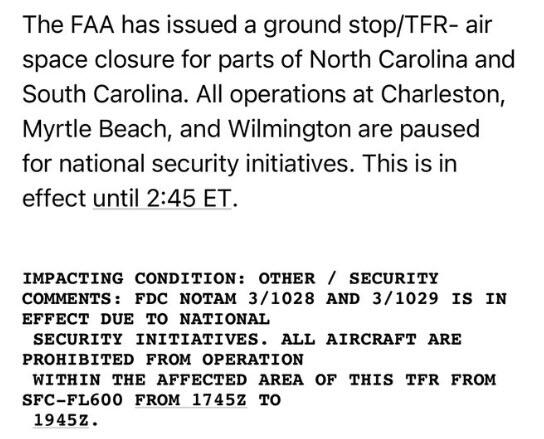
The FAA closed airspace in parts of North and South Carolina and at three airports effective until 2:45 E.T. citing "national security initiatives" in the area. 

The order to halt flights created a massive gap over the ocean on flight tracking websites such as FlightRadar24.

"The FAA has paused departures from and arrivals to Wilmington (ILM), Myrtle Beach International (MYR) and Charleston International (CHS) airports. The agency has also closed additional airspace," an FAA spokesperson told Fox News Digital. 

Flight radar

A large gap of flights could be seen on flight tracking websites on Saturday. (Flightradar24.com / Fox News)

Shortly after the order was issued, Fox News Digital confirmed that the Chinese spy balloon was shot down

While the balloon was off the coast of South Carolina, the balloon was shot down by the U.S. military on Saturday afternoon, according to Fox News sources.

The Biden administration has faced strong criticism from Republicans and political commentators for waiting several days to shoot down the balloon as it made its way across the United States while possibly surveilling sensitive military sites.

Biden military officials said that they were hesitant to shoot down the balloon over land due to the possibility of injuring people on the ground.

https://www.foxbusiness.com/politics/faa-ground-stop-chinese-spy-balloon-shootdown-results-massive-flight-radar-gap-south-carolina-coast

Lawmakers Worry X-Waiver Elimination Could Stir Buprenorphine Diversion

 Could dropping the "X-waiver" have unintended consequences? That's what some House members suggested during a hearing on ways to address the fentanyl crisis

opens in a new tab or window, along with other healthcare issues.

"Sometimes ... medications are dangerous, potentially, and even though we want more access, we still have to stick with science, and make sure the proper individuals, who are properly trained, are the only ones that have the ability to prescribe these medications," said Larry Bucshon, MD (R-Ind.), vice-chair of the House Energy & Commerce Health Subcommittee, which held Wednesday's hearing.

Medication assisted treatment (MAT) is "an important tool in the right circumstances," said Bucshon, a cardiovascular and thoracic surgeon, but without "proper guardrails" it could lead to harm. Moreover, because buprenorphine is "itself an opioid," the medication is "extremely vulnerable for misuse and diversion," he added. For that reason, Bucshon said he remains opposed to the "broad expansion of prescribing authority" as a means of expanding access to buprenorphine. Bucshon said he finds it unfortunate that not all of his colleagues agree with this view and as a result, prescribing authorities have "dramatically expanded" access to the drug.

Buprenorphine a 'Street Drug'?

In an omnibus spending bill passed in late December, Congress eliminated the "X-waiver,"opens in a new tab or window the requirement that providers obtain a special waiver through the Drug Enforcement Administration (DEA) to dispense certain narcotics, including buprenorphine, which is often administered as a sublingual film. The bill also allows community health aides to dispense buprenorphine and other narcotics used in maintenance or detoxification treatment without having to register through the DEA.

Asked whether he was aware of buprenorphine's use as a "street drug," Neeraj Gandotra, MD, chief medical officer at the Substance Abuse and Mental Health Services Administration (SAMHSA) said buprenorphine is primarily used for treatment or "withdrawal mitigation." Bucshon countered that "multiple peer-reviewed articles and even some NIH and DOJ [Department of Justice] intelligence [suggest] that it is a significant risk -- that buprenorphine [is] being a diverted drug."

Rep. Diana Harshbarger, PharmD (R-Tenn.), raised similar concerns later in the hearing stating that "[t]here are people who take those strips, heat them up, and use them as injectables." But she also expressed concern about stopping access to buprenorphine for those who need it.

Asked by Bucshon what SAMHSA is doing to prevent "possible diversion" of buprenorphine, Gandotra said that his agency has partnered with professional societies to ensure that practitioners are trained in diagnosing and treating substance use disorder "irrespective of the X-waiver."

Bucshon also pressed Jon DeLena, associate administrator of business operations for the DEA, to explain how that agency will respond when "we start seeing [buprenorphine] on the street." DeLena echoed Bucshon's own comments about the need for "guardrails." While helping individuals access treatment is important, "it has to be done in a way that does not contribute to overprescribing, misprescribing, or diversion of that substance," he said.

Timothy Westlake, MD, an emergency medicine physician from Wisconsin who spoke later in the hearing, said he would "much rather see buprenorphine abused than fentanyl or oxycontin or oxycodone. And the people that are abusing it for substance use disorder are going to be abusing something. It kind of falls into the same [category as] ... harm reduction."

Harshbarger expressed concern about potential disruptions in access to needed treatment when the public health emergency ends, asking DeLena when the DEA plans to release its proposed rule on providing controlled substances via telemedicine. DeLena said the agency is "very close," but did not provide a specific timeframe.

Scheduling Fentanyl-Like Substances

Subcommittee members also debated whether fentanyl-like substances should be classified as Schedule 1 drugs. Republicans spoke in favor of the HALT Fentanyl Actopens in a new tab or window, which would permanently schedule all fentanyl-like substances as Schedule 1 drugs.

In May 2021, President Biden signed legislation that temporarily extended a Trump-era order classifying all fentanyl-like drugsopens in a new tab or window as Schedule 1 controlled substances. Proponents say the order helped law enforcement prosecute drug traffickers, but criminal justice reform advocates oppose the extension, because Schedule 1 drugs require mandatory minimum sentences, which they argue would lead to more incarcerations and exacerbate racial disparities in prison.

"I'm concerned that this class-wide scheduling approach sets a precedent of guilty until proven innocent," said Rep. Tony Cárdenas (D-Calif.), referring to provisions around mandatory minimum sentencing. He said the bill imposed "harsh federal penalties" and excludes any mention of testing the substances to see if they are possibly harmless or if they could have "therapeutic value." "We could be overlooking the next naloxone," Cárdenas said.

Rep. Morgan Griffith (R-Va.) argued that the legislation does not impede research on fentanyl-related substances, and even "makes it easier to get through the pathways to get research done."

Social Media's Role in Drug Trafficking

Lawmakers also discussed the problem of drugs being trafficked to teenagers over social media. Molly Cain, a parent advocate from Spokane, Washington, spoke of her 23-year-old son Carson's death in 2020 from a fentanyl overdose. Her son had been prescribed alprazolam (Xanax) for anxiety during college, and at 22 was diagnosed with cancer of the appendix.

The day after Thanksgiving, Cain, after not hearing back from her son, found him dead on his living room floor. She waited 3 months for a toxicology report to confirm that he'd died from fentanyl poisoning. In the meantime, she began receiving pictures of drugs from a person on Snapchat on her son's phone. The DEA investigated, and the person Cain believes sold her son the drugs that killed him served less than 24 hours in jail. Cain said she reached out to Snapchat and the business claimed it had filters in place to prevent illicit activity.

"I think that they've been given a free pass... and I think it's time we start holding them accountable," she said. Cain said her son bought pills to help relieve his anxiety, but instead they cost him his life.

Rep. Kim Schrier, MD (D-Wash.), a pediatrician, said she is working on legislation to "make sure families have the tools to keep their children safe." She also spoke about the importance of education and awareness for children, prescribers, and patients, and asked another witness where parents can find guidance about speaking to their children about drugs.

"Today is a different world than I grew up in with social media... but it's also the world of 'Take one pill and you die,'" said Stephen Loyd, MD, chief medical officer for Cedar Recovery, headquartered in Mount Juliet, Tennessee. "Most of us have some kind of experience with things in our past that maybe we could have handled better," said Loyd, who is himself in recovery for opioid use disorder. Children need to know their parents aren't perfect, he said.

Loyd's son was age 9 when Loyd sought help for his substance use problem. And he was open with his son and daughter about what he was going through. Loyd also urged parents to warn children that "just because it comes out of a bottle that a doctor wrote a prescription for, it is not okay."

Schrier agreed, adding that "anything anybody hands you, whether they tell you it's ibuprofen or... Adderall ... that could be the pill that ends your life."

https://www.medpagetoday.com/publichealthpolicy/opioids/102944

Heart Failure Risk Lingers Long After Chemotherapy, Regardless of Dose

 Anthracycline users with breast cancer or lymphoma had an upfront risk of congestive heart failure (CHF) that persisted during long-term follow-up in a population-based case-control study.

The cumulative incidence of new-onset CHF was significantly higher for cancer patients treated with anthracyclines compared with healthy controls at every time point -- namely:

  • 1 year: 1.81% vs 0.09%
  • 5 years: 2.91% vs 0.79%
  • 10 years: 5.36% vs 1.74%
  • 15 years: 7.42% vs 3.18%
  • 20 years: 10.75% vs 4.98%

Importantly, cancer patients receiving anthracyclines were at elevated risk of CHF compared with controls (adjusted HR 3.25, 95% CI 2.11-5.00), whereas patients with cancer not receiving anthracyclines did not have such risk reach significance (HR 1.78, 95% CI 0.83-3.81), reported Hector Villarraga, MD, of Mayo Clinic in Rochester, Minnesota, and colleagues.

"Our long-term follow-up data suggest that some patients with cancer treated with anthracyclines remained at increased risk of CHF decades after their cancer diagnosis. Therefore, these individuals are expected to require regular clinical follow-up to screen for and modify coexisting cardiovascular risk factors (e.g., diabetes, hypertension, hyperlipidemia, body mass index, tobacco exposure, and sedentary lifestyle) and assess for early signs and symptoms of CHF," the authors wrote in JAMA Network Open

opens in a new tab or window.

Anthracycline therapy includes doxorubicin (Adriamycin) and epirubicin (Ellence) and has established links to cardiovascular adverse eventsopens in a new tab or window such as left ventricular (LV) dysfunction, heart failure, myocarditis, pericarditis, atrial fibrillation, ventricular tachycardia, and ventricular fibrillation.

Villarraga's group reported that the exact anthracycline dose -- including the low range <180 mg/m2 or the high range >250 mg/m2 -- did not appear to significantly change the user's risk of CHF.

Besides anthracycline use, age was the other independent predictor of CHF identified (HR 2.77 per 10 years, 95% CI 1.99-3.86).

Interestingly, radiation therapy to the chest and mediastinum had a protective, inverse relationship with CHF (adjusted HR 0.32, 95% CI 0.13-0.74).

There was no difference in the risk of developing CHF among participants treated before versus after the year 2000 or users of beta-blockers, angiotensin-converting enzyme (ACE) inhibitors or angiotensin receptor blockers (ARBs), or statins.

"It is clear from this study ... that there is an increased risk of both short- and long-term clinical CHF after anthracycline exposure in patients with breast cancer or lymphoma regardless of cumulative dose. These data continue to move forward the field of cardio-oncology, but they also emphasize the need for improved understanding of the pathophysiology of this disease process to facilitate better use of surveillance and treatment strategies," commented Michael Fradley, MD, medical director of the Cardio-Oncology Program at the University of Pennsylvania in Philadelphia, in an accompanying editorialopens in a new tab or window.

American guidelinesopens in a new tab or window give a IIa recommendation for ARB, ACE inhibitor, and beta blocker treatment for asymptomatic patients with cancer therapy-related cardiomyopathy. Initiation of these drugs for the primary prevention of drug-induced cardiomyopathy gets a more tepid IIb recommendation.

Meanwhile, evaluation of cardiac function

opens in a new tab or window has IIa endorsements for people with cardiovascular risk factors or known cardiac disease being considered for or already receiving potentially cardiotoxic anticancer therapies.

For their retrospective study, Villarraga and colleagues relied on the Rochester Epidemiology Project, which makes integrated health records from two healthcare systems in Olmsted County, Minnesota, available for researchers.

Study participants were 812 residents of Olmsted County diagnosed with breast cancer or lymphoma from January 1985 through December 2010, who were matched 1:1.5 with healthy controls from the same community. The overall cohort averaged 52.6 years of age, with 78% being women and 93% classified as white.

The investigators had their analyses adjusted for between-group differences in baseline age, sex, diabetes, hypertension, hyperlipidemia, coronary artery disease, obesity, and smoking history.

Follow-up comprised a combination of electronic data extraction and manual record review, and reached a median 8.6 years in the case group versus 12.5 years in the control group.

Overall, patients with cancer, anthracycline users or not, had higher risks of CHF compared with the control cohort (adjusted HR 2.86, 95% CI 1.90-4.32).

Fradley highlighted the lack of imaging assessment of LV function in the study. "CHF symptoms can occur in the setting of both a normal and reduced LV ejection fraction, and the Rochester Epidemiology Project population represents a combination of both disease phenotypes," he noted.

"This highlights our deficiency in understanding the pathophysiology of anthracycline-associated cardiac dysfunction; its potential impact on the myocardium is not only limited to a decline in contractility. It is essential that we better understand the mechanism of anthracycline-associated cardiac dysfunction to offer better surveillance and management recommendations," the editorialist wrote.

The study authors also acknowledged the lack of racial and ethnic diversity in the study population, which may limit the study's generalizability.

"Further prospective studies are required to balance the potential benefits of anthracycline vs the cardiovascular risks and to develop surveillance models and susceptibility indexes," the team added.

preliminary versionopens in a new tab or window of the project had been presented at the American College of Cardiology annual meeting in 2018.

Disclosures

Villarraga had no disclosures; co-authors reported various ties to industry.

Fradley reported financial relationships with AstraZeneca, Abbott, AbbVie, Medtronic, Pfizer, and Zoll.

Primary Source

JAMA Network Open

Source Reference: opens in a new tab or windowLarsen CM, et al "Association of anthracycline with heart failure in patients treated for breast cancer or lymphoma, 1985-2010" JAMA Netw Open 2023; DOI: 10.1001/jamanetworkopen.2022.54669.

Secondary Source

JAMA Network Open

Source Reference: opens in a new tab or windowFradley MG "Heart failure in patients with cancer treated with anthracyclines -- revisiting the foundation of cardio-oncology" JAMA Netw Open 2023; DOI: 10.1001/jamanetworkopen.2022.54677.


https://www.medpagetoday.com/cardiology/chf/102955

What Doctors Should Know About Xylazine in Fentanyl

 It's been about 3 years since Joseph D'Orazio, MD, and his colleagues at Temple University Hospital in Philadelphia first noticed something different among injection drug users who came to the hospital.

Some patients who overdosed responded differently to the rescue agent naloxone (Narcan), and then there were the wounds -- severe wounds that required extensive treatment, and sometimes, amputation.

That wasn't something they'd seen before in the ongoing opioid crisis.

They learned that a veterinary sedative called xylazine was increasingly being added to fentanyl, the predominant opioid in the area, to boost its effects and extend its high.

"That's where we're feeling it the most, with these really severe wounds," D'Orazio told MedPage Today. "We've been doing a lot more amputations over the last couple of years for really bad necrotic wounds and dysfunctional limbs and infections that go all the way down to the bone."

Philadelphia has been flagged as the epicenter of the xylazine crisis, which is now prevalent throughout the northeast and has started to show up in cities across the U.S. The problem is popping up on regulators' radars. In the past few months, several federal agencies, including the FDAopens in a new tab or window, the Office of National Drug Control Policyopens in a new tab or window (ONDCP), and the National Institute on Drug Abuseopens in a new tab or window have released statements about the growing problem.

"Xylazine is making the opioid crisis worse," said Andrew Kolodny, MD, an expert in opioid policy and addiction medicine at Brandeis University in Waltham, Massachusetts. "It's hard to imagine anything could make the opioid crisis even worse. But this really is making it worse, both in increased mortality and in people becoming addicted to xylazine as well as opioids."

What Is Xylazine?

Xylazine was never intended for use in humans, according to Kelly Ramsey, MD, MPH, chief of medical services at the New York State Office of Addiction Services and Supports in Albany.

"It was actually studied by a pharmaceutical company in the 1960s as a potential medication for hypertension in humans, but because of the severe central nervous system sedation, it was deemed not appropriate for human use ... but it was approved by the FDA as a veterinary medication," Ramsey, a member of the American Society of Addiction Medicine board of directors who was speaking for herself, said in a phone interview. "It's used most typically as an anesthetic and a sedative for procedures for both large and small animals."

Xylazine is an alpha-2 agonist that would be most comparable to dexmedetomidine (Precedex), a sedative used in the intensive care unit, said Lewis Nelson, MD, a medical toxicologist and chair of emergency medicine at Rutgers New Jersey Medical School in New Brunswick. Another comparable medicine, he said, is clonidine (Catapres).

Xylazine is added to fentanyl to make its effects last longer, said Chelsea Shover, PhD, of the University of California Los Angeles, who co-authored a paper in Drug & Alcohol Dependenceopens in a new tab or window on xylazine's spread across the U.S.

"Fentanyl is very strong, but it's also very short-acting," Shover told MedPage Today. "If someone has a fentanyl use disorder, they have to use frequently to stay well. That's difficult with illicit drugs. Lots of people in that situation don't have a lot of money ... so if something shows up on the market that can extend the high, there becomes a demand for that."

It's not clear exactly how xylazine found its way into the street drug market, but Shover notes that ethnographic studies first called attention to the problem in Puerto Rico in the mid-2000s.

"We have a significant Puerto Rican population here in Philadelphia," particularly in the Kensington neighborhood where xylazine use is prevalent, D'Orazio said. "But Philadelphia isn't the only place that has people who immigrated from Puerto Rico."

A senior Biden administration official told MedPage Today that the earliest report of xylazine was "in the early 2000s. ... The rise in the U.S. where it was used as an adulterant of fentanyl started in the mid-20-teens, with a real increase in 2019."

joint reportopens in a new tab or window issued in December by the Drug Enforcement Administration (DEA) and the Department of Justice noted that according to findings from the DEA's lab system between 2020 and 2021, although the xylazine problem is most prominent in the Northeast, "each of the four regions [Northeast, South, Midwest, and West] has seen an increase in identifications of xylazine. The South has the largest increase, reporting a 193% increase in xylazine instances, followed by the West with an almost 112% increase."

What is clear is that the xylazine on the streets is not illicit. It's pharmaceutical-grade, and it's being diverted, doctors said.

"This isn't clandestine production of a drug," D'Orazio said. "This is a pharmaceutical. They're finding empty bottles of pharmaceutical-grade xylazine at packaging areas, where dealers are bagging [drugs]."

Narcan Still Works

One of the problems with xylazine is that it brings on profound sedation that "knocks you out for a long time," Shover said.

"If you're out in a public place, that leaves you vulnerable to physical or sexual assault or robbery," she said. "You're not aware of what's going on around you and you're not able to protect yourself."

Being passed out for hours could also lead to other conditions such as deep vein thrombosis or compartment syndrome, Ramsey said.

The opioid overdose reversal agent naloxone may appear to be ineffective in someone who has overdosed with both fentanyl and xylazine in their system, but it's actually not, several sources said.

When trying to reverse these patients with naloxone, "they've remained really sleepy and many have been deemed Narcan-resistant, but really it's just a polysubstance overdose since they're on a sedative also," D'Orazio said. "Xylazine doesn't reverse with Narcan so they remain sedate."

While xylazine doesn't cause respiratory depression, he said, it causes mental status depression, which can lead to a blunted response to the hypoxia that comes with an overdose.

"It's like you have an occluded airway," he said. "It's sort of the same as how a benzodiazepine overdose would look."

For bystanders who administer naloxone, that means if breathing returns but patients aren't awake, they should be placed on their side in the recovery position.

In hospitals, physicians will do some airway maneuvers for these patients, such as putting their head to the bed at 30 degrees, keeping their airways open, and monitoring oxygen levels via a pulse oximeter.

Only rarely do these cases require intubation and ventilation, D'Orazio said.

He also noted that xylazine has a withdrawal profile that's different from other sedatives, like alcohol or benzodiazepines. Instead of primary effects such as increased heart rate, sweating, confusion, or seizures, xylazine withdrawal "has primarily been anxiety-associated. People are very restless and uncomfortable. They feel dysphoric, and it's quite difficult to manage," D'Orazio said.

"Just recognizing that there is a xylazine withdrawal syndrome is number one," he added.

While an optimal treatment strategy for xylazine withdrawal remains to be developed, he said, he usually recommends using benzodiazepines for detoxification.

'The Wounds Are Much More Severe'

D'Orazio said the wounds he and his colleagues are seeing with xylazine use are different from anything they've witnessed with injection drug use in the past.

"There's always been the risk of an abscess or cellulitis that leads to a wound that takes some time to heal, but this is very different," he told MedPage Today. "With xylazine, the wounds are much more severe, much deeper, and much harder to manage."

He said his hospital has done more amputations over the last couple of years, as not all injuries can be managed with wound care therapy.

There are no data on what percentage of those who use fentanyl adulterated with xylazine develop these severe wounds, but D'Orazio said that "most patients have at least some wounds to some degree. It may not be so severe that they need to be hospitalized, but they've got some degree of wounds."

However, clinicians don't see such wounds with people who smoke or use fentanyl intranasally, he said, so it's not clear exactly why xylazine seems to cause these wounds.

"There's a lot of speculation that it's cytotoxic," D'Orazio said, noting that more research is needed, as only animal studies exist. Indeed, there are some reports that repeated use in animals causes lesions, "so it was typically recommended that if you had to sedate that animal multiple times, don't use xylazine in a chronic fashion," he said.

Nelson noted, however, that there's a lot of xylazine in the drug supply in New Jersey, but that state hasn't seen as much of a problem with severe wounds. Philadelphia may have a larger proportion of injection drug users, he said.

It's possible that xylazine may cause wounds via its activity as a vasoconstrictor, reducing blood flow to the area, Nelson said.

Fears of unmanageable withdrawal could also play a role in wound development, D'Orazio said. Since withdrawal is harder to treat, people worry they'll get sick, and avoid coming to the hospital, he said. Wounds may be more severe because of that delay, he noted.

One of the downstream effects of wounds is that people can't get into inpatient rehabilitation programs, as many don't take complex medical cases, D'Orazio said. Wounds also prevent people from getting into sober living facilities for the same reason, he said.

"It has really cut off people who are looking to achieve recovery," he said.

Better Tracking Needed

It's hard to tell exactly how widespread xylazine use is in the U.S., since there's no national tracking of the compound. The DEA report notes that "a comprehensive count of xylazine-positive overdose deaths in the United States is not currently possible, as not all jurisdictions routinely conduct testing for xylazine in postmortem toxicology. Testing procedures can vary even within the same state. In addition, it is not currently included with the CDC's reporting of national statistics on fatal overdoses. As a result, it is very likely the prevalence of xylazine is widely underestimated."

"It's not part of drug use surveys," Shover said. "It's not a variable you can pull from publicly available data, like you can for, say, cocaine or heroin."

The CDC did not return a MedPage Today request for comment regarding xylazine monitoring. However, the agency has published two studies on xylazine in its journal Morbidity and Mortality Weekly Report in recent years.

In 2021, the agency examined data

opens in a new tab or window from the State Unintentional Drug Overdose Reporting System in 38 states and Washington, D.C. Of 45,676 overdose deaths in 2019, 1.8% were xylazine-positive and 1.2% were xylazine-involved. The authors concluded that xylazine detection in overdose deaths is likely under-reported.

In April 2022opens in a new tab or window, researchers reported that Cook County, Illinois, saw a total of 210 xylazine-associated deaths from January 2017 to October 2021, with the numbers rising throughout the study period. As with the other study, fentanyl was present in the vast majority of xylazine-involved deaths, the team found.

Ramsey said more than 90% of fentanyl samples in Philadelphia in 2021 were found to contain xylazine. Nelson said the figure stood at 30% in New Jersey a year ago, and has likely grown since. New York City recently announced that nearly 20% of opioid-involved overdose deaths also involved xylazine.

"It's difficult to get even just like, within the last couple months, a picture of what's happening with xylazine in the U.S.," Shover said.

The ONDCP discussed xylazine last month at a meeting of its evolving and emerging threats committee. "It is critical to continually assess changes in the illicit drug market to guide our approach to new threats like Xylazine," ONDCP director Rahul Gupta, MD, said in a statement emailed to MedPage Today. "This includes evaluating existing data on trends and emerging patterns of use, listening to people and experts on the ground, utilizing the Emerging Threats process outlined by Congress in the SUPPORT Act, and ensuring that our response is protecting the people of the United States."

https://www.medpagetoday.com/special-reports/features/102915

FAA Shuts Down Some East Coast Airspace Due To "National Security Initiatives"

 Update (1330ET): Shortly after President Biden reportedly said "we are going to take care of it," referring to the Chinese spy balloon that is calmly drifting across US airspace, the FAA has shut down 3 airports and closed airspace in parts of North and South Carolina:

A suspected Chinese surveillance balloon appears to be heading toward North Carolina, according to ABC News, citing a senior US official familiar with the situation. That official said the US would probably shoot the balloon down over the Atlantic Ocean and retrieve it. 

Within the last hour, numerous Twitter users have uploaded footage of what appears to be the Chinese balloon floating above North Carolina. 

Local police tell residents don't shoot their guns at the giant balloon. 

On Friday, we cited Capital Weather Gang, who accurately predicted the balloon's trajectory while it was floating above the Midwest. Now updated predictions for Saturday morning show the balloon might be headed toward the Atlantic. 

The balloon's payload is approximately 90 feet long, or the length of two motorhomes, and the balloon itself is much larger. Here's one of the clearest views of the balloon. 

And there might be more balloons. We noted last night:

"We are seeing reports of a balloon transiting Latin America," Brig. Gen. Pat Ryder, a Pentagon spokesperson, told Fox News Friday night. "We now assess it is another Chinese surveillance balloon."

US officials have not ruled out shooting the balloon down. That might happen as soon as the balloon moves offshore into the Atlantic. Time for Space Force to shine. 

https://www.zerohedge.com/geopolitical/suspected-chinese-spy-balloon-spotted-over-north-carolina-us-might-shoot-it-down-over

FAA shuts down airpsace near Atlantic amid reports of plan to shoot down Chinese spy balloon

 U.S. officials are considering shooting down the Chinese spy balloon once it crosses over the Atlantic, according to reports.

A senior U.S. official told Fox News about the plan on Saturday after ABC News reported on Friday that a similar plan was being considered.

The FAA issued a ground stop and airpsace clearance for parts of North Carolina and South Carolina and operations at Charleston, Myrtle Beach, and Wilmington were paused for "national security initiatives" just after 1 p.m.

The Free Markets Case You Haven’t Heard About

 A small, independent website designer in Colorado is getting national attention. Why? The US Supreme Court heard a case on Monday about whether the government can force her to say something that goes against her personal beliefs.

While it’s one of the biggest free-speech cases this Supreme Court term, you may not have heard about the ramifications for free markets and the ability of small businesses, particularly individual creative professionals, to employ their talents without government interference.

Many headlines cast the case as being about discrimination, suggesting that whether a creative professional can refuse to speak a certain message is the same as refusing to serve customers based on who they are.

It’s not.

The distinction between message and identity is critical to the ability of all people, particularly people with minority viewpoints, to create the diverse and vibrant society that we all enjoy. This includes the ability to serve market niches, or to develop new markets, without government stepping in to dictate the nature of the service.

From immigrants bringing the culture of their native lands to specialize in businesses satisfying the needs of their fellow immigrants, and in the process sharing that culture with their new community, to social entrepreneurs focused on delivering the message of social change, the freedom to serve a particular market without government pressure to homogenize services has been critical to the spontaneous expansion of the rich and intricate society in which we live.

That’s what is at stake in 303 Creative. Lori Smith is the Colorado designer who brought this case, 303 Creative LLC v. Elenis. As she’s built her small business, she’s found a market niche developing a range of sites for causes she enjoys working for, from animal rights to veterans groups, and for a diverse array of people, including LGBTQ customers. Everyone involved agrees that Smith serves all customers regardless of who they are.

But they don’t agree on what she is allowed to say, or not say. Colorado insists that she must express views she doesn’t believe about marriage or stay out of the market altogether. That raises the inevitable risk of downstream market effects that are likely to cause mayhem if Lori’s ability, and the ability of creative professionals like her, to create their own brands is not roundly defended.

But perhaps more disturbing than Colorado’s attempt to control Lori’s speech is the reasoning the Tenth Circuit applied to justify upholding the law. Unlike other similar cases, there is no dispute here about whether creating website content is speech. Colorado stipulated that it is and the Tenth Circuit acknowledged that Colorado is compelling Lori to speak a message she does not wish to speak. This means that Colorado’s application of the law to Lori Smith is subject to strict scrutiny, which is a test the government almost always fails. But the Tenth Circuit upheld the law for a unique, and heretofore unheard of reason: that an individual artist, “due to the unique nature of [her] services…is more similar to a monopoly.”

This “monopoly-of-one” theory is imported from inapposite commercial law, in which monopoly power focuses on whether there are viable substitutes for a seller’s goods or services. But monopoly power does not turn, as the Tenth Circuit held, on whether an individual artist is unique or delivers superior service, nor on whether a particular invention or creation is unique. If applied to individuals, it would create a world in which any expressive professional would immediately become subject to expression-on-demand if that expressive professional is innovative and thus “unique.” Applied to a market that has numerous entrants in just the local area, and that provides services that can be delivered from literally any place on the planet, the monopoly-of-one theory is particularly absurd.

If government can tell creatives what messages they must deliver, the impact will extend far beyond Christian artists to place all expressive professionals at risk. Attorneys, educators, mental health professionals, and any other professional who relies on speech to do her job, if she does that job uniquely well, has a monopoly on her own talents. To any expressive professional who does not want to speak on demand, the effect will be chilling.

A web designer who recognizes growing demand and opportunity relating to quinceañera celebrations, for example, may develop a unique planning platform, drawing together services from other providers, connecting remote loved ones, and supporting communications, all with special insight into cultural significance and fitting tone to make the day as special as possible. Those services, reflecting the designer’s insight and skill, would be unique.

But that success would not give her a monopoly over web design simply because she has developed a niche within the broader market. Nor should the government be empowered to insist that she modify her message to support debutante balls, retirement parties, or gender reveals, even if she had no objection to those celebrations, but simply wasn’t interested or feared extension would water down her brand. Now, one may argue that the law would never be enforced against such a business because the distinctions it draws between services are not discrimination. But that is simply saying that the law could be enforced only against disfavored viewpoints, leaving favored businesses free to prosper. This is shaky ground on which to build a business in a world where viewpoints that are favored today may be disfavored tomorrow.

While the ramifications of 303 Creative may have far-reaching effects if decided against protecting speech rights, a decision upholding the speech rights of creative professionals will leave us largely where we are today, with a variety of speakers delivering a broad range of messages via a myriad of diverse businesses that reflect the individuality and ingenuity of their owners and the market demand. More than what’s perceived as a culture-war fight, 303 Creative may have significant implications for the freedom of market participants to develop and sell their own unique talents without government regulation of what they may say.

Cynthia Fleming Crawford is senior policy counsel at Americans for Prosperity Foundation which filed amicus briefs in support of 303 Creative, available here and here.

Ms. Crawford received her JD from the Georgetown University Law Center, an MA in American Government from Georgetown University, an MBA from the Johnson School of Management at Cornell University, and a BA in Applied Mathematics from the University of California, Berkeley.

https://www.aier.org/article/the-free-markets-case-you-havent-heard-about/