Search This Blog

Wednesday, February 22, 2023

Gilead: Encouraging Data From Real World Studies Of Flagship COVID-19 Treatment


  • Gilead Sciences Inc (NASDAQ: GILDannounced data from three retrospective real-world Veklury (remdesivir) studies for COVID-19 treatment.

  • The studies demonstrated that initiating Veklury within the first two days of hospital admission can help reduce mortality and hospital readmission rates among all patients hospitalized with COVID-19, regardless of disease severity.

  • A reduction in mortality was also observed in vulnerable populations.

  • Related: WHO Recommends Gilead's COVID-19 Therapy For Severe Disease.

  • Two studies analyzed clinical practice information from the U.S. Premier Healthcare databases of more than 500,000 adult patients hospitalized with COVID-19.

  • For patients with no documented use of supplemental oxygen at baseline, treatment with Veklury was associated with a 19% lower risk of mortality at Day 28.

  • Patients on low-flow or high-flow oxygen also had a 21% and 12% lower mortality risk at Day 28, respectively.

  • Patients on invasive mechanical ventilation/ECMO at baseline had a 26% reduced risk for mortality at Day 28.

  • These findings were observed throughout all variant periods, including Omicron, in patients who did not require supplemental oxygen and across all levels of supplemental oxygen use.

  • A separate analysis found that hospitalized patients with COVID-19 treated with Veklury were also significantly less likely (27%) to be readmitted within 30 days to the same hospital.

  • Based on in vitro analyses, Veklury retains potent antiviral activity against recent Omicron subvariants of concern.

Market Faces A Second "Shattering Revelation"

 By Michael Every of Rabobank

Shattering revelations

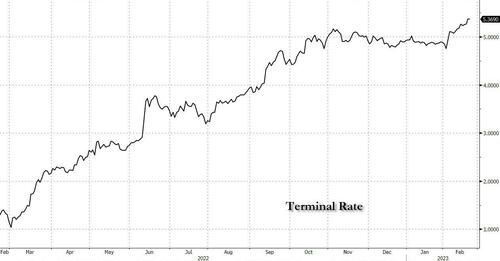
Yesterday saw stocks swoon (S&P -2.0%, Dow -2.1% to negative year-to-date) and bonds slump (US 2-year yields +10bp, 10-year yields +12bp to test closer to 4%), with expectations of the Fed Funds terminal rate rising to 5.35% - still 15bps short of reality, but a partial market catch-up to it.
There were lots of reasons why the “2023 is not 2022 because reasons!” crowd saw their hopes shattered. First, early February global PMI surveys underlined growth is picking up in services, where inflation, staff shortages, and pay pressures are most deeply entrenched: Japan was 53.6 (vs. 52.3 in January), the Eurozone 53.0 (50.8), the UK 53.3 (48.7), and the US 50.5 (46.8). Where is the economic downturn that means unemployment rises, so rates and yields plunge, so stocks surge?

Second, Timiraos of the Wall Street Journal highlighted research from the Cleveland Fed arguing "A deep recession would be necessary to achieve” 2.1% inflation by 2025, i.e., the curve flattening trade. Yet, “the researchers also conclude that, **if 2.8% inflation doesn't result in an un-anchoring of inflation expectations**, the December FOMC projection (in which inflation stays somewhat above the 2% target for longer) would be the optimal policy.**” That’s a hypothetical argument for curve steepening trades, surely?

Third, geopolitics. President Putin’s bellicose national address expressed that Russia feels betrayed by the West, despises what the West now is, and won’t retreat from Ukraine. President Biden, in Poland (not France or Germany) stressed in lofty terms that the US will never abandon Ukraine. As the Guardian puts it, Biden and Putin both implicitly tie their futures to the outcome in Ukraine. That will be expensive for one, or both, politically.

It is expensive economically too. Higher production of military goods is inflationary. Poland are doubling their defence spending to 4% of GDP: the rest of the EU is doing a tenth of that in new spending while waiting for the US to lead. Are you putting a Cold War surge in defence spending and the need for a larger army despite labour shortages into your inflation projections? No? Because in an op-ed Monday, Dutch Prime Minister Rutte wrote...

In peacetime, it's easy to pay lip service to beautiful ideals. But when democracy and freedom are attacked, it comes down to it. In today's geopolitical reality, for the first time in a long time, we have to ask ourselves: what is our way of life worth to us?... in the Netherlands and in many other NATO member states, the defence budget is being structurally increased at a rapid pace.”

Escalation will also be costly for the geopolitical and geoeconomic architecture markets rest on. A European Council on Foreign Relations (ECFR) survey of opinion in nine EU states, the UK, US, China, Russia, India, and Turkey underlines the war in Ukraine is “defining a new world order”. This is no revelation to anyone outside Europe or blue states in the US, and the limited subset of countries surveyed still displays Western-centric thinking. However, the revealed sharp geographical differences in attitudes to the war, democracy, and the global balance of power suggest to the ECFR that we may be at an historic turning point to a “post-western” world order.

The paradox of the Ukraine war is that the west is both more united, and less influential in the world, than ever before,” says the ECFR’s director.

The unity is clear as PM Rutte argues, “I cannot see how this will be China’s century… the 21st century will be the century of democracy and thus the century of America,” and, “It is extremely important that we in the Netherlands and Europe appreciate the great role of the US.

Yet the loss of influence is also clear, as the Wall Street Journal is blunter: “Russia, China Challenge US-Led World Order” – and to thunderous applause in places.

Relatedly, Friday will see China’s proposed peace plan for Ukraine. Any such attempt should be applauded, but the question is on whose terms. Western observers remain skeptical the plan will see any concrete details, while rumors are also flying China may threaten to do for Russia what the US is doing for Ukraine, amplified by the news that Xi Jinping will visit Moscow soon.

Logically, assuming China is not going to dump Russia, which it won’t, there are few potential outcomes:

  • China offers nothing new. However, this would underline that it remains a bystander having bullets fired at it by the White House, who just warned that Chinese firms that try to circumvent sanctions on Russia will face “repercussions”: like the ones forbidding the flow of Iranian oil?; or
  • China “escalates to deescalate” with an implied threat to stand behind Russia, in which case:
    • The US accepts a grand deal to climb down and partition Ukraine. That would mean a Western retreat on an historic scale that could snowball into a broader partition of the geopolitical and geoeconomic architecture – and the US won’t want that. Yet it would also allow the US to pivot towards Taiwan – and China won’t want that; or
    • The US reacts as if ‘China just bought a ticket for the Titanic after seeing the movie’, and the geopolitical and geoeconomic architecture shatters.

In short, the most logical probability is that neither the China peace plan nor the upcoming Xi visit to Moscow provide anything new. In which case, Ukraine escalation, inflation, and global polarisation it is. Yet the fact that we have a war in Ukraine at all should underline that the fat tail-risks are of something even worse – a scenario we originally flagged in our Ukraine metacrisis report in early 2022.

If you think markets are unhappy in recognizing that they have been wrong on Fed Funds again, wait until they grasp that shattering revelation.

https://www.zerohedge.com/markets/market-faces-second-shattering-revelation

GSK's ViiV says study shows its long-acting HIV shot as effective as Gilead's daily pill

 British drugmaker GSK's HIV treatment division, ViiV Healthcare, published data on Wednesday showing its long-acting HIV injection is as effective as the market-leading daily pill made by Gilead Sciences Inc.

GSK's ViiV ran the so-called "head to-head" clinical study on its own injection Cabenuva, which is given every two months, and Gilead's Biktarvy, an oral pill taken daily.

Analysts and investors are paying close attention to the future of GSK's HIV business as patents for treatments containing its core HIV compound, dolutegravir, begin to expire in 2028.

Given existing HIV treatments effectively suppress the virus, the next frontier for pharma companies is introducing different mechanisms for delivering the drugs, such as injections, which some people living with HIV say they prefer to pills.

Gilead, together with rival Merck & Co Inc, launched a study in 2021 that is testing a combination of its experimental HIV drugs to develop its own long-acting injection.

GSK forecasts that sales from longer-acting HIV injections like Cabenuva will enable it to manage the loss of exclusivity from dolutegravir. It forecasts that by 2026, sales from its longer-acting medicines will generate around 2 billion pounds ($2.4 billion) in revenue, around one third of HIV sales.

The 12-month clinical study involved 670 people living with HIV who prior to the study were virally suppressed and taking Gilead's Biktarvy. Two thirds of those people were switched to the Cabenuva injection, while the others remained on Biktarvy.

The study met its primary goal of showing that Cabenuva was as effective as Biktarvy, while some 90% of the switchers said they preferred the long-acting regimen to the daily pill, ViiV said in a press release.

Reasons given included that they did not have to remember to take a pill every day and did not have to be reminded of their HIV status every day, ViiV said.

Biocryst upped to Buy from Hold by Needham

 Target $14

https://finviz.com/quote.ashx?t=BCRX&p=d

Trump Heads To East Palestine To Capitalize On Biden's 'Failed' Toxic Train Derailment Response

 Former President Donald Trump is expected to visit East Palestine, Ohio, Wednesday and donate pallets of water and other supplies to the small town grappling with the toxic aftermath of the train derailment earlier this month. 

Last weekend we told readers about Trump's plan to visit East Palestine. Now it's been confirmed by Fox News that he will meet with officials and residents today.

Trump will meet with East Palestine Mayor Trent Conaway; Sen. J.D. Vance, R-Ohio; Rep. Bill Johnson, R-Ohio; State Rep. Monica Robb-Blasdel; and Ohio State Sen. Michael Rulli. 

"President Trump is meeting with the citizens of East Palestine and will never forget them and what they are going through.

"Contrast that with Biden and the federal government who has failed them from the beginning," a Trump advisor told Fox News.

On Monday, President Biden, who has barely mentioned East Palestine, decided to visit Ukraine instead of East Palestine. During an appearance on Fox News that same day, Mayor Trent Conaway said the president's visit overseas was the "biggest slap in the face" as his town continues to suffer following a freight train crash carrying hazardous materials, including vinyl chloride. 

"That was the biggest slap in the face that tells you right now, he doesn't care about us," Conaway told Fox's Jesse Watters. He added: "So … he can send every agency he wants to but I found that out this morning and one of the briefings that he was in the Ukraine giving millions of dollars away to people over there, not to us and I'm furious."

Fox's Tucker Carlson recently said: 

"East Palestine is a poor, white town that voted for Trump. So honestly, who cares? No one in the Biden administration did care and that's an atrocity." 

We told readers days ago: Trump wants to capitalize on what Legal Insurrection noted, "Ohio's toxic train derailment is Biden's Katrina." 

https://www.zerohedge.com/markets/trump-heads-east-palestine-capitalize-bidens-failed-toxic-train-derailment-response

China Says Ready To "Join Forces With Russia" To "Defend National Interests"

 Despite all latest among Washington's repeat warnings to Beijing against strategic or military cooperation with Moscow, China is now pledging to "join forces" with "like-minded" partner Russia to defend national interests. The statement came by the close of the first day of the director of the Office of the Foreign Affairs Commission of the Communist Party of China’s Central Committee Wang Yi's trip to Moscow.

"The People’s Republic of China is ready to join forces with Russia to decisively stand up for national interests and promote mutually beneficial cooperation in all areas," Wang said Tuesday while meeting with Russian Security Council Secretary Nikolay Patrushev. On Wednesday he met with Russian President Vladimir Putin in what appeared a warm and cooperative visit.

"During a virtual meeting at the end of last year our leaders [Xi Jinping and Vladimir Putin] came up with a plan for further development of bilateral relations. We are ready to join forces with the Russian side, in accordance with the high-level agreements, to decisively stand up for national interests and virtues, and promote mutually beneficial cooperation in all areas," the Chinese diplomat's statement said.

He additionally said China will "together with all like-minded partners further promote the development of the international order in the direction of equitable development."

"It’s necessary to unlock the potential of this mechanism, and it’s also necessary to develop new steps of strategic interaction in accordance with the changing situation in order to provide the necessary guarantees for national development," Wang added. "I want to fully join your appreciation of the strategic cooperation between the two countries."

The positive and glowing statements amid the high-level visit comes at a crucial juncture in which Moscow needs a powerful backer in its corner which also holds a seat on the national security council. The war in Ukraine is days away from reaching its one-year mark since the invasion began.

The Kremlin praised Wang's stance in response, with Russian Foreign Minister Sergey Lavrov welcoming "China's balanced position on the Ukraine issue." He further declared that "ours and China's vision is much the same" concerning the crisis.

However, it will be interesting to see if any further specifics on Ukraine emerged from the China side. So far, Wang appears to be advancing the official party line which has been somewhat ambiguous, also while in Moscow saying that China will maintain its "objective and impartial stance" on the Ukraine crisis. Toward this end, he said that China "appreciates Russia's willingness to resolve the crisis through negotiations," according to TASS.

Beijing has of late expressed its desire for warring parties to reach negotiated peaceful settlement in Ukraine. This could be focus of President Xi Jinping's upcoming trip to Russia. While news of the future trip broke Tuesday, President Putin confirmed Wednesday that it will happen - a very significant symbolic first since the Ukraine invasion.

"We are expecting the president of the People's Republic of China to visit Russia. We agreed on this earlier," Putin said as he welcomed Wang Yi in the Kremlin. The Russian leaders praised the "new frontiers" that both countries are forging together

President Vladimir Putin said on Wednesday that China's Xi Jinping would visit Russia, saying relations had reached "new frontiers" amid U.S. concerns that Beijing could provide material support to Russia's invasion of Ukraine.

"We understand that [China] has a domestic political agenda, but we assume that as we tackle all the issues related to this agenda - with the National People's Congress, which is made up of Chinese deputies, who must also resolve serious personnel issues - we will implement our plans for personal meetings as well, which will give an additional impetus to our relations," the Russian president added. A specific timetable has yet to be publicized, but US policy makers along with the rest of NATO and other UN Security Council members will without doubt be watching closely.

Meanwhile, Putin is on the offensive against his enemies near and far...

And concerning Zelensky's prior day's comments on the prospect of WW3 given deepening Moscow-Beijing relations...

* * * 

Rabobank previews China's proposed peace plan for Ukraine in the analysis below:

Relatedly, Friday will see China’s proposed peace plan for Ukraine. Any such attempt should be applauded, but the question is on whose terms. Western observers remain skeptical the plan will see any concrete details, while rumors are also flying China may threaten to do for Russia what the US is doing for Ukraine, amplified by the news that Xi Jinping will visit Moscow soon.

Logically, assuming China is not going to dump Russia, which it won’t, there are few potential outcomes:

  • China offers nothing new. However, this would underline that it remains a bystander having bullets fired at it by the White House, who just warned that Chinese firms that try to circumvent sanctions on Russia will face “repercussions”: like the ones forbidding the flow of Iranian oil?; or
  • China “escalates to deescalate” with an implied threat to stand behind Russia, in which case:
    • The US accepts a grand deal to climb down and partition Ukraine. That would mean a Western retreat on an historic scale that could snowball into a broader partition of the geopolitical and geoeconomic architecture – and the US won’t want that. Yet it would also allow the US to pivot towards Taiwan – and China won’t want that; or
    • The US reacts as if ‘China just bought a ticket for the Titanic after seeing the movie’, and the geopolitical and geoeconomic architecture shatters.

In short, the most logical probability is that neither the China peace plan nor the upcoming Xi visit to Moscow provide anything new. In which case, Ukraine escalation, inflation, and global polarisation it is. Yet the fact that we have a war in Ukraine at all should underline that the fat tail-risks are of something even worse – a scenario we originally flagged in our Ukraine metacrisis report in early 2022.

https://www.zerohedge.com/geopolitical/china-says-ready-join-forces-russia-defend-national-interests-putin-confirms-xi-visit

Immunocore: Initial Phase 1 data for first soluble TCR therapy for people living with HIV

 Data from the single ascending dose part of thePhase 1 trial showsIMC-M113V is well tolerated

Expected markers of T cell activation observed in half of participants at 15-mcg dose;plasma viral load remained suppressed throughout dosing and follow-up

The multiple ascending dose part of the trial is enrolling participants to identify safety and anti-viral activity

https://www.biospace.com/article/releases/immunocore-announces-initial-phase-1-safety-and-pharmacodynamic-activity-data-with-first-soluble-tcr-therapy-for-people-living-with-hiv/