Search This Blog

Wednesday, February 22, 2023

'US could default on debt as soon as June'

 The U.S. could default on the national debt as soon as June if lawmakers and the White House do not strike a deal to raise the federal borrowing limit, according to projections released Wednesday by prominent nonpartisan think tank.

The Bipartisan Policy Center (BPC), which closely tracked the debt ceiling, issued new projections Wednesday of the “X-Date,” the date at which the Treasury Department will exhaust extraordinary measures to avert a federal default

BPC warned Wednesday that lawmakers have until anywhere between start of summer and early fall to raise the debt limit or risk a government default – an outcome experts warn could be damaging to the economy. 

“We think the most likely time when they were not able to fund the government is sometime in the summer or early fall, but that there’s a slight chance that we run up against this very close-to-the-ground point in mid June or early to mid June,” said Shai Akabas, director of economic policy at BPC, in a Wednesday press call.

The center released the updated timeline on early Wednesday after factoring in new data from the Congressional Budget Office (CBO) and the Treasury Department. The group estimated last year that the “X-Date” would hit no sooner than the third quarter of 2023, but several economic and legislative factors can also impact the timeline.

Akabas said extensions to the repayment pause on the federal student loans and the roughly $1.7 trillion government funding omnibus passed by Congress late last year could shorten the timeline.

“Beyond that, there have been significant economic changes. Inflation has been more persistent than people anticipated almost a year ago,” he said in a Wednesday press call.

“Interest rates have risen faster than people anticipated, which means that we are paying more to service our debt. So, most of those factors have worked in the direction of pulling the X-Date forward, relative to expectations last spring,” Akabas said.

While it’s difficult to pinpoint a hard X-Date, projections are expected to become more precise the closer the government arrives to running out of cash. Experts are also keeping an eye on how revenues will impact the timeline, particularly as tax season heats up in the weeks ahead. 

BPC said that if revenues from tax season fail to meet expectations, there could be “a ‘too-close-for-comfort’ situation prior to quarterly tax receipts due on June 15.” 

BPC also pointed to estimates projecting federal spending to surpass $3 trillion “and take in approximately $2.5 trillion between February and June 2023,” warning that “variation of a few hundred billion dollars in either direction would not be shocking, yet would markedly affect the X-Date.”

The Treasury Department last month began implementing what it described as “extraordinary measures” to keep the government from defaulting on its debt after it approached the roughly $31.4 trillion threshold previously set by Congress. 

Yellen has warned the nation could default as soon as June and is applying pressure on Congress to move quickly to raise the ceiling, which caps how much debt the government can take on to fulfill its obligations.

“Let’s not wait until the last minute. I believe it is a basic responsibility of our nation’s leaders to get this done,” she said recently, while warning of the potential economic threats a default could yield.

“Household payments on mortgages, auto loans, and credit cards would rise, and American businesses would see credit markets deteriorate,” Yellen said last week. “On top of that, it is unlikely that the federal government would be able to issue payments to millions of Americans, including our military families and seniors who rely on Social Security.” 

Experts have also been upping calls for Congress to act fast, as Washington remains largely divided over how to address the debt limit. 

The BPC noted on Wednesday that it’s providing “estimates earlier than usual this year,” or about five months out from its “X-Date range,” in a bid “to maximize the time policymakers have to act.”

“They owe it to every hardworking American and small business owner to avoid the costs and risks associated with dragging this out to the 11th hour,” Akabas said.

https://thehill.com/business/3869077-us-could-default-on-debt-as-soon-as-june-analysis/

'What a free IRS e-filing tax return system could look like'

 The IRS is mulling a massive transformation to the way Americans file their taxes.

As Americans prepare for the upcoming filing deadline, the IRS is studying how it could build its own online filing system through which Americans could file their taxes for free.

Such a system could pose a serious threat to tax preparation companies, who’ve long fought against efforts to make the tax-filing system easier to navigate.

While it could be years before the IRS launches an eventual e-filing system, regular taxpayers — along with industry groups and policy organizations — are already starting to weigh in on what they want this new system to be. 

The agency is studying how it could build an online e-filing system and is expected to deliver a report to Congress on the issue in May.

After three years of disarray at the IRS caused by the pandemic resulted in backlogs of tax returns and unanswered phone calls, advocates and taxpayers are hoping the new proposals could be a breath of fresh air for the highly complex U.S. tax system.

“This could simplify things, and I’m not opposed to that,” Ilene Miklos, a New York resident and family lawyer, told The Hill in an interview. “You might actually save a lot of money, because you wouldn’t need an accountant to help you. We might put them out of business.”

Miklos said she’s had good experiences with similar online services for Medicare and that she prefers how that online system lays out the figures in her coverage plan to hearing it explained from a person over the phone.

“I received some mail from Medicare and it was confusing to me. It was contradictory. And when I spoke to a human on the phone, they couldn’t explain it to me at all. Then I went into my own account, and I went, ‘Oh, now I understand it,’ ” she said. “It was actually better online.”

What would an e-file system look like?

The first step toward an eventual federal e-filing system is the IRS’s report, for which the agency received $15 million from the Inflation Reduction Act.

The IRS report will look at how much the program would cost, how taxpayers would feel about using it and whether a third-party expert thinks the IRS could successfully build and maintain such a system. 

The IRS has tapped Ariel Jurow Kleiman, a Loyola University law school professor, for the report’s analysis.

Jurow Kleiman declined to comment.

It’s not clear to what extent the report will lay out the actual design specifications for such a platform, but some policy groups have already started coming up with their own ideas and suggestions.

One such proposal from Code for America, a San Francisco-based technology think tank, envisions the program as a smartphone-based app or web platform. The platform would use digital forms that already include data that the IRS already has about taxpayers from previous years’ tax returns.

The Code for America system would likely be limited at first to basic personal income tax-filing and later expanded to more complicated tax forms and situations.

“You start with basic cases that are relatively easy and then you expand out from there,” Gabriel Zucker, a tax benefits policy specialist with Code for America, said in an interview.

“It would be great if eventually it served every taxpayer, but we think it’s important for the IRS to focus on low-income taxpayers with these simple tax situations first,” he said.

How will the IRS verify your identity?

The proposal includes a section devoted to identity verification, an increasingly sensitive area of modern bureaucracy and systems administration due to online risks that include identity theft, privacy violations and the exclusion and mistreatment of marginalized groups of people.

After clearing the identity verification section, filers would then be able to fill out forms that are already partially completed.

Just like with private tax preparation software, information that has a lower likelihood of changing from year-to-year — such as Social Security numbers or the number of people in a household — could just be rolled over for convenience.

“This is all the stuff that the IRS will have from a prior year return, or if there isn’t one, perhaps the year before. If there’s neither, folks will have to start from scratch of course, but this is the kind of thing you can have pre-populated for review,” Zucker said.

This part of the software could also calculate the applicability of certain common tax credits, such as the earned income tax credit and child tax credit, without having to fill out additional forms.

The last section would comprise review pages to see final payment information, as well as a consent page for third-party filers.

How IRS e-filing could transform tax prep industry

A free federal tax-filing system could represent a paradigm shift in the way normal people file their taxes and sap a major source of profit for the tax preparation industry.

The tax preparation service industry cost taxpayers and companies $11.3 billion in 2019, which was paid out to more than 100,000 individual businesses, according to a report from Los Angeles-based market research firm IBISWorld published on the General Services Administration website.

The two biggest companies in that industry are Intuit, which controls 22.1 percent of the market, and H&R Block, which controls 19.6 percent.

Until recently, these companies participated in an agreement with the IRS, originally containing a noncompete clause, through which lower-income taxpayers could use their software for free. 

But this agreement, called the Free File Alliance, was heavily criticized for sidetracking people onto commercial payment options. Last year, the Federal Trade Commission sued Intuit for what it called a “deceptive” free filing ad campaign.

Will this e-filing work for complicated tax returns?

For taxpayers with multiple streams of income and more complicated tax situations, the appeal of a personal accountant or tax preparer is perhaps unlikely to be diminished by whatever the IRS proposes to Congress.

“This makes a lot of sense, but I feel like where we are now, I definitely need to have an accountant, though it would be great if I didn’t have to,” Jill Rousseau, a stay-at-home parent in New York who rents out rooms in her property, said in an interview with The Hill. “Our taxes are really complicated and if we ever got audited, I would want to have an accountant to be able to work us through that and make sure that everything is correct.”

“It’s complicated to figure out,” she said.

Some veteran tax preparers don’t expect an online e-filing system to make a major impact.

Joseph P. Marino, who’s been working at an H&R Block for 36-years in Brooklyn, told The Hill he hasn’t been briefed on the forthcoming e-filing report from the IRS and that he hadn’t heard anything about it.

“Tax law changes every year and that’s a given,” he said. “I’ve been sitting at the same desk, the same seat, and I don’t expect to move anywhere.”

Marino said that the most significant change he’d experienced over his long career was the move from filing paper returns to electronic ones. He said he thought the new potential system from the IRS “could be advantageous to the public.”

https://thehill.com/business/3868134-free-irs-e-filing-tax-return-system/

FDA widens advisory on eye products after patients blinded, hospitalized

 The Food and Drug Administration (FDA) on Tuesday widened an advisory on artificial tear products to include additional ones manufactured by Global Pharma Healthcare Private Limited over concerns of a potential bacterial contamination that could result in blindness or death.

The FDA warning now urges consumers and health care professionals not to use EzriCare Artificial Tears, Delsam Pharma’s Artificial Tears and Delsam Pharma’s Artificial Eye Ointment, which are intended to be sterile. 

The manufacturer first recalled the artificial tears at the recommendation of the FDA due to what the agency says were violations of its current good manufacturing practice.

Among the issues noted by the FDA were drug formulation issues, concerns about packaging and lack of appropriate microbial testing. 

The Centers for Disease Control and Prevention (CDC) earlier this month warned against using the EzriCare or Delsam Pharma’s Artificial Tears products as it investigated what it says is a potentially related string of some 56 Pseudomonas aeruginosa bacterial cases.

The cases span 12 states and include five reports of vision loss and one death, according to the CDC’s latest update.

https://thehill.com/policy/healthcare/3869356-fda-widens-advisory-on-eye-products-after-patients-blinded-hospitalized/

SNAP recipients sue USDA over reimbursement of stolen funds

 A new class action lawsuit was filed Wednesday on behalf of New York residents who had their Supplemental Nutrition Assistance Program (SNAP) benefits stolen in hopes of getting them reimbursed.

The lawsuit, which was filed by The Legal Aid Society and Freshfields Bruckhaus Deringer US LLP, seeks to restore benefits that were electronically stolen to about 8,800 SNAP enrollees in New York. The lawsuit is against the United States Department of Agriculture (USDA) and the USDA Food and Nutrition Service (FNS), who the plaintiffs allege refused to allow New York to use federal funds to replace the benefits electronically stolen, according to a Legal Aid Society press release.

As of December 2022, there were about 2.8 million people in New York who used the SNAP program, according to state data. SNAP benefits are electronically transferred onto an electronic benefits transfer card, which enrollees can use like a debit card to purchase eligible food in accepted retailers, according to the federal benefits website.

The press release published Wednesday said that the USDA’s alleged refusal to allow New York to disperse federal funds is dependent on a regulation the USDA enacted in 2010 that prohibit states from having the authority to replace SNAP benefits in the case of “skimming” incidents, which is a kind of electronic theft.

“Our clients and all low-income New Yorkers who rely on SNAP benefits to feed themselves and their families are suffering tremendously and must be immediately reimbursed for their stolen benefits, which they lost through no fault of their own,” Alex MacDougall, an attorney for The Legal Aid Society, said in a statement.

“It is unacceptable that the USDA is essentially passing the buck and not taking responsibility for reimbursing victims of skimming, despite legal mandates that protect other forms of electronic theft and the agency’s responsibility to ensure that benefits systems are protected,” she added.

The Hill has reached out to the USDA about the filing.

https://thehill.com/homenews/state-watch/3869534-snap-recipients-sue-usda-over-reimbursement-of-stolen-funds/

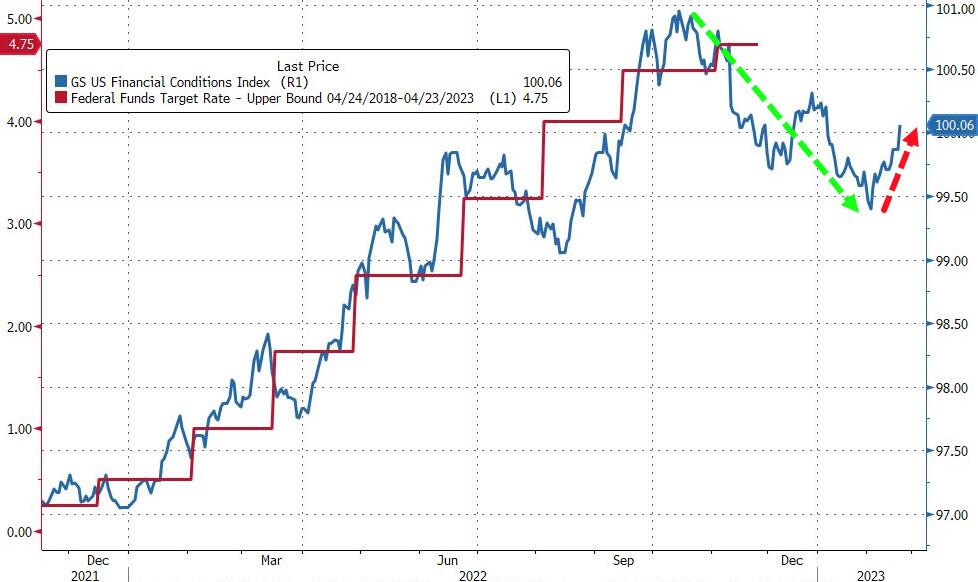
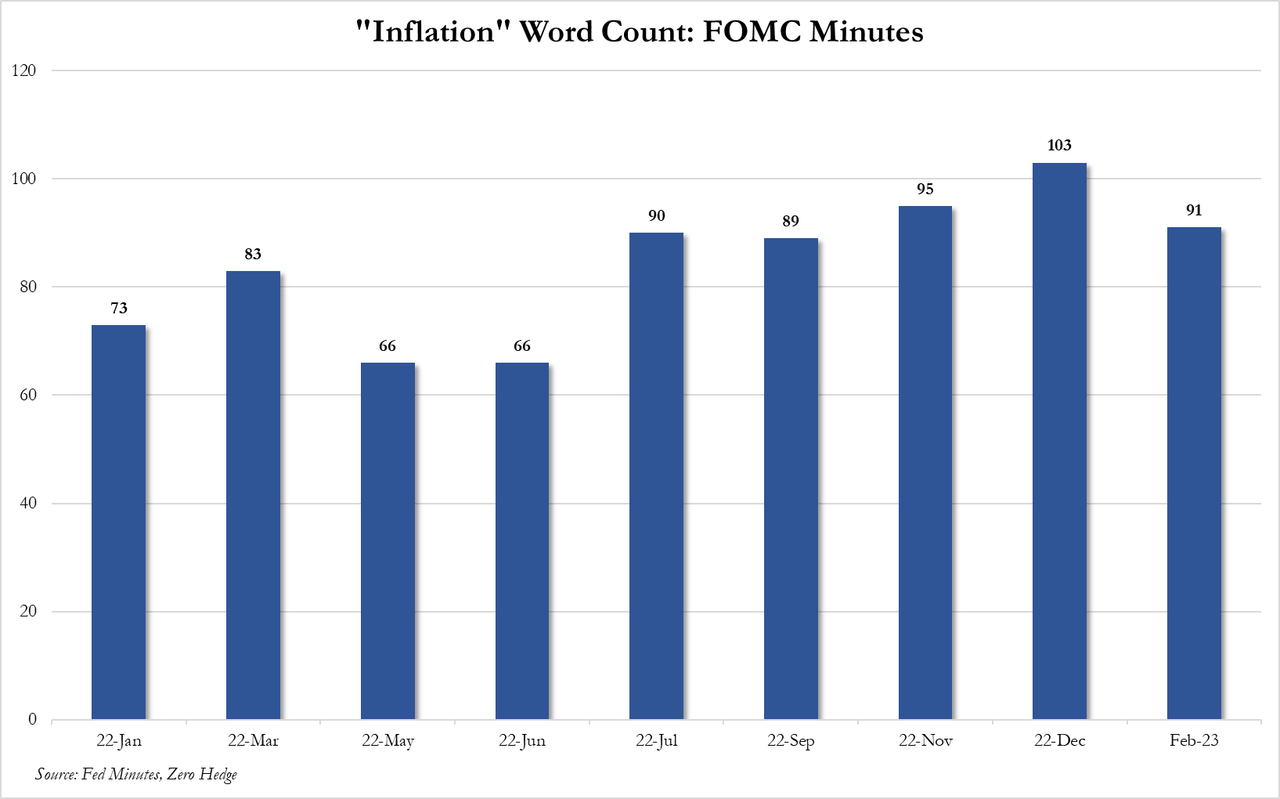
FOMC Minutes Suggest Fed Fears Financial Conditions Decoupling, Warns Of Equity Valuations

 Fed Minutes appear to argue against what Powell said during the presser on the decoupling of financial conditions from monetary policy: 

Powell declined to try to talk down financial markets, pointedly noting that it wasn’t up to him to persuade people, saying:

“We’re just going to have to see.”

By contrast, it seems like there were others on the panel that were concerned.

“Participants noted that it was important that overall financial conditions be consistent with the degree of policy restraint that the Committee is putting into place in order to bring inflation back to the 2 percent goal.”

Additionally:

“several participants observed that some measures of financial conditions had eased over the past few months.”

While Powell said at the meeting

“Financial conditions didn’t really change much from the December meeting to now.”

And there's a long way to go to catch up...

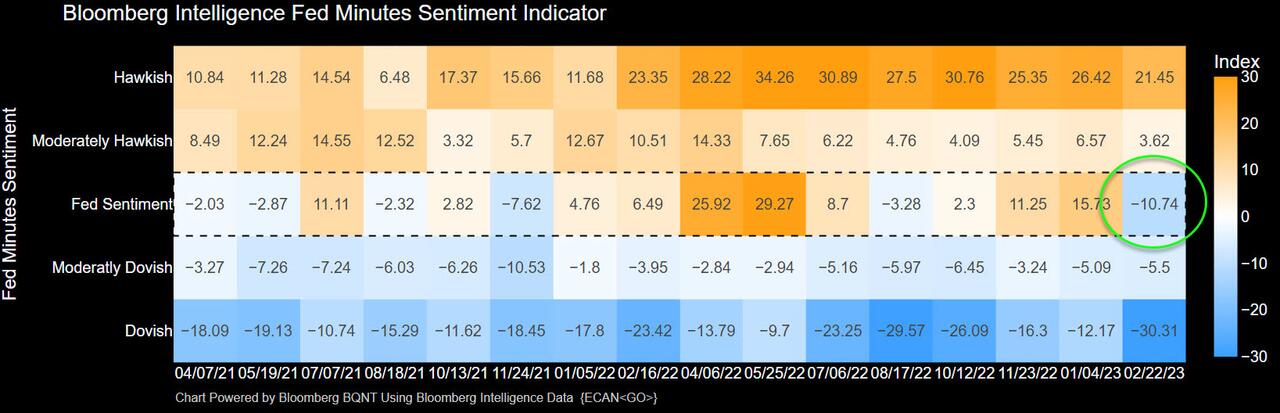
Overall, Bloomberg's sentiment model suggests the Minutes were more dovish than the last...

*  *  *

Since the last FOMC meeting (on Feb 1st) when Chair Powell dismissed any fears about loosening financial conditions, prompting a panic-bid in stocks, financial conditions have done nothing but tighten as the FedSpeak along with 'good' economic news has nuked the 'Fed pivot' narrative...

Source: Bloomberg

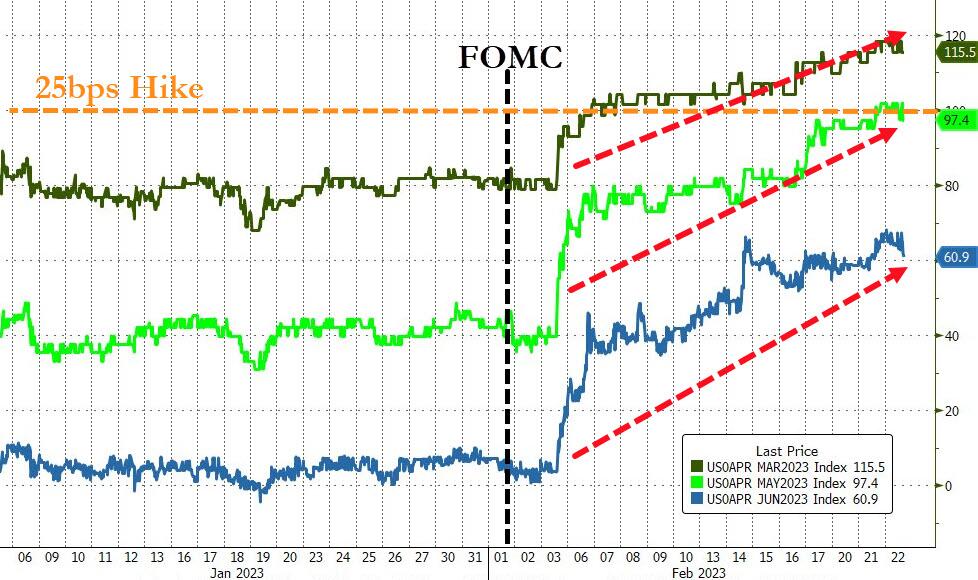
That is even more evident in the hawkish explosion higher in the market's expectation for The Fed's terminal rate and the collapse in hopes of a H2 2023 rate-cut...

Source: Bloomberg

With the odds of 25bp hikes in March, May, and June all rising rapidly...

Source: Bloomberg

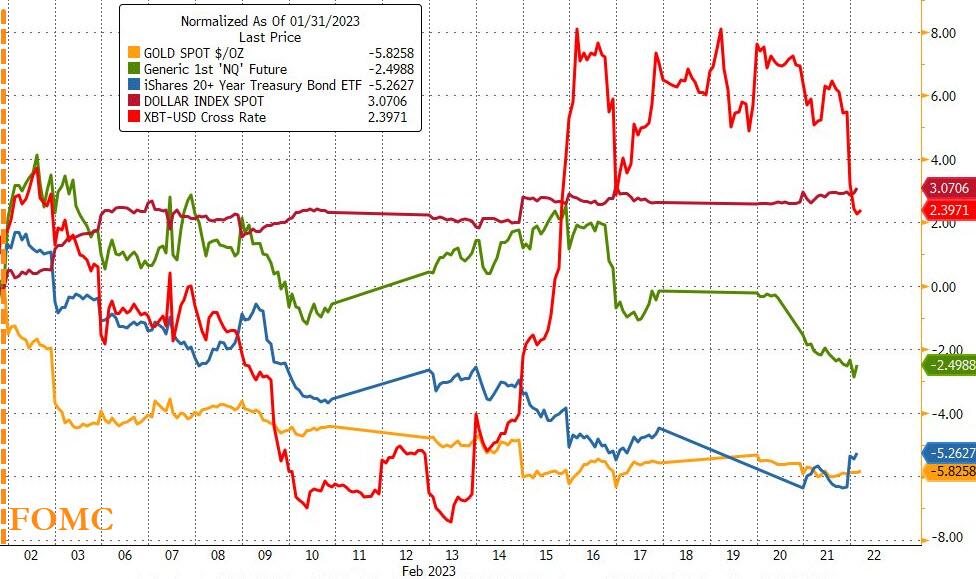
All of which has prompted chaos across asset classes with gold and bonds down notably, bitcoin and the dollar stronger and stocks fading fast in the last few days...

Source: Bloomberg

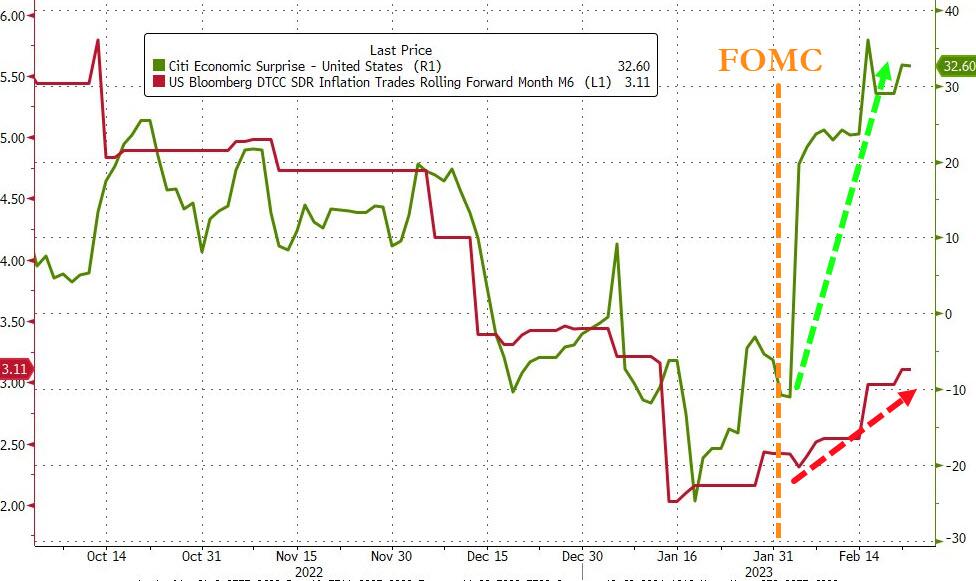
And if there is one final thing to consider before The Minutes come out, it's the fact that US macro data has dramatically surprised to the upside (and sticky inflation expectations along with it):

  • the 517,000 surge in January payrolls that blew away estimates

  • the re-acceleration of month-on-month CPI inflation in January

  • the biggest jump in the ISM services gauge since mid-2020

  • the largest increase in retail sales in nearly two years

...making the Minutes very stale.

Source: Bloomberg

As a reminder, Fed Chair Powell actually told us during the press conference on Feb 1st that:

The minutes will come out in three weeks and will give you a lot of detail. We spend a lot of time talking about the path ahead and the state of the economy. And I wouldn’t want to start to describe all the details there, but that was -- the sense of the discussion was really talking quite a bit about the path forward.”

While the biggest issue to watch for is just how dovish sentiment really is within The Fed, we already know that at least two Fed members pushed for 50bps (Mester and Bullard) at the last meeting, so what will The Minutes tell us (now that they are so stale)...

On 25 or 50 bps

In their consideration of appropriate monetary policy actions at this meeting, participants concurred that the Committee had made significant progress over the past year in moving toward a sufficiently restrictive stance of monetary policy. Even so, participants agreed that, while there were recent signs that the cumulative effect of the Committee’s tightening of the stance of monetary policy had begun to moderate inflationary pressures, inflation remained well above the Committee’s longer-run goal of 2 percent and the labor market remained very tight, contributing to continuing upward pressures on wages and prices.

Against this backdrop, and in consideration of the lags with which monetary policy affects economic activity and inflation, almost all participants agreed that it was appropriate to raise the target range for the federal funds rate 25 basis points at this meeting. Many of these participants observed that a further slowing in the pace of rate increases would better allow them to assess the economy’s progress toward the Committee’s goals of maximum employment and price stability as they determine the extent of future policy tightening that will be required to attain a stance that is sufficiently restrictive to achieve these goals.

A few participants stated that they favored raising the target range for the federal funds rate 50 basis points at this meeting or that they could have supported raising the target by that amount. The participants favoring a 50-basis point increase noted that a larger increase would more quickly bring the target range close to the levels they believed would achieve a sufficiently restrictive stance, taking into account their views of the risks to achieving price stability in a timely way.

All participants agreed that it was appropriate to continue the process of reducing the Federal Reserve’s securities holdings, as described in its previously announced Plans for Reducing the Size of the Federal Reserve’s Balance Sheet.

On Risk Management

"Almost all participants observed that slowing the pace of rate increases at the current juncture would allow for appropriate risk management."

On Inflation

"A number of participants observed that a policy stance that proved to be insufficiently restrictive could halt recent progress in moderating inflationary pressures."

The Fed staff doesn’t see inflation moving back to 2% until 2025:

“With steep declines in consumer energy prices and a substantial moderation in food price inflation expected for this year, total inflation was projected to step down markedly this year and then to track core inflation over the following two years. In 2025, both total and core PCE price inflation were expected to be near 2 percent.”

On market valuations

“The staff judged that asset valuation pressures remained notable. In particular, the staff noted that measures of valuations in both residential and commercial property markets remained high, and that the potential for large declines in property prices remained greater than usual. In addition, the forward price-to-earnings ratio for S&P 500 firms remained above its median value despite the decline in equity prices over the past year.”

On Household Spending Slowdown

"In their discussion of the household sector, participants noted that growth in consumer spending had softened recently. Several participants remarked that there had been a reduction in discretionary expenditures, especially among lower- and middle-income households, whose purchases were shifting toward lower-cost options."

On Labor Hoarding

"A number of participants remarked that some businesses were keen to retain workers after their recent experiences of labor shortages and hiring challenges. These participants noted that this consideration had limited layoffs even as the broader economy had softened"

On The Debt Limit

“A number of participants stressed that a drawn-out period of negotiations to raise the federal debt limit could pose significant risks to the financial system and the broader economy.”

On financial conditions

...officials said it was important “that overall financial conditions be consistent with the degree of policy restraint that the Committee is putting into place in order to bring inflation back to the 2 percent goal.”

Additionally:

“several participants observed that some measures of financial conditions had eased over the past few months.”

While Powell said at the meeting

“Financial conditions didn’t really change much from the December meeting to now.”

Still a long way to go to normalize back to monetary policy...

Read the full Minutes below:

https://www.zerohedge.com/markets/fomc-minutes-3

US plans to allow Medicaid for drug treatment in prisons

 The federal government is planning to allow states to use Medicaid funds to provide drugs to combat addiction and other medical services for people at state jails and prisons in an effort to help some of those most at risk of dying in the nation’s overdose epidemic.

Dr. Rahul Gupta, director of the White House Office of National Drug Control Policy, announced Tuesday that states would be encouraged to submit proposals for how to use money from the joint federal-state low-income health insurance program for incarcerated people. Those that do would be required to provide mental health and drug treatment and would have the option to add some other services.

Speaking during a visit to New Jersey’s Camden County Jail, Gupta said the U.S. Centers for Medicare and Medicaid Services will release its full guidance this spring.

Advocates have long called for such a move and the government last month announced that California was being given approval to use Medicaid for some services for incarcerated people.

“Treating substance abuse disorder in prison and jails is smart,” said Gupta, who also announced that by summer all federal prisons will be offering medications to treat substance use disorder. “It’s a smart move for our economic prosperity, for our safety and health of our nation.”

The Medicaid plan represents a departure for the joint federal-state health insurance program for low-income people. When it was launched in 1965, it came with a ban on using the funds to help incarcerated people.

Studies have found that the majority of people incarcerated in jails and state prisons met the criteria for drug dependence or abuse — and that former inmates are far more likely to die in their first weeks after release than the average non-incarcerated person. The leading cause of death for people newly released is overdose, partly because tolerance to drugs decreases for people who don’t use them while incarcerated.

Advocates for allowing Medicaid to fund treatment in lockups say it could keep people alive and reduce crime.

“We’re really hopeful that this coverage will help people improve their health outcomes and avoid additional involvement in the criminal justice system,” Gabrielle de la Gueronniere, the vice president for health and justice policy at the Legal Action Center, said in an interview Tuesday.

In some places, the Medicaid change could usher in new drug treatment options.

But in New Jersey, it’s largely a financial change. State Human Services Commissioner Sarah Adelman said 20 of the state’s 21 counties already have medication-assisted treatment programs at their jails.

The treatment costs are high, particularly for Sublocade, an opioid addiction treatment drug administered through a shot every four weeks. Since 2019, the Camden County Jail has spent more than $528,000 since 2019 to provide the drug to 170 people. It has cost $664,000 to provide a similar drug in a daily pill to about 3,100 people. The funding comes through the state’s SAFE program, which uses state allocations and grant money. In the Camden facility, nearly one-fourth of incarcerated people are receiving medication treatment now.

“It allows us to use those SAFE dollars to go further and to do more,” said Sarah Adelman, the state human services commissioner.

Some Camden County Jail inmates spoke with Gupta before he made his announcement.

One, Rachel Parker, said that she was already being treated with Suboxone when she was brought to the jail in early January.

Past jail stays meant a painful withdrawal, making it even more stressful to be there.

“It’s like you’re fearing death,” she said.

But she said this time, she’s been able to keep getting treated and knows that when she’s released, she’ll have a prescription to continue her treatment.

https://apnews.com/article/health-center-camden-prisons-f9db003d4ee9ce41c252552c6d2d6797

Psychiatric hospital for Michigan's sickest children struggles to stop patient escapes

 Michigan’s only state-run psychiatric hospital for children—reserved for patients with the most severe mental illnesses—has experienced a surge of patient escapes in just the last month.

Five patient escapes from Hawthorn Center occurred in January alone, with some of those patients now facing possible criminal charges as a result of their conduct once they left the hospital.

For children battling the most severe mental illnesses, there is no place more vital than the Northville Township hospital.

As 7 Action News as reported, the waiting list to be admitted to Hawthorn is usually months long.

The children treated there are in need of urgent, round-the-clock care. Almost always, says mental health advocate Marianne Huff, they pose a danger to themselves or others.

“Starting fires in their family home, threatening their parents and their siblings,” Huff said, listing off the behaviors of many patients admitted to the hospital. Trying to hang themselves, overdoses.”

But as hard as it is to get into Hawthorn Center, some patients have found it easy to get out.

14 different patient escapes have been reported at the facility since 2020, according to police records obtained by 7 Action News.

Some juvenile patients were missing for more than an hour. On multiple occasions, K-9 units needed to be called in to help search for patients who had disappeared.

7 Action News obtained nearly a dozen calls to 911 over the last two years, where staff requested law enforcement’s help in locating the patients.

“One of the patients just jumped the fence,” a staffer reported during one 911 call in 2022.

In another call, a Hawthorn employee can be heard asking a colleague: “Where’d she go?” in reference to a missing female patient. “I don’t know where she went.”

Said another staffer in a call made this year: “I mean, this happens. Unfortunately, it happens quite often.”

The three escapes in January were especially troubling, according to sources, because some patients escaped more than once.

The most violent escape occurred on January 31 after one teen patient was able to gain hold of a staff member’s keys. He left, along with two other patients.

The three patients traveled a mile down Haggerty Road before entering a gas station in Livonia. Surveillance video shows one of the patients standing at the counter trying to buy vaping supplies.

When the clerk asked for ID, the patient is seen moving behind the counter, then throws a punch before trying to steal products on a shelf.

The two scuffle and more punches are thrown before the clerk calls 911.

A clerk then called 911, reporting that someone was "trying to rob the gas station." Fighting and yelling can be heard in the background.

Seconds later on the other side of the counter, another patient begins to fight with a second employee.

That patient didn’t have a weapon, but the man he was fighting with did — licensed to carry a concealed pistol. He later told police that he nearly used it.

“I pulled it out, kept it in the holster though,” the employee said, according to police body camera recordings. “Because I felt like he might be a kid.”

Both gas station employees sustained minor injuries.

“It could have been a huge tragedy,” said Ali Saad, who owns the gas station. “I really think that something has to be done about it.”

The patients—who came to Hawthorn to help stabilize their behavior—would be handcuffed and are now facing potential criminal charges.

“If there wasn’t another person here, God knows what this guy could have done,” Saad said. “There’s knives, there’s things that he could have (used to) create some great bodily harm.”

The biggest problem contributing to the patient escapes, according to employees, is that the hospital is woefully understaffed.

Today, there are 91 vacant positions at the hospital with openings for 27 nursing positions and 37 childcare workers.

“To me, it speaks to the staffing shortage,” said Huff, who is president of the Mental Health Association in Michigan. “It speaks to the fact that these are kids that have significant behavioral health issues.

Hawthorn staff do not have permission to talk to us on camera, but off camera they told 7 Action News every day at the hospital is a struggle.

Said one employee: “We have a lot of staff on medical (leave) or staff that recently quit because of the workload the hospital puts on us.”

Said another, who’s worked there more than three years: “This is the worst it’s ever been.”

“These are young people with significant behavioral health issues,” Huff said. “We’d like to think that if someone is in the state hospital, they wouldn’t be able to escape from the state hospital.”

Officials with the Michigan Department of Health and Human Services declined an on-camera interview about the escapes at Hawthorn.

Instead, they released a statement that said they “review all incidents at our state hospitals to determine if changes in procedures are needed. In all cases of elopement from Hawthorn Center this year, youth were immediately followed by staff. In all cases, youth were returned to the facility the same day and in two cases youth were returned to the center within minutes of leaving.”

https://www.wxyz.com/news/local-news/investigations/children-with-severe-mental-illness-keep-escaping-from-michigan-psych-hospital