Search This Blog

Sunday, December 10, 2023

Hamas threatens to kill all remaining hostages if demands are not met

 Hamas on Sunday threatened to kill all of its remaining hostages if demands such as more aid for Gaza and prisoner exchanges were not met, after suffering repeated losses in its battle with Israel.

The Palestinian terror group is still holding the bodies of 20 hostages who died in captivity, Israel said over the weekend.

Abu Obeida, a spokesman for Hamas’ armed wing, claimed Sunday that not another single kidnap victim will leave Gaza alive unless Israel agrees to all its demands in negotiations that broke down at the start of December.

At least some of those demands have been for more aid for Gaza residents and the freeing of Palestinian prisoners.

“Neither the fascist enemy and its arrogant leadership… nor its supporters… can take their prisoners alive without an exchange and negotiation and meeting the demands of the resistance,” Obeida said in a televised broadcast.

The ultimatum came as Israeli Prime Minister Benjamin Netanyahu’s office said that of the 137 hostages believed to still be in Hamas custody, 20 are dead.

More than 100 were freed in an aid and prisoner pact last month.

Family members of the estimated 137 hostages still in Gaza demanded their release during a demonstration in Tel Aviv on Saturday.ABIR SULTAN/EPA-EFE/Shutterstock

Hamas had previously accused Israel of killing hostages during its relentless airstrike campaigns in northern Gaza, with the allegations reiterated in a Hamas video by hostage Yarden Bibas, who blamed Netanyahu for the death of his wife and two young boys.

Israel slammed the claims as propaganda, and it has accused the terror group of stooping so low as to even refuse to hand over the bodies of its dead.

Hamas is allegedly trying to leverage the corpses in the stalled hostage exchange negotiations in hopes of freeing more Palestinians from Israeli prisons and seeing more aid trucks arrive in Gaza.

Israel believes at least 20 hostages taken by Hamas have died in captivity.via Reuters

The terrorists had freed more than 100 hostages during a seven-day ceasefire last month, but after the two sides failed to agree on an eighth wave of exchanges, the war resumed Dec. 1.

Since the end of the cease-fire, 3,500 Hamas targets have been taken out in the Gaza Strip, the Israel Defense Forces said Sunday, with more than 22,000 targets destroyed since the war began Oct. 7 with Hamas’ deadly sneak attack on Israel.

A senior IDF official claimed that with Israel’s latest advancements in northern and southern Gaza, there are now “signs of Hamas breaking,” the Times of Israel reports.

Israel has aimed its artillery at southern Gaza.AFP via Getty Images

“The extent of the destruction and damage creates command and control problems [for Hamas]. There are areas in the Gaza Strip that Hamas no longer controls militarily,” the official said.

But despite Israel’s latest victories across Gaza, the official said fighting will only intensify as Hamas continues to hold out for as long as it can.

After nearly two months of warfare in northern Gaza, including raiding and destroying multiple headquarters, the IDF is now focusing its bombardments around Khan Younis, the largest city in the south.

Palestinians enter a destroyed building to collect their belongings after an Israeli airstrike at the Bureij camp Sunday.APAImages/Shutterstock

There has been heavy fighting reported in the center of the city, where hundreds of thousands of Palestinians have fled to after being evacuated from the north.

During the fighting, the IDF encircled the northern Gaza home of Hamas leader Yahya Sinwar, the man believed to have orchestrated the Oct. 7 massacre that killed more than 1,200 Israelis.

But Sinwar had already allegedly escaped south by hiding out in an evacuating humanitarian vehicle and is now believed to be in one of the tunnels in Khan Younis that is part of Hamas’ extensive underground network, the Times of Israel reported.

Civilian casualties remain reportedly high as the war carries on past its second month.Getty Images

Along with taking out half of Hamas’ estimated 24 battalion leaders, the Israeli military estimates that about 7,000 Hamas terrorists have been killed during the war.

Gaza’s Hamas-linked Health Ministry believes the war has claimed more than 17,700 victims in all, the majority women and children, with an IDF spokesman previously describing the ratio of terrorist-to-civilian killed as “positive.”

US Secretary of State Antony Blinken has urged the Jewish state to do more to avoid the deaths of civilians in the Palestinian enclave, acknowledging that not enough has been done by America’s staunch ally.

US Secretary of State Antony Blinken has advised Israel to mitigate the civilian casualties.REUTERS

“The intent is there, but the results are not always manifesting themselves,” Blinken told CNN’s “State of the Union” on Sunday.

Blinken said Israel needs to conduct lengthier pauses in the war to allow civilians to escape and for more aid to arrive to the nearly 2 million Palestinians who have been displaced since the conflict began.

Despite the concerns over Israel’s handling of the war, Blinken noted that the Jewish state has the final say on how it will conduct the fighting and when it will end.

“We have these discussions with Israel, including about the duration as well as how it is prosecuting this campaign against Hamas,” he said. “These are decisions for Israel to make.

“But Hamas has decisions to make, too. It could get out from hiding behind civilians tomorrow. It could put down its arms tomorrow. It could surrender tomorrow, and this would be over,” the US’s top diplomat said.

Blinken also defended America’s decision to bypass a congressional vote to sell nearly 14,000 rounds of tank ammunition for Israel.

The secretary of state said the sale was only a small amount of what Israel needs as he called on Congress to pass a $100 billion aid bill for Israel, Ukraine and other national security necessities.

https://nypost.com/2023/12/10/news/hamas-threatens-to-kill-all-remaining-hostages-if-demands-are-not-met/

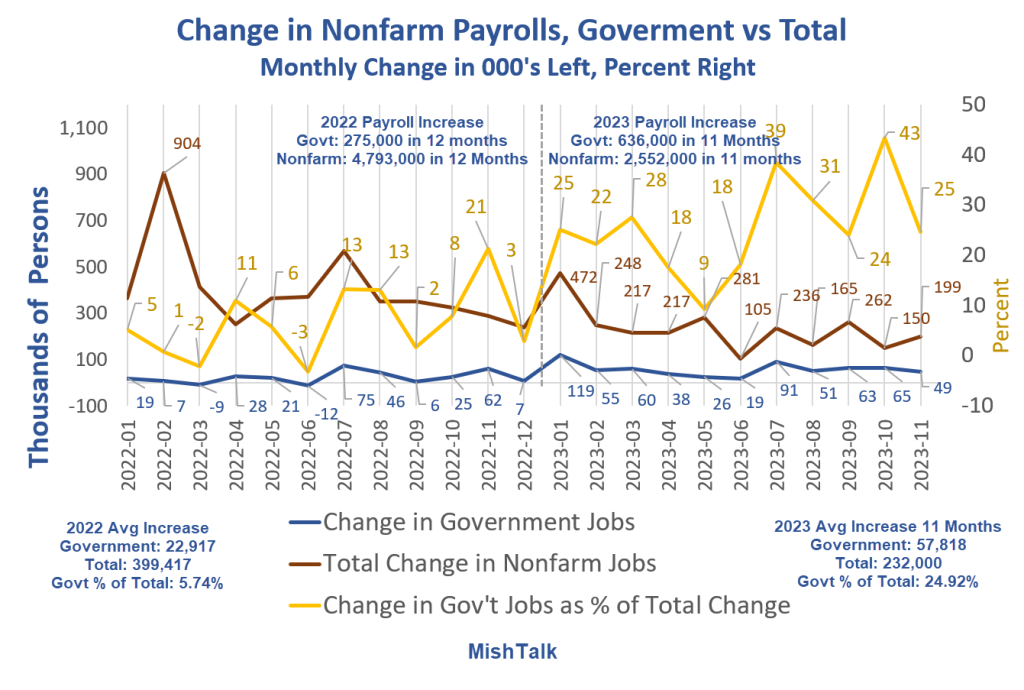
Government Accounts for Nearly 25 Percent of All Job Gains in 2023

 The following image explains how government jobs temporarily kept the economy from falling apart and the unemployment rate low this year.

Data from the BLS, chart by Mish

Government jobs have been on fire the entire year.

The total job gains so far in 2023 is 2.552 million. Government jobs account for 636,000 of them!

Government employment covers only civilian employees; military personnel are excluded. Employees of the Central Intelligence Agency, the National Security Agency, the National Imagery and Mapping Agency, and the Defense Intelligence Agency also are excluded. Postal Services are included.

Annual Change in Gov’t Jobs

636,000 / 2.552 million is 24.92 percent of all jobs gains this year. 

Chart Notes

  • When government jobs account for more than 10 percent of all jobs, the economy is nearing recession.
  • The last time we saw government jobs account for 25 percent of the total was right before the Great Recession
  • Headed into the Covid recession, government jobs were 10.82 percent of the total.
  • Headed into the 2001 recession, we had two years of government percentages at 14.49 percent and 13.62 percent.
  • To avoid weird looking negative percentages in years where nonfarm payrolls declined I set the numbers to zero.
  • The green highlights are years when government hobs declined but overall payrolls increased.

Surging government jobs is sure to raise questions about the Inflation Reduction act authoring $80 billion for IRS reforms including IRS agents, but most of these gains are at the state level.

Of the 636,000 increase in government jobs, only 79,000 were at the federal level, with exclusions as noted above.

BLS Jobs Report Stronger than ADP, Fueled in Part by End of UAW Strike

On Friday, I reported BLS Jobs Report Stronger than ADP, Fueled in Part by End of UAW Strike

In retrospect, a far better headline would read, “… fueled in part by a stunning increase in government jobs for the entire year.”

In case you missed it, please see How Much Did the Huge 412,000 Birth-Death Adjustment Impact October’s Job Report?

How the BLS calculates jobs created in the birth and death of businesses is an amazing exercise in and of itself.

If You Lose a Job, It’s Getting Harder to Find a New One

Finally, If You Lose a Job, It’s Getting Harder to Find a New One

Correction

I revised the lead sentence to “The following image explains how government jobs temporarily kept the economy from falling apart and the unemployment rate low this year.”

The economy certainly isn’t “humming” as I originally typed.

https://mishtalk.com/economics/government-accounts-for-nearly-25-percent-of-all-job-gains-in-2023/

Japan OKs World's 1st 'Self-Amplifying' mRNA COVID-19 Vaccine Without Published Efficacy Or Safety Data

 by Naveen Athrappully via The Epoch Times (emphasis ours),

Japan has approved the world’s first self-amplifying mRNA (sa-mRNA) COVID-19 vaccine, although the manufacturer has not published safety or efficacy data for the shot.

Tokyo-based Meiji Seika Pharma received approval for manufacturing and marketing its Kostaive sa-mRNA COVID-19 vaccine, the company announced in a Nov. 28 press release. The mRNA in the vaccine is designed to self-amplify when delivered into cells, which generates a “strong immune response and the potential for extended duration of protection.” The vaccine is intended for primary immunization (2 doses) as well as booster immunization in adults. Kostaive is the "world's first approved product applying self-amplifying mRNA technology," according to the press release.

Both mRNA and sa-mRNA are RNA vaccines that use a virus’ genetic code against it. When an mRNA vaccine is injected into an individual, the mRNA instructs cells to make a specific protein and thus stimulates immune response. An sa-mRNA vaccine takes this concept further by making multiple mRNA copies, which ends up generating more spike protein.

Toby Young, general secretary of the Free Speech Union, a public interest group, pointed out in a Nov. 30 X post that the sa-mRNA vaccine was approved in Japan “despite only testing it on 800 people, no control group and only checking antibody levels not infection rates. Medicine regulation died with Covid.”

A phase 3 study compared the Kostaive ARCT-154 vaccine to Pfizer’s Comirnaty mRNA COVID-19 vaccine. The pre-print study, which has not been peer-reviewed, was posted in July at MedRxiv.

The study, funded by the Japanese Ministry of Health, Labour and Welfare, followed a primary phase study that analyzed the safety and efficacy of the Kostaive vaccine. The results of that study have not been published; the manuscript is “in preparation," according to the phase 3 study report.

The trial was conducted among 828 people between December 2022 and February 2023. This is a far lower number of participants than Pfizer’s phase 3 study, which involved over 40,000 individuals. The small scale of Kostaive trial has raised questions about its validity.

According to the pre-print study, Kostaive recipients reported a slightly lower number of localized reactions—such as localized pain or swelling—compared to Comirnaty. However, Kostaive recipients reported higher numbers in specific adverse events such as chills, diarrhea, dizziness, headache, malaise, nausea, and myalgia, or muscle pain.

According to Meiji Seika Pharma, the phase 3 clinical trials for booster shots showed that Konstaive elicited “higher and longer-lasting neutralizing antibody titers against the original strain” as well as an Omicron subvariant, compared to Comirnaty.

The vaccine was developed by San Diego-based Arcturus Therapeutics. Meiji Seika Pharma licensed the vaccine for sale in Japan via Melbourne-based CSL Seqirus in April this year.

The company is collaborating with Arcalis, an mRNA vaccine manufacturing firm, to establish manufacturing capabilities in Japan. Meiji Seika Pharma is working towards commercializing Kostaive in 2024.

Risks of sa-mRNA

As sa-mRNA vaccines produce copies of mRNA and thus boost the production of proteins, some experts are worried about the consequences they can have on the human body and concerned that any negative effects from mRNA vaccines could be amplified by injecting sa-mRNA shots.

During testimony at the European Parliament last month, cardiologist Peter McCullough said that “there's not a single study showing that the messenger RNA is broken down” in the human body once it is injected. Since the vaccines are “made synthetically, they cannot be broken down.”

The spike protein from the mRNA vaccines has been found circulating in the body as long as six months from vaccination, he pointed out.

Dr. McCullough said that the spike protein is “proven” in 3,400 peer-reviewed manuscripts to cause four major domains of disease—cardiovascular, neurological disease, blood clots, and immunological abnormalities.

In a recent Epoch Times article, molecular biologist Klaus Steger noted that “a small amount of saRNA [sa-mRNA] results in an increased amount of produced antigen.”

“Due to increased antigen levels, one injection of saRNA—whether linear or circular—may cause adverse events comparable with repeated (booster) injections of modRNA.”

Mr. Steger had previously pointed out that BioNTech's "mRNA" vaccines are made not with messenger RNA but with modified RNA (modRNA).

A study published in the journal Trends in Biotechnology in June this year admitted that the “main challenges involved in the global authorization [of sa-mRNA vaccines] are potential safety concerns regarding the replicative character of these vaccines.”

“As for all self-amplifying vaccines, concerns have been raised over adverse events in vulnerable individuals. For example, replicon [sa-mRNA] vaccines could persist in immunocompromised individuals as clearance may be less efficient,” it said.

The use of sa-mRNA vaccines in pregnant women also poses risks, especially if the vectors used in the vaccines come from viruses that cause congenital infections, like the Venezuelan Equine Encephalitis Virus, the study said.

“Additional preclinical and clinical studies are required to safeguard the implementation of replicon vaccines in vulnerable individuals," it cautioned.

Commenting on the Kostaive vaccine, Mike Donio, the founder of science education website Science Defined, said in a Nov. 30 X post, “I’ve been saying for a while that the first generation Covid vaccines were only the start of a coming wave of mRNA therapies.”

“First, they told us that the mRNA wouldn’t persist in cells for a long time. Now they’ve unleashed self-amplifying mRNA, which means it replicates itself. Wonder how long that will last? Maybe forever? Now tell me how they don’t want to at least try to mess with our genetics.”

The Epoch Times reached out to Meiji Holdings for comment.

https://www.zerohedge.com/covid-19/japan-approves-worlds-first-self-amplifying-mrna-covid-19-vaccine-without-published

Court Ruling Shakes Up New York's Concealed Carry Law Landscape

 In a ruling that has both sides claiming victory, a federal appeals court upheld some parts of New York State's Concealed Carry Improvement Act (CCIA), however other aspects were struck down. This ruling, emerging from the U.S. Court of Appeals for the Second Circuit on December 8, marks the latest crescendo in a legal saga that is polarizing the nation.

The court's decision, which combined four lower court cases due to overlapping issues, overturned some lower court rulings while sustaining others. Notably, the court invalidated the CCIA's ban on gun possession on private property without explicit permission and lifted the prohibition of gun possession in places of worship. Additionally, it rejected the mandate for concealed carry permit applicants to disclose their social media accounts to authorities.

However, the court upheld several CCIA provisions, including the need for applicants to show good moral character and disclose family members on permit applications. It maintained the ban on concealed carry in designated “sensitive places,” with the notable exception of places of worship, and upheld requirements for an interview, character references, and extensive training.

New York Attorney General Letitia James hailed the ruling as a win, emphasizing in a statement that the court’s decision to enforce key CCIA components. Her statement underlines a commitment to New York's stringent gun laws and a crusade against gun violence.

"Today’s decision to permit the state to enforce critical provisions of the Concealed Carry Improvement Act as the court process moves forward will help keep New Yorkers safe," said James, adding "My office will continue to defend New York’s gun laws and use every tool to protect New Yorkers from senseless gun violence."

Meanwhile, the Second Amendment Foundation (SAF), instrumental in two of the four cases reviewed by the court, celebrated the ruling as a triumph for gun rights. SAF's involvement in the Christian v. Chiumento and Hardaway v. Chiumento cases, which challenged aspects of the CCIA, underscored their strategic legal approach. SAF's founder, Alan M. Gottlieb, and Executive Director Adam Kraut, highlighted these cases as victories in their mission to safeguard firearms freedom.

"These are just two more examples of SAF carrying out its mission to win firearms freedom, one lawsuit at a time," said Gottlieb.

Adam Kraut, meanwhile, said the ruling was the result of a focused legal strategy.

"Our challenges were narrowly constructed, allowing us to win a small but significant victory in the Christian case. Because the legislature changed the law after our lawsuit was filed in the Hardaway case, we consider that a victory as well," he said.

The ruling is set against the backdrop of the U.S. Supreme Court’s decision in York State Rifle and Pistol Association v. Bruen, which affirmed a constitutional right to public gun carry for self-defense. Following this landmark ruling, a dichotomy has emerged across the U.S., with 27 states adopting “constitutional carry laws” allowing unlicensed firearm carry, while others, like New York, have tightened restrictions.

The CCIA, a direct response to the Bruen decision, introduced more rigorous training requirements, expanded no-carry zones, mandated in-person interviews, and shortened license recertification periods. Its aim: to recalibrate New York's gun laws in line with the new legal landscape.

Yet, this latest court decision is far from the final word. Advocates for gun rights, such as Erich Pratt of Gun Owners of America, vow to continue their legal crusade, signaling an unyielding resolve to overturn the CCIA in its entirety.

"Governor Hochul and her cabal in Albany never seem to get the message, and in turn, GOA is proud to have played a major role in rebuking her unconstitutional law. Nevertheless, this was not a total victory, and we will continue the fight until this entire law is sent to the bowels of history where it belongs," wrote Erich Pratt, senior vice president for Gun Owners of America, on the group's website.

As the legal tussle over New York's gun laws continues, the implications are clear: the debate over the Second Amendment is far from settled. This ruling, a complex blend of victories and setbacks for both sides, underscores the ongoing, intricate, and often contentious negotiation between gun rights and gun control in the United States. As the case potentially heads to the Supreme Court, it remains a pivotal battleground in the enduring struggle to define the contours of the Second Amendment in contemporary America.

https://www.zerohedge.com/political/court-ruling-shakes-new-yorks-concealed-carry-law-landscape

MedPAC drafts 2025 payment proposal

 MedPAC drafted its 2025 payment update recommendations Dec. 8, according to the American Hospital Association.

The draft recommendations urge Congress to update hospital inpatient and outpatient service Medicare payment rates by the existing law amount with an added 1.5%. MedPAC also recommended a transition to a safety net index policy, which would provide an additional $4 billion to safety net hospitals. 

Other MedPAC 2025 proposals to Congress include updating 2025 Medicare payments by 50% of the Medicare Economics Index increase, AHA reported. Under the physician fee schedule, MedPAC also suggests Congress provide a non-budget-neutral add-on payment for low-income Medicare beneficiary services.

MedPAC also urged Congress to reduce the 2025 payment rate for home health agencies by 7%, skilled nursing facilities by 3%, and inpatient rehabilitation facilities by 5%. The commission will vote on these recommendations in January 2024.

https://www.beckershospitalreview.com/finance/medpac-drafts-2025-payment-proposal.html

If You Didn’t Like The First Term, Just Wait For The Second

 by Ron Faucheux via RealClear Wire,

Second presidential terms are like half-chewed gum – the zest and flavor are gone. Hence the phrase “second-term curse.” We’ve had 17 presidents who were elected and reelected. History shows us that the second act usually falls short

Why is this? For starters, popular mandates tend to dissipate over time, and public familiarity tends to curdle into boredom or contempt. Second terms often lack purpose and are tarnished by missteps, scandals, and hubris. Usually, the best presidential appointments are made in the first term.

If either Joe Biden or Donald Trump is nominated, no matter which one wins the general election, we’re in for a second term in January 2025. Sharply negative views have already accumulated around both men; neither would have the benefit of a truly fresh start.

While Trump’s second term would be nonconsecutive, the first since Grover Cleveland’s, it would still fit within the second-term paradigm, especially if he uses it to exact revenge on his enemies, as some pundits predict.

Either Biden or Trump would start a second term as a lame duck and may have to battle impeachment, probably for things done in the first term. Old cuts and scars will deepen alongside new wounds. Trump will have criminal trials on his docket and may try to pardon himself, which could launch a long, bruising court fight. Biden will likely face investigations into a range of matters, including his son’s business dealings.

During Thomas Jefferson’s first four years, he doubled the size of our young nation with the Louisiana Purchase, the shrewdest real estate deal in history. The Embargo Act, which devastated a fragile economy, came in his second term.

Grover Cleveland’s first term ushered in good government reforms. He opposed the spoils system, created the Interstate Commerce Commission, and modernized the Navy. Although he won the popular vote for reelection, he lost the Electoral College vote. Four years later, he won a second, nonconsecutive term, which was overwhelmed by two economic depressions and numerous labor strikes.

Woodrow Wilson’s first term was marked by the passage of significant economic reforms. His second was dominated by World War I, which he promised to avoid, and the attempted ratification of his beloved League of Nations, which he fumbled. He also suffered a severe stroke, incapacitating him during the last 16 months of his presidency.

Franklin Roosevelt took on the Great Depression during his first four years. Social Security, immense public works, bank deposit insurance, labor laws, securities regulation, and rural electrification became realities. His second term started with the botched attempt to “pack” the Supreme Court, followed by another economic downturn and a clumsy bid to purge the Democratic Party of New Deal skeptics. Of Roosevelt’s four terms, his mistake-prone second, most historians agree, was least impressive. His third was consumed by World War II, and the fourth lasted less than three months.

Richard Nixon’s top foreign policy achievements occurred during his first term. His second term was engulfed by Watergate, and that led to an inglorious resignation.

Ronald Reagan’s course correction for America happened mostly during his first term: renewing national confidence, reducing taxes and spending, fighting inflation, building up the military, and breaking the PATCO strike. While his second term set the stage for the collapse of the Soviet Union, it was distracted by the Iran-Contra affair.

Bill Clinton’s first term set into motion economic policies that would carry his presidency. This provided second term cushion – although a big chunk was squandered on the Monica Lewinsky scandal and impeachment.

George W. Bush’s first four years were momentous: responding to the 9/11 terrorist attacks, launching wars in Afghanistan and Iran, and passing big tax cuts. It was in his second term when the bungling of Hurricane Katrina’s aftermath wrecked his administration’s reputation for competence, and that, in turn, poisoned perceptions of his war management.

In his first term, Barack Obama passed Obamacare and major economic stimulus programs. Osama bin Laden was also captured and killed. His second term focused on fixing Obamacare and trying to sell a range of policies, domestic and foreign, that never won much public confidence.

If either Biden or Trump wins, we’ll have a second-term presidency. As The Old Philosopher, Eddie Lawrence, might have said, “Something else to look forward to, hey Bunkie?”

Ron Faucheux is a nonpartisan political analyst. He publishes LunchtimePolitics.com, a public opinion newsletter, and is the author of “Running for Office,” a tell-all book for political candidates.

https://www.zerohedge.com/political/if-you-didnt-first-term-just-wait-second

Seagen Combo Has 100% Progression Free Survival at 12 months in Phase 2 Trial in Early Hodgkin Lymphoma

 – 88% of patients with advanced stage classical Hodgkin Lymphoma in trial remained progression free at 24 months –

– Investigational regimen that eliminates two commonly used chemotherapy agents, vinblastine and bleomycin, continues to show consistent safety and tolerability profile, with no cases of febrile neutropenia and no new safety signals observed –

https://www.businesswire.com/news/home/20231210494461/en/