Search This Blog

Monday, April 8, 2024

Novo Nordisk parent refiles US application on Catalent deal

 The parent of Wegovy producer Novo Nordisk has refiled an application to the U.S. Federal Trade Commission (FTC) for approval of a $16.5 billion deal to buy manufacturing subcontractor Catalent, a spokesperson said on Monday.

Novo Nordisk Foundation said last month it had agreed to buy Catalent to boost output of the weight-loss drug Wegovy. After the deal closes, it would sell three of Catalent's fill-finish sites on to Novo Nordisk for $11 billion.

An application was submitted to U.S. anti-trust authorities on March 4. But "following informal discussions with the FTC staff", the company withdraw and filed a new application on April 2, a Catalent SEC filing dated April 3 showed.

A Novo Foundation spokesperson confirmed to Reuters that the company "has resubmitted the application to give authorities more time".

Novo had said the deal was expected to be completed towards the end of 2024. The spokesperson declined to comment on whether that was still possible and also declined to comment on why the application had been refiled.

https://finance.yahoo.com/news/novo-nordisk-parent-refiles-us-103118874.html

Vatican says 'no' to sex changes and gender theory in new document

 The Vatican on Monday reaffirmed its opposition to sex changes, gender theory and surrogate parenthood, as well as abortion and euthanasia, four months after supporting blessings for same-sex couples.

At the same time, the head of its doctrinal office (DDF), Cardinal Victor Manuel Fernandez, said the Vatican opposed the criminalisation of homosexuality as practised by a number of countries with the support of local Catholic groups.

The release of "Dignitas infinita" (Infinite dignity), a 20-page document, follows fierce conservative pushback, especially in Africa, against the DDF's previous declaration - on LGBT issues.

There is no suggestion that the new text, which describes what the Church perceives as threats to human dignity, was prepared in direct response to the rows over same-sex blessings, as it has been five years in the making. But it has undergone extensive revisions over the period.

Pope Francis approved it last month after requesting that it also mention "poverty, the situation of migrants, violence against women, human trafficking, war, and other themes", Fernandez said in a statement.

The declaration said surrogate parenting violates the dignity of both the surrogate mother and the child, and recalled that Francis in January called it "despicable" and urged a global ban.

GENDER THEORY

On gender theory, it said "desiring a personal self-determination ... amounts to a concession to the age-old temptation to make oneself God, entering into competition with the true God of love revealed to us in the Gospel".

Gender theory suggests that gender is more complex and fluid than the binary categories of male and female, and depends on more than visible sexual characteristics.

The declaration said that "any sex-change intervention, as a rule, risks threatening the unique dignity the person has received from the moment of conception".

It acknowledged the possibility of surgery to resolve "genital abnormalities", but stressed that "such a medical procedure would not constitute a sex change in the sense intended here".

The Vatican has, nevertheless, tried to reach out to transsexual people, who have been cleared by the DDF to be baptised and serve as godparents, and have been among invitees to the Vatican.

Fernandez, a liberal theologian and personal friend of the pope, a fellow Argentine, defended Francis' right to update Church positions in line with the times, noting how, in the past, it had gone from supporting to condemning slavery.

"It now seems that Pope Francis cannot say anything different from what has been said before, as if the teachings of the Church had been permanently set by previous popes," the cardinal lamented.

Monday's declaration doubled down on the Vatican's standing condemnation of abortion, euthanasia and the death penalty.

It also mentioned sexual abuse as a threat to human dignity - calling it "widespread in society", including within the Catholic Church - as well as cyberbullying and other forms of online abuse.

https://www.yahoo.com/news/vatican-says-no-sex-changes-100307218.html

Trump says abortion laws should be decided by US states

 Republican presidential candidate Donald Trump said on Monday that abortion laws should be determined by U.S. states, stopping short of proposing a national ban that could have imperiled his chances in the November election.

In a video posted on his social media platform, the former president said he supported exceptions for rape, incest and to protect the life of the mother. He also reiterated that he supports the availability of in-vitro fertilization.

He did not back a national ban to prohibit abortions beyond a number of weeks into a pregnancy, disappointing some religious and conservative backers who had hoped he would pursue national limits should he return to the White House.

Trump previously signaled support for a ban beyond 15 weeks of pregnancy but said political considerations were paramount in the first presidential election since a Supreme Court ruling in 2022 ending a nearly 50-year federal right to the procedure.

"Always go by your heart. But we must win. We have to win," Trump said in the video.

A call for a national ban could have hurt Trump's chances in the six or seven U.S. states likely to determine the outcome in November. Overall, 57% of Americans think abortion should be legal in most or all cases, a March Reuters/Ipsos poll found.

While his statement aimed to carve out a political middle ground, it drew criticism from Democrats on the left who favor abortion rights and from anti-abortion groups on the right who want stricter limits, underscoring the divisions over the issue.

Alluding to the three conservative justices he appointed to the Supreme Court, Trump took credit for the high court's overturning of the landmark 1973 Roe v. Wade decision, which had protected a right to abortion at up to around 24 to 28 weeks.

The court's decision triggered a voter backlash that was widely credited with curbing Republican gains in the 2022 congressional midterm election and propelling Democrats to victories in some state elections last year.

"This 50-year battle over Roe v. Wade took it out of the federal hands and brought it into the hearts, minds and vote of the people in each state. It was really something. Now it's up to the states to do the right thing," Trump said.

President Joe Biden, a Democrat, has made Trump's opposition to abortion rights a tenet of his re-election campaign.

"Trump is scrambling. He's worried that since he's the one responsible for overturning Roe the voters will hold him accountable in 2024," Biden said in a statement issued by his campaign. "Well, I have news for Donald. They will."

While Americans tend to accept restrictions on abortion after the first trimester, polls also show that a sizable majority prefer to have the decision made by the patient and her doctor, not the government.

Trump has criticized a six-week ban pursued by Florida Governor Ron DeSantis, a former rival for the Republican nomination, as overly restrictive and politically toxic. But Trump is aligned with many Republicans in Congress and evangelical Christians urging strict curbs on the procedure.

"With Roe v. Wade overturned, leaving abortion to the states is his way of punting on the issue," Jeanette Hoffman, a Republican political consultant, said of Trump's position. "Now that the primary is over, there’s nothing to be gained from proposing a national abortion ban, as he’ll lose support from voters in many swing states."

The Supreme Court's reversal of Roe v. Wade allowed the matter to be decided state-by-state. In response, Republicans have enacted restrictive abortion laws in nearly two dozen states.

The Reuters/Ipsos poll in March found a sizable majority of Democrats - 83% - think abortion should be legal in most or all cases while most Republican poll respondents - some 57% - think abortion should be outlawed in most or all cases.

Marjorie Dannenfelser, head of anti-abortion group Susan B. Anthony Pro-Life America, said on Monday she was "deeply disappointed" in Trump's position, arguing it would allow Democratic lawmakers to take steps to expand access to the procedure in some states.

"Unborn children and their mothers deserve national protections and national advocacy from the brutality of the abortion industry," Dannenfelser said in a statement.

https://www.yahoo.com/news/trump-says-abortion-laws-determined-112102691.html

Neuralink rival readies large-scale brain implant trial

 Synchron Inc, a rival to Elon Musk's Neuralink brain implant startup, is preparing to recruit patients for a large-scale clinical trial required to seek commercial approval for its device, the company's chief executive told Reuters.

Synchron on Monday plans to launch an online registry for patients interested in joining the trial meant to include dozens of participants, and has received interest from about 120 clinical trial centers to help run the study, CEO Thomas Oxley said in an interview.

"Part of this registry is to start to enable local physicians to speak to patients with motor impairment," he said. "There's a lot of interest so we don't want it to come in a big bottleneck right before the study we'll be doing."

New-York based Synchron is farther along in the process of testing its brain implant than Neuralink. Both companies initially aim to help paralyzed patients type on a computer using devices that interpret brain signals.

Synchron received U.S. authorization for preliminary testing in July 2021 and has implanted its device in six patients. Prior testing in four patients in Australia showed no serious adverse side effects, the company has reported.

Synchron will be analyzing the U.S. data to prepare for the larger study, while awaiting authorization from the U.S. Food and Drug Administration to proceed, Oxley said. Synchron and the FDA declined to comment on the expected timing of that decision.

The company aims to include patients who are paralyzed due to the neurodegenerative disease ALS (amyotrophic lateral sclerosis), stroke and multiple sclerosis, Oxley said.

Mount Sinai in New York, the University at Buffalo Neurosurgery and the University of Pittsburgh Medical Center (UPMC) are collaborating on the preliminary study. Synchron said it hopes to involve these centers in the larger trial.

Dr. David Lacomis, chief of UPMC's Neuromuscular Division, said his team is still participating in the preliminary human testing “and the study is going well.”

Yields To Stay Elevated As Inflation Emboldens Short Bond Trade

 by Simon White, Bloomberg macro strategist,

Rising inflation is likely to push more traders to go outright short on US Treasuries, supporting yields.

The inflation tide is turning. Disinflation has stalled in the US, core inflation in Japan is stuck at more than 30-year highs, and the global median inflation rate has stopped falling.

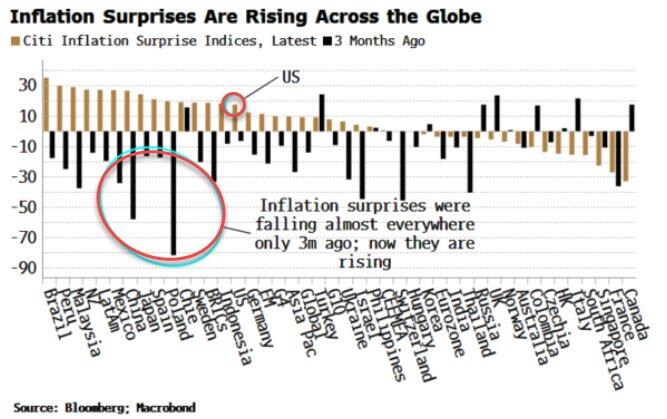
Global disinflation momentum has petered out. The Citi Inflation Surprise indices, which were negative in almost every country only three months ago, are now positive is most countries.

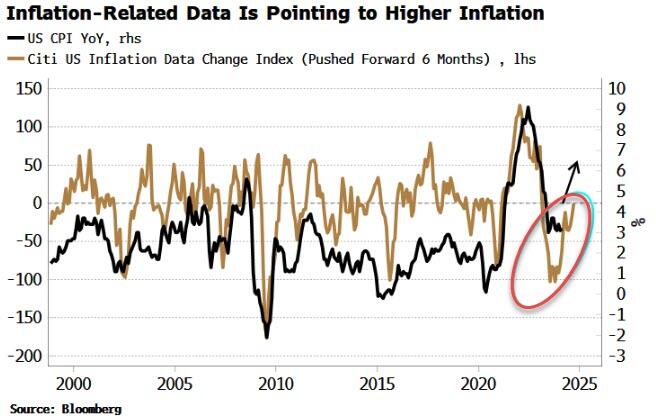
We’ll get updates on inflation this week from several countries in Europe as well as the US. Leading data has been consistently pointing to a re-rise in US inflation.

To add to that, Citi also produces an Inflation Data Change Index for the US, which tracks the cumulative change in inflation-related data. It shows US CPI should soon start rising again.

That’s a challenge for bond holders. Speculators’ positioning in USTs in the Commitment of Traders report is very net short, but this data is polluted by the basis trade, i.e. trading the bond future versus the underlying cash bond.

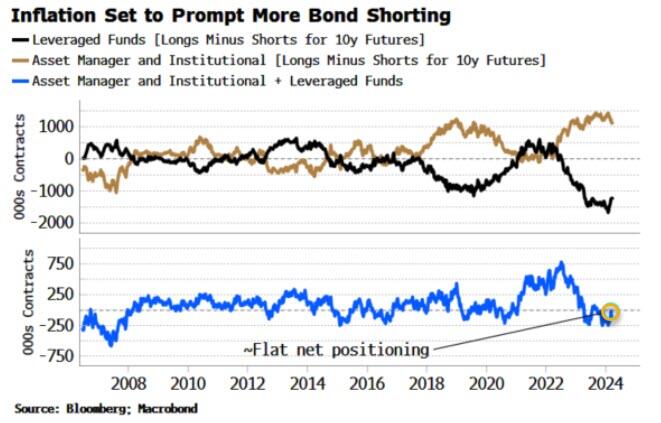
A better way to look at the data to try to account for this is to focus on the positioning of asset managers and leveraged funds. Typically, the second places the trade with the first via the repo market.

If we net the positioning in futures between leveraged funds and asset managers that should eliminate much of the contribution from basis trading. The net position in 10y UST futures is basically flat (orange line in the chart below).

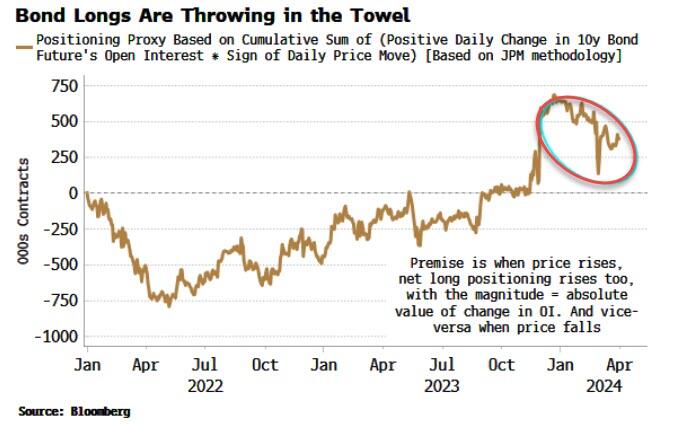
Another proxy for bond positioning shows that longs in 10y notes have been falling quite rapidly from their highs at the end of the last year. Furthermore, JP Morgan’s Client Treasury Survey shows outright shorts at almost series lows.

The overall message is that bond traders have been reducing longs as recession risk has receded, but they have not yet gone net short en masse. However, the inflation picture is likely to soon change that.

This week’s inflation data has a risk tilt, in that a lower-than-expected print is unlikely to prompt a stampede of fresh longs, but data that is above expectations could see any lingering doubts about going short bonds adamantly put to one side.

https://www.zerohedge.com/markets/yields-stay-elevated-inflation-emboldens-short-bond-trade

Why US Public Debt Is Unsustainable And Is Destroying The Middle Class

by Daniel Lacalle,

In a recent tweet, a talented financial analyst and investor stated: “The “debt is unsustainable” narrative has been around for 40 years plus. What’s astonishing to me is how the people who push this narrative never ask themselves, “Why has it been sustainable for so long?”. 

There is a widespread idea that the fiscal imbalances of a world reserve currency issuer would end in an Argentina-style bankruptcy. However, the manifestation of unsustainability did not even appear as drastic in Argentina itself. Hey, Argentina continues to exist, doesn’t it?

Excessive public debt is unsustainable when it becomes a burden on productive growth and leads the economy to constantly rising taxes, weaker productivity growth, and weaker real wage growth. However, the level of unsustainable accumulation of debt may continue to rise because the state itself imposes public debt on banks’ balance sheets and the state forces the financial sector to take all its debt as the “lowest risk asset.” However, law and regulation have merely imposed and forced this construct. Rising debt bloats the government’s size in the economy and erodes its growth and productivity potential.

Many diabetic and obese people continue to eat too much unhealthy food, thinking nothing has happened so far. That does not mean their eating habits are sustainable.

Those who ignore the accumulation of public debt tend to do so under the idea that nothing has happened yet. This is a reckless way of looking at the economy, a sort of “we have not killed ourselves yet; let us accelerate” mentality.

An ever-weaker private sector, weak real wages, declining productivity growth, and the currency’s diminishing purchasing power all indicate the unsustainability of debt levels. It becomes increasingly difficult for families and small businesses to make ends meet and pay for essential goods and services, while those who already have access to debt and the public sector smile in contentment. Why? Because the accumulation of public debt is printing money artificially.

When money is created in the private sector through the financial system, there is a process of wealth creation and productive money creation. The financial system creates money for projects that yield a genuine economic return. Some fail, others soar. That is the process of productive economic growth and progress. Only when the central bank manipulates interest rates, disguises the cost of risk, and increases the money supply to monetize unproductive deficit spending can it distort this process.

Private banks in an open economy create money to accelerate progress and free-floating interest rates limit the accumulation of unproductive and dangerous risk. When the central bank wants to disguise the worsening solvency of fiscally imprudent governments, it does so by tampering with interest rates—making fiscally irresponsible governments’ borrowing cheaper—and artificially increasing the amount of currency in the system, monetizing public debt—a destructive process of money creation as opposed to the saving-investment function of banking.

When the fiscal position is unsustainable, the only way for the state to force the acceptance of its debt—newly created currency—is through coercion and repression.

A state’s debt is only an asset when the private sector values its solvency and uses it as a reserve. When the state imposes its insolvency on the economy, its bankruptcy manifests in the destruction of the purchasing power of the currency through inflation and the weakening of real wage purchasing capacity.

The state basically conducts a process of slow default on the economy through rising taxes and weakening the purchasing power of the currency, which leads to weaker growth and erosion of the middle class, the captive hostages of the currency issuer.

Of course, as the currency issuer, the state never acknowledges its imbalances and always blames inflation and weak growth on the private sector, exporters, other nations, and markets. Independent institutions must impose fiscal prudence to prevent a state from destroying the real economy. The state, through the monopoly of currency issuance and the imposition of law and regulation, will always pass on its imbalances to consumers and businesses, thinking it is for their own good.

The government deficit is not creating savings for the private economy. Savings in the real economy accept public debt as an asset when they perceive the currency issuer’s solvency to be reliable. When the government imposes it and disregards the functioning of the productive economy, positioning itself as the source of wealth, it undermines the very foundation it purports to protect: the standard of living for the average citizen.

Governments do not create reserves; their debt becomes a reserve only when the productive private sector economy within their political boundaries thrives and the public finances remain under control. The state does show its insolvency, like any issuer, in the price of the I.O.U. it distributes, i.e., in the purchasing power of the currency. Public debt is artificial currency creation because the state does not create anything; it only administers the money it collects from the same productive private sector it is choking via taxes and inflation.

The United States debt started to become unsustainable when the Federal Reserve stopped defending the currency and paying attention to monetary aggregates to implement policies designed to disguise the rising cost of indebtedness from unbridled deficit spending.

Artificial currency creation is never neutral. It disproportionately benefits the first recipient of new currency, the government, and massively hurts the last recipients, real wages and deposit savings. It is a massive transfer of wealth from the productive economy and savers to the bureaucratic administration.

More units of public debt mean weaker productive growth, higher taxes, and more inflation in the future. All three are manifestations of a slow burn default.

So, if the state can impose its fiscal imbalances on us, how do we know if the debt it issues is unsustainable? First, because of the units of GDP created, adding new units of public debt diminishes rapidly. Second, the erosion of the currency’s purchasing power persists and accelerates. Third, because productive investment and capital expenditure decline, employment may remain acceptable in the headlines, but real wages, productivity, and the ability of workers to make ends meet deteriorate rapidly.

Today’s narrative tries to tell us that nothing has happened when a lot has. The destruction of the middle class and the deterioration of the small and medium enterprise fabric in favor of a rising bureaucratic administration that consumes higher taxes but still generates more debt and deficits It does end badly. And all empires end the same way, with the assumption that nothing will happen. The currency’s acceptance as a reserve does come to an end. The persistent erosion of purchasing power and declining confidence in the legally imposed “lowest risk asset” are some of the red flags some are willing to ignore, maybe because they live off other people’s taxes or because they benefit from the destruction of the currency through asset inflation. Either way, it is profoundly anti-social and destructive, even if it is a slow detonation.

The fact that there are informed and intelligent investors who willingly ignore the red flags of weakening the middle class, declining purchasing power of the currency and deteriorating solvency and productivity shows why it is so dangerous to allow governments to maintain fiscal imprudence. The reason why government money creation is so dangerous is because the government is always happy to increase its power over citizens and blame them for the problems its policies create, presenting itself as the solution.

Can debt continue to rise? Of course. The gradual process of impoverishment and serfdom is relatively comfortable when the state can impose the use of the currency and force its debt into your pension by law and regulation.

To think that it will last forever, and nothing will happen is not just reckless “accelerate, we have not crashed yet” mentality. It is ignoring the reality of money. Independent money, gold, and similar, solve this.

https://www.zerohedge.com/markets/why-us-public-debt-unsustainable-and-destroying-middle-class