Search This Blog

Thursday, April 11, 2024

NGO 'demands' Cal. $20 minimum wage for fast food workers extend to all sectors

 A fair wage advocacy group is demanding that California’s new $20 minimum wage law for fast food workers be extended to all sectors to help working-class people who are struggling with the state's high cost of living. 

FOX Business spoke with Saru Jayaraman, president of One Fair Wage to discuss what she described as the skyrocketing levels of home insecurity and food insecurity post-pandemic. 

Fast food workers winning a $20 minimum wage, she said, "was just the beginning." 

Jayaraman pointed to the exorbitantly high cost of living in the Golden State where, in some counties, an individual would need a $40 an hour salary to live comfortably. 

Saru Jayaraman speaking at an event

President of One Fair Wage Saru Jayaraman speaks during a Learn About Worker Experiences event at the Skal restaurant in Brooklynon April 11, 2022, in New York City. (Roy Rochlin/Getty Images for One Fair Wage / Getty Images)

"People are leaving the state or are not having children, not having families. These are all the very basics we should be thinking about for humans living in California and needing to survive," Jayaraman told FOX Business. "I mean the level of crisis that people have been enduring since the pandemic is severe." 

California Gov. Newsom signed AB 1228 in September and the law went into effect earlier this month. The new law applies to workers at restaurants that have at least 60 locations nationwide. 

Ahead of the law coming into effect, restaurant owners and other industry insiders warned that the law would be detrimental to small businesses and consumers. 

placeholder

One Los Angeles-based restaurant owner complained to FOX Business that there were going to be "massive layoffs" and "massive job losses." 

Another former assistant manager at Fosters Freeze in Lemoore, California described the new law as "a shock." 

Jayaraman has dismissed these concerns, arguing that such dire predictions have not been born out in past minimum wage increases. 

"That is the argument they always make. Every single time the minimum wage goes up, they always say it’s going to kill business, jobs will be lost, and we’ve never seen it happen. Not in California, not in any other state. It has never happened," said Jayaraman, who is also the Director of the Food Labor Research Center at the University of California, Berkeley.

She argued that raising the minimum wage will put more money into workers’ pockets who in turn spend their extra earnings, stimulating the economy and growing industries. 

Saru Jayaraman wearing a red dress

Saru Jayaraman speaks at the One Fair Wage Fundraiser at Gracias Madre on September 21, 2023, in West Hollywood, California. (Mark Von Holden/Variety via Getty Images / Getty Images)

That the minimum wage would pass prices onto consumers, she argued that consumers have already been experiencing inflation, coupled with stagnant wages. 

"Frankly, inflation has already happened, and many prices have already gone up. Grocery store prices have already gone up. And so, it’s not a matter of we can’t raise wages anymore because prices might go up," she said. "Prices have already gone up. If we don’t keep wages in step with the rising cost of living, either workers will leave the state or these other horrible things happen." 

Jayaraman said small businesses have been "leading the way" when it comes to offering more money for workers. 

"They have joined forces with us to say ‘we really need a policy that’s going to create a level playing field so that we’re not sticking our necks out," Jayaraman said. "You need policy to signal to these workers it’s worth working in restaurants again."


https://www.foxbusiness.com/economy/labor-group-demands-californias-20-minimum-wage-fast-food-workers-extend-all-sectors

High demand for AI training data may up unethical practices in collecting patient data

 With the rise in patient-facing psychiatric chatbots powered by artificial intelligence (AI), the potential need for patient mental health data could drive a boom in cash-for-data scams, according to mental health experts.

A recent example of controversial data collection appeared on Craigslist when a company called Therapy For All allegedly posted an advertisement offering money for recording therapy sessions without any additional information about how the recordings would be used.

The company's advertisement and website had already been taken down by the time it was highlighted by a mental health influencer on TikTokopens in a new tab or window. However, archived screenshots of the websiteopens in a new tab or window revealed the company was seeking recorded therapy sessions "to better understand the format, topics, and treatment associated with modern mental healthcare."

Their stated goal was "to ultimately provide mental healthcare to more people at a lower cost," according to the defunct website.

In service of that goal, the company was offering $50 for each recording of a therapy session of at least 45 minutes with clear audio of both the patient and their therapist. The company requested that the patients withhold their names to keep the recordings anonymous.

The website stated that the company was committed to providing "top-quality therapy services" for individuals. And the recordings would be used by its research team "to learn more about approaches to mental healthcare."

There were no further details about how the company planned to use those recordings, and they did not respond to requests from MedPage Today to clarify their business model.

However, experts suggested this is just one example of an unexpected incentive created from the growth of AI in mental healthcare.

John Torous, MD, director of the digital psychiatry division at Beth Israel Deaconess Medical Center in Boston, told MedPage Today that misuse of patient data related to AI models is an "extremely legitimate concern," because large language models are only as good as their training data.

"Their chief weakness is they need vast amounts of data to truly be good," Torous said. "Whoever has the best data will likely have the most practical or -- dare I say -- the best model."

He added that high-quality patient data is likely going to be the limiting resource for developing AI-powered tools related to mental healthcare, which will increase the demand and, therefore, the value of this kind of data.

"This is the oil that's going to power healthcare AI," Torous added.

"They need to have millions, if not billions, of examples to train on," he added. "This is gonna become a bigger and bigger trend."

Torous highlighted that mental healthcare technology companies have already been caught crossing this line with unethical use of patient-facing AI tools.

For example, in early 2023, nonprofit mental health platform Kokoopens in a new tab or window announced that it used OpenAI's GPT-3 to experiment with online mental health counselingopens in a new tab or window for roughly 4,000 people without their informed consent. The announcement, which came from the CEO Rob Morris' X (formerly Twitter) accountopens in a new tab or window, highlighted the lack of understanding around ethical concerns related to patient consent from these companies, Torous said.

Another example, he noted, came when users of the text message-based mental health support tool Crisis Text Lineopens in a new tab or window learned that the company was sharing their data with a for-profit AI sister companyopens in a new tab or window called Loris.ai. Eventually, the company ended the relationship after substantial backlash from its usersopens in a new tab or window.

While concerns around patient data persist, there are also notable clinical implications for patient care and safety, according to Jacob Ballon, MD, MPH, of Stanford University in California.

"I would not want someone to do AI therapy on its own," he told MedPage Today, adding that people seek out psychotherapy to help with complex, sometimes life-threatening, mental health conditions. "These are serious things that people are dealing with and to leave that to an unregulated, unmonitored chatbot is irresponsible and ultimately dangerous."

Ballon added that he doesn't think AI models are capable of producing the nuanced expertise needed to help individual patients address their unique mental health concerns. Even if a company could train their AI chatbot on enough high-quality patient data, it would not be able to appreciate the complexity of each patient, he noted.

Despite those concerns, Torous thinks there will be growth in companies attempting to train AI models on patient data, whether it is collected ethically or not.

"There's probably going to be this whole world where I wonder if patients are going to be pressured or cajoled or convinced to give up their [personal health data]," he said, predicting that the market for patient mental health data will only continue to grow in the coming years.

https://www.medpagetoday.com/special-reports/exclusives/109626

'CDC: COVID Vax Not Linked to Sudden Deaths in Young Adults'

 The hunt for a signal of excess sudden cardiac deaths among young people after COVID-19 vaccination left Oregon health officials empty-handed, they reported.

Investigators searched death certificates for Oregon residents 16-30 years old who died from cardiac or undetermined causes of death from June 2021 to December 2022 and tried to match these deaths with mandatory statewide records of mRNA COVID vaccination, according to Juventila Liko, MD, and Paul Cieslak, MD, both of the Oregon Health Authority's Public Health Division in Portland, in the CDC's Morbidity and Mortality Weekly Reportopens in a new tab or window.

Among the 24 male decedents with an mRNA COVID-19 vaccination record, two died within 100 days of having received the vaccine: one recorded as dying of congestive heart failure attributed to hypertension, and the other had an undetermined cause of death.

As for the 16 female decedents logged as having received at least one mRNA COVID-19 vaccine dose, just one died within 100 days of vaccination. The immediate cause was recorded as undetermined, albeit related to chronic respiratory failure with hypoxia attributed to mitral stenosis.

Meanwhile, out of the 1,292 identified deaths of young people in the state, COVID-19 was cited as the cause for 30.

"These data do not support an association between receipt of mRNA COVID-19 vaccine and sudden cardiac death among previously healthy young persons. COVID-19 vaccination is recommended for all persons aged ≥6 months to prevent COVID-19 and complications, including death," study authors concluded.

Oregon residents over 16 years of age became eligible for COVID-19 vaccination on April 19, 2021. That month, reports of myocarditis after COVID-19 vaccination, particularly among young male vaccine recipients, began to appear in the voluntary Vaccine Adverse Event Reporting System (VAERSopens in a new tab or window).

This rare complication had not been reported in clinical trials leading to the authorization of the Pfizer/BioNTech and Moderna mRNA vaccines (Comirnaty and Spikevax, respectively).

Multiple studies subsequently described myocarditis associated with COVID vaccines as mostly mildopens in a new tab or windowDetailed recordsopens in a new tab or window showed that affected vaccine recipients tended to be men and boysopens in a new tab or window who were typically able to recover after a few days in the hospital.

Nevertheless, skeptics remained concerned about possible vaccine-related cardiac fatalities in teenagers and young adults. These fears were flamed by reports of sudden deaths among professional athletesopens in a new tab or window and cardiovascular events in this age groupopens in a new tab or window in 2022.

The present study from Oregon did not show evidence of these risks.

Liko and Cieslak acknowledged that their analysis did not account for any potential vaccine-associated cardiac deaths occurring more than 100 days after COVID vaccination. Additionally, Oregon's population may be too small to detect rare events such as sudden cardiac death among young people.

Disclosures

Liko and Cieslak had no relevant disclosures.

Primary Source

Morbidity and Mortality Weekly Report

Source Reference: opens in a new tab or windowLiko J, Cieslak PR "Assessment of risk for sudden cardiac death among adolescents and young adults after receipt of COVID-19 vaccine -- Oregon, June 2021-December 2022" MMWR 2024; DOI: 10.15585/mmwr.mm7314a5.


https://www.medpagetoday.com/infectiousdisease/covid19vaccine/109629

'Swag, Computers, Travel': Fani In Hot Seat Again As DOJ Sees 'Inconsistencies' With $480K Grant

 The Justice Department has uncovered "inconsistencies" in a $480,000 federal grant used by Fulton County DA Fani Willis, two years after she fired a whistleblower who warned against misusing it to pay for "swag," computers, and travel.

According to the Washington Free Beacon, the grant is riddled with reporting discrepancies from Willis' office.

"During our review of the award to respond to this inquiry, we have noticed some inconsistencies in what Fulton County has reported to [the Federal Subaward Reporting System] and we are working with them to update their reporting accordingly," a DOJ spox told the outlet on Friday.

No further details were provided regarding the $488,000 grant - which was intended for the creation of a Center for Youth Empowerment and Gang Prevention in Atlanta. While the grant ended in September of last year, the center was never opened.

Jim Jordan

In early February, House Judiciary Committee Chairman Jim Jordan (R-OH) subpoenaed Willis for records related to the grant, as well as whistleblower allegations made by fired staffer Amanda Timpson, who was listed as the grant director until Willis fired her in January 2022.

Jordan threatened to hold Willis in contempt of Congress on March 14 after the district attorney responded to his subpoena with a "narrow set of documents" that had nothing to do with Timpson’s whistleblower allegations. Willis wrote in response that Jordan’s demands were "unreasonable and uncustomary" and suggested his investigation was an effort to derail her election interference case against former president Donald Trump. -Free Beacon

According to Timpson, she was demoted after attempting to stop a top Willis campaign aide, Michael Cuffee, from using part of the $488,000 grant to pay for "swag," computers and travel.

"He wanted to do things with grants that were impossible, and I kept telling him, like, 'We can't do that,'" Timpson wrote Willis in a Nov. 19, 2021 meeting. "He told everybody … 'We're going to get MacBooks, we're going to get swag, we're going to use it for travel.' I said, 'You cannot do that, it's a very, very specific grant.'"

"I respect that is your assessment," Willis replied. "And I'm not saying that your assessment is wrong."

Willis later apologized to Timpson and said that Cuffee had "failed" her administration - yet less than two months later, Timpson was abruptly fired and escorted out of her office by seven armed investigators, according to Timpson.

After she filed a wrongful termination whistleblower complaint, Willis' office said in a statement that Timpson was a "holdover from the prior administration" who was fired due to her "failure to meet the standards of the new administration."

According to the Free Beacon:

Fulton County records show that Willis’s office transferred $88,900 from the federal gang prevention grant to the Offender Alumni Association. But the group’s administrative director, Toni Barnett, told the Free Beacon that she had no idea why the county was reporting making those payments to her group in 2022 and 2023.

"I have no idea where that information is coming from," Barnett told the outlet on March 15. "I have no idea why you’re calling or where you’re getting that information from. You need to go to that government resource and you need to let that validate whatever you want to say or print. Because I don’t know what you’re talking about."

Read the rest of the report here...

https://www.zerohedge.com/political/swag-computers-and-travel-fani-hot-seat-again-after-doj-uncovers-inconsistencies-480k

Americans Now Worry About Out-Of-Control Power Bill Inflation

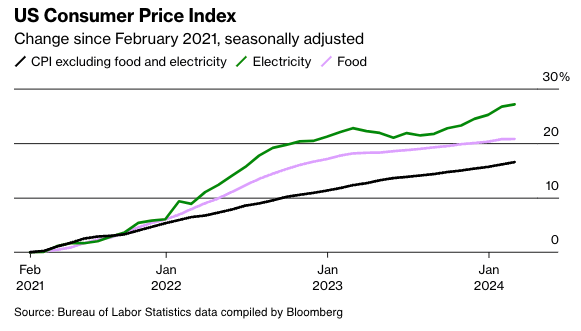
Tens of millions of Americans are having trouble paying their power bills as residential electricity inflation continues to run rampant. The latest data from the US Bureau of Labor Statistics (February's print) shows that three out of every four major cities in the US had power prices rise for residential customers. 

"Food has been a worry, but now electricity is the worry," 75yo Alfredo De Avila told Bloomberg, adding, "Unless you want to go to candles and firewood, we have no other choice but to bite the bullet and pay."

For the Oakland, California, resident, already battered by high taxes, food inflation, elevated fuel pump prices, and out-of-control violent crime, the latest price increase from the state's largest electricity utlity, PG&E Corp, of a 13% jump in power bills in January, plus more expected rises this year, could put the retiree under more financial pressure.

BLS data (from February's print) shows that power prices nationwide have jumped 27% since early 2021. 

The National Energy Assistance Directors Association, representing state directors of the Low Income Home Energy Assistance Program, recently reported that the average US household heating bill was $836. This decreased from $978 the previous year and slightly down from $849 in 2020. Nonetheless, the Household Pulse Survey data in March indicated that 19.2% of families could not pay at least one energy bill in the past 12 months, an increase from 16.5% in the same period the year before. And power bill debt in the nation has just hit a record high

Soaring power costs are happening during a major upgrade of the nation's power grid. Bloomberg said utilities are "undergoing multibillion-dollar overhauls to replace aging fossil fuel plants with greener alternatives and to make existing systems more resilient to wildfires, hurricanes, and flooding." 

In a note last week titled "The Next AI Trade," we outlined how power grids are racing to increase generation capacity to accommodate new demand, fueled by onshoring trends, electrification of transportation of buildings, extreme weather, and artificial intelligence data centers. 

"A lot of people's eyes just popped out in the past six months," Rob Gramlich, president of Grid Strategies LLC in Washington, DC, said, adding, "It's been 20 to 25 years of flat power demand, but now we're in a new mode."

Emily Fisher, executive vice president for clean energy at the Edison Electric Institute, a trade group for the utility industry, said these costs can no longer be avoided, noting, "We have to make these investments to have a reliable and affordable system." 

Add rampant electricity inflation to the long list of soaring costs, such as the recent surge in gasoline prices at the pump as they inch closer to the politically sensitive level of $4 a gallon, elevated food prices, and the worst housing affordability in a generation. No wonder the vast majority of Americans are fed up with the failure of Bidenomics, as the president's polling numbers have been going down the drain. 

America is unaffordable. 

https://www.zerohedge.com/commodities/americans-now-worry-about-out-control-power-bill-inflation

ATF Wants Funding For Data Analysts To Gather Gun Trace Information

  by Michael Clements via The Epoch Times (emphasis ours),

The Bureau of Alcohol, Tobacco, Firearms, and Explosives (ATF) wants more funding, personnel, and technology, along with Universal Background Checks, to combat gun trafficking.

The agency included the wish list in Volume III of a four-part report, “National Firearms Commerce and Trafficking Assessment: Firearms Trafficking Investigations.”

According to the report, the agency is hobbled by unwieldy databases, outdated processes, and a lack of full-time employees to track firearms from their first point of sale to the time they turn up at crime scenes.

Second Amendment advocates counter that the agency has restrictions on it that prevent it from building a registry of firearms. They say the ATF should be more focused on crime than politics.

All the federal government needs to do is prosecute those who break these laws,” Randy Kozuch, executive director of the NRA Institute for Legislative Action (NRA-ILA) said in an email to The Epoch Times.

An ATF spokesperson did not respond to a request for comment.

The report draws data from 9,708 ATF firearm trafficking investigations conducted between 2017 and 2021, according to a statement on the ATF webpage.

It found nearly 230,000 trafficked guns in 7,779 cases between 2017 and 2021. On average, 16 firearms were found per investigation—almost 60 percent of the cases involved five or fewer guns, gun parts, or regulated accessories.

Dealing firearms without a license was the most common trafficking-related crime reported. This has become something of a hot-button issue for Second Amendment advocates.

Gun rights advocates who spoke with The Epoch Times dismissed the report as evidence that the ATF has been weaponized. They claim that President Joe Biden is pushing an anti-gun agenda by using the ATF to bludgeon legal gun owners and federally licensed dealers (FFLs).

Aidan Johnston, Director of Federal Affairs for Gun Owners of America (GOA), said the ATF’s data belies the agency’s true intention. He pointed to the five or fewer firearms uncovered in the majority of the agency’s investigations.

At the same time, less than one percent of the cases involved 251 or more guns. But those cases accounted for almost 59 percent of the firearms trafficked between 2017 and 2021. Mr. Johnson believes that many cases involve honest FFLs caught up in the ATF’s zero-tolerance policy.

“They’re actually investigating normal people who sold five guns or less, when they really should be targeting the people they only target one percent of the time,” Mr. Johnston told The Epoch Times.

They should not be targeting the people who work in good faith with the ATF.

Volunteers help attendees register for the Gun Rights Policy Conference in Phoenix, Ariz., on Sept. 23, 2023. (Michael Clements/The Epoch Times)

Alan Gottlieb, founder and executive vice president of the Second Amendment Foundation, agrees with Mr. Johnston.

He says the data can’t be trusted because it’s based on sample data. This fact, combined with what he considers the politicization of the ATF under President Biden, makes the report suspect.

It’s hard to trust anything they say,” Mr. Gottlieb told The Epoch Times.

The report states that the ATF’s current information-gathering system was designed for investigators, not data analysts. If the agency were adequately funded and had full-time analysts, it could provide more accurate and comprehensive reports.

Building this functionality into ATF’s data systems is a public safety imperative; it is necessary to enable ATF to provide timely, accurate, and actionable information and analysis to [provide information] on trends and threats posed by firearm trafficking,” the report reads.

Mr. Johnston scoffed at the idea of increased funding for the ATF. He claims the agency can’t be trusted with the data it has.

By federal law, the ATF is required to destroy much of the data it gathers on legal firearm owners. This is to prevent it from building a registry of firearms.

According to the Congressional Research Service, this has not stopped the agency from amassing millions of records from FFLs over the years.

A February 2024 report by the Service stated that in November 2021, the ATF reported having 921 million records from FFLs that had gone out of business. Mr. Johnston believes the agency has only gathered more records since 2021.

A participant takes aim during the National Women's Range Day at Texas Gun Experience on March 9, 2024. The event was sponsored by Gun Owners of America and Epowered2A. (Michael Clements/The Epoch Times)

They’ve already built an illegal registry. I don’t support giving an extra dime to this agency,” Mr. Johnston said.

The report listed crimes the ATF is dedicated to fighting, including providing false information to an FFL, which often occurs when a legal buyer purchases a gun for a prohibited person. This is the so-called straw purchase.

Another crime mentioned in the report is being a felon in possession of a firearm, which is often the result of a straw purchase.

According to the report, trafficked firearms were reportedly connected to almost 19 percent of aggravated assaults, 11 percent of homicide cases, and more than 9 percent of attempted homicides.

Felons Found With Guns

About 60 percent of those found with trafficked firearms were convicted felons. Almost half, 48 percent, were between 25 and 34 years old.

ATF recognizes the role firearms play in violent crimes and pursues an integrated regulatory and enforcement strategy. Investigative priorities focus on armed violent offenders and career criminals, narcotics traffickers, narco-terrorists, violent gangs, and domestic and international arms traffickers,” the online statement reads.

Mr. Kozuch said nothing is currently stopping the ATF from fighting crime.

“ATF’s own data undermines its conclusions that new laws are needed, but it’s unsurprising that the Biden Administration’s ATF would use any opportunity to push more gun control,” Mr. Kozuch’s statement reads.

Mr. Johnston agreed. He said the report makes clear what the ATF sees as its primary mission.

“They’re not here to crack down on crime; they’re here to crack down on the Second Amendment,” he said.

https://www.zerohedge.com/political/atf-wants-funding-data-analysts-gather-gun-trace-information

Government programs widen black-white health disparities

 Thanks to better prevention, screening, diagnosis and treatment, cancer mortality in the United States has fallen 33% since 1991, per data the American Cancer Society published this year. 

But that progress has not been equally distributed.

The cancer mortality rate for black people remains higher than for white people.

Between 2000 and 2020, the gap between black and white outcomes grew wider for breast cancer and male colorectal cancer. 

Overall, the average life expectancy at birth for black Americans is just under 71 years.

For white people, it’s almost six years longer.

There are many reasons for racial health disparities like these.

But an underappreciated one is the consistent failure of Medicaid, the public insurance plan for the poor the federal government and the states jointly fund, to improve the health of its beneficiaries.

For decades, federal-welfare programs like Medicaid have overpromised and underdelivered.

That’s a particular problem for minorities, who are overrepresented among its beneficiaries.

About 19% of Medicaid and Children’s Health Insurance Program enrollees are black, whereas black people make up only about 14% of the general population.

Per the US Department of Health and Human Services, 43% of black people have public health insurance, compared with 35% of white people.

Medicaid pays doctors much less than commercial insurance or even Medicare.

Doctors also have trouble collecting those below-market payments.

Some 19% of Medicaid claims are not initially paid in full.

Doctors respond by limiting the number of Medicaid beneficiaries they’ll see.

Research has shown roughly three in 10 providers are unwilling to accept new Medicaid patients. 

Those who can secure an appointment often have to wait.

One study found Medicaid patients were more likely to wait 20 minutes or longer for previously scheduled appointments than privately insured patients. 

A landmark study of Oregon’s Medicaid population found that “Medicaid coverage generated no significant improvements in measured physical health outcomes” compared with remaining uninsured. 

Despite the poor-quality care Medicaid offers, enrollees are disincentivized from leaving the program. 

In most states, beneficiaries must have incomes of no more than 138% of the federal poverty level, currently $31,200 for a family of four.

Presented with an opportunity to make more, a Medicaid beneficiary might reasonably say “No” for fear of losing coverage. 

Actively encouraging low-income Americans not to make more even when given the chance is no way to allay hardship. 

Because race and economic status are intertwined, eliminating racial disparities in health care requires that we raise more people out of poverty.

To do that, we need to reduce dependence on failing government programs like Medicaid — and grow the economy so more people of all races, creeds and colors can climb the income ladder.

Within the healthcare space, there are several market-oriented reforms that can help people secure better care at lower cost. 

Health savings accounts allow patients to set aside and spend money tax-free for health care.

When providers compete for patients’ healthcare dollars, quality goes up and costs decline.

HSAs can even be useful to those at the bottom of the income scale, who may have less money to sock away.

Many employers contribute to their employees’ HSAs; the average employer contribution in 2022 was $869. 

Further, most people don’t spend that much on health care.

The 50% of the population with the lowest total health spending accounted for 3% of the nation’s 2021 health bill, according to the Peterson-KFF Health System Tracker.

Average spending for this cohort was $385. One in seven people spent zero dollars on health care that year.

In other words, saving even a little bit every year in an HSA could allow most people to cover their yearly medical expenses — and save for bigger bills down the line.

Market-oriented reforms that increase the supply of care — like relaxing scope-of-practice rules that restrict what nurse practitioners and physician assistants can do without a doctor’s supervision — can also help narrow disparities, especially given that one-quarter of black Americans live in primary-care-shortage areas. 

Closing the racial health gap is possible.

But first, we have to acknowledge the failures of public health-care programs, which have worsened the very problems they were designed to solve. 

Sally C. Pipes is president, CEO and Thomas W. Smith fellow in health-care policy at the Pacific Research Institute. Her latest book is “False Premise, False Promise: The Disastrous Reality of Medicare for All.”

https://nypost.com/2024/04/11/opinion/government-programs-are-widening-black-white-health-disparities/