Search This Blog

Friday, April 12, 2024

Swing State Poll Shows Black Voters Abandoning Biden In Huge Numbers

 Blacks constitute only 14 percent of the voting age population, but the swings toward Trump are so huge they could decide the election.

WSJ Swing State Poll, anecdotes in blue by Mish

According to a Wall Street Journal Swing State Poll, blacks, especially black males are abandoning Biden in huge numbers.

While most Black men said they intend to support Biden, some 30% of them in the poll said they were either definitely or probably going to vote for the former Republican president. There isn’t comparable WSJ swing-state polling from 2020, but Trump received votes from 12% of Black men nationwide that year, as recorded by AP VoteCast, a large poll of the electorate.

That’s an 18 percentage point swing, minimum, for black males, if the national results and the swing state voting is similar.

By confirmed, I mean those who said they intended to vote for Trump.

The gap is even larger if we factor in undecided voters. Biden is down by a massive 30 percentage points vs 2020. I suspect most in that group will end up voting for Biden, but a fair number will vote for RFK, not vote at all, or vote for Trump.

While Black women are less likely than Black men to support Trump, some are exploring other options, including third parties and potentially staying home.

In a sign that Biden hasn’t yet won commitments from many of these voters, some 42% of Black women in the survey fell into a group that the Journal pollsters say are up for grabs in the election, or still persuadable in their vote choice. These voters say they have not yet decided on a candidate, might vote for an independent or third-party option or are likely—but not certain—to back one of the major-party candidates.

While Latino women and Black men in the survey also signaled in large numbers that they remain persuadable in their vote choice, the share of Black women is noteworthy, given that they are among the most loyal Democratic groups in the electorate.

Among women, Trump has picked up five percentage points while Biden is potentially down 16 percentage points.

Powerful Message

A representative for the Trump campaign said: “Our coalition message to Black and Hispanic communities this election is simple: If you want strong borders, safe neighborhoods, rising wages, quality jobs, school choice and the return of the strongest economy in over 60 years, then vote for Donald J. Trump.”

Remove the words Black and Hispanic and it’s a strong message to everyone.

Black Eligible Voter Population

Turnout by Race

Image from brennancenter.org

Election Math

In the last election, voting turnout from Blacks was 63 percent. That would be 0.63 * 34.4 million or 21.67 million total votes.

In the last election about 9 percent of them nationally voted for Trump (12 percent men and 6 percent women averaged to 9 percent), thus 91 percent for Biden. That’s roughly 19.72 million votes for Biden and 1.95 million for Trump, a net of +17.77 million to Biden.

Now we are looking at about 20 percent going to Trump.

That’s 17.34 million votes to Biden and 4.33 million to Trump for a net of 13.01 million votes to Biden.

Net-to-net, my current projection is a net loss of 4.76 million blacks vs 2020 for Biden.

This was an interesting mental exercise, but it is already reflected in the swing state polls (or should be if the poll is properly weighted) so don’t double count!

What Will Decide the Election?

New Geography claims EVs will decide the election. That’s a reason, but it’s well down my list. What about yours?

On April 7, I asked If Biden Loses the Election, What Will Be the Top Reason?

No poll to date has gotten to the specific point that is most likely to cost Biden the election.

It’s the economy, but specifically housing [rent and housing affordability].

The CPI Rose Sharply in March

The CPI rose 0.4 percent in March. Rent is up another 0.4 percent in March with gasoline up 1.7 percent. Together, the pair was about half of the total rise.

CPI data from the BLS, chart by Mish

On April 10, I noted The CPI Rose Sharply in March Led by Shelter and Gasoline

Rent of primary residence, the cost that best equates to the rent people pay, jumped another 0.4 percent in March.  Rent of primary residence has gone up at least 0.4 percent for 31 consecutive months! 

Q: Who is most impacted by sharply rising rent?
A: Blacks and younger voters

Here’s the deal according to the National Association of Realtors.

While the U.S. homeownership rate increased to 65.5% in 2021, the rate among Black Americans lags significantly (44%), has only increased 0.4% in the last 10 years and is nearly 29 percentage points less than White Americans (72.7%), representing the largest Black-White homeownership rate gap in a decade.

If the Fed Cuts Rates Before the Election, Does Biden or Trump Benefit More?

I also discuss home ownership in my Q&A If the Fed Cuts Rates Before the Election, Does Biden or Trump Benefit More?

Meanwhile, please note that on that hot CPI report 30-year mortgage rates shot up to 7.37 percent.

Are You Better Off Now Than Four Years Ago?

Finally, please consider my question Fact Check: Are You Better Off Now Than Four Years Ago?

Renters, especially blacks and young voters with few assets are likely to say no.

This fully explains all of the polls. Yet Biden and all the economists still cannot figure out why so many people are miserable.

My base case is Trump will win the election as huge percentages of Blacks and young voters drop support for Biden.

https://mishtalk.com/economics/swing-state-poll-shows-black-voters-abandoning-biden-in-huge-numbers/

EU regulator rules out link between weight-loss drugs and suicidal thoughts

 The European Union drug regulator found no evidence that a class of diabetes and weight-loss drugs such as Novo Nordisk's hugely popular Wegovy, are linked to suicidal thoughts, it said on Friday, ending a nine-month probe.

The regulator's Pharmacovigilance Risk Assessment Committee, which monitors drugs' side effects, said that no updates were required to the treatments' product information after reviewing the available evidence.

Shares of Danish drugmaker Novo Nordisk rose nearly 2% after the EMA released its findings.

The finding comes after the European Medicines Agency (EMA) extended in December its review into the class of weight-loss and diabetes drugs known as GLP-1 receptor agonists, to get more data from drugmakers to further investigate the issue.

The analysis started in July after Iceland's health regulator flagged three cases of patients thinking about suicide or self-harm after using Novo's drugs. The review focused on medicines that contain either semaglutide or liraglutide, both GLP-1 targeting compounds.

Liraglutide is the active ingredient in Novo's weight-loss treatment Saxenda while semaglutide is the active ingredient in Wegovy and top-selling diabetes treatment Ozempic.

The EMA analysed results from a large US study and did not find a direct association between the use of semaglutide and suicidal thoughts.

Results from another study conducted by EMA also did not support a link between GLP-1 drugs and risk of suicidal thoughts. Both the studies were based on electronic health records.

The U.S. Food and Drug Administration's preliminary review in January also found no link between GP-1 drugs and suicidal thoughts or actions.

GLP-1 receptor agonists, originally developed to help control blood sugar in patients with diabetes in Novo's Nordisk's Ozempic and Mounjaro developed by Eli Lilly, also slow digestion and reduce hunger.

https://uk.finance.yahoo.com/news/eu-regulator-finds-no-between-101521443.html

'If Trump wins, he plans to free Wall Street from 'burdensome regulations''

 A second Trump White House would seek to sharply reduce the power of U.S. financial regulators, according to a review of public documents and interviews with people allied with the former president.

In the wake of the worst economic crisis since the Great Depression, Congress dramatically expanded the U.S. government's oversight of the financial industry to prevent a repeat of the 2008 global banking meltdown.

Donald Trump would likely renew his efforts to scale back those reforms, if elected, as well as pare protections for small-scale investors and borrowers, and allow companies to raise money with less scrutiny, according to the interviews and proposals from groups positioned to influence a new conservative administration. Reuters spoke with, among others, about a dozen people who have provided advice or been consulted by Trump or his allies.

The Republican Party’s presumptive nominee has not announced a formal policy staff or released detailed positions on how he would regulate Wall Street, aside from short videos and snippets in campaign appearances.

But, the sources told Reuters, a constellation of experts and Trump allies are pitching regulatory rewrites, identifying potential staff and floating ideas on TV, in op-eds and directly to Trump at his Mar-a-Lago Club in Palm Beach, Florida.

Some of the ideas in Trump’s current policy orbit have long circulated in conservative economic conversation. They include curtailing the Dodd-Frank Act, a set of post-2008 financial crisis rules intended to reduce systemic risk. Another idea is to make it easier for private companies to raise capital – in turn opening access to less transparent and more difficult-to-trade private funds and securities.

More recent policy ideas include attacking environmental, social and governance (ESG) investments and disclosures, which help screen businesses based on socially conscious factors, or potential dramatic cuts to staff at regulators through a mechanism known as Schedule F, which would reclassify up to 50,000 civil servants across the government as easily-replaceable political appointees.

Karoline Leavitt, national press secretary for the Trump campaign, said Trump had success in peeling back regulations during his administration.

"President Trump's pro-growth, deregulatory agenda ignited the greatest economy in history,” Leavitt said in an email to Reuters.

The Trump administration, with mixed success, worked to reverse a range of Obama-era rules, such as those that eased regulations for Wall Street banks or “fiduciary” rules for brokers.

Excluding the immediate effects of the coronavirus pandemic, official data show unemployment at its lowest since the 1960s under both Trump and Biden. Though pandemic and other distortions can make comparisons difficult, in inflation-adjusted terms the U.S. economy grew more slowly in Trump’s first three years in office (8.1%) than under Biden (10.6%), according to Commerce Department data.

Michael Faulkender, a former Trump Treasury official, has called publicly for scrapping bank stress testing under the 2010 Dodd-Frank Act in favor of stronger capital requirements, saying that requiring banks to pass the same set of evaluations leaves the system open to collapse if they all run into the same problems at once.

He is now chief economist at the America First Policy Institute (AFPI), which was founded by former Trump officials. Asked about his policy positions, Faulkender pointed to his previous writing about ESG investing.

“As the academic literature has documented, ESG is too much in the eye of the beholder,” he told Reuters. “Therefore, it can and has been used to deviate from the fiduciary duty that money managers have to their clients, and it has distracted financial supervisors from the safety and soundness criteria that should be used in ensuring the ongoing strength of the U.S. financial system.”

TARGETING CLIMATE CHANGE RULES

Robert Bowes, a former Trump appointee who has worked with the conservative Heritage Foundation, has called for the abolition of the Consumer Financial Protection Bureau – created by the Dodd-Frank Act to police the lending industry at the federal level – and referred to the Securities and Exchange Commission as an “unaccountable meddling shakedown agency” that “uses its regulation to target political enemies, to ram through woke and radical green agenda.”

In an email, Bowes told Reuters he was “very concerned about the disastrous bank regulation and economic policies by the Biden administration.”

Asked about that characterization and others about burdensome regulations, a Biden White House spokesperson said congressional Republicans have pushed to continue Trump-era policies by “gutting life-saving regulations and legalizing predatory business practices,” thereby increasing risks to the financial system and the economy.

It’s unclear what ideas Trump will take up, and what can become settled policy. But taken together, the ideas being promoted in conservative circles would overturn key aspects of current financial regulation.

The changes would reverse reforms ranging from investor protections to risk management by the biggest banks, Brian D. Feinstein, an expert on financial regulation at the University of Pennsylvania’s Wharton School, said of the policy proposals being floated for a second Trump administration.

“It would upend the U.S.'s entire system of financial regulation,” he said.

Campaign spokeswoman Leavitt characterized Biden’s administration as engaging in a "massive push to increase burdensome regulations, especially on our energy and auto industries."

The Biden administration has pushed regulations to spur the use of electric vehicles and renewable energy sources, in addition to seeking fair lending requirements, increased investor disclosures and bank capital hikes.

Trump has repeatedly said he wants much less regulation than now exists. A person who regularly speaks with him on economic matters said Trump would be “sure” to “go after all of this climate change stuff,” likely a nod to new corporate climate risk disclosure rules and ESG investments.

Feinstein, the Wharton professor, said that some of the proposed policies from Trump’s allies would need to go through Congress, such as limiting the Dodd-Frank Act, making their fortunes uncertain. That will depend on the outcome of November’s elections in the U.S. Senate and House of Representatives. Currently, Democrats control the Senate and Republicans have a narrow House majority.

But agencies like the Securities and Exchange Commission, whose five-person bipartisan commission is appointed by the White House (usually one each year) and approved by the Senate, would have power to push through other proposals, such as those related to environmental reporting, Feinstein said.

And bureaucratic changes such as expanding the definition of political appointees through Schedule F could have a major effect on financial regulators by removing job protections for many career professionals, compelling them to pursue the president’s preferences rather than their own independent judgment, he added. The Biden administration has maneuvered to slow such a move by Trump should he return to office.

Even if Trump loses the election, the judicial appointments from his 2017-2021 presidency could change the legal landscape for the Consumer Financial Protection Bureau and the Securities and Exchange Commission, with the Supreme Court considering challenges to the power of those agencies to issue regulations.

THINK TANK TRANSITION

The Heritage Foundation, the influential Washington-based conservative think tank, has positioned itself as central to getting the agenda through regardless.

Heritage’s preparations, dubbed “Project 2025,” include a more-than-900-page book of policy ideas and an expansive database of pre-screened personnel. The group has compiled policy recommendations since the Reagan era, but the latest edition includes more detail on financial regulation than in 2016.

Among Heritage’s policy authors is Stephen Moore, a conservative economist and longtime advisor to Trump who recently pitched him at Mar-a-Lago on candidates to lead the Federal Reserve. Moore proposes a transformation of the U.S. Department of the Treasury that would slash the Internal Revenue Service’s budget and terminate employees who have participated in diversity initiatives, among other things.

Moore told Reuters he’d like to see “less of the regulators sticking their fingers in all these financial transactions, especially in areas like banking regulation,” singling out bank capital requirements in particular.

A spokesperson at Heritage declined to comment.

The America First Policy Institute, the nascent think tank led by Trump White House strategist Brooke Rollins, is also angling for influence. The group is home to more than 50 former Trump administration officials and staff, including Larry Kudlow, the FOX Business Network host and former White House economic adviser who remains close to Trump; Faulkender, who led the Covid-era Paycheck Protection Program at Treasury; and Robert Lighthizer, the former U.S. Trade Representative.

The group has also written a high-level policy agenda and is “crafting action-oriented plans for each federal department and agency” as part of the “America First Transition Project.”

A spokesman for AFPI said in an email that its Transition Project "is focused on unleashing American prosperity by implementing the America First Agenda."

Lighthizer did not respond to a request for comment.

POTENTIAL PERSONNEL

Steven Cheung, the Trump campaign’s communications director, said in an emailed statement that there has been “no discussion” of potential personnel.

But during a January campaign speech, Trump floated billionaire investor and donor John Paulson as a potential Treasury Secretary. Paulson has said he supports the “reduction of unnecessary regulation”; on Saturday, he hosted other major donors and Trump at his Palm Beach home, raising $50.5 million, according to the campaign.

Trump wants Paulson to lead Treasury, and if not him, Scott Bessent, another investor and campaign contributor, according to a source familiar with internal conversations among Trump and his advisers.

Former SEC Chair Jay Clayton is among other potential candidates for Trump’s Treasury team, according to two sources familiar with the situation, but considered a long shot.

The consideration of Paulson, Bessent and Clayton was previously reported by Bloomberg and The Wall Street Journal.

Clayton, in an email to Reuters, said only that he expected the financial team in a new Trump administration would be similar to the first, which he said was “focused on lifting real wages, facilitating growth through domestic investment, and providing strong long term returns for retirees.”

Paulson, in a statement to Reuters, said, "It’s too early to discuss any positions in President Trump’s administration." Bessent did not respond to a request for comment.

https://ca.finance.yahoo.com/news/trump-wins-plans-free-wall-101259730.html

Israeli Media Says Iran Postponed Attack 'At Last Minute' Due To Threat Of US Intervention

 Update(1329ET): Israeli media sources have claimed that Iran is poised to launch a major attack on Israel, but that the strikes were postponed "at the last minute".

Israeli news website Ynet reported Thursday that "Tehran decided to either delay the strike or change the nature of its response to Israel's attack on its consulate in Damascus, likely due to warnings from the administration of United States President Joe Biden. According to more:

The outlet cited Iranian semi-official news agency Mehr as claiming the attack could happen "maybe tonight," but soon after deleting the video with the assertion.

The last 48 hours has seen Washington raise the possibility that it could intervene militarily in defense of Israel if Iran retaliates for the April 1st Israeli attack on its embassy in Damascus.

Meanwhile, some international airlines, most notably German airline Lufthansa, have paused their flights to Tehran, citing heightened fears of imminent military action in the region. Russia has also taken steps to warn its citizens against travel to the region, particularly Israel, as the region remains at boiling point.

Oil Price underscores that as the waiting game continues, an Iran Strike Threat Hangs Over Inflation-Focused Oil Markets. The industry publication observes, "Oil markets have not visibly responded to the threat hanging over the Middle East, with Brent crude and West Texas Intermediate (WTI) trading down over 1% at 11:00 a.m. ET on Wednesday on inflation concerns that have led to speculation that the Federal Reserve may not implement a June rate cut."

Israel's military believes preparation for major attack currently underway...

Iranian officials have signaled they are taking a path of strategic patience but that a significant response is still coming.

* * *

We previously reported that Iran now considers Israel's embassies and diplomatic sites abroad as essentially fair game in the wake of Israel's April 1st airstrikes on Iran's embassy in Damascus, which killed two high-ranking IRGC generals and at least five others.

An analyst from the Middle East Institute, Jason Brodsky, observed last week that "There are reports Iran's regime may be eyeing hitting an Israel diplomatic compound in a third country via drones & missiles. Israel maintains embassies in Bahrain; UAE; Jordan; Egypt; Azerbaijan; & Turkey. I would keep an eye on Jordan."

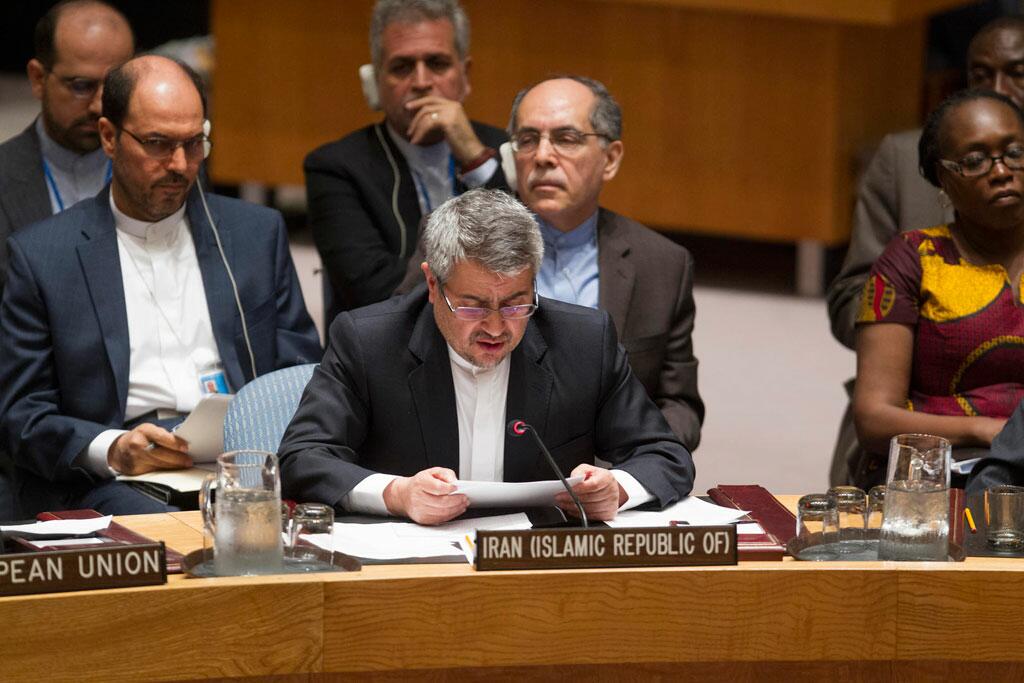
Russia's Foreign Ministry had underscored in reacting to the Israeli strike on the Iranian consular compound "the inviolability of which is guaranteed by the relevant Vienna Conventions, to be categorically unacceptable." Indeed it was unprecedented for a nation's military to intentionally attack another state's sovereign embassy. Iran is outraged at the UN Security Council's silence.

Image source: United Nations

Iran on Thursday is making noise over this at the UN Security Council in New York. Iran's permanent mission to the UN has blasted the council for failing to condemn Israel’s "reprehensible act of aggression" on Iran’s diplomatic premises in Syria. Al Jazeera reports the Iranian ambassador's fresh statement as follows

It said in a statement on X that if the perpetrators had been brought to justice, "the imperative for Iran to punish this rogue regime [Israel] might have been obviated."

Iran’s Supreme Leader Ali Khamenei and other top officials have promised retaliation for the attack on the consulate building that killed members of the Islamic Revolutionary Guard Corps, including two generals.

So Iran is now saying that in light of UN inaction, which has not so much resulted in verbal censure of Israeli actions, it will be 'forced' to respond militarily. 

All of this could spark a major war in the Middle East, possibly including US military intervention on behalf of Israel as well well, with President Biden having just promised "ironclad support" in defense of Israel. "As I told Prime Minister Netanyahu, our commitment to Israel’s security against these threats from Iran and its proxies is ironclad," Biden said Wednesday. "Let me say it again — ironclad. We’re going to do all we can to protect Israel’s security." He explained this is in response to Tehran "threatening to launch a significant attack on Israel."

Iran appears to be taking its time, waiting patiently while it plans a response. Israel has made very clear that any attack launched from Iranian soil will be met with a stronger response against the territory of the Islamic Republic. There are fresh reports saying Tehran has so far delayed its retaliation due to Washington threats that it will join Israel in hitting back against any strikes.

Below is commentary on what could happen next submitted by Avi Melamed, a former Israeli intelligence official who went on to serve as deputy and then as senior Arab affairs adviser to Jerusalem Mayors Teddy Kollek and Ehud Olmert, operating as a negotiator during the first and second intifadas. 

* * *

As the world braces for the Iranian response to the last week’s strike on Quds force commander Brig. Gen. Mohammad Reza Zahedi, it’s likely Tehran is weighing the use of its proxies versus a direct strike. Iran’s proxy warfare strategy is a shield the regime uses to avoid direct retaliation.

This calculated and sophisticated tactic allows Tehran to continue its aggression through intermediaries without facing any consequences. The ongoing assaults orchestrated by Iranian proxies underscore the regime's influence — and ability — to shape the Middle Eastern geopolitical landscape but come at the cost of navigating local politics and civil strife. Iran’s largest proxy in the region is Hezbollah in Lebanon.

Since the start of Israel’s counteroffensive in Gaza, Hezbollah has launched salvo after salvo of rockets against Israel’s evacuated northern communities. While rhetoric would point to Hezbollah escalating to the point of a full-fledged war on Israel’s northern border, it has yet to target Haifa or significant Israeli infrastructure, a move that would launch a massive war between Israel and Hezbollah, likely triggering a dissolution of Lebanon through a civil war, which Hezbollah would need to allocate resources to fighting in addition to its battles with Israel.

Most recently a senior coordinator for the Hezbollah-rival and Christian-affiliated Lebanese Forces, Pascal Suleiman, was kidnapped in Lebanon and his body was found in Syria. While the official statement is that the attack was prosecuted by “car thieves,” all signs seem to point to Hezbollah involvement.

Syria is the second Achilles heel that Tehran must consider. Any attack by a proxy force could be countered by an Israeli response that threatens or collapses Assad’s regime and with it the Iranian land corridor from Iran to Hezbollah in Lebanon and ultimately to the Mediterranean. Finally, Tehran must consider the potential response that would be triggered by a direct attack on Israel.

On X, Israeli Foreign Minister Israel Katz threatened very clearly today that “If Iran attacks from its own territory, Israel will respond and attack in Iran.” Even with Katz’s statement, there is no guarantee that Israel will continue to dance to the tune of Iran and its proxy model, and any future attack launched by Iran or its proxies could ultimately trigger a direct response against the Iranian homeland.

While the world sits on edge waiting for the inevitable Iranian response, it's important to note that the regime has thus far acted strategically, that it will respond in order to send a message of strength and restore its deterrence capacity, but that it will do so at the time it calculates will best achieve its successful return of deterrence.”

https://www.zerohedge.com/geopolitical/iran-blames-un-security-council-inaction-what-might-come-next

Avian Flu Found In Seventh State As Cattle Restrictions Grow

 by Zachary Stieber via The Epoch Times (emphasis ours),

North Carolina authorities on April 10 reported that cows in the state tested positive for highly pathogenic avian influenza, as the state became the latest to impose restrictions on the movement of cows.

Testing of samples from North Carolina conducted by the U.S. Department of Agriculture (USDA) came back positive for the influenza, also known as the bird flu and HPAI, the North Carolina Department of Agriculture and Consumer Services said.

We have spent years developing methods to handle HPAI in poultry, but this is new and we are working with our state and federal partners to develop protocols to handle this situation,” Steve Troxler, the state’s agriculture commissioner, said in a statement.

He noted that, according to the U.S. Food and Drug Administration, there is presently no concern regarding the safety or availability of pasteurized milk or milk products in the United States. Some experts, though, have warned there’s not enough evidence to support that position.

Avian influenza cases in cattle first appeared in the United States in March. USDA officials have since confirmed cases in 20 herds across six states, including Idaho, Kansas, and Texas, and a single case in a human. They have not yet commented on the North Carolina situation.

Stephanie Langel, an assistant professor at Case Western Reserve University’s School of Medicine, said on social media that because the influenza is not a reportable disease in cows, it’s likely the outbreak is larger than currently represented.

USDA officials do not require testing and only recommend testing if cows start exhibiting symptoms.

Additionally, the majority of workers on dairy farms (especially large farms) are undocumented and are less likely to report symptoms,” Ms. Langel said, referring to illegal immigrants. “I worry we are underestimating human infections.”

The strain of HPAI that’s circulating, H5N1, originates from birds. Dead birds have been found on farms that have had cows with confirmed cases.

Bird flu is often fatal in birds and humans, but human cases are rare. The recent human case in Texas is only the second in history in the United States. Both patients recovered, officials say.

Worldwide, between 2003 and April 1 of this year, 889 human cases have been reported to the World Health Organization (WHO) from 23 countries. Of those patients, 463 died, the organization said.

Genomic sequencing of the virus in the Texas patient showed a mutation that makes the flu more likely to infect mammals, but the risk to people remains low, according to U.S. public health officials.

“Since the virus has not acquired mutations that facilitate transmission among humans and based on available information, WHO assesses the public health risk to the general population posed by this virus to be low and for occupationally exposed persons, the risk of infection is considered low-to-moderate,” WHO said in an April 9 brief. The agency noted that sustained human-to-human transmission of the strain and similar variants have never been detected.

No vaccines are currently available against H5N1.

Officials recommend people not get close to dead animals or animal droppings and not consume raw milk or raw cheese.

Restrictions

Due to the positive tests from cows in North Carolina, officials joined a growing number of states in restricting the movement of cows.

The movement of cattle from herds with confirmed cases in other states to North Carolina has been suspended, according to the North Carolina Department of Agriculture and Consumer Services.

Seventeen other states have also placed restrictions on cattle importations from the affected states, with Maryland joining the list on Wednesday.

Several states have said the sick cattle have come from Texas, where the first cases were detected.

Now that 21 herds have tested positive, it “stretches plausibility that it was all from one farm, but theoretically possible, given the amount cattle can move,” Gail Hansen, a doctor of veterinary medicine who used to be the state veterinarian for Kansas, wrote on the social media platform X.

The USDA has advised against moving sick or exposed animals and minimizing the movement of other cattle “as much as possible.”

If cattle must be moved, we strongly encourage extreme diligence by producers, veterinarians, and animal health officials to ensure only healthy cattle are moving and to ensure the validity of interstate health certificates,” the agency said.

https://www.zerohedge.com/medical/avian-flu-found-seventh-state-cattle-restrictions-grow

'Biden Admin Tells Congress Famine Is Underway In Gaza For First Time'

 A top Biden administration official has for the first time declared that famine now exists in parts of the Gaza Strip, more than five months after the Israel-Hamas war began. 

USAID Director Samantha Power said it is "credible" to assess that famine is already occurring. Her testimony was issued at Wednesday's House Foreign Affairs Committee hearing, where in her introductory statement she laid out that "nearly the entire population" of Gaza is "living under the threat of famine."

The United Nations defines famine as when there is widespread malnutrition as well as hunger-related deaths due to a lack of access to food in a locale or country.

According to more from Power's testimony before Congress:

USAID Administrator Samantha Power, a well-known liberal interventionist and the author of a famous book on American leaders' failure to act in the face of genocide, answered in the affirmative after U.S. Rep. Joaquin Castro (D-Texas) asked whether "famine is already occurring" in Gaza, which is under a suffocating Israeli siege and relentless bombing campaign.

"Yes," said Power. "In northern Gaza, the rate of malnutrition prior to October 7th was almost zero, and it is now one in three—one in three kids."

"USAID teams have been working day and night to address the catastrophic humanitarian crisis," Power added. "Food has not flowed in sufficient quantities to avoid this imminent famine in the south and these conditions that are giving rise already to child deaths in the north," she described.

The following three conditions must be present for a crisis to be deemed famine, according to more from the United Nations definition:

  • At least 20 per cent of the population in that particular area are facing extreme levels of hunger;
  • 30 per cent of the children in the same place are wasted, or too thin for their height; and
  • The death – or mortality – rate has doubled, from the average, surpassing two deaths per 10,000 daily for adults and four deaths per 10,000 daily for children.

USAID Director Power and other Biden admin officials have been center of increased outrage among progressive Democrats over their pro-Israel policies.

The very hearing that Power testified in was at one point interrupted activists who shouted denunciations at the USAID chief for "not using her power and influence to end" the assault. Progressive activist group Code Pink led the protests...

The protesters pointed out the contradiction in Biden's policy - on the one hand it decries famine and a humanitarian disaster in Gaza, but on the other continues arming Israel, and all the while is unwilling to attach conditions on defense aid.

https://www.zerohedge.com/geopolitical/biden-admin-tells-congress-famine-underway-gaza-first-time