The U.S. Federal Aviation Administration is investigating falsified documents that were used to verify the authenticity of titanium used in some recently manufactured Boeing and Airbus jets, the New York Times reported on Friday.
Friday, June 14, 2024

Canada's Uranium Mining Boom Positions It To Overtake Kazakhstan As Top Producer
Canada was the world's top uranium producer for years until Kazakhstan dethroned it in 2009. Fast forward to 2022, and Canada held the second spot, pumping out 15% of the global supply. By 2023, Canada became the top uranium supplier to the US, delivering 27% of total deliveries. With uranium prices soaring in the last several years, primarily because of the 'Next AI Trade' theme (laid out for pro subs), Canada's uranium mining boom could lead it to reclaim the top spot.
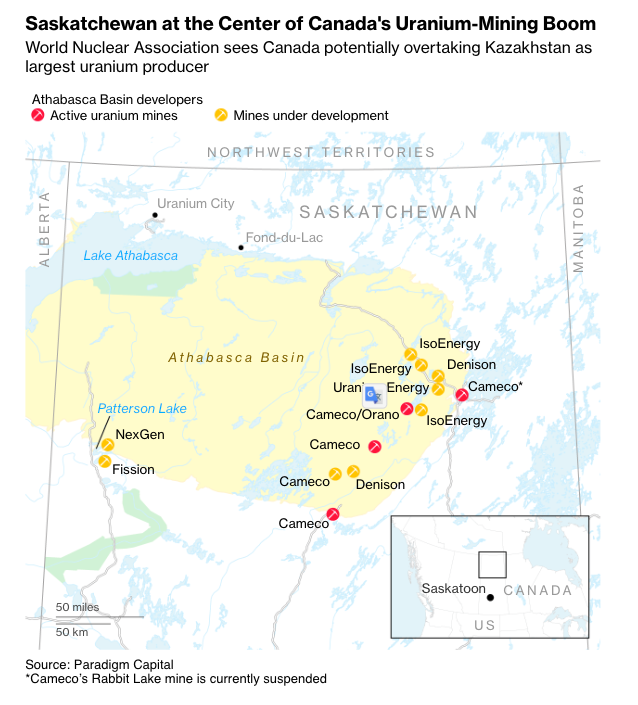
A new report from Bloomberg highlights that Canada's Saskatchewan province is the epicenter of the country's uranium mining boom:
What Saskatchewan has, though, is uranium. Lots of uranium. The bedrock is so loaded with it that the area around just one stretch of the lake, it is believed, could generate enough nuclear energy to power more than 40 million homes for a quarter century.
Cameco and Cameco/Orano operate several active mines in the commodity-heavy region, and there are also a number of new mines under development.
According to the World Nuclear Association, Canada is poised to overtake Kazakhstan as the largest uranium producer as new mines come online in the years ahead.
Prime Minister Justin Trudeau has made a hard pivot, embracing nuclear power to achieve Canada's net-zero emissions goals. This marks a major reversal after years of promising to move the economy away from commodity extraction.
Let's revisit our December 2020 note titled "Buy Uranium: Is This The Beginning Of The Next ESG Craze" and, more recently, "The Next AI Trade." In these notes, we argue that nuclear power is the cleanest and most reliable energy source for electrifying America.
Thank AI data centers for the consumption surge in power.
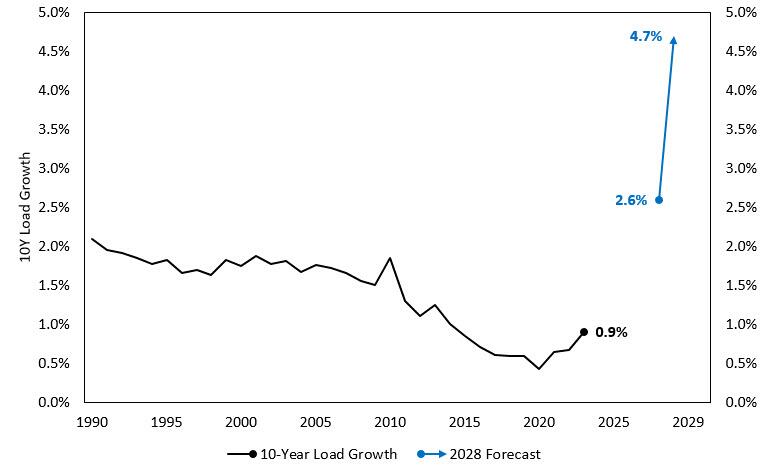
Goldman's forecast of cumulative electricity growth shows that over the next five years, electricity growth is expected to jump from 2.6% to 4.7%, driven by major utilities revising their estimates higher.
Wall Street finally jumped on the nuclear power bandwagon earlier this year. From Goldman to BlackRock, everyone is piling into the powering-up America theme with nuclear energy.
Given this hot trend, projections from the World Nuclear Association show that global uranium supply deficits will explode in the 2030s as new plants come online.

Due to tightening supply and higher demand, uranium prices have soared over the last five years, up 233%, outpacing silver, gold, copper, and lithium.

Recently, BofA's Lawson Winder provided clients with a transcript of a panel discussion with some of the world's top uranium executives...
The biggest takeaway: "Many institutions are still learning the role of uranium in the energy transition, suggesting upside to money in the space."

Most of the nuclear power expansion currently occurs in the Eastern Hemisphere, mainly in China and India. However, with the Biden administration finally getting serious about atomic power, a significant reversal in the US is underway with the recent historic restart of the Palisades nuclear plant in Michigan.

"Today, there are 61 nuclear power plants under construction globally. Another 90 or so are in the planning stage and more than 300 have been proposed," Bloomberg said.
The US receives 19% of its electricity from 93 nuclear power reactors. In the years ahead, more retired reactors will be restarted, which will increase the number.

Russia controls about 46% of global enrichment capacity, while the US controls only 9.5%. The US' reliance on Russian uranium is a major problem in a world that is fracturing into a dangerous multi-polar state.
The mining boom in Canada signals that the country could soon reclaim its spot as the world's top producer while breaking the US' dependency on Russian uranium.
Vertex Positive Long-Term Data On CASGEVY™ (exagamglogene autotemcel)
- Results from CLIMB-111, -121 and -131 accepted for oral presentation -
- Data from these trials, with the longest follow-up of more than five years, demonstrate transformative, consistent and durable benefit of CASGEVY™ -
- Safety profile consistent with busulfan conditioning and autologous hematopoietic stem cell transplant -
Protagonist Rusfertide Phase 2 at the EHA2024 Congress Showing Durable Hematocrit Control
- Long term follow-up from REVIVE Phase 2 study up to 3 years shows durable hematocrit (Hct) control (< 45%), decreased phlebotomy use, long-term tolerability, and no new safety signals in patients with polycythemia vera
- Patients receiving rusfertide in the open-label extension of the REVIVE study are eligible to roll over to the THRIVE study for an additional 2 years of treatment
Kite Evidence for Yescarta® Demonstrate Benefit From Earlier Lines of Treatment
- Analysis Shows Manufacturing of Yescarta in Second-Line Treatment of Relapsed/Refractory Large B-cell Lymphoma Can Help Reduce Time from Leukapheresis to Infusion vs. Third-Line+ Treatment
- Data Builds on Previous Evidence on the Association Between Timely Infusion and Patient Outcomes
- Preliminary Results Supporting Safety and Feasibility of Outpatient Administration of Yescarta and Tecartus® to be Presented
Molecular Partners Positive Preclinical Data for Next Gen Stem Cell Transplant Leukemia Therapy
- Proof-of-concept of Switch-DARPin platform established in vivo, enabling the use of logic-gated and reversible immune activators
- Preclinical safety, efficacy, and pharmacokinetics support MP0621’s potential to selectively kill cKit-positive cells and conditionally block CD47 with limited systemic side effects
- MP0621 presently in IND-enabling studies with Phase 1 in AML anticipated in 2025
Microsoft to delay release of Recall AI feature on security concerns
Microsoft will not roll out "Recall", an AI-powered feature that tracks computer usage, with its new computers next week and will instead preview it with a smaller group later, the tech giant said on Thursday, amid concerns of privacy risks.
The Recall feature tracks web browsing to voice chats, creating a history stored on the computer that the user can search when they need to remember something they did, even months later.
Recall will now be available only for a preview on its Windows Insider Program (WIP) in the coming weeks instead of being broadly available for Copilot+ PC users on June 18, Microsoft said in a blog post.
The decision is "rooted in our commitment to providing a trusted, secure and robust experience for all customers and to seek additional feedback prior to making the feature available to all Copilot+ PC users," the Redmond, Washington-based company said.
Copilot+ PCs are a category of personal computers with artificial intelligence (AI) features that were unveiled in May.
The WIP is a public software testing program that allows millions of "Windows biggest fans" to preview upcoming features for the operating system.
The company said it plans to make the Recall preview available for all Copilot+ PCs coming soon after feedback from the WIP community.
Privacy concerns were raised soon after the announcement of this feature, with some social media users expressing fears that it could enable spying, while billionaire technologist Elon Musk called it a "Black Mirror episode", making comparisons to the Netflix series that explores the harmful effects of advanced technology.
https://finance.yahoo.com/news/microsoft-delay-release-recall-ai-030922063.html
Subscribe to:
Posts (Atom)