Search This Blog

Thursday, November 7, 2024

Promising New Data for Novel, Established Drugs for Common GI Conditions

 Hello. I’m Dr David Johnson, professor of medicine and chief of gastroenterology at Eastern Virginia Medical School in Norfolk, Virginia. 

I’ve just returned from the American College of Gastroenterology (ACG) 2024 Annual Scientific Meeting, which this year was held in Philadelphia, Pennsylvania. 

In this series, I’ll be giving you my top studies presented at ACG 2024, which will be split into two parts. These studies are not presented in any order of priority because I think they all have clinical applications, some of which are more immediate. Where possible, I’ll also provide you with some teaching points that occurred to me when I viewed the data in these presentations. 

Repetitive Use Injuries Among Endoscopists 

First is a study that assessed musculoskeletal injuries that occurred while performing endoscopy, which is a large part of what we do as gastroenterologists. I’ve personally experienced virtually all these injuries during my 45-plus years in the field. These findings provide a useful perspective of what we can do to potentially avoid such injuries going forward. 

This study comes to us from researchers at the University of Utah,[1] who looked at an author- developed and validated questionnaire called QuickDash (Disability of Arm, Shoulder, Hand). Endoscopists were evaluated by occupational therapists in their department, who looked at strength testing as well as a series of provocative tests to identify injuries.

Thirty-five endoscopists were enrolled. Overall, 34% reported experiencing pain and 17% reported numbness. In the previous week, 48% had been bothered by pain and 11% by tingling, and 17% reported limitations on what they could do at work. 

Additionally, 17% experienced interrupted sleep. I think that finding is particularly important, because when you have fragmented sleep it lowers sensory thresholds. Essentially, this means that the day after interrupted sleep, you respond with a heightened sensory response. 

Physical testing showed reduction in grip strength in approximately half of participants, including both right and left grip. More than 70% had at least one abnormal positive provocative test.

There were a couple factors associated with an increased risk for adverse outcomes. Those who performed 20 or more procedures a week were at higher risk of pain (P = .007). I recognize that some of you probably perform 20 or more endoscopies in a single day. 

Negative outcomes were also more likely to occur among physicians performing biliary endoscopy. Performing endoscopic retrograde cholangiopancreatography during 20%-60% of the week resulted in greater likelihood of experiencing decreased bilateral pinch strength. 

The bottom line is that there’s an extremely high prevalence of repetitive use injury among endoscopists. Whether you’re just starting out, mid-career, or more senior, you need to be aware of this. 

Kudos to the ACG who put together hands-on sessions across 2 days with extended ergonomics training provided by physical therapists with expertise in this area. These sessions were standing room only every time I visited them.

During the meeting, the ACG also announced the publication of a new book, Ergonomics for Endoscopy: Optimal Preparation, Performance, and Recovery, that is available on the ACG’s website. I had the privilege to meet the two authors, survey the book, and briefly discuss it with them. It’s phenomenal, and something that I think every endoscopist can benefit from. 

So, in summary, don’t put aside these concerns. It’s your career, and the better we can do in preventing these injuries, I think the better you’ll feel going forward. 

On-Demand Vonoprazan for Heartburn 

The second study of note[2] dealt with vonoprazan, a potassium-competitive acid blocker.

The question surrounding vonoprazan is whether it has clinical value as an on-demand option rather than simply as maintenance therapy administered via daily dosing. Previous results have suggested that it may have a more rapid effect when it’s taken on demand. 

This post hoc analysis of a randomized trial evaluated a 4-week run-in period during which patients received vonoprazan 20 mg daily, followed by a 6-week period after which patients switched to on-demand therapy. To be eligible, during the run-in period patients had to be 80% compliant with the study drug and report no heartburn during the last 7 days of treatment. If so, they were then randomized to receive vonoprazan at 10 mg, 20 mg, or 40 mg, or placebo.

Eligible patients reported 16% heartburn-free days during the screening period. During the run-in period, heartburn-free days increased to 83% among those taking vonoprazan 20 mg daily. When this was stopped and patients transitioned to on-demand vonoprazan, they still had a very high rate of heartburn-free days, ranging from 71% to 75%. Over 90% in the treatment group had their symptoms improved within 2 hours, with improvement noted as early as within 1 hour. 

We know that proton-pump inhibitors don’t produce this effect, which presents a challenge for us. This study suggests there may be a very strong role for on-demand therapy in patients who have reflux, which certainly showed in terms of responsiveness during the 4-week run-in period.

Rifaximin Monotherapy Reduces Risk for Overt Hepatic Encephalopathy Recurrence

The next trial[3] looked at rifaximin monotherapy for prevention of relapse of overt hepatic encephalopathy

Rifaximin has been added to the baseline primary treatment of lactulose, a combination that has been analyzed in pivotal studies. However, lactulose is a difficult drug to titrate. We typically ask patients to let us know if they have Bristol Stool Scale scores ≥ 6. This results in an inordinate number of calls back to the clinic or office. Diarrhea is a particular problem in these patients. 

This study, which was presented by Dr Jasmohan S. Bajaj from Virginia Commonwealth University, analyzed data from two randomized trials: a phase 3 double-blind trial and a phase 4 open-label trial. Both studies were conducted in patients with Child-Pugh classification A and B cirrhosis, whose overt hepatic encephalopathy was graded with a Conn score ≤ 1. Researchers only looked at those patients who received rifaximin 550 mg twice daily without lactulose, or lactulose titrated to a target of two to three soft stools a day plus placebo. The primary endpoint, which was used in both trials, was time to first breakthrough overt hepatic encephalopathy episode, measured as a Conn score ≥ 2.

There were 125 patients in the rifaximin group and 145 patients in the lactulose group. Patients in both groups had mean age of 57 years and a median Model for End-Stage Liver Disease score of 12. 

Treatment with rifaximin produced significantly striking results. In the rifaximin group, the risk for breakthrough overt hepatic encephalopathy episodes was reduced by 60%, with a number needed to treat of 4, which is extremely powerful. Regarding mortality reduction, the number needed to treat with rifaximin alone was 19. 

The take-away message here is that it’s difficult to use lactulose. We frequently have to stop it. These results provide reassurance that rifaximin has a dramatic effect even when used by itself. The recommended first-line therapy is still to begin with lactulose, but this study provides us with very strong data regarding the use of rifaximin alone. 

Apraglutide’s Efficacy in Short-Bowel Syndrome 

The fourth study[4] I’d like to highlight adds to the growing data around a long-acting glucagon-like peptide 2 analog, apraglutide.

Results from the phase 3, double-blind STARS trial were first presented at Digestive Disease Week earlier in the year. They showed that apraglutide had efficacy and contributed to a reduction in the risk for needing parenteral support, maintenance of weight, and fluid requirements in patients with short-bowel syndrome and intestinal failure. However, questions remained regarding whether there were variations in response based on patient demographics and short-bowel syndrome–specific characteristics. 

Researchers looked at a subgroup of patients from the STARS trial. The primary endpoint remained the same as in the main trial: relative change from baseline in actual parenteral support weekly volume at week 24. However, rather than measure it in the overall population, they did so according to geographic region, gender, age, body weight, race and ethnicity, and short-bowel syndrome characteristics, including differences in parenteral support volume, length of the remnant small intestine, and time from short-bowel syndrome diagnosis.

Across all these demographic and disease characteristic categories, there was absolutely no difference in the primary endpoint. 

Apraglutide seems to be inordinately promising. This is a once-weekly treatment, as opposed to liraglutide, which is problematic because it has to be given daily. 

From what I understand, apraglutide has been offered a fast-track status by the US Food and Drug Administration. Again, from what I’ve heard, it will be evaluated upon submission beginning sometime in the first quarter of 2025, which may mean that apraglutide could be available as early as 2026. 

This would be a big deal for patients with short-bowel syndrome who would have a once-weekly treatment option as opposed to daily treatment and its accompanying problems of compliance and relatively reduced response.

Biologics for Treating Immune Checkpoint Inhibitor Colitis

The final study[5] I want to discuss in this presentation dealt with adverse responses to immune checkpoint inhibitor (ICI) therapy. We see this increasingly in our clinics as ICIs become more widely used. They are wonderful drugs, but ICI-induced colitis can occur in up to 30% of patients. 

The oncologic approach is to try and stay the course, while gastroenterologists are tasked with treating the colitis so that these patients can maintain their cancer treatment. Steroid therapy is the primary first-line treatment against ICI colitis, but the use of biologic therapy with infliximab or vedolizumab has been associated with favorable outcomes as well. 

ICI colitis is graded on a scale. Whereas grade 1 ICI colitis indicates increased stool frequency of less than four a day and the absence of symptoms, grade 2 indicates a progression to a stool frequency of 4 to 6 times a day, the appearance of blood or mucus in the stool, and symptoms like abdominal pain.

Researchers sought to answer the question of which treatment is better for patients with moderate to severe ICI colitis: infliximab or vedolizumab? They performed a database analysis of patients at their institution who received at least one dose of these biologics. The endpoint was sustained clinical response (ie, without a recurrent colitis episode), as well as patients achieving improvement to grade 1 ICI colitis.

The data for infliximab and vedolizumab were quite good. Sustained clinical response was noted in 91% of patients receiving infliximab and 86% receiving vedolizumab. There was no difference in infection risk between the groups. 

There’s a teaching point in the study’s other key finding, which is that following biologic initiation, steroids were more rapidly discontinued with vedolizumab vs infliximab (median, 25 days vs 56 days, respectively). Therefore, vedolizumab may have the added benefit of patients being able to get off steroids more quickly. That’s the take-home message: Vedolizumab may be better. We certainly are comfortable with both biologics, but patients getting off steroids would be better.

There are two additional teaching points I’d like to convey.

First, don’t forget to perform a biopsy, because there are patients who may have cytomegalovirus colitis and we don’t want to miss it. A biopsy may also reveal whether they have a macroscopically normal rectosigmoid. So, you should biopsy to look for microscopic changes. As 98% of ICI colitis cases involve the left colon, you can get by with just using a flexible sigmoidoscopy.

Second, don’t forget to check for celiac disease. Patients taking ICIs may develop celiac disease as a side effect of treatment. So, I always order a celiac profile as well. 

David A. Johnson, MD, a regular contributor to Medscape, is professor of medicine and chief of gastroenterology at Eastern Virginia Medical School in Norfolk, Virginia, and a past president of the American College of Gastroenterology. His primary focus is the clinical practice of gastroenterology. He has published extensively in the internal medicine/gastroenterology literature, with principal research interests in esophageal and colon disease, and more recently in sleep and microbiome effects on gastrointestinal health and disease. 

https://www.medscape.com/viewarticle/promising-new-data-drugs-both-novel-and-established-several-2024a1000kdv

The Most Common Chronic Liver Disease in the World

 Matthew F. Watto, MD: Welcome back to The Curbsiders. I'm Dr Matthew Frank Watto, here with my great friend and America's primary care physician, Dr Paul Nelson Williams. Paul, what is MASLD?

Paul N. Williams, MD: MASLD is metabolic dysfunction–associated steatotic liver disease. 

Watto: We talked about a really stripped-down way of testing people for MASLD. If we see mildly elevated liver enzymes, what should we be testing, and how does alcohol factor in?

Williams: Before you can make a definitive diagnosis of MASLD, you need to rule out other causes of liver inflammation — things that would cause a patient’s transaminases to increase. Alcohol is synergistic with everything that can harm the liver.

A great place to start is to gauge someone's alcohol intake to make sure it isn’t causing hepatic inflammation. The phosphatidyl ethanol level is a serologic test to determine chronic, heavy alcohol use. It's a new kid on the block. I've seen it mostly ordered by hepatologists. It is a way of determining whether someone has had fairly consistent alcohol use up to 4 weeks after the fact. The cutoff for a positive test is 20 ng/mL.

Dr Tapper frames the test this way. He isn’t using the test to catch someone in a lie about their alcohol use. He tells patients that he orders this test for all patients with liver inflammation, because alcohol is a common cause. The test helps him better understand the factors that might be affecting the patient’s liver function. 

If the test comes back positive, you can have a conversation about that, and if it’s not positive, you move on to the next possible cause. Other fairly common causes of liver inflammation are relatively easy to address. 

Watto: Instead of ordering ceruloplasmin or alpha-1 antitrypsin tests, for example, the first thing Dr Tapper recommends is checking for hepatitis B and C. We can cure hepatitis C. We can’t cure hepatitis B, but it’s important to know if the patient has it. Primary care physicians should be comfortable ordering these tests. 

Really high ALT levels (eg, in the 200s) don’t usually happen from steatotic liver disease. In those cases, we would send an expanded panel that might include tests for autoimmune hepatitis-ANA, anti–smooth muscle antibody, and IgG levels. Otherwise, most of these patients don't need much more testing.

What is a FIB4 score and how does that factor in?

photo of Curbsiders

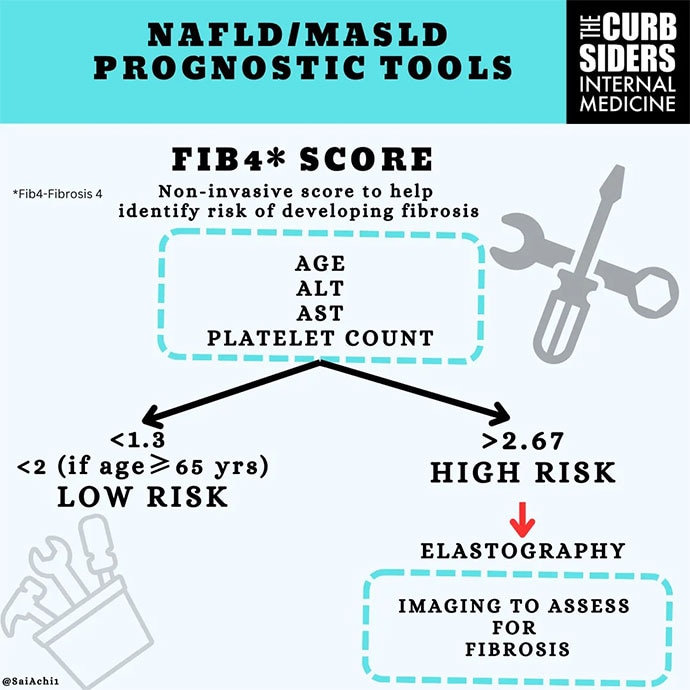
Williams: The FIB4 score estimates the degree of fibrosis based on the ALT and AST levels, platelet count, and the patient’s age. These data are plugged into a formula. If the FIB4 score is low (meaning not much fibrosis is present), you can stop there and do your counseling about lifestyle changes and address the reversible factors.

If the FIB4 score is above a certain threshold (1.3 in young adults and 2.0 in older adults), you need to find a more concrete way to determine the degree of fibrosis, typically through imaging. 

Elastography can be done either with ultrasound or MRI. Ultrasound is typically ordered, but Dr Tapper recommends doing MRI on patients with a BMI > 40. Those patients are probably better served by doing MRI to determine the degree of liver fibrosis.

Watto: Patients with low FIB4 scores probably don't need elastography but those with high FIB4 scores do. For the interpretation of ultrasound-based elastography results, Dr Tapper gave us the "rule of 5s".

photo of Curbsiders

 Elastography results are reported in kilopascal (kPa) units. A finding of 5 kPa or less is normal. Forty percent of those with a result of 10 kPa might have advanced liver disease. Above 15 kPa, the likelihood of cirrhosis is high, becoming very likely at 25 kPa. Finally, with a result of > 25 kPa, portal hypertension is likely, and you might need to have a conversation about starting the patient on medicine to prevent variceal bleeding.

We are moving toward more noninvasive testing and avoiding biopsies. We have cutoff values for MRI-based elastography as well. Both of these tests can help stage the liver. 

What can we tell people about diet? 

Williams: Weight loss is helpful. You can reverse fibrosis with weight loss. You can truly help your liver and bring it closer to its healthy baseline with weight loss. A loss of 7.5% body weight can reduce steatohepatitis, and with around 10% of body weight loss, you can actually resolve fibrosis, which is remarkable.

We all know that weight loss can be very therapeutic for many conditions. It's just very hard to achieve. As primary care doctors, we should use what we have in our armamentarium to achieve that goal. Often, that will include certain medications.

Watto: I like giving patients the 10% number because if they weigh 220 pounds, they need to lose 22 pounds. If they weigh 300 pounds, it's 30 pounds. Most people who weigh 300 pounds think they need to lose 100 pounds to have any sort of health benefit, but it’s much less than that. So, I do find that helpful.

But now a new drug has been approved. It's a thyroid memetic called resmetirom. It was from the MAESTRO-NASH trial. Without weight loss, it helped to reverse fibrosis.

This is going to be used more and more in the future. It's still being worked out exactly where the place is for that drug, so much so that Dr Tapper, as a liver expert, hadn't even had the chance to prescribe it yet. Of course, it was very recently approved. 

https://www.medscape.com/viewarticle/most-common-chronic-liver-disease-world-2024a1000k1p

Watch for Psoriasis After Cancer Immunotherapy, Study Says

 PD-1 and PD-L1 immune checkpoint inhibitors (ICIs) for treating advanced cancer were associated with an increased risk of new-onset psoriasis, a large observational study from Taiwan found.

In an as-started analysis, the risk for psoriasis among patients with stage III/IV cancers was two- to three-fold higher among ICI users when compared against controls who received chemotherapy or targeted agents (5.76 vs 1.44 cases per 1,000 person-years, respectively):

  • HR 3.31 (95% CI 1.93-5.68) with adjusted inverse probability of treatment weighting (IPTW)
  • Subdistribution HR 2.43 (95% CI 1.41-4.20) with adjusted IPTW

Findings from the nationwide cohort were consistent in on-treatment analyses (16.13 vs 2.35 per 1,000 person-years) and across all follow-up intervals and all sensitivity analyses, reported Li-Ting Kao, PhD, of National Defense Medical Center in Taipei City, Taiwan, and colleagues.

"Although this adverse effect is relatively uncommon, it is important for medical professionals, clinicians, and caregivers to be aware of this potential risk to improve skin health and ensure optimal cancer care," the group concluded in JAMA Dermatologyopens in a new tab or window.

This study provides robust evidence of a significantly elevated risk of new-onset psoriasis specifically in ICI users across a large cancer patient cohort, commented Shoshana Marmon, MD, PhD, of New York Medical College in Valhalla.

"Oncologists should monitor for early signs of psoriasis after starting ICIs, educate patients to report skin changes promptly, and collaborate with dermatologists on how to best manage psoriasis without disrupting cancer treatment," Marmon told MedPage Today.

The mechanism behind an ICI-psoriasis link is unknown, Kao and colleagues noted.

However, "ICIs block inhibitory pathways, such as PD-1/PD-L1 and CTLA-4, which cancer cells use to evade the immune system, thereby leading to the reactivation of T cells," they wrote. "This may enhance immune activity and can quickly lead to inflammation and autoimmunity, manifesting as psoriasis."

Notably, the researchers reported that the excess risk of psoriasis was highest within the first 180 days of ICI use, with a subdistribution HR of 7.69 (95% CI 3.98-14.85) in the IPTW adjusted as-treated analysis, which was meant to mimic an intent-to-treat analysis.

The findings confirm what is seen in clinical practice, observed Steven Daveluy, MD, of Wayne State Dermatology in Dearborn, Michigan.

"One of the interesting aspects of immune-related [adverse events] is their ability to present just about any time during treatment or even after treatment is completed," said Daveluy, who was not involved with the study. "The authors confirmed this finding in psoriasis, noting it could show up anywhere between 2 and 150 weeks of treatment, with a median of 4 weeks."

As for managing incident psoriasis that requires more than topical agents, Daveluy said biologicsopens in a new tab or window can help gain control of the chronic skin condition while keeping patients on cancer treatment. He usually opts for an interleukin (IL)-17 inhibitor first.

"There is evidence that cancers utilize the IL-17 pathway for growth and angiogenesis," Daveluy said. "IL-17 inhibitors are under study to investigate their potential benefits as part of a cancer treatment regimen." IL-23 inhibitors also appear safe in cancer patients, but more data would help to confirm that, he added.

For their study, Kao and co-authors relied on data from the Taiwan National Health Insurance database -- which captures more than 99% of residents -- and the Taiwan Cancer Registry.

They found records of 135,230 stage III/IV cancer patients (mean 63 years, 45% female) who received antineoplastic medications from January 2019 to June 2021, including 3,188 patients eligible for the ICI group. Over an average follow-up of about 18 months (197,107 person-years), psoriasis was diagnosed in 295 patients (0.2%).

In the absence of randomization, the researchers used the IPTW approach to balance baseline variables between ICI and non-ICI groups. Among the ICI group, most users took the agents as monotherapy (74%), with the remaining on ICI therapy in combination with targeted therapies or cytotoxic therapies.

Subgroup analyses showed potentially higher risks for psoriasis among ICI users who were over age 65 or men, but this was not supported by subsequent statistical testing. There were no significant differences between ICI users and non-ICI users in rates of outpatient or dermatology visits per month.

Kao and colleagues acknowledged study limitations, including the lack of details on psoriasis severity and missing patient variables (e.g., lifestyle, genetic factors, body mass index, and environmental exposures) that may be related to psoriasis. Additionally, Taiwan's insurance database did not cover CTLA-4 inhibitors, which limits the generalizability of results beyond PD-1 and PD-L1 inhibitors.

Disclosures

The study was supported by the Ministry of Science and Technology of Taiwan and the Tri-Service General Hospital of Taiwan.

Kao reported research funding from IQVIA.

Daveluy reported relationships with AbbVie, Novartis, Pfizer, Regeneron, Sanofi, and UCB.

Marmon reported no conflicts of interest.

Primary Source

JAMA Dermatology

Source Reference: opens in a new tab or windowTo S-Y, et al "Psoriasis risk with immune checkpoint inhibitors" JAMA Dermatol 2024; DOI: 10.1001/jamadermatol.2024.4129.


https://www.medpagetoday.com/dermatology/psoriasis/112783

Prostate Cancer Treatment Associated With Long-Term Complications

 Even accounting for age-related symptoms and disease, treatment of prostate cancer came with higher rates of complications associated with worse quality of life and new health risks, a cohort study showed.

At 12 years, the risk of urinary or sexual complications was seven times greater after prostatectomy (HR 7.23, 95% CI 5.96-8.78) and nearly three times greater after radiotherapy (HR 2.76, 95% CI 2.26-3.37) compared with a control group of males without prostate cancer (both P<0.001), researchers led by Joseph Unger, PhD, of the Fred Hutchinson Cancer Center in Seattle, reported in JAMA Oncology

Furthermore, participants treated with radiotherapy had a nearly threefold greater risk of bladder cancer than the untreated population (HR 2.78, 95% CI 1.92-4.02, P<0.001), including an increased risk of bladder cancer requiring cystectomy (HR 3.56, 95% CI 1.40-9.02, P=0.008). Radiation-specific outcome risk was particularly high, including a 131-fold increased risk of radiation cystitis and an 87-fold higher risk of radiation proctitis (both P<0.001).

In addition, 12-year risk of erectile dysfunction, urinary incontinence, and placement of penile prosthesis were more than twofold greater after radiotherapy compared with the untreated individuals in the control population.

"Complications after prostate cancer treatment are common and are associated with a myriad of harms," Unger and colleagues wrote. "Inadequate understanding of these risks may lead to patients regretting their treatment decisions. Accurate characterization of treatment risks is vital for informed decision-making, especially because complications can occur early after treatment whereas benefits may accrue years later."

They added that the magnitude of risk compared with "the relatively small benefit found by randomized clinical trials of prostate cancer screening and treatment" should be reflected in cancer screening and treatment guidelines, and also highlight the importance of patient counseling before screening, biopsy, or treatment.

"No national organization currently includes quantitative information on prostate cancer treatment-related risks and benefits," the authors concluded. "We recommend it be included to encourage truly informed decision-making."

In this study, the authors linked Medicare claims records with data from the Prostate Cancer Prevention Trialopens in a new tab or window (PCPT) and Selenium and Vitamin-E Cancer Prevention Trialopens in a new tab or window (SELECT).

Of the 51,961 total participants in those trials, 29,196 had records that were linked to Medicare with coverage of 12 months or more. Mean age at time-at-risk initiation was 68.7 years, and 8.4% were Black and 91.6% other racial groups.

Of the Medicare-linked cohort in the study, 3,946 participants were diagnosed with prostate cancer, of whom 655 and 1,056 were treated with prostatectomy and radiotherapy, respectively.

The median follow-up duration for the entire cohort was 10.2 years, totaling 312,882 person-years of follow-up. Of these, 6,855 person-years occurred after prostatectomy (median 10.5 years), and 8,949 person-years occurred after radiotherapy (median 8.5 years).

The 12-year risk of any complication was 6.57 times greater (95% CI 5.39-8.01, P<0.001) for prostatectomy compared to untreated participants. The difference in risk of any complications for prostatectomy was greatest early in the follow-up period, and decreased over time as untreated participants experienced aging-related events.

Risk of any complication at 12 years was three times greater (HR 3.04, 95% CI 2.51-3.67, P<0.001) for radiotherapy-treated participants compared with those untreated.

Unger and colleagues acknowledged the study had several limitations. For example, they noted that the PCPT and SELECT trials were randomized prevention trials, with inclusion and exclusion criteria that determined eligibility and could limit the generalizability of their incidence estimates.

Disclosures

This research was supported in part by the National Institutes of Health, National Cancer Institute, and Hope Foundation for Cancer Research.

Unger reported consulting fees from AstraZeneca and Loxo/Lilly outside the submitted work. A co-author reported employment with Flatiron Health at the time of manuscript submission.

Primary Source

JAMA Oncology

Source Reference: opens in a new tab or windowUnger JM, et al "Long-term adverse effects and complications after prostate cancer treatment" JAMA Oncol 2024; DOI: 10.1001/jamaoncol.2024.4397.


https://www.medpagetoday.com/urology/prostatecancer/112785

'In Vermont, Where Almost Everyone Has Insurance, Many Can't Find or Afford Care'

 On a warm autumn morning, Roger Brown walked through a grove of towering trees whose sap fuels his maple syrup business. He was checking for damage after recent flooding. But these days, his workers' health worries him more than his trees'.

The cost of Slopeside Syrup's employee health insurance premiums spiked 24% this year. Next year it will rise 14%.

The jumps mean less money to pay workers, and expensive insurance coverage that doesn't ensure employees can get care, Brown said. "Vermont is seen as the most progressive state, so how is healthcare here so screwed up?"

Vermont consistently ranks among the healthiest states, and its unemployment and uninsured rates are among the lowest. Yet Vermonters pay the highest prices nationwideopens in a new tab or window for individual health coverage, and state reports show its providers and insurers are in financial trouble. Nine of the state's 14 hospitals are losing moneyopens in a new tab or window, and the state's largest insurer is struggling to remain solvent. Long waitsopens in a new tab or window for care have become increasingly common, according to state reports and interviews with residents and industry officials.

 Embed code 2 

Rising health costs are a problem across the country, but Vermont's situation surprises health experts because virtually all its residents have insurance and the state regulates care and coverage prices.

For more than 15 years, federal and state policymakers have focused on increasing the number of people insured, which they expected would shore up hospital finances and make care more available and affordable.

"Vermont's struggles are a wake-up call that insurance is only one piece of the puzzle to ensuring access to care," said Keith Muelleropens in a new tab or window, PhD, a rural health expert at the University of Iowa in Iowa City.

Regulators and consultants say the state's small, aging population of about 650,000 makes spreading insurance risk difficult. That demographic challenge is compounded by geography, as many Vermonters live in rural areas, where it's difficult to attract more health workers to address shortages.

At least part of the cost spike can be attributed to patients crossing state lines for quicker care in New York and Massachusetts. Those visits can be more expensive for both insurers and patients because of long ambulance rides and charges from out-of-network providers.

Patients who stay, like Lynne Drevik, face long waits. Drevik said her doctor told her in April that she needed knee replacement surgeries -- but the earliest appointment would be in January for one knee and the following April for the other.

Drevik, 59, said it hurts to climb the stairs in the 19th-century farmhouse in Montgomery Center she and her husband operate as an inn and a spaopens in a new tab or window. "My life is on hold here, and it's hard to make any plans," she said. "It's terrible."

Health experts say some of the state's health system troubles are self-inflicted.

Unlike most states, Vermont regulates hospital and insurance prices through an independent agency, the Green Mountain Care Board. Until recently, the board typically approved whatever price changes companies wanted, said Julie Wasserman, MPH, a health consultant in Vermont.

The board allowed one health system -- the University of Vermont Health Network -- to control about two-thirds of the state's hospital market and allowed its main facility, the University of Vermont Medical Center in Burlington, to raise its prices until it ranked among the nation's most expensive, she said, citing data the board presented in September.

Hospital officials contend their prices are no higher than industry averages.

But for 2025, the board required the University of Vermont Medical Center to cut the prices it bills private insurers by 1%.

The nonprofit system says it is navigating its own challenges. Top officials say a severe lack of housing makes it hard to recruit workers, while too few mental health providers, nursing homes, and long-term care services often create delays in discharging patients, adding to costs.

Two-thirds of the system's patients are covered by Medicare or Medicaid, said CEO Sunny Eappen, MDopens in a new tab or window. Both government programs pay providers lower rates than private insurance, which Eappen said makes it difficult to afford rising prices for drugs, medical devices, and labor.

Officials at the University of Vermont Medical Center point to several ways they are trying to adapt. They cited, for example, $9 million the hospital system has contributed to the construction of two large apartment buildings to house new workers, at a subsidized price for lower-income employees.

The hospital also has worked with community partners to open a mental health urgent care center, providing an alternative to the emergency department (ED).

In the ED, curtains separate areas in the hallway where patients can lie on beds or gurneys for hours waiting for a room. The hospital also uses what was a storage closet as an overflow room to provide care.

"It's good to get patients into a hallway, as it's better than a chair," said Mariah McNamara, MD, MPHopens in a new tab or window, an ED doctor and associate chief medical officer with the hospital.

For the about 250 days a year when the hospital is full, doctors face pressure to discharge patients without the ideal home or community care setup, she said. "We have to go in the direction of letting you go home without patient services and giving that a try, because otherwise the hospital is going to be full of people, and that includes people that don't need to be here," McNamara said.

Searching for solutions, the Green Mountain Care Board hired a consultant who recommended a number of changes, including converting four rural hospitals into outpatient facilities, in a worst-case scenario, and consolidating specialty services at several others.

The consultant, Bruce Hamory, said in a call with reporters that his report provides a road map for Vermont, where "the healthcare system is no match for demographic, workforce, and housing challenges."

But he cautioned that any fix would require sacrifice from everyone, including patients, employers, and health providers. "There is no simple single policy solution," he said.

One place Hamory recommended converting to an outpatient center only was North Country Hospital in Newport, a village in Vermont's least populated region, known as the Northeast Kingdom.

The 25-bed hospital has lost money for years, partly because of an electronic health record system that has made it difficult to bill patients. But the hospital also has struggled to attract providers and make enough money to pay them.

Officials said they would fight any plans to close the hospital, which recently dropped several specialty services, including pulmonology, neurology, urology, and orthopedics. It doesn't have the cash to upgrade patient rooms to include bathroom doors wide enough for wheelchairs.

On a recent morning, CEO Tom Frank walked the halls of his hospital. The facility was quiet, with just 14 admitted patients and only a couple of people in the ED. "This place used to be bustling," he said of the former pulmonology clinic.

Frank said the hospital breaks even treating Medicare patients, loses money treating Medicaid patients, and makes money from a dwindling number of privately insured patients.

The state's strict regulations have earned it an anti-housing, anti-business reputation, he said. "The cost of healthcare is a symptom of a larger problem."

About 30 miles south of Newport, Andy Kehler often worries about the cost of providing health insurance to the 85 workers at Jasper Hill Farmopens in a new tab or window, the cheesemaking business he co-owns.

"It's an issue every year for us, and it looks like there is no end in sight," he said.

Jasper Hill pays half the cost of its workers' health insurance premiums because that's all it can afford, Kehler said. Employees pay $1,700 a month for a family, with a $5,000 deductible.

"The coverage we provide is inadequate for what you pay," he said.

https://www.medpagetoday.com/publichealthpolicy/publichealth/112786

'Pentagon chief urges ‘calm, orderly’ Trump transition in memo to troops'

 Defense Secretary Lloyd Austin told U.S. troops that the Pentagon will make a “calm, orderly, and professional transition” to the incoming Trump administration, according to a Wednesday memo.

“Our fellow citizens have elected the next President of the United States,” Austin wrote. “As it always has, the U.S. military will stand ready to carry out the policy choices of its next Commander in Chief, and to obey all lawful orders from its civilian chain of command.”

He also wrote that U.S. service members will “continue to stand apart from the political arena,” continue to support and defend the Constitution, and stand with ally and partner countries.

“You are not just any military,” Austin writes. “You are the United States military — the finest fighting force on Earth — and you will continue to defend our country, our Constitution, and the rights of all of our citizens.”

Austin’s memo comes in the wake of an unprecedented victory by President-elect Trump, who last month suggested he would be open to using the U.S. military for domestic law enforcement against the “radical left” as well as for mass deportations.

“I think the bigger problem are the people from within. We have some very bad people. We have some sick people, radical-left lunatics,” Trump said in an in an interview with Fox News. “And it should be very easily handled by, if necessary, by [the] National Guard or, if really necessary, by the military, because they can’t let that happen.”

His election also has raised questions inside the Pentagon about what would happen if he unlawfully calls on active-duty troops to deploy domestically or invokes the Insurrection Act.

While the 1878 Posse Comitatus Act largely prohibits active-duty troops from carrying out law enforcement duties inside the United States, the Insurrection Act of 1807 can be used by the president to call on American troops if there’s been “any insurrection, domestic violence, unlawful combination or conspiracy” in a state that “opposes or obstructs the execution of the laws of the United States or impedes the course of justice under those laws.”

Austin also appeared to take a swipe at Trump last month, when he criticized “some who say that both sides are to blame” in the war that began when Russian President Vladimir Putin invaded Ukraine in 2022.

He did not name Trump or far-right Republicans who have opposed sending more aid to Ukraine and have been critical of defending the country.

“There are some who don’t understand — or say they don’t understand — what is at stake between the free world and an aggressive tyrant like Putin. And I say: Let them come to Kyiv,” Austin said at the Kyiv Diplomatic Academy after making a surprise visit to Ukraine.

https://thehill.com/policy/defense/4979378-defense-secretary-lloyd-austin/