Antonio Gracias—founder and CEO of the Chicago-based investment firm Valor Equity Partners and now a DOGE official—joined theAll-In Podcaston Thursday to discuss the fraud and waste his team uncovered at Social Security, describing it as the "tip of the iceberg" and "mind-blowing."
Gracias went viral on X about a week ago at an America PAC town hall in Wisconsin and revealed a "mind-blowing" chart that showed a massive surge in Social Security numbers issued to illegal aliens over the Biden- Harris regime's first term.
Gracias provided more color on the podcast about the unusual data his team found at Social Security. He said the data indicated a dramatic spike in the number of Social Security numbers issued to migrants in Biden's first term.
He said that digging deeper, his team found this growth—which started around 2017 under a program active since then—was largely tied to asylum seekers and parolees entering via Notices to Appear (NTAs) at the border. Of the 5.4 million total in the data, 1.2 million had "unknown" status, and 1.2 million were "general parole," lacking specific program designations.
He said this reflects an "abuse" of legitimate programs, with loosened requirements—like a simplified four-question asylum form replacing a detailed four-page one—allowing more people to enter legally after crossing illegally.
Gracias said border arrivals get an NTA (court date years out), apply for asylum via a form, and then file for work authorization (Form 765), leading to a Social Security number mailed without an interview. He said the vetting process for these migrants was severely lax.
Downstream, these migrants with newly printed Social Security numbers accessed max benefits (1.3 million on Medicaid) and, shockingly, thousands registered to vote in some states—a federal crime—confirmed by voter roll checks in "friendly" states, he pointed out, adding that the Trump administration is exploring a response.
"We found people on all the benefit programs and we found them on unemployment we found them on Medicaid ... so adjacent to your point the people on Medicaid unemployment they're not contributing ... they're taking out they're mooching... right there are criminals - I mean look we sent this data list to the National Targeting Center. I don't want to get too far into the data, but I can tell you they found hard hits in the Target Center of very bad people, criminals, and people on a terrorist watchlist that are in this group and so yeah ... I mean it's a problem we got to figure out how to deal with it. And, of course, there are people who also have jobs paying in the system, which is also true. All these things are true, and we're trying to search the data and figure out how to actually deal with it now," Gracias said.
Gracias explained that when accounting for the Democratic Party's open southern border invasion and the surge in migrants receiving Social Security numbers—coupled with voting data—it becomes increasingly clear this was all about "importing voters."
"I'm talking about four states. We looked at the voter roles. We found thousands of these people on the voter roles, many of whom had voted right in one state in particular. Well over a thousand voted. Yeah, I think this was a move to import voters," he said.
Gracias begins around the 4:56 mark...
Remember, Voter ID and citizenship verification expose the Democratic Party's voting scam.
Now you know why Democrats hate DOGE. The entire scam has been exposed.
Instead of screaming and yelling at President Trump's tariff schedule, as the European Union and China are doing, smart nations have taken the side door to cut deals with President Trump and get their nations off the tariffs list entirely.
It's as if they are sorting themselves out, smart ones from dumb ones.
Start with Argentina, which got the deal done immediately:
We know President Javier Milei, who is a libertarian economist on the side, hated tariffs with a purple passion anyway. Whatever was there on the Argentinian side was the doing of his socialist predecessors. Getting rid of these tariffs was easy as empanada pie for him and he presides over a growing economy in need of good markets.
Now it's Argentinian steaks for all of us! Celebrate!
Then comes Cambodia, which has a manufacturing base heavily dependent on U.S. buyers.
They slashed their own tariffs by two thirds so as to have something nice to bring to the table when they get facetime with President Trump. Look how courteous and cordial their letter is:
Why pay high tariffs when all you have to do is lower your own and the much of the problem is solved? They know Trump will play fair with them.With Israel, it's the same -- they are getting ready to deal and bringing something to the table:
There's also this list -- all good countries:
More here -- not sure about the EU, having read their statements, but anything is possible:
This list is probably the most reliable, given the source:
They want to fix this for themselves and for the U.S. And as hedge fund biggie Bill Ackman noted earlier, the best deals are going to be the first ones, and they know this. Now they are standing up and being counted.
If deals are reached, trade should be tariff-free and we Americans should be in for some abundant and pleasant times -- the good nations going for real free trade, and all sides benefiting.
It may be what President Trump wanted all along, to find out which allies are real allies -- and ties with these countries, all worth strengthening, will be strengthened on an even playing field. If all goes well it could be the exact opposite of what the doomsaysers have been predicting.
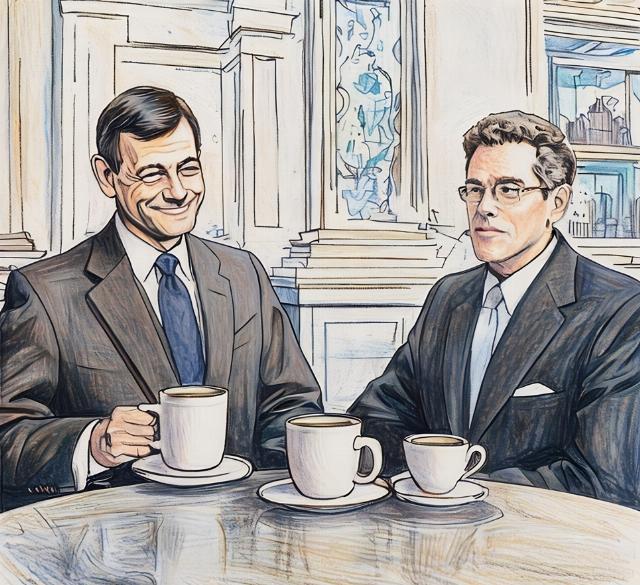
News broke over the last couple of days that one of Chief Justice John Roberts’s good buddies is Norm Eisen, one of the chief instigators of the plot to destroy Donald Trump through Deep State manipulation and lawfare. Under a long-standing federal rule of judicial conduct banning even the “appearance of impropriety,” Justice Roberts’s close relationship with Eisen means he should step down.
We all know who John Roberts is. He’s the squish who leapfrogged from having been an appellate court judge for only two years to suddenly being Chief Justice of the Supreme Court. Since then, he embedded Obamacare in America and has rather consistently sided with the Court’s activist justices on issues that, as a matter of constitutional law and Supreme Court precedent, deserved originalist outcomes.
Most egregiously, when Roberts presided over the first impeachment against Trump—which conservatives believe was to keep people from learning about Joe Biden’s corrupt dealings in Ukraine through his son Hunter—he ensured that Trump was denied basic due process. To that end, he denied Trump access to any of the proceedings in the House and to Democrat witnesses, and Trump was not allowed to bring his own witnesses. This was the first time in history that impeachment, a proceeding with roots in medieval England, was carried out without due process for the accused. Heck, even a drug dealer would have had more rights.
Image by Andrea Widburg using AI.
Not everyone, though, knows much about Norm Eisen, although they should. Eisen rose to prominence in 2007, when he campaigned for his fellow Harvard law classmate, Barack Obama. Obama rewarded Eisen (ironically) with a role in “ethics” and “government reform.” Also ironically, Eisen aggressively pushed for greater government transparency, the very thing that Elon Musk is now making happen and that Democrats are burning Teslas to stop.
Where Eisen really started flexing his muscles, though, was when Trump was elected. It was Eisen who was the architect of the Ukraine impeachment against Trump—again, something conservatives believe was a fraudulent effort intended to stop (and that did stop) Trump from exposing how Biden was manipulating foreign policy to enrich his family. According to the WaPo, Eisen was a “critical force in building the case for impeachment.”
Also, during the Trump years, Eisen was one of the people who sought to destroy professionally and personally John Eastman and Jenna Ellis, Trump’s attorneys during the fraught post-2020 election. This was the first time ever that the government has persecuted lawyers in this way. Eisen is a pure Democrat party hack who has the contacts and intelligence to advance a variety of initiatives that conservatives continue to believe do not align with facts or law.
That’s why it was shocking to learn that Eisen and John Roberts (the same man who denied Trump his due process rights during the impeachment that Eisen orchestrated) are good friends:
According to Norm Eisen—the man who practically wrote the Deep State’s playbook on color revolutions, all things anti-Trump, and lawfare in the US—he and Chief Justice John Roberts are not only good pals, but they even spent a week together in the Czech Republic. According to Norm, the two BFFs were there working on “American rule of law” issues.
Hmm…
Norm was so proud of this that he actually bragged about the trip and made it very clear that Roberts isn’t corrupt—he’s just a “close friend” who happened to fly overseas and stay at Eisen’s posh 150-room palace to collaborate on transatlantic political projects.
Moreover, Eisen has spoken publicly about the fact that Roberts and Amy Coney Barrett (a highly intelligent woman with a small mind and a stunning lack of wisdom who owes her place on the Supreme Court to Trump) dislike Trump and want to block his administration. In other words, it seems Eisen is saying the two justices are pre-deciding cases out of personal animus toward Trump and the agenda that the American people elected Trump to implement:
Alex Jones, who was on the receiving end of Eisen’s efforts, has more about what Eisen has spearheaded to advance the Democrat agenda, in addition to talking about the Roberts-Eisen relationship. Jones makes clear, again, how Eisen is the architect of every anti-Trump lawfare effort beginning in 2017:
Some might say, well, just because he’s a Supreme Court justice doesn’t mean Roberts can’t have friends. We want a government that has functional people who can understand each other’s values and speak across the aisle. But that’s really not the case for Supreme Court justices. If their relationships reasonably cast doubt on people’s belief that they can be impartial, they’re done as judges. (And please note, this is different from Clarence Thomas having rich friends who are Republicans but who do not have cases pending in court and are not amongst the most powerful figures in the Republican party.)
It's not just me saying that. It’s right there, in the Code of Conduct for United States Judges: “Canon 2: A Judge Should Avoid Impropriety and the Appearance of Impropriety in all Activities.” (Emphasis mine.) In the commentary to that Canon, we learn that,
An appearance of impropriety occurs when reasonable minds, with knowledge of all the relevant circumstances disclosed by a reasonable inquiry, would conclude that the judge’s honesty, integrity, impartiality, temperament, or fitness to serve as a judge is impaired. Public confidence in the judiciary is eroded by irresponsible or improper conduct by judges... A judge must avoid all impropriety and appearance of impropriety. This prohibition applies to both professional and personal conduct.
It's a sure thing after the Eisen revelations that both Democrats and Republicans believe that Roberts is irredeemably hostile to Trump in a way that impairs his ability to rule impartially on anything involving the administration and, moreover, that he is getting marching orders or, at the very least, gentle guidance from Norm Eisen. Whether one likes this (Democrats) or is horrified (Republicans), it is an unsustainable position for a Supreme Court justice, especially the most powerful member of the Supreme Court.
Roberts should resign immediately, and Coney Barrett should probably follow close behind. Neither can serve anymore in a way consistent with the Code of Conduct, and both will best preserve their reputations and that of the Supreme Court by retiring gracefully.
A rare cooperative security meeting was held between the US and Chinese militaries this week. Called the China-US Military Maritime Consultative Agreement (MMCA), it just wrapped up its annual working group summit held Wednesday through Thursday.
During the proceedings the Chinese People’s Liberation Army (PLA) made clear it will respond to any "dangerous provocations" by the US military in the waters and airspace near China. The strong statement came at the end of the meetings.
"The reconnaissance, survey, and high-intensity drills conducted by US warships and aircraft in the sea and airspace near China are highly likely to cause misjudgment, jeopardizing China’s sovereignty and military security," the PLA Navy said.
The Chinese military delegation made clear that "the safety of vessels and aircraft is closely related to national security." But ironically these words were issued just after huge PLA 'live fire' drills around Taiwan were just wrapped up. The PLA had specifically denounced the 'separatist' rhetoric of Taiwan's leadership.
Already several US warships have traversed the contested Taiwan Strait under President Trump. Still, the PLA Navy overall assessed that two sides had "candid and constructive" exchanges in Shanghai.
This after a series of 'close encounters' between the two rivals in recent years. China has also had clashes with Japanese and Philippine coast guard assets and fishing vessels as jockeying over regional waters continues.
This past week's PLA drills near Taiwan appeared to be based on invasion plans, including simulated strikes on Taiwan's key ports, and military and energy infrastructure.
Taiwan’s Ministry of National Defense listed out the following Chinese military weaponry which was moved near Taiwan on Tuesday into Wednesday: 71 sorties by military aircraft and drones, 21 navy ships ranged around the island, and the aforementioned Shandong carrier which was spotted about 220 nautical miles east of Taiwan.
A PLA spokesman had at the start of the week described drills which "test the troops' capabilities" in areas such as "blockade and control, and precision strikes on key targets."
The Trump administration's rhetoric has of late reflected the 'strategic ambiguity' which has long defined US policy on the question of defending Taiwan from a mainland attack. But the White House has been largely focused on achieving peace in Ukraine, though the Pentagon still considers China the 'top pacing threat'.
April 3, President Donald Trump announced it as “Liberation Day.” And by that he meant we were going to be liberated from asymmetrical tariffs of the last 50 years. And it was going to inaugurate a new what he called “golden age” of trade parity, greater investment in the United States, but mostly, greater job opportunities and higher-paying jobs for Americans.
And yet, the world seemed to erupt in anger. It was very strange.
Even people on the libertarian right and, of course, the left were very angry. The Wall Street Journal pilloried Donald Trump.
But here’s my question.
China has prohibitive tariffs, so does Vietnam, so does Mexico, so does Europe.
So do a lot of countries.
So does India.
But if tariffs are so destructive of their economies, why is China booming?
How did India become an economic powerhouse when it has these exorbitant tariffs on American imports?
How did Vietnam, of all places, become such a different country even though it has these prohibitive tariffs?
Why isn’t Germany, before its energy problems, why wasn’t it a wreck? It’s got tariffs on almost everything that we send them.
How is the EU even functioning with these tariffs?
I thought tariffs destroyed an economy, but they seem to like them. And they’re angry that they’re no longer asymmetrical.
Apparently, people who are tariffing us think tariffs improve their economy. Maybe they’re right. I don’t know.
The second thing is, why would you get angry at the person who is reacting to the asymmetrical tariff and not the people who inaugurated the tariff?
Why is Canada mad at us when it’s running a $63 billion surplus and it has tariffs on some American products at 250%. Doesn’t it seem like the people who started this asymmetrical—if I could use the word—trade war should be the culpable people, not the people who are reluctantly reacting to it?
Sort of like Ukraine and Russia. Russia invaded Ukraine. Do we blame Ukraine for defending itself and trying to reciprocate? No, we don’t. We don’t blame America because it finally woke up and said, “Whatever they tariff us we’re gonna tariff them.”
Which brings up another question: Are our tariffs really tariffs?
That is, were they preemptive? Were they leveled against countries that had no tariffs against us? Were they punitive? No. They’re almost leveled on autopilot. Whatever a particular country tariffs us, we reciprocate and just mirror image them. And they go off anytime that country says, “It was a mistake. We’re sorry. You’re an ally. You’re a neutral. We’re not going to tariff this American product.” And we say, “Fine.” Then the autopilot ceases and the automatic tariff ends. In other words, it’s their choice, not ours. We’re just reacting to what they did, not what we did.
Couple of other questions that I’ve had. We haven’t run a trade surplus since 1975—50 years. So, it wasn’t suddenly we woke up and said, “It’s unfair. We want commercial justice.” No. We’ve been watching this happen. For 50 years it’s been going on. And no president, no administration, no Congress in the past has done anything about it. Done anything about what? Leveling tariffs on our products that we don’t level on theirs.
It was all predicated in the postwar period. We were so affluent, so powerful—Europe, China, Russia were in shambles—that we had to take up the burdens of reviving the economy by taking great trade deficits. Fifty years later, we have been deindustrialized. And the countries who did this to us, by these unfair and asymmetrical tariffs, did not fall apart. They did not self-destruct. They apparently thought it was in their self-interest. And if anybody calibrates the recent gross domestic product growth of India or Taiwan or South Korea or Japan, they seem to have some logic to it.
There’s a final irony.
The people who are warning us most vehemently about this tariff quote the Smoot-Hawley Act of 1930. But remember something, that came after the onset of the Depression—after. The stock market crashed in 1929. That law was not passed until 1930. It was not really amplified until ’31.
And here’s the other thing that they were, conveniently, not reminded of: We were running a surplus. That was a preemptive punitive tariff, on our part, against other countries. We had a trade surplus. And it was not 10% or 20%. Some of the tariffs were 40% and 50%. And again, it happened after the collapse of the stock market.
In conclusion, don’t you find it very ironic that Wall Street is blaming the Trump tariffs for heading us into a recession, if not depression, when the only great depression we’ve ever had was not caused by tariffs but by Wall Street?
As a follow up to Victor Davis Hanson's brief essay, hedge fund billionaire Bill Ackman commented on X that while Hanson made a compelling case for the Trump tariff strategy, he gets one issue incorrect. He describes the Trump tariffs as reciprocal and proportional to those other nations have assessed on us.
In actuality, the Trump tariffs were set at levels substantially above, and in many cases, at a multiple of the counterparty country’s tariff levels.
Initially, the market responded favorably, up more than one percent when Trump referred to ‘reciprocal tariffs’ in his Rose Garden speech. It was only when he put up a chart showing the actual tariffs that the markets plunged.
We can divine from this response that market participants are supportive of the administration using tariffs as a tool to lower the asymmetrical tariffs of our trading partners, but are highly concerned with tariff levels set well in excess of a corresponding country’s levels.
So why did Trump take this approach?
The answer goes back to ‘The Art of the Deal.’ Trump’s negotiating style is to ask for the moon and then settle somewhere in between. It has worked well for him in the past so he is using the same approach here.
The market’s response is due to the fear that if this strategy fails and the tariffs stay in place, they will plunge our economy into a recession. And we don’t need to wait for failure as it doesn’t take long for a high degree of uncertainty to cause economic activity to slow.
Press reports today have said that all deals are now on hold. This is not surprising. Capitalism is a confidence game. Uncertainty is the enemy of business confidence.
The good news is that a number of countries have already approached the negotiating table to make tariff deals, which suggests that Trump’s strategy is beginning to work.
Whether this is enough to settle markets next week is unknowable, but we will find out soon.
The idea that Wall Street and investors are opposed to the President’s efforts to bring back our industrial base by leveling the tariff playing field is false.
Our trading partners have taken advantage of us for decades after tariffs were no longer needed to help them rebuild their economies after WWII.
The market is simply responding to Trump’s shock and awe negotiating strategy and factoring in some probability that it will fail or otherwise lead to an extended period of uncertainty that will sink us into a recession.
The market decline has been compounded by losses incurred at so-called pod shops and other highly levered market participants that have been forced to liquidate positions as markets have declined.
Stocks of even the best companies are now trading at the cheapest valuations we have seen since Covid. If the President makes continued progress on tariff deals, uncertainty will be reduced, and the market will begin to recover.
As more countries come to the table, those that have held out or have reciprocated with higher tariffs will have growing concerns about being left behind. This should cause more countries to negotiate deals until we reach a tipping point where it is clear that the strategy will succeed. When this occurs, stocks will soar.
Trump’s strategy is not without risk, but I wouldn’t bet against him.
The more that markets support the President and his strategy, the higher the probability that he succeeds, so a stable hand on the trading wheel is a patriotic one.
An important characteristic of a great leader is a willingness to change course when the facts change or when the initial strategy is not working. We have seen Trump do this before. Two days in, however, it is much too early to form a view about his tariff strategy.
Trump cares enormously about our economy and the stock market as a measure of his performance. If the current strategy works, he will continue to execute on it. If it needs to be tweaked or changed, I expect he will make the necessary changes. Based on the early read, his strategy appears to be working.
A U.S. judge said several companies including Walmart, Beech-Nut and Gerber must face a nationwide lawsuit claiming that toxic heavy metals contaminated their baby food, causing brain and neurodevelopmental damage to children who ate it.
In a decision on Wednesday, U.S. District Judge Jacqueline Scott Corley said parents can try to prove that defective manufacturing, negligence and failure to warn about more than 600 baby food products caused their children to suffer autism spectrum disorder and attention deficit hyperactivity disorder.
Parents said some defendants failed to adhere to internal limits about how much arsenic, cadmium, lead and mercury in baby food was safe, while others never addressed the issue.
Corley said this made it plausible to claim that some baby food was unsafe, if safety criteria were not followed. The San Francisco-based judge also said no "ironclad rule" required the parents to allege that toxicity crossed a particular threshold.
Beech-Nut is owned by Nestle, Gerber is owned by Switzerland's Hero Group, and Walmart sold its baby food under its own name.
Other brands in the case include Hain Celestial's Earth's Best Organics, Danone's Happy Baby and Happy Tot, Sun-Maid Growers of California's Plum Organics and Neptune Wellness Solutions' Sprout Organic.
Lawyers for the defendant companies did not immediately respond to requests for comment on Thursday.
The companies have said their baby food is safe. They also argued that heavy metals are naturally present in the environment, and parents "cannot simply allege that detectable levels of heavy metals make baby food defective."
R. Brent Wisner, a lawyer for the plaintiffs, said he was pleased with the decision.
"Selling baby food with lead and arsenic is simply not OK, and with the court's ruling, we are one step closer to holding these companies accountable for their decades of malfeasance," Wisner said in an email.
Parents sued after a 2021 report by a U.S. House of Representatives subcommittee on economic and consumer policy said "dangerous" levels of heavy metals in some baby food could cause neurological damage.
Corley dismissed Campbell's, which sold Plum Organics to Sun-Maid in 2021, as a defendant.
Amazon.com and its Whole Foods unit have also been sued for selling Hain and Danone baby food.
The case is In re: Baby Food Products Liability Litigation, U.S. District Court, Northern District of California, No. 24-md-03101.
China's state-run media has taken to the internet with AI-generated videos, featuring dancing robots and fraught consumers, to chide U.S. President Donald Trump and tariffs they say threaten high inflation and economic distress for Americans.
"'Liberation Day', you promised us the stars. But tariffs killed our cheap Chinese cars," an automated female voice sings in a video on the website of China's CGTN, a state-run English-language broadcaster, over a shot of a woman at a kitchen table staring at an empty fork.
The two-minute, 42-second clip, referring to Trump's use of "Liberation Day" for the day of his tariff announcement, was captioned with a warning: "Track is AI-generated. The debt crisis? 100 percent human-made."
Another video posted on the X.com page of state-run news agency Xinhua, also generated by artificial intelligence, shows a robot named TARIFF that chooses to self-destruct rather than follow its creator's orders for high tariffs that bring "trade wars and unrest".
China has sharply criticised the U.S. tariffs, which have triggered the biggest stock market rout since the pandemic, and retaliated on Friday with import duties and export curbs of its own.
Economists say consumers are likely to see higher prices due to the trade war and that the U.S. economy could enter a downturn, while some U.S. trade partners are putting their own levies on American products - effects that Trump has called a "disturbance".
The CGTN video, which displays lyrics in English and Chinese over images of car factories and humanoid robots dancing in burned-out streets, makes a more dire assessment.
"You taxed each truck, you taxed each tire. Midwest burnin' in your dumpster fire," the automated voice sings.