Two weeks ago, when we first reported that as a result of the ongoing Trump trade war with China, "chinese factories are shutting down, laying off workers", we said that as a result of this war of attrition in which the outcome of every incremental clash and battle will be used just as aggressively for media propaganda, "the fact that any marginal pain will be amplified as trade war weakness will mean that Beijing will do everything in its power to prevent the full extent of the shutdowns from being revealed."
Sure enough, fast forward to today when the WSJ reports that whereas "not long ago, anyone could comb through a wide range of official data from China... then it started to disappear."
Regular China-watchers know very well that when it comes to local "data" reporting, China's fabrication and goalseeking skills are second to none, and even the US Bureau of Labor Statistics is a rank amateur compared to Beijing's National Bureau of Statistics, which tramples over actual econometric reporting with the glee of a bull in a, well, China shop. It's why nobody actually believes any of the propaganda released by Beijing, and instead independent, private (and very expensive) third-party services for data collection and analysis are used to measure accurately the current state of China's economy.
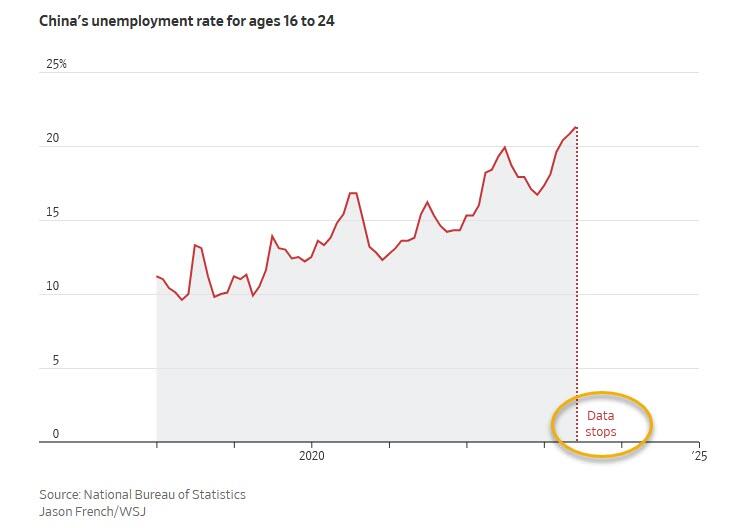
So imagine how bad it must be when instead of simply making stuff up, China decides that the easier approach is simply to no longer report the fake data. The best example is surely the data on Chinese youth unemployment which hit a record 22% in the summer of 2023... at which China decided to simply stop reporting it altogether.re\Up
Curiously, China halted reports on its youth unemployment just weeks after we quoted Goldman China strategist Maggie Wei (full note available to professional subs), who said that "Chinese youth unemployment rates tend to be higher than overall unemployment rates as this group appear particularly vulnerable to economic downcycles, likely due to a lack of experience." In other words, when it comes to early indicators of economic collapse, this is it.... And more importantly, such an indicator would also telegraph to China's millions of unemployed young men and women that there are millions more like them, and that all they have to do to fix their plight, is to demand change in Beijing and stage a youth insurrection. Which, of course, is the single biggest nightmare for China's communist party.
But it's not just youth unemployment: according to the WSJ, land sales measures, foreign investment data and countless other unemployment indicators have gone dark in recent years, while data on cremations and a business confidence index have been cut off. Even official soy sauce production reports are gone.
In all, "Chinese officials have stopped publishing hundreds of data points once used by researchers and investors", according to a Wall Street Journal analysis.
In most cases, Chinese authorities haven’t given any reason for ending or withholding data. But the missing numbers have come as the world’s second biggest economy has "stumbled under the weight of excessive debt, a crumbling real-estate market and other troubles, spurring heavy-handed efforts by authorities to control the narrative."
Or, precisely what we said when we warned in April that "Beijing will do everything in its power to prevent the full extent of the shutdowns from being revealed."
China’s National Bureau of Statistics stopped publishing some numbers related to unemployment in urban areas in recent years. After an anonymous user on the bureau’s website asked why one of those data points had disappeared, the bureau said only that the ministry that provided it stopped sharing the data.
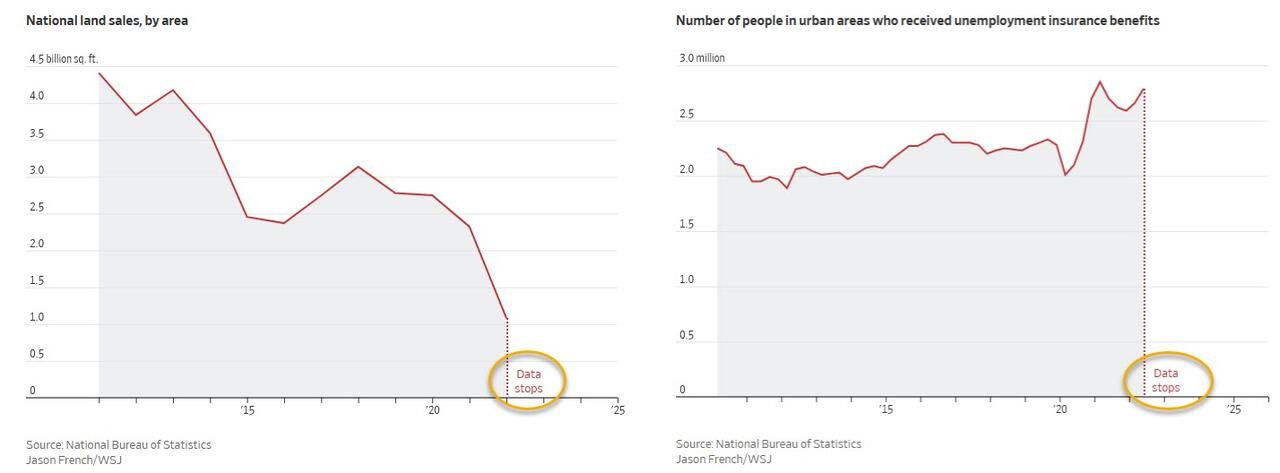
The "mysteriously" disappearing data, which is there one day, and gone as soon as it gets ugly, has made it impossible for people to know what’s going on in China at a pivotal time, with the trade war between Washington and Beijing expected to hit China hard and weaken global growth. Plunging trade with the US has already led to production shutdowns and job cuts, but of course, without actual data to confirm or deny the true state of the economy, Beijing can rely on propaganda and state media, both of which it rules with an iron fist and an impenetrable reality distortion firewall.
Of course, getting a true read on China’s growth has always been tricky. Many economists have long questioned the reliability of China’s headline gross domestic product data, and concerns have intensified recently. Official figures put GDP growth at 5% last year and 5.2% in 2023, but some have estimated that Beijing overstated its numbers by as much as 2 to 3 percentage points; in some cases speculation is rife that China's economy is actually contracting, and how can it not be when the largest asset of China's middle class. real estate, has been in a persistent shock for the past five years with Beijing unable to kickstart growth as it already has too much debt.
To get what they consider to be more realistic assessments of China’s growth, economists have turned to alternative sources such as movie box office revenues, satellite data on the intensity of nighttime lights, the operating rates of cement factories and electricity generation by major power companies. Some parse location data from mapping services run by private companies such as Chinese tech giant Baidu to gauge business activity.
One economist said he has been assessing the health of China’s services sector by counting news stories about owners of gyms and beauty salons who abruptly close up and skip town with users’ membership fees.
None of this is news to regular Zerohedge readers: Back in 2007, the late former Chinese premier Li Keqiang famously told the U.S. ambassador in 2007 that GDP data for a Chinese province he governed at the time were “man-made” and therefore unreliable, according to a leaked U.S. diplomatic cable. Instead, he said he kept track of electricity consumption, rail-freight volumes and new bank loans.
Official GDP figures were “for reference only,” he confided to the ambassador, according to the cable. Li died in October 2023.
Meanwhile, Chinese "data", at least the type that is still reported, magically goalseeks to the centrally-planned mandates of the Communist Party, never veering as much as 0.1% from where it "should" be: China’s official GDP growth of 5% in 2024 exactly - and hillariously - matched the target the government had set the previous year.
Economists privately dismissed the figure, with one telling the WSJ it would have been more credible if authorities had released something lower. Retail sales, construction activity and other data painted a considerably weaker picture, they noted. Bank of Finland and Capital Economics have generally found bigger swings in GDP than what China reports—and its estimates are lower than official figures in recent quarters. But of course, admitting even more weakness would promptly push the tide of trade war against China, and that is something Beijing - which is locked in an existential for Xi Jinping clash with Trump - simply can not afford to do.
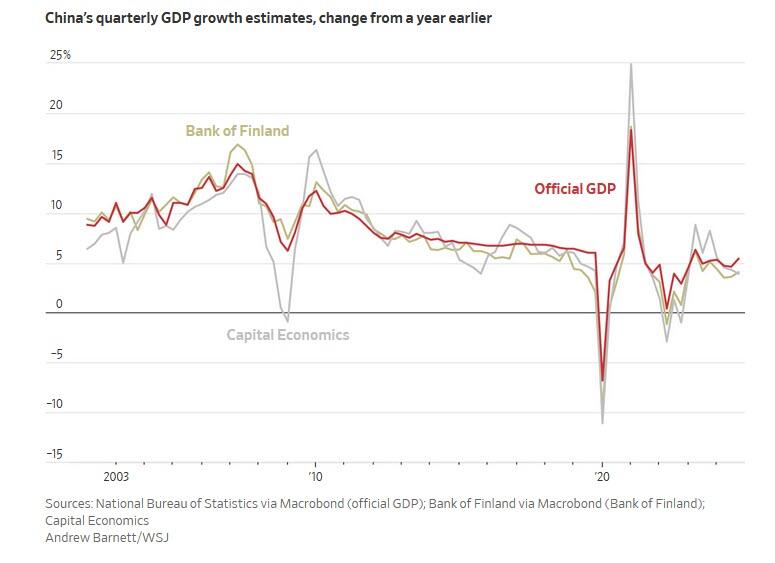
Shocking nobody, in December a prominent Chinese economist at state-owned SDIC Securities, Gao Shanwen, said at a conference in Washington that China’s economic growth “might be around 2%” the past few years, adding, “we do not know the true number of China’s real growth figure.”
China’s leader Xi Jinping ordered that Gao be disciplined and he has been banned from speaking publicly for an unspecified period. The Securities Association of China warned brokerages in late December to ensure their economists “play a positive role” in boosting investor confidence.
For its part, China’s statistics bureau has defended its data practices, saying that data quality has improved over the years and that it has taken steps to ensure accuracy and investigate any misconduct during collection. Nobody outside of China believes that, but many - in their blind Trump derangement fury - will blindly parrot it, facilitating the spread of Chinese propaganda offshore.
In February, Goldman Sachs came up with an alternative way of measuring China’s economic growth by crunching figures such as import data, which can be read as proxies for domestic spending. The thinking was that trade data get published frequently and is hard to fudge, since China’s trading partners also report those numbers.
That approach implied that China’s growth in 2024 averaged 3.7%. Using a different method, Rhodium Group, a New York-based research outfit, said growth was closer to 2.4% in 2024, or less than half the reported growth!
But reality does not matter when - as we said two weeks ago - presenting an image of stability, no matter how fake and manipulated, is paramount for China’s Communist Party, especially now, with many middle-class Chinese worried about the future and the country entering uncharted territory in its competition with the U.S.
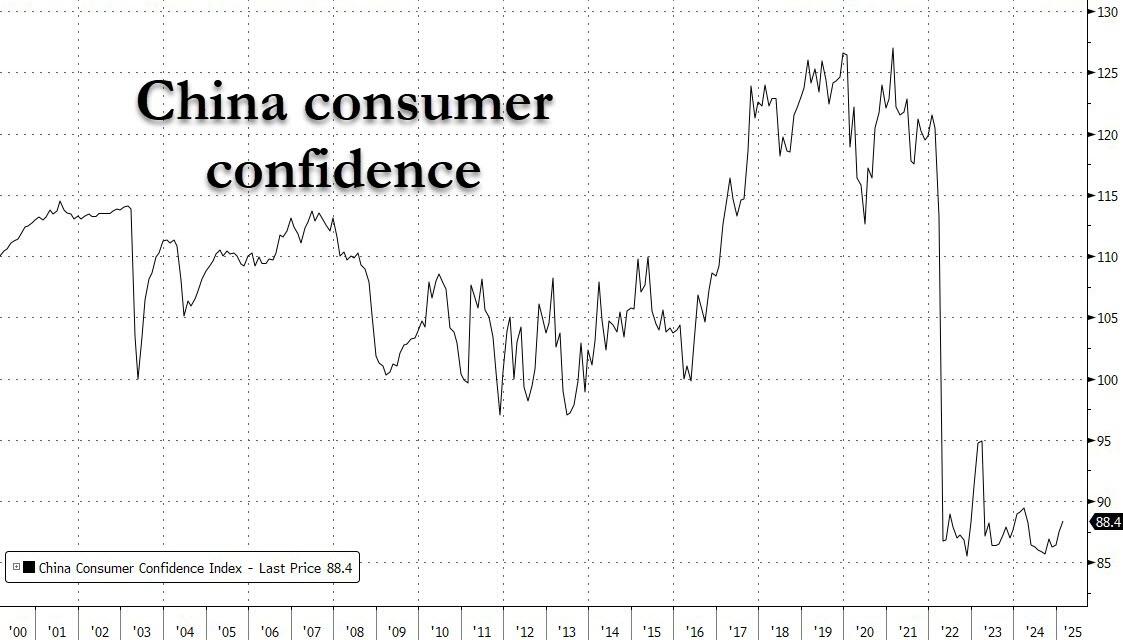
Often, the data that goes missing involves areas of high sensitivity or headaches for Beijing, such as the property market, whose collapse in recent years wiped out billions of dollars of household wealth and triggered protests by frustrated home buyers. To this point, one data series that hasn't been banned yet, but soon will be, is China's consumer confidence. It has never been lower.
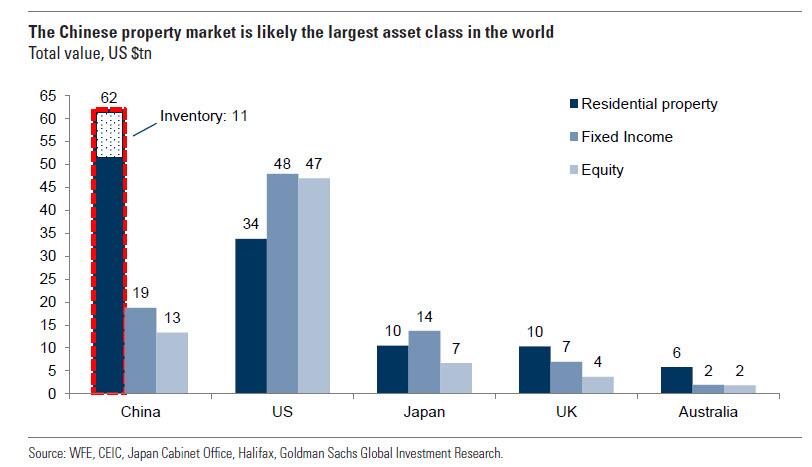
As reported here previously, during the boom years, China’s developers furiously bought up land from local governments at sky-high prices. The transactions poured money into local governments’ coffers and signaled future development plans, a key driver of the economy. At one point China's real estate market was the single largest asset on planet earth, as this Goldman chart from 2021 showed.
And then the crash came: the downturn began in 2021, after Beijing tightened credit on the sector, resulting in a domino effect which culminated with the bankruptcy of such property giants as Evergrande and Country Garden, and the collapse of Vanke. With home sales falling and real-estate developers going bankrupt, a Chinese think tank called Beike Research Institute released a report in 2022 that found the average housing vacancy rate among 28 Chinese cities was far higher than the average in the U.S. and other places, a sign of oversupply.
The report drew attention because China doesn’t release an official vacancy rate, and property analysts were trying to figure out how badly developers had overbuilt. A few days later, Beike retracted the report and apologized, saying that some of the data had errors. Analysts said they believed the group pulled the data under government pressure.
That's when the official data started disappearing too.
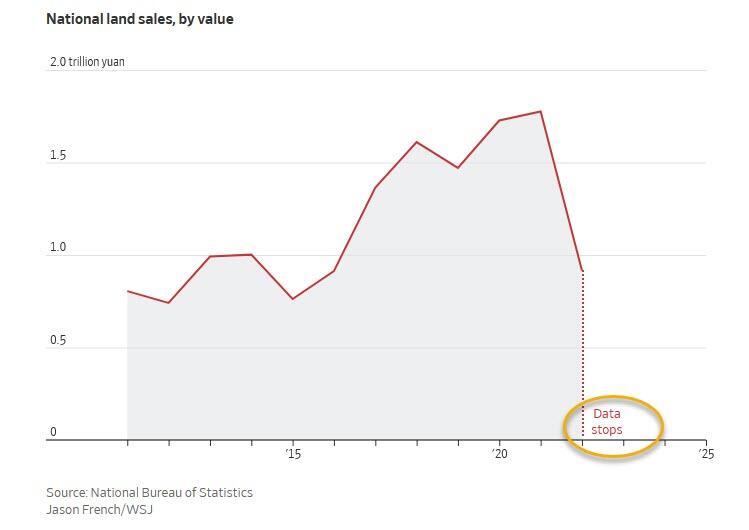
Figures show the value of land sales plummeted 48% in 2022, a big problem for heavily indebted local governments, which suddenly lacked funds to pay salaries or carry on with infrastructure projects. That data disappeared at the start of 2023.
Then, by mid-2023, much of the talk locally revolved around the dismal job market for young people. Many of the students finishing college didn’t have job offers, and viral social-media posts showed them dressed in caps and gowns splayed out motionless on the ground, interpreted by many as a form of silent protest.
Around that time, the official youth unemployment rate hit a record 21.3%. Zhang Dandan, a Peking University economist, made headlines saying she thought China’s true youth unemployment rate might be as high as 46.5%.
Then, as noted above, in August 2023, Beijing announced they would simply stop releasing the youth unemployment rate, saying they "needed to revisit" how they calculated the figures.
Hilariously, five months later Beijing began releasing a new data series. The real youth jobless rate, it said, was 14.9%, or about half of what the previous series had reported.
Officials said the new data series excluded nearly 62 million people who were studying full-time in universities, and so shouldn’t be counted as jobless. That, of course, make zero sense to economists. Statistics typically count anyone actively looking for a job as unemployed, including full-time students.
Alas, since the cover up is usually worse than the crime, by this point China had little to lose and things only got worse.
In April 2024, China’s stock market was teetering as economic worries deepened. Foreign investors dumped more than $2 billion of Chinese stocks over a two-week span, spooking domestic individual investors.
China’s two major exchanges in Shanghai and Shenzhen abruptly announced that they would stop publishing real-time data on inflows and outflows of foreign investors. The Shanghai Stock Exchange said in a statement that it was aligning its practices with other international markets, which don’t disclose real-time trading data of specific groups of investors.
After authorities stopped publishing the real-time data in mid-May, the CSI 300 benchmark index continued its decline for four consecutive months, until authorities announced a blitz of measures to support the country’s weakening economy in September. Amusingly, while Beijing has repeatedly vowed and jawboned it would stimulate the economy and markets, it has yet to actually do so, for one simple reason: China has no fiscal space, with total Chinese debt at historic levels as Beijing already used up its debt quote in the past 20 years to boost the economy while borrowing from the future.
Some data are still publicly available but harder to get. Beijing passed a law in 2021 that caused data providers to make certain information, such as corporate registry data and satellite images, accessible only in mainland China.
Meanwhile, formerly trusted Chinese data provider Wind Information started to limit international users’ access to certain data sets, such as online retail shopping figures and land-auction records, in early 2023. That led one economist at a foreign bank in Hong Kong to start making regular weekend trips to the neighboring mainland city of Shenzhen to download data, the economist told the WSJ.
Also gone in recent years: official figures on Chinese toll road operators’ year-end debt balances and the number of new stock-market investors.
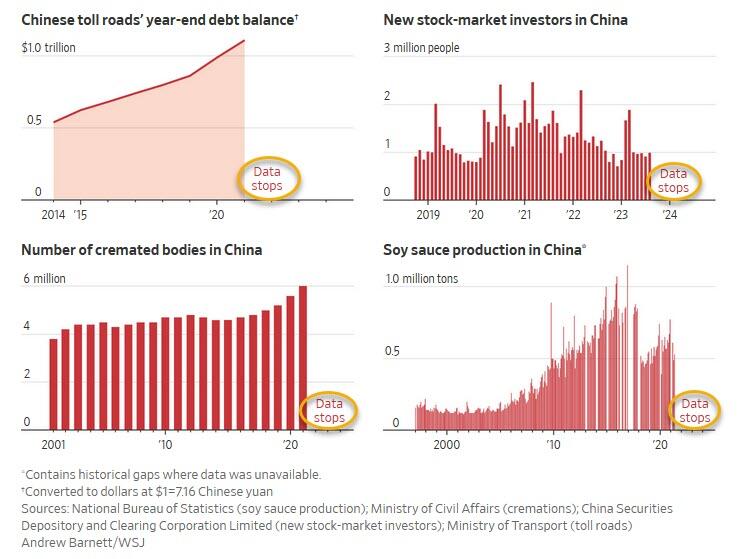
And who can forget the absurd lengths Beijing went to during covid to cover up the economic devastation in the aftermath of the Wuhan virus spread. China stopped publishing national cremation data after it ended its controversial zero-Covid policy to contain the virus in late 2022, a move analysts estimated could lead to between 1.3 million and 2.1 million deaths. The government also censored discussions about the impact of the virus on social media.
Last but not least, the country’s sharp drop in fertility has also become a major economic liability... and the data pointing to it is gone, too. In the mid-2000s, an economist named Yi Fuxian questioned the accuracy of China’s population data and argued that tuberculosis vaccinations were a better measure of population growth because every newborn in China is required to be vaccinated. In 2020, only 5.4 million such vaccines were administered, according to data compiled by the private Chinese think tank Forward Business and Intelligence. Chinese authorities said the country recorded 12.1 million births that year.
Sure enough, a year later, the National Institutes for Food and Drug Control discontinued the weekly data release of tuberculosis vaccines administered, along with other vaccine data.
One can only imagine the true extend of demographic devastation in China... well, literally. Because there is zero data to actually analyze it.
Some information that has disappeared defies explanation. Data providing estimates of the size of elementary school toilets stopped being released in 2022, then resumed publication in February. Official soy sauce production data stopped appearing in May 2021, and hasn’t returned.
https://www.zerohedge.com/markets/beijing-stops-publishing-hundreds-statistics-cover-economic-collapse