Search This Blog

Wednesday, August 20, 2025

Leaked Emails Show EPA Sought To Discredit Scientist After Ohio Train Derailment Disaster

 Via American Greatness,

Leaked emails from the Environmental Protection Agency (EPA) show that the agency sought to discredit an independent scientist who questioned official data on contamination following the East Palestine, Ohio train derailment and fire in February 2023.

Following the official EPA announcement that were no dangerous levels of toxins in the area and that it was safe for residents to return home, independent testing expert Scott Smith reported finding high levels of dioxins in the soil in East Palestine.

According to News Nation, when Smith’s findings were reported in spring of 2023, former EPA administrator Judith Enck said the agency should pay attention to Smith’s test results.

Instead of taking new samples and doing similar testing, leaked emails show that the EPA began collecting Smith’s personal information and monitoring his actions in an effort to discredit the environmental scientist.

Smith’s personal information and whereabouts were distributed to more than 50 EPA employees, his dog’s picture was circulated and drones were documented hovering near the scientist on multiple occasions.

Lesley Pacey, with the Government Accountability Project, told NewsNation that the EPA’s response was “troubling” since it was a matter of public health.

Pacey said, “What the EPA seems to have done here in East Palestine is that they were more interested in controlling the narrative and controlling what was going out to the community, from the community and back to the community,” adding, “They were definitely controlling the narrative of nothing to see here, no long-term health impacts.”

Smith, who has been to East Palestine more than 30 times, said the money spent on surveilling him would have been better spent on testing the soil and water for toxins from the train cars that burned.

Smith said, “They don’t want to look for the full spectrum of chemicals that I look for, and instead of sitting down with me and having a dialogue for the benefit of the community, they launched this smear campaign. They’re clearly not serving the community they’re supposed to protect. And it’s not just East Palestine. It’s a systemic thing.”

Smith has since met with Secretary of Health and Human Services Robert F. Kennedy Jr, who called him an extraordinary advocate for the people affected by the disaster.

https://www.zerohedge.com/political/leaked-emails-show-epa-sought-discredit-scientist-after-ohio-train-derailment-disaster

Large-Scale Heart Screening Finds Widespread Risk Factors

 Almost 70% of participants screened at a large-scale pop-up community health event had at least one uncontrolled risk factor for cardiovascular disease, according to a recent study in the Journal of the American College of Cardiology, and presented simultaneously at this year’s scientific meeting of the Cardiac Society of Australia and New Zealand.

The community screening event was focused on atherosclerotic cardiovascular disease, a leading cause of cardiovascular death that is driven largely by modifiable risk factors. Despite advances in detection and treatment, many remain unaware of their risk.

“This is a missed opportunity to prevent a heart attack,” said Stephen Nicholls, MBBS, PhD, director of the Monash University Victorian Heart Institute in Victoria, Australia, and senior author of the study. “Prevention is key, and prevention begins with knowing your numbers.”

A Cricketer’s Death

As part of the Shane Warne Legacy Health Test initiative, researchers conducted a prospective, observational cohort study from December 15, 2023, to January 31, 2024, to evaluate the effectiveness of a large-scale, opportunistic pop-up screening approach. Shane Warne, a popular Australian cricket star, died suddenly in 2022.

The screening initiative involved computerized health stations (SiSU Health) and was heavily promoted to the public in advance of the event. Stations were installed in a total of 311 community pharmacies across all eight Australian states and territories, as well as at a stadium during a 4-day international cricket test match.

The stations recorded the participants’ physical characteristics, lifestyle factors, and a brief medical history. Regardless of the screening results, all participants were encouraged to visit their physician for a complete physical examination.

Findings ‘Unfortunately’ No Surprise

A total of 76,085 people were screened during the 7-week study, with almost 90% of screenings occurring at pharmacies. Nearly half of the participants (45.3%) were aged 45 years or older, and about 5% of all attendees at the sporting event took part in the screening.

The majority (68.9%) of those who underwent screening had at least one uncontrolled cardiovascular risk factor, and 26% had two or more. The most common (60.5%) risk factor was an increased BMI, followed by elevated blood pressure (37.2%) and being a current smoker (12.1%).

“Unfortunately, these findings did not surprise us at all,” Nicholls said. “We know that cardiovascular disease is common, there is a large burden of risk factors in the community, and much of the [burden] is unknown.”

People who were screened at the sporting event were more likely to be men (77% vs 49.7%), to be between ages 35 and 64 years (60% vs 44.9%), and to have an uncontrolled risk factor (79.9% vs 67.7%) than were those screened at a pharmacy. Of those at the sporting event with elevated blood pressure, about half said they had not had a blood pressure measurement within the past year, and approximately 80% said they were not taking an antihypertensive medication.

The researchers noted individuals who were screened had only a brief period of rest before the blood pressure measurement, and the consumption of alcohol and the overall excitement of the event may have affected some of the results.

Among those who were screened in a pharmacy setting, those living in rural regions had a greater burden of diabetes (6.2% vs 5.1%) and were more likely to have an uncontrolled risk factor (72.4% vs 66.2%) than were residents of more rural areas of the country.

While younger women were more likely to undergo screening at a pharmacy during daytime hours, and older men were more likely to be screened at the sporting event, a notable anomaly was observed for older men who were screened at pharmacies during the sporting event.

“They were getting the message while watching the [event on] TV, and they showed up,” Nicholls said.

Playing the ‘Long Game’

While not necessarily on the same scale as the Australian screening event, targeted community screening initiatives can be found across the US. For the past 2 years, the American College of Cardiology (ACC) has held community health screenings as part of its annual meeting. The events are typically promoted to underserved groups with historically low rates of screening and high rates of heart disease.

Through the Caring Hearts Initiative, the ACC also partners with Higi, a technology company that manufactures screening kiosks similar to those used in the Australian study.

“Since we’ve started that initiative, we’ve screened at least 13,000 people,” said Melvin R. Echols, MD, MSCR, the Chief Diversity, Equity, and Inclusion Officer at the ACC and associate professor of medicine at the Morehouse School of Medicine in Atlanta.

Adam Berman, MD, MPH, a cardiologist at the NYU Grossman School of Medicine in New York City and one of the authors of an editorial accompanying the Australia study, said that for a large-scale screening initiative to be successful, there needs to be a concerted effort to prioritize prevention of cardiovascular disease.

“It’s about playing the long game, which is something that we can only see a benefit from years down the line,” Berman said. “But prevention is the key to broadly improving cardiovascular population health.”

Nicholls, Echols, and Berman disclosed having no relevant financial conflicts of interest.

https://www.medscape.com/viewarticle/large-scale-heart-screening-finds-widespread-risk-factors-2025a1000lzx

Lithium Deficiency May Spur Alzheimer’s — and Guide Treatment

 Lithium, long prescribed for bipolar disorder and as an adjunct in depression, is essential for brain resilience, and new research suggests that deficiency of the mineral in neural tissue may contribute to Alzheimer’s disease (AD).

For the first time, investigators found that lithium is sequestered by amyloid plaques in AD, depleting its availability in neural tissue. In addition, they found that a novel lithium-based compound engineered to bypass plaque binding reversed synaptic and cognitive deficits in mouse models and has the potential to restore memory

In addition, analyses of human brain tissue showed that loss of lithium was one of the earliest changes leading up to AD. In mice with lowered lithium levels, researchers found similar accelerated brain pathology and memory decline.

Amyloid-beta (Aβ) plaques in the brain are a hallmark of AD. When they develop early in the disease, they bind to lithium, inhibiting uptake of the mineral in the brain and lead to the reduced lithium levels observed in the study.

Researchers also identified a plaque-evading lithium salt that, when administered to mouse models with AD, was associated with significantly reduced AD-type pathology and improved memory.

“We found that endogenous lithium in the brain changed during aging, and this could be recapitulated in mouse models of the disease,” coinvestigator Bruce A. Yankner, MD, Department of Genetics, Harvard Medical School, Boston, told Medscape Medical News.

“Importantly, by simply depleting [lithium] from the mouse diet, we found that it had protean effects, changing the cell biology of the aging brain, the pathology of Alzheimer’s disease, and parameters of neurocognitive function,” Yankner added.

The findings were published online on August 6 in Nature.

A 10-Year Journey

About 10 years ago, the same researchers found that the neuron-restrictive silencer factor, the transcription factor (REST), which was previously established as a central regulator of neural development, was involved in the brain’s response to aging and AD, Yankner said.

A component of this discovery was the regulation of REST by the Wnt signaling pathway. Lithium is a classic approach to activating Wnt signaling, he added.

“While using lithium in this context, we were impressed with its ability to reduce all the various neuropathologic and cellular changes in animal models of Alzheimer’s,” Yankner said. “I wondered whether lithium itself might be part of the disease mechanism.”

So the Yankner and his team set out to determine whether there might be endogenous lithium in the human brain.

Using high-sensitivity inductively coupled plasma mass spectrometry adapted for human brain and blood samples, researchers measured 27 abundant and trace metals in the brains and blood of individuals with normal cognition, amnestic mild cognitive impairment (MCI), or AD.

To Yankner’s surprise, of all the major and trace metals analyzed, only lithium was significantly reduced in the prefrontal cortex of participants with MCI or AD. It also had the lowest P value of any metal.

“Other metals changed in AD, but they did not show significant changes in MCI, the earliest stage of memory loss,” Yankner said.

In addition, every case of MCI and AD showed significant concentrations of lithium in Aβ plaques.

“Together, these results indicate that endogenous [lithium] homeostasis is perturbed in the brain in MCI and AD,” the investigators wrote.

Lithium as a Potential Treatment?

The researchers also found cortical distribution of endogenous lithium in Aβ precursor proteins in mice. Reducing cortical lithium by 50% not only increased Aβ and phosphor-tau in the animal models but also increased inflammatory microglial activation and cognitive decline.

The use of lithium orotate, a lithium salt with reduced amyloid binding, led to reduced pathological changes, reduced memory loss, and restored microglial function, and may be “a potential approach to the prevention and treatment of AD,” the researchers wrote.

Lithium toxicity is a concern for older patients who receive highly concentrated formulations of the drug to treat psychiatric illness. But lithium orotate is significantly less concentrated and mice treated with the compound showed no evidence of toxicity.

Yankner said that, from a clinical standpoint, his team will now advance on two fronts.

First, they are exploring ways to detect lithium deficiency early, either by measuring it directly or through surrogate markers. Second, they aim to identify subpopulations most likely to benefit from lithium based on clinical and biochemical criteria.

“As a neuroscientist, I am excited about exploring the physiology of lithium in the brain. Our single nucleus RNA sequencing data suggests that there are significant effects of endogenous lithium on all brain cell types we examined,” Yankner said.

“I believe that future studies may uncover some very interesting biology,” he added.

Several Limitations

Commenting on the study for Medscape Medical News, Ozama Ismail, PhD, director of Scientific Programs at the Alzheimer’s Association, said a major limitation to interpreting the findings is the use of a mouse model.

“Animal models do not directly replicate Alzheimer’s in humans; rather, they can provide some insights into the biology of disease progression and development. The mouse models have been modified to accumulate amyloid beta, a hallmark protein that builds up in the brains of people with Alzheimer’s,” said Ismail, who was not involved with the research.

He noted that studies in mouse models represent a crucial early step in the development of any therapeutic intervention.

“However, before we can know the exact role of this metal in Alzheimer’s biology, much more research is needed to understand the effect of lithium levels in the brain in people from a wide variety of communities and different health status,” he said, adding that large clinical trials are also needed to understand whether lithium really can be therapeutic for AD.

Ismail emphasized the importance of investigating all potential therapies, noting that, as with other major diseases, effective treatment for AD will likely require a combination of medications and lifestyle interventions.

Regarding the human analyses in the current study, he emphasized that the findings do not clarify the mechanism behind the reduced lithium levels — whether the disease itself causes the decrease or another factor indirectly lowers them.

As for the human analyses in the current study, he pointed out that the findings do not explain the mechanism driving the reduced lithium in these individuals — whether the disease itself is causing the reduction or if another factor may be indirectly lowering the levels.

“This is where the animal study comes in, as it tries to get to the mechanism, and suggests that when lithium is lower, amyloid is higher. This might be due to immune changes or metabolic changes, and we need more research to understand this better,” Ismail said.

The investigators and Ismail reported no relevant financial relationships.

https://www.medscape.com/viewarticle/lithium-deficiency-may-spur-alzheimers-and-guide-treatment-2025a1000lxu

Billionaires Backing Woke Math Doesn't Add Up Amid DEI Rollback

 by Lee Fang

Jim Simons’ mathematical skills helped transform him from a prize-winning academic at Harvard and MIT into a legendary financier whose algorithmic models made Renaissance Technologies one of the most successful hedge funds in history. After his death last year, one of his consequential bequests went to his daughter, Liz, who oversees the Heising-Simons Foundation and its nearly billion-dollar endowment.

@CommunityChange YouTube channel
Liz Simons is using some of the money made by her hedge fund math whiz father, Jim Simmons, to push math informed by social justice. 

What Liz Simons has chosen to do with that inheritance might have surprised her father. Jim Simons devoted much of his charitable giving to basic research in mathematics and science, but his daughter’s foundation is moving in a very different direction. The Heising-Simons Foundation and similar organizations are supercharging a movement to remake K-12 mathematics education according to social justice principles.

The revamp the advocates seek is profound. They reject well-established practices of math instruction while infusing lessons with racial and gender themes. The goal is to motivate disadvantaged students while dispensing with the traditional features of math, like numerical computation, that they struggle with on standardized tests – considered an oppressive feature of white supremacist culture.

In many quarters, including corporations and universities, diversity, equity, and inclusion programs are in retreat due to pressure from the Trump administration and the courts. Not so in public education, with curricula that are locally controlled and largely insulated from the dictates of Washington. That allows progressive foundations and like-minded charitable trusts to continue to pour millions of dollars into reshaping math education for black and Latino kids, including a $800,000 grant this year from the Heising-Simons Foundation, even though there exists no credible research showing that the social justice approach improves their performance.

“Politicians, and legislatures, even school boards,” are often too “hamstrung” to get things done, Bob Hughes, the director of K-12 education at the Gates Foundation, said at an online symposium on the need for racial equity policies in America's classrooms. Philanthropy, he added, faces fewer barriers in making rapid changes.

Erikson Institute website
The Heising-Simons Foundation has awarded millions to organizations that elevate DEI and anti-racist activism in math instruction. 
 
Erikson Institute website

The Gates Foundation has been a leader in the promotion of anti-racist math instruction. It supported a project called “A Pathway to Equitable Math Instruction.” The project discards basic tenets of learning, like asking students to “show their work” and find the “right” answer as vestiges of “white supremacy culture.” The pathway is promoted by EdTrust West, which also receives support from the Spencer Foundation, the Heising-Simons Foundation, and other major donors.

The Gates and Heising-Simons foundations have both supported TODOS Mathematics for All, an Arizona-based organization that calls for elevating DEI practices and anti-racist activism into all math instruction, with over $553,750 in grants in recent years. “We can no longer believe that a focus on curriculum, instruction, and assessment alone will be enough to prepare our children for survival in the world. We need antiracist conversations for ourselves and for our children,” TODOS president Linda Fulmore announced in 2020.

Last year, the group hosted an hour-long webinar on “2SLGBTQIA+ identity in mathematics education.” During the event, a speaker expounded at length on various queer and indigenous identity groups while spending virtually no time on math-related curriculum or instruction. At one point, the presenter erroneously claimed that there are “15.3 billion students in U.S. high schools” – a figure that would require the entire global population to be enrolled in American secondary education twice over. The speaker likely meant to say million.

The foundations similarly fund practical lessons that put race at the center of math instruction. In Alexandria, Virginia, for example, the Heising-Simons Foundation supported a public-school program that encouraged kindergartners through second-graders to count the characters in picture books by race. At the end of each session, teachers guided students in creating racial scorecards for each book, then voting to select those with the fewest white characters. The exercise was presented as mathematics education.

Jo Boaler, a controversial professor of education at Stanford University who championed the push to remove eighth-grade algebra from San Francisco’s public schools in the name of equity, traces her support to this network of foundations. The Gates Foundation and Valhalla Foundation, which was founded by Scott Cook, the co-founder of tech firm Intuit, have long funded her math education project called YouCubed.

MathTalk Youtube channel
Professor Danny Bernard Martin regards math instruction as a "white supremacist construct."

These deep-pocket donors also fund Danny Bernard Martin, a professor of math education at the University of Illinois at Chicago and a leading voice of what critics call “woke math.” Over the past six years, the Racial Justice in Early Mathematics Project, which Martin co-leads at the Erikson Institute in Chicago, has received nearly $2.5 million from the Heising-Simons Foundation. This year, the foundation announced an additional $800,000 grant to help the project develop toolkits for wider implementation among teachers, administrators, and researchers.

Martin’s views extend far beyond typical calls for educational equity. He regards mathematics instruction as fundamentally a “white supremacist construct” that inflicts “epistemological violence” on black students. In his estimation, even DEI programs are too conservative – mere accommodations “rooted in the fictions of white imaginaries” and designed to appease “white logics and sensibilities.”

The solution Martin proposes is radical: Black students should seek instruction exclusively from black teachers at “independent black institutions.” They should resist the temptation of “advanced coursework and mathematics-related employment” and instead engage in “walkouts and boycotts” to protest against mathematics education as it currently exists. The very structure of math instruction, Martin contends, has dehumanized black students through low test scores and failing grades.

The ideas of the Racial Justice in Early Mathematics Project and its leaders have reverberated through America’s classrooms. California’s new mathematics curriculum framework, which guides K-12 education statewide, repeatedly cites Martin. The framework has been sharply criticized by educators for leaning heavily on politicized concepts of math. The document suggests, for instance, that teachers “take a justice-oriented perspective” when providing instruction, and discourages the use of “tracking” – or the practice of separating students into different classrooms based on their abilities.

The ideas espoused by Martin and others have been met with sharp criticism from parents and educators.

Independent Institute
Williamson Evers rejects calls for minority students to abandon math education over alleged racism.

Williamson Evers, a former assistant secretary of education and a fellow at the conservative-leaning Independent Institute, has been monitoring what he calls the “woke math” movement for years. “It’s very important to have math skills,” he told RealClearInvestigations. Evers rejects the identity-based claims made by Martin and others who have called for minority students to abandon math education over alleged racism. “There are mathematicians and scientists on every continent from every background, and this idea of boycotting education would harm black schoolchildren.”

Elizabeth Statmore, a math teacher at the elite Lowell High School in San Francisco and a critic of social justice math, says the way to improve the performance of black and Latino students lies in the nitty-gritty, such as better teaching, holding students accountable, and providing them with more academic and emotional support.

“But it’s not sexy, they’re not on the keynote circuit like Danny Bernard Martin and Jo Boaler,” Statmore said. “They’re building a brand, not doing the kind of math education research that is helping to improve outcomes for disadvantaged children.”

Representatives of the Heising-Simons Foundation, the Erikson Institute, and Martin did not respond to requests for comment.

The Heising-Simons Foundation’s focus on racializing math education reflects its broader ideological commitments. Like many progressive foundations, it uses its significant funds to advance a range of left-wing policies that might have a hard time establishing themselves without billionaire support.

The foundation has also donated to PolicyLink, the organization behind DefundPolice.org, and to the Anti-Police Terror Project, which advocates for abolishing police departments in high-crime cities like Oakland, California. Liz Simons was also among a small clique of California megadonors behind the push to elect progressive prosecutors such as George Gascon in Los Angeles and Chesa Boudin in San Francisco. They declined to pursue felony charges against a range of violent offenders over concerns about racial equity.

The attempt to reimagine mathematics through the lens of critical race theory isn’t new - scholars have been working along these lines since the 1980s. They argue that historical racial oppression continues to influence everything from geometry curricula to standardized testing. Traditional emphases on objectivity, rigorous standards, and subject-matter mastery should be replaced, the scholars argue, with ideological exercises designed to promote racial and social consciousness.

What is new is the scale and speed of adoption. As America has grappled with questions of racial justice in recent years, billionaire foundations have provided the resources to implement these ideas widely in both public and private schools.

The donors appear motivated by a deep sense of ideological commitment to righting past wrongs related to racial injustice.

At the 2020 education donor symposium, Liz Simons recalled her experience working briefly as a Spanish bilingual teacher in an impoverished community in Oakland. “The much larger systemic problems,” she witnessed, Simons said, guided her to the goal of shaping early childhood education.

Na’ilah Suad Nasir, president of the Spencer Foundation, noted that she previously worked as the vice chancellor of “equity and inclusion” at the University of California, Berkeley. Expanding racial equity in education, she said, has been her “life’s work.”

When it comes to math instruction, social justice means stripping it of basic features like numbers. In workshops hosted by the Racial Justice in Early Mathematics Project in 2023, the group promoted “numberless word problems” – mathematical exercises stripped of numerical computation. The method, instructors explain, is designed to counter “European ways of knowing and doing.” Sisa Pon Renie, one presenter, spoke of wanting to challenge the “persistent myth that math is just abstract and without any cultural relevance.” The project champions this numberless approach as essential for “helping children understand how mathematics might be an important tool to understand social issues and promote justice.”

But critics say the emphasis on prose over calculation will exacerbate the very disparities that social justice advocates claim to address.

“Imagine you’re a Cambodian refugee, and you get some math problem that’s loaded with prose,” Evers, of the Independent Institute, said. “Maybe you’re very good at the figures part, the calculating part, the mathematical part.” Such students, he argued, are placed at a disadvantage when mathematical instruction is embedded in critical-theory frameworks and dense with English text. “They unnecessarily load these things down, make it harder, and it’s not even math. It’s an inadequate mode of teaching.”

The real-world consequences of these approaches have played out most dramatically in San Francisco. A decade ago, officials removed Algebra 1 from middle schools, arguing that the change would give black and Latino students, who were underrepresented in the math class, more time to prepare while avoiding placing them in lower-level tracks.

David Margulies, a parent involved with the San Francisco community, observed that families wanting their children to take Algebra 1 in eighth grade shifted away from public to private schools, online learning, and homeschooling. Students who don’t take the math class in middle school find it more difficult to take calculus in high school.

“Families figured out how important this is, and they are looking elsewhere,” he noted.

A 2023 Stanford study found that San Francisco’s Algebra 1 experiment did little to close racial achievement gaps. Black enrollment in Advanced Placement math classes remained unchanged, while Latino participation increased by 1%.

Meanwhile, education systems that have increased rather than decreased academic rigor have seen notable improvements in black student performance. In 2019, Dallas public schools began automatically enrolling students who performed well on state exams in middle-school algebra. The program increased black participation in advanced mathematics from 17% in 2018 to 43% in 2023.

Erikson Institute website
The Racial Justice in Early Project seeks to "foster racial justice in early math education."

Last year, during a Racial Justice in Early Mathematics Project webinar titled “Who Is Labeled Smart?” Martin addressed the backlash against San Francisco’s push for educational equity. He toned down his scathing critique of merit-based advanced education programs that he believes harm black and Latino students and made a surprising statement about his own son’s schooling.

“I’m guilty, I’m guilty,” Martin said, almost sheepishly. “My son is, quote unquote, in one of those tracks.”

https://www.realclearinvestigations.com/articles/2025/08/19/billionaires_backing_woke_math_doesnt_add_up_amid_dei_rollback_1129311.html

Rise of Phantom Obamacare Enrollees


  • The number of ACA individual market enrollees with no medical claims more than tripled from 2021 to 2024. Nearly 12 million enrollees had no medical claims during 2024—equal to 8 million enrollees on an annualized basis.
  • A staggering 40 percent of enrollees in 94 percent actuarial value silver plans and bronze plans had no medical claims in 2024.
  • The rise in phantom enrollees is absent in the small-group market, strongly suggesting it was driven by Biden’s COVID credits.
  • Tens of billions in federal subsidies are flowing to insurers and brokers for phantom enrollees—people without a single doctor visit, prescription filled, or service received.
  • This surge mirrors Paragon’s findings on improper enrollment, showing taxpayer dollars wasted on coverage for people not using the program.

On August 11, the Centers for Medicare and Medicaid Services released new data that shows a concerning spike: the number of individual market enrollees with no medical claims more than tripled from 2021 to 2024—a consequence of Biden-era policies that fueled a surge of phantom enrollees. The percentage of individual market enrollees with no claims jumped from fewer than 20 percent in 2021 to 35 percent in 2024—an increase of nearly 80 percent in three years. This explosive growth in phantom enrollees matches patterns Paragon has documented for more than a year.

A pandemic-era expansion of Affordable Care Act (ACA) subsidies led to a staggering increase in the number of individual market enrollees with no claims—from 3.5 million in 2021 to 11.7 million in 2024. In 2024, more than one-third of enrollees—and two-in-five with fully subsidized plans—generated no claims, meaning every taxpayer dollar went to insurers and middlemen without funding a single medical service. The likely issue: millions of enrollees had other forms of coverage or were enrolled without their knowledge. More generous subsidies should lead to more people using needed care, not tens of billions of annual subsidies spent on coverage delivering nothing—no doctor visits, no prescriptions, and no medical services.

Figure 1 shows the percentage of individual market and small group market enrollees with no claims from 2019 through 2024. From 2019 to 2021, the percentages in each market were nearly the same, so the small group market serves as a reasonable control to assess the impact of significant policy changes that affected the individual market. The small group market—unaffected by Biden subsidy expansions—held steady at about one in five zero-claim enrollees, underscoring that the spike in the individual market was policy-driven, not a natural trend. From 2021 to 2024, the percentage of enrollees without claims in the individual market increased by 16.0 percentage points—12.1 percentage points above the 3.9 percentage point increase in the proportion of small group market enrollees without any claims.

Biden's COVID Credits Lead to Surge in Individual Market Enrollees Without Medical Claims
 

In 2021, President Biden signed legislation significantly expanding subsidies to insurers for individual market plans in 2021 and 2022. In 2022, Biden signed legislation that extended these Biden COVID credits through 2025. The COVID credits were the primary factor in a surge of improper enrollment in the exchanges, which Paragon estimates reached 5.0 million people in 2024 and 6.4 million people in 2025. They also appear to have caused a significant increase in enrollees who do not use any medical services through their plan.

CMS reports that the total number of individual market enrollees without claims in 2024 was 11.7 million. CMS’s count includes anyone enrolled at any point in the year, making it higher than annualized enrollment reports. On an annualized basis, there were only about two-thirds as many individual market enrollees as reported by CMS’s data. Adjusted to an annual basis, 7.8 million individual market enrollees used no medical services in 2024—an increase of nearly 5.5 million enrollees using no medical services from 2021. In 2024 alone, taxpayers spent billions subsidizing coverage for 7.8 million full-year enrollees who never used their insurance. Every dollar went to insurers and middlemen, with zero benefit to patients.

As Paragon discussed in our The Great Obamacare Enrollment Fraud series, large-scale fraud schemes have led to people enrolling in exchange plans without their knowledge, and others being misled by false offers of cash or gift cards to apply for insurance. A few months ago, a Bloomberg exposé revealed fraud rings in Florida, including brokers earning thousands daily by enrolling people who often had no idea.

The main subject of Paragon’s research was the category of enrollees claiming income between 100 and 150 percent of the federal poverty level (FPL). Biden’s COVID credits fully subsidized premiums for 94 percent AV plans for people in that income category. As a result of the COVID credits, enrollees, brokers, and insurers all had strong incentives to cheat—or significantly benefited from others doing so. It is therefore unsurprising that rampant fraud and improper enrollment followed.

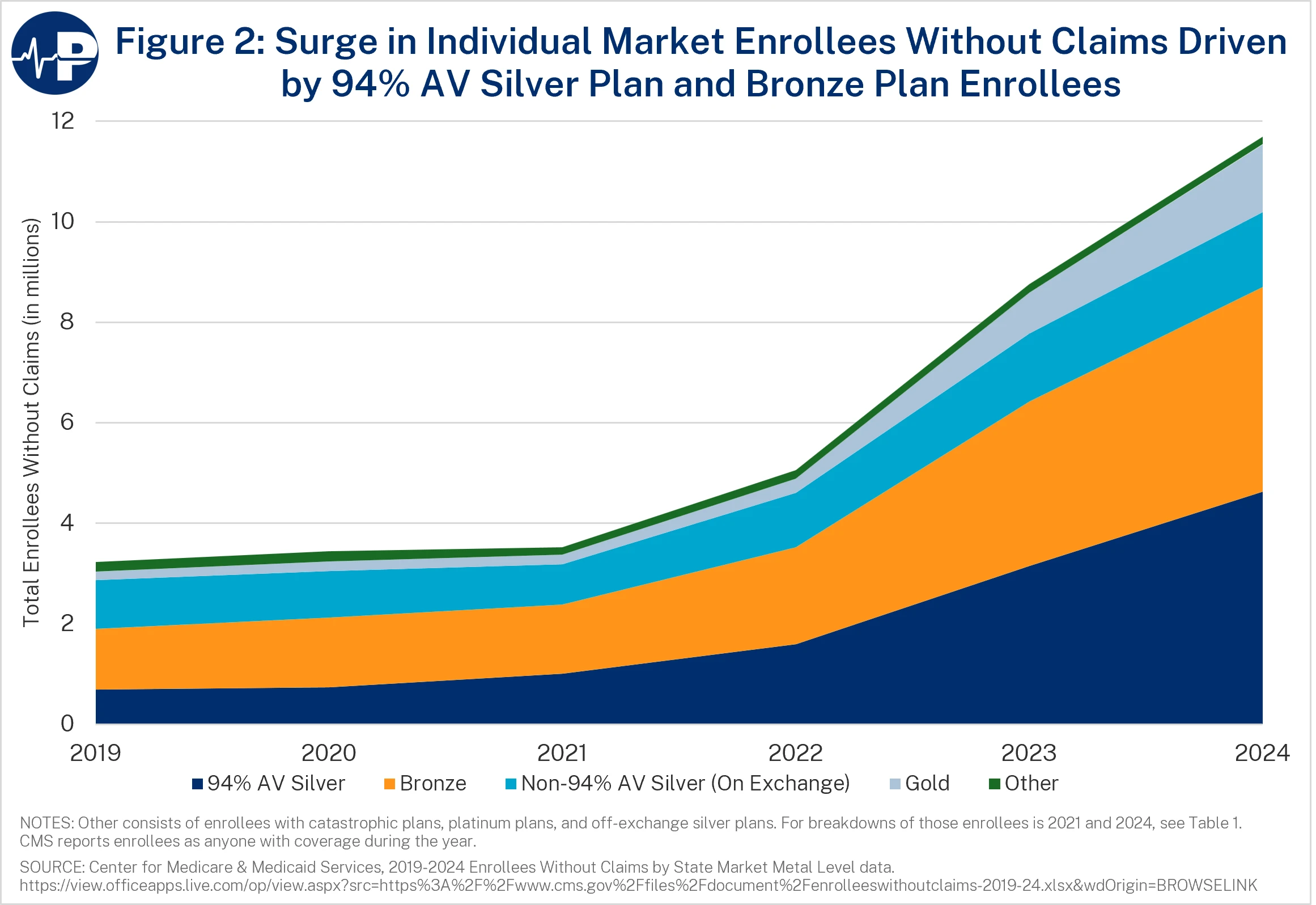
Figure 2 shows the total number of individual market enrollees without claims from 2019 to 2024. The total number was fairly flat from 2019 to 2021, going from 3.2 million to 3.4 million in 2020 to 3.5 million in 2021—before rapid growth in 2022. In 2022, the number was 5.1 million; up to 8.8 million in 2023; and up to 11.7 million in 2024. Figure 2 demonstrates that the growth of enrollees without claims was driven by 94 percent actuarial value (AV) silver plans and bronze plans.

Surge in Individual Market Enrollees Without Claims Driven by 94% AV Silver Plan and Bronze Plan Enrollees
 

Only enrollees claiming income between 100 and 150 percent of FPL can get 94 percent AV plans, which contain sharply reduced deductibles, copayments, and out-of-pocket limits. In Paragon’s Great Obamacare Enrollment Fraud calculations, we compare enrollees claiming between 100 and 150 percent FPL to the eligible population in that range, with the excess indicating likely fraudulent enrollment. As improper enrollment soared, it is not surprising that enrollment of people without claims has soared.

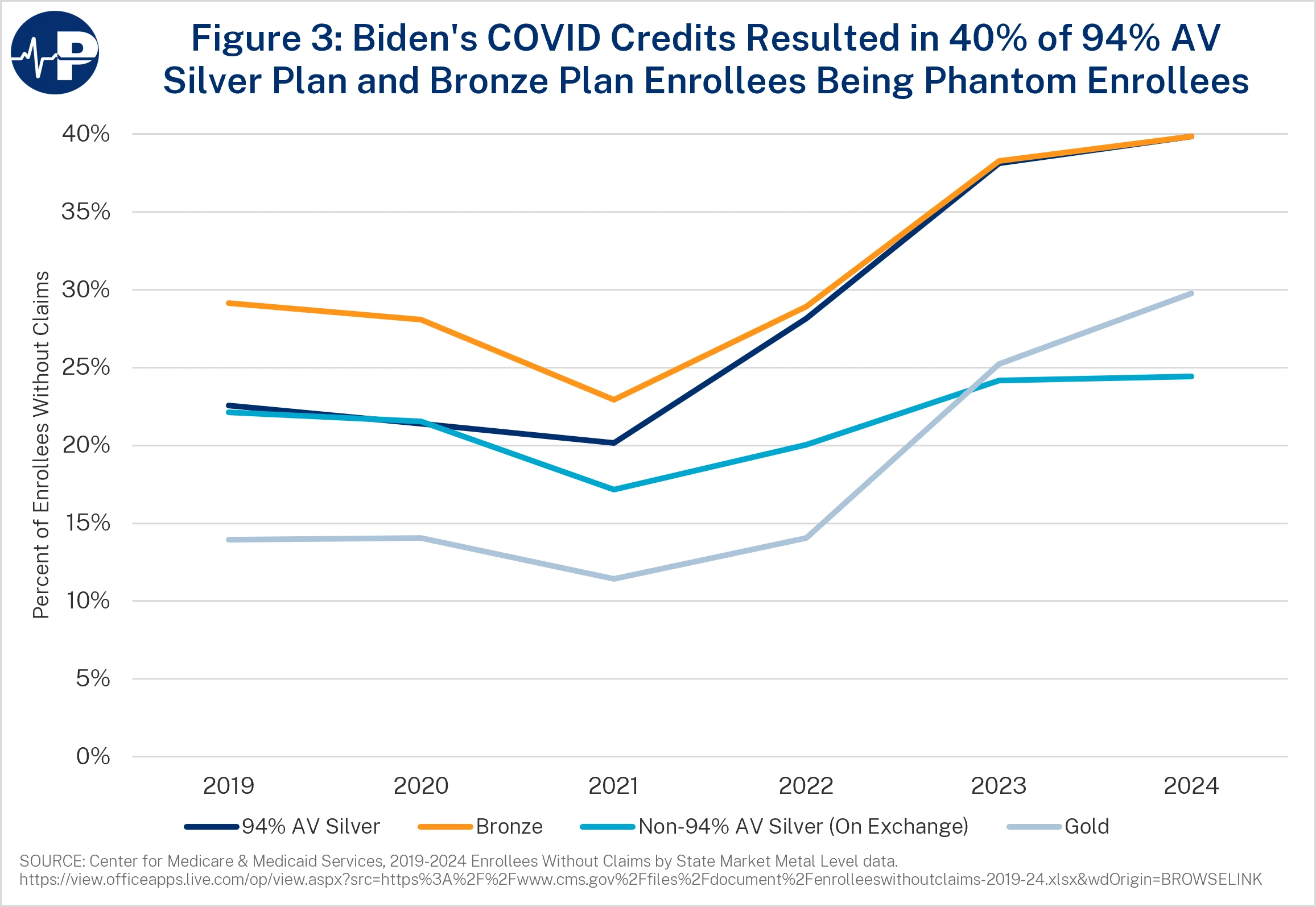
Total enrollment in the 94 percent AV silver plans soared from 3.4 million in 2020 (and 5.0 million in 2021) to 11.6 million in 2024. Consistent with both fraud and the enrollment of a large number of people without awareness of their enrollment, the share of 94 percent AV plan enrollees with no claims doubled from 20 percent in 2021 to 40 percent in 2024—about 3.1 million people in 2024 on an annual basis.

Bronze plans, often free to those above 150 percent of FPL, accounted for another third of the zero-claims growth—likely a way for unscrupulous brokers to enroll people without triggering premium payments that would alert them. Brokers can collect commissions regardless of whether that enrollee ever uses the plan—creating a perverse incentive to pad rolls with people who don’t need or even want coverage.

Figure 3 shows the percentage of zero-claim enrollees for the four main plans (bronze, 94 percent AV silver, exchange non-94 percent AV silver, and gold) from 2019 to 2024. Figure 2 shows the most significant increase was among enrollees with the 94 percent AV silver plans, but there were also significant increases in the percentage of zero-claim enrollees with bronze plans and gold plans. Due to the incentives created by the method used to calculate premium subsidies, many gold plan enrollees can also receive fully subsidized plans. As Figure 2 shows, the total number of zero-claim gold plan enrollees remains well below zero-claim bronze or 94 percent AV plan enrollees.

Biden's COVID Credits Resulted in 40% of 94% AV Silver Plan and Bronze Plan Enrollees Being Phantom Enrollees
 

Table 1 contrasts the total number of enrollees without claims and the percentage of enrollees with that coverage without claims from 2021 to 2024—and corresponds to Figure 2. The total number of enrollees without claims rose from 3.5 million to 11.7 million. Of the growth in the total number of enrollees without claims, 44.3 percent was from the 94 percent AV plans and 33.0 percent was from the bronze plans.

Surge in No Medical Claims Among Individual Market Enrollees, 2021 to 2024
 

In Paragon’s previous work, we uncovered that improper enrollment in exchange plans was concentrated in states using the federal exchange, or HealthCare.gov. In 12 states, over 40 percent of 94 percent AV silver enrollees had no claims in 2024: Louisiana (49.4 percent), Ohio (46.5 percent), Texas (45.9 percent), South Carolina (45.6 percent), Arizona (45.0 percent), Oklahoma (44.1 percent), Tennessee (43.5 percent), North Carolina (42.3 percent), Massachusetts (41.1 percent), Georgia (40.9 percent), Illinois (40.5 percent), and Missouri (40.4 percent). All of these states, except Massachusetts, use HealthCare.gov. Florida tops the list with 1.2 million zero-claim 94 percent AV plan enrollees, though its share was slightly lower at 37.7 percent.

Biden’s COVID credits turned the exchanges into a major profit engine for insurers and intermediaries, with CMS’s own data showing that coverage does not translate into care. The One Big Beautiful Bill included important program-integrity reforms that will reduce wasteful and fraudulent exchange spending. Congress must recognize that nearly 8 million full-year individual market enrollees in 2024 consumed no health care at all, even as tens of billions of subsidies flowed to major insurance companies on their behalf. Congress should let the Biden COVID credits expire and pursue ACA reforms that direct dollars to patient care, not middlemen.


https://paragoninstitute.org/paragon-prognosis/the-rise-of-phantom-obamacare-enrollees-biden-covid-credits-drive-massive-increase-in-individual-market-enrollees-with-no-medical-claims/

Iterum brings first oral penem antibiotic to US market

 Iterum Therapeutics has become the first drugmaker to bring an oral antibiotic in the penem class to market in the US, launching Orlynvah as a treatment for uncomplicated urinary tract infections (uUTIs).

The launch of the product – which comes a few months after Orlynvah (sulopenem etzadroxil and probenecid) was approved by the FDA – keeps the Dublin, Ireland-headquartered biotech ahead of rival companies bidding to bring new therapies for uUTIs to the US market.

That includes GSK with Blujepa (gepotidacin) – which was approved in March by the FDA as the first drug with a new mechanism of action for uUTIs in nearly three decades – as well as Alembic Pharma with Pivya (pivmecillinam), cleared for uUTIs in 2024 and acquired when Alembic bought Utility Therapeutics last month. Both Blujepa and Pivya are due to be launched in the US before the end of the year.

Specifically, Orlynvah was given a green light by the FDA for adult women with uUTIs caused by Escherichia coliKlebsiella pneumoniae, or Proteus mirabilis with limited or no alternative oral antibacterial options. It was initially turned down by the agency, which issued a complete response letter (CRL) to Iterum in 2021 with a request for more data.

According to Iterum, it is the first new branded product to be introduced in the US for uUTIs in more than 25 years and offers "a critical option for patients and physicians facing a shrinking arsenal of effective oral therapies." It is also the company's first commercial-stage product.

In the pivotal REASSURE study, which read out in January 2024, Orlynvah was shown to be statistically non-inferior to Augmentin (amoxicillin/clavulanate) in achieving an overall response – a combination of a clinical cure plus microbiologic eradication.

Almost two-thirds (60%) of women experience a UTI in their lifetime, and 44% experience three or more episodes annually, making it the most common outpatient infection encountered in women in the US. There are estimated to be approximately 40 million prescriptions annually in the US for uUTIs.

Antimicrobial resistance (AMR) is an increasing problem, with one study last year involving 150,000 patients with uUTIs finding that more than half (57%) were resistant to at least one antibiotic class and 13% were resistant to three or more.

As an oral option, Orlynvah provides an alternative to injectable carbapenems which are the main treatment option for resistant infections, and could allow patients to be treated more easily outside hospitals.

https://pharmaphorum.com/news/iterum-brings-first-oral-penem-antibiotic-us-market

Genentech Walks Away From $2B Partnership With Adaptive Biotechnologies


Adaptive and Genentech first partnered in 2018 to advance T cell receptor-based therapies for cancer.

Adaptive Biotechnologies lost a powerhouse partner after Roche subsidiary Genentech walked away from a potentially $2 billion cancer-focused cell therapy collaboration.

The Washington-based biotech revealed the news in an SEC filing on Monday, noting that the collaboration between the two companies will end Feb. 9, 2026. The partners will work to wind down their joint cell therapy activities and, thereafter, Adaptive will no longer be held to its exclusivity obligations under the agreement. In conjunction with the termination, Adaptive will receive $33.7 million in non-cash revenue during the second half of this year.

The decision to walk away from Adaptive “was not based on any emerging safety concerns,” a Genentech spokesperson told Endpoints News on Tuesday.

Adaptive and Genentech formed the partnership in 2018, according to the regulatory filing, though the arrangement was announced in January 2019. The agreement included a $300 million upfront payment and a promise of up to $2 billion in development, regulatory and commercial milestones. Adaptive was also eligible for royalties on sales of products resulting from the collaboration.

For six years, the partners advanced T cell receptor (TCR)-based therapies for cancer, with an eye toward tailoring treatment to the patient’s individual case. In May 2023, the collaboration secured its first Investigational New Drug clearance.

That same year, however, Roche pulled back from TCR therapies. In its first-quarter 2023 report just a few weeks earlier, the pharma discontinued two Phase I TCR assets that were being tested for solid tumors. Roche continued its retreat from this field and in April 2024 ended its $3 billion cell therapy collaboration with Adaptimmune. The companies first partnered in September 2021 to advance allogeneic T cell therapies for up to five cancer targets, as well as personalized T cell-based programs. Neither progressed past the discovery phase.

The pullback extends into Genentech as well. In August last year, the company shuttered its cancer immunology unit amid a sweeping review of the subsidiary’s oncology investments. R&D activities in this area were folded into its molecular oncology efforts. Ira Mellman, former vice president of Cancer Immunology, departed Genentech.

https://www.biospace.com/business/genentech-walks-away-from-2b-partnership-with-adaptive-biotechnologies