Search This Blog

Thursday, August 21, 2025

RBC says PTC Therapeutics CRL may signal difficulty for Biohaven

 RBC Capital analyst Leonid Timashev notes that PTC Therapeutics (PTCT) received a complete response letter for vatiquinone in Friedreich’s ataxia from the FDA, which the agency having noted that substantial evidence of efficacy was not demonstrated and that a well-controlled study would be needed. The firm sees “multiple parallels” between PTC and Biohaven (BHVN), which gives it “concerns” about the upcoming priority review for troriluzole in spinocerebellar ataxia. While the parallels are “concerning,” the firm also notes “several potential differentiators” that could allow Biohaven to deliver on troriluzole in SCA, though RBC remains on the sidelines with a Sector Perform rating on Biohaven given what it calls “a higher risk catalyst setup into year-end.”

https://finance.yahoo.com/news/rbc-says-ptc-therapeutics-crl-144020615.html

PTC stung by FDA decision not to approve rare disease drug

 It looks like PTC Therapeutics will have to carry out another clinical trial of its drug candidate for inherited neuromuscular disorder Friedreich's ataxia (FA) before the FDA will consider approval.

The US regulator has sent a complete response letter (CRL) to PTC, declining to approve the drug, called vatiquinone, because it said the main MOVE-FA study filed in support of the application had not shown conclusive efficacy.

The decision did not come entirely out of left field, and that may be why PTC's share price barely moved in response to the announcement.

PTC had moved ahead with a filing for the 15-LO inhibitor on the back of the MOVE-FA data, even though the study failed to meet its primary objective of improving symptoms of the disorder compared to placebo at 72 weeks.

The study looked at the efficacy of the drug on symptoms of FA affecting upper and lower limb coordination, swallowing, speech, and stability when standing. While it missed the main endpoint, PTC opted to file for approval regardless, based on data in a subgroup of patients who adhered to the drug throughout the study, as well as results on secondary outcome measures like fatigue levels.

"We are, of course, disappointed by the FDA's decision to not approve vatiquinone," said Matthew Klein, PTC's chief executive, who noted that the FDA is seeking another 'adequate and well-controlled' study.

"We believe the data collected to date demonstrate that vatiquinone could provide a safe and effective therapy for both children and adults living with Friedreich's ataxia," he added. "We plan to meet with the FDA to discuss potential steps to address the issues raised in the CRL."

The muted response to the FDA's decision among investors could stem in part from an acknowledgement that vatiquinone is considerably less important to the company's growth in the coming years than its new treatment for the rare disease phenylketonuria (PKU), Sephience (sepiapterin), which was approved in the EU in June and in the US last month and is heading for a decision in Japan before the end of the year.

Analysts at JPMorgan have modelled peak global sales of $1.2 billion for Sephience, with $750 million of that total coming from the US market, representing a big source of growth for PTC, which recorded sales of $179 million in the second quarter and is modelling full-year revenues of $650 to $800 million.

https://pharmaphorum.com/news/ptc-stung-fda-decision-not-approve-rare-disease-drug

Nicox plans filings for glaucoma after phase 3 win

 Nicox is on track to file for approval of its NCX 470 therapy for eyesight-robbing disease glaucoma after it showed efficacy in a second pivotal trial.

The positive data from the Phase 3 Denali trial showed that NCX 470, a nitric oxide-donating bimatoprost eyedrop formulation, was as effective as latanoprost 0.005%, the standard therapy, in lowering intraocular pressure (IOP) in patients with open-angle glaucoma.

That matches the outcome of the earlier Mont Blanc phase 3 trial, which was reported in 2022, although at the time there was some disappointment that Nicox's drug was unable to show superiority to the go-to therapy. Regardless, with two positive trials in hand, Nicox now plans to file NCX 470 for approval in the US and China.

Glaucoma is an eye condition which is usually caused by a build-up of pressure in the eye. It begins when the fluid in the eye cannot drain properly, resulting in IOP increases that can damage the optic nerve, as well as the nerve fibres from the retina, leading to progressive loss of vision and, in some cases, blindness.

In Denali, the IOP-lowering effect from baseline for NCX 470 was 7.9 to 10.0 mmHg, compared to 7.1 to 9.8 mmHg for latanoprost, fulfilling its primary objective.

The 696-subject trial also included a pre-specified secondary efficacy analysis of time-matched change from baseline IOP, with reductions that were numerically greater with NCX 470 than latanoprost at five of six timepoints – at 8 am and 4 pm on weeks two, six, and 12 – with three comparisons reaching statistical significance. However, overall statistical superiority on this secondary measure was not achieved.

On the tolerability front, Nicox said that NCX 470 was not associated with any serious adverse events, and the main side effect was redness in the eye due to dilated blood vessels (conjunctival hyperaemia). All told, 10.1% of patients on NCX 470 discontinued compared to 6.6% in the latanoprost group over up to 12 months of follow-up.

Despite the mixed efficacy results, shares in Nicox had gained almost 10% at the time of writing, suggesting that investors were optimistic of a positive outcome for the planned marketing applications.

France-based Nicox has previously said that NCX 470 addresses a global glaucoma market estimated to be worth around $6 billion a year, and has modelled peak sales of more than $300 million.

The company has commercial partnerships in place with Ocumension for NCX 470 in China, Hong Kong, Macau and Taiwan, as well as Korea and Southeast Asia, while Kowa has rights in the rest of the world, including the US. Phase 3 trials in Japan are underway, while a Nicox spokesperson said discussions with the EMA on the appropriate regulatory route to approval are needed, which will now be the responsibility of Kowa.

"We are now moving forward towards potential recurrent NCX 470 royalty revenue from 2027 onwards," commented Nicox's chief executive Gavin Spencer.

"Our established partnerships with Kowa and Ocumension enable us to accelerate [filing] preparations, whilst also allowing us to focus on potential future strategies for the company," he added.

Nicox is due for a €5 million milestone payment from Kowa on the back of the Denali readout. The company also has a follow-up NO-donating glaucoma candidate (NCX 1728) in preclinical development which has been licensed to Glaukos.\

https://pharmaphorum.com/news/nicox-plans-filings-glaucoma-after-phase-3-win

'HHS Staffers Accuse RFK Jr. of ‘Sowing Public Mistrust’ Against CDC After Shooting at HQ'


In an open letter, Health and Human Services employees asked the Secretary to stop and disavow the spread of health misinformation, particularly about vaccines, infectious diseases and federal health agencies.

Over 750 current and former employees at the Department of Health and Human Services are calling on Secretary Robert F. Kennedy Jr. to tone down what they characterized as “dangerous and deceitful statements” that have fostered distrust against federal health workers, exposing them to physical harm.

“The violent August 8th attack on CDC’s headquarters in Atlanta was not random,” staff wrote in an open letter published Wednesday, referring to the shooting earlier this month at the agency’s main campus when nearly 200 bullets were fired into CDC buildings. One police officer died in the attack. The gunman, 30-year-old Patrick Joseph White, took his own life after the incident.

“The attack came amid growing mistrust in public institutions, driven by politicized rhetoric that has turned public health professionals from trusted experts into targets of villainization—and now, violence,” according to the letter, which was addressed to Kennedy himself and members of U.S. Congress.

Kennedy, the letter continued, is “complicit” in this erosion of public trust “by repeatedly spreading inaccurate health information.” The secretary has, for instance, “falsely attributed” autism to childhood vaccination despite decades of research disproving this link. Kennedy has also mistakenly claimed that mRNA vaccines aren’t protective against COVID-19, even pulling back some $500 million in funding for related research, according to the letter.

Kennedy’s rhetoric has even sometimes painted federal workers as the enemy, with Wednesday’s open letter noting that he has previously called the CDC a “cesspool of corruption.”

These statements have “contributed to the harassment and violence experienced by CDC staff,” the employees claimed. To keep the federal health workforce safe, the letter outlined three main requests: that Kennedy “stop spreading inaccurate health information” and publicly disavow the spread of misleading information about vaccines, infectious diseases and federal health agencies; acknowledge that the CDC’s work is “rooted in scientific, non-partisan evidence” with the goal of improving the health of Americans; and provide more concrete guarantees of their safety, such as functional alerts and emergency protocols. The letter also calls for the removal of “high-profile online material targeting the federal workforce such as the widely seen ‘DEI watchlists.’”

In a statement to Endpoints News, a spokesperson for HHS pushed back on the open letter, saying that “any attempt to conflate widely supported public health reforms with the violence of a suicidal mass shooter is an attempt to politicize a tragedy.”

https://www.biospace.com/policy/hundreds-of-hhs-staffers-accuse-rfk-jr-of-sowing-public-mistrust-against-cdc-after-shooting-at-q

J&J Adds $2B to US Manufacturing Commitment


President Donald Trump first threatened pharma tariffs in February and recently said they were imminent. Johnson & Johnson’s new investment adds to a $55 billion pledge made by the company in March.

Johnson & Johnson is investing $2 billion more into its U.S. manufacturing footprint—on top of a $55 billion commitment in March—as President Donald Trump continues to threaten the biopharma industry with hefty tariffs on imported products.

In a news release on Thursday, the pharma announced that it has entered into a 10-year agreement with Fujifilm for a 160,000-square-foot production plant in North Carolina, where J&J’s previous investment focused and where much of other pharmas’ U.S. manufacturing boosts have landed. The new investment will create around 120 new jobs in the region, according to J&J, adding to the 500 positions associated with the March move. On Thursday, the pharma provided an update for this investment, revealing that construction is ongoing for its facility in Wilson, North Carolina.

Despite already having more manufacturing sites in the U.S. than in any other country, J&J continues “to strengthen our presence here,” CEO Joaquin Duato said in a prepared statement on Thursday.

This latest investment package comes amid Trump’s looming pharma tariffs, which he has been threatening the industry with for around six months now. Most recently, Trump earlier this month told CNBC that levies on pharma imports could reach as high as 250%, though he plans to implement this in phases. The industry, for instance, would first be subject to a “small tariff” before ramping up to 150%, then 250%.

A few days earlier, Trump reached a trade deal with the European Union, under which pharma products will carry a 15% tariff.

In parallel, the Trump administration also has an ongoing Section 232 national security investigation into pharma imports. Launched in April under Secretary Howard Lutnick’s Department of Commerce, the probe is set to run for 270 days, according to the Trade Expansion Act of 1962, after which a report should be filed to the president, who then can impose certain trade restrictions, including tariffs.

According to an Aug. 14 report from Reuters, Lutnick had said the probe would end last month, before pushing back his own timeline by two weeks on July 29. But in that same article, Reuters cited industry, White House and European government sources, who said that tariffs are likely still weeks away. The government official from Europe even noted that tariffs could be delayed until next month, while also warning that timelines could change again.

Since Trump’s initial threat in February, several big pharma companies have pumped billions into their domestic operations. In addition to Johnson & JohnsonAstraZeneca and Roche have also made U.S.-based investments. Meanwhile, the FDA has launched a new PreCheck program to help pharma companies establish or expand manufacturing sites in the U.S.

https://www.biospace.com/business/j-j-adds-2b-to-us-manufacturing-commitment-amid-trumps-protracted-tariff-threats

Bullard Backs 100bps In 2025 Rate Cuts In Hopes Of Replacing Powell

 With candidates hoping to replace Jerome Powell coming up with increasingly dovish - not to mention - plans on how to attract Trump's attention and jump in the lead earlier this morning, former St. Louis Fed president James Bullard, who has emerged a long-shot contender for the next US central bank chief, called for a percentage point of interest-rate cuts this year, with scope to do more in 2026.

“Rates are a little bit high right now, and I think we can get down about 100 basis points going into 2026 — I think that’ll start with a rate reduction here at the September meeting, and probably be followed up later this year,” Bullard said on Fox Business Thursday.

Bullard, now dean of Purdue University’s business school, said he’d been in contact with Treasury Secretary Scott Bessent about his candidacy for Fed chair, and is aiming to set up an interview with him, “probably” after Labor Day — which falls on Sept. 1.

As for further rate cuts next year, Bullard said it will depend on how data come in. He also cited the need to protect the reserve status of the dollar.

Unfortunately for Bullard, he remains dead last in the Polymarket Powell-replacement sweepstakes, and he will have to either push for NIRP or, even better, Yield Curve Control if he hopes to have any real chance of getting Trump to notice him. 

US Manufacturing Activity "Unexpectedly" Soars To Highest Since 2022

 One month after unexpectedly sliding into contraction for the first time in 2025, moments ago the S&P Manufaturing PMI even more unexpectedly soared from 49.8 to 53.3, not only smashing expectations of another decline to 49.7 and printing well above the highest economist forecast and in fact printing 7-sigma above the median estimate...
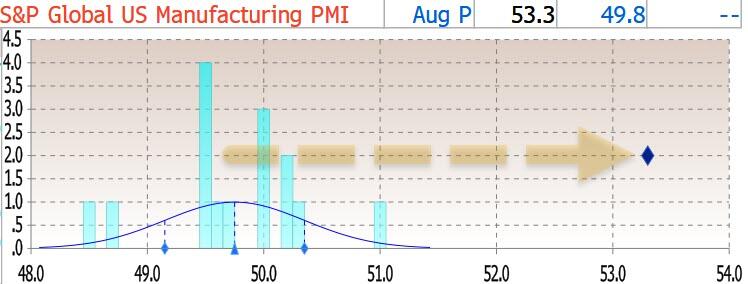
... but was the highest print since May 2022! According to S&P's PMI report, the surge signaled "a renewed improvement of factory business conditions after a brief deterioration in July." 

At the same time the S&P Services PMI declined from last month's red hot 55.7 to 55.4, but still beat estimates of 54.2. As a result, the composite PMI of US business activity grew at the fastest rate recorded so far this year in August, rising to 55.4 from 55.1, matching the previous post-covid high from Dec 2024 and  adding to signs of a strong third quarter. Output has now grown continually for 31 months, with the latest two months seeing the strongest back-to-back expansions since the spring of 2022. 
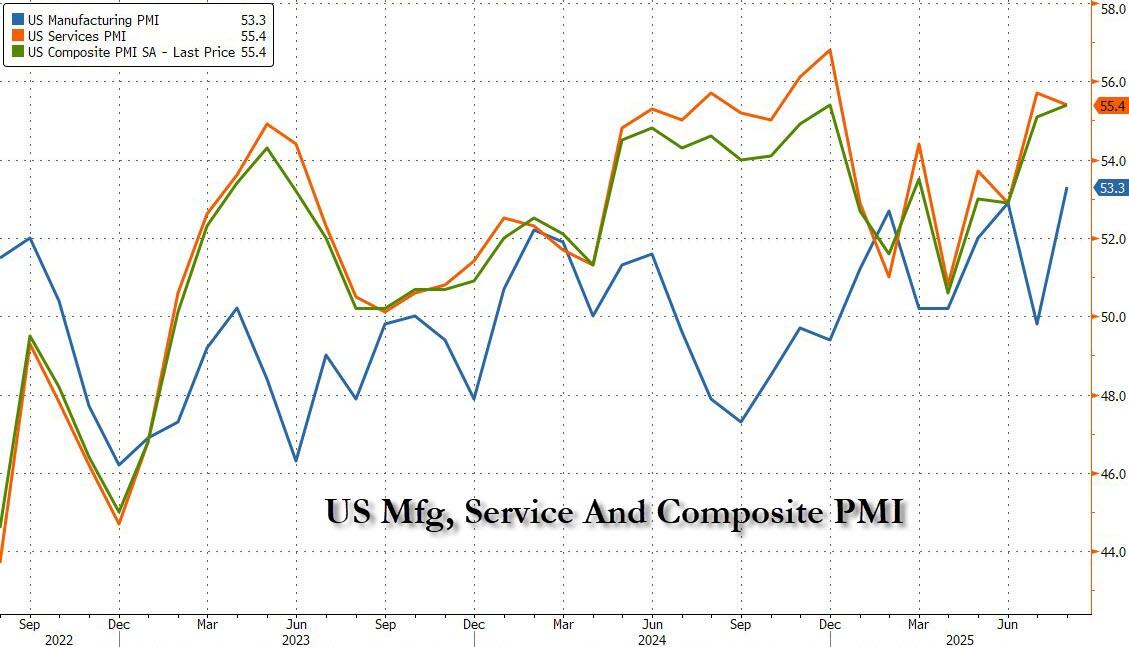
According to the report, growth was seen across both manufacturing and service sectors of the economy. Hiring also picked up. Most notably, job creation reached one of the highest rates seen over the past three years as companies reported the largest build-up in uncompleted work since May 2022.

Some more details:

  • Production rose for a third successive month, rising at a pace not recorded since May 2022, buoyed by the largest influx of new orders since February 2024.
  • Factory employment meanwhile rebounded after a decline in July to register the largest payroll gain since March 2022. Inventories of inputs also rose sharply after a drop in July.
  • That left only the suppliers delivery times index acting as a drag on the PMI (reflecting faster deliveries), but to a lesser degree than in July.
  • Backlogs rose at an unchanged and therefore joint-steepest rate since May 2022 in the services economy, while manufacturing backlogs also rose to the greatest extent in over three years.
  • While many manufacturers reported improved sales and demand, the upturn in production and order inflows was in part linked to renewed inventory building. Stocks of finished goods rose to an extent not previously recorded since data were first available in 2007, while stocks of purchased inputs showed the second-largest rise seen for over three years.
  • While stock building was partly fueled by expectations of rising demand, some factories also reported increased safety-stock building amid fears of supply shortages or to protect against further price rises, in turn reflecting the recent impact of import tariffs.

There was more good news when it comes to jobs: employment rose for a sixth successive month, with the pace of job creation hitting the highest since January (and one of the strongest rates seen for over three years). Service providers took on staff at the fastest pace for seven months while factory job gains reached the highest since March 2022. Companies largely took on additional staff in response to rising backlogs of work. Uncompleted orders rose for a fifth consecutive month, rising in August at a pace unsurpassed since May 2022 reflecting stronger demand and near-term capacity constraints at some companies.

There were some concerns on the price side, with tariffs reported as the key driver of further cost increases in August. Companies across both manufacturing and service sectors collectively reported the steepest rise in input prices since May and the second-largest increase since January 2023. Rates of increase accelerated in both sectors. While the manufacturing cost rise was especially large, being the second-steepest since August 2022, the service sector increase was the second-highest since June 2023. Average prices charged for goods and services rose at the sharpest rate since August 2022 as firms passed higher costs on to customers. Although goods price inflation cooled slightly for a second month in a row, it remained among the highest seen over the past three years. Service sector price inflation meanwhile was the sharpest since August 2022.

Business confidence in the outlook also improved but remained much weaker than seen at the start of the year as companies reported ongoing concerns over the impact of government policies, especially in relation to tariffs. Tariffs were again widely cited as the principal cause of sharply higher costs, which in turn fed through to the steepest rise in average selling prices recorded over the past three years. 

Commenting on the report, Chris Williamson, Chief Business Economist at S&P Global Market Intelligence said that the "strong flash PMI reading for August adds to signs that US businesses have enjoyed a strong third quarter so far. The data are consistent with the economy expanding at a 2.5% annualized rate, up from the average 1.3% expansion seen over the first two quarters of the year."

“Companies across both manufacturing and services are reporting stronger demand conditions, but are struggling to meet sales growth, causing backlogs of work to rise at a pace not seen since the pandemic-related capacity constraints recorded in early 2022. Stock building of finished goods has also risen at a survey record pace, linked in part to worries over future supply conditions."

 “While this upturn in demand has fueled a surge in hiring, it has also bolstered firms’ pricing power. Companies have consequently passed tariff-related cost increases through to customers in increasing numbers, indicating that inflation pressures are now at their highest for three years."

 As a result, the economist concludes that the "rise in selling prices for goods and services suggests that consumer price inflation will rise further above the Fed’s 2% target in the coming months. Indeed, combined with the upturn in business activity and hiring, the rise in prices signaled by the survey puts the PMI data more into rate hiking, rather than cutting, territory according to the historical relationship between these economic indicators and FOMC policy changes.”

In other words, the report coming unexpectedly strong, may be just an attempt by the traditionally anti-Trumpian S&P to pressure the Fed into maintaining a hawkish bias even as the labor market - at least as measured by most other 3rd parties - continues to deteriorate. 

https://www.zerohedge.com/markets/us-manufacturing-activity-unexpectedly-soars-highest-2022