Search This Blog

Thursday, August 21, 2025

Appeals Court Tosses Trump's $454 Million Civil Fraud Judgement As Prez Claims 'Total Victory'

 A New York appeals court has tossed out a $454 million civil fraud judgement handed down last year against Donald Trump, his family, and his company. 
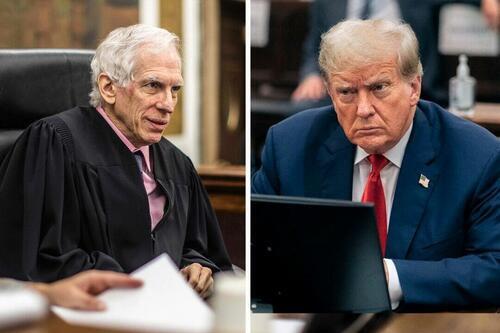
 New York Supreme Court Justice Arthur Engoron, Donald Trump

While the Appellate Division's First Department upheld the ruling, it found that the $454 million penalty was excessive and at odds with the Eighth Amendment.

"The documentary evidence supports Supreme Court's conclusion that the Attorney General made a prima facie showing that each defendant participated in the fraudulent scheme," reads the opinion. "The trial record is also replete with evidence supporting the court's determination that the individual defendants had the requisite intent to defraud, a necessary element of each Penal Law claim."

The decision comes after New York Attorney General Letitia James’s office asked an appeals court last August to uphold the $454 million civil fraud judgment against Trump. 

The appellate judges, however, said of the judgement; "while harm certainly occurred, it was not the cataclysmic harm that can justify a nearly half billion-dollar award to the State."

In response to the decision, President Trump claimed 'TOTAL VICTORY in the FAKE New York State Attorney General Letitia James Case!" 

"The amount, including Interest and Penalties, was over $550 Million Dollars. It was a Political Witch Hunt, in a business sense, the likes of which no one has ever seen before. This was a Case of Election Interference by the City and State trying to show, illegally, that I did things that were wrong when, in fact, everything I did was absolutely CORRECT and, even, PERFECT," Trump wrote on Truth Social.

The case can now be appealed by either side to the state's highest court, the New York Court of Appeals.

"Today's ruling by the New York appeals court is a resounding victory for President Trump and his company," Trump's former personal attorney, Alina Habba, said in response. "The court struck down the outrageous and unlawful $464 million penalty, confirming what we have said from the beginning: the Attorney General’s case was politically motivated, legally baseless, and grossly excessive." 

Following a three-month civil trial last year, Judge Arthur Engoron found Trump liable for inflating his net worth to secure better business deals, writing in his decision that Trump and his co-defendants engaged in frauds that "leap off the page and shock the conscience," adding "Their complete lack of contrition and remorse borders on pathological. They are accused only of inflating asset values to make more money. The documents prove this over and over again."

Trump has long claimed that the case was politically motivated, saying "I've been persecuted by someone running for office," referring to NY Attorney General Letitia James, who brought the case - and is currently under investigation for her own real estate fraud

In his February decision, Engoron temporarily barred Trump and his family from leading New York-based companies, along with the $454 million fine. With interest, the penalty was closer to half-a-billion dollars. 

Trump denied all wrongdoing - arguing that the alleged victims in the case were sophisticated banks who were happy to go into business with the Trump Organization, and profited from the deals. Meanwhile, Trump's lawyers argued that James violated the statue of limitations, misapplied the relevant law, and encouraged the excessive penalty. 

https://www.zerohedge.com/political/appeals-court-tosses-trumps-454-million-civil-fraud-judgement

'What is known about the Nord Stream gas pipeline explosions?'

 Italian police have arrested a Ukrainian man suspected of coordinating the attacks on the Nord Stream gas pipelines in 2022, German prosecutors said on Thursday.

The arrest is the first significant breakthrough in the investigation of mysterious underwater explosions that occurred in September 2022 in the Baltic Sea.

Here is what we know about the blasts:

WHAT IS NORD STREAM?

Nord Stream system consists of two double pipelines, Nord Stream 1 (NS1) and Nord Stream 2 (NS2), built by Russia's state-controlled Gazprom to deliver up to 110 billion cubic metres (bcm) of gas annually across the Baltic Sea to Germany.

The four concrete-coated steel pipelines of about 1,200 km (750 miles) in length and more than 1 meter in diameter lay at a depth of around 80-110 m.

NS1 came on stream in 2012. NS2 was completed in September 2021 and filled with gas, but has never been commissioned.

Germany cancelled its approval process days before Russia's invasion of Ukraine on February 24, 2022, which put Europe's reliance on Russian natural gas in the political spotlight.

HOW WERE THE PIPELINES DAMAGED?

On Sept. 26, 2022, Swedish seismologists registered several blasts, some 17 hours apart, off the Danish island of Bornholm that ruptured three of the four NS pipelines, sending plumes of methane into the atmosphere.

Gazprom said about 800 million cubic metres of gas, equivalent to about three months of Danish gas supplies, had escaped. It took several days for the gas to stop leaking.

Only one pipeline of the four, part of NS2, remains intact. In January, Denmark granted permission to conduct preservation work on it, but it is unclear whether any work has taken place.

Western companies which had stakes or financed construction of the pipelines, such as E.ON and Shell, have written off all their investments since the explosions.

WHO WAS BEHIND THE EXPLOSIONS?

No one has taken responsibility.

Denmark and Sweden concluded it was an act of sabotage, but closed their investigations in February 2024 without identifying any suspects.

Investigations by Western media, including the New York Times and the Wall Street Journal, said a pro-Ukrainian group was behind the attack.

German prosecutors identified the suspect arrested in Italy only as Serhii K., and said he was part of a group of people who planted devices on the pipelines near Bornholm.

He and his accomplices had set off from Rostock on Germany's north-eastern coast in a rented sailing yacht to carry out the attack, the prosecutors said.

Germany's Der Spiegel magazine and ZDF TV broadcaster have previously reported that a group of six people - five men and one woman - were on the yacht that left Rostock on September 6 and returned on September 23, 2022.

The boat, called Andromeda, was spotted at a small Danish island of Christianso, near the explosion sites, at the Swedish port of Sandhamn and at a marina in Kolobrzeg, Poland, before returning to Germany.

German investigators, who raided the yacht in January 2023, found on board traces of the same explosives as discovered by Sweden at the explosion sites, German media reported.

Germany told the United Nations that it believed trained divers could have attached devices to the pipelines at a depth of about 70 to 80 metres (230-262 ft).

German media also reported that Berlin had issued a European arrest warrant in 2024 against a Ukrainian diving instructor, identified as Volodymyr Z, in connection with the attacks.

The suspect, who lived in Poland at that time, later left for Ukraine, Polish prosecutors said. They also said there was no evidence to suggest that Poland was used as a hub for the attacks.

WHAT DID WESTERN INTELLIGENCE KNOW ABOUT THE ATTACK?

A day after the explosions, on September 27, 2022, Der Spiegel reported that the CIA had warned Germany in summer 2022 about possible attacks on Baltic Sea pipelines.

The Washington Post, citing leaked information posted online, wrote in June 2023 that the United States had learned of a Ukrainian plan to attack the Nord Stream natural gas pipelines three months before they were damaged.

The intelligence report was based on information provided by a source in Ukraine, the Post said, adding the CIA shared it with Germany and other European countries in June 2022.

Dutch national broadcaster NOS reported the same month that the tip came from the Dutch military intelligence agency MIVD.

According to the Post, the CIA relayed to Ukraine's then Commander-in-Chief General Valeriy Zaluzhnyi through an intermediary that Washington opposed such an operation.

Reuters was unable to verify the reports independently.

https://www.thestar.com.my/news/world/2025/08/22/explainer-what-is-known-about-the-nord-stream-gas-pipeline-explosions

Ionis’ hereditary angioedema drug approved

 The Food and Drug Administration on Thursday approved a drug Ionis Pharmaceuticals developed for the rare genetic disease hereditary angioedema, making the therapy, known as donidalorsen, the third new medicine to reach market this year for the rare genetic condition.

Donidalorsen, which Ionis will sell under the brand name Dawnzera, is approved to prevent the swelling attacks associated with hereditary angioedema in adults and children at least 12 years of age. Ionis will disclose the drug’s price on a conference call Thursday afternoon, a company spokesperson said.

HAE is a rare, inherited condition estimated to affect about 1 in every 50,000 people worldwide. The disease is characterized by recurrent swelling attacks that can last for days if untreated, and most commonly affect the limbs, face, gastrointestinal tract and throat. These episodes can be life-threatening.

Despite its rarity, HAE has become a crowded area of drug research. Prior to Dawnzera’s approval, several therapies were already available to treat or prevent these attacks. Two — Kalvista Pharmaceuticals’ Ekterly and CSL Behring’s Andembry — made it to market this year. A gene editing medicine is in late-stage testing, too.

As a result, investors’ expectations for Dawnzera are “relatively low,” analysts at the investment bank Stifel wrote in a client note in May.

Ionis, though, believes Dawnzera could become the preferred choice for patients looking to prevent swelling attacks. Current options, like the once-monthly injection Andembry and Biocryst Pharmaceuticals’ pill Orladeyo, reduce the rate of attacks, but don’t ward them off completely. In a poll Ionis conducted this year, a majority of patients contacted hadn’t yet found their best preventive option.

“Patients are looking for better efficacy, better convenience and better tolerability,” said CEO Brett Monia, in an interview. “At least one of those boxes are not checked with existing treatments,” he added, noting as evidence how people with HAE often “bounce around from one treatment to another” over the course of a year.

Dawnzera is different. It’s the first RNA-targeting medicine for HAE, and works by reducing levels of prekallikrein, a protein implicated in the onset of swelling attacks. Phase 3 results published in The New England Journal of Medicine last year showed that, among patients who received injections every four weeks, monthly attack rates were on average 81% lower than among those who received placebo. An every-other-month dose was associated with a 55% reduction versus placebo.

Monia also pointed to results from a study testing Dawnzera in patients who switched from another preventive therapy. That study found further reductions in swelling attack frequency among those who changed to Dawnzera. About 84% of trial participants also said they preferred Ionis’ treatment, citing convenience and better symptom management.

The most common side effects associated with treatment were injection site reactions, urinary and upper respiratory tract infections and abdominal discomfort. 

“We don’t see any reason why [Dawnzera] would not be the preferred first-line treatment for those patients who are newly diagnosed,” Monia said. However, given the majority of patients are already taking preventive therapies, the company will focus its marketing efforts there, hoping the results it’s accrued will convince people to switch medications.

Ionis’ HAE drug is the second approved medicine the company will sell on its own. A pioneer in developing RNA medicines called antisense oligonucleotides, the company has long been known for partnering its products instead of commercializing them. But under Monia, who became CEO in 2020, the company has changed course.

Since shifting its strategy, the company has launched one drug on its own, Tryngolza, for a rare disorder called familial chylomicronemia syndrome. Multiple others are in late-stage testing.

“I felt it was going to be like turning around an aircraft carrier,” Monia said, but “the employees, the scientists, everybody at Ionis was ready for this.”

https://www.biopharmadive.com/news/ionis-donidalorsen-dawnzera-hereditary-angioedema-approval-fda/758195/

Masimo sues US Customs over approval of Apple Watch imports

 Masimo (NASDAQ:MASI) filed a lawsuit against U.S. Customs and Border Protection over a decision that allowed Apple (NASDAQ:AAPL) to import Apple Watches with blood-oxygen feature technology during a patent dispute between the companies.

The lawsuit said the action challenges an August 2025 ruling by U.S. Customs and Border Protection, or CBP, allowing Apple to bypass an order from the U.S. International Trade Commission, or ITC, that prohibits the importation of Apple Watch products that infringe Masimo's patents. 

Masimo said in the lawsuit that Customs improperly decided that Apple can import watches with pulse oximetry technology, reversing its own ruling from last year without notifying Masimo.

Apple, Masimo and U.S. Customs and Border Protection did not immediately respond to a request for comment from Seeking Alpha.

The lawsuit said that in October 2023 the ITC determined that Apple’s watches infringed multiple claims of Masimo’s patents related tolight-based pulse oximetry technology. The ITC accordingly issued an order prohibiting the importation of Apple’s alleged infringing products.

The lawsuit added that in January 2024 CBP conducted a thorough adversarial proceeding, with participation from Apple and Masimo, and determined that Apple’s redesigned watches could be imported only to the extent the infringing functionality was completely disabled.

"It has now come to light that CBP thereafter reversed itself without any meaningful justification, without any material change in circumstances, and without any notice to Masimo, let alone an opportunity for Masimo to be heard," said the lawsuit.

Last week, Apple said it was introducing a redesigned blood oxygen feature for some Apple Watch Series 9, Series 10, and Apple Watch Ultra 2 users through an iPhone and Apple Watch software update. The U.S. tech giant had noted that the update was enabled by a recent U.S. Customs ruling.

Masimo's lawsuit noted that CBP’s function is to enforce ITC exclusion orders, not to create loopholes that render them ineffective.

"By issuing its August 2025 ruling through an ex parte process and applying a self-imposed rule against considering indirect infringement theories, CBP has acted unlawfully and deprived Masimo of the protections of its patents," said the lawsuit.

Masimo has asked the Washington court to halt the agency's ruling.

https://www.msn.com/en-us/money/companies/us-customs-sued-by-masimo-over-approval-of-apple-watch-imports-with-blood-oxygen-feature/ar-AA1KVFMp

'Germany's Ecosia proposes stewardship to run Google Chrome'

 Germany's Ecosia, a nonprofit search engine, said on Thursday it has submitted a proposal to assume a 10-year stewardship of Alphabet's Google Chrome web browser.

According to the proposal, Google would legally separate Chrome into a foundation, retaining ultimate ownership and intellectual property rights and give Ecosia operational responsibility for 10 years, Ecosia said.

Ecosia plans to reinvest part of Chrome's profits in climate action under Ecosia’s governance, with the remainder returned to Google as compensation for the stewardship.

Google did not immediately respond to a request for comment.

Earlier in August, Perplexity AI made a $34.5 billion unsolicited all-cash offer for Chrome, a bid far above its own valuation as the startup reaches for the browser's billions of users pivotal to the AI search race.

https://sg.finance.yahoo.com/news/germanys-ecosia-proposes-stewardship-run-124201408.html

'Meta opens data center in Kansas City and prepares AI-optimized sites'

 Meta announced today that its Kansas City Data Center is now serving traffic. That means that this data center is now part of the company's global infrastructure that brings its technologies and services to life, making it possible to connect billions of people worldwide. Meta has been a part of the Kansas City community since breaking ground on the data center in 2022

Meta's Kansas City data center is now online, representing a $1 billion investment in Missouri.

"In 2022, we selected Kansas City because it offered excellent infrastructure, a robust electrical grid, a strong pool of talent for construction and operations jobs, and incredible community partners," said Brad Davis, Data Center Community and Economic Development Director at Meta. "We are extremely proud to be part of this community, and we look forward to continuing to strengthen our partnership for years to come. Our thanks go to the State of MissouriKansas City, Missouri Partnership, Kansas City Area Development Council, Evergy, Missouri Department of Economic Development, Turner Construction - Kansas City, and the rest of our amazing partners who have helped get us to this important milestone."

Construction of the Kansas City Data Center has resulted in an average of 1,500 skilled trade workers on site at peak, and the facility will support more than 100 jobs when fully operational. This facility represents an investment of more than $1 billion in the state of Missouri.

"Meta's grand opening in Kansas City is a powerful testament to Missouri's ability to attract and support the most innovative companies in the world," said Subash Alias, CEO of Missouri Partnership. "This investment brings transformative technology, high-quality jobs, and lasting economic impact to our state, and we are proud that Meta chose Missouri as a key part of its future."

From the beginning, Meta has been committed to being an active part of the Kansas City-area community and investing in its long-term vitality. The company has provided more than $1 million in direct funding to Clay CountyPlatte County, and City of Kansas City, Missouri schools and nonprofits. Meta is also investing in local small businesses with Community Accelerator events focused on AI training. These events will equip business owners with the necessary skills to benefit from AI tools, including Meta AI.

"Meta's investment in Kansas City is a clear signal that our city is a place where innovation, talent, and community come together," said Mayor Quinton Lucas. "We look forward to working with Meta to ensure this development integrates well with our community priorities and delivers meaningful benefits for Kansas City residents."

"Meta's investment in Kansas City is more than a billion-dollar vote of confidence in our people and our potential," said Tracey Lewis, President and CEO of the Economic Development Corporation of Kansas City, Missouri. "From the thousands of skilled trade workers who helped build the facility to the operational jobs it will support for years to come, this project is creating real opportunities for Kansas Citians and strengthening our local workforce."

Like all of its data centers, Meta's Kansas City Data Center is LEED Gold certified, and its electricity use is matched with 100% clean and renewable energy. Meta also prioritizes water stewardship, and the Kansas City Data Center was a leader in implementing construction water 'Best Management Practices' – utilizing stormwater from onsite retention ponds for construction activities. This resulted in over one million gallons of potable water being saved during the construction process.

About Missouri Partnership
Missouri Partnership is a public-private economic development organization focused on attracting new jobs and investment to the state and promoting Missouri's business strengths. Since 2008, Missouri Partnership has worked with partners statewide to attract companies that have created 35,200+ new jobs, $1.8 billion+ in new annual payroll, and $8.3 billion+ in new capital investment. Some recent successful projects that led to major investment in Missouri include Accenture Federal Services LLC, American Foods Group, Casey's, Chewy, Inc., Google, James Hardie, Meta, Swift Prepared Foods, URBN, USDA, and Veterans United.

https://ktla.com/business/press-releases/cision/20250820CG55169/meta-data-center-opens-represents-1b-investment-in-missouri/

Gilead Sciences to Buy Interius BioTherapeutics for $350 M

 Gilead Sciences agreed to buy Interius BioTherapeutics, a privately held biotechnology company developing in-vivo CAR therapeutics, for $350 million.

Gilead on Thursday said the deal complements the cell-therapy expertise of its Kite unit by incorporating Interius's integrating in-vivo platform.

The Foster City, Calif., biopharmaceutical company said this approach enables the generation of CAR T-cells directly within the patient's body and may offer a more durable and long-lasting therapeutic effect by inserting DNA into the patient's genome.

Gilead said it expects the transaction to reduce its adjusted per-share earnings by 23 cents to 25 cents this year.

https://www.morningstar.com/news/dow-jones/202508216434/gilead-sciences-to-buy-interius-biotherapeutics-for-350-million