Search This Blog

Thursday, August 21, 2025

Gilead stock falls after CVS holds off adding HIV prevention shot to plans

 Gilead Sciences (NASDAQ:GILD) stock fell 2.7% in pre-market trading Thursday after reports that CVS Health (NYSE:CVS) will not add the company’s new HIV prevention drug, Yeztugo, to its commercial plans for now.

According to Reuters, CVS, which operates the largest U.S. pharmacy benefit manager, based its decision on "clinical, financial, and regulatory factors." The company also will not cover Yeztugo under its Affordable Care Act formularies, as its ACA preventive program follows recommendations from the U.S. Department of Health and Human Services.

This setback comes despite Gilead management’s previous confidence about Yeztugo’s coverage trajectory. The company had stated it was "well on our way to achieving 75% access for Yeztugo within six months and 90% within 12 months."

BMO Capital analyst Evan David Seigerman called the development "an incremental negative to GILD" but noted that "CVS coverage delays are not yet concerning for Yeztugo broad coverage goals." He pointed out that conversations with CVS are ongoing, and that the U.S. Preventative Services Task Force (USPSTF) has yet to make a determination on adding Yeztugo as a covered drug.

Mizuho analysts suggested that upcoming coverage decisions from UnitedHealth (NYSE:UNH) and Cigna (NYSE:CI) could now be more significant catalysts than previously thought. They noted that CVS appears to be "pushing back on price for the injection(s) either straight up or when compared to daily pills."

Yeztugo, administered as a bi-annual injection, has demonstrated strong efficacy in clinical trials for HIV prevention.

https://finance.yahoo.com/news/gilead-stock-falls-cvs-holds-125002143.html

94% 6-Month Survival Rate: Immuneering Pancreatic Cancer Drug Draws $25M Investment at Premium


Immuneering (Nasdaq: IMRX) has secured a $25 million private placement from institutional and accredited investors. The company is offering 6,329,113 shares at $3.95 per share, a 15% premium to the previous closing price, along with warrants to purchase 2,848,096 additional shares at $5.50 per share.

The financing was driven by strong investor interest following impressive clinical results, including a 94% overall survival rate at 6 months in first-line pancreatic cancer patients treated with atebimetinib in combination with mGnP, significantly outperforming the standard of care's 67% survival rate. The funding will support the development of Deep Cyclic Inhibitors, including atebimetinib, a MEK inhibitor targeting the MAPK pathway.

Ackman backing new school in seven states with VERY apt name

 Billionaire Bill Ackman is continuing his quest to change 'woke' education in America by backing new, AI-assisted 'Alpha Schools' in seven states. 

Ackman has been on a mission to remove 'woke ideology' from Ivy League campuses but his Alpha Schools will focus on K-12 education.

Alpha Schools already exist in TexasFlorida and California and are coming to four more states this fall, including a Manhattan campus, heading to Ackman's backyard, where he will become an ambassador.

The schools use artificial intelligence and teachers are known as 'guides' - many of whom don't have traditional teaching backgrounds - who help 'speed-teach' two hour lessons to students. 

They claim that the two-hour, AI-software backed lessons teach students twice as much than a traditional school. 

Children are still kept active in the afternoons with 5-mile bike rides and AI-generated plans that allow children to explore personal hobbies and teaching practical skills like entrepreneurship, public speaking and financial literacy, according to WSJ

Ackman, whom some have hailed as the new Warren Buffett, hailed the program on social media: 'The first truly breakthrough innovation in K-12 education that I have seen since the Kipp Academy.' 

'The bottom line: Alpha kids love school and have incredible outcomes.' 

Billionaire Bill Ackman is continuing his charge to change education in America as he's backing new, AI-assisted 'Alpha Schools' in four states

Billionaire Bill Ackman is continuing his charge to change education in America as he's backing new, AI-assisted 'Alpha Schools' in four states

While much of Ackman's activism has been aimed at rooting DEI and ' woke ideology' out of the Ivy League schools that helped make him, Alpha Schools are aimed at K-12 education

While much of Ackman's activism has been aimed at rooting DEI and ' woke ideology' out of the Ivy League schools that helped make him, Alpha Schools are aimed at K-12 education

Co-founder Mackenzie Price noted that social issues and politics are not allowed in her classrooms.

'We do not let anything - political, social issues - come in the way. We stay very much out of that,' she said. 

The schools are charging 'founding families' anywhere from $45,000 to $60,000 a year for tuition.  

Unsurprisingly, liberal teachers union head Randi Weingarten is not a fan of Price's ideas.

'Students and our country need to be in relationship with other human beings. When you have a school that is strictly A.I., it is violating that core precept of the human endeavor and of education,' she told The New York Times

Ackman has long been at odds with Harvard, criticizing the university for not doing enough to protect students from antisemitism

Early last year he launched an unsuccessful bid to get four candidates on the ballot for a governing board.

The financier runs New York-based hedge fund firm Pershing Square Capital Management and has been a vocal supporter of Trump's policies on tariffs and spending. 

Co-founder Mackenzie Price (pictured) noted that social issues and politics are not allowed in her classrooms

Co-founder Mackenzie Price (pictured) noted that social issues and politics are not allowed in her classrooms

Alpha Schools already exist in Texas, Florida and California and are coming to four states this fall, including a Manhattan campus, heading to Ackman's backyard, where he will become an ambassador

Alpha Schools already exist in Texas, Florida and California and are coming to four states this fall, including a Manhattan campus, heading to Ackman's backyard, where he will become an ambassador

Harvard is 'a collection of buildings, nice real estate' located in Cambridge, Massachusetts next to the Charles River, he said.

But its cutting-edge faculty, researchers and students could easily move elsewhere, he said. 

'This is the best time in history to start a university.'

He also again hit out at the school's governing board, saying it has become insular and that there is no mechanism to remove members the way there is in corporate America where investors can run board challenges.

'What happens when you have a board that can self-appoint itself, and it becomes insular, and with a $53 billion endowment, they think, okay, we can just do whatever is on our mind.'

https://www.dailymail.co.uk/news/article-15019363/MAGA-billionaire-backing-new-school-four-states-apt-name.html

Dynavax's shingles vaccine holds its own against GSK's Shingrix in early clinical test

 Dynavax’s lofty ambition to snatch Shingrix’s crown got off to a promising start after the biopharma’s investigational shingles vaccine held its own against GSK’s mainstay in the first part of a phase 1/2 study.

The trial evaluated various formulations and dosing regimens of the recombinant subunit vaccine, dubbed Z-1018, against Shingrix in healthy adults aged 50 to 69 years old. The formulation Dynavax has decided to move into the second part of the trial was shown to achieve a 100% humoral vaccine response rate—which measures antibody production—at one month after the second vaccine dose, compared to 96.9% for the Shingrix cohort.

When it came to responses for gE-specific CD4+ T cells, this Z-1018 group showed a cellular immune response rate of 89.7% compared to 93.5% for the Shingrix group, Dynavax said in an Aug. 21 release.

Dynavax’s vaccine was well tolerated, according to the release, with investigators seeing “low rates of grade 2 and 3 solicited local and systemic post-injection reactions (PIRs) in all dose, formulation, and dosing regimen arms.”

For the formulation Dynavax will take forward, 12.5% of patients reported grade 2 or 3 PIRs, and 27.5% reported grade 2 or 3 systemic PIRs. The rates for the Shingrix cohort were higher, at 52.6% and 63.2%, respectively. 

“These positive data mark an important inflection point for our novel shingles vaccine program as we strive to develop a product with a potential best-in-class profile with the aim to disrupt the multi-billion-dollar shingles vaccine market, which is currently dominated by one product,” Dynavax CEO Ryan Spencer said in the release.

“We met our goal for this study, as the results show immune responses comparable to Shingrix, along with a favorable tolerability profile, and provide the basis for selecting the dose and regimen to advance into further development,” Spencer added. “Based on these findings, plans are underway to initiate part 2 of the phase 1/2 trial in the 70 and older population, an opportunity to further de-risk this program ahead of phase 3 development.”

Shingrix was approved by the FDA in 2017, and GSK racked up 850 million pounds sterling ($1.1 billion) in sales of the vaccine in the second quarter of 2025 alone.

Despite Shingrix’s seemingly unassailable position, Dynavax’s chief medical officer Robert Janssen, M.D., explained that the company is betting that Z-1018’s immune and tolerability data could offer a path to carving out a slice of the market.

“We are very encouraged by the magnitude and consistency of the immune responses observed, particularly the robust CD4⁺ T cell activity for Z-1018 compared to Shingrix,” Janssen said. “A vaccine that provides a strong immune response alongside favorable tolerability, compared to the current standard of care, could provide an important new option for protection against this debilitating disease.”

Z-1018 consists of a Dynavax-manufactured glycoprotein E (gE) antigen along with the biopharma’s CpG 1018 adjuvant. CpG 1018 is already used in Dynavax’s approved hepatitis B vaccine HEPLISAV-B as well as in various COVID vaccines.

Based on the results of the study to date, the company has settled on taking a 100-mcg dose of gE antigen with an eight-week dosing interval into the next part of the study, due to start later this year. That study will be another head-to-head against Shingrix, studying the vaccines in patients aged 70 years and older.

https://www.fiercebiotech.com/biotech/dynavaxs-shingles-vaccine-holds-its-own-against-shingrix-early-clinical-test

SelectQuote Q4 2025: Healthcare Services powers full-year outperformance

 SelectQuote Inc. (NYSE:SLQT) presented its fourth quarter and full fiscal year 2025 results on August 21, 2025, highlighting significant progress in its business transformation strategy. The company, which operates in insurance distribution and healthcare services, exceeded its original financial guidance for the year despite facing challenges in its traditional Medicare Advantage business.

Trading near its 52-week low at $1.85 in premarket activity, SelectQuote has experienced considerable stock volatility, with shares down over 28% year-to-date according to recent data. This presentation comes after a disappointing Q3 earnings report where the company missed EPS expectations by $0.01, triggering a nearly 12% stock decline.

Full-Year Performance Highlights

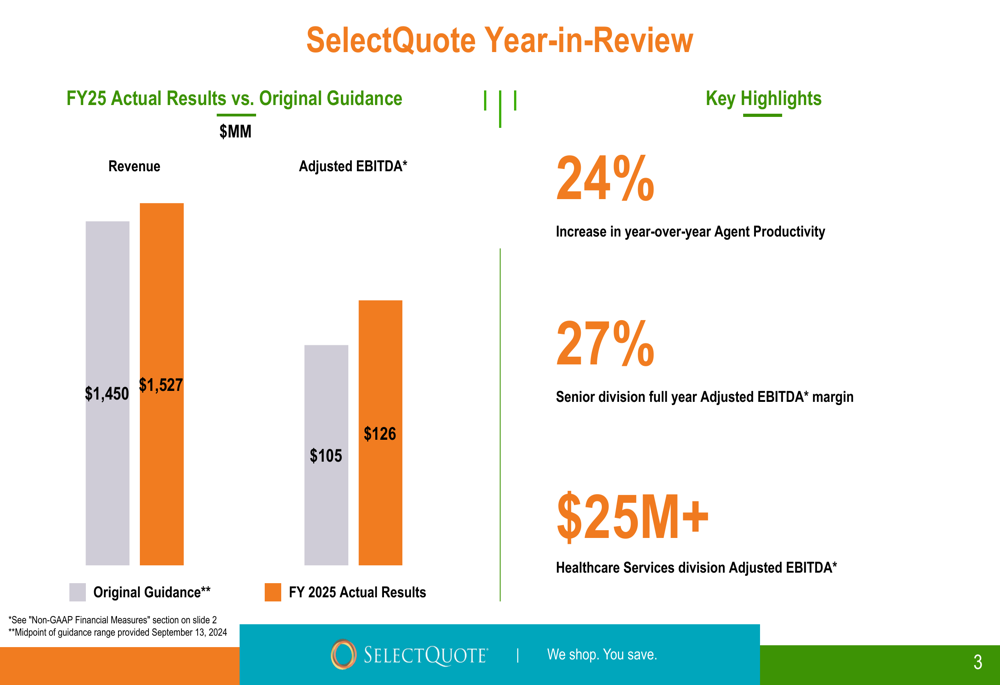
SelectQuote reported full-year fiscal 2025 revenue of $1.527 billion, exceeding its original guidance of $1.450 billion. Similarly, the company delivered Adjusted EBITDA of $126 million, surpassing its initial target of $105 million. These results were achieved alongside a 24% year-over-year improvement in agent productivity.

As shown in the following chart comparing actual results to original guidance:
For the fourth quarter specifically, SelectQuote reported revenue of $345 million, up from $307 million in Q4 2024. However, Q4 Adjusted EBITDA declined to $3 million from $14 million in the same period last year, reflecting ongoing investments in growth initiatives and operational changes.

Business Transformation and Revenue Diversification

The most notable development in SelectQuote’s business has been the dramatic shift in its revenue composition. The Healthcare Services (NASDAQ:HCSG) segment, particularly the SelectRx pharmacy business, has emerged as the company’s primary growth engine, now representing nearly half of total revenue.

As illustrated in this revenue diversification chart:
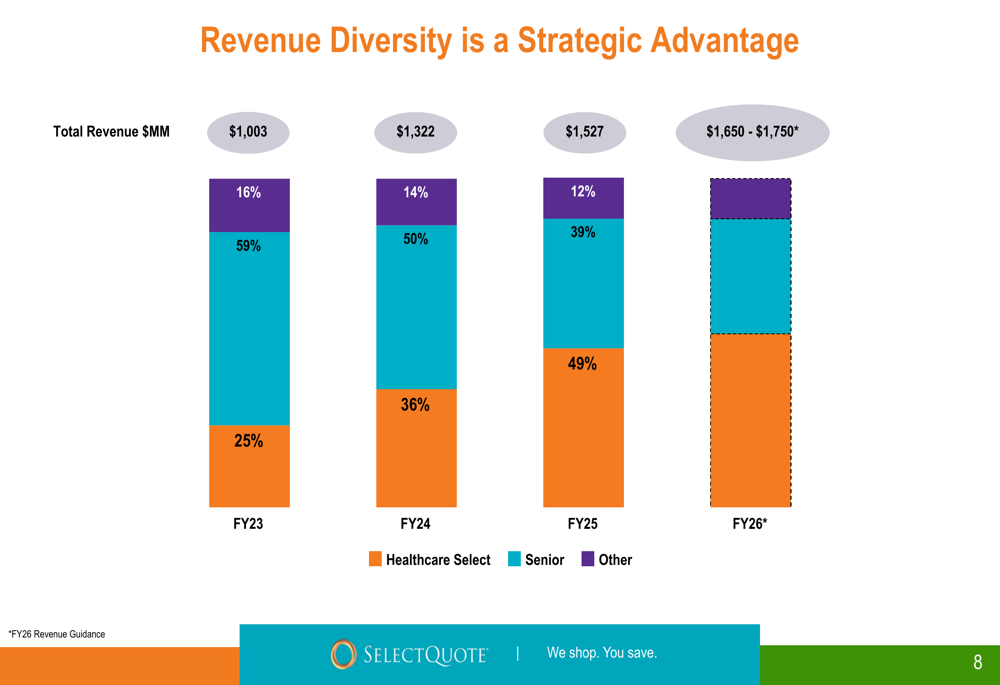
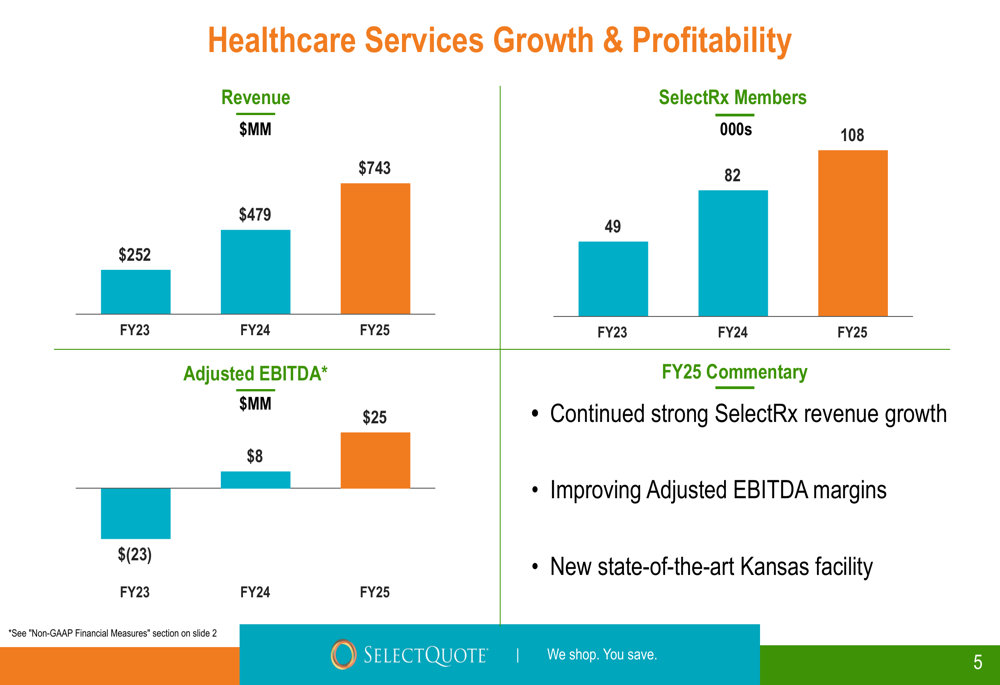
Healthcare Services revenue grew from $252 million in FY23 to $743 million in FY25, while SelectRx membership more than doubled from 49,000 to 108,000 members during the same period. Meanwhile, the Senior segment, which focuses on Medicare Advantage plans, has decreased from 59% of revenue in FY23 to 39% in FY25.

The growth trajectory of the Healthcare Services division is clearly demonstrated in this chart:
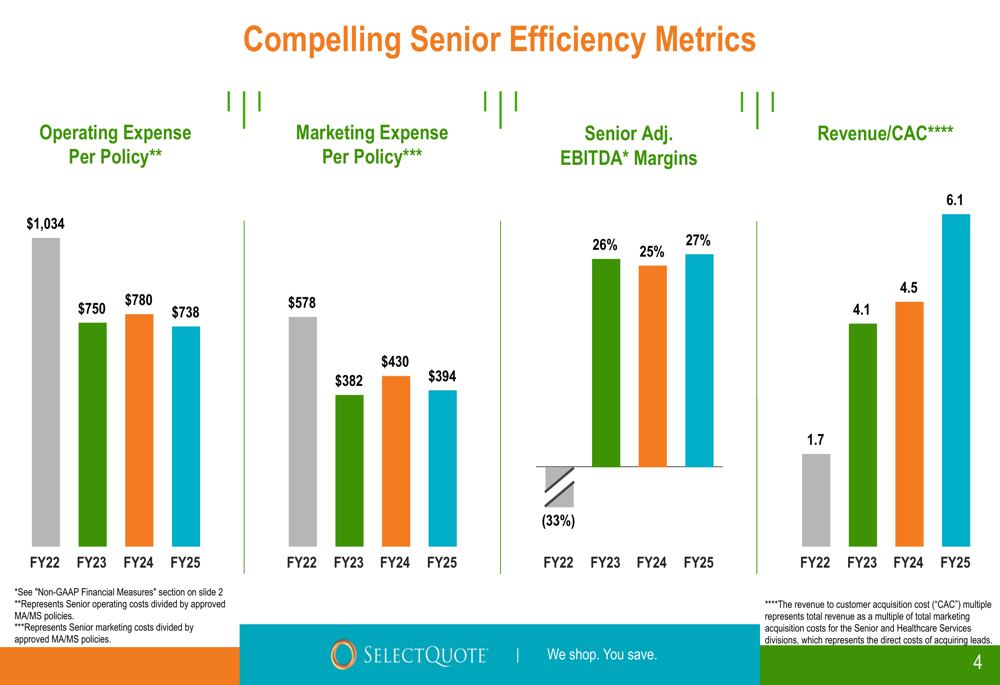
Despite its reduced share of overall revenue, the Senior segment has shown significant efficiency improvements. Operating expense per policy decreased from $1,034 in FY22 to $738 in FY25, while marketing expense per policy fell from $578 to $394 during the same period. These efficiency gains helped the Senior segment achieve a 27% Adjusted EBITDA margin in FY25, a dramatic improvement from a negative 33% margin in FY22.

The company’s efficiency metrics are detailed in the following chart:
Technology and Operational Improvements

SelectQuote emphasized its technology-driven approach as a key competitive differentiator. The company’s intelligent automation platform processes 7.5 million calls and powers over 300,000 healthcare interactions. According to the presentation, this automation has reduced enrollment time by 25% and Health Needs Assessment call time by 30%.

The company’s data-driven infrastructure and high-touch service model are positioned as critical advantages in the competitive healthcare market, with a revenue-to-customer acquisition cost ratio of 6.1x demonstrating marketing efficiency.

Capital Structure Improvements

SelectQuote has significantly strengthened its financial position during FY25 through strategic capital management initiatives. Total debt decreased from $683 million on June 30, 2024, to $385 million on June 30, 2025.

The debt reduction was achieved through two key transactions: a $100 million securitization in October 2024 that established a foundation for future warehouse financing, and a $350 million preferred equity investment in February 2025 that was used to repay $260 million of term debt and support growth initiatives.

These capital structure improvements are illustrated in the following chart:
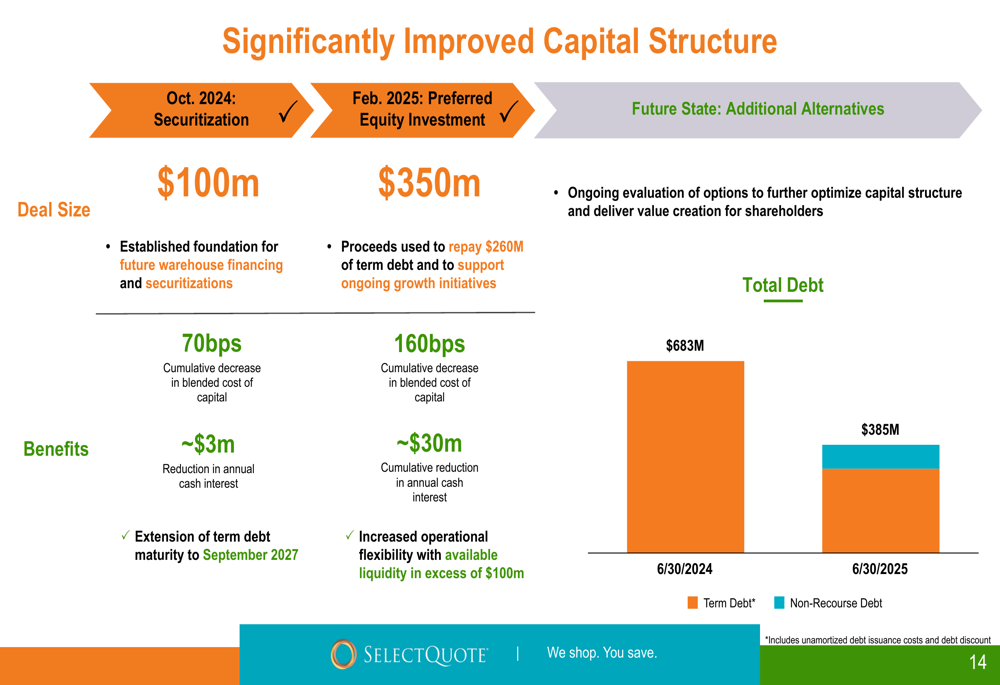
The company reported that these transactions resulted in a 230 basis point cumulative decrease in blended cost of capital and approximately $33 million in annual cash interest savings, while extending term debt maturity to September 2027.

FY26 Guidance and Outlook

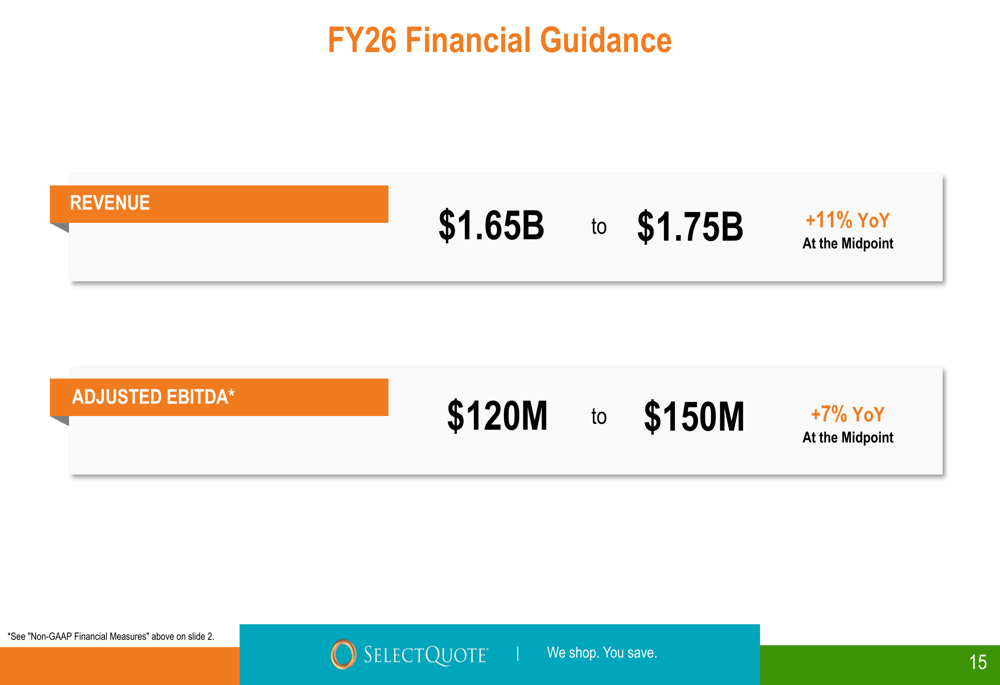
Looking ahead to fiscal year 2026, SelectQuote provided optimistic guidance, projecting revenue between $1.65 billion and $1.75 billion, representing approximately 11% year-over-year growth at the midpoint. Adjusted EBITDA is expected to be between $120 million and $150 million, a 7% increase at the midpoint compared to FY25.

The company’s forward-looking projections are summarized in this guidance chart:
Management indicated that the revenue mix is expected to remain consistent with FY25, with Healthcare Services continuing to represent approximately 49% of total revenue, Senior segment at 39%, and other businesses at 12%.

Challenges and Competitive Landscape

While the presentation emphasized positive developments, SelectQuote continues to face challenges. The company’s stock performance reflects investor concerns about profitability and competition in the Medicare Advantage market. The workforce reduction in the Medicare Advantage segment mentioned in previous earnings calls could impact service levels, and the company has acknowledged potential near-term headwinds in Healthcare Services due to new facility ramp-up costs.

The transformation toward healthcare services represents both an opportunity and a risk, as the company pivots away from its traditional insurance distribution model toward a more integrated healthcare services approach in an increasingly competitive landscape.

Despite these challenges, SelectQuote’s diversification strategy and improved operational efficiency provide a foundation for potential recovery, though investors remain cautious as reflected in the company’s current stock price trading near 52-week lows.

Full presentation:

https://www.investing.com/news/company-news/selectquote-q4-2025-slides-healthcare-services-powers-fullyear-outperformance-93CH-4204359

PayPal, Mesh jump into crypto conversion

 The proliferation of digital currencies presents their users an important task: How to convert one to another and into stablecoins. Mesh, a startup building a digital assets payments network, joins a field of firms offering a solution.

PayPal Holdings is using Mesh’s technology to power a new pay-with-crypto conversion tool to connect dozens of cryptocurrencies and stablecoins for shoppers and merchants. The capability will be rolled out in the U.S. in time for the 2025 holiday shopping season, a PayPal spokesperson said Wednesday in an email.

PayPal and Mesh, a startup in which PayPal’s venture arm has invested, touting savings for merchants below current international credit card conversion costs, in a July 28 press release announcing the new tool. 

“You need to bridge the gap between what users have and what the merchant’s supposed to receive,” Mesh CEO Bam Azizi said in an Aug. 13 interview. The technology allows merchants to accept more than eight dozen flavors of crypto for payment, converting them into fiat. In the future, PayPal said it will let merchants settle with its PYUSD stablecoin, launched two years ago.

Stablecoins “are not made equal,” Azizi said. “So if you have USDC and the merchant wants USDT, you still need to convert it as an end user. That’s not the most optimal way for users to pay for things.” (USDC is Circle Internet Group’s stablecoin while Tether issues USDT.)

For example, if numerous customers held Tether USDT and a seller wants another stablecoin, “they just simply click and pay, and we abstract all the complexity” of the transaction for a shopper and the conversion for a merchant, Azizi explained.

Stablecoins are typically pegged to a fiat currency such as the euro or U.S. dollar, making their value more stable than other digital assets like Bitcoin that frequently surge and decline.

San Francisco-based Mesh is building a payments network to connect crypto exchanges, digital wallets and financial services platforms to simplify digital currency payments and conversions. The company has about 100 employees.

“Don’t forget that we have 650 million crypto owners (globally) and they have all sorts of assets, whether it’s NFT (non-fungible tokens) or tokenized real estate or collectibles or Bitcoin, Ethereum – you cannot ignore that population,” Azizi said. “They’re not going anywhere.”

The U.S. Genius Act, signed into law last month, has triggered a corporate race towards stablecoins and lofty IPO valuations for stablecoin companies such as Circle and Bullish. Companies from Amazon to Bank of America, Expedia Group and Walmart are mulling whether to issue stablecoins

President Donald Trump’s election last year, along with the rise of a contingent of Congress members receptive to the cryptocurrency industry, has given the industry new momentum after years of chafing under strict crypto regulation by the Biden administration. 

As stablecoins enter the financial mainstream, Azizi sees a future in which they dominate digital payments while their more volatile crypto cousins — such as Bitcoin, Dogecoin and Shiba Inu — remain largely the domain of investors. 

“The killer app for stablecoin is going to be payment, whether it’s cross border payment, B2B payment or [a] payout,” said Azizi, who co-founded Mesh five years ago. 

The company said last week it has raised about $130 million, including from PayPal Ventures, Coinbase Ventures and Kingsway Capital.

The creation of more on-and-off ramps for crypto-fiat conversion will also further stablecoin adoption, he said. Mesh faces competition from companies such as Bastion, Binance, Stripe-owned Bridge and Coinbase to provide crypto users pathways for exchanging coins and fiat.

“Stablecoin is going to be what crypto wanted to be, what Bitcoin wanted to be: Peer-to-peer payment without any centralized authority sitting in the middle,” Azizi said. “Stablecoin has all the beauty, all the upside of crypto and blockchain networks, and none of the downside. It’s not volatile. Some people might like volatility for investment reasons … but it’s not the best way to pay.”

https://www.paymentsdive.com/news/paypal-mesh-jump-into-crypto-conversion-stablecoins-Circle-Bullish/758130/