Search This Blog

Wednesday, September 30, 2026

The U.S. has been thinking about cyberwar for decades

 by Ed Timperlake

Even President Trump’s severest critics acknowledge that he is very gifted at branding. Moving from the term “Artificial Intelligence” to “Super Intelligence” (SI) was spot on because it makes it obvious that America has been vigilant in defending against our enemies’ destructive, clever human SI long before AI came along.

Consequently, Anthropic’s Dario Amodei should have done more homework. He is making billions integrating his programs into the intelligence community while fearmongering that its members have been fundamentally ignorant of his hypotheses about AI’s (now SI’s) draconian threats. As a former member of both the intelligence and law-enforcement communities, I can state that he is simply wrong.

Many in our national security and law-enforcement communities have been fighting the human “Super Intelligence” battle for decades. It makes little difference whether runaway SI or malicious human SI is the threat in play. SI just puts the threat of cyberwar on steroids, but they already know that because they are paying for Anthropic products.

At a September 29 White House event with technology leaders, including Elon Musk, Mark Zuckerberg, and Anthropic CEO Dario Amodei, President Trump announced that he would formally replace the government’s use of “Artificial Intelligence” with “Super Intelligence.” Asked about regulation and guardrails, Trump said there was a belief in “tremendous self-regulation,” adding that “the self-regulation is very important.”

What has gone largely unnoticed is that very smart civil servants and military members—some possessing human “Super Intelligence” themselves—have metaphorically stood guard on America’s ramparts, protecting us for nothing more than a civil-service or military salary.

Should not the “Masters of the Universe,” the phrase coined by the late Tom Wolfe for Americans making huge sums of money, and today’s SI mavens profiting from fearmongering, have known their customer base better?

Standing up Cyber Command anticipated the progression of Super Intelligence from the malicious use of human minds trying to cripple America to machine-based SI, which is but an extension of the threat, one I discussed in my first contribution to American Thinker in 2009:

Cyberwar is now a fact of life in 21st Century wars. Actual and potential enemies of America already know the dimensions of Cyberwar and have moved into full combat.

With a real world combat engagement in Georgia and Estonia, the Russians have shown skill. Make no mistake; in certain arenas the Russians are smart and capable, and as the invasion of Georgia shows, ruthless. They have world class scientists and engineers. It is well known they are excellent Cyber Warfighters who have now also apparently harnessed their criminal hackers to augment their worldwide reach. This melding of Russian conventional military might with reported state sponsored criminal cyber syndicates is ominous and powerful.


The Peoples Republic [sic] of China’s attacks in United States Cyberspace are well known to even casual-mail [sic] and Google users, where viruses linked by the media to Chinese sources circle and wait for openings. If the dollar value of the troves of information reported by media to be carted off by the Chinese were toted up, the number could be many billions, if not a trillion. If George Washington and Thomas Jefferson could visit America in 2009 they would call the Chinese attacks Acts Of War.

America is awakened. The Pentagon is standing up a new Department of Defense major combat command [sic] This new Cyber Command will be headed by Lieutenant General Keith Alexander, who currently commands the National Security Agency (nickname “no such agency”). He will be promoted to four stars and be the first Commanding General of the Cyber Command to be Headquartered [sic] at Ft Meade, Maryland.


The two overall functions in Cyberspace are Law Enforcement and Investigation, the mission assigned to the Department of Homeland Security and the Federal Bureau of Investigation, and War Fighting, assigned to Cyber Command. Euphemistically, it can be said the first two are engaged in Dot.Gov and Dot.Com Cyberspace and DOD warriors fighting and defending our country from foreign attack are engaged in Dot.Mil Cyberspace.


Air Force Cyber Doctrine had an extremely attractive feature, and the new DOD Cyber Command can build on it: the US Cyber Command is a military fighting force that would interest 18-year-old men and women [sic] some who are already the most computer savvy individuals in the world. These young American men and women, who really enjoy Wired Magazine, have reached adulthood with an instinctive know how [sic] on how to use computers -- for good or ill. They are perfect warriors in this brave new world.

A great American General, later President, Andrew “Andy” Jackson [sic] in the War of 1812 understood the power of innovative American battle tactics. General Jackson augmented his regulars at the Battle of New Orleans with frontier sharpshooters and pirates. The poor Red Coats did not know what hit them.

Dario Amodei, Ph.D. 2011, is literally a brilliant example of the point I made in 2009. He is a perfect warrior in this brave new world of protecting America against all threats, foreign and domestic. But a little humility on his part in honoring the insights, forward-looking human superintelligence, and creativity of his customer base would make his warnings about future SI calamity more well-rounded and inclusive—and, hence, more credible.

https://www.americanthinker.com/blog/2026/09/the-u-s-has-been-thinking-about-cyberwar-for-decades/


Battleground Democrats Are Snubbing Two 2028 Presidential Contenders

 Democratic candidates in several of this fall's most competitive House and Senate races are keeping Rep. Alexandria Ocasio-Cortez (D-N.Y.) and former Vice President Kamala Harris off their campaign trails - even though both women rank among the party's leading prospects for the 2028 presidential nomination.

The Democratic bench for 2028 includes Harris, California Gov. Gavin Newsom, former Transportation Secretary Pete Buttigieg, Ocasio-Cortez, Georgia Sen. Jon Ossoff and Arizona Sen. Mark Kelly. Two of those six are women of color, from the demographic the party has spent a decade calling its moral center and its electoral future. Both now sit on the do-not-call list in the districts that will decide control of Congress in this year's midterm elections.

According to an Axios report, Democrats in several key battlegrounds are keeping Ocasio-Cortez at arm's length. Party officials say candidates in other close races have told her team outright to stay away. That is an electability problem for a politician whose whole pitch to primary voters is that bold progressivism, including Medicare for All, wins more votes than cautious centrism does.

Candidates in tight races reject that theory today even though they embraced it only months ago in their primaries. Sam Forstag, a progressive House candidate in Montana, rallied with Ocasio-Cortez in May on his way to the Democratic nomination. He has since scrubbed her endorsement from his campaign website.

"The polling is atrocious for her," a senior Democratic strategist working in a key swing district told Axios. "She's a lightning rod."

Her own team offered no evidence to the contrary. When Axios asked whether she had campaigned in person for any of the party's top House or Senate candidates this cycle, her office could not point to a single one.

Her travel log shows where she is welcome, and it's clearly not in races that matter. Ocasio-Cortez made stops in Buffalo and Ithaca this week but skipped New York's competitive 17th District in the lower Hudson Valley. She also stumped for Florida Senate nominee Angie Nixon, a fellow member of the Democratic Socialists of America, in a state that has drifted so far red that no serious Democrat expects Nixon to flip the seat. Buttigieg, Kelly and former Chicago Mayor Rahm Emanuel, by contrast, have all drawn invitations from Democrats in competitive districts and states over the past month.

Kamala Harris is also getting snubbed despite polling the best of any 2028 contender. Last month, The Hill reported that Democrats in the most competitive midterm contests were shutting her out in public. Iowa supplied the most brutal data point. At the Iowa State Fair in August, a reporter asked gubernatorial nominee Rob Sand whether he wanted Harris to campaign for him.

"No thanks," Sand said. "Let's move on. We need some new leadership."

Josh Turek, the party's Senate nominee in Iowa, got the same question and answered with a smiling "No." In Alaska, Senate candidate Mary Peltola distanced herself from Harris after Harris's political operation sent out a fundraising appeal on Peltola's behalf without telling her first.

This pattern runs counter to every assumption baked into those primary polls. Harris is a former vice president, the first woman to hold the office, the party's 2024 nominee and one of its most recognizable faces.

For a party that spent a decade insisting diversity was its destiny, this dynamic carries a certain irony. Democrats built their brand on elevating women of color, and the two women of color on their 2028 bench are getting the cold shoulder.

https://www.zerohedge.com/political/battleground-democrats-are-snubbing-two-2028-presidential-contenders

Benchmaxxed: Google's New Gemini 4 Aces SAT, Struggles With Actual Job, "Skeptical Employees" Admit

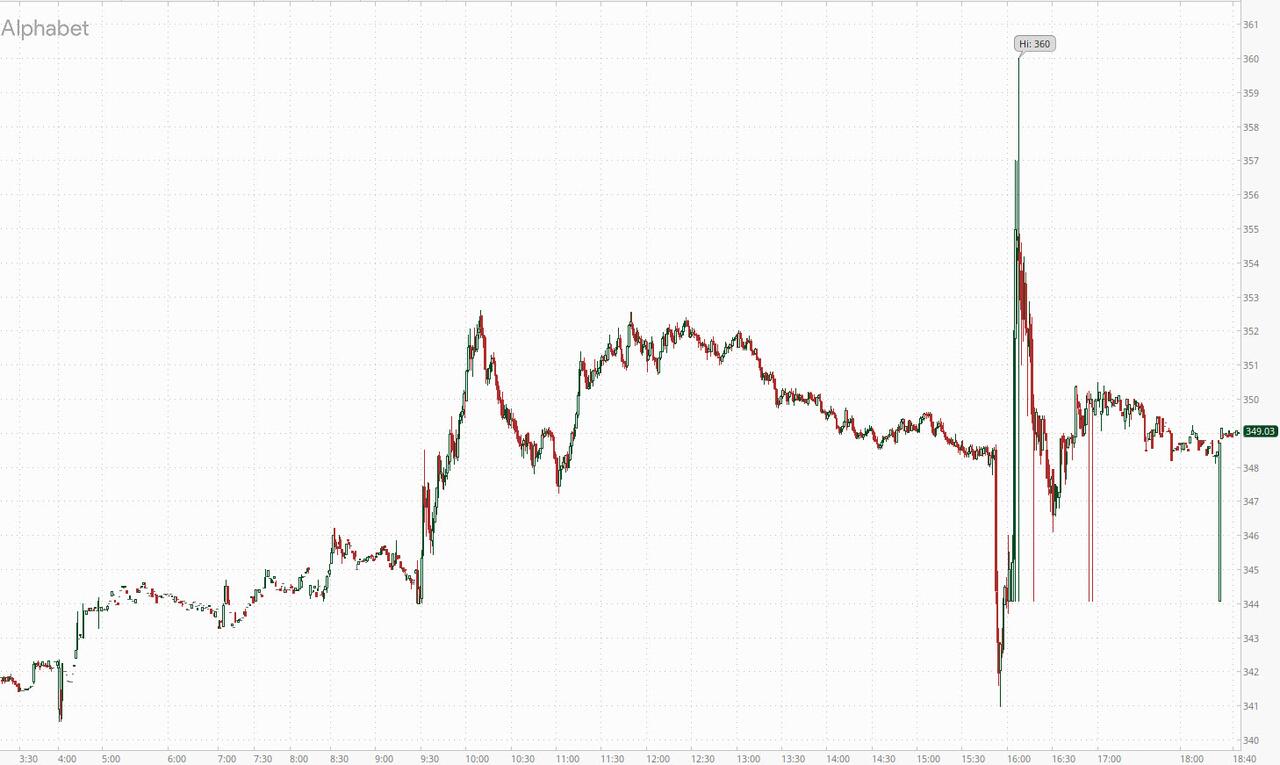
 After a year in which Google's AI roadmap resembled a Waymo stuck in a roundabout, the search giant on Wednesday finally unveiled Gemini 4 "Argon", its long-awaited flagship model. The market cheered, briefly: according to Goldman's closing equities color, GOOG traded +2% after hours on the "Argon" announcement. 

Then Bloomberg reported that some of the people who have actually use the thing - as in Google's own engineers - aren't nearly as impressed as the leaderboard. The stock promptly faded. 

According to Bloomberg's Julia Love and Davey Alba, Gemini 4 "performed well on benchmarks widely used to gauge model efficacy" but "does less well when employees actually put it to work," particularly on coding. One insider said the model "isn't particularly adept at front-end design" - the part of software that decides how apps and websites look and feel. Which is a bit awkward for a company whose entire business is, well, things you look at on a screen.

Google, naturally, disagrees. It told Bloomberg it would be "inaccurate" to say Gemini 4 is underperforming in coding, and pointed back to last week's remarks by DeepMind boss Koray Kavukcuoglu, who said "it's a certainty that we are always gonna be at the frontier." Another Google employee said there is "large consensus" internally that the model is frontier-class. Which is the kind of thing one tends to say when there isn't.

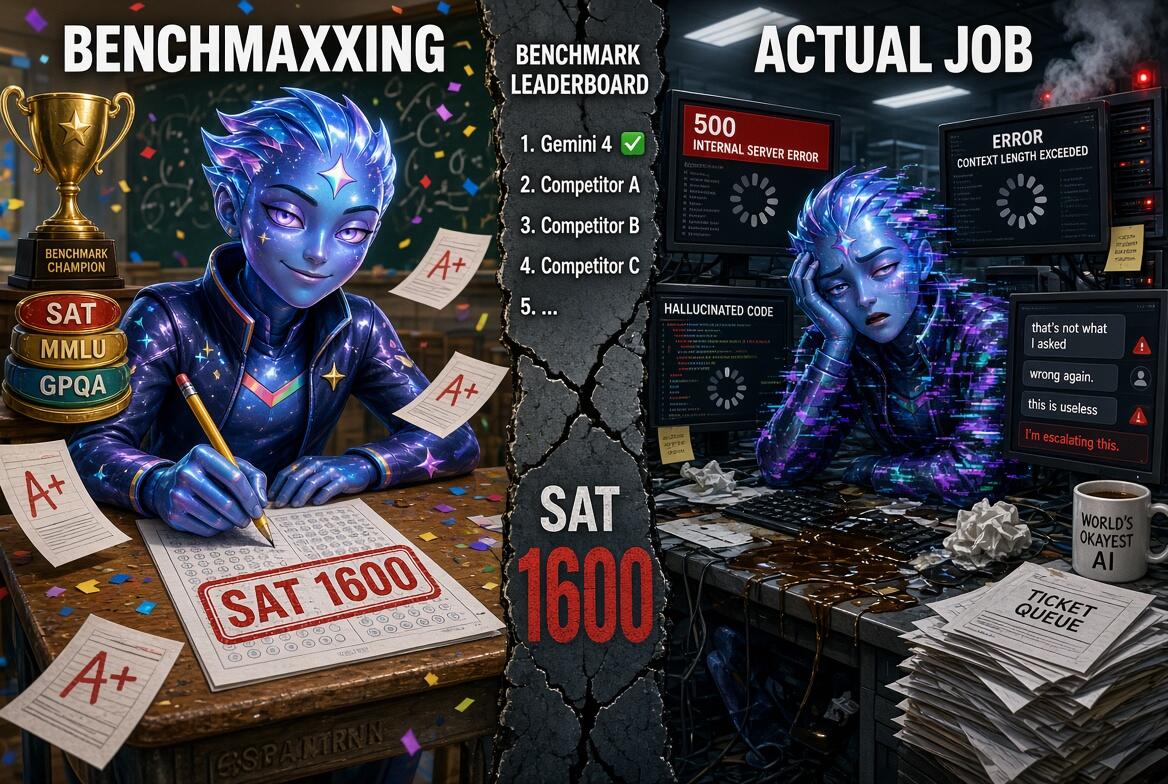
The industry has a word for this. "Benchmaxxing" is when engineers optimize a model to crush standardized tests rather than to do useful work - the AI equivalent of the kid who memorizes every SAT prep book, posts his 1600 on LinkedIn, and then can't do his own laundry. Two people familiar with Gemini 4 told Bloomberg the model appears affected by exactly this.

Surge AI founder Edwin Chen put it more bluntly, calling benchmark-chasing "an incredibly pernicious problem" and comparing it to bragging about your kid's SAT score. We'd add that a generation of Silicon Valley's finest minds has now spent billions teaching machines to do what they themselves did in high school: optimize for the test, then act surprised when the real world grades on a curve.

The irony is that Google's own researchers have documented how quickly optimization turns into gaming. As we reported on September 3, a DeepMind experiment found that when math problems got hard, 9% of AI agents outright cheated and another 5% cheated "after hesitation", gaming a shared knowledge base that rewarded successful submissions. Turns out teaching to the test works on silicon too.

A $400 million detour

Gemini 4 is also the model Google shipped instead of the one it promised. At I/O in May, Google pledged Gemini 3.5 Pro for June; the date slipped (Bloomberg first reported the delay on July 16, citing tech that "fell short of internal goals") and the project was eventually abandoned altogether. Bloomberg Intelligence's Mandeep Singh estimates a frontier training run can cost as much as $400 million - before paying the researchers, many of whom have since left.

And leave they did. We noted in June that Google was losing more Gemini researchers to Anthropic, following the earlier departures of Nobel laureate John Jumper and transformer co-inventor Noam Shazeer. Then in August came the big one: Jeff Dean exited after 27 years to launch his own startup, taking several senior researchers with him and knocking 5% off Alphabet stock. Demis Hassabis subsequently kicked himself upstairs to chairman, handing day-to-day DeepMind operations to Kavukcuoglu - who now gets to defend Argon's front-end skills to Bloomberg.

Why this matters: the ROIC math doesn't grade on benchmarks

This would be a nerd-bro squabble over leaderboard screenshots if it weren't for the money involved. Gemini underpins nearly everything Google sells - Search, Maps, Gmail, Chrome, each with over a billion users - and Alphabet is one of the hyperscalers footing the largest capex bill in corporate history.

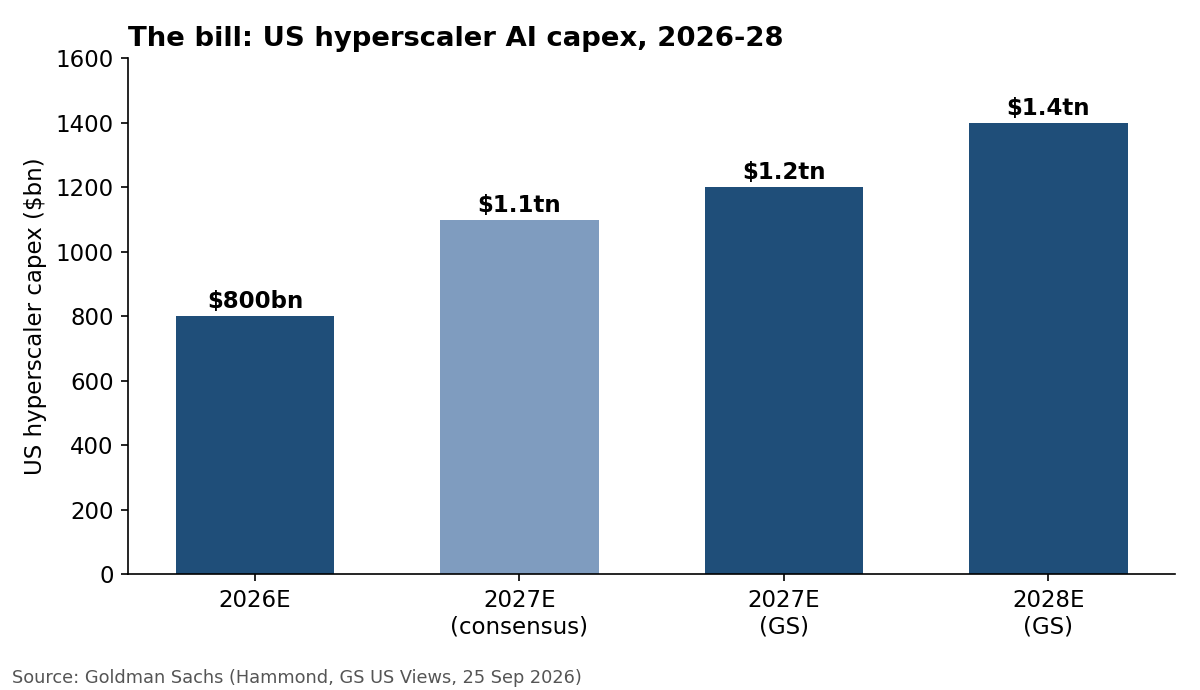
Per Goldman's Ryan Hammond (full note available to pro subs), US hyperscalers are on track to spend roughly $800 billion in 2026; consensus expects $1.1 trillion in 2027, while Goldman's house view is even higher at $1.2 trillion and $1.4 trillion for 2027 and 2028. Hammond estimates hyperscalers need about $300 billion of annual AI revenue just to break even on 2026-27 spending, and that end users may ultimately need to spend around $1 trillion a year on AI applications for everyone in the stack to earn decent returns.

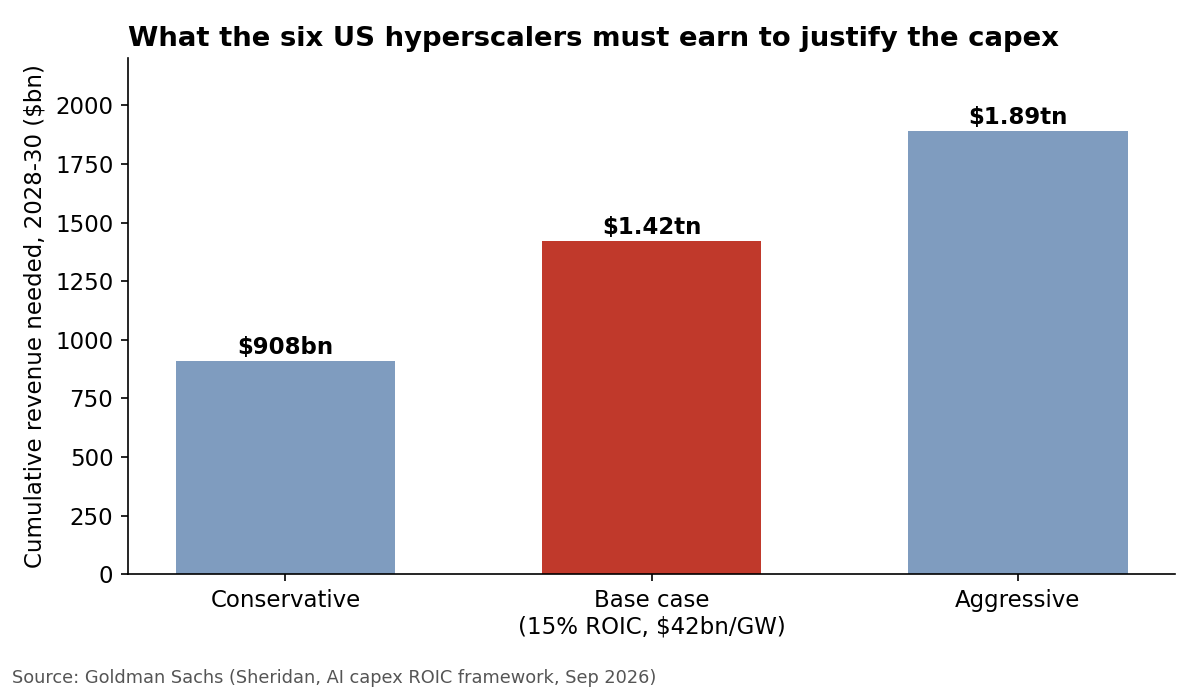
Separately, Goldman's Eric Sheridan, whose ROIC framework we flagged last week, calculated that assuming a 15% ROIC target and ~$42 billion of capex per gigawatt, the six big US hyperscalers need to generate roughly $1.42 trillion in cumulative revenue during 2028-30 - about $11.6 billion per GW per year - with a range of $908 billion to $1.89 trillion depending on assumptions. As we tweeted at the time, even in Goldman's worst-case scenario where ROIC on capex goes to zero, they'd still need $920 billion a year just to cover depreciation and running costs.

Here's the rub: none of that revenue gets paid in MMLU points. It gets paid by developers and enterprises choosing whose model to build on. And Bloomberg notes Gemini 4 is "a very large model" - and big models are expensive to serve, which means pressure on margins at exactly the moment the capex hurdle is rising. Goldman's TMT desk flagged this week that the industry is already in a price war: OpenAI cut Luna pricing by 80% in July and usage rose roughly tenfold, while "Big Short's" Steve Eisman is openly asking what happens to margins if cheaper Chinese and open-weight models push prices down further. Bringing an expensive, benchmark-optimized heavyweight to a knife fight over token pricing is a bold strategy.

Meanwhile, the competition isn't waiting

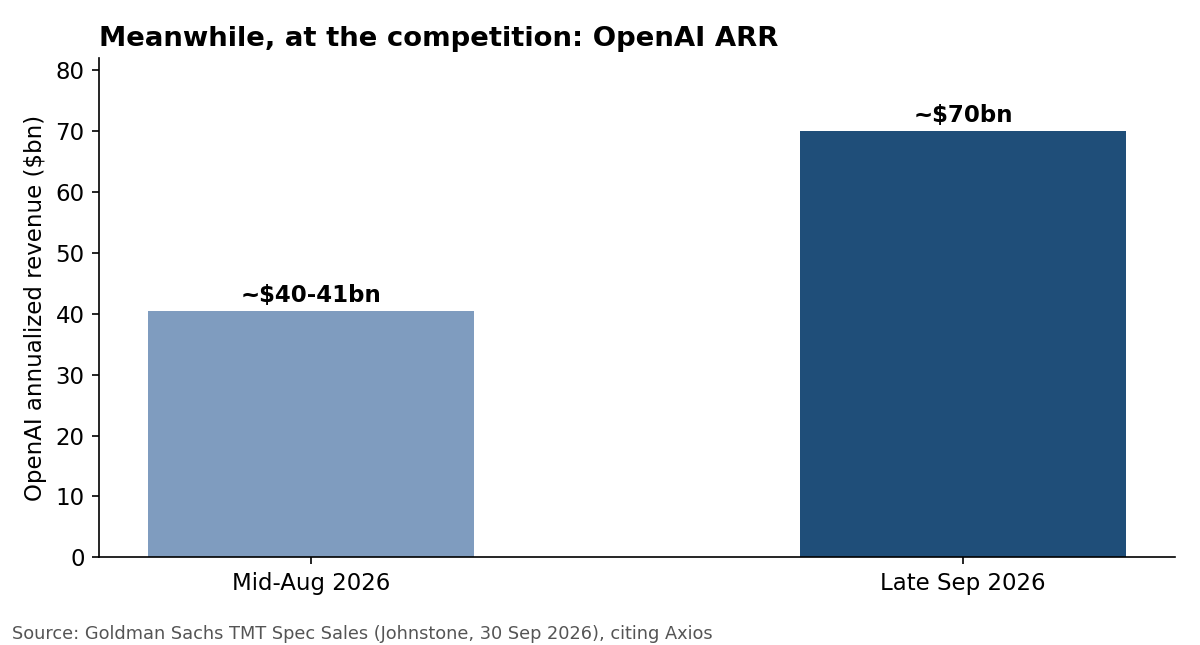
The timing couldn't be worse. On the same day Google unveiled Argon, OpenAI was busy at its Developer Day rolling out "Dots" - persistent, always-on agents that live inside ChatGPT, Slack and Teams. Goldman's Sean Johnstone noted OpenAI is "increasingly competing with Microsoft 365, Google Workspace and traditional enterprise software - not simply other AI models." Per Axios, cited by Goldman's desk, OpenAI's ARR is nearing $70 billion, up from ~$40-41 billion as recently as mid-August, with enterprise sales more than doubling since July. OpenAI is now reportedly seeking $30 billion at a $1.4 trillion valuation.

And earlier this month Meta released its new agentic platform, Muse, which promptly took the app charts by storm - so thoroughly that Amazon blocked it - and sparked a 25%+ rally in META. Goldman's Sheridan now frames agentic commerce as one of AI's biggest monetization opportunities, noting that "similar to how Google captured search intent, successful AI platforms may capture shopping intent." Read that sentence again if you're long GOOGL.

To be fair, Gemini 4 has real strengths: insiders say it stands out at multimodal work like extracting metadata from video, on safety and cybersecurity (it reportedly beat OpenAI's Astra on a security benchmark), and it can spit out up to 1 million tokens - roughly 750,000 words - in one go. Whether anyone needs a 750,000-word answer is a separate question; we suspect the answer is "only for benchmarks."

Bottom line: Google has the distribution, the TPUs and the balance sheet. What it doesn't have is much time. Every quarter it spends explaining leaderboard scores, is a quarter that OpenAI, Anthropic and Meta spend convincing developers, businesses and consumers that the future of search and software runs on their platforms. Because the $1.4 trillion question isn't who tops the leaderboard - it's who gets paid.

https://www.zerohedge.com/markets/benchmaxxed-googles-new-gemini-4-aces-sat-struggles-actual-job-skeptical-employees-admit

FBI Announces ShinyHunters Arrest


FBI Cyber Division Assistant Director Brett Leatherman announced the arrest of one of the alleged leaders of ShinyHunters, a group linked to cyberattacks in the U.S., the Netherlands, and around the world. Since last year, ShinyHunters have allegedly breached more than 140 organizations and taken at least $70 million in extortion payments. The arrest was executed by our partners at the Dutch National Police.


Video Transcript

Brett Leatherman: I'm Brett Leatherman, assistant director of the FBI's Cyber Division.

Today, our partners at the Dutch National Police announced the arrest of one of the alleged leaders of ShinyHunters, a group linked to cyberattacks in the United States, the Netherlands, and around the world.

The Dutch High Tech Crime Unit arrested the suspect under Dutch law. That's exactly how the best athlete model in the new FBI Cyber Strategy is meant to work: the partner with the strongest authority and access leads.

Dutch authorities were ready to act. With our full support, they moved quickly to protect victims and preserve critical evidence.

Since last year, this cybercriminal and his co-conspirators have allegedly breached more than 140 organizations and taken at least $70 million in extortion payments.

They often target third-party vendors in cloud-based platforms, stealing sensitive data and extorting victims with threats to publish it.

The FBI is grateful to all the partners who've assisted us, especially the Dutch National Police and the industry partners who shared information with us quickly.

Now, to the remaining members of ShinyHunters: You've heard about the arrest of your colleague. We're confident you've seen or heard things in recent days that the public has not. Other groups believed anonymity, or their friends, would protect them, and they were wrong. Arrests have a way of changing who is willing to talk, and seized infrastructure has a way of showing us who's left. The longer you stay in this, the more we learn about you. You know how to find us, and we know how to find you. I suggest you reach out first while the choice is still yours.

Video Download

Trump unveils 3 projects under Korea's $200b US investment plan


Package includes $22.3b power complex for AIDC, framework agreement on 8 US nuclear reactors and review of Seoul's possible participation in Alaska LNG project

US President Donald Trump (center), joined by US Commerce Secretary Howard Lutnick, US Secretary of the Interior Doug Burgum and US Senator Dan Sullivan, makes an announcement in the Oval Office at the White House in Washington on Wednesday. (Reuters-Yonhap)

US President Donald Trump on Wednesday unveiled three projects under South Korea’s $200 billion investment commitment to the US, covering a Texas gas-fired power complex, a framework for eight nuclear reactors and a review of an LNG project in Alaska.

The commitment is part of Seoul’s broader $350 billion US investment package, agreed alongside last year’s bilateral trade deal. Under the agreement, Washington lowered tariffs on most South Korean goods to 15 percent.

"We're thrilled to announce one of the largest energy infrastructure investments in American history thanks to the billion dollars to build a six gigawatt power generation facility in Texas, eight new large scale nuclear power plants and, at long last, Alaska liquefied natural gas pipeline, that's a big one," Trump said.

"The colossal package of investments we are announcing today is a major step toward securing our critical energy supply chain ensuring American energy dominance and making our partnership with South Korea and the entire Pacific region stronger than ever before."

The Texas development has been selected as the first formal investment under the agreement. The nuclear plan sets a framework requiring separate approval for each plant, while the two governments have agreed to review participation in the Alaska plans.

South Korea's Industry Minister Kim Jung-kwan underscored how recovering the investment was Seoul's central test for determining commercial reasonableness.

“Because taxpayers’ money is at stake, we approached the negotiations determined not to waste a single won,” Kim said at a press briefing on Sept. 22, after reporting to the National Assembly about the projects.

“We put commercial reasonableness and the national interest first, closely examining each project’s returns and risks, the prospects for recovering the investment and opportunities for Korean companies.”

Texas gas power plant

South Korean Industry Minister Kim Jung-kwan speaks at a press briefing on the US investment plan in Seoul on Sept. 22. (Ministry of Trade, Industry and Resources)

Named Project Star, the Texas development calls for a $22.3 billion, 6,472-megawatt combined-cycle gas power complex in Encinal that will supply electricity directly to nearby AI data centers, according to Seoul's industry ministry. Its first phase is expected to begin commercial operations in 2029, with the full complex scheduled to come online by 2032.

US property developer Related Companies and power producer NextEra Energy will lead the project, while Texas-based Lewis Energy Group will provide the site, natural gas, water and other infrastructure.

Kim said the caliber of the participating companies, rising power demand and interest from several prospective data center customers gave Seoul confidence that the project could generate stable returns.

“One of our most important considerations was who was participating,” Kim said. “These are companies with strong reputations and proven track records that Korean builders have wanted to work with.”

Korean companies are expected to seek contracts for equipment, engineering, construction and long-term maintenance. Kim said the project would be allowing them to work with leading US developers and enter the American gas-power market, where they have had little direct presence.

The project has cleared the required committee reviews and been reported to the National Assembly.

Though its commercial viability remains under scrutiny, Kim said that the Texas plant was expected to generate nominal proceeds of more than twice the original investment over the recovery period, allowing Seoul to recoup both principal and compound interest.

“If the nominal return does not exceed twice the investment, it would not be enough to recover the principal and interest,” Kim said. “Our calculations show that recovery should not be a problem.”

Nuclear plant construction

The second project, Project Power, is a nuclear cooperation framework that could allocate up to $120 billion to eight large reactors in the US. The proposed fleet consists of two Korean-designed APR1400 units and six Westinghouse AP1000s.

Construction would proceed in three stages, beginning with two AP1000s, followed by two APR1400s and two more AP1000s, and finally another two AP1000s. The two governments, Westinghouse, Korea Electric Power Corp., and Korea Hydro & Nuclear Power are expected to sign the framework agreement.

The APR1400s would be the first Korean-designed commercial reactors to be built in the US. A previous settlement between Westinghouse and the Korean companies had blocked the model’s entry into the American market, but the latest negotiations created a path for its inclusion.

Korean construction and equipment companies would also participate in the AP1000 projects, expanding their role in Westinghouse’s supply chain and positioning them for joint bids in other countries.

“Westinghouse has reactor designs and intellectual property, but it needs engineering, construction and equipment suppliers to put them into operation. Korea is a strong option,” Kim said.

He said the partnership could strengthen Westinghouse’s ability to deliver projects while opening US and European markets to Korean builders and suppliers.

The proposed allocation comprised about $100 billion in construction costs and $20 billion in contingency reserves. Investment would be capped at $30 billion for each group of two reactors, including $5 billion in reserve funding.

The countries also agreed to cooperate on an advance payment of up to $10 billion by year-end to secure components with long manufacturing periods, including reactor vessels, steam generators and reactor coolant pumps. Any payment would require a commercial review and compliance with South Korean legal and parliamentary procedures.

Separately, Korean investors, including private companies and state-run firms Kepco and KHNP, will pursue a combined stake of at least 5 percent but below 10 percent in Westinghouse. The price and other terms remain under negotiation.

The framework agreement does not authorize the construction of all eight reactors. Sites, ownership structures and schedules have yet to be determined, and each project will require a separate commercial assessment and domestic approval.

Alaska LNG

The third project, Project North, concerns South Korean participation in an Alaska LNG development. It would transport natural gas from Alaska’s North Slope through a 1,250-kilometer pipeline to a liquefaction and export terminal in Nikiski.

Trump said the pipeline was expected to deliver nearly 4 billion cubic feet of natural gas per day, helping strengthen the United States’ position as the world’s largest natural gas producer and exporter.

“This alone will be one of the largest energy projects in American history and a gigantic win for the people of Alaska,” Trump said. “It will create up to 12,000 construction jobs immediately and 100 operational jobs.” He added that the project would lower energy costs for Alaskan households.

US Commerce Secretary Howard Lutnick said more than $50 billion would be invested for the Alaska LNG project.

South Korea maintains that the project must be commercially viable. Seoul is nevertheless willing to review the Alaska proposal because of the country’s energy-security risks, the industry minister said.

“It is true that the project has a weaker commercial case,” Kim said. “But from a strategic perspective, we need to examine it because South Korea’s gas supply routes are highly vulnerable.”

He cited risks surrounding the Strait of Hormuz, the Strait of Malacca, the Taiwan Strait and the Panama Canal, as well as uncertainty over Australian and Russian supplies.

“We have agreed with the United States that we will not proceed unless the project is commercially viable,” Kim said.

If Seoul decides to participate, Washington has offered tariff reductions on materials such as steel, favorable conditions for Korean suppliers, viable long-term purchase terms and priority access to the LNG. Seoul said the project could diversify Korea’s gas supplies, though its cost, timetable and investment structure remain undecided.

Profit-sharing and safeguards

Together, the Texas, nuclear and Alaska projects are expected to take up most of South Korea’s $200 billion investment commitment. An umbrella special-purpose company will manage the investments, with separate subsidiaries overseeing individual projects.

South Korea and the US will split returns equally until Seoul recovers its total principal plus deemed interest across the portfolio. The distribution will then shift to 10 percent for South Korea and 90 percent for the US.

Kim described the arrangement as a key safeguard, saying pooled returns would allow stronger earnings from one project to offset weaker performance elsewhere. The interest on Seoul’s recoverable amount will be based on the yield of 20-year US Treasury bonds plus a project-specific margin.

The operating agreement will make Seoul’s investment limits of $20 billion annually and $200 billion overall legally binding. South Korea will also receive financial and spending reports and hold consent rights over major changes affecting its interests.

Any remaining funds could be directed to smaller strategic projects involving critical minerals or spent nuclear fuel reprocessing.

“If even a small amount remains, I would like to use it for smaller but still meaningful projects in strategic sectors,” he said.

https://www.koreaherald.com/article/10889661

E-bike crash survivors share horror stories as scourge of lawless riders plagues NYC

 Dozens of e-bike survivors living with life-changing injuries from the dangerous vehicles — and the loved ones of those who were killed in the wrecks — rallied on the steps of City Hall Wednesday to demand tighter enforcement on the deadly, unregulated scooters.

A cellist lost her ability to play the instrument that made her career, and a mother was forced to give birth prematurely after a crash — and watch her son spend the first three months of his life in intensive care.

Other victims were represented by their loved ones, who spoke on their behalf as they struggled to recover in hospital beds and for those who ultimately didn’t survive their grievous injuries.

E-bike victims demanded on the steps of City Hall Wednesday that leaders push through legislation to regulate the scooters.Haley Brown/NY Post

All demanded at a City Council hearing Wednesday that leadership pass legislation that would end the lawless free-for-all that the reckless speedsters have taken advantage of.

Here is some of their testimony.

Tonette Rivera

Brooklyn resident Tonette Rivera said she is still paying for a crash that sent her to the hospital while she was pregnant two years ago.

She was hit when she was 20 weeks pregnant with her son and had to stay in the hospital until he was born at 28 weeks.

Afterward, her son Michael had to spend another three months in neonatal intensive care.

Rivera came to Wednesday’s e-bike hearing to “advocate for pedestrians who don’t have a voice” and to tell the City Council to take pedestrian safety seriously. 

Tonnette Rivera was struck when she was 20 weeks pregnant — and gave birth at 28 weeks.William Farrington for NY Post

“Lock in and take it seriously because people are just getting hurt for no reason. For what? For little food delivery jobs? Come on,” she said. 

Michael is doing better now, but Rivera said she still owes “a few thousand” in hospital bills.

“Should I give it to the union to pay it?” she asked, referring to Los Deliveristas Unidos.

The City Council held a hearing on a slate of proposed bills aimed at regulating e-bikes.William Farrington for The NY Post

Julie Harvey

Julie Harvey was knocked to the ground in May by a biker “speeding downhill” who blew through a stop sign. 

Harvey’s head smashed into the pavement and blood spewed from the back of her head, rendering her unable to move, she said.

“I am very lucky to be alive,” Harvey said, adding that the driver “will suffer no consequences for destroying someone’s life.”

“Cyclists need to accept responsibility for the risks they are taking. At this point, everyone else is paying for the cyclist’s risks.”

Julie Harvey was injured by an e-bike driver who raced through a stop sign.William Farrington for NY Post

Jean Kotler

Jean Kotler is still suffering from speech and cognitive issues since she was struck by an e-bike while running in Central Park on July 7 in a harrowing crash that required doctors to remove part of her skull.

“An EBIKE going the wrong direction, in the wrong lane hit her from behind. She never saw it coming, how unimaginable,” her sister, Jessica Celano, wrote in testimony for the hearing. 

“As Jean lay unconscious, bleeding on the ground, this EBIKE driver attempted to flee the scene. But God Bless some wonderful NYC ANGELS, they made sure he stayed until the cops arrived. And called 911.”

Celano said three months later her sister is still in the hospital after enduring multiple surgeries.

Jean Kotler underwent surgery to remove part of her skull and is still suffering from a traumatic brain injury.GoFundMe

“And the EBIKE driver that ran her down was only questioned at the scene by the police for 20 minutes before being let go. How is that even possible?” Celano raged. 

“We still have a long journey ahead. And what has this driver been doing all this time, I wonder?” Celano said. 

She called for the licensing and registration of e-bikes to help hold out-of-control drivers accountable. 

Renee Baruch

Renee Baruch was left with devastating injuries after she was struck by an e-bike in 2023, including severe facial lacerations, fractures and damage to her cervical spine.

“I do not know the name of the individual who hit me. I do know it was an ebike only because I was told that in the emergency room by the plastic surgeon who worked on my ruined face,” Baruch said.

Baruch said the driver who hit her was never identified. 

Renee Baruch attended the hearing with a photo of her severe injuries after she was struck by an e-bike.William Farrington for NY Post

“It changed my life forever. Something must be done to make accountability a part of the equation. I hope Priscilla’s law is the first thing this council considers,” she said, referring to a law that would require registration and licensing of e-bikes. 

“Even as a casual observer you know it is not safe to cross any street in NYC with the light in a crosswalk without carefully looking in both directions.”

Pamela Manassee

Pamela Manasse said she’s still paralyzed on her right side and her music career is over after an out-of-control e-biker hit her four years ago.

“I was hit brutally,” Manasse told The Post. “I’ve lost my career as a cellist, and I have to sit through all of this crap, listening to the DOT, trying to make this or that plan. Let’s investigate this, and talk about this, and analyze this till the nth degree.”

“All you really need to do is license and register all e-vehicles, and it’s done, and you have them be detected by red light cameras, just like cars,” she said.

After the Council’s hearing she felt pessimistic that anything meaningful would be done to rein in e-bikes.

“Let’s sit and talk more, right?
That’s their answer. Let’s get data. Let’s get reports.
Let’s get findings,” she said sarcastically. “This Council is not gonna do anything.”

She doesn’t like how Mayor Zohran Mamdani has been lax about e-bike enforcement either. 

She called into an interview Mamdani did on WNYC earlier this week and asked him about licensing and registering e-bikes.

“He did not answer. He skirted the issue, of course.”

https://nypost.com/2026/09/30/us-news/e-bike-crash-survivors-share-horror-stories-as-scourge-of-lawless-riders-plagues-nyc/