Search This Blog

Friday, October 9, 2026

Musk: SpaceX's valuation may exceed $1 quadrillion

 SpaceX Founder and Chief Executive Officer Elon Musk said on Friday that the rocket company could eventually reach a valuation of $1 quadrillion.

"...I believe there is such a path and the probability of achieving it is not zero," Musk said on X. The world's richest man previously said he can see a path to SpaceX becoming "worth orders of magnitude more than the current Earth economy."

As part of Musk's growing business portfolio, SpaceX announced that it purchased a nationwide low-band spectrum license portfolio of up to 14 megahertz of paired spectrum in the 800 MHz band, potentially becoming "a major mobile carrier" in the United States. The news shook up the telecommunications sector, sending stocks of US leading providers, such as T-Mobile Inc., AT&T Inc., and Verizon Communications Inc., to crumble.

The company currently holds a $2 trillion valuation.

https://breakingthenews.net/Article/Musk:-SpaceX's-valuation-may-exceed-dollar1-quadrillion/67269475

'How New US Medical Schools Are Training Clinicians'

 A new wave of MD and DO programs is reshaping early clinical and community training. These schools start patient contact in the first weeks, lean on simulation and plastinated anatomy, and build curricula around local community needs. Here's a quick look at what sets them apart.

1. Filling the Gap

The AAMC (formerly known as the Association of American Medical Colleges) projects a US physician shortage of up to 86,000 by 2036. There are currently 163 MD-granting schools and 47 osteopathic colleges nationwide. Since 2019, 11 MD programs have gained preliminary or full accreditation, and since 2020, osteopathic education has added 22 new teaching campuses. Several of these new programs explicitly design their training around community and underserved-area needs, aiming to produce physicians equipped to serve the populations most likely to face care shortages.

2. Beyond Traditional Cadavers

Kaiser Permanente Bernard J. Tyson School of Medicine houses an Anatomy Resource Center that uses plastinated donor specimens instead of traditional cadavers. Tissue is preserved with curable polymers, creating durable, odorless specimens for long-term study. Clinical cases are built directly into anatomy lab sessions, linking anatomy content to real patient scenarios as students learn. A nearby simulation center has students work with trained actors, practice procedures, handle emergencies, and use electronic health records.

3. Early Exposure, Lower Barriers

Kaiser Permanente students begin a longitudinal clerkship in week one, spending a half day weekly with a physician preceptor, with required experience at a federally qualified health center. That early clinical access is paired with tuition coverage through the first seven classes. The school is also shifting toward needs-based aid, lowering both clinical and financial barriers to entry. The University of Georgia School of Medicine takes a similar early-access approach, teaching history-taking and basic assessment from week one, first with actors and then real patients.

4. Research as Identity

Meritus School of Osteopathic Medicine in Hagerstown, Maryland, sits within a health system with more than 120 years of community-based care. The school positions research as central to its mission of training physicians who serve that community long-term. One day a week is set aside for research, with students paired with faculty mentors from the start. Its first class enrolled 90 students in fall 2025, and the next will grow to 145.5. Care Beyond the Clinic

Roseman University College of Medicine in Las Vegas centers training on household-level factors, including housing, food security, transportation, and employment, alongside medical care. Its model relies on sustained partnerships with local organizations and the households students serve. Admissions favor Nevada ties and interest in underserved care, though staying in-state isn't required.

Bottom Line

These programs share a focus on early patient contact, simulation, and community-anchored training. These changes may shape how students arrive at clinical rotations and residency. Whether this improves long-term readiness or retention in underserved areas remains to be seen.

This article is based on a recent Medscape article titled " New US Medical Schools: These Aren’t Your Parents’ Programs" and was created using several editorial tools, including AI, as part of the process. Human editors reviewed this content before publication.

https://www.medscape.com/s/viewarticle/how-new-us-medical-schools-are-training-clinicians-2026a10011rv

US To Crack Down On Mail-Order Canadian Drug Imports

 The Canadian prescription drug lifeline for thousands of Americans may be in jeopardy. 

New US Customs and Border Protection regulations starting October 22 will disrupt or even halt mail-order prescription deliveries from Canada and elsewhere to US patients, patient advocates say.

“This is an emergency,” warned Lucia Mueller, president of PharmacyChecker.com, which verifies international pharmacies and compares drug prices, in an interview.

If Customs doesn’t work with the FDA to find a way to allow the drugs across the US border, she said, “People will ration or skip their meds.”

Here are six things to know:

Feds Are Changing the Rules

The Wall Street Journal reported that as of October 22, medications mailed from other nations will need to “go through a customs process requiring a licensed customs broker and a financial guarantee — a bar few individual mail-order prescriptions have ever had to clear.”

Advocates are most concerned about Canada, home to many online mail-order pharmacies that serve US customers.

The potential elimination of access to Canadian drugs appears to be an “unintended consequence” of a Trump administration move to crack down on imports, said Mariana Socal, MD, PhD, associate professor of health policy and management at Johns Hopkins Bloomberg School of Public Health in Baltimore.

The White House claimed it targeted international mail to prevent illegal drugs from coming into the country.

Currently, the federal government allows exceptions for individual patients to import specific drugs from Canada to manage chronic conditions, Socal said.

Mueller said she’s concerned that the new international mail procedures could undermine a channel through which Americans have for decades obtained lower-cost prescription medicines from licensed pharmacies abroad. American medications on average cost more than twice their Canadian equivalents.

People in the US often turn to prescription drugs from Canada because they’re uninsured or underinsured, Socal said.

“It’s not patients with the most resources who are doing this,” she said. “It’s the individuals with the least ability to pay.”

Tim Smith, general manager of the Canadian International Pharmacy Association in Winnipeg, Manitoba, Canada, which certifies 51 online pharmacies, said his understanding is that customs will eliminate the existing flexibility.

“We have been given no indication that there is going to be anything but enforcement,” Smith said.

There’s also worry that the new requirements imposed on Canadian pharmacies will cause prices to go up even if their shipments are allowed to enter the US.

Little Communication, Actual Impact Unclear

Federal officials don’t appear to have sent out any statements explaining whether mail-order prescription deliveries from Canada will be stopped or limited.

The FDA, US Customs and Border Protection, the Department of Health and Human Services, and the Department of Homeland Security didn’t reply to Medscape Medical News requests for comment.

Patients Fear What Comes Next

In the worst-case scenario feared by patients and patient advocates, the importation of prescription drugs will be cut off completely, leaving US customers in the lurch. 

Mueller said she is “overwhelmed and profoundly shaken” by messages from worried patients.

She said one wrote her: “I would have to choose food and live with uncontrolled diabetes and a chance of blood clots any time. Buying my two main medications from foreign pharmacies has probably saved my life.”

As Smith explained, US clinicians write prescriptions for drugs that are sent to online Canadian pharmacies. The pharmacies work with Canadian physicians who conduct assessments and then write prescriptions themselves if appropriate. The drugs are then dispensed and sent to patients in the US.

The US Market for Foreign Drugs Is Big

Current data about the number of US customers who get drugs from Canada or other countries is scarce. However, a 2020 JAMA Network Open study estimated that 2.3 million people in the US bought prescription medicine from abroad. The groups most likely to buy their drugs abroad were aged 65 years or older, uninsured, Hispanic, lower income, and in poor health.

Canadian pharmacies sell maintenance medications, such as those that prevent blood clots and treat high cholesterol and diabetes, said Smith, the Canadian online pharmacy representative. Members of his organization don’t sell controlled substances, and the average delivery is worth less than $200, he said.

What about medications like cancer drugs that can cost hundreds of thousands of dollars in the US?

“That’s not a part of the world that [our] members live in at all,” Smith said. 

Foreign Drugs Can Be Much Cheaper

US customers who are underinsured or uninsured — or who can’t afford their copays — can save big money by using online Canadian pharmacies or international pharmacies with a Canadian storefront.

Many “Canadian” online pharmacies are actually prescription referral websites that have dispensing pharmacies located not only in Canada but across the world, Mueller said.

Drug prices can vary widely between US and international pharmacies. Mueller noted that the lowest US pharmacy price for the anticoagulant apixaban (Eliquis) is $5.53 per tablet vs the lowest online international pharmacy price of 70 cents.

Price gaps are even larger for the type 2 diabetes drug empagliflozin (Jardiance, $11.21 vs $1.08 per tablet, respectively) and the anticoagulant rivaroxaban (Xarelto, $19.56 vs 81 cents per tablet, respectively), she said.

Lawmakers Are Speaking Up

About 71 members of the US House, all Democrats, signed an October 1 letter calling on the federal government to “delay any implementation of new procedures with respect to prescription medicines unless you can provide clear assurances that your agencies will not prevent genuine prescription medicines clearly intended for personal use and not appearing to present an unreasonable risk from entering the United States.”

They add that they support the Customs “goal of using better data to identify and intercept high-risk shipments.”

For now, Mueller said, “This is a life-and-death situation. We are advising patients that if they’re having trouble filling prescriptions due to cost, they speak to their prescribing clinician about therapeutic equivalents and investigate coupons and patient assistance programs.”

The sources cited in this article had no relevant disclosures.

https://www.medscape.com/viewarticle/us-crack-down-mail-order-canadian-drug-imports-what-you-need-2026a10011qs

Teva US approval for WELTRUZA, first only, once‑monthly subcutaneous long-acting schizophrenia injectible

Teva wins FDA approval for WELTRUZA, first and only once‑monthly subcutaneous long-acting injectable olanzapine for adult schizophrenia in U.S.

https://finviz.com/stock?t=TEVA&p=d

Cavity treatment provider vVardis files for an estimated $200 million US IPO

 vVardis Holding, which sells proprietary non-invasive restorative treatments for early-stage cavities, filed on Friday with the SEC for an initial public offering that we estimate could raise $200 million.


Based in Switzerland, vVardis develops and sells Curodont, a peptide-based treatment for early-stage cavities that is applied in a dental office in five minutes or less, with no drilling or needles. Its US product, Curodont Repair Fluoride Plus, is marketed as an over-the-counter drug under an FDA monograph and generates the vast majority of revenue. A fluoride-free version, Curodont Repair, is sold as a medical device in the UK and parts of Europe. The company sells in the US exclusively through Henry Schein, supported by its own sales force, and its products have been sold to over 20,000 of the approximately 110,000 general dental practices in the US.

The Zug, Switzerland-based company was founded in 2020 and booked $50 million in revenue for the 12 months ended June 30, 2026. It plans to list on the NYSE under the symbol VVVV. vVardis Holding filed confidentially on July 2, 2026. Goldman Sachs, J.P. Morgan, William Blair, UBS Investment Bank, Deutsche Bank, and Apollo Global Securities are the joint bookrunners on the deal. No pricing terms were disclosed.

US Grants Safety Feature Exemption For Self-Driving Trucks

 by Kimberly Hayek via The Epoch Times,

Federal regulators have approved a five-year exemption for self-driving trucking companies from rules that require drivers to place warning devices around a stopped truck.

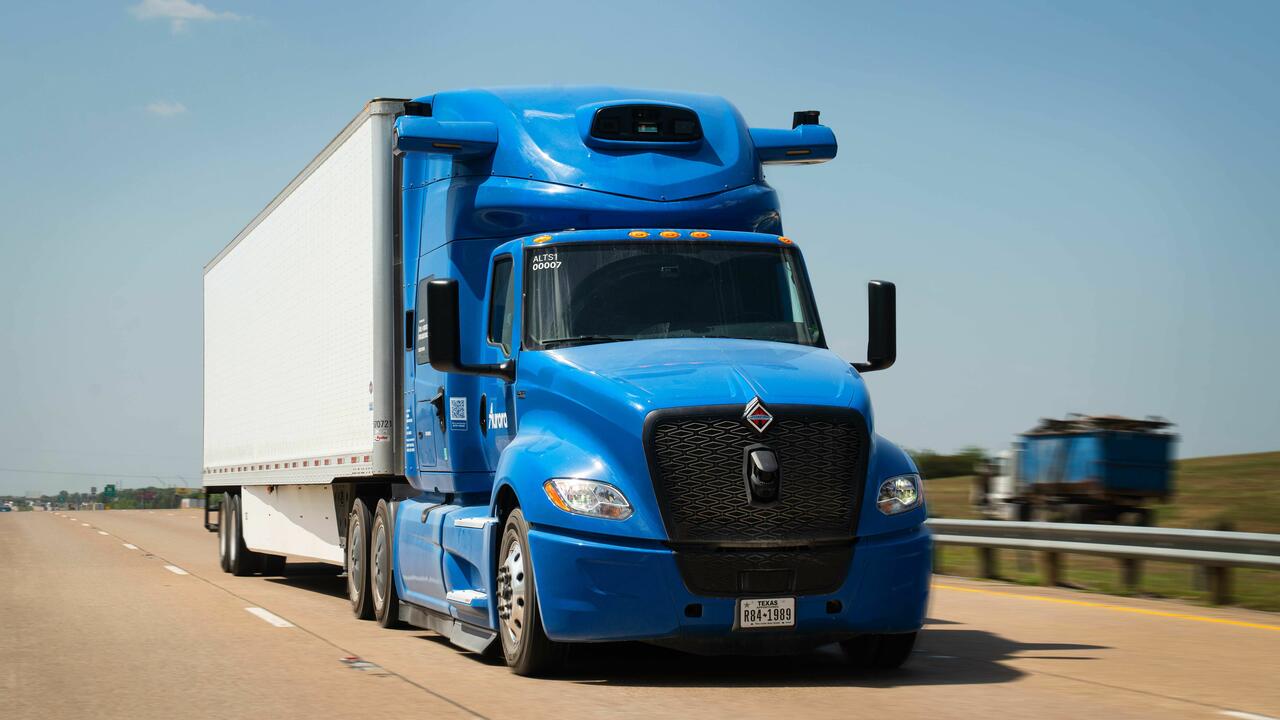
The Aurora Driver, in this undated photograph. Courtesy of Aurora

The Department of Transportation said Wednesday it has agreed to allow autonomous trucking companies to use warning beacons mounted on the truck cab to avoid needing human drivers. The decision removes a hurdle for companies seeking to expand commercial driverless operations in the United States.

Companies must notify the Federal Motor Carrier Safety Administration (FMCSA) beforehand if they want to operate under the exemption. They must also report any crashes involving a vehicle while the cab-mounted warning beacons are activated or should have been activated.

Alphabet's self-driving unit Waymo and Aurora jointly sought a waiver of the rule in 2023.

Pennsylvania-based Aurora sued FMCSA in early 2025 over the decision not to approve the waiver during the Biden administration. The company said in October 2025 that it was filing to dismiss the lawsuit after the department issued a three-month waiver. That waiver was extended several times.

Aurora filed a new application in April, seeking a five-year exemption to allow trucks to use beacons instead of roadside warnings.

The company, which has around 20 self-driving trucks in on-road operations, told Reuters that warning beacons enhance roadside safety without putting a person in harm's way.

In May last year, it said it was launching a commercial self-driving truck service in Texas, hauling between Dallas and Houston. The company said it planned to expand that service to El Paso, Texas, and Phoenix by the end of 2025, adding it had briefed officials before the driverless launch.

Aurora said in its July 2026 shareholder letter filed with the SEC that it is targeting 200 driverless trucks in operation by year-end.

The International Brotherhood of Teamsters, one of the largest labor unions in the United States, said last year that its representatives testified at the Nevada Capitol in Carson City, asking lawmakers to support legislation requiring all commercial vehicles weighing more than 26,000 pounds to have a trained human safety operator behind the wheel.

"For Big Tech companies to think they can come into any state and replace the jobs of hardworking union members with this dangerous and inferior technology is an insult to professional drivers everywhere," Peter Finn, president of Teamsters Joint Council 7, said in April 2025. "SB 395 is critical to protecting the middle class. That is why we are demanding that Nevada lawmakers vote in favor of this legislation."

The legislation, SB 395, passed the Nevada Senate but failed to advance in the state's assembly.

The Epoch Times reached out to Aurora for comment but did not receive a response by the time of publication.

'Race With China'

The Department of Transportation unveiled a framework for automated vehicles that same month. It said the framework would prioritize safety, unleash innovation by removing regulatory barriers, and enable commercial deployment of automated vehicles.

"This Administration understands that we're in a race with China to out-innovate, and the stakes couldn't be higher," Transportation Secretary Sean P. Duffy said at the time. "As part of DOT's innovation agenda, our new framework will slash red tape and move us closer to a single national standard that spurs innovation and prioritizes safety."

https://www.zerohedge.com/ai/us-grants-safety-feature-exemption-self-driving-trucks

Oil Drops After Trump Says Putin Agreed To Release Some Diesel Into Global Market

 With less than a month left until the midterms, and with Trump's approval rating at daily all time lows largely due to record - for this time of year- gasoline and especially diesel prices - the President badly needed some good news, even if largely superficial, and he announced it late on Friday just an hour before the close when Trump posted on Truth Social that Vladimir Putin had agreed to release (a modest amount) of diesel supplies into the global market, as the administration looks to tame price hikes for the critical fuel.

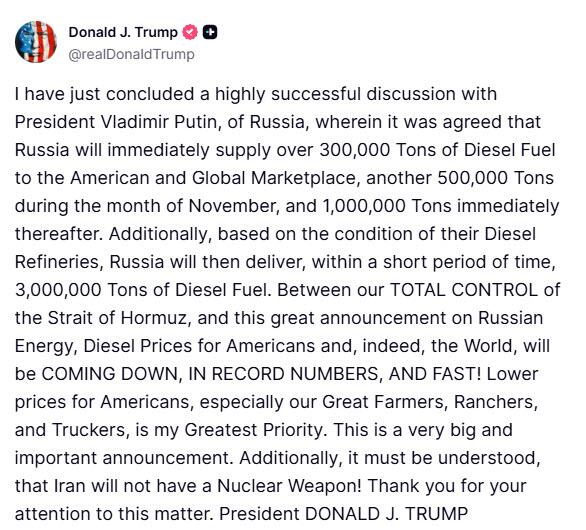
Trump said on Truth Social that “it was agreed that Russia will immediately supply over 300,000 Tons of Diesel Fuel to the American and Global Marketplace, another 500,000 Tons during the month of November, and 1,000,000 Tons immediately thereafter.”

He added that then, “based on the condition of their Diesel Refineries, Russia will then deliver, within a short period of time, 3,000,000 Tons of Diesel Fuel.”

Trump claimed the releases would help lower diesel prices for US farmers, ranchers and truckers - key voting blocs ahead of November midterm elections in which costs of living, including for energy, are the dominant issue. 

Maybe, but when one does the math, one has to scratch one's head: the 300K tons released in October amounts to just over 2.2 million barrels of diesel. Considering the US consumes just over 4 million barrels of diesel per day that amounts to half a day of consumption. 

Extending the math for November we get 3.725 million barrels or less than a full day's consumption, and the "1,000,000 tons thereafter" is a little over 4 days of consumption. We doubt the "3,000,000 to be delivered within a short period of time" will ever happen, so in reality Putin will sell the US just over 5 days of Diesel consumption.

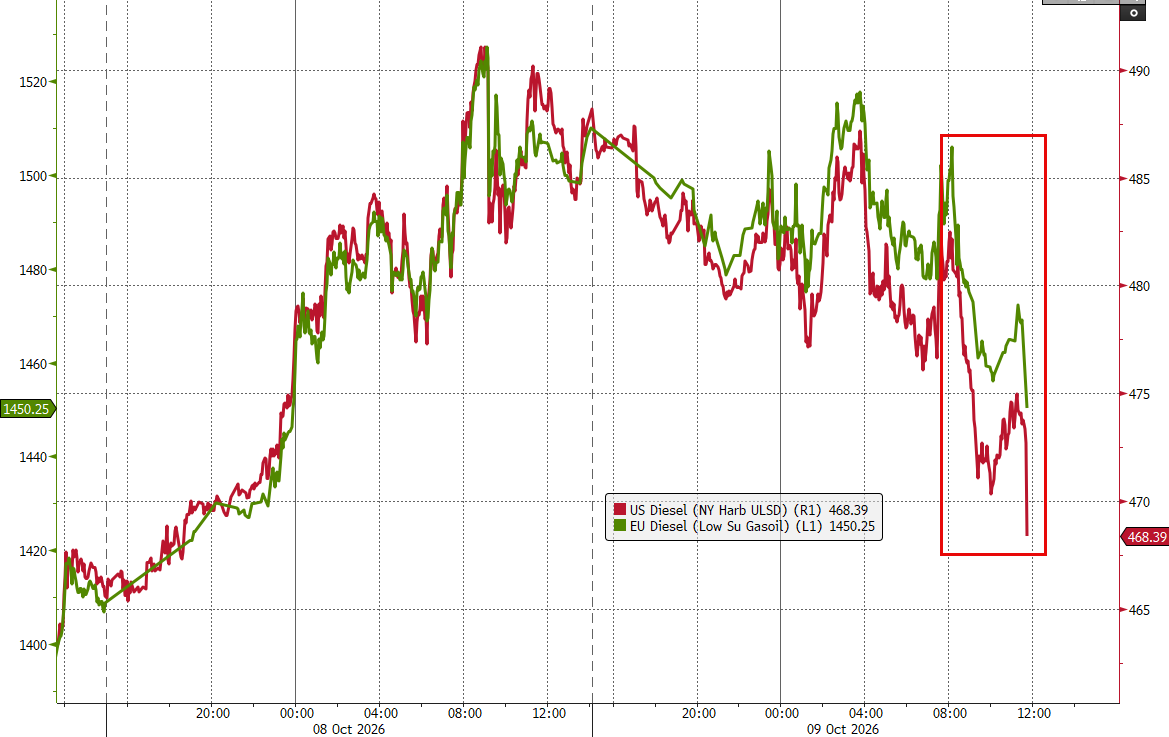
The market's kneejerk reaction was favorable with both US and European diesel prices sliding, helping push WTI Crude down by about a buck to $91.

Then again, once the algo reaction fades, we expect carbon-based traders to realize how negligible this "deal" actually is.

The US Treasury Department on Friday said that the Office of Foreign Assets Control is “immediately issuing a temporary general license to allow the supply of Russian diesel to the global market” which will extend until April 2027.

Last but not least, what will most likely end up happening in the real world, is that Putin will send out a diesel tanker, and once Ukraine drones it, the deal will promptly fall apart. 

https://www.zerohedge.com/energy/oil-drops-after-trump-says-putin-agreed-release-some-diesel-global-market