- The global smartphone market declined 20% YoY in Q3 2026, reaching its lowest Q3 level in 14 years, as continued memory shortages constrained supply for most OEMs.
- Samsung led the market with a 23% share, driven by better-than-competitive positioning in securing shipments and robust early demand for its Z8 foldable series, led by the Z Fold8
- Apple’s market share crossed 20% for the first time in any Q3, reaching 22%, despite a YoY decline in shipments.
- The market saw a widening gap between premium and price-sensitive segments, with premium demand remaining resilient while higher device prices put greater pressure on affordability.
Beijing, Berlin, Buenos Aires, Fort Collins, Hong Kong, London, New Delhi, Seoul, Taipei, Tokyo – Oct 12, 2026
Global smartphone shipments declined 20% YoY in Q3 2026, the lowest Q3 level since 2012, according to preliminary estimates from Counterpoint Research's Market Monitor service. The market decline was close to Counterpoint's expectations, as relentless increases in DRAM and NAND prices intensified memory cost shock in Q3. This sharply inflated BOM (Bill of Materials) costs and deepened supply shortages, significantly disrupting OEM shipments. In response, OEMs passed on higher component costs to consumers, driving up global smartphone retail prices by 20% so far in 2026 and further increasing market average selling price (ASPs).
Commenting on the global smartphone market, Senior Analyst Shilpi Jain said, “Q3 was the second successive quarter to take the full brunt of the memory crisis. The extreme memory shortage is pushing the smartphone market into a more selective phase, reshaping OEM strategies and even consumer behavior. Consumers are holding on to their devices longer than estimated, increasingly considering refurbished devices and prioritizing higher-value devices, while OEMs are adjusting portfolios, pricing, and market strategies to protect profitability. This is creating greater pressure across the mass market, while premium demand remains comparatively resilient, widening the gap between premium and price-sensitive segments.”
Global Smartphone Sell-in Shipment Share Top 5 Brands (Preliminary Data)
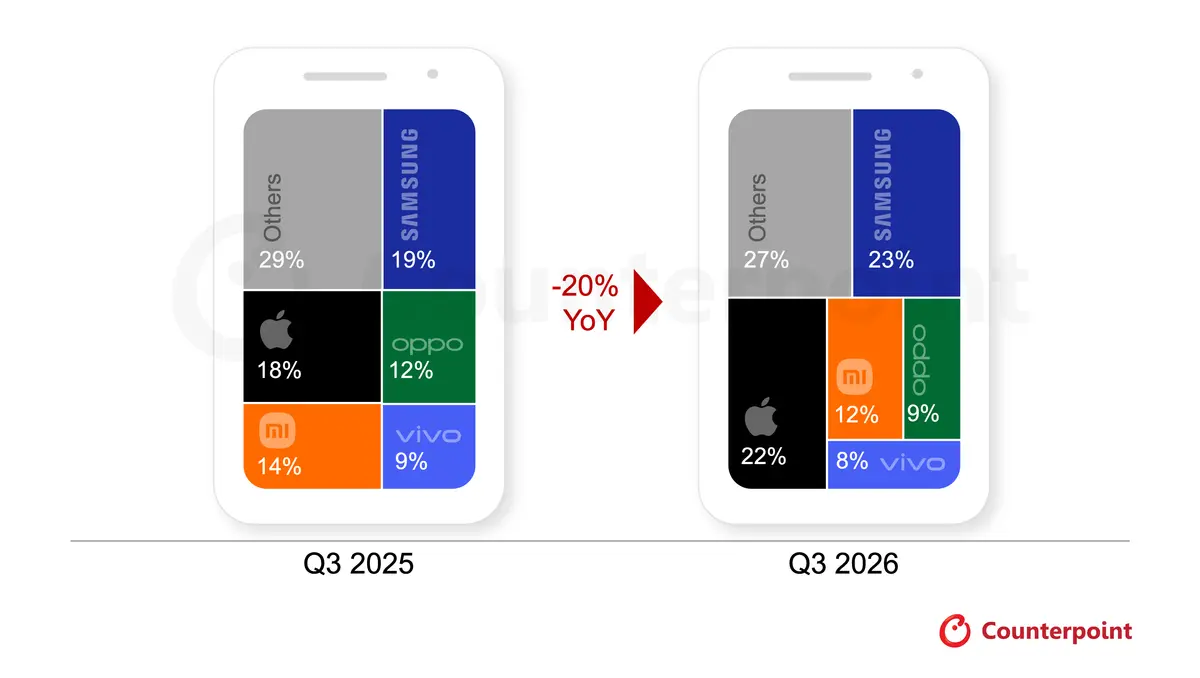
Source: Counterpoint Research's preliminary Market Monitor report, Q3 2026 (based on sell-in)
Note: OPPO includes OnePlus and realme. Percentage totals may not add up to 100% due to rounding.
Samsung retained its top position in Q3 2026, with shipments declining 3% YoY while its market share increased to 23%, the largest share gain among major OEMs. The company’s focus on higher ASPs and revenue growth supported stronger value growth despite lower shipment volumes, with premiumization and its strong foldable launch contributing to the mix. The Galaxy Z Fold8 series saw robust initial demand, while stable component supply supported the mid-range A series in emerging markets as some Chinese brands reduced their presence.
Apple’s market share crossed 20% for the first time in any Q3, reaching 22%, despite a YoY decline in shipments. The volume decline was largely driven by the absence of a base iPhone 18, which resulted in a smaller launch-month channel fill than the full iPhone 17 lineup a year earlier. Apple also joined the industry wide shift toward price hikes, although the impact was limited to the final weeks of the quarter. However, the iPhone 18 Pro models saw a stronger launch than their predecessors, particularly in China and India, while sustained momentum from the iPhone 17 series helped offset a higher shipment decline.
Xiaomi also recorded a significant shipment decline in Q3 2026, with its market share falling to 12%. The company reduced exposure to lower price segments and non-core overseas markets, while raising ASPs and tightening shipment plans to avoid selling devices at uneconomical margins amid ongoing memory crises. However, Xiaomi continues to strengthen its presence in China’s upper midrange and premium segments, with the Xiaomi 18 series and foldable models receiving a positive response. Its in-house XRING O3 chipset further supported differentiation in the premium segment.
(Xiaomi’s market share has been revised from 10% to 12%)
OPPO and vivo recorded shipment declines of more than 20% YoY, with their market share falling to 9% and 8%, respectively. Both brands raised prices across their entry and mid-range portfolios in response to higher memory costs. OPPO consolidated its portfolio and operations across OPPO, realme, and OnePlus to reduce overlap and improve cost efficiency, while also prioritizing margins by shifting supply from thinner-margin segments to higher-return markets and models.
vivo is prioritizing its core India and China markets, strengthening its Y series to capture value-conscious consumers while expanding its premium X, V and S series. However, price hikes pushed budget models out of key price bands, while stock shortages further constrained shipments.
The outlook for the remainder of 2026 remains challenging, with OEMs increasingly prioritizing profitability over shipment volumes amid elevated component costs and weaker affordability. Production cuts, tighter portfolios, and greater focus on premium devices are likely to continue, while price-sensitive segments face further pressure from higher device prices and limited availability of components. A meaningful recovery in overall volumes is unlikely until component costs and supply conditions improve.

No comments:
Post a Comment
Note: Only a member of this blog may post a comment.