Last week the uranium showed up. This week Washington signed off on who gets to look at what happens to it.
On Thursday morning LIS Technologies (LIST), the private laser enrichment developer in which NANO Nuclear is a shareholder and strategic partner, announced that the Nuclear Regulatory Commission has approved its Standard Practice Procedures Plan (SPPP) for the Test Demonstration Facility in Oak Ridge, Tennessee, the same building that, as we reported a week ago in "The Gas Station Gets Its Gas," took delivery of its first shipment of uranium hexafluoride (UF6) on October 8.
Two milestones in seven days, for a company that is still pre-revenue and that most investors had never heard of a year ago, is a remarkable clip for an industry which is desperately in need of modernization with electricity costs soaring across the US, and which usually measures progress in decades.
What The NRC Actually Approved
An SPPP sounds like paperwork, and it mostly is. But it is the paperwork that matters for this particular technology. The plan lays out the security procedures and controls for the facility's "closed area," the restricted space where LIST keeps classified matter tied to its proprietary CRISLA-4G laser enrichment process. The NRC found the plan meets the requirements of 10 CFR Part 25 (access authorization), 10 CFR Part 95 (facility security clearance and safeguarding of classified information) and 32 CFR Part 117 (the Pentagon's industrial security rulebook), and concluded it gives "reasonable assurance" that LIST will adequately protect the classified material and sensitive information in its possession.
Translation: laser enrichment know-how is treated as a national security secret, and before a company can keep doing classified work in Oak Ridge, it has to prove to the NRC that it can keep that secret. The same dynamic is why every enrichment technology in the West lives behind locked doors and security clearances, and away from prying Iranian spies: a process that can cheaply enrich uranium to reactor grade can, in the wrong hands, keep going...
LIST submitted the plan on February 11, so the review took 246 days which by NRC standards that is practically express delivery.
Two caveats worth flagging. First, the SPPP only takes full effect once LIST passes a successful NRC operational readiness review. Second, the approval is a stepping stone toward the item that actually matters, a possessing facility security clearance for the Oak Ridge site, which CEO Jay Yu called "the next step." In other words, Thursday's news unlocks the next door; a few more still stand between LIST and commercial enrichment which is the end game.
Christo Liebenberg, LIST's president and co-founder, explained why the company is celebrating a security plan:
"After decades working in laser enrichment, I know how carefully the NRC reviews these plans, so this approval means a great deal... The path to a facility security clearance runs through exactly this kind of demonstrated discipline, and clearing that bar is a necessary step toward taking our CRISLA technology from demonstration to commercial nuclear fuel production, as part of Project F.U.E.L. (Future Uranium Enrichment with Lasers)."
Director of Regulatory Affairs Julie Olivier was more succinct: the approval brings LIST "one step closer to licensing a full-capacity laser-based uranium enrichment facility."
One Week, Two Boxes Ticked
Regular readers have been following LIST since January, when the company unveiled a $1.4 billion laser enrichment project on the 206-acre "LIST Island" at the footprint of the Manhattan Project's K-25 gaseous diffusion plant. Since then it has bought a $6.2 million building next door for its isotope and deconversion pilots, started technical feasibility and environmental characterization work on LIST Island (August 20), received its first UF6 (October 8) and now cleared the NRC's security review.
Here is how the timeline looks, along with what is still left to do:
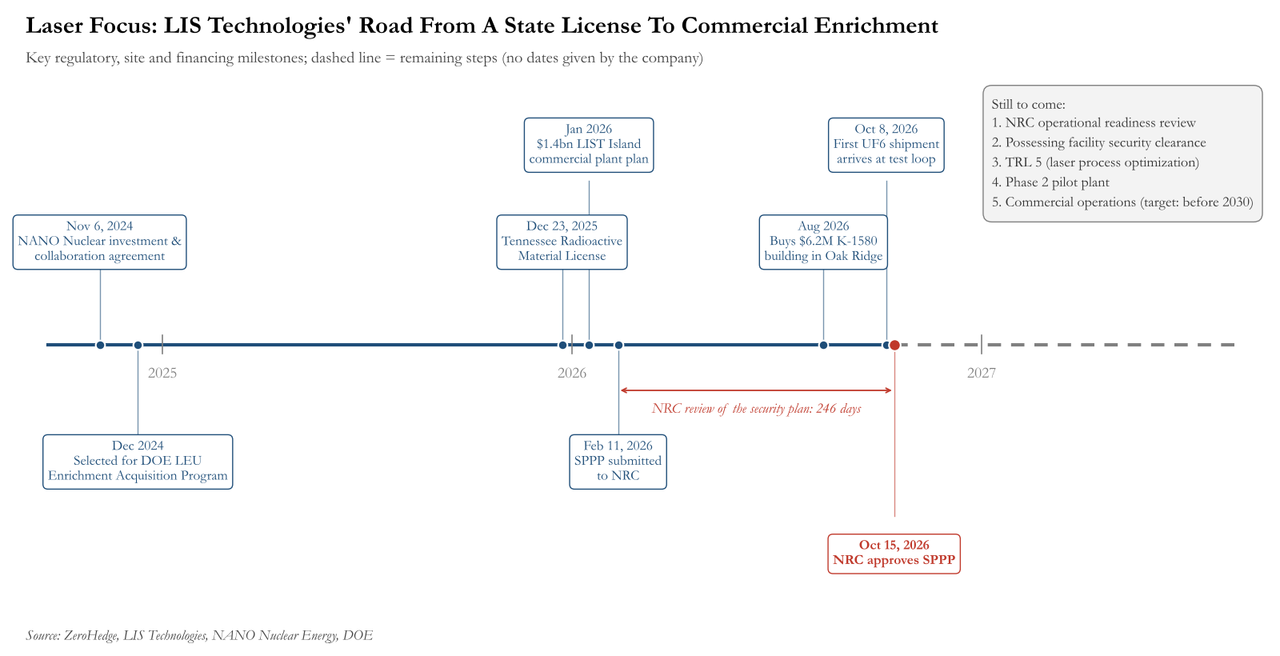
The sequencing matters. Last week's UF6 delivery lets LIST start optimizing its laser process on real feedstock, with the goal of reaching Technology Readiness Level 5 "in the coming months." Thursday's approval protects the classified side of that work. Neither puts a commercial plant in the ground - that will take some time - and LIST's own fine print says it can only make realistic economic predictions for a commercial facility after a successful Phase 2 pilot plant. But, and this is what matters to stock bulls, each step removes a reason to doubt the next one.
Why Anyone Should Care: SWU At A Record
None of this would rate a second post in a week if enrichment were plentiful. It is the opposite. As Jefferies' uranium team noted in its latest Uranium Market Update (available to pro subs), spot enrichment, which is measured in Separative Work Units, hit a series high of $215/SWU in August, against $181/SWU in the long-term market, and the prompt premium in enrichment is now wider than in conversion. Put differently, buyers are paying up for enrichment capacity they can get soon, because there is very little of it.
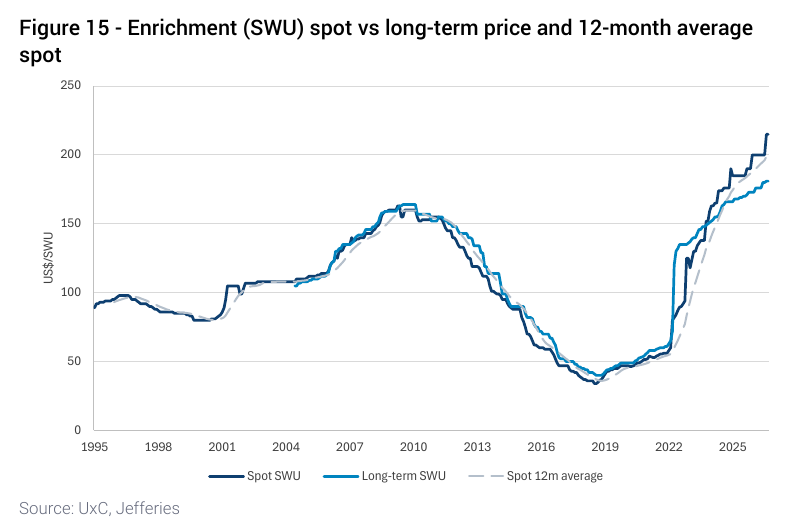
Spot SWU has more than quintupled from its 2018 trough, and it is now well above the 2009 peak.
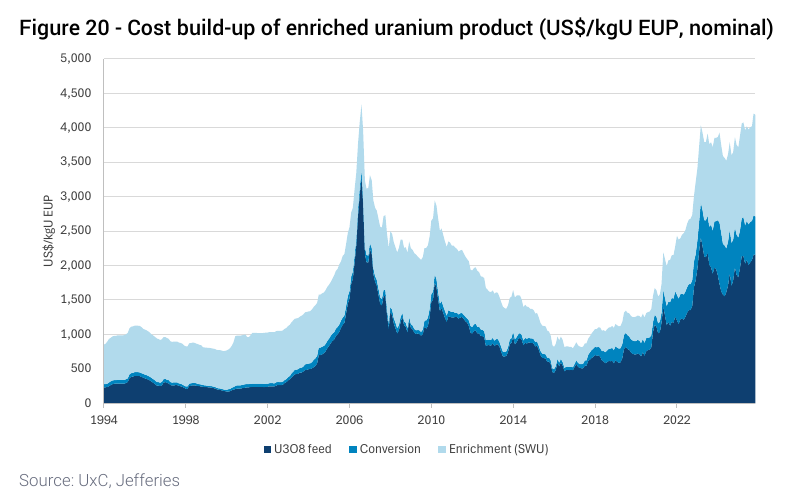
Enrichment has also become a much bigger slice of what a utility pays for fuel. Jefferies estimates the spot-basis cost of enriched uranium product (EUP) at $4,366/kgU in August, up 15% YoY, with enrichment accounting for $1,340/kgU, or 31% of the total, and calls enrichment "a substantial source of incremental cost pressure."
And the West is short capacity at precisely the wrong moment: the US has a single commercial enrichment plant (Urenco's in Eunice, NM), the Russian import ban waivers run out in January 2028, and the DOE has been demanding a faster enrichment buildout while handing out $900 million checks each to Centrus, General Matter and Orano. Building centrifuge capacity is not getting any easier either: BofA just cut its price objective on Centrus (LEU) by 10%, the only uranium name in its coverage to get a cut, citing the "rising complexity of its substantial U.S. enrichment capacity build-out" (full note available to pro subs).
That is exactly the opening laser enrichment is supposed to fill: a smaller, modular, less energy-hungry way to make SWU. LIST is no longer alone in pitching it to Wall Street, either. Goldman's clean energy analyst Brian Lee, who hosted LIST's would-be competitor Quantum Leap Energy (the ASP Isotopes unit slated for a spin-off) on October 8, wrote in his note (available to pro subs) that the company is "focused on commercializing laser-based enrichment capabilities as well as uranium conversion," with the discussion centered on "the broader opportunity to address growing bottlenecks across the Western nuclear fuel cycle." When Goldman starts hosting laser enrichment roadshows, the theme has left the lab and the only question is which institutions will be the first to buy.
The NANO Angle
For NANO shareholders, the logic is the same as last week, just one step further along. Under their November 2024 collaboration agreement, LIST is NANO's preferred supplier of enriched UF6, and the two intend for LIST to supply that enriched UF6 to NANO at no cost, with LIST compensated via a profit-sharing arrangement that has yet to be finalized. NANO's job is to handle what comes after enrichment, which is why it bought an NRC-licensed deconversion site in Lea County, NM two weeks ago. Jay Yu, who runs LIST, is also NANO's founder, so the related-party questions we raised last week haven't gone anywhere.
We summarized the setup in a tweet when last week's milestone hit:
The market, for its part, remains unimpressed: NNE was down about 3% at $12.58 Thursday morning with short interest back to record high just shy of 40% of float. Then again, a security plan approval is the kind of milestone that never moves a stock on the day, and always shows up in hindsight.
And for those keeping score of the alternatives, Vivek Ramaswamy's nuclear startup is betting on a reactor design that skips enrichment altogether, which tells you how big the bottleneck has become: some developers would rather redesign the reactor than wait in the SWU line (good luck to them).
Bottom Line
In a week, LIST went from an empty test loop to a test loop with uranium in it and an NRC-approved plan to protect the classified process that will run on it. The hard parts are still ahead: the readiness review, the facility security clearance, TRL 5, a Phase 2 pilot and roughly $1.4 billion of financing for a commercial plant. Lasers have also broken plenty of hearts before (ask anyone who worked on AVLIS).
But with spot SWU at a record, the Russian import waivers expiring in just over a year and even the incumbent centrifuge builders running into complexity, the West needs every credible enrichment path it can get. As Jay Yu put it Thursday, the goal is to make LIST "the nation's leader in nuclear laser enrichment innovation." We have argued for years that whoever controls the fuel will collect the rent long after the reactor startups finish raising money; this week, the fuel side of NANO's stack got two steps closer to collecting it.

No comments:
Post a Comment
Note: Only a member of this blog may post a comment.