Search This Blog

Saturday, January 23, 2021

Italy to rethink vaccine rollout if supply problems persist

 Italy will have to rethink its COVID-19 vaccination plans if supply problems persist, a senior health official said on Saturday.

The country had already had to cut its daily inoculations by more than two thirds because of delays in deliveries of shots from U.S. drugmaker Pfizer Inc, Franco Locatelli, the head of Italy’s higher health council, told a press conference.

Now that AstraZeneca Plc has also warned of cuts in deliveries to its doses - even as they await clearance for use in the bloc - Italy might have to redraw its national roll out at the end fo the month, he said.

Vaccinations in Italy have slowed to 20,000-25,000 a day from peaks of more than 90,000 around two weeks ago, Locatelli said.

Rome has threatened to sue the Pfizer which said last week it was temporarily slowing supplies to Europe to make manufacturing changes that would boost output.

Pfizer’s vaccination deliveries to Italy were 29% lower this week and would be down 20% next week, though they should return to agreed levels from Feb. 1, Locatelli said.

On Friday, a senior official told Reuters AstraZeneca had also informed the European Union it will cut deliveries of its COVID-19 vaccine to the bloc by 60% because of production problems.

The European Medicines Agency will rule on whether to approve the AstraZeneca vaccine for use in the bloc on Jan. 29 and Rome will have to reassess immunisation plans after that, Locatelli said.

“The reduction calls for a rethinking of the vaccine rollout we had initially envisaged. We’ll have to consider matters towards the end of January,” Locatelli said.

So far 1.312 million doses of vaccine had been injected in Italy, corresponding to around 70% of deliveries, placing Italy second in Europe after Germany, Locatelli said.

Nearly 40,300 people have completed the vaccination cycle after receiving the second dose, he added.

https://www.reuters.com/article/us-health-coronavirus-italy-vaccines/italy-to-rethink-vaccine-rollout-if-supply-problems-persist-idUSKBN29S0H8

Aurinia LUPKYNIS™ (voclosporin) OKd for Lupus Nephritis

 - LUPKYNIS is the first FDA-approved oral therapy for lupus nephritis (LN), a condition that causes irreversible kidney damage and increases the risk of kidney failure, cardiac events, and death -

- LUPKYNIS demonstrated significantly improved renal response rates compared to typical standard-of-care (SoC) in clinical trials

- LUPKYNIS is now commercially available in the U.S. -

- Multimedia components are available with this press release (link here) -

- Conference call to be hosted Monday, January 25, 2021, 8:30 a.m. ET -

The webcast can be accessed on the investor section of the Aurinia website at www.auriniapharma.comTo participate in the teleconference, please dial +1-877-407-9170 (Toll-free U.S. & Canada).

https://finance.yahoo.com/news/fda-approves-aurinia-pharmaceuticals-lupkynis-012400315.html

Friday, January 22, 2021

Baltimore nursing home has had 0 COVID-19 cases: things to know

 Maryland Baptist Aged Home in Baltimore hasn't reported a single case of COVID-19, a rare instance as more than 1 million cases have been reported across the country's long-term care facilities, CBS News reports. 

The Rev. Dr. Derrick DeWitt, the small facility's CFO, spoke to CBS about what they have done to keep COVID-19 out of their facility. 

Three actions the facility took:

1. Shutdown early. After learning about the first few U.S. COVID-19 cases, Dr. DeWitt shutdown the facility Feb. 28, prohibiting all visitation. Even Dr. DeWitt stayed out of the facility, he told CBS. 

2. Enforced rigid staff restrictions. "We were extreme with our employees," Dr. DeWitt said. The nursing home asked employees to stay committed to safety measures outside of work, including not attending family gatherings, wearing masks at home and encouraging them to avoid public transportation by paying for their ride sharing trips to and from work. "And everyone bought in," Dr. DeWitt said. "That's why all credit for us being COVID-free has to go to our employees." 

3. Prioritized residents' and employees' emotional well-being. "We couldn't ignore the toll of isolation and separation, with no more community meals or activities," Dr. DeWitt said. "We made sure every room had a television and radio, and each resident was able to FaceTime or Zoom with their family on a weekly basis. We also brought in extra 'activities staff' to make sure people had one-on-one activities and exercise." 

Dr. DeWitt added that since the facility is small, with 29 residents, they were better able to manage and enforce safety measures. "I want to underscore that some facilities could have done everything right and still ended up with COVID-19," he told CBS. "I think the models that we have of long-term care facilities almost lend themselves to infection. When you talk about having 300 to 400 people and trying to control infection during a pandemic, that's a lose-lose situation right there." 

To read the full conversation, click here. 

https://www.beckershospitalreview.com/post-acute/baltimore-nursing-home-has-had-0-covid-19-cases-3-things-to-know.html

SARS-CoV-2 needs cholesterol to invade cells, form mega cells

 People taking cholesterol-lowering drugs may fare better than others if they catch the novel coronavirus. A new study hints at why: the virus relies on the fatty molecule to get past the cell's protective membrane.

To cause COVID-19, the SARS-CoV-2 virus must force its way into people's —and it needs an accomplice. Cholesterol, the waxy compound better known for clogging arteries, helps the virus open cells up and slip inside, Howard Hughes Medical Institute Investigator Clifford Brangwynne's lab reports.

Without cholesterol, the virus cannot sneak past a cell's protective barrier and cause infection, the team writes in a preprint posted to bioRxiv.org on December 14, 2020. The work, which recreated the early stage of infection in lab-grown cells, has not yet undergone the scientific vetting process of peer review.

"Cholesterol is an integral part of the membranes that surround cells and some viruses, including SARS-CoV-2. It makes sense that it should be so important for infection," says Brangwynne, a biophysical engineer at Princeton University.

The finding might underlie the better health outcomes seen in COVID-19 patients taking cholesterol-lowering drugs known as statins, he adds. Although scientists haven't yet established the mechanism responsible, this study and another published last fall suggest the drugs prevent SARS-CoV-2 from getting into cells by denying it cholesterol.

This discovery of cholesterol's importance could help scientists develop new stopgap measures to treat COVID-19 until most people are vaccinated, Brangwynne says. The work may also shed light on a strange feature of the disease: the formation of giant, compound cells found in the lungs of COVID-19 patients. In their experiments, the scientists saw similar mega cells emerge under the microscope.

Mimicking a viral infection

In normal times, Brangwynne's team studies the physical forces that organize molecules within cells. But in the spring of 2020, his lab, like many others across the world, shifted focus, training their biological expertise on SARS-CoV-2. They began investigating how viral and human proteins interact, and how that interaction lets SARS-CoV-2 enter cells. "We're not a virology lab, we've never worked in this space before, so we started thinking about the tools and approaches we have developed that we could use," he says.

Brangwynne's lab often works with lab-grown cells. To mimic SARS-CoV-2 infection, his team engineered such cells to sport one of two molecules, either the viral "spike protein" or the human ACE2 protein. (To cause an infection, the virus must fuse its membrane to a cell's membrane. This process begins when spike proteins meet their cellular target, ACE2.)

In the lab, the researchers watched as lab-grown cells with these proteins interacted. First, tiny tentacles emerged from cells with ACE2 and stuck to spike proteins on nearby cells. At these points, the two cellular membranes fused and openings formed, letting the cells' contents mix. Eventually, the two cells melded together—similar to how scientists expect the virus merges with a cell to infect it.

The researchers, including Princeton's David Sanders, Chanelle Jumper, and Paul Ackerman, tried to disrupt this cell melding. Using an automated system, they tested the effects of about 6,000 compounds, as well as more than 30 tweaks to the spike protein. These experiments and others suggested that if SARS-CoV-2's membrane lacks cholesterol, the virus cannot enter its target cell.

This isn't the first evidence implicating cholesterol. The previous study, by a group at the University of California, San Diego, found that the body's immune response to the virus produces a compound that depletes cholesterol—but in this case from the cell's own membrane, not the virus's.

"Cholesterol has been very well studied as an important factor in a large number of viral infections," says Peter Kasson, a scientist at the University of Virginia who studies the physical mechanisms of viral disease. "The interesting thing is that cholesterol's role in viral entry varies a lot between viruses." It's not clear exactly how cholesterol aids SARS-CoV-2, but understanding that process could offer clues about the biology of infection, says Kasson, who was not involved in the research.

The apparent beneficial effect of statins extends to other viral infections, too. Some research suggests that these drugs impair the influenza virus by depriving it of cholesterol, Kasson says. But that may not be the only way the drugs can alter the course of , he says. "It's a little complicated because statins also modify the immune response."

Mysterious mega cells

As Brangwynne's experiments ran, his team noticed something strange. The cells continued to engulf one another, spilling their contents together like eggs cracked into a bowl. The compound cells, known as syncytia, that appeared under the microscope resemble those found in healthy tissues, such as muscle and the placenta, and in some viral diseases.

"People already knew that the COVID-19  will create syncytia, but the researchers were able to visualize the process beautifully," says Jennifer Lippincott-Schwartz, a senior group leader at HHMI's Janelia Research Campus, who was not involved in the research. "Cell-cell fusion is itself a really under-studied area in biology."

The experiments likely illustrate how mega cells found in patients' lungs form, she says. "The formation of syncytia can be very injurious in the case of COVID, where it can destroy lung tissues and lead to death."

Brangwynne says it's not clear yet whether or not syncytia play a major role in the progression of COVID-19. But, his team writes, the discovery of 's contribution could help scientists fight the disease. "Our findings underscore the potential utility of statins and other [similar] treatments."

More information: David W. Sanders et al. SARS-CoV-2 Requires Cholesterol for Viral Entry and Pathological Syncytia Formation, bioRxiv (2020). DOI: 10.1101/2020.12.14.422737

https://phys.org/news/2021-01-sars-cov-cholesterol-invade-cells-mega.html

New type of artificial corneal implant integrates directly into eye wall

New type of artificial corneal implant that integrates directly into the eye wall
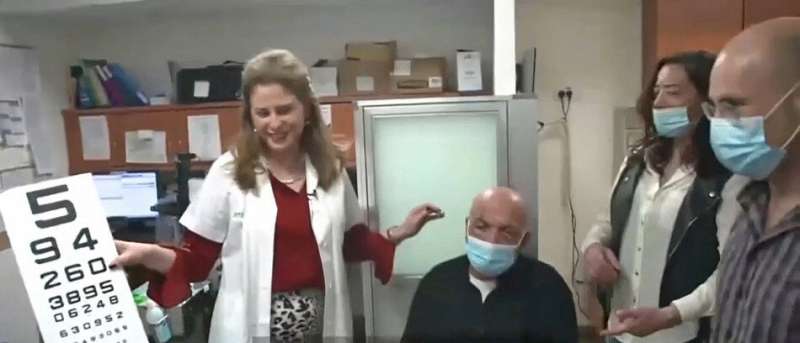
Prof. Irit Bahar and Dr. Gilad Litvin, together with the first-in-human KPro patient and his daughter, the moment his sight returned. Credit: CorNeat Vision

A team of doctors and researchers at CorNeat, an Israel ophthalmic medical device company, has developed and implanted into a patient a new type of artificial cornea that integrates directly into the eye wall. Members of the CorNeat team announced on their web page the successful implantation of their device, called the KPro, into a 78-year-old male patient last week.

The cornea is the clear front part of the eye, covering and protecting the iris and pupil. When the cornea is damaged beyond repair due to disease or injury, it results in blindness. Current treatment generally involves transplanting a healthy cornea from a donor. Unfortunately, there are far fewer donors than people needing new corneas, so medical researchers have been looking to create artificial corneas. To date, such efforts have generally involved the need for  to support the connection between the artificial device and human eye parts. In this new effort, the researchers have developed a new kind of cornea that does not require the use of any tissue—instead, it has a skirt that is made of a material that allows infiltration by fibroblasts and collagen. The research team claims full integration of the cornea skirt can be achieved within a few weeks of surgery.

The artificial cornea looks very much like a flying saucer from science fiction movies. It has a clear middle section that serves as the cornea; surrounding the clear section is the white skirt—the researchers have not revealed what it is made of for patent reasons. The KPro comes as a kit that includes the artificial cornea encased in a protective box and the tools a surgeon would need to implant the cornea in a patient. The procedure for doing so involves removal of the epithelium that covers the cornea, marking where the new cornea should go, removing the old cornea and then suturing the new artificial one in place.

The patient with the new artificial cornea was reportedly able to make out the faces of family members and read numbers on a chart the day after his surgery.

More information: www.prnewswire.co.uk/news-rele … dness-866070880.html

https://medicalxpress.com/news/2021-01-artificial-corneal-implant-eye-wall.html 

Exercising muscle combats chronic inflammation on its own

 Exercising muscle combats chronic inflammation on its own

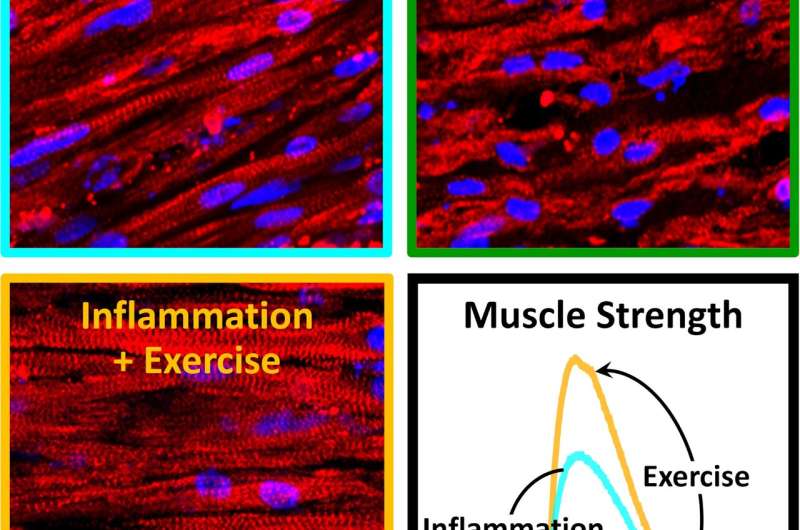
Long, thin, well-defined muscle fibers (top left) are in shambles after prolonged inflammation (top right), but maintain their structure (bottom left) and strength (bottom right) when exercised during the inflammation. Credit: Zhaowei Chen, Duke University

Biomedical engineers at Duke University have demonstrated that human muscle has an innate ability to ward off the damaging effects of chronic inflammation when exercised. The discovery was made possible through the use of lab-grown, engineered human muscle, demonstrating the potential power of the first-of-its-kind platform in such research endeavors.

The results appear online on January 22 in the journal Science Advances.

"Lots of processes are taking place throughout the  during exercise, and it is difficult to tease apart which systems and cells are doing what inside an active person," said Nenad Bursac, professor of biomedical engineering at Duke. "Our engineered muscle platform is modular, meaning we can mix and match various types of cells and tissue components if we want to. But in this case, we discovered that the  were capable of taking anti-inflammatory actions all on their own."

Inflammation is not inherently good or bad. When the body is injured, an initial low-level inflammation response clears away debris and helps tissue rebuild. Other times, the  overreacts and creates an  that causes damage, like the often deadly cytokine storms brought on by some cases of COVID-19. And then, there are diseases that lead to chronic inflammation, such as  and sarcopenia, which can cause muscle to waste away and weaken its ability to contract.

Among many molecules that can cause inflammation, one pro-inflammatory molecule in particular, , has been associated with various types of muscle wasting and dysfunction. While previous research in humans and animals has shown that exercise can help mitigate the effects of inflammation in general, it has been difficult to distinguish what role the muscle cells themselves might play, let alone how they interact with specific offending molecules, such as interferon gamma.

"We know that chronic inflammatory diseases induce muscle atrophy, but we wanted to see if the same thing would happen to our engineered human muscles grown in a Petri dish," said Zhaowei Chen, a postdoctoral researcher in Bursac's laboratory and first author of the paper. "Not only did we confirm that interferon gamma primarily works through a specific signaling pathway, we showed that exercising muscle cells can directly counter this pro-inflammatory signaling independent of the presence of other cell types or tissues."

To prove that muscle alone is capable of blocking interferon gamma's destructive powers, Bursac and Chen turned to an engineered muscle platform that the laboratory has been developing for nearly a decade. They were first to grow contracting, functional human skeletal muscle in a Petri dish, and since then the lab has been improving its processes by, for example, adding immune cells and reservoirs of stem cells to the recipe.

In the current study, the researchers took these fully functional, lab-grown muscles and inundated them with relatively high levels of interferon gamma for seven days to mimic the effects of a long-lasting chronic inflammation. As expected, the muscle got smaller and lost much of its strength.

The researchers then applied interferon gamma again, but this time also put the muscle through a simulated exercise regime by stimulating it with a pair of electrodes. While they expected the procedure to induce some muscle growth, as shown in their previous studies, they were surprised to discover that it almost completely prevented the effects of the chronic inflammation. They then showed that simulated exercise inhibited a specific molecular pathway in muscle cells, and that two drugs used to treat rheumatoid arthritis, tofacitinib and baricitinib, which block the same pathway, had the same anti-inflammatory effect.

"When exercising, the muscle cells themselves were directly opposing the pro-inflammatory signal induced by interferon gamma, which we did not expect to happen," said Bursac. "These results show just how valuable lab-grown human muscles might be in discovering new mechanisms of disease and potential treatments. There are notions out there that optimal levels and regimes of exercise could fight chronic inflammation while not overstressing the . Maybe with our engineered , we can help find out if such notions are true."

More information: Z. Chen el al., "Exercise mimetics and JAK inhibition attenuate IFN-γ-induced wasting in engineered human skeletal muscle," Science Advances (2020). advances.sciencemag.org/lookup … .1126/sciadv.abd9502

https://medicalxpress.com/news/2021-01-muscle-combats-chronic-inflammation.html

Pennsylvania moves smokers to top of coronavirus vaccine list

 Pennsylvania has moved smokers to the top of its list for getting the COVID-19 vaccine.

The Pennsylvania Department of Health has added “persons ages 16-64 with high-risk medical conditions” to phase 1a of its vaccine allocation plan. Smoking is listed as a high-risk condition.

Health care personnel, long-term care facility residents and people 65 years old and older are also included in Pennsylvania’s phase 1a. The state is now in phase 1a of its allocation plan.

A spokesperson for the department told WTAE-4 in Pittsburgh that “Pennsylvania has chosen to follow the [Centers for Disease Control and Prevention] recommendations and include smoking among the list of medical conditions putting individuals at greater risk.”

The Pennsylvania Department of Health didn’t immediately return a request for comment from The Hill.

The CDC’s Advisory Committee on Immunization Practices currently recommends those aged 16-64 with medical conditions that increase their risks of severe COVID-19 to be included in phase 1c, but states are free to modify their distribution plans to their discretion.

The CDC says that smoking increases one’s risk of severe illness from COVID-19. Smoking weakens the immune system, which lowers the body’s ability to fight off disease.

The move comes as states expand eligibility in a rush to vaccinate more of its residents. CNN reported that New Jersey and Mississippi currently offer the vaccine to smokers, and several other states have smokers next in line. 

https://thehill.com/homenews/state-watch/535382-pennsylvania-moves-smokers-to-top-of-coronavirus-vaccine-list