Search This Blog

Tuesday, January 26, 2021

Microwaves used to deactivate coronavirus, flu, other aerosolized viruses


Microwaves used to deactivate coronavirus, flu, other aerosolized viruses
Conceptual schematic showing key portions of the viral aerosol microwave inactivation experiment. Credit: Air Force Research Laboratory.

As the pandemic has continued to spread globally, studies indicate the COVID-19 virus may be contained in aerosols that can be generated and spread through breathing, coughing, sneezing, or talking by infected individuals. Researchers are increasingly focused on developing tools and methods to assist in decontaminating surfaces and spaces.

While scientists have previously explored the use of electromagnetic energy to deactivate flu virus in bulk fluids, less work has been done to understand the role of nonionizing radiation, such as microwaves, in reducing the infectivity of viral pathogens in aerosols. The tools required to both safely contain contaminated aerosol streams and expose these aerosols to controlled, well-characterized microwave doses have not been readily available.

In Review of Scientific Instruments, researchers from the Air Force Research Laboratory report development of a set of experimental tools capable of presenting  to an  mixture of biological media and virus with the capability to vary power, energy, and frequency of the electromagnetic exposure. The researchers seek to better characterize the threshold levels of microwave energy needed to inactivate aerosolized viral particles and, thus, reduce their ability to spread infection.

"In this way, we believe our  is capable of a fundamental investigation of a wide variety of inactivation mechanisms. This range of capability is especially important given the range of potential interaction mechanisms found in the literature," said co-author John Luginsland.

The key portions of each system fit within standard biosafety cabinets, ensuring multiple layer containment of pathogens. Additionally, the systems are designed to prevent release of microwave radiation into the laboratory environment, which, at elevated levels, could potentially interfere with diagnostic equipment and other electronics.

During initial experiments, the AFRL researchers are exposing a human-safe coronavirus surrogate, bovine coronavirus, to a range of  waveforms at frequencies ranging from 2.8 GHz to 7.5 GHz.

"The bovine coronavirus is similar in size and configuration to human coronavirus but is safe to humans," said co-author Brad Hoff.

If exposure to microwaves is demonstrated to be sufficiently effective in reducing infectivity, experimental efforts could then proceed to use aerosols containing COVID-19 coronavirus or other human-infecting pathogens.

"If shown to be effective, the use of microwaves may enable the potential for rapid decontamination not currently addressed by  or chemical cleaning for highly cluttered areas, while potentially operating at levels safely compatible with human occupancy," said Hoff.

More information: "Apparatus for controlled microwave exposure of aerosolized pathogens" Review of Scientific Instruments, aip.scitation.org/doi/10.1063/5.0032823

https://medicalxpress.com/news/2021-01-microwaves-deactivate-coronavirus-flu-aerosolized.html

Telehealth's cybersecurity risk

Experts have repeatedly predicted that telehealth would present a major challenge for healthcare cybersecurity in the coming year.  

But it's not enough to know telehealth is likely to be an issue. The real task is working collaboratively to address those dangers.  

At the second installment of the American Telemedicine Association's EDGE policy conference on Tuesday, leaders in the healthcare space reiterated the importance of cybersecurity as a patient safety issue.  

"We've been measuring the risks and the threat for telemedicine-type services for many years," said Christopher Logan, director of healthcare industry strategy at VMWare.

Even before the COVID-19 pandemic, "healthcare already had a cyber target on its back," said Logan.

Now, with the explosion of connected devices in conjunction with the rising value of digital medical records and an increasingly remote workforce, Logan said maintaining seamless cybersecurity will be more important than ever. 

This is particularly important, he said, given that patient safety can be on the line – as we've seen with the fallout and continued disruption from high-profile ransomware cases over the last year. Ransomware attacks have even been linked to a patient's death in Germany.  

"At the end of the day, 'adequate security' is not enough when you think about what we're trying to accomplish," said Logan.  

Of course, taking precautionary steps in terms of security-as-a-service and planning for a worst-case scenario will be paramount in developing a robust security profile. But Logan noted that "the most important aspect of any security program … is always going to be the people that are involved."   

Mark Jarrett, chief quality officer and deputy chief medical officer at Northwell Health, agreed: "What we're trying to [do] … is look at it from the patient viewpoint and the provider's viewpoint."  

It's not a matter of computer literacy, he said, but rather whether there are basic security measures in place. Providers who are associated with larger hospitals, said Jarrett, may have the privilege of an additional, institutionalized layer of security, while smaller or medium-sized providers "are basically on their own."  

And again, this is magnified by the increasing reliance on telehealth, which frequently relies on patients' own network security – especially when it comes to remote patient monitoring devices. Jarrett noted that this could be a good opportunity for the government to intervene. 

"I don't love overregulation, but this is an area where we have to be careful, because patients will be hurt," he said. "Cybersecurity is a patient safety issue."

Still, said Jessica Wilkerson, a cyber policy advisor with the All Hazards Readiness, Response and Cybersecurity team at the Center for Devices and Radiological Health within the Food and Drug Administration, cybersecurity is a shared responsibility.

"FDA does not regulate telemedicine," she reminded co-panelists. But "if there's one thing FDA has really learned … it's that everybody has to be doing their part."  

Even for medical device manufacturers, she said, that device will still go into a hospital system or someone's home, where it needs to be kept secure. "You have to be doing your part and talking to the other person about what they're doing and adjust on a constantly evolving basis," she said.   

"Telemedicine is the epitome of cybersecurity issues," she continued, in that there are varying levels of security expertise at play. "The whole ecosystem approach to cybersecurity is so critical."

"At the end of the day, we all know technology is going to fail," added Logan. "We have to be running a little faster than the bad guy.

"The key here is going to be people. That's going to help reduce the risks associated with telemedicine," he continued. "We're going to be able to reduce that risk only if we work in harmony together."

https://www.healthcareitnews.com/news/addressing-telehealths-cybersecurity-risk-will-be-industry-wide-problem

Even Presidential Pressure May Not Get More Vaccine to Market Faster

 Americans are dying of covid-19 by the thousands, but efforts to ramp up production of potentially lifesaving vaccines are hitting a brick wall.

Vaccine makers Moderna and Pfizer-BioNTech are running their factories full tilt and are under enormous pressure to expand production or collaborate with other drug companies to set up additional assembly lines. That pressure is only growing as new viral variants of the virus threaten to launch the country into a deadlier phase of the pandemic.

President Joe Biden has said he plans to invoke the Cold War-era authority of the Defense Production Act to provide more vaccines to millions of Americans. Consumer advocates — who had called for Donald Trump to use the Defense Production Act more aggressively as president — are now asking Biden to do the same.

But even forcing companies to gear up production won’t provide much-needed doses anytime soon. Expanding production lines takes time. Establishing lines in repurposed facilities can take months.

“The big problem is that even if you can get the raw material and get the infrastructure set up, how do you get a company that is already producing at maximum capacity to go beyond that maximum capacity?” said Lawrence Gostin, a professor of global health law at Georgetown University.

Ordering the companies to work 24/7 “would be a naïve solution,” said Dr. Nicole Lurie, a senior adviser to the CEO of the Coalition for Epidemic Preparedness Innovations, an international group that finances vaccines for emerging diseases. “They’re probably already doing that to the extent they have the raw materials.”

Lurie added, “If you completely wear people out, mistakes happen. You have to balance speed with quality and safety.”

The technological challenges involved are daunting, and the companies haven’t been forthcoming about what’s needed to overcome any supply shortfalls.

“We don’t know what the holdup is. Is it capacity? Raw materials? People? Glass vials? We just don’t know what the bottleneck is,” said Erin Fox, senior director of drug information and support services at the University of Utah Health Hospitals.

Forcing other companies to start making the vaccines might not work either, Gostin said.

“I’m not sure if Biden could require a private company to transfer its technology to another company,” Gostin said. “That is highly questionable legally. … President Biden’s room for maneuvering isn’t as great as people think.”

Drug companies define “trade secrets” broadly, Fox said. “In general, drug companies don’t have to tell me who is making their product, where it’s made, the location of the factory. … That’s considered proprietary.”

Part of the challenge relates to how these vaccines are made. The first two authorized products use lipid nanoparticles to deliver a snippet of the coronavirus’s genetic material — called messenger RNA, or mRNA — into cells. The viral genes teach our cells how to make proteins that stimulate an immune response to the novel coronavirus.

Messenger RNA is fragile and breaks down easily, so it needs to be handled with care, with specific temperatures and humidity levels.

The vaccines “are not widgets,” said Lurie, who served as assistant secretary for preparedness and response at the Department of Health and Human Services during the Obama administration.

Every step, experts say, to get vaccines to market has its complexities: obtaining raw materials; building facilities to precise specifications; buying single-use products, such as tubing and plastic bags to line stainless steel bioreactors; and hiring employees with the requisite training and expertise. Companies also must pass safety and quality inspections and arrange for transportation.

The Defense Production Act, for instance, would allow the government to commandeer a plant that already has a fermenter — there are plenty in the biotech industry — to expand production. But that’s just the first stage in making an mRNA vaccine and, even then, it would take about a year to get going, said Dr. George Siber, a vaccine expert who is on the advisory board of CureVac, a German mRNA vaccine company.

Companies would first have to do a breathtakingly thorough cleaning to prevent cross-contamination, Siber said. Next, they would need to set up, calibrate and test equipment, and train scientists and engineers to run it. Finally, Siber said, unlike a drug, whose components can be tested for purity, there’s no way to be sure a vaccine produced in a new facility is what it claims to be without testing it on animals and people.

“Making vaccines is not like making cars, and quality control is paramount,” said Dr. Stanley Plotkin, a vaccine industry consultant credited with inventing the rubella vaccine. “We are expecting other vaccines in a matter of weeks, so it might be faster to bring them into use.”

However, even that will require patience. Johnson & Johnson, expected to announce clinical trial results this month, has said that it won’t be able to deliver as many shots as planned because of manufacturing delays. The company did not confirm a manufacturing delay and declined to respond to questions.

AstraZeneca’s vaccine, also funded in part by U.S. taxpayers, is in use already in the United Kingdom and India, but the Food and Drug Administration has raised questions about its late-stage trial, so it may not be available here until the spring.

Novavax, another U.S.-funded vaccine maker, has been plagued by delays and only recently began recruiting volunteers for its big trial. Merck, the most recent company to get federal support for covid vaccines, announced Monday it was scrapping its two candidates after they failed to produce adequate immune response in early tests.

“None of the vaccine makers are manufacturing at the volume they ultimately want to be at,” Lurie said. “They all have manufacturing delays.”

Pfizer, which has committed 200 million doses to the U.S. government by the end of July, said last week it expected “no interruptions” in shipments from its primary U.S. covid manufacturing plant in Kalamazoo, Michigan. Pfizer spokesperson Sharon Castillo said the company has expanded manufacturing facilities and added more suppliers and contract manufacturers. Those efforts, and the company’s announcement that its five-dose vials actually contain an extra dose, mean “we can potentially deliver approximately 2 billion doses worldwide by the end of 2021.”

The U.S. government also has an option to acquire another 400 million doses of the Pfizer-BioNTech vaccine, though the company declined to provide details on that option when asked.

But countries around the world are competing for the same supplies and raw materials, Gostin said.

Biden could use the Defense Production Act “to force Pfizer to prioritize U.S. contracts, but that would be politically risky,” given that other countries could retaliate by hoarding supplies. Although Pfizer is an American company, it has partnered with BioNTech, of Germany, to make its covid vaccine. “That would lead to a global mess.”

Trying to corner the world market on vaccine ingredients or supplies would look bad, experts say, given that the United States just this week joined Covax, an international venture to source and distribute vaccines, in an effort to ensure poor countries aren’t left behind.

Paradoxically, the rush to get vaccines to market may have resulted in a less efficient manufacturing process.

Vaccine companies typically spend months making their factories run as efficiently as possible, as well as finding an ideal dose and the most effective interval between doses, Lurie said. Given the urgency of the pandemic, however, they delayed parts of this process and launched straight into mass production.

Pfizer angered European countries last week when it paused vaccine production at a Belgian plant to upgrade its capacity. Pfizer said the weeklong closure would decrease vaccine deliveries to Europe for three to four weeks before boosting supplies in February. The move doesn’t affect U.S. vaccine supplies.

“The U.S can’t necessarily readily access stuff that’s being held for vaccines in other countries,” Lurie said.

And forcing other companies to make covid vaccines could jeopardize production of other important shots, such as measles, said Dr. Amesh Adalja, a senior scholar at the Johns Hopkins Center for Health Security. Routine childhood immunization rates have fallen during the pandemic, raising the risk of epidemics.

Using the act to prioritize covid vaccine manufacturing has already disrupted supplies of at least one drug, Fox noted. In December, Horizon Therapeutics warned doctors and patients to expect a shortage of a drug called Tepezza, used to treat thyroid-related eye disease, because its manufacturer was ordered to prioritize covid shots.

Lawmakers and consumer advocates such as Public Citizen called on the government to use the Defense Production Act more aggressively. In a letter sent earlier this month, Sen. Elizabeth Warren (D-Mass.) and Rep. Katie Porter (D-Calif.) said Moderna should share its technique for stabilizing its vaccine at normal refrigerator temperatures, without “ultracold” freezers.

Moderna officials have said the intrinsic differences in the two companies’ mRNA material make that technology hard to share. Besides, they say, Pfizer has declined to share data with Moderna. Pfizer has declined to comment on the issue.

Since Moderna’s effort is federally funded, the government presumably has march-in rights and could take over production, said Mike Watson, former president of Moderna subsidiary Valera, in an email. “The reality is that however far you push production capacity, you sooner or later reach a bottleneck.”

Experts say it’s not as simple as demanding that glassmaker Corning step up and make glass vials, for example. Of course, the vials will need to meet rigorous requirements. But there’s also this: The U.S. is facing a shortage of mined sand, the main component needed to make glass vials.

https://khn.org/news/article/ramping-up-covid-vaccine-production-could-take-months-even-with-bidens-best-tool-to-pressure-companies/

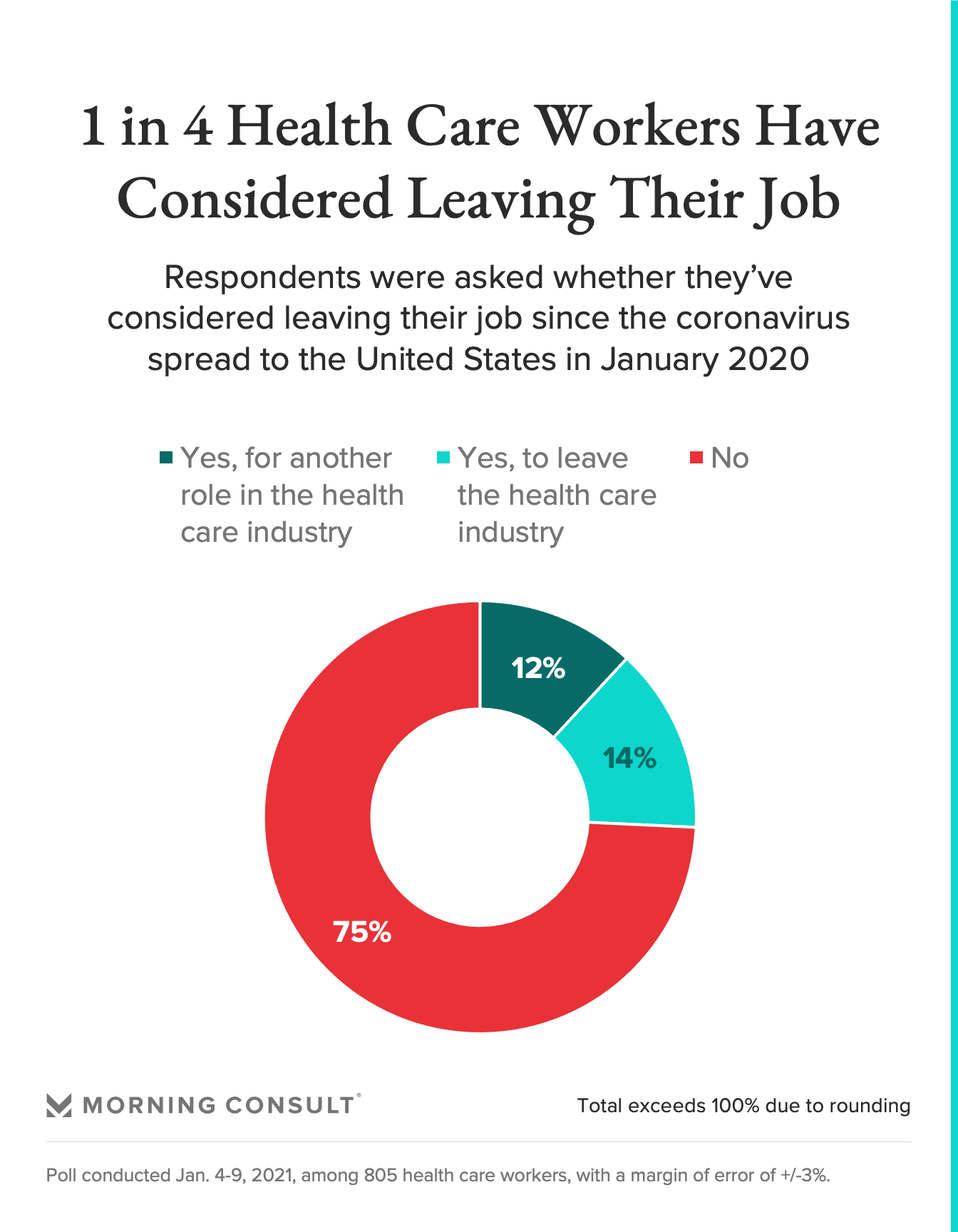
About 1 in 4 Health Care Workers Considered Quitting Since Pandemic Start


  • Another 12% of health care workers say they’ve mulled leaving their current role for another position in the industry.

  • Since February, 11% of health care workers have been laid off or lost their job, including 5% due to their employer’s financial constraints.

  • About 1 in 10 health care workers have resigned from a job since February.

Some of the most enduring images from last spring, as COVID-19 overwhelmed health systems around the world, came from the balconies and front stoops of New York, London, Paris and other major cities, when people emerged from their homes and applauded the efforts of health care workers battling the once-in-a-generation pandemic.  

The message was clear: Health care workers were heroes, and the world was indebted to them for their sacrifices in seeing us through these dark and dangerous times. 

But as the ovations waned and COVID-19 persisted, health care workers were left battling the virus with seemingly no end in sight, carrying an exhausting mental and physical burden that appears to have led to a significant share of them questioning their professional futures.

A new Morning Consult survey found that 26 percent of U.S. health care workers have considered leaving their job since the pandemic spread to the United States last January. Included in that share are 14 percent who say that COVID-19 has left them thinking that they might leave the health care profession altogether. 

A notable share of the 1,000 health care workers surveyed have already exited their roles. The poll found that 11 percent have been laid off or lost their job since Feb. 15, 2020, including 5 percent because of financial constraints felt by their former employer. And another 11 percent said they resigned from their position during that time period. 

The survey, which was conducted Jan. 4-9 and has a margin of error of 3 percentage points, underlines an especially stark fear among health policy experts and administrators: that looming medical staff shortages across the country, particularly in nursing, are an inexorable threat. 

“It does not surprise me, but it does alarm me,” Dr. Janis Orlowski, chief health care officer at the Association of American Medical Colleges, said of the data. “After what everyone has been through so far and what we’re continuing to go through, I can see where people may just want to take a break. They say that they may want to leave the industry, and maybe what they want to do is just take a break from the intensity of the work, and hopefully they’ll come back.”

Though the share of health care workers who are thinking of leaving the industry is small, any defections would be especially damaging given widely accepted projections of staffing shortfalls. 

Data from the Association of American Medical Colleges estimated that the United States could face a shortage of between 54,100 and 139,000 physicians by 2033, a projection that includes deficits in primary and specialty care. 

The association’s June report also found that more than 40 percent of active physicians will be 65 or older over the next 10 years, and burnout could expedite retirements. 


The nursing industry, meanwhile, has a projected employment growth rate of 7 percent from 2019 to 2029, according to the U.S. Bureau of Labor Statistics, putting it ahead of the national average of 4 percent for all occupations.

But despite those positive BLS projections, the nursing shortfall is even more pronounced than the physician deficit: A 2018 study from the American Journal of Medical Quality projected a shortage of over half a million nurses by 2030, with the southern and western regions of the country most afflicted.  

“It is pretty clear that the current nurse workforce and workforce in general is inadequate. And there are significant shortages in certain job descriptions that are related to delivering respiratory care and intensive care,” said Dr. Albert Wu, director of the Center for Health Services and Outcomes Research at Johns Hopkins Medicine. “We are not well-positioned to deal with this or even the next crisis.”

Wu said that due to a variety of factors, survey results may even underestimate health care workers’ desire to leave their current jobs. For example, he said, many nurses, who represent the largest share of providers, are leaving their full-time jobs during the pandemic to work as traveling nurses for a per diem salary that is three or four times what they make now. As more nurses leave for these assignments, that increases the interest of their colleagues in these jobs.


https://morningconsult.com/2021/01/25/about-a-quarter-of-health-care-workers-have-considered-leaving-their-job-since-the-onset-of-the-pandemic/

Cortexyme Updates Pipeline, Anticipated 2021 Milestones

 — Based upon successful completion of the GAIN Trial’s interim analysis, pipeline expansion announced for 2021

— Atuzaginstat to be studied in the PEAK trial, a new Phase 2 study for Parkinson’s disease

— COR588, a novel lysine gingipain inhibitor, on track to enter the clinic in Q3 2021

— Top-line data in 643 subject Alzheimer’s disease pivotal GAIN Trial on schedule to be announced in Q4 2021

— Top-line data in 233 subject periodontal disease clinical study to be announced in Q4 2021

— Current cash position projected to fund operations into 2023

— GAIN open-label extension (OLE) rollover to date has been approximately 90% of eligible participants

https://www.biospace.com/article/releases/cortexyme-announces-pipeline-update-and-anticipated-2021-milestones/

Cassava Sciences may have potential blockbuster

 Cassava Sciences, a clinical-stage biotech company, has no revenue yet. But the company's stock is up more than 25% over the past year. The reason is the company has a potential blockbuster Alzheimer's drug -- simufilam.

Cassava just reported results from its phase 2B study on the drug, showing 98% of patients with mild or moderate Alzheimer's in the study treated with simufilam for 28 days showed improvements in biomarkers of the disease's pathology, including improved memory, less neuroinflammation and less neurodegeneration with no safety issues. The company said it expects to complete a phase 3 study regarding the safety of the disease this year.

It's hard to stress enough what a big deal a successful Alzheimer's drug would be. According to the Alzheimer's Association, the disease, the most common form of dementia, affects more than five million Americans 65 and older. With the population of those 65 and over in the United States expected to grow from 56 million in 2020 to 88 million by 2050, the number with Alzheimer's would obviously grow. The association said by 2050, there will be 13.8 million people internationally living with Alzheimer's.

There is no drug on the market that has been shown to reverse or even slow the disease's progression, and no new drugs for Alzheimer's have been approved since 2003. It's possible a successful Alzheimer's treatment would be worth $20 billion a year by 2030 with no competitors, according to J.P. Morgan analysts.

https://www.fool.com/investing/2021/01/23/the-3-best-healthcare-stocks-to-buy-for-2021/

Vir notes promising early stage hep B data

 Shares of Vir Biotechnology (NASDAQ:VIR) soared 74% on Tuesday after the immunology company released promising results from an early-stage study of its experimental antibody treatment for the hepatitis B virus (HBV). 


Preliminary data from Vir Biotechnology's phase 1 trial of its subcutaneously administered monoclonal antibody, VIR-3434, showed a marked reduction in HBV surface antigen levels in patients with chronic HBV infection.

Better still, Vir Biotechnology engineered VIR-3434 to include a vaccinal mutation that could potentially allow it to function as a T cell vaccine against HBV.

"The need for a functional cure for the nearly 300 million people living with chronic HBV is paramount," Dr. Kosh Agarwal, the lead study investigator, said in a press release. "Lowering HBsAg [the HBV virus surface antigen] may help unlock a patient's immune system, allowing it to provide the immune control necessary to achieve a functional cure."


In addition to its HBV treatment, Vir Biotechnology also designed its experimental COVID-19 antibody therapy, VIR-7832, to include the XX2 vaccinal mutation technology, to which it has exclusive rights. The company plans to begin a phase 1b/2a trial of VIR-7832 in the coming weeks.

https://www.fool.com/investing/2021/01/26/why-vir-biotechnology-stock-skyrocketed-today/