Search This Blog

Monday, November 6, 2023

'CDC adding flu, RSV surveillance at major US airports'

 The Centers for Disease Control and Prevention (CDC) announced Monday it will be expanding its respiratory viral surveillance of international travelers.

In 2022, the CDC launched its Traveler-based Genomic Surveillance program (TGS), a public-private partnership to serve as an early-warning detection system at U.S. airports for COVID-19 variants. The voluntary program involves taking nasal samples from international travelers coming into the U.S., with select positive samples being sent to the CDC.

The program is a partnership with Ginkgo Bioworks and XpresCheck.

The agency will expand these efforts by testing for more than 30 other additional pathogens, including respiratory syncytial virus (RSV) and the flu. This pilot program will launch at four U.S. airports: Kennedy International Airport, San Francisco Airport, Logan International Airport and Dulles Airport.

“The expansion of the Traveler-based Genomic Surveillance program to flu, RSV, and other pathogens is essential as we head into fall respiratory season,” Cindy Friedman, chief of CDC’s Travelers’ Health Branch, said in a statement.

“The TGS program, which began during the COVID-19 pandemic, acted as an early warning system to detect new and rare variants of the SARS-CoV-2 virus and will do the same for other respiratory viruses going forward.”

Since launching last year, the TGS has enrolled more than 360,000 anonymous volunteers, covering flights from 135 countries.

“By building sustainable, scalable infrastructure that is capable of detecting biological threats beyond SARS-CoV-2, the TGS program is a global leader in the evolution of biosecurity,” said Matt McKnight, Ginkgo Bioworks general manager for biosecurity. “Persistent monitoring can give officials an early warning by offering a view into how pathogens spread across the globe.”

https://thehill.com/policy/healthcare/4295650-cdc-flu-rsv-surveillance-airports/

Sangamo cut to Sector Perform from Outperform by Wells Fargo

 Target to $2 from $6

https://finviz.com/quote.ashx?t=SGMO&ty=c&ta=1&p=d

Viatris US court win reopens path to generic of J&J hypertension drug

 A U.S. appeals court on Monday gave Viatris' Mylan Pharmaceuticals another chance for its proposed generic of Johnson & Johnson.

https://www.reuters.com/legal/litigation/viatris-us-court-win-reopens-path-generic-jj-hypertension-drug-2023-11-06/

C4 upped to Neutral from Underperform by Credit Suisse

 Target to $10 from $12

https://finviz.com/quote.ashx?t=CCCC&ty=c&ta=1&p=d

Candel Positive Interim Data from Phase 2 Trial of CAN-2409 in Non-Metastatic Pancreatic Cancer


  • Initial positive interim data revealed notable improvements in patients with borderline resectable pancreatic ductal adenorcarcinoma (PDAC) after experimental treatment with CAN-2409
  • Estimated overall survival rate was 71.4% at 36 months in CAN-2409 treated patients versus 16.7% in the control arm after chemoradiation
  • In patients with progressive disease, there was both a CA19-9 and a survival response to salvage chemotherapy in the CAN-2409 arm, but not in the control arm.
  • Dense aggregates of immune cells, including CD8 positive granzyme B positive cytotoxic T cells, dendritic cells, and B cells, were observed in PDAC tissue after CAN-2409 treatment, confirming activation of a robust antitumoral immune response
  • Safety analysis demonstrated that multiple injections of CAN-2409 were generally well tolerated, with no reported dose-limiting toxicities and no cases of pancreatitis

Speaker Johnson Sensible About Health Care

 Newly-installed House Speaker Mike Johnson, R-La., has a clear vision for the future of America's health sector. It's one that fans of free markets should be pleased with.

Previously, Johnson served as chair of the House Republican Study Committee. During his tenure, the committee released "A Framework for Personalized, Affordable Care" — a detailed, commonsense plan for addressing some of our nation's most daunting health care challenges.

If he makes that plan a legislative priority in the months ahead, he has a chance to make his mark on a healthcare debate that Democrats have dominated for too long.

Take the Framework's approach to reining in Medicaid. Originally created as a health insurer of last resort for truly needy Americans, Medicaid has become the nation's leading source of coverage — largely because of Obamacare.

The health law dramatically relaxed Medicaid's eligibility requirements, funneling an additional 21 million people into the program, according to a 2022 report from the U.S. Department of Health and Human Services.

Today, Medicaid insures more than one in five patients — many of them working-age, able-bodied Americans.

Predictably, this rapid growth in enrollment has put Medicaid on a path to fiscal calamity. Between 2020 and 2021 alone, program spending grew by more than 9%, to $734 billion. According to the latest federal projections, spending will exceed $1 trillion in 2028.

To return Medicaid to something resembling its original purpose, the Framework proposed a new funding formula. Instead of giving states at least one dollar of federal money for every dollar they spend on the program, the feds would provide fixed per-capita block grants to each state.

This would not only give states greater control over their Medicaid dollars. It would encourage them to keep costs under control. After all, they're responsible for every dollar lost to waste and inefficiency.

The Republican Study Committee under Johnson also proposed a number of compelling ideas for expanding health savings accounts.

These savings vehicles enable patients to set aside tax-free dollars for health expenses. Because patients control their dollars, they have a strong incentive to spend them wisely on the best-value care. Providers, meanwhile, have to compete for consumers' health care dollars. That gives them an incentive to keep prices low and quality high.

The Framework proposed allowing people to contribute more to HSAs — up to $9,000 per year for individuals and up to $18,000 per year for families. That's more than double what they can contribute now. And it would make more people eligible to contribute to HSAs — including Medicare beneficiaries.

In addition, the Framework would permit people to pay insurance premiums with pre-tax money from their HSAs. That would help level the tax treatment between people who have gotten tax-free coverage through work for decades and those who shop for coverage on the individual market, who have long had to pay premiums with post-tax money.

Just as encouraging are some of Johnson's ideas for Medicare reform.

The Republican Study Committee's 2020 budget proposal argued for raising Medicare's eligibility age to reflect the increase in life expectancy since the program's inception — a commonsense way of bringing down overall costs.

That budget proposal also made the case for shifting Medicare to a "premium support" model, in which beneficiaries receive direct financial assistance from the government that they can use to purchase their own insurance on a special Medicare exchange. Wealthier seniors would receive less in premium support than those with lower incomes.

This exchange would offer a range of private coverage options as well as traditional Medicare. In this way, it would introduce greater choice and competition into the program — which, over time, would reduce costs and foster innovation.

The GOP has chosen a House speaker who both recognizes the major flaws in our health system and has a detailed plan for correcting them. Those who want to see a more efficient, better-value healthcare system should hope he has the opportunity to advance that plan.

Sally C. Pipes is president, CEO, and the Thomas W. Smith fellow in healthcare policy at the Pacific Research Institute. Her latest book is "False Premise, False Promise: The Disastrous Reality of Medicare for All," (Encounter Books 2020).

https://www.newsmax.com/sallypipes/healthcare-mike-johnson/2023/11/03/id/1140886/

Doctors and 'experts' who got it wrong during the COVID-19 pandemic

 Doctors and ‘experts’ who got COVID policy wrong are asking for forgiveness. Their errors hurt children— resulting in massive learning losses— and caused broader destabilization to the economy, work life, social communities and more. Do they deserve forgiveness? And, why did they err in the first place?

Recently Scott Galloway, the NYU professor, appeared on Bill Maher. On the topic of school closure, he said:

School closure was not just wrong in retrospect however, the available data showed it was wrong at the time. With professor Vlad Kogan, I documented the clear data that schools must remain open, and worked extensively on this issue in 2020 and beyond.

Sadly, in many places in the US, they remained closed for another 8 months. This was particularly true in left leaning cities with strong teachers unions. Teachers unions sabotaged kids’ futures.

School closure was not the only misguided policy. Masking children— as young as 2 years old for years on end often with cloth facial decorations— was another policy error. It simply has no evidence to support it, and frankly only an idiot would advise doing it to a 2 year old (they take it off to nap in the same room, btw). Sadly, the American Academy of Pediatrics pushed this error.

I wrote about this topic for the Atlantic magazine, only to face criticism from everyone’s favorite internet comedian and private practice opthalmologist Dr. Glaucomflecken, who called publishing my piece an ‘awful decision’.

Image

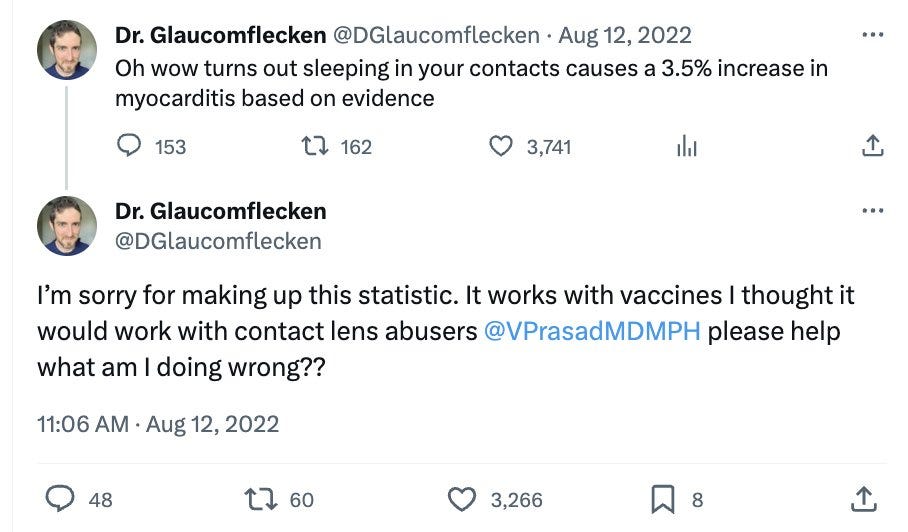
Later, Will Flanary (Dr. G) would once again venture into COVID policy debates: this time commenting about myocarditis after COVID19 vaccination— a safety harm that has now been added to package inserts. He wrote dismissively that the concern was invented.

Image

Of course, myocarditis is such an important safety concern that many nations banned the use of Moderna in young people, spaced doses, and some have abandoned annual booster plans in young, healthy populations. In our work, we showed the harms of boosters outweighed benefits in young healthy men.

Why did doctors and professors make these COVID19 errors?

The answer is simple. Groupthink. The vast majority of people— even physicians and experts— do not read and interpret papers themselves. Nearly all of them rely on their peer networks to shape their opinion. Likely, Scott Galloway’s views were shaped by sentiments in NYC during the pandemic. NYC was hit hard in April 2020, but closing schools was never a policy solution that would help. Instead it was a self inflicted wound.

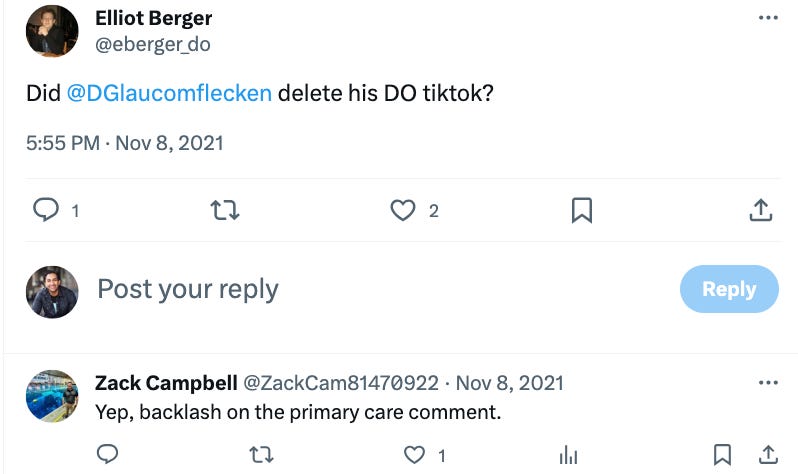
Glaucomflecken is essentially a woke medical comedian. His comedy tries to sate the most extreme left wing doctors. On at least 1 occasion, he deleted a video because it was perceived as critical of primary care.

Given this, it is natural that the extreme left wing position— that kids should mask— is one that became incorporated in his worldview, and naturally criticizing my Atlantic article was an easy way to signal his allegiance.

Ultimately, all of this behavior is sad. Instead of aspiring to be better students of evidence based medicine, experts simply want to be bigger virtue signalers. The failure in terms of why so many bad pandemic policies were pushed by so many is that so many people were not thinking independently, and perhaps some are simply not capable of it.

Do they deserve forgiveness?

Scott Galloway is asking for forgiveness. In my mind, forgiveness should be given to any civilian who held incorrect COVID policy views. I forgive the accountants and waiters of the world. But, experts and physicians have a duty to understand a medical topic before commenting, and while they should be forgiven, the worst offenders— those consistently wrong— should also be precluded from commenting on health policy going forward.

Additionally, compensation is required for the victims of bad policy. Every person fired over vaccine mandates— which were unethical as they did not halt spread— should be paid restitution. People who were fined for non compliance with mask mandates, or parents frustrated by masking policies in daycare should receive an apology. Families escorted off airplanes because children (as young as 2) did not mask, should be compensated. Once this happens, I think forgiveness is more palatable.

https://www.sensible-med.com/p/doctors-and-experts-who-got-it-wrong