Search This Blog

Saturday, December 16, 2023

Payers' increasing claims denials, delays 'wreaking havoc' on provider revenue cycles

 A jump in claim delays and denials is “wreaking havoc on providers’ revenue cycle performance” and contributing to health systems’ “volatile” accounts receivable and diminishing cash reserves, according to a recent pair of analyses.

The first, published this week by Kodiak RCA (formerly Crowe healthcare consulting), pulls average revenue cycle performance benchmarks from its platform incorporating data from more than 1,800 hospitals and 200,000 physicians.

The analysis found, among other trends, an increase in overall initial denial rates from 10.15% in 2020 to 11.2% in 2022, and then up again to 11.99% in the first three quarters of 2023.

Additionally, it pointed to 2020-2023 increases in 90-day-plus accounts receivable’s percentage of payer claim value, both for patients with Medicare Advantage (19% to 36%) and commercial (27% to 36%) coverage.

“Clearly, the leading driver of aged [accounts receivable] more than 90 days is related to increases in initially denied claims, which require additional time and resources from hospitals, health systems and medical practices to resolve,” the group wrote.

The other report, released late last month by Syntellis and the American Hospital Association (AHA), reviewed the financial data of more than 1,300 hospitals and health systems.

Its highlights included 55.7% and 20.2% increases in denials from Medicare Advantage and commercial payers, respectively, from the top of 2022 to the midway point of 2023.

It also outlined “significant volatility” among nationwide hospitals’ accounts receivable. As measured by every $1 million in net patient service revenue, the metric ranged from a low of $18,896 in May 2023 to a high of $33,598 in February 2023. Month-to-month fluctuations reached highs of $14,287 for commercial payers and $8,872 for Medicare Advantage payers.

“These issues compound reimbursement challenges from Medicare fee-for-service and Medicaid, which chronically underpay hospitals relative to the total cost of care,” Syntellis and AHA wrote in their report. “Taken together, a lack of proper and prompt reimbursement has both upstream impacts on hospitals’ cash flow as well as downstream impacts on patient care.”

Kodiak RCA’s analysis noted that the payer denials are a driving factor in other revenue cycle challenges for providers. Hospitals and other providers can’t bill patients for their share of the payment until the question of their insurance is settled, meaning that longer adjudication of an initial claim increases the time until providers will eventually receive that portion of their revenue from patients, the professional services group wrote.

What’s more, Kodiak RCA said that longer billing delays tend to reduce the likelihood that consumers will ever pay their bill — meaning the insurers’ denied and delayed claims are one likely factor in a 3.6% reduction in the rate of self-payments after insurance collection Kodiak RCA found among commercially insured patients.

“The out-of-sight-out-of-mind dynamic is as true in healthcare as it is in retail,” the group wrote. “It’s challenging enough from a revenue cycle and net revenue standpoint to have patients pay only about 40% of what they owe. It’s another thing to have the percentage dropping artificially because they’re not getting their bills on time. ... This can have a significant negative impact on a provider’s bottom line.”

Syntellis and AHA’s report noted that the payment collection difficulties land amid “significant” increases across multiple operating expense categories, like labor, drug, supply and maintenance spending. Together, the trends fueled a 28% decrease in hospitals’ median days of cash on hand (173 days to 124 days) from January 2022 through June 2023, according to the report.

“Such challenges will only worsen unless regulatory agencies conduct greater oversight of problematic payer practices and address other administrative hurdles that further strain hospital resources, deplete cash reserves, and inhibit medically necessary care,” Syntellis and AHA wrote.

Commentary from health system executives and management teams during the recent earnings season suggest growing frustration with payers’ claims practices. In October, Universal Health Services Chief Financial Officer Steve Filton told investors that payers’ “increasingly aggressive behavior” surrounding claims had weighed down the system’s managed care revenues, while Tenet Healthcare CEO Saum Sutaria, M.D., painted payers’ claims denials as “excessive and inappropriate” during his company’s investor call.

https://www.fiercehealthcare.com/finance/payers-increasing-claims-denials-delays-wreaking-havoc-provider-revenue-cycles

Fees charged by hospitals for colonoscopy procedures 50% higher than surgical centers: study

 A new price comparison study finds over 50% higher facility fees for commercially insured colonoscopies performed in hospitals rather than ambulatory surgery centers (ASCs), suggesting that “money has apparently been left on the table” for employers and consumers.

Published Friday in JAMA Health Forum, the analysis reviewed data on 13,287 facility fees charged by roughly 3,600 hospitals and 17,000 ASCs across the country. The data were made available last year under price transparency requirements for payers and compiled by pricing data comparison platform Turquoise Health.

Among these, the study’s researchers found that hospitals charged average facility fees of $1,530 for a colonoscopy, $1,760 for a colonoscopy plus a biopsy and $1,761 for a colonoscopy with the removal of polyps, as of May. At an ASC, the same three items were $989, $1,034 and $1,030 respectively.

Controlling for insurer, negotiated type and county fixed events revealed hospitals’ facility fees to be 54%, 56% and 61% higher across the three codes.

The wide price difference between hospitals and ASCs represents a great saving opportunity for many patients and employers, Ge Bai, professor in the Johns Hopkins Bloomberg School of Public Health’s Department of Health Policy and Management, as well as the study’s senior author, told Fierce Healthcare. “Money has apparently been left on the table.”

Bai said that the significant price differences “seem hard to justify” and often translate to higher payments for commercial beneficiaries and their sponsors (the patients and the employers) alike.

While hospitals and payers have both been required by the government to make their pricing available for some time now, the information has been difficult for patients and others to use due to limited or unclear formatting requirements, according to price transparency researchers and advocacy organizations. The government has taken notice, with the Biden administration and lawmakers alike taking recent steps to increase access.

Should the industry reach that point, stark differences in cost such as those highlighted in the study will begin driving changes in consumer behaviors, Bai said.

“Patients pay to obtain medical services. If the service is identical, many patients probably aren’t willing to pay more just because it is offered in a hospital,” she said. “Once patients are allowed to personally [and] directly benefit from using low-cost options, many patients will do so.” 

Bai and colleagues’ sample includes the fees disclosed by four of the country’s largest health insurers (Anthem, Cigna, Healthcare Service Corporation and UnitedHealthcare) and cover three common codes for colonoscopy, a procedure the researchers chose because it is “shoppable, largely homogeneous and commonly performed in both [hospital and ASC] settings.”

“Due to data limitations, we did not adjust for variation on system affiliation, case mix, utilization or quality of care across hospitals or ASCs,” they wrote. “Nevertheless, the results suggest that a site-neutral payment policy for a largely homogeneous and shoppable service may generate savings for commercial plan sponsors and beneficiaries.”

Though this study held its analysis to commercially insured patients, the location-specific differences in payment invoke the heated lobbying battle over site-neutral Medicare payments.

Hospitals contend that higher payments they receive for services that can be delivered in other settings are needed to support the broader array of care capabilities offered in their facilities. Advisory group recommendations and the recent passage of a bill containing site-neutral payment provisions for Medicare Part B drugs through the House, however, suggest that momentum is turning against hospitals on the issue.

https://www.fiercehealthcare.com/providers/hospitals-colonoscopy-facility-fees-over-50-higher-ambulatory-surgery-centers-study-finds

Google unveils MedLM generative AI models for healthcare; HCA, Augmedix, BenchSci to test

 Google continues to advance its generative AI models designed specifically for healthcare use cases. This week, the tech giant unveiled MedLM, a family of foundation models designed for healthcare industry use cases and available through Google Cloud.

Google's work on generative AI models in healthcare has advanced rapidly since it rolled out Med-PaLM, a large language model designed to provide answers to medical questions, just a year ago.

The company developed two models under MedLM, built on Med-PaLM 2. The first MedLM model is larger, designed for complex tasks. The second is a medium model, able to be fine-tuned and best for scaling across tasks, according to the company in a blog post. Its first two models are now available to U.S. Google Cloud customers via the company’s Vertex AI platform.

"In the coming months, we’re planning to bring Gemini-based models into the MedLM suite to offer even more capabilities," wrote Yossi Matias, vice president of engineering and research at Google and Aashima Gupta, global director, healthcare strategy and solutions at Google Cloud in the blog post.

Gemini is Google's newest large language model as a competitor to OpenAI and Microsoft's GPT-4.

Google says it has been working with companies to test MedLM and those companies are now moving it into production in their solutions, or broadening their testing. 

For the past several months, HCA Healthcare has been piloting a solution to help physicians with their medical notes in four emergency department hospital sites. Physicians use an app developed by tech company Augmedix on a hands-free device to create accurate medical notes from clinician-patient conversations.

Augmedix, which developed technology for ambient medical documentation, was piloting Google Cloud’s Med-PaLM 2 and will now integrate MedLM into its technology stack. 

"Generative AI solutions for use in healthcare delivery require a more tailored and precise approach than general purpose LLMs, which is why we value our strategic partnership with Google Cloud,” Ian Shakil, Augmedix founder, director, and chief strategy officer said. “Google Cloud has established its leadership as an AI innovator with solutions specifically designed to address the needs of healthcare providers.”

Augmedix uses Google Cloud’s Vertex AI platform to fine-tune some models using training data created by the company's existing technology, which generates 70,000 notes per week and spans more than 30 specialties.

The company anticipates that integrating MedLM into its ambient medical documentation products will improve the quality of medical note output and provide faster turnaround time. Augmedix also plans to rapidly expand into more sub-specialties through 2024.

BenchSci, a company that uses AI to hasten drug discovery, is integrating MedLM into its ASCEND platform to further improve the speed and quality of pre-clinical research and development.

Google also is working with Deloitte to use generative AI to improve provider search and Accenture to leverage the tech to improve patient access, experience and outcomes.

https://www.fiercehealthcare.com/ai-and-machine-learning/google-unveils-medlm-generative-ai-models-healthcare-hca-augmedix-and

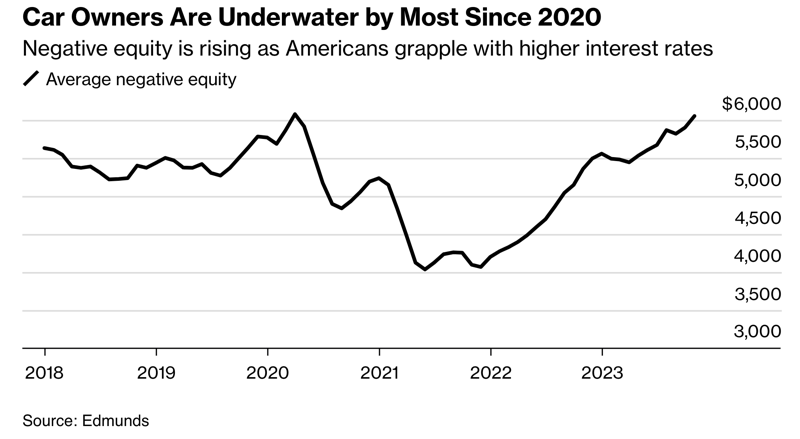
Number Of Americans In Upside-Down Auto Loans Continues To Worsen

 Consumers face increasing financial difficulties due to elevated inflation, a generational high in interest rates, maxed-out credit cards, lack of personal savings, and two years of negative real wage growth amid the mounting failures of 'Bidenomics.' The latest distress is that the number of Americans in upside-down auto loans has reached the highest level since 2020. 

According to automotive research firm Edmunds.com, the number of Americans with auto loans "underwater" or "negative equity" in November reached an average of $6,054, the highest level since April 2020. 

Source: Bloomberg 

Teamsters authorize strike at Anheuser-Busch's US breweries

 The Teamsters union said on Saturday that 99% of its members had voted to authorize a strike at brewer Anheuser-Busch's U.S. breweries.

The union is seeking an agreement that would improve wages, protect jobs and secure healthcare and retirement benefits for 5,000 of its members at Anheuser-Busch's 12 U.S. breweries.

The current agreement expires on Feb 29, 2024.

https://finance.yahoo.com/news/teamsters-authorize-strike-anheuser-buschs-190540698.html

Virtue Un-Signaled: San Francisco Halts Reparations Office Due To Budget Cuts

 San Francisco has committed a dastardly act of racism, putting a halt to its virtuous office of reparations amid budget cuts.

Apparently there are more important things than transferring wealth to black people, despite everything we've been told. The office, which was set to launch this year, was eliminated as part of Mayor London Breed's $75 million cuts to the city's budget in preparation for a major deficit in 2024.

The cuts come despite a fight from supervisor Shamann Walton, who called the cuts "disheartening," in a statement to the SF Examiner.

"I understand the importance of no cuts to existing programs, but the Black community will continue to pursue justice and equity through reparations here in San Francisco," said Walton. "My hope is that the city’s deficit is eliminated quickly so that we can fund the Office of Reparations and fulfill the commitment made to address the historical injustices and inequities that have persisted for generations for Black San Franciscans."

San Francisco Human Rights Commission Director, Sheryl Davis, told the outlet that despite cuts to the office of reparations, the city will continue to work on several related initiatives spawned from the effort - including locating a satellite campus in one of the nation's historically black colleges and universities in San Francisco, and collaborating with city officials to utilize vacant storefronts.

"A lot of the work, it’ll be tight but we’ll leverage some of the funding we had in our budget," said Davis.

The Office of Reparations was viewed as a key step in implementing the reparations plan, which was drafted by the African American Reparations Advisory Committee and accepted by the Board of Supervisors earlier this year. The $2 million would be used to hire staff who would begin to form and fund programs enumerated in the plan. -SF Examiner

In July, San Francisco’s African American Reparations Advisory Committee issued their final report (pdfwith a lengthy list of recommendations, including a $5 million lump sum payment to each eligible person and additional $97,000—adjusted to median income—each per year for the next 250 years; home, renters, and commercial insurance paid by the city; selling condominiums for $1 to eligible residents; and tax abatement on sales tax for the next 250 years.

https://www.zerohedge.com/political/virtue-un-signaled-san-francisco-halts-reparations-office-due-budget-cuts

Tech hedge funds soar, piggybacking on Nasdaq rally

A number of U.S. equities hedge funds focused on technology are set to post double-digit returns this year, boosted by a powerful rally in the Nasdaq and after being hard hit in 2022, according to performance numbers obtained by Reuters.

San Francisco-based SoMa Equity Partners' long/short fund, led by chief investment officer Gil Simon, soared 48% this year through November, according to a document, versus a 36% gain in the Nasdaq. Last year, the fund was down 33.9%.

Whale Rock Capital's long/short rose 28%, compared with a decline of 43% last year, two sources familiar with the matter said. Tiger Global Management's long/short fund was up 27%, a third source said - it lost 56% last year.

Coatue Management was up 20% through November, a source familiar with the return said. Last year, it was down 19%.

The so-called TMT hedge funds' (technology, media and telecommunications) performance comes as the Nasdaq surged 41.3% so far this year fueled by investors bets on the prospects of artificial intelligence. That compared with 2022 when the index fell 33%.

This year's trend has mainly benefited the so-called Magnificent Seven mega-cap growth and technology companies: Apple, Microsoft, Alphabet, Amazon , Nvidia, Meta Plaforms and Tesla .

In a letter to investors seen by Reuters, SoMa Equity told its clients it had holdings in Microsoft, Amazon and Meta. Still, those shares were not among SoMa's five top contributors to performance in the last quarter. The hedge fund profited the most from exposure to Universal Music Group NV, Wix.Com Ltd, Uber Technologies Inc, Varonis Systems Inc and Atlassian Corporation, it said.

On the short side, bets against consumer-led shorts related to automotive, travel and luxury spending also helped performance, according to the letter.

On average, TMT long/short hedge funds are up 14.2% this year through November, according to data provider PivotalPath, after tumbling 22.4% in 2022.

https://finance.yahoo.com/news/1-tech-hedge-funds-soar-231853457.html