Search This Blog

Sunday, April 14, 2024

NYC block turned into illicit open-air market for migrant crooks, prostitution

 A stretch of Jackson Heights has devolved into an illegal migrant shopping district — an unchecked open-air market where everything from women to stolen goods can be had, The Post has learned.

Roosevelt Avenue near 91st Street is littered daily with migrant vendors hawking goods they ripped off from shopkeepers just steps away, while prostitutes proposition passersby at all hours — and frustrated merchants and residents say they’re helpless to do anything about it.

“It’s relentless,” said Milton Reyes, who manages Mi Farmacia pharmacy on the avenue. “You should see it on Saturdays. It’s so heavy you can’t even step onto the sidewalk. There are a lot of doctor’s offices right around here and my customers don’t even want to get dropped off.

Women standing on the sidewalk near the intersection of Roosevelt Avenue and Elmhurst Avenue on April 13, 2024.NYPJ
Mechanical tools on display near Roosevelt Ave. on April 13, 2024.NYPJ for New York Post
Vendors selling tools on the sidewalk near Roosevelt Ave.NYPJ for New York Post

“I’m not faulting the police,” Reyes added. “They will come by and they will pick up a few of them. But as soon as the police car pulls away they start moving back. Twenty minutes later they’re all set up again like nothing happened.”

Migrant peddlers lay out the stolen merchandise for re-sale at a steep discount, with items as benign as mouthwash, diapers and baby formula spread out on blankets or beach towels right on the sidewalk.

The ill-gotten goods are stored in suitcases packed into vans parked across the street, hauled out for display starting in the morning — with one crooked vendor even wheeling up the items inside a stolen Target shopping cart during one business day this week.

They scattered when a reporter and photographer from The Post showed up, mistaking the news crew for police officers — but were back in business as soon as they passed.

Sex workers openly cruise the street, as older madams sit nearby and point out potential johns as they pass by.

One law enforcement source blamed soft-on-crime laws that severely limit what cops can do and cut low-level, non-violent offenders loose once they get to court.

“Roosevelt Avenue is the microcosm — a perfect storm composed of lunatic legislation that prevents enforcement of laws and the subsequent punitive results,” the source said.

Migrant sidewalk vendors peddle goods shoplifted from retail stores just steps away on Roosevelt Avenue.Stephen Yang
Milton Reyes, manager of Mi Farmacia in Jackson Heights, says shoplifters ransack the store and sell the goods on the sidewalk outside.Matthew McDermott

“Add to that waves of people with nothing to lose and you have criminality and degradation in quality of life for the community — and the city as a whole.”

Open-air prostitution has plagued sections of Roosevelt Avenue for months, with a seedy “Market of Sweethearts” thriving with sex for sale right on the street or inside a series of walk-up buildings now functioning as brothels.

In January, cops moved in and shuttered a dozen of the bordellos for their illegal activity and unsanitary conditions — but it didn’t stop the sleazy sex trade for long.

Migrant vendors sell their stolen goods on blankets and beach towels, which can be picked up and stashed if the police show up.Stephen Yang

In Jackson Heights, the hookers now share the landscape with shoplifting migrants who mob and ransack local retailers then brazenly sell their stolen merchandise for 20% or 30% less just steps from the stores, retailers said.

“They are stealing,” Francisco O’Porta, a security guard at “Lot-Less” told The Post. “They rip it out of the box, but it’s ours. You can see. It is brand new, but they are selling it as used. It’s our stuff.

“They have been training people,” said O’Porta, 55, of Long Island City. “They have lookouts, you know, people to yell so they can pick up and leave when police come. I am catching a lot, a lot of them stealing. I caught 20 people last week. Twenty in one week. They are hurting business.”

“It’s relentless,” one merchant says of the illegal peddling taking place right outside his store — with items stolen from his shop up for sale at a discount.Stephen Yang
From early morning, migrants spread out stolen goods on the sidewalk on Roosevelt Avenue and sell them at a discount while ripped-off retailers can do nothing.Stephen Yang

Customers constantly complain, but shopkeepers’ calls to 311 do little to stop the lawlessness.

“I don’t know what’s ever going to get rid of this,” said one local who would only identify himself as Zhou H. “It’s like a sub-economy. Everybody buys from these guys. There was a few, mostly at night. Kind of like a bazaar. About a year ago, it built up.

“But I thought, these people aren’t getting the kind of opportunities, they need to feed themselves, you know, they’re trying to survive so, whatever,” he said. “About a year ago, there’s five of them, starting at 10 in the morning. Then 10 of them and then there’s 20 of them all day. At night? Forget about it!

“It’s just become normal,” he added.

https://nypost.com/2024/04/14/us-news/nyc-block-turned-into-illicit-open-air-market-for-migrant-crooks-sources/

'Thoughts on Crude Market Following Iran's Direct Attack On Israel'

 Iran's direct attack on Israel on Saturday evening is viewed certainly as an escalation in the Middle East conflict. Tehran's missile and drone attack (widely unsuccessful) has been well-telegraphed (read: here & here) for the last two weeks, pushing up Brent crude oil futures above the $90 a barrel mark on heightened geopolitical risks in the region. 

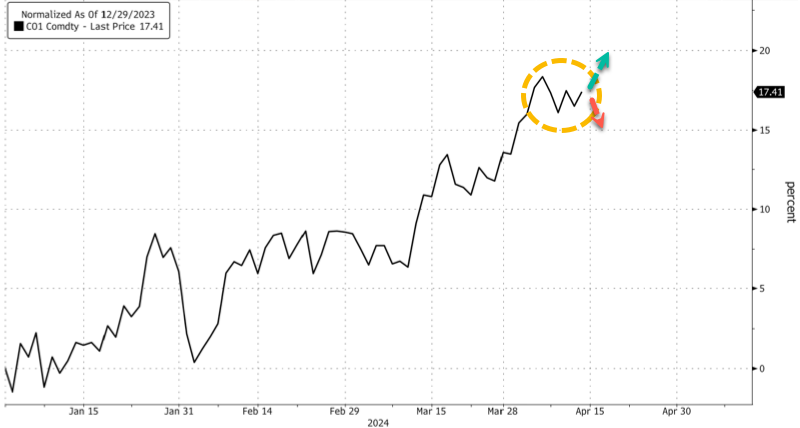
Iran's direct attack on Israel could lead some traders to reevaluate the geopolitical risk premium even more. And this is because Tehran's attack on Israel was direct, instead of through the usual foreign proxies such as Lebanon's Hezbollah militia and Yemen's Houthi rebels. So far, crude prices have been up 17.5% this year and have surged nearly 4% since the strike on Iran's embassy earlier this month. 

"Oil prices might spike at the opening, as this is the first time Iran struck Israel from its territory," said Giovanni Staunovo, an analyst at UBS Group AG, as quoted by Bloomberg

Staunovo added, "How long any bounce will last will also depend on the Israeli response."

According to Iman Nasseri, Middle East managing director at consultancy FGE, Brent crude has already priced in about a $10 risk premium. He said another $2 to $5 premium could be priced in on further concerns about tit-for-tat attacks across the region. 

On Sunday, Iran warned the US if it supports an Israeli counterattack, then expect further escalation in the conflict across the region, especially with missiles and drones targeting US military bases. 

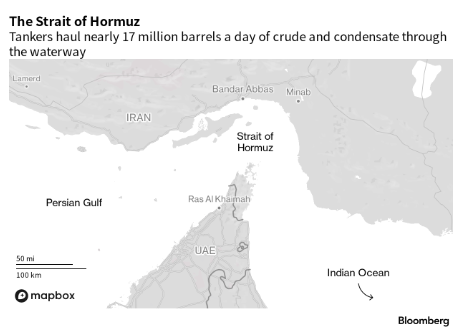
Adding more fears in energy markets is the report earlier on Saturday that Iran's paramilitary Revolutionary Guard seized an Israeli-linked container ship near the Strait of Hormuz, a critical maritime chokepoint in the region. Already, Iran-backed Houthis have targeted US and Israeli ships in the Bab-el-Mandeb Strait, yet another critical maritime chokepoint that disrupts global trade flows. 

Making sense of this all is Bloomberg's commodity expert Javier Blas, who outlined a few conclusions for energy markets following the flare-up in violence overnight:

  1. From a purely physical standpoint, nothing has changed in the world of oil. Middle Eastern crude is flowing into the global economy unimpeded, and the Strait of Hormuz, the world's most important energy chokepoint, remains open to shipping. Put simply: there's no oil shortage.

  2. The risk of a future disruption has increased. It would be naïve to say the Middle East looks today exactly as it did last week; a lot did change. I don't think it was a purely symbolic attack. Even though telegraphed well in advance, Iran launched about 170 drones, 30 cruise missiles and 120 ballistic missiles, with the clear aim of overwhelming Israel's defences. The options market, via deep out-of-the-money call contracts, should reflect the higher risks

  3. Iran appears to have aimed for an escalation to-deescalate, rather than opening the first chapter of a regional war. Even well before the drones and missiles reached Israel, Tehran indicated the attack was a one-off "legitimate defense" after the Israeli bombing of its embassy in Syria: "The matter can be deemed concluded." If Israel considers that its response, bringing America and several Arab nations alongside to neutralize almost all the incoming bombs, was akin to a strategic victory, then the region returns to its precarious status quo. If so, headline oil prices don't need to rally. Instead, the risk will be reflected better via the options market.

  4. Putting aside geopolitics, oil supply and demand fundamentals look healthy. Even the most bearish forecast for oil demand suggests consumption growth in 2024 will match the historical annual average of 1.2 million barrels a day. The bullish forecasts are for much higher growth, in the 1.5-to-1.9 million barrels a day range. On the supply side, a series of glitches have reduced production this year, particularly of US shale oil. As a result, global oil inventories, which typically increase in the first half of the year, have remained unchanged. Unless OPEC+ increases production soon, stockpiles will drop in the second half of the year.

  5. OPEC+ is keeping the market tight. Despite oil prices well above $80, it decided in late March to roll over its first-quarter output cuts into the second quarter. My expectation is that the group will open the taps at its next meeting, scheduled for June 1. In its last monthly oil report, the cartel noted on April 11 that the "robust oil demand outlook for the summer warrants careful market monitoring" – the kind of preparatory language ahead of an output hike.

  6. How OPEC+ increases production would be as important as the hike itself. I expect the group to hike output slowly, leaving its options open. Rather than pre-announcing a series of production increases, it could instead opt to call monthly meetings, keeping the market guessing whether it would add enough crude.

  7. Unless Israel and Iran engage in tit-for-tat attacks that disrupt oil flows, OPEC+ has more than enough spare production capacity to control a price rally. Saudi Arabia, the United Arab Emirates, and Iraq are keeping about 5 million barrels of day out of the market – equal to about 5% of the world's demand, and more than what Iran itself produces.

  8. Barring a regional war, the biggest oil supply risk is political. President Joe Biden has promised a "diplomatic" response to the Iranian attacks. Since he was inaugurated in 2021, Biden has all but allowed Iran to increase its oil output, relaxing the enforcement of US sanctions on Tehran. In March, Iranian oil output hit a five-year high of 3.25 million barrels a day, up from 2.1 million in January 2021. If Biden resumes enforcing the sanctions, it could tighten the market significantly unless OPEC+ offsets the impact. I'm dubious Biden would take that course of action in an election year.

  9. Russia stands to win. Thanks to a tight oil market, Moscow is already selling its crude at $75 a barrel, well above the Group of Seven cap of $60 a barrel. If Washington enforces sanctions against Iran, it could create space for Russia's own sanctioned barrels to both win market share and achieve even higher prices. One of the reasons why the White House turned a blind eye to Iranian oil exports is because its priority was to hurt Russia. Higher Iranian production was the unsaid — and unrecognized — cost of that policy. Now Washington needs to reconsider what's its biggest concern.

  10. The risk that the White House would tap the country's Strategic Petroleum Reserve later this year has increased notably. Even if half the size it was a decade ago, the stockpile of about 365 million barrels is still a formidable force. Biden can use the cover of rising tension in the Middle East to justify its use and try to push oil prices down toward $80 a barrel if OPEC+ decides it's happy letting them rise to $99.99, or even beyond.

All in all, higher crude prices are terrible news for President Biden's reelection odds as inflation reaccelerates. We explained to readers in early March that the probability was rising that America's enemies would 'weaponize crude' against the US to trigger the next financial shock.

https://www.zerohedge.com/commodities/javier-blas-outlines-ten-takeaways-crude-market-following-irans-direct-attack-israel

Fallout from Trump's bid to overturn election loss heads to Supreme Court

 The actions of Donald Trump and his supporters following his 2020 election loss top the U.S. Supreme Court's agenda in the next two weeks in cases involving his bid to avoid prosecution for trying to undo his defeat and an attempt by a man indicted in the Capitol attack to escape a charge that Trump also faces.

The two cases assume even greater prominence as Trump campaigns to return to the White House as the Republican candidate challenging Democratic President Joe Biden in the Nov. 5 U.S. election.

The justices on Tuesday hear arguments in an appeal by Joseph Fischer, who was indicted on seven charges following the Jan. 6, 2021, Capitol riot including corruptly obstructing an official proceeding - congressional certification of Biden's victory over Trump. They then hear arguments on April 25 in Trump's assertion of presidential immunity from prosecution.

"The court has not yet directly addressed issues related to Jan. 6," said Erwin Chemerinsky, dean of the University of California, Berkeley School of Law. "But Fischer and Trump so clearly raise issues arising from Jan. 6."

Trump took numerous steps to try to reverse his 2020 loss. His false claims of widespread voting fraud helped fuel the attack on the Capitol as Congress met to certify Biden's victory. Trump and his allies also devised a plan to use false electors from key states to thwart certification.

Federal prosecutors brought obstruction charges against about 350 of the roughly 1,400 people charged in the Capitol attack including Fischer and Trump. A Supreme Court ruling dismissing the charge against Fischer could make it more complicated - but not impossible - to make the charge stick against Trump, according to experts. The charge carries a sentence of up to 20 years in prison, though Jan. 6 defendants convicted of obstruction have received far lesser sentences.

This is one of four criminal cases against Trump, whose first trial gets underway on Monday in New York on charges involving hush money paid to a porn star. Trump has pleaded not guilty in all of the cases and called them politically motivated.

The Supreme Court on March 4 reversed a ruling by Colorado's top court to exclude Trump from the state's ballot under a constitutional provision involving insurrection. But the justices did not address the lower court's finding that Trump had created "an atmosphere of political violence" before the Jan. 6 attack and "engaged in insurrection."

IMMUNITY CLAIM

Until Trump, no former president had faced criminal charges.

Trump has asserted that he has "absolute immunity" because he was serving as president when he took the actions that triggered Smith's election subversion indictment. Smith has urged the Supreme Court to reject that claim on the principle that "no person is above the law."

In August 2023, Smith brought four federal criminal counts against Trump in the election subversion case: conspiring to defraud the United States, corruptly obstructing an official proceeding and conspiring to do so, and conspiring against the right of Americans to vote.

Fischer is awaiting trial on six criminal counts, including assaulting or impeding officers and civil disorder, while he challenges his obstruction charge at the Supreme Court.

According to prosecutors, Fischer charged at police officers guarding a Capitol entrance during the attack. Fischer, at the time a member of the North Cornwall Township police in Pennsylvania, got inside and pressed up against an officer's riot shield as police attempted to clear rioters. He remained in the building for four minutes before police pushed him out.

U.S. District Judge Carl Nichols, a Trump appointee, dismissed Fischer's obstruction charge, ruling that it applies only to defendants who tampered with evidence. The U.S. Court of Appeals for the District of Columbia Circuit reversed that decision, ruling that the law broadly covers "all forms of corrupt obstruction of an official proceeding."

A Supreme Court decision favoring Fischer could mean that hundreds of other defendants who faced the same charge could seek to be re-sentenced, withdraw their guilty pleas or request new trials.

"It may not make a lot of practical difference in most cases because if defendants were convicted of multiple charges the judge might decide not to alter the sentence even if the obstruction charge is gone," said Randall Eliason, a former federal prosecutor who now teaches at the George Washington University Law School.

About two-thirds of the Jan. 6 defendants charged with obstruction also were charged with other felonies.

Eliason said that a win for Fischer might not deter Smith from pursuing the obstruction charges against Trump, despite the higher bar that the Supreme Court might set.

"The charges against Trump can probably survive because Smith will be able to argue that his case did involve evidence-based obstruction, based on the slates of phony electors," Eliason said.

Legal experts have said the Supreme Court would need to rule by about June 1 for Trump's trial on the election-related charges to finish before Nov. 5. If Trump regains the presidency, he could seek to force an end to the prosecution or potentially pardon himself of any federal crimes. Trump has pledged to pardon Jan. 6 defendants.

https://www.yahoo.com/news/fallout-trumps-bid-overturn-election-100300785.html

Medical Properties Trust Sells Majority Interest in Utah Hospitals

 Generates Approximately $1.1 Billion of Total Cash Proceeds to MPT

Brings Total Liquidity Transactions Year-to-Date to $1.6 Billion, or 80% of MPT’s Initial FY 2024 Target

Medical Properties Trust, Inc. (the "Company" or "MPT") (NYSE: MPW) today announced that it has sold its interests in five Utah hospitals to a newly formed joint venture (the "Venture") with an investment fund (the "Fund") affiliated with a leading multi-strategy, multi-billion dollar institutional asset manager with a proven track record in real estate investments. MPT has retained an approximate 25% interest in the Venture and the Fund purchased an approximate 75% interest for $886 million, fully validating MPT’s underwritten lease base of approximately $1.2 billion. Simultaneous with the closing of this sale transaction, the Venture placed new non-recourse secured financing, providing $190 million of additional cash to MPT based on its share of the proceeds and further confirming underwritten asset values.

https://finance.yahoo.com/news/medical-properties-trust-sells-majority-200500721.html

Israel's Defense Against Iran Attack Overnight 'Likely Cost Over $1 Billion'

 Via Middle East Eye

It cost Israel more than $1bn to activate its defense systems that intercepted Iran's massive drone and missile attack overnight,  according to a former financial adviser to Israel's military. 

"The defence tonight was on the order of 4-5bn shekels [$1-1.3bn] per night," estimated Brigadier General Reem Aminoach in an interview with Ynet news.

Aminoach highlighted that the staggering price tag stands in contrast to the relatively low amount that Iran had spent to launch its assault, which some estimates have put at less than 10 percent of what it cost Israel to stop the attack. 

Iran launched more than 300 drones and missiles towards Israel on Saturday, in response to an Israeli attack on its consulate in Syria that killed two senior Revolutionary Guard commanders earlier this month.

Israel said its military forces and its allies had intercepted 99 percent of the missiles, but some ballistic missiles penetrated Israeli defences and hit the Nevatim Airbase in southern Israel. 

"If we're talking about ballistic missiles that need to be brought down with an Arrow system, cruise missiles that need to be brought down with other missiles, and UAVs [unmanned aerial vehicles], which we actually bring down mainly with fighter jets," he said. 

"Then add up the costs - $3.5m for an Arrow missile, $1m for a David's Sling, such and such costs for jets. An order of magnitude of 4-5bn shekels."

David's Sling is a weapons system meant to intercept medium to long-range rockets and missiles. The Arrow system was designed to thwart long-range missiles, including the types of ballistic missiles Iran launched on Saturday and of long-range missiles launched by the Houthis in Yemen.

https://www.zerohedge.com/geopolitical/israels-defense-against-iran-attack-overnight-likely-cost-over-1-billion