Search This Blog

Thursday, August 8, 2024

American Stasi: Tulsi Gabbard Confirms "Quiet Skies" Nightmare

 Tuesday night, while self-styled Democratic nominee Kamala Harris pledged to defend “freedom, compassion, and the rule of law” to cheers in Philadelphia, Hawaii’s Tulsi Gabbard described being tracked by teams of government agents in a surveillance regime more reminiscent of East Germany than a free country. Whistleblowing Air Marshals told Uncover DC Gabbard was singled out as a terror threat under the so-called “Quiet Skies” program, and the former presidential candidate says she noticed.

“The whistleblowers’ account matches my experience,” says Gabbard. “Everything lines up to the day.”

This story began two weeks ago, when the former Hawaii congresswoman returned home after a short trip abroad. In airport after airport, she and her husband Abraham Williams encountered obstacles. First on a flight from Rome to Dallas, then a connecting flight to Austin, and later on different flights for both to cities like Nashville, Orlando, and Atlanta, their boarding passes were marked with the “SSSS” designation, which stands for “Secondary Security Screening Selection.” The “Quad-S” marker is often a sign the traveler has been put on a threat list, and Gabbard and Williams were forced into extensive “random” searches lasting as long as 45 minutes.

“It happened every time I boarded,” says Gabbard. The Iraq war veteran and current Army reservist tends to pack light, but no matter.

“I’ve got a couple of blazers in there, and they’re squeezing every inch of the entire collar, every inch of the sleeves, every inch of the edging of the blazers,” she says. “They’re squeezing or padding down underwear, bras, workout clothes, every inch of every piece of clothing.” Agents unzipped the lining inside the roller board of her suitcase, patting down every inch inside the liner. Gabbard was asked to take every piece of electronics out and turn each on, including her military phone and computer.

That was the other strange thing. “I use my military ID to get through security sometimes,” says Gabbard, who among other things traveled to her reservist base in Oklahoma during this period. Once, she was unable to get through security with military ID. Transportation Security Administration (TSA) agent saw the “SSSS” marker. “The TSA agent said, ‘Why are you Quad-S? You’re in the military,’” explains Gabbard. “And I said, ‘That’s exactly what I’m wondering.’
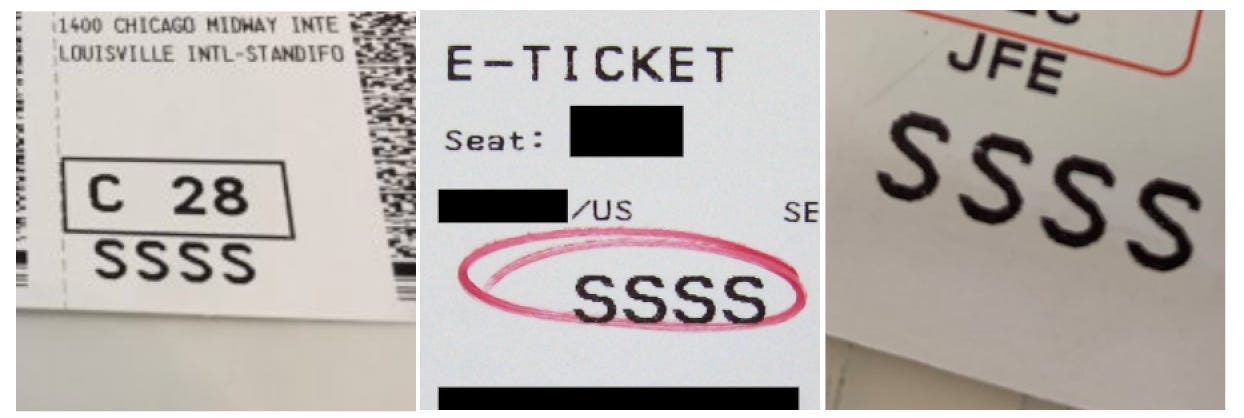
Examples of “Quad-S” boarding passes. Tulsi Gabbard’s air tickets, as well as those of her husband Abraham, were similarly marked

Gabbard goes on: “Then I said, ‘The only thing I can think of is, I work in politics.’ And he said, oh.”

The agent told her he’d encountered supporters of a certain former president who’d had no issues traveling before, but were now “marked quad-S every time they traveled.” Gabbard shrugged and slogged through, still encountering extra security. At one flight, she says, there were “at least six TSA agents doing additional screening,” along with canine support. “There were dogs in Dallas when we got there, dogs at a couple of the gates.”

She called a colleague, who told her: these things happen, don’t worry. “So I thought, ‘Maybe I’m just being paranoid,’” Gabbard says. Then she saw this past Sunday’s report in Uncover DCa site edited by the well-known Twitter writer Tracy BeanzUncover interviewed Sonya LaBosco, the Executive Director of the Air Marshal National Council (AMNC), an advocacy association for Federal Air Marshals. Disclosing Gabbard had been placed on a domestic terror watch list, the former Marshal LaBosco told a disturbing story:

According to LaBosco… Gabbard is unaware she has two Explosive Detection Canine Teams, one Transportation Security Specialist (explosives), one plainclothes TSA Supervisor, and three Federal Air Marshals on every flight she boards.

Uncover DC said Gabbard was initially placed on the list on July 23rd, and that trios of Air Marshals first began following her on flights on July 25th. As Racket would learn, surveillance was conducted on at least eight flights, with different three-Marshal teams for each flight, part of the Transportation Security Administration (TSA) “Quiet Skies” regimen that can literally surround people with human watchers. There are “potentially 15 or more TSA uniformed and plain clothes” at a gate for such assignments, LaBosco told Racket. The story about Gabbard was surfaced by two TSA whistleblowers, including one detailed to follow her. When Gabbard read this, she felt a shock of recognition.

“When I saw that, I thought, ‘Wow, okay. So everything I was experiencing was exactly what I feared was going on,’” she says.

Though clearly outraged, Gabbard stresses the important part of her story isn’t any inconvenience or insult she’s gone through.

“This is not a woe-is-me situation,” she explains. Instead, “it’s bringing to the forefront… how brazen the political retaliation and abuse of power continues to be under the Biden-Harris administration.”

The former Democratic congresswoman from Hawaii’s 2nd district is far from the first American to be placed under physical surveillance as a “domestic terrorist” threat in post-9/11 America. Especially since January 6th, 2021, when the Quiet Skies program expanded to accommodate a broad effort to track people who were at the Capitol, Americans following Americans on airplanes is no longer uncommon, though the public largely has no idea of the scale of this activity.

However, Gabbard is by far the highest-profile figure to be caught up in this surveillance web. As a war veteran with no connection to J6 or any other known offense, her appearance on a terror watch list is striking, and symbolic of the way politicians and intelligence officials have turned the machinery of the War on Terror inward in the last decade. This aspect of the story galls Gabbard the most.

“I enlisted because of the terrorist attack on 9/11,” Gabbard says. “I was like a lot of Americans. We enlisted to ensure the safety, security, and freedom of the American people and go after the terrorists who attacked us. And so now to have confirmation — I guarantee there are other men and women in uniform or veterans now being targeted.

“I can’t think of a word that adequately captures how I feel. The closest I can think of is the deepest sense of betrayal.” She pauses. “It cuts to the core.”

Gabbard pointed to this summer’s release of documents from the ill-fated “Homeland Intelligence Experts Group,” an advisory panel led by former CIA chief John Brennan and former Director of National Intelligence James Clapper. Litigation filed on behalf of former Ambassador to Germany Ric Grenell led to the disbanding of the group, and the production of documents identifying Trump supporters, people “in the military,” or “religious” as “indicators for extremism or terrorism.” Gabbard says this is an indication that the intelligence community is targeting people of “many stripes,” but “especially so those who still wear the uniform or who have worn the uniform.”
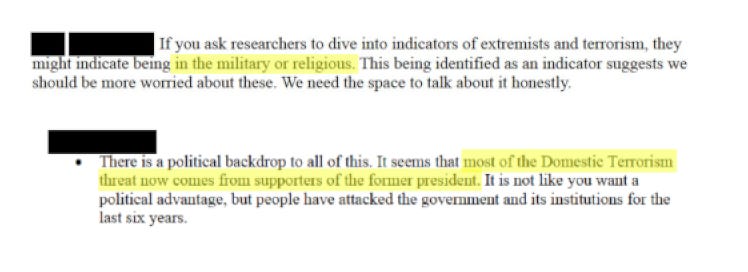
“IN THE MILITARY”: The Homeland Intelligence Experts Group identified soldiers as a heightened risk for domestic terrorism

Neither Gabbard nor, apparently, the whistleblowing Marshals know why the former congresswoman would be on a terror watch list. Gabbard has been a persistent, pointed critic of politicians in the current administration. The day before her reported placement on the TSA list, Gabbard appeared on the Ingraham Angle and criticized the “proxy war” in Ukraine, saying the administration was selling the public “crap” excuses for expanding its military commitment, with intent to turn Ukraine into “another Afghanistan.” A debate clash in the 2020 primary was also a factor in ending Harris’ run that year, featuring the viral line: “She put over 1500 people in jail for marijuana violations and then laughed about it when asked if she ever smoked.”

Gabbard’s account squares with LaBosco’s description of how Quiet Skies works. Surveillance, LaBosco says, is “every flight, every leg. If she has three legs that day, it’ll be nine Air Marshals. So if she does three flights in a day, she’ll have a set of Air Marshals on every one of her flights.” As for canine teams, “They maneuver over to the gate area. You will have plainclothes TSA officers, you will have uniformed TSA officers and the canine teams will be running in the gate area. They’ll have them floating around to try to pick up a scent of something.” LaBosco says these dogs are only trained for explosives, not narcotics.

What now? Gabbard, who has spoken to at least one of the whistleblowers, is reviewing possible courses of action, contacting former congressional colleagues about a possible Hill investigation. In a seemingly related matter, Empower Oversight — the firm that represented FBI whistleblowers Steve Friend and Marcus Allen as well as IRS special agents Gary Shapley and Joseph Ziegler in the Hunter Biden case — sent a letter Monday night to Homeland Security Inspector General Joseph Cuffari demanding an immediate investigation in the Gabbard case. The firm represented an Air Marshal in another ugly Quiet Skies case two years earlier (see below), and though Cuffari’s IG office promised in January 2023 to investigate, there’s no evidence it ever did, making the Gabbard story more troubling.

Worse, Empower today says it’s learned that the TSA has already initiated an investigation to identify the two TSA whistleblowers who leaked “sensitive security information” in Gabbard’s case. The firm sent another letter to the IG this morning asking for help in stopping retaliation before it begins. “A retaliatory investigation that hunts for whistleblowers in order to intimidate them into silence is exactly the wrong step for the agency to take,” the firm wrote, adding that the TSA “should be investigating the abuses on which [Marshals] are blowing the whistle.” The TSA has not commented for this article.

“Quiet Skies” is a Transportation Security Administration (TSA) program for tracking “travelers who may present an elevated risk,” as well as “unknown or partially known terrorists.” It’s a signature initiative for a new vision of the federal enforcement state that, as covered in this space before, moved after 9/11 from an emphasis on making cases and building prosecutions to endless intelligence-gathering as well as “disruption” and “prevention.” In a key moment, the FBI in 2008 put out a new “baseline collection plan,” which urged agents to come with plans to “disrupt” potential “acts of violence” or other “criminal behavior.” Agents began getting credit for an internal metric called “disruptions,” which allowed them to rise without records of prosecutions or even arrests.

Because most investigations under this new system will never lead to court, agents do not have to worry about meeting probable cause standards or justifying surveillance. The behaviors may be technically permitted, even if some would consider them unconstitutional.

“It all comes under the heading of the Department of Pre-Crime,” adds Empower attorney Jason Foster, longtime Chief Investigative Counsel to the Senate Judiciary Committee. “So it’s ‘We don’t have to prove anything. We’re not going to court. We’re just following people.’”

In the wake of 9/11 programs like the TSA’s “No Fly List” and the multi-agency Terrorist Screening Center regularly made the news as the focus of controversies, with criticism often coming from Democrats. In an incident that sounds similar but in fact underscores the expansion of the scope of such programs, the late Massachusetts Senator Ted Kennedy was prevented from boarding planes on five occasions in 2004, apparently because a suspected terrorist was using “Anthony Kennedy” as an alias. These programs symbolized the Bush-era reflex for wide-scale screening of mostly Muslim suspects, and came to be frowned upon as racist and anachronistic. When a judge in 2019 finally declared the Terrorist Screening Database unconstitutional, voices across the spectrum cheered, “It’s about time.”

Despite the perception that terrorist watchlists are a thing of the past, they’ve actually expanded, with Clear Skies representing an aggressive new generation of watchlisting, which no longer just targets Muslims but ranges of alleged domestic offenders. Though it’s theoretically possible Gabbard’s case will prove a mistaken-identity caper à la Kennedy’s incident (“I can’t imagine what, but they might have an excuse,” a Republican House aide counseled), LaBosco insists whistleblowers waited to make sure it wasn’t an “anomaly” before coming forward. “We thought, ‘Maybe this was a mistake,’” she says. “But then, second flight, third flight… no, this is no mistake.”

Quiet Skies eats up an astonishing amount of resources: an Inspector General’s report about the program in 2019 “identified $394 million in funds that could be put to better use,” meaning nearly half the Air Marshals’ budget was being wasted. LaBosco says this is no surprise. “Think about the overtime, the vouchers, the overnight travel, the per diems. Think of all the wasted resources that we so desperately need right now… We’re not going to find a terrorist following Tulsi Gabbard. We’re not even looking for the bad guys anymore.”

Air Marshals have complained more than once about being asked to spy on Americans. The existence of the program was first exposed on July 28, 2018, when Boston Globe writer Jana Winter published an exposé: “Welcome to the Quiet Skies.” The Globe report said 30 or more people were followed every day by Air Marshals, some of whom told the paper they worried the program “may be unconstitutional.”

The Globe story led to a July 30th letter Massachusetts Senator Ed Markey to TSA Administrator David Pekoske, asking about reports that the TSA was “monitoring seemingly innocuous behavior such as whether a person slept on the plane, used the bathroom, or obtained a rental car.” The letter was followed by a remarkable (if mostly unattended) hearing in which Markey questioned Pekoske in September 2018.

When Markey asked if it were true that “innocent” Americans not suspected of crimes were followed under Quiet Skies, Pekoske deflected, then said finally, “I wouldn’t use the term ‘innocent.’” The hearing also disclosed that “thousands” of Americans were in the program. Pekoske later conceded Quiet Skies hadn’t led to a single arrest, nor had it foiled any plots, a fact that is apparently still true:

Three years later in July 2021, in a story out of a Philip K. Dick novel, a Senior Federal Air Marshal with 27 years of experience discovered that his wife had been labeled a “domestic terrorist.” She was reportedly targeted for “Special Mission Coverage” for having attended the January 6th speech by Donald Trump at the Capitol, which she did not enter. When the Marshal told his supervisor, he was advised to “let it play out” as “it was not our investigation.”

Eventually, the Marshal turned to aforementioned whistleblower firm Empower Oversight, which helped him file a protected disclosure with the Office of Special Counsel. The OSC on July 8, 2021 wrote back, declining to refer the matter for investigation to the Inspector General’s office. Empower then wrote directly to the Inspector General’s office, which to date has “provided no public accounting of what it has done.” The Marshal did manage to work with the FBI to have his wife’s name removed from the terror watchlist, though this did not slow the program.

Quite the contrary, according to LaBosco, who says the program has grown “off the charts,” especially since January 6th. “They’re watching 8-year-old children. They’re following 17-year-old cheerleaders that were traveling for cheer competitions, people who lost their legs in combat… TSA is out of control against the American people.”

Gabbard’s recent political career has already been marked by bizarre attacks and harassment. A feature describing her as a favorite of the Putin government was timed to the launch of her 2020 presidential campaign, and Hillary Clinton made waves by denouncing her as a Russian “asset.” After this episode, she intends to fight back. “I’m going to be encouraging former colleagues of mine in Congress who I know are concerned about this to exercise their oversight authorities,” she says.

“These actions are those of a tyrannical dictator. There’s no other way to describe what they’re doing.”


Matt Taibbi


https://www.racket.news/p/american-stasi-tulsi-gabbard-confirms

The greatest threat to the Democrats’ election hopes

 "I want my life back." It’s a broadly held sentiment that poses the greatest threat to the Democrats’ election hopes this November. Here’s why. 

For working- and middle-class Americans, it means returning to a time when you could go to the grocery store or fill your gas tank without being shocked by the costs. A lost and better time when getting a burger and fries was not a luxury purchase, your savings were sufficient to meet an unexpected expense, buying a house was not an impossible dream, and getting that new car was something your budget could handle. 

Those bygone days harken to a time before Democrats saw the pandemic as an opportunity to transform our economy. Recall the February 2021 The New York Times article titled "The Biden Team Wants to Transform the Economy. Really." Democrats don’t talk about that much anymore, and with good reason. 

Their post-pandemic spending spree caused "inflationary pressures of a kind we have not seen in a generation" – as their economist emeritus, Larry Summers, warned it would. As he predicted, inflation surged, dealing a devastating blow to American family budgets and aspirations. 

So, no one should be surprised that voters are now yearning for a president who spends less time rebuilding "our economy from the middle out and the bottom up" – whatever that means – and more time actually increasing their incomes with no or low inflation

Perhaps the greatest irony of the Biden-Harris effort to grow the economy "from the middle out and the bottom up" has been its "trickle up" effects. The wealthiest Americans have been benefiting from elevated levels of investment income.

Working- and middle-class Americans, on the other hand, have seen their wages depleted by inflation, personal savings well below pre-pandemic levels, and credit card debt at record highs. In fact, rapidly growing credit card and car loan delinquencies are signaling "increased financial stress, especially among younger and lower-income households," according to the New York Fed. 

As the impact of inflation has now hit the jobs market, a global stock market sell-off is threatening the value of retirement savings in 401(k) plans, potentially wiping out billions of dollars in value. 

Consider our economy officially transformed.

Unfortunately for Democrats, most Americans still recall 2019, a year in which, under President Trump, median household income soared to historic highs. The poverty rate plummeted to a 60-year low, hitting "an all-time record low for every race and ethnic group." Income inequality also declined – yes, it declined. 

Job openings exceeded the number of people unemployed in every month. As a result, unemployment rates for Blacks, Hispanic and Asians all hit record lows while labor force participation increased. 

It was a very good year. 

Because this all occurred without Biden-Harris levels of transformative government spending, inflation remained under control, averaging 1.8% for the year. Wage growth, on the other hand, ended the year up 3.1%. Wages grew faster than prices and interest rates were low enough to make large purchases – such as cars and homes – economically feasible. 

Seriously, who doesn’t miss 2019’s economic security and prosperity (let alone world peace, safe cities and secure borders)? For working- and middle-class Americans, it was the best of times. 

Then, the pandemic hit. 

Biden and Harris claim they inherited a post-pandemic economic disaster and had to spend like drunken sailors (an insult to drunken sailors, who at least spend their own money) to prevent a recession. It’s a lie. 

Many governors shut down their states’ economies during the pandemic. That created a bipartisan economic crisis that Trump addressed well before the Biden-Harris administration took office. 

In the 10 months before January 2021, over 16.5 million workers (that’s about 1.7 million per month) returned to work as states. with Trump's encouragement, reopened their economies. Economic growth accelerated at a V-shaped recovery pace with GDP hitting a stunning 33.4% in the third quarter of 2020 and a still impressive 4% in the fourth quarter. And, by the way, the inflation rate Biden/Harris inherited from Trump in January 2021 was 1.4%.

The economy was on pace for a full V-shaped recovery. Absent the glaring economic incompetence of the Biden-Harris post-pandemic spending spree, it would have quickly and fully recovered.

Should Harris prevail in November, we will get more – or worse – economic incompetence. Keep in mind that Harris cast the tie-breaking vote behind passage of both the ironically misnamed American Rescue Plan and the Inflation Reduction Act. Those multitrillion-dollar spending boondoggles drove the surge in inflation that forced the Fed to increase interest rates – and she owns them. 

Harris’ San Francisco-style economic policies would include higher taxes, more regulation and more, much more, spending. From Trump, we would get growth-driving (and revenue-enhancing) tax cuts, reduced regulation, support for U.S. energy production and a pullback on the current absurd level of government spending (while preserving Medicare and Social Security). In other words, a return to the economic sanity that so clearly benefited working- and middle-class Americans. 

Bottom line, "I want my life back" means a future with the prosperity, peace and economic competence our nation once enjoyed under President Trump rather than the continuing chaos and insecurity of the Biden-Harris years. It’s a sentiment that could decide this election.

Andy Puzder is an American attorney, author, and businessman. He is the former chief executive officer of CKE Restaurants, the parent company of Hardee's and Carl's Jr.

https://www.msn.com/en-us/money/markets/one-sentiment-is-the-greatest-threat-to-the-democrats-election-hopes/ar-AA1orG5v

Thanks to the IRA, Medicare Part D Is Fighting for Its Life

 CMS does its utmost to shield seniors from the IRA’s impacts. It won’t be enough.

The Biden Administration continues to pretend that it’s been protecting Medicare and the seniors who depend on it, but last week the Health and Human Services (HHS) bureaucracy was forced to pull out all the stops to mask the havoc caused by their signature legislative achievement, the Inflation Reduction Act (IRA).

Each year, insurance plans submit bids to the Center for Medicare and Medicaid Services (CMS) for the right to offer prescription drug coverage to Medicare beneficiaries. These bids provide CMS with information about the package of benefits offered and the cost of offering these benefits. CMS summarizes this information for the public at the end of each July, and usually includes information about average premiums. For years, premiums have been stable and even exhibited declines as they did over the course of the Trump Administration.

Last year, the first year the IRA’s Part D changes started to take effect, premiums increased 21 percent. Policymakers and insurance plans have been warning that this year would be even worse, but the Administration ignored these warnings, and publicly predicted premiums this year would be stable.  But as the final bids came in from plans, reality set in. 

CMS delayed announcing the premiums and instead suddenly unveiled a three-year Premium Stabilization Demonstration.  The new demonstration, announced100 days before a Presidential election, allows CMS to assume more of the plans’ costs by injecting taxpayer dollars into the program and mute the IRA’s massive inflationary effects.

CMS’s lack of transparency and the haphazard creation of this demonstration program—plans have only been given a week to decide if they will participate—suggests the Agency should have more carefully considered what plans had been telling it for months: they could not participate in the program and seniors would lose coverage if something drastic wasn’t done. 

The effort CMS is investing to hide the program’s collapse is shocking even to those of us who expected trouble. The bid announcement included information on how much plans believe it will cost them to cover an average beneficiary each month. To call the increase an explosion would be an understatement; since 2023, just after the IRA was passed, the cost to provide benefits has increased a whopping 417 percent.

Announcing huge premium increases for seniors going into the Democratic Convention would have spoiled the party. The Premium Stabilization Demonstration means that bids will need to be recalculated, delaying publication of premiums until mid-September, when they will be more reasonable due to the demonstration’s taxpayer subsidy. As a political bonus, the delay in the premium announcement gives the Administration a week and a half to tout “savings” from the IRA’s drug price setting component, scheduled to be announced September 1st

CMS stated in its announcement that the Premium Stabilization Demonstration won’t grow more generous, but things will only get tougher for Part D in the years ahead. As the Drug Price Negotiation scheme takes effect in 2026, the price discounts that used to be the result of true negotiation between plans and drug companies get replaced by government price setting. Before the IRA, plans had used these discounts to reduce premiums, as they do in the commercial market, but Congressional Democrats used that money to fund Biden’s green energy boondoggle, meaning upward pressure on premiums will mount.

After the election, policymakers will be left with unpalatable choices: if the demonstration expires, Part D will become too expensive for enough seniors to buy coverage and the program will die.  Or taxpayers can be asked to stomach more spending. Either way, Part D’s success is destroyed. 

The Administration has not yet released estimates of how much this Rube Goldberg will add to the deficit. In its oversight capacity, Congress must seek these answers, but expect a lot of zeroes.

After the election, Democrats in Congress needs to admit that partisan Part D reform was a grave mistake, as is true of the broader drug price “negotiation” program. Democrats should be held accountable for this fiasco, and Republicans shouldn’t abide their longstanding practice of trading tax cuts or some other priority with acquiescence to increased subsidies to mask failed policies with gushers of taxpayer funds.  Ideally, Congress should restore both bipartisan drug policy and the successful design of the Part D program created in 2003 while modernizing the program to contend with today’s groundbreaking therapeutics. If protecting seniors and preserving America’s supremacy in medical innovation are Congress’s priorities, a proper balance can be achieved.

Joe Grogan is a nonresident senior scholar at the USC Schaeffer Institute and served as domestic policy adviser to President Trump, 2019-20

https://www.realclearpolicy.com/articles/2024/08/07/thanks_to_the_ira_part_d_is_fighting_for_its_life_1050305.html

Drill, America, Drill

 It’s hard to imagine a political debate over the need for food or water. Not about how or from where either is obtained, but about the human need for them. We don’t need to say “Plant, Baby, Plant!” to remind us that agriculture is a critical industry, or “Pump, Baby, Pump!” to highlight the importance of maintaining the water supply. But when it comes to oil, the politically motivated mantra, “Drill, Baby, Drill!” invokes controversy.

The controversy comes from the idea that petroleum is a discretionary product—something that we can simply “transition” away from. Yet petroleum is as essential to the health and survival of modern society as are food and water.

To use the economists’ term, oil’s “utility” is demonstrated by the inexorable rise in global petroleum consumption across the last century, interrupted only briefly by deep recessions. Even if we consider Europe alone, which has seen more than two decades of spending, mandates, and policies directed at transitioning away from oil, the data show that the region’s petroleum use has remained largely stable. (For similar reasons, so has its wheat consumption.) And those data leave uncounted much of Europe’s oil use that is “exported,” i.e., hidden upstream in supply chains to obtain, produce, and transport goods to that continent, a feature of oil use akin to the foreign grain used for imported meat.

Consider one little-noted fact. Beginning soon after the twentieth century’s second Great Oil Price Shock and marked from the dawn of the modern computer era with the 1984 launch of the Apple Mac computer, global use of oil per capita has remained largely unchanged over those past four decades.

There’s a reason for that. Virtually every product or service uses petroleum somewhere in its supply chain. Today, petroleum fuels 96 percent of all vehicles, which transfer goods and people. No part of modern society—from mines and farms to factories and grocery stores and e-commerce—can function without transportation.

Even as potential petroleum alternatives emerge, oil consumption keeps going up, particularly in areas with rising incomes. This is true despite all the government spending and rhetoric aimed at changing that fact. It’s no exaggeration to say that if oil were unavailable, everything would grind to a halt.

Few activities better capture oil’s key role in the modern economy than global tourism, a nearly $1.5 trillion industry. The confluence of low-cost air travel and rising incomes has enabled a 700 percent rise in “international tourist arrivals” over the past half-century. Not everyone is happy about this petroleum-driven rise in tourism, however. Environmentalists lament the rise of so-called “mass tourism” and the supposed harms of democratized travel.

The affordability of travel and modern tourism emerges from the economics of jet-fuel-burning aircraft. Over that half-century, engineers have vastly improved fuel efficiencies at the same time that oil prices have, on average, remained within a fairly narrow range (dramatic, episodic gyrations aside). As for the future, more efficiency gains will inevitably come and far more aircraft will be in the skies. Over the next two decades, industry forecasts see a demand for at least another 20,000 commercial aircraft, roughly doubling the global fleet. Those new airplanes will consume, roughly, an additional 50 billion barrels of oil over the two decades of typical operational lifespan.

There is no technical prospect for significant replacement of petroleum with either biofuels (food), hydrogen (the chimerical “green fuel” de jour), or batteries. Devoting millions of additional acres of farmland to produce fuel, rather than food, would be environmentally destructive, expensive, and arguably immoral. As for hydrogen, even if aspirations for radical advances in chemistry are realized, the resulting fuel would be several-fold more expensive than hydrocarbons. And all the clickbait about electric aircraft? Even the most ardent technorati understand the limits of physics. As a feature article in Wired recently declaimed, “No, You Can’t Have a Solar-Powered Passenger Plane.”

Meantime, the electric-vehicle industry is deep into a season of discontent, as EVs’ engineering and performance shortfalls continue to manifest themselves. Consumers keep buying vehicles with internal-combustion engines, and it seems likely that bans on the sale of conventional cars will backfire politically. Moreover, even if enthusiasts’ aspirations were realized and EVs’ share of all global vehicles went from 2 percent to fully half, that would only cut global oil consumption by some 10 percent.

Such realities answer the question that a recent New York Times headline posed: “Why Is the Oil Industry Booming?” The Times is really asking why, given all the mandates and subsidies, the world isn’t transitioning away from oil. They would never ask that question with respect to food or water, of course, or any of the other foundational and often irreplaceable inputs to civilization including myriad metals and minerals from copper to aluminum, and even many ancient and still widely used materials such as glass, wood, and stone. But petroleum remains, by a huge margin, the largest global commodity market. The Times and other transitionists, however, like to imagine that oil use is somehow discretionary.

The question the Grey Lady should have asked is not if the world will continue to need oil, but who will produce it, and at what price? Russia, Saudi Arabia, Iran, and the rest of OPEC, and increasingly China, all have vigorous expansion plans to—you’ll excuse the phrase—“Drill, baby, drill!” for both oil and its hydrocarbon cousin, natural gas. The geopolitical implications are obvious.

In the meantime, other nations that are already oil superpowers, or nascent ones, are reaping the rewards. Norway, with its offshore oil and gas industry, enjoys one of the highest per capita GDPs in the Western world—far higher than that of the rest of Europe and even higher than that of the U.S. Norway’s government has recently called for industry to “ramp up” drilling offshore and in the Arctic. The people of Guyana are on track to join those in Norway and Qatar near the top of the world’s per capita GDP rankings because of the remarkable volume and velocity of their own new offshore oil production. Similarly, the citizens of Namibia are celebrating the results of recent exploratory drilling and pointing to a similar economic boom on their horizon.

The United States, notwithstanding all the recent media, regulatory, and political hostility targeting its domestic hydrocarbon industries, is still the world’s biggest producer of petroleum, thanks to the shale revolution. There are no geophysical or technical reasons that constrain yet further expansion of domestic production to meet global needs. But the extent and velocity of any increases will depend mainly on two variables: prevailing prices, and whether policies seek to constrain or facilitate production.

To paraphrase a now popularly reused aphorism of Benjamin Franklin: America, you have hydrocarbon dominance, if you can keep it.

Buffett's Berkshire currently holding more short-term US Treasury bills than the Fed

 Warren Buffett's Berkshire Hathaway is currently sitting on a massive reserve of short-term U.S. Treasury bills that exceeds the amount of the securities held by the Federal Reserve.

The company announced in its latest earnings report that it has $234.6 billion in short-term Treasury bills on its books — a sizable increase from the $130 billion it held at the end of last year and an amount that surpasses the $195 billion in T-bills held on the Federal Reserve's balance sheet.

Treasury bills are U.S. government-issued securities that have a duration ranging from four weeks at the low end to 52 weeks at the upper end. Investors who hold U.S. Treasurys earn interest on those bonds and the proceeds are exempt from state and local taxes.

Berkshire increasing its holdings of Treasury bills comes after the conglomerate increased its reserves of cash and cash equivalents — a metric that includes Treasurys — to a record level of $277 billion as of the end of the last quarter. That figure had been $189 billion at the end of the prior quarter.

It did so in part by slashing its holdings of Apple stock by about half to $84 billion as of the end of June — though the tech giant still remains its largest stock investment and is more than twice as large as the roughly $41 billion in Bank of America stock the firm owns.

TickerSecurityLastChangeChange %
BRK.ABERKSHIRE HATHAWAY INC.648,887.99+7,887.99+1.23%

Buffett said at the company's annual meeting in May that he viewed building the company's cash and cash equivalents as a better alternative than investing in more stocks, given the market conditions.

Warren Buffett Berkshire Hathaway

Buffett said at the company's annual meeting in the spring that Treasury bills are the "safest investment there is." (Christopher Goodney/Bloomberg via Getty Images / Getty Images)

At the annual meeting, Buffett called Treasury bills "the safest investment there is" and has long invested Berkshire Hathaway's cash in them.

The company's larger holdings of T-bills — which currently earn an interest rate ranging from about 5.3% for one month T-bills to 4.3% for 12 month T-bills — contributed to Berkshire's interest income rising by $2 billion, or 79%, in the first six months of this year.

https://www.foxbusiness.com/economy/buffetts-berkshire-currently-holding-more-short-term-us-treasury-bills-than-federal-reserve