United States Central Command confirmed on X that an unspecified number of F-22 Raptor stealth fighter jets have arrived in its 'area of responsibility'—which includes over 4 million square miles and 21 countries in the Middle East, Central and South Asia, and Northeast Africa.
"U.S. Air Force F-22 Raptors arrived in the U.S. Central Command area of responsibility Aug. 8 as part of U.S. force posture changes in the region to mitigate the possibility of regional escalation by Iran or its proxies," US CENTCOM said.
We reported earlier that as many as 12 F-22s arrived in the Middle East today (see the reporting below)...
Unconfirmed, but some X users that identified as "OSINT"—or open-source intelligence—pointed out some of stealth fighters landed at the Al Udeid Air Base in Qatar.
* * *
Some geopolitical observers anticipate retaliation by Iran (or Iranian proxy groups), possibly including a direct assault on Israel. This suggests the Middle East is on the brink of a broader conflict that could escalate into a regional war.
In recent days, the Biden administration has been working through diplomatic channels, utilizing its Middle East allies to convince Tehran to reconsider its retaliation strike against Israel. They've warned Tehran that a massive missile and drone strike on Israel could spark regional conflict, Politico said, citing two senior US officials earlier this week.
While initial assessments had expected a retaliation strike earlier this week, Al Arabiya has reported any retaliation may now be postponed. However, we've noted...
In another development, Israeli journalist Hananya Naftali reported Wednesday, "Twelve American F-22 Raptors head to the Middle East, ready to counter any Iranian threat against Israel."
On Tuesday, YouTube CobraEmergencyfilmed twelve F-22s that landed at RAF Lakenheath in Suffolk, England.
By Thursday morning, X users that identified as "OSINT"—or open-source intelligence—pointed out that these stealth fighter jets were headed towards the Middle East.
"It was previously believed that they would be Deployed to Al Udeid Air Base in Qatar, but this approach direction suggests that it may be an Airbase that's further West, like Muwaffaq Salti in Jordan," OSINTdefender wrote on X.
Meanwhile, the USS Theodore Roosevelt aircraft carrier is positioned in the Gulf of Oman.
The US has more than 50,000 troops stationed across the Middle East.
Earlier this week, Jared Cohen, President of Global Affairs and Co-Head of the Goldman Sachs Global Institute, noted in a conversation with another colleague, "We don't know the timing of a potential Iranian retaliation, and it's impossible to predict the scale with certainty. But a direct Iranian-led assault against Israel looks increasingly likely, and Israelis and their partners are preparing."
Nevada has agreed to purge over 90,000 ineligible voters from its rolls following a legal battle with the Republican National Committee and the Trump campaign, according to a press statement from the Nevada GOP.
The purge will focus on Clark County, which includes Las Vegas, and will remove individuals no longer active under state law, the Wednesday statement alleged,
RNC Chair Michael Whatley praised the decision as a significant step for voter security.
“Election integrity starts with clean voter rolls, and that’s why we’ve brought litigation in key states to compel outcomes just like this,” he tweeted.
The Nevada GOP’s Executive Board also expressed satisfaction with the voter roll cleanup in a press statement.
“We are incredibly pleased with the recent voter roll clean-up in Clark County. Our team has worked tirelessly to ensure a fair and free election this November,” the board stated.
The party vowed to achieve similar victories across the state’s 16 counties ahead of the 2024 presidential election, where President Donald Trump is expected to face Kamala Harris, the embattled and unpopular vice president.
The push for clean voter rolls began in April 2024, shortly after former RNC Chair Ronna McDaniel’s resignation. In June, U.S. District Court Judge Cristina Silva dismissed the lawsuit, claiming the state had insufficient time to address the issues raised.
According to Nevada-based News 4, Secretary of State Cisco Aguilar, a Democrat, began the cleanup after sending postcards to over 150,000 voters whose mail was returned as “undeliverable” during the 2023 primaries.
The voters who did not respond by Aug. 6 were moved to inactive status and will not receive automatic ballots until they update their registration, the outlet reported.
It isn’t immediately clear whether Aguilar’s actions came after the GOP’s requests. Headline USA has reached out to the RNC for clarification.
Nevada is considered a pivotal state for both Trump and Harris in 2024. Trump narrowly lost the state in 2016 and 2020 to Democrats Hillary Clinton and Joe Biden, respectively. Redfield & Wilton Strategies poll shows both candidates tied at 40%.
Science Translational Medicinehas published a study by researchers from the Institute of Biology Leiden (IBL) on a potent new antibiotic that can overcome resistance. "The idea was to tweak the original antibiotic and create a next-generation drug," says Nathaniel Martin, professor of Biological Chemistry. He is already considering ways to bring the new antibiotic to market.
Sometimes science is about being in the right place at the right time, and that's how the story of the antibiotic EVG7 began. Back in 2017, Nathaniel Martin and his team were working in the lab, developing new chemical reactions that could be used to modify the structure of various molecules.
It was then that Martin first had the idea of applying these new methods to modify the structure of a certain type of antibiotic: vancomycin. He thought of this specific antibiotic for a good reason. Vancomycin is a very useful and strong antibiotic, but it has some drawbacks. It carries the risk of kidney injury, and since the 1980s, more and more bacteria have become resistant to the drug.
A next-generation antibiotic
If a new version of vancomycin could be developed that overcomes these obstacles, it would be a great option for patients suffering from life-threatening infections caused, for example, by hospital superbugs. After early findings indicated that such an improved version was possible, Martin and his team got to work.
"The idea was to tweak the properties of the antibiotic by modifying its structure, creating a next-generation vancomycin," Martin says. In other words, he aimed to make it both stronger and less harmful to the kidneys, as well as capable of overcoming bacterial resistance mechanisms.
A more potent drug, with fewer side effects
During the process, Ph.D. candidate Emma van Groesen played an important role, and the compound EVG7 was named after her initials. The '7' was added because it was the seventh in the series of vancomycin compounds that proved to be the most active one.
And it was indeed very active. Compared to the original vancomycin, EVG7 was found to be 100-to-10,000 times more potent against a range of bacterial pathogens. This means that less of the antibiotic needs to be administered, potentially reducing side effects.
New spin-off company or licensing agreement
Now, several years later, EVG7 is ready for its next phase. "It took us about two and a half years to get our study accepted in Science Translational Medicine," Martin explains. "This is the top journal to aim for and publication in STM often indicates an experimental drug has clinical potential."
It also means the reviewers who assess the manuscript are very experienced and often highly critical. "In our case, they came with two rounds of follow-up questions and requests for additional experiments. But in the end, these reviewers helped make the study stronger."
Martin is already thinking about how to bring this next-generation antibiotic to market. "We have the ambition to either spin out a new company for the development or license the technology to an existing drug company. We are actively pursuing both strategies."
Two to three years before drug can be tested on humans
This doesn't mean EVG7 is quite ready yet for the market. Developing a new drug is a long, complicated and expensive process. Martin expects it will require about 5 million euros in external investment and take two to three years before the drug can be first tested in humans.
His team also needs to further optimize the process used for preparing EVG7, so that the antibiotic can be produced in large enough quantities to be commercially viable.
Martin stresses that it's quite an achievement for a preclinical drug candidate to be developed in an academic lab. In this case, the majority of the experimental work was done by a team consisting of master students, Ph.D.s, and postdoctoral researchers in his lab in the IBL.
More information: Emma van Groesen et al, Semisynthetic guanidino lipoglycopeptides with potent in vitro and in vivo antibacterial activity, Science Translational Medicine (2024). DOI: 10.1126/scitranslmed.abo4736
Early-stagetrialsin Alzheimer's disease patients and studies in mouse models of the disease have suggested positive impacts on pathology and symptoms from exposure to light and sound presented at the gamma band frequency of 40 Hz.
A new study zeroes in on how 40Hz sensory stimulation helps to sustain an essential process in which the signal-sending branches of neurons, called axons, are wrapped in a fatty insulation called myelin. Often called the brain's "white matter," myelin protects axons and insures better electrical signal transmission in brain circuits.
"Previous publications from our lab have mainly focused on neuronal protection," said Li-Huei Tsai, Picower Professor in The Picower Institute for Learning and Memory and the Department of Brain and Cognitive Sciences at MIT and senior author of the new study in Nature Communications. Tsai also leads MIT's Aging Brain Initiative. "But this study shows that it's not just the gray matter, but also the white matter that's protected by this method."
This year Cognito Therapeutics, the spin-off company that licensed MIT's sensory stimulation technology, published phase II human trial results in the Journal of Alzheimer's Disease indicating that 40Hz light and sound stimulation significantly slowed the loss of myelin in volunteers with Alzheimer's.
This year, Tsai's lab also published a study showing that gamma sensory stimulation helped mice withstand neurological effects of chemotherapy medicines, including by preserving myelin.
In the new study, members of Tsai's lab led by former postdoc Daniela Rodrigues Amorim used a common mouse model of myelin loss—a diet with the chemical cuprizone—to explore how sensory stimulation preserves myelination.
Amorim and Tsai's team found that 40Hz light and sound not only preserved myelination in the brains of cuprizone-exposed mice, it also appeared to protect oligodendrocytes (the cells that myelinate neural axons), sustain the electrical performance of neurons, and preserve a key marker of axon structural integrity. When the team looked into the molecular underpinnings of these benefits, they found clear signs of specific mechanisms including preservation of neural circuit connections called synapses; a reduction in a cause of oligodendrocyte death called "ferroptosis;" reduced inflammation; and an increase in the ability of microglia brain cells to clean up myelin damage so that new myelin could be restored.
"Gamma stimulation promotes a healthy environment," said Amorim, who is now a Marie Curie Fellow at the University of Galway in Ireland. "There are several ways we are seeing different effects."
The findings suggest that gamma sensory stimulation may help not only Alzheimer's disease patients, but also people battling other diseases involving myelin loss, such as multiple sclerosis, the authors wrote in the study.
Maintaining myelin
To conduct the study, Tsai and Amorim's team fed a group of male mice a diet with cuprizone and gave another group of male mice a normal diet for six weeks. Halfway into that period, when cuprizone is known to begin causing its most acute effects on myelination, they exposed some mice from each group to gamma sensory stimulation for the remaining three weeks. In this way, they had four groups: completely unaffected mice, mice that received no cuprizone but did get gamma stimulation, mice that received cuprizone and constant (but not 40Hz) light and sound as a control, and mice that received cuprizone and also gamma stimulation.
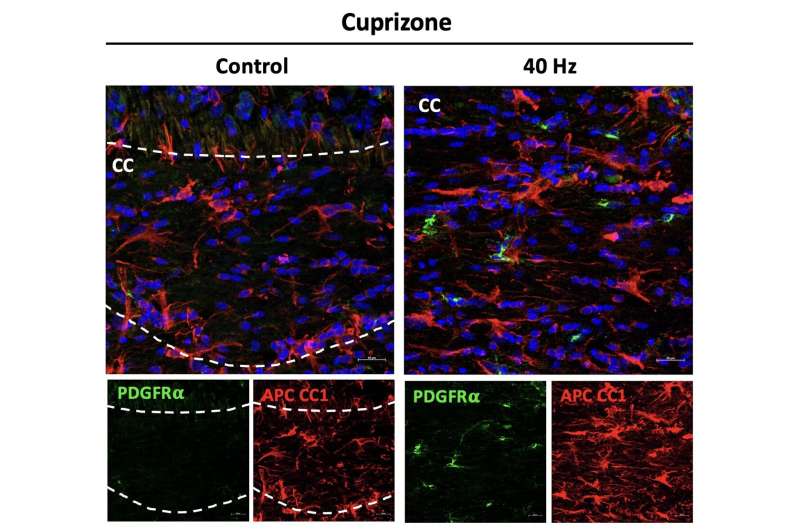
To assess the number of immature and mature oligodendrocytes in the corpus callosum in mice fed cuprizone and given 40 Hz stimulation (right), compared to mice fed cuprizone and given constant stimulation as a control, researchers measured the marker PDGFRa (green) and APCCC1 (red). The 40Hz group exhibited a signficantly higher number of each type of oligodendrocytes. Credit: Tsai Laboratory/MIT Picower Institute
After the six weeks elapsed, the scientists measured signs of myelination throughout the brains of the mice in each group. Mice that weren't fed cuprizone maintained healthy levels, as expected. Mice that were fed cuprizone and didn't receive 40Hz gamma sensory stimulation showed drastic levels of myelin loss. Cuprizone-fed mice that received 40Hz stimulation retained significantly more myelin, rivaling the health of mice never fed cuprizone by some, but not all, measures.
The researchers also looked at numbers of oligodendrocytes to see if they survived better with sensory stimulation. Several measures revealed that in mice fed cuprizone, oligodendrocytes in the corpus callosum region of the brain (a key point for the transit of neural signals because it connects the brain's hemispheres) were markedly reduced. But in mice fed cuprizone and also treated with gamma stimulation, the number of cells were much closer to healthy levels.
Electrophysiological tests among neural axons in the corpus callosum showed that gamma sensory stimulation was associated with improved electrical performance in cuprizone-fed mice who received gamma stimulation compared to cuprizone-fed mice left untreated by 40Hz stimulation. And when researchers looked in the anterior cingulate cortex region of the brain, they saw that MAP2, a protein that signals the structural integrity of axons, was much better preserved in mice that received cuprizone and gamma stimulation compared to cuprizone-fed mice who did not.
Molecular mechanisms
A key goal of the study was to identify possible ways in which 40Hz sensory stimulation may protect myelin.
To investigate, the researchers conducted a sweeping assessment of protein expression in each mouse group and identified which proteins were differentially expressed based on cuprizone diet and exposure to gamma frequency stimulation. The analysis revealed distinct sets of effects between the cuprizone mice exposed to control stimulation and cuprizone-plus-gamma mice.
A highlight of one set of effects was the increase in MAP2 in gamma-treated cuprizone-fed mice. A highlight of another set was that cuprizone mice who received control stimulation showed a substantial deficit in expression of proteins associated with synapses. The gamma-treated cuprizone-fed mice did not show any significant loss, mirroring results in a 2019 Alzheimer's 40Hz study that showed synaptic preservation. This result is important, the researchers wrote, because neural circuit activity, which depends on maintaining synapses, is associated with preserving myelin. They confirmed the protein expression results by looking directly at brain tissues.
Another set of protein expression results hinted at another important mechanism: ferroptosis. This phenomenon, in which errant metabolism of iron leads to a lethal buildup of reactive oxygen species in cells, is a known problem for oligodendrocytes in the cuprizone mouse model. Among the signs was an increase in cuprizone-fed, control stimulation mice in expression of the protein HMGB1, which is a marker of ferroptosis-associated damage that triggers an inflammatory response. Gamma stimulation, however, reduced levels of HMGB1.
Looking more deeply at the cellular and molecular response to cuprizone demyelination and the effects of gamma stimulation, the team assessed gene expression using single-cell RNA sequencing technology. They found that astrocytes and microglia became very inflammatory in cuprizone-control mice but gamma stimulation calmed that response. Fewer cells became inflammatory and direct observations of tissue showed that microglia became more proficient at clearing away myelin debris, a key step in effecting repairs.
The team also learned more about how oligodendrocytes in cuprizone-fed mice exposed to 40Hz sensory stimulation managed to survive better. Expression of protective proteins such as HSP70 increased, as did expression of GPX4, a master regulator of processes that constrain ferroptosis.
In addition to Amorim and Tsai, the paper's other authors are Lorenzo Bozzelli, TaeHyun Kim, Liwang Liu, Oliver Gibson, Cheng-Yi Yang, Mitch Murdock, Fabiola Galiana-Meléndez, Brooke Schatz, Alexis Davison, Md Rezaul Islam, Dong Shin Park, Ravikiran M. Raju, Fatema Abdurrob, Alissa J. Nelson, Jian Min Ren, Vicky Yang and Matthew P. Stokes.
More information: Daniela Rodrigues-Amorim et al, Multisensory gamma stimulation mitigates the effects of demyelination induced by cuprizone in male mice, Nature Communications (2024). DOI: 10.1038/s41467-024-51003-7
Even as diversity, equity, and inclusion efforts draw increased scrutiny at the state level, a federal government agency is bragging about promoting DEI - and using Americans’ hard-earned tax dollars to do it.
“Progress” is how National Institutes of Health diversity officer Marie Bernard recently described the agency’s work to fund more research by black scholars.
But the massive amount of time and money the NIH is dedicating to DEI in higher education is anything but “progress” when the color of a person’s skin or their “gender identity” is weighed more heavily than their merit.
Meanwhile, professionals are expressing concerns about DEI efforts leading to a lower caliber of students and recent graduates, including future doctors and military leaders.
The NIH has been working since 2011 to close up what an agency-commissioned report described as a “gap” in funding to black researchers, Bernard wrote in a recent blog post on the NIH website.
“Over the last 13 years since the release of the Ginther report, NIH has initiated numerous initiatives to foster diverse perspectives in science,” including a Diversity Program Consortium and institute-wide trainings “to foster diverse perspectives in science,” she wrote.
Her own role as the chief officer for scientific workforce diversity also was created as a result of the report, Bernard wrote.
While “gaps remain in funding rates by race and ethnicity for research project grants,” Bernard said the NIH is “encouraged by the overall trends.”
But Bernard denied that the NIH is funding projects “based on demographic characteristics,” writing:
“Clearly, to benefit from the full range of talent available within the United States and foster creativity and innovation in science, we need as broad a range of voices as possible. … NIH, of course, does not fund based on demographic characteristics, and those data are not available to reviewers during their deliberations. However, we will continue looking at the data retrospectively to determine whether we are achieving equity and evaluating our programs and policies to be assured that there are no barriers to everyone being at the table.”
In the same article, however, she mentioned the NIH Faculty Institutional Recruitment for Sustainable Transformation initiative, which “target[s] early career faculty who have an interest and commitment to [diversity, equity, inclusion, and accessibility].”
That initiative awarded more than $64 million to four universities earlier this year for the purpose of recruiting more “diverse” faculty. And it’s the third round of awards – meaning that is just a fraction of the total funding.
For those wondering why identity politics and DEI have become such a big focus in higher education, consider the old adage “follow the money.”
With the federal government continuing to pour hundreds of millions of dollars into such projects, it is little wonder these controversial ideas are getting so much attention.
The US is preparing to play Air Force for Israel's skies as itdeploysa dozen F-22 stealth raptor jets to the Middle East region. This change in 'force posture' was not debated in Congress (nor is it even really being debated on the mainstream networks), despite that clearly US service members could soon find themselves in the middle of a war between Iran and Israel.
The White House has issued a fresh warning to Tehran on Thursday as it is said to still be gearing up for a strike on Israel in retaliation for the July 31st killing of Hamas leader Ismail Haniyeh at a residence in Tehran. The new warning from Washington includes both negative economic consequences and threats of destabilizing actions directed against the newly elected government of Masoud Pezeshkian.
"The United States has sent clear messaging to Iran that the risk of a major escalation if they do a significant retaliatory attack against Israel is extremely high," a US admin official told The Wall Street Journal.
The official further said that Tehran has been put on notice over "a serious risk of consequences for Iran’s economy and the stability of its newly elected government if it goes down that path."
Is this a threat of regime change? To the ears of Iranian officials, it will sure sound like it given the country on its eastern border and the country on its western border were both regime-changed by Washington.
Currently, the consensus among US national security officials is that Hezbollah is likely to play a much bigger and coordinated role in any potential Iranian ballistic missile and drone attack on Israel:
Officials also don’t know for sure whether Hezbollah plans to attack at the same time in a coordinated offensive with Iran or separately. Hezbollah has a large arsenal of missiles that can reach Israel and the concern is that the group and Iran might attack at the same time to try to overwhelm Israel’s missile defenses.
"Last time we got more of a heads up, and this time people are making their best guesses," said a third U.S. official.
But while the US mainstream media narrative remains that it is exclusively Iran and its regional allies that are the regional 'aggressors' against Israel and the US, the fact remains that it is Israel which has attacked close Tehran ally Syria literally hundreds of times over the past years.
And more recently, Israel attacked the Iranian embassy in Damascus (the aftermath which is pictured above). Nation-states did not attack each other's embassies even during World Wars I and II, and the strike on the diplomatic complex was unprecedented in history as an intentional act prior to Israel's April 1st operation in the Syrian capital.
Senator Ron Johnson (R-WI) was a guest on SiriusXM's 'The Wilkow Majority' where he discussed some people’s concerns about the lack of security for President Trump in Pennsylvania and whether the federal government will properly investigate what exactly happened.
ANDREW WILKOW, host: We've watched as the Trump-Russia thing, the dossier, to Crossfire Hurricane to the Mueller Report. We know that an unverified document of nonsensical accusations were somehow made the leap from campaign ad stuff, which look, I guess under the First Amendment, a campaign could produce an ad, an attack ad that's not entirely truthful. But somehow that morphed into a FISA court warrant. And millions of people who support President Trump have watched, as it seems, that elements within the government have gone to great lengths to air fingers quote, "Get Trump." And the worst of all fears would be an assassination. Are you at all worried that it's not what someone may be doing directly, but indirectly, or not doing, that maybe having lax security, you know, not putting the full force of the secret service on President Trump's detail? Are you at all worried that there are people that want that to happen?
SEN. RON JOHNSON: I mean, like, what I think probably happened on January 6th where they withheld the police presence? ‘If something happens, well, this will sink Trump forever.’ I mean, Pelosi, her people knew about this. They knew about possible plans to breach the Capitol. And according to J. Michael Waller, there was not one law enforcement officer present on the west side of the Capitol. How can that possibly be? But of course, the Senate Committee, they didn't investigate that. The House January 6th committee obviously didn't investigate that. I mean, those were also just whitewashes, committees designed to not get to the truth, but to cover up what probably happened. Okay. To get Trump.
So I completely understand the suspicion that's out there. It's legitimate suspicion, and that's why this has to be fully investigated. I'm not going to rest until we uncover things.
And let's face it, I uncovered an awful lot. I know firsthand how corrupt the FBI's investigation was. I've been a target of their corruption - the recipient of unsolicited briefings where they talked about being a target of Russian disinformation to try and obviously sabotage the revelation of the Hunter Biden laptop. But it kind of worked because we didn't take possession that when it was first offered to us. We went to the FBI to find out what they knew about it. They wouldn't tell us for weeks until the computer shop guy turned it over to Rudy Giuliani's attorney. The rest is history. So, no, these guys know what they're doing.
They pre-sabotaged the Hunter Biden laptop. They completely, it was a complete corruption of the Russian collusion hoax. And by the way, has the Washington Post, have these guys given back the Pulitzer Prizes they earned or won for a complete false story, the narrative they promoted that put America in political turmoil, that it's still present to this day. I mean, where's the mea culpas in the media? You'll never get it. Because they're active advocates for the left themselves. That's the problem. Trump is not up against Kamala Harris. He's up against the leftist media.