Search This Blog

Thursday, April 9, 2026

From Pixels to Prescriptions: How AI Is Reshaping Pathology in Oncology

 Whole-slide imaging is now a validated component of modern pathology practice, supported by increasingly robust foundation models that generalize across stains and scanners and by updated Clinical Laboratory Improvement Amendments (CLIA) guidance that clarifies digital and remote workflows (see part 1). Just as importantly, the same biopsy can now support triage, prognosis, molecular testing, and even treatment selection without additional tissue handling.

This convergence of validated digital slides, stronger AI backbones, and clearer regulatory footing sets the stage for the next shift: AI that doesn’t just detect cancer but informs treatment decisions.

Here is what’s cleared or designated today and how it fits into oncology practice.

First Image-Based Treatment Biomarker 

In August 2025, the FDA granted de novo authorization to ArteraAI Prostate. ArteraAI is the first AI-powered digital pathology tool cleared to provide both prognostic and predictive information in localized prostate cancer, creating a new product-code category for similar tools.

It analyzes biopsy whole-slide image plus clinical variables to estimate 10-year metastasis risk, prostate cancer-specific mortality, and the likelihood of benefit from treatment intensification (such as adding androgen deprivation therapy or androgen receptor pathway agents to radiation). It is included in NCCN Prostate (category 2A), and Medicare payment is established (effective January 1, 2024). Notably, FDA’s order includes a predetermined change control plan, allowing Artera to add scanner compatibility without full resubmission.

Consider a patient with high-risk localized prostate cancer preparing to start radiation. Traditional inputs include Gleason grade, prostate-specific antigen, clinical stage, and in some cases genomic classifiers. ArteraAI adds a morphology-derived estimate of treatment benefit, supported by validation anchored in datasets linked to trials such as STAMPEDE.

The shift is subtle but important. Instead of asking, “Is this patient high risk?” you can begin asking, “Is this tumor biologically likely to benefit from intensification?” This approach does not replace genomics or clinical judgment. It augments them with slide-derived biology.

The UK Vanguard Path program will evaluate how well the predictions made by ArteraAI align with real-world outcomes among more than 4000 men treated for prostate cancer over at least 5 years, measuring the AI’s real-world impact on treatment decisions and timelines.

Detection-Assist Tools 

Before predictive AI tools such as ArteraAI come assistive AI tools such as Paige and Ibex, which function as safety nets within routine pathology workflows.

Paige Prostate Detect was the first FDA-authorized AI in pathology, flagging suspicious foci on prostate core biopsies. It received class II designation through the agency’s de novo classification pathway in 2021. In April 2025, Paige PanCancer Detect received breakthrough device designation for detecting suspicious foci across multiple tissues and organs — the first such designation for a multitissue AI assist. Tempus acquired Paige in August 2025, merging approximately 7 million slides with multiomics data to accelerate the path from discovery to regulated tools.

Ibex Prostate Detect, an AI-powered cancer diagnostics from Galen Second Read, received FDA 510(k) clearance in February 2025. This tool flags cases initially signed out benign for re-review, producing case-level alerts and heatmaps of likely cancer regions — a pragmatic backstop in high-volume services.

These are assistive tools, not autonomous diagnosis. For oncologists, their value lies in reducing false negatives, standardizing triage, and supporting workforce-constrained pathology services.

Virtual Staining: Histology to Sequencing 

Virtual staining represents a broader shift in oncology AI, from tools that primarily detect cancer on slides to systems that actively improve downstream clinical workflows, including molecular testing, tissue utilization, and treatment planning.

ClearStain (Pictor Labs; research use in the US) generates a hematoxylin and eosin (H&E)-equivalent digital image from an unstained section destined for molecular testing. Pathologists can annotate tumor on the same section that undergoes DNA/RNA extraction, what you see is what you sequence. Proscia is integrating Pictor’s virtual stains into its Concentriq platform, signaling ecosystem uptake.

The implications are significant. This approach preserves tissue in small biopsies, improves tumor purity selection, reduces failure of next-generation sequencing (NGS) due to tissue depletion, and shortens turnaround time. For tissue-limited lung or prostate rebiopsies, this is immediately relevant. The conceptual shift: The diagnostic slide becomes an active guide for downstream molecular workflows.

Multimodal Models: What Comes Next 

Companies such as Noetik are training multimodal transformer models (OCTO/OCTO-VirtualCell) on paired H&E slides, spatial transcriptomics, spatial proteomics, and sequencing data from thousands of tumors (nearly 40 million cells). These systems simulate spatial single-cell gene expression in context.

They are not FDA diagnostics yet, but this is the pipeline for future computational biomarkers. Partnerships, such as those with Agenus, aim to derive predictive biomarkers for immunotherapy directly from morphology plus learned biology. The trajectory is clear: Detection, prognosis, treatment prediction, and pathway inference are all derived from the diagnostic slide. 

The Moravec Paradox in Pathology 

The Moravec paradox states that what is easy for humans is often hard for AI, and what is hard for humans may be easy for AI. In digital pathology, that dynamic is visible:
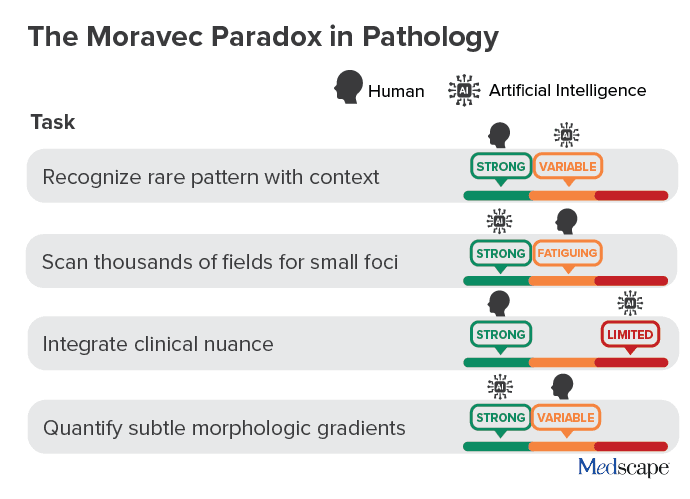
infographic

AI excels at large-scale scanning and quantification. Humans excel at contextual reasoning and clinical integration. The future is not replacement but division of labor.

What Oncologists Should Do Now 

Confirm whole-slide imaging readiness. Ask your pathology group whether primary diagnosis has been validated on the current whole-slide imaging platform according to College of American Pathologists guidance, including appropriate case mix and concordance. As a practical benchmark, many programs cite at least 60 cases and more than 95% concordance.

Also ask how performance is monitored over time, particularly when scanners, stains, or viewing software change.

Then ask the key operational question: Can your current viewer support third-party AI modules? This determines whether you can adopt one tool now and scale later without rebuilding infrastructure.

Clarify remote review policy. Ensure that your pathology and compliance teams have a clearly defined operational policy for remote digital review. Under current CLIA guidance, remote review of digital slides is permitted under the primary CLIA certificate when required conditions are met. Remote cytology digital review requires separate certification after March 23, 2026, and physical glass slides cannot be reviewed remotely under the primary certificate.

For oncology teams, this matters because digital workflows can expand access to subspecialty expertise across sites, but only if implemented within a compliant framework.

Build a prostate decision pathway. If you treat localized prostate cancer, determine whether ArteraAI ordering is enabled and incorporate it into multidisciplinary discussions when intensification decisions are on the table. Set expectations that this is an AI-enabled biomarker augmenting clinico-pathologic risk and genomics — not replacing them. Note Medicare payment status in your pathway to reduce billing friction.

Pilot virtual staining where tissue is scarce. For NGS-bound specimens, ClearStain can preserve tissue and reduce sequencing failures. Align on indications, such as scant core biopsies, along with validation steps and appropriate reporting language. In the United States, these tools remain research use only unless locally validated.

What to Watch Next 

Expect a trickle-down effect from foundational-model class encoders, such as PLUTO-4, which will boost accuracy and generalization across multiple commercial tools — backbone upgrades you may not see named in reports. Pan-organ detection is also on the near-term horizon. FDA breakthrough designation for Paige PanCancer Detect suggests a “universal triage” across organ systems. Additionally, health-system impact data will soon become widely available through the National Health Service Vanguard Path program, which is set to provide prospective evidence for AI-guided treatment selection in routine practice.  

Bottom Line 

Digital pathology is no longer about viewing slides on a screen. It is about extracting additional biologic signal from tissue already collected, without another biopsy. 

When evaluating any AI tool, consider these three questions:

  1. What is the regulatory status: de novo, 510(k), or research use?
  2. Is it validated on our scanners and viewers?
  3. Does it change a treatment decision I make every week?

If the answer to the third question is yes, it belongs in the multidisciplinary conversation. The microscope isn’t disappearing. It’s becoming computational.

The next chapter will not be about whether AI can detect cancer; that question is largely settled. It will be about whether image-derived biomarkers can reliably guide systemic therapy, immunotherapy selection, and resistance monitoring across tumor types. As foundation models mature and more slide-based predictors enter regulated use, the diagnostic biopsy will increasingly function as a multiomic sensor with morphology, molecular inference, and treatment guidance layered into a single workflow. Our job as oncologists is not to chase every tool, but to integrate the ones that meaningfully improve decisions for the patient in front of us.

Thoughts? Drop me a line at Arturo.AI.MedTech@gmail.com or DM on X (@DrArturoAI. Let’s keep the conversation — and the foundational models — going forward. 

Arturo Loaiza-Bonilla, MD, MSEd, is the co-founder and chief medical AI officer at Massive Bio, a company connecting patients to clinical trials using artificial intelligence. His research and professional interests focus on precision medicine, clinical trial design, digital health, entrepreneurship, and patient advocacy. Dr Loaiza-Bonilla serves as systemwide chief of hematology and oncology at St. Luke’s University Health Network, where he maintains a connection to patient care by attending to patients 2 days a week. 

https://www.medscape.com/viewarticle/pixels-prescriptions-how-ai-reshaping-pathology-oncology-2026a1000akz

Acute Gastric Dilatation: When Binge Eating Becomes an Emergency

 Early in my career, I did not immediately recognize binge eating as a behavior that could carry acute medical risk. Learning about acute gastric dilatation changed that perspective.

Many clinicians associate binge eating primarily with long-term metabolic consequences. Yet a binge episode may precede acute massive gastric dilatation — a potentially life-threatening condition requiring urgent medical intervention. 

This complication has been reported in patients with eating disorders as well as in individuals with no prior eating disorder history. Failure to consider the condition promptly can lead to serious consequences, including death.

Binge Eating May Not Be Disclosed 

Recognizing binge eating in clinical settings can be challenging because patients may not disclose the behavior. 

In a qualitative study of psychotherapy clients who concealed eating or body image concerns, many described seeking treatment for other issues — most commonly depression or anxiety — while leaving eating-related problems unspoken. Shame, including fear of the therapist’s judgment, was the most frequently cited reason for nondisclosure.

Research suggests that individuals often avoid discussing eating and body image struggles in healthcare settings, particularly when they anticipate weight stigma. As a result, binge eating and other eating disorder behaviors can remain unidentified unless clinicians ask directly and create conditions that reduce shame. 

One approach my psychotherapypatients have suggested medical providers can take to lower this barrier is to focus clinical guidance on behaviors and health rather than weight.

Binge Eating Can Occur at Any Body Size 

Binge eating episodes can occur at any body size. Clinical eating disorders — including binge-eating disorder, bulimia nervosaanorexia nervosa, and atypical anorexia nervosa (anorexia in a not-emaciated body) — also span the weight spectrum. 

However, stereotypes and the long-standing focus on emaciated presentations of anorexia nervosa have shaped assumptions about how people with eating disorders might look. In the case of binge eating, reliance on physical appearance can delay recognition of risk and potential acute complications.

Published case reports demonstrate that acute gastric dilatation can arise in a range of clinical contexts.

Illustrative Case Examples 

No Known Eating Disorder 

A 17-year-old boy presented with acute abdominal pain and distension after fasting for approximately 24 hours (reportedly for religious reasons) and then consuming a large meal. Imaging revealed massive gastric dilatation. Emergency laparotomy demonstrated a gangrenous, necrotic stomach with perforation requiring surgical management.

High-Volume Eating Environment 

A 28-year-old woman presented with diffuse abdominal pain, nausea, and inability to vomit after consuming five meals within 3 hours at a food festival. Imaging demonstrated severe gastric distension consistent with acute gastric dilatation. She initially left the hospital against medical advice due to concerns over medical expenses but returned hours later with persistent symptoms, including constant nausea, inability to vomit, and obstipation. Her clinical course was complicated by gastric necrosis and perforation, requiring multiple laparotomies during a prolonged hospitalization.

History of Atypical Anorexia Nervosa

A 16-year-old girl presented with acute gastric dilatation after a binge episode. She had a history of obesity followed by atypical anorexia nervosa but no longer met diagnostic criteria at presentation. Daily binge eating had occurred for approximately 1 month prior. Surgical treatment was required.

History of Anorexia Nervosa

A 26-year-old woman presented with severe abdominal pain, nausea, and inability to vomit for approximately 2 hours. She initially reported consuming four beers and a Cobb salad. Imaging revealed acute massive gastric dilatation, and surgical intervention removed approximately two gallons of partially digested food. She later disclosed a history of anorexia nervosa and a preceding binge episode.

Bulimia Nervosa

A 22-year-old woman presented with abdominal pain and vomiting after a binge eating episode. Massive gastric dilatation was identified, and decompression removed approximately 11 liters of gastric contents. She died approximately 36 hours postoperatively from related complications. A history of recurrent bulimic episodes was disclosed by family members following her death.

Clinical Implications 

I spoke with Jennifer Gaudiani, MD, internationally recognized expert on this topic, and author of Sick Enough: A Guide to the Medical Complications of Eating Disorders and Undernutrition

She noted that symptom severity does not always reflect medical risk, explaining, “I’ve taken care of patients who experience excruciating abdominal pain yet who have normal imaging, and others whose massive gastric dilatation — definitely a surgical emergency — is found incidentally on imaging done for other reasons. They maybe had mild nausea at most.”

Dr Gaudiani emphasized that clinicians cannot rely on symptoms alone to determine safety. 

“Binge eating can cause gastric dilatation, especially when patients have underlying gastroparesis, or slowed stomach emptying, due to undernutrition or other causes,” she said. “Patients, loved ones, and clinicians should have a high index of suspicion. A simple x-ray can diagnose this problem.”

Conclusion 

Patients benefit when clinicians remain alert to acute abdominal pain following large food intake, whether or not a history of an eating disorder is disclosed.

Individuals at risk for gastric dilatation do not have a consistent or recognizable appearance and therefore may hide in plain sight. Early recognition and intervention can be lifesaving. 

https://www.medscape.com/viewarticle/acute-gastric-dilatation-when-binge-eating-becomes-emergency-2026a1000aag

Minneapolis Pushes To Legalize Sex Bath-Houses For Gay Somali Immigrants

 by Steve Watson via Modernity.news,

Minneapolis city leaders are barreling ahead with plans to legalize adult bathhouses and sex venues where consenting adults can engage in sexual activity, scrapping a 38-year ban enacted during the AIDS epidemic.

The push, driven by activists, comes as the gay Somali community in Minneapolis has been clamoring to legalize bathhouses. City leaders are considering the proposal that would allow patrons to engage in sexual intercourse in the venues, the New York Post reports.

This latest development underscores the deepening assimilation issues in a city long transformed by mass Somali immigration.

The Minneapolis City Council has referred a package of four proposed ordinances to staff for further development. These include creating licensing and business regulations for adult sex venues that facilitate sexual activity between consenting adults, updating zoning codes for sexually oriented businesses, revising health and sanitation standards related to contagious diseases, and adding exceptions to miscellaneous offenses provisions.

Activists from the Safer Sex Spaces Coalition have led the charge. They argue the 1988 ban, which targeted “high-risk sexual conduct” such as fellatio, anal intercourse, and vaginal intercourse in commercial settings, is outdated and stigmatizing.

“The Minneapolis Health Department and other public health organizations acknowledge this ordinance is no longer the tool needed to promote public health, “the coalition stated adding “Social science research tells us that commercial sex spaces, like gay saunas, are important for promoting safer sex practices, enhancing HIV prevention, and increasing access to testing and treatment. These spaces also enhance feelings of identity, camaraderie, authenticity, and belonging. They are spaces where people overcome isolation and develop a sense of community and pride.”

Council Member Jason Chavez supported referring the measures, saying: “LGBTQIA+ gathering spaces, including bathhouses, have long been targeted by criminalization and policing, and our communities have paid a devastating price for that. That’s why we’re referring this to staff to begin building policy alongside community members and stakeholders.”

Council President Elliott Payne noted that such activities “already happen in the shadows, and we are trying to ensure that they are safe for patrons, especially when LGBTQ+ individuals are under attack by the federal government.” He pointed to potential regulations modeled on San Francisco, including condom availability and staff training on harm reduction.

A spokesperson for Mayor Jacob Frey indicated the mayor supports continued exploration of the issue.

Hardly surprising given that all he does is pander to Somalis.

The original 1988 ban drew backing even from within the LGBTQ+ community at the time, including the city’s first openly gay council member, Brian Coyle, who backed the measure before his death from AIDS-related complications in 1991. Activists now claim the rules disproportionately harmed same-sex partnerships and people with HIV/AIDS while driving gatherings into unsafe private spaces.

Recent coverage confirms the council delayed full debate on the ordinances this week but remains committed to directing staff research.

Critics view the effort as emblematic of misplaced priorities. While neighborhoods struggle with the social and economic fallout of rapid demographic change—including documented fraud schemes and parallel economies—the focus shifts to licensing orgy venues and updating “stigmatizing language” in city code.

Minneapolis—often called “Little Mogadishu”—has faced repeated exposure for hundreds of millions in Somali cash smuggling operations routed through Minneapolis-St. Paul International Airport, in addition to an explosion of Somali related fraud scandals.

TSA whistleblowers who highlighted these schemes faced pushback, including accusations of racism and Islamophobia from figures tied to the Walz administration aimed at silencing concerns over Somali fraud.

Legalizing commercial sex spaces in a city already wrestling with smuggling networks and identity politics does not signal enlightened governance. It signals a leadership class more attuned to activist coalitions than to restoring order and cohesion.

Voters across the heartland have grown weary of cities that import unassimilated populations and then contort public policy around every resulting demand.

Minneapolis offers a cautionary tale of where such approaches lead—public health debates recycled from the 1980s, now layered atop deeper failures in border security and cultural integration.

https://www.zerohedge.com/political/minneapolis-pushes-legalize-sex-bath-houses-gay-somali-immigrants

Amazon plans $25B data centers in Mississippi

 Amazon.com, Inc. said on Thursday that it will invest $25 billion in Mississippi over two years, creating 2,000 "high-paying," "high-tech" jobs and strengthening the state's infrastructure.

The plan includes carbon-free energy projects, $300 million in grid upgrades, and converting the already existing Canton's data center to 100% recycled wastewater for cooling by 2027.

"We're covering all our energy expenses, increasing our investment in Madison County, expanding into Warren County, and transforming a former manufacturing plant in Hinds County—producing reliable infrastructure that will serve Mississippi for generations. Governor Reeves and local leaders have been outstanding partners, and we're just getting started," Amazon's Chief Global Affairs and Legal Officer David Zapolsky said.

https://breakingthenews.net/Article/Amazon-plans-dollar25B-data-centers-in-Mississippi/66039651

Florida AG says state opened OpenAI probe

 Florida Attorney General James Uthmeier said on Thursday that his office had opened an investigation into OpenAI and ChatGPT.

In a social media post, Uthmeier accused the company of activities that he said harmed children, endangered Americans, and facilitated the recent Florida State University mass shooting. "AI should advance mankind, not destroy it. We're demanding answers on OpenAI's activities that have hurt kids, endangered Americans, and facilitated the recent FSU mass shooting," he said.

Uthmeier announced in a social media post, but no formal press release had appeared on the Florida attorney general's website at the time of writing.

https://breakingthenews.net/Article/Florida-AG-says-state-opened-OpenAI-probe/66039604

Netanyahu: We'll be hitting Hezbollah until Israel is secure

 Israeli Prime Minister Benjamin Netanyahu stated on Thursday that his country will continue striking Hezbollah in Lebanon until northern Israel is "secure."

"We continue to hit Hezbollah hard, and we will not stop until we restore your security. I have already brought four peace agreements with Arab countries, and I intend to bring more. Real peace, peace from strength," Netanyahu said, following United States President Donald Trump's statement that Israel will be "scaling back" strikes in Lebanon.

The Israeli prime minister also noted that there is "no ceasefire" in Lebanon, after Lebanese President Joseph Aoun said that a ceasefire between the two countries is the "only solution" to the ongoing conflict, ahead of the direct talks, which Netanyahu confirmed will start "as soon as possible."

https://breakingthenews.net/Article/Netanyahu:-We'll-be-hitting-Hezbollah-until-Israel-is-secure/66040793

Ops at Saudi energy sites said to have been halted

 Operational activities at several "important" energy facilities in Saudi Arabia have been halted over recent strikes, the Saudi Press Agency reported on Thursday, citing an official source at the country's Ministry of Energy.

The source detailed that one individual was killed and seven were injured during these attacks, which also led to: a loss of some 700,000 barrels per day in throughput at the East-West Pipeline; a reduction in production of a total of 600,000 barrels per day at the Manifa and Khurais facilities; and issues with exports of refined products at SATORP in Jubail, Ras Tanura refinery, SAMREF refinery in Yanbu, and Riyadh refinery.

Riyadh warned that the continuation of such attacks will make matters worse, leading to more volatility in the oil market and affecting the security of supply.

https://breakingthenews.net/Article/Ops-at-Saudi-energy-sites-said-to-have-been-halted/66040851