The US Embassy in Abu Dhabi and the US Consulate General in Dubai have canceled all consular appointments from July 13 to 15, citing the regional security situation.
The embassy said it remains on ordered departure status, with non-emergency US government personnel relocated outside the UAE.
Only limited consular assistance is currently available to U.S. citizens, while routine visa services remain suspended.
The United Arab Emirates (UAE) Ministry of Foreign Affairs issued a statement condemning repeated assaults on Kuwait's Consulate General in Basra, Iraq.
The ministry said the attacks violated international law, stressing the need to safeguard diplomatic missions and personnel. The statement cited the Vienna Convention on Diplomatic Relations as the framework obligating the protection of foreign missions. It urged Baghdad to "fulfill its legal obligations" by securing the site, investigating the incidents and holding those responsible accountable.
United States President Donald Trump gave his approval for military operations against Yemen's Houthi rebels on a phone call with Saudi Arabian Crown Prince Mohammed bin Salman (MbS), Axios reported, citing US officials.
This call followed urgent diplomatic meetings between US Secretary of State Marco Rubio and Saudi officials, with Saudi Arabia seeking American backing to prepare for a potential regional conflict.
The agreement led directly to Monday's escalation, when Saudi warplanes bombed Sanaa International Airport to block a sanctioned Iranian flight. The Houthis retaliated with drone and missile strikes on Saudi Arabia's Abha airport, breaking a fragile four-year truce.
U.S. authorities have seized about 2,040 pounds of cocaine and almost 5,800 pounds of marijuana in three separate maritime interdictions carried out with international partners.
The most recent interdiction involved the Joint Interagency Task Force (JIATF) South and Panama's National Aeronaval Service intercepting a go-fast vessel following a rapid aerial and surface pursuit, JIATF South said in a July 10 post on X. The operation led to the seizure of roughly 2,010 pounds of cocaine.
JIATF South, based in Key West, Florida, is an international alliance that monitors and facilitates the interdiction of drug traffickers in maritime and air domains. Operating across a 42-million-square-mile area, JIATF South involves cooperation from 13 domestic and 20 international partners. The task force seeks to disrupt the flow of illegal drugs and dismantle transnational criminal organizations.
In a second interdiction, JIATF South and authorities from Costa Rica cooperated to intercept a drug smuggling vessel and capture a pick-up boat that was fleeing, according to a July 9 X post. The operation led to the seizure of 3,672 pounds of marijuana, with four suspects arrested.
The third interdiction was a joint operation between JIATF South, Customs and Border Protection (CBP), and Dominican Republic partners that intercepted a vessel in the Caribbean Sea attempting to transport illicit cargo, the task force said in a July 8 X post.
Authorities seized 2,124 pounds of marijuana and about 30 pounds of cocaine, and detained two smugglers in this incident. A smuggling route operated by a major transnational criminal organization was disrupted.
Drug seizures have risen under the Trump administration.
In a June 18 statement, the CBP said it had seized 56 percent more drugs in the current fiscal year through May than during the same period in fiscal year 2024 under the previous administration.
In the four months between February and May, marijuana seizures averaged 37,033 pounds per month, which is 61 percent higher than the same period in the 2024 fiscal year.
For the month of May, the nationwide seizure of cocaine, marijuana, fentanyl, heroin, and methamphetamine was 32 percent higher than in May 2024.
"CBP remains on the frontline against drug smuggling, seizing dangerous narcotics before they reach American communities," the agency said.
Northern Border Drug Trafficking
Last week, a Canadian national was sentenced to 240 months in prison for leading a criminal organization that trafficked hundreds of kilograms of cocaine and methamphetamine valued at up to $17 million from the United States into Canada, according to a July 9 statement from the Drug Enforcement Administration (DEA).
The issue of drug trafficking at America's northern border was highlighted by Michael J. Krol, Homeland Security Investigations' assistant director for domestic operations, during a June 30 House committee hearing.
"Unique to the northern border, the flow of illicit drugs reflects both inbound and outbound dynamics," Krol said.
A key concern "is the drug flow moving through the United States into Canada. Cartel-owned cocaine and other controlled substances are routed north for domestic consumption and onward shipment to Europe," he added.
During fiscal year 2024-25, the Canada Border Services Agency reported seizing roughly 7,700 pounds of cocaine, compared to 2,700 pounds seized during fiscal year 2020-21, Krol said.
During a May 12 Senate committee hearing, DEA head Terry Cole and FBI Director Kash Patel said they were working to disrupt new drug production facilities in Canada.
"We see more precursors coming into the Port of Vancouver, coming into Canada," Cole said.
Patel said that drug traffickers have gotten "smart" with improved security at the U.S. southern border, shifting operations to Canada.
The FBI was working with Canadian authorities to disrupt the production facilities that criminals have moved north, according to Patel.
When we picture intellectual property theft, we picture a break-in. A hacker slips past the firewall, copies the source code, and disappears. So, when an American AI company tells Congress that China just pulled off the largest extraction campaign it's ever recorded, the natural assumption is that someone cracked the vault.
Nobody broke in. And that's exactly what makes this threat so difficult for Washington to address.
Last week, Anthropic told the Senate Banking Committee that operators affiliated with the Chinese conglomerate Alibaba ran roughly 28.8 million queries with its Claude models through nearly 25,000 fraudulent accounts between April and June. According to the company, the goal was not to steal the model. It was to harvest its answers, then use those answers to train a competing Chinese system at a fraction of the cost.
This technique is called distillation, and not all of it is sinister. Training a smaller model on the outputs of a larger one is a routine and legitimate practice when a company does it with its own systems. What Anthropic alleges is something else: unauthorized extraction from a competitor's proprietary service, carried out at industrial scale through fake accounts that violated its terms of use. The line between ordinary engineering and a national-security problem runs right through that word "unauthorized."
The unsettling part is how ordinary the attack looks from the outside. The operators signed up, gained access, and asked questions, millions of them, aimed at the model's most valuable skills: writing software and reasoning through complex tasks step by step. The model did precisely what it was built to do. No alarm tripped, because from the system's perspective, nothing went wrong. A determined competitor simply walked through the front door, at enormous scale, to approximate years of American research by learning from the model's outputs.
That is a genuinely new kind of problem, and it scrambles the usual playbook.
The instinct in Washington has been to treat Chinese AI gains as a hardware story. Keep advanced chips out of Beijing's hands, the thinking goes, and you slow its progress. That instinct isn't wrong. Compute is a real chokepoint... China keeps trying to smuggle chips and route around the controls, and tightening those rules is sound policy.
But chip controls were designed to stop someone from building a powerful model. They do nothing to stop someone from quietly copying the behavior of a model that already exists.
You can wall off the foundry and leave the storefront wide open. That is the gap distillation walks through, and it is why a hardware-only strategy, however necessary, cannot be the whole answer.
The stakes are not only strategic. Every successful extraction campaign compresses years of research and billions of dollars of private investment into millions of automated queries, undermining the incentives that made American frontier AI leadership possible in the first place. This is what intellectual property theft looks like in the age of AI: not stolen code, but a copied teacher. Alibaba is simply the first vivid example, and it won't be the last.
The encouraging news is that the government has already named the problem. In April, the White House science office issued a memo warning that foreign entities, mostly based in China, are running "industrial-scale campaigns to distill U.S. frontier AI systems," and it committed the administration to better information sharing and defensive coordination with industry. The House Foreign Affairs Committee advanced a bill that would track these extraction attempts and authorize sanctions against the companies behind them. And in response to the Alibaba disclosure, Sens. Bill Hagerty (R-Tenn.) and Andy Kim (D-N.J.) are pushing an amendment to this year's defense bill directing the Commerce Department to penalize Chinese firms caught doing it.
That bipartisan momentum is the right reflex. To work, the response must match the attack, and that means treating model extraction like any other strategic economic attack rather than a routine business dispute.
Two priorities follow. First, detection is a shared problem, yet companies fight it alone. The fake accounts and evasion patterns show up across multiple American labs, but legal uncertainty discourages competitors from comparing notes. Congress can give them clear permission to share threat signals with one another and with the government, the way banks already share intelligence on fraud. Second, deterrence must reach the storefront, not just the foundry. If a Chinese lab can lose access to American chips for smuggling them, it should face comparable consequences for systematically abusing American AI services to copy them.
America has spent years debating how to keep advanced AI out of China's hands. The harder question may be how to keep China's AI companies from quietly learning everything they can from the models we place online for the world to use. Last week's disclosure put a number on it: 28.8 million questions, asked through the front door. Washington has finally started looking at the right entry point. Now it needs to figure out how to lock it.
Joseph Hoefer is a principal and chief AI officer at Monument Advocacy, where he leads the firm's AI policy practice.
During my two decades at the CIA, I watched the Chinese Communist Party methodically transform strategic industries, recognizing that a strong industrial base drives national security. Nowhere is that more consequential than biotechnology.
Beijing has spent years subsidizing its domestic biotech sector, and the results are no longer hypothetical. China's share of global drug development has grown from roughly 8 percent to more than 30 percent over the past decade, while the U.S. share has fallen from 48 percent to 37 percent.
These are not vanity metrics. They reflect a deliberate, state-directed strategy to capture one of the world's most strategically important industries for economic power and geopolitical advantage.
Washington's response should bolster American security by strengthening American innovation leadership. Thus far, Washington has favored broad restrictions that look tough on China by walling off American capital and access rather than strengthening America's capacity to discover new medicines.
The impulse is understandable. But protectionist policies that overlook downstream consequences and in reality do little to slow China while weakening American competitiveness, are not a national security strategy.
We have seen how this story ends. Beginning in 2012, the United States responded to subsidized Chinese solar panels with tariffs that eventually reached 250 percent, citing both economic and national security concerns. China's share of the global market did not fall. It grew. Manufacturers routed production through Vietnam, Malaysia and Thailand to get around the duties, American prices climbed more than 20 percent relative to other markets, and domestic manufacturing never scaled to fill the gap.
If solar illustrates the economic cost of this approach, shipbuilding reveals the strategic one. The Jones Act of 1920 reserved domestic shipping for American-built, American-crewed ships. Protection came. Investment never did. China now accounts for more than half of global commercial shipbuilding. By the Navy’s own assessment, its shipbuilding capacity is more than 200 times America’s. In 2024, China built more than 1,000 commercial vessels. We built eight. Worse, the loss strengthened a rival’s fleet.
Now apply that lesson to medicine, where losing is measured in lives. We already depend on China for a dominant share of the active pharmaceutical ingredients that finished generic drugs cannot exist without, and for certain categories, American manufacturers have no current realistic domestic alternative. A sudden retreat behind new barriers without first securing a domestic supply or ensuring long term domestic investment would only deepen that dependence. A country that cannot secure essential medicines has surrendered a critical element of national readiness.
At this year's meeting of the American Society of Clinical Oncology, a cancer therapy developed by a Chinese biotechnology company earned a coveted spot in the conference's Plenary Session, the first China-originated drug to do so. The medicine is now under FDA review -- a reminder that China is no longer simply manufacturing medicines. It is increasingly discovering them.
By one major bank's estimate, drugs originating in China could account for more than one-third of FDA approvals by 2040, up from 5 percent today.
Washington can respond in one of two ways: wall off investment and access or ask why China is gaining ground in one of America's most strategically important industries -- and what we must do to stay ahead.
Making China weaker is not the same as making America stronger. Only the latter improves American preparedness, readiness, and security.
The more urgent problem is what Washington is doing to itself. The White House has proposed cutting the National Institutes of Health, the upstream source of the discoveries that become approved drugs, by roughly 40 percent. We are making it harder to keep the world's best scientists. Federal regulation has failed to keep pace with the science, so early-phase clinical trials that should take months now take years. Each is a self-inflicted wound.
America will not outcompete China by imitating its model, nor does it need to. Our advantage has always been different: a market-driven system, entrepreneurial spirit, best-in-class science, and a network of trusted allies.
Washington should build on those strengths and make biotech a national security priority. Fund the basic research now on the chopping block. Modernize the FDA so discoveries reach patients in months rather than years. Secure pharmaceutical supply chains through domestic production and allied partnerships. Treat the recruitment of scientific talent as a priority. Better coordinate the FDA, NIH, Treasury, Defense Department, and intelligence community around a coherent biotechnology strategy.
The United States will not counter the threat from China by building higher walls around an already weakened industry. It will do so by strengthening the foundations of American scientific leadership before the window to do so narrows further.
Jennifer Crook spent two decades at the Central Intelligence Agency, most recently in its China Mission Center. She is now Executive Director of the American Biosecurity Initiative.
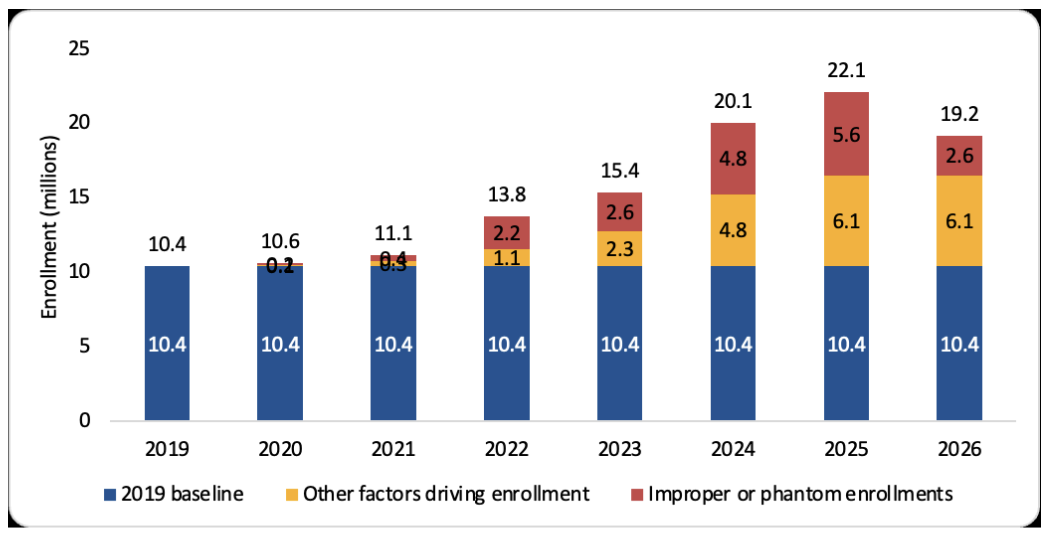
he latest enrollment numbers from HHS are a good new/bad news story. The good news is Obamacare fraud is down sharply from 2025’s record 5.6 million people. The bad news is there are still an estimated 2.6 million improper enrollees in 2026.