Search This Blog

Monday, July 27, 2026

San Jose leads nation in ‘baby bust’ as families flee urban centers

 Children are disappearing from major cities, and urban centers in California are leading the trend.

The number of kids living in cities has fallen 6% nationwide over the past 10 years, according to a Wall Street Journal analysis, as families increasingly ditch big-city life for more affordable pastures.

San Jose, the Silicon Valley hub that’s home to some of the state’s most expensive real estate, has lost a staggering 20% of its population under 18 — coming in first on the list of cities that have lost the largest percentages of kids.

San Jose lost 20% of its population under 18 between 2015 and 2024, according to a report.f11photo – stock.adobe.com

Even more dramatic, the number of kids under age 5 in San Jose has plummeted 34% in a decade, according to the report.

In Los Angeles, meanwhile, the number of children under 18 fell by 16% between 2015 and 2024.

Of the 25 cities that have lost the most children in that time frame, six were in California.

San Diego has lost 14% of its children while Fresno, Sacramento and San Francisco have lost 5%, 4% and 3% respectively, according to the analysis, which examined cities with more than 500,000 residents.

San Diego has lost 14% of its population under 18 over a decade.Gary – stock.adobe.com
Fresno lost 5% of its kids in ten years.Jacob – stock.adobe.com

Falling birthrates — a nationwide trend, with the number of births falling by 9% over the past decade — are only one factor driving the disappearance of kids from major cities.

The Covid pandemic accelerated the flight of families choosing to leave cities in search of more space and affordable living, the report noted.

“Families had more exit options and they took them,” Connor O’Brien, a fellow at think tank the Institute for Progress, told the WSJ.

A handful of large cities, particularly in the Sun Belt, have bucked the trend and increased their share of kids.

The number of children in Fort Worth, Texas, and Jacksonville, Fla., increased by 11% over a decade, followed by Washington, D.C. and Seattle, which have each increased their kid populations by 10%.

https://nypost.com/2026/07/27/us-news/san-jose-leads-nation-in-baby-bust-as-families-flee-cities/

Mamdani publishes names, addresses of all NYC owners to be hit with pied-à-terre tax

 Mayor Zohran Mamdani’s administration has published a searchable database of Big Apple properties that could fall under the state’s new pied-à-terre tax, effectively doxxing thousands of wealthy New Yorkers.

The city’s Department of Finance uploaded the comprehensive list – which purports to cover all unoccupied, non-primary residences in the five boroughs worth north of $1 million – including the full names and addresses of every property owner.

“It’s a reckless and foolish move, especially considering there are potentially thousands of properties on this list that do not qualify as second homes or whose owners will successfully dispute their inclusion,” Council Minority Leader David Carr (R-Staten Island) — whose own home appears on the list — told The Post Monday.

The move follows a widely panned X post by the mayor in which he put wealthy residents on notice to “check your mailbox when you’re back in the five boroughs, because you’ve got mail,” a warning that notification letters were on their way.

“The best city in the world deserves the best parks, libraries, and schools in the world. That’s only possible when we all pay our fair share,” Mamdani wrote Thursday.

The socialist darling has long touted the policy enacted by Gov. Kathy Hochul and Albany Democrats to tax second homes in the city – though critics have warned it could cause property values to plummet.

Mamdani threatened to raise city property taxes by a staggering 9.5% in February unless he was allowed to “tax the rich” to cover a $12 billion budget gap that was later revised down to $5.4 billion.

City Hall estimates the pied-à-terre tax would yield $500 million per year for the Big Apple’s budget. 

But Democratic city Comptroller Mark Levine’s office said the real figure would be closer to $340 to $380 million and could diminish over time.

Unsurprisingly, the colossal database of names and addresses included several A-list New Yorkers, including director Woody Allen, longtime Vogue editor Anna Wintour and actress Cynthia Nixon — a loyal Mamdani supporter.

What is surprising is the document’s sheer size and some of the properties included.

Citywide, The Post counted over 960,000 residences and individuals listed as potentially in line to be hit with Mamdani’s pied-à-terre tax, even though just 31,000 homes were supposed to be subjected to the new levy as he and Hochul initially sold it to the public.

Many of the homes included in the database appeared to be misaligned with a tax aimed at well-heeled residents with multi-million dollar vacation homes, including some two dozen modest homes on Chaffee Avenue in working-class Throggs Neck in the Bronx.

Challenger Drive on Staten Island was another middle-class enclave with dozens of addresses appearing on Mamdani’s list, though it wasn’t clear that they were in fact second homes.

The average home values on Chaffee Avenue and Challenger Drive ranged from mid-$500,000s to the low $800,000s — a far cry from the price tag of your average New York summer residence.

One address appearing on the list is the Breezy Point Shopping Center in Rockaway, Queens, a small outdoor mall containing several shops, which is definitely not a vacation home.

“All the mayor is doing is tanking the luxury home market in NYC and sending millions of dollars in real estate business to other states. But the upside is Mamdani is a shoo-in for ‘Realtor of the Year’ in Texas and Florida,” Carr railed.

Steven Fulop, president and CEO of the Partnership for NYC, a nonprofit business advocacy group, said the list “raises real safety and privacy concerns.” 

“Publishing individual property owners’ names and home addresses raises real safety and privacy concerns that go well beyond the tax debate itself. Transparency about how a new tax is administered doesn’t require putting private citizens’ addresses into a searchable public database that can put people in harm’s way,” he said. 

“In a political climate this polarized, the mayor didn’t need to invite that kind of risk — we should be looking for ways to dial down tensions, not heighten them. We’d urge the administration to revisit this approach.”  

The mayor is just getting started in fulfilling his campaign pledge to siphon funds from rich New Yorkers to bankroll his wealth redistribution agenda.

But it turns out even the middle-class isn’t safe from the pricey giveaways on his wishlist, which are being funded by the $23 billion in taxes Mamdani has backed since being sworn in.

He’s also pushing ahead with a months-long pressure campaign for even more new state taxes, including on city property owners, The Post reported last week.

https://nypost.com/2026/07/27/us-news/mamdani-names-all-nyc-property-owners-who-could-be-hit-with-new-pied-a-terre-tax/

BofA Downplays China's DUV Tool Production Report, Sees Only "Modest Threat" To ASML

 ASML Holding NV shares in Amsterdam suffered their steepest decline in more than a year, breaking below the crucial 50-day moving average after The Information reported that a Chinese state-backed company had begun producing immersion deep-ultraviolet (DUV) lithography machines.

The Information did not cite the Shanghai-based company that plans to manufacture about five DUV machines this year and roughly 20 in 2027. The firm reportedly assembled teams from other Chinese chip-equipment firms, including Shanghai Yuliangsheng Technology.

ASML builds lithography machines that print transistor patterns onto silicon wafers. Its DUV machines are considered the workhorses of the semiconductor industry, producing highly advanced chips ranging from DRAM and NAND memory to logic and AI chips, as well as smartphone and automotive processors.

Only three weeks ago, we reported that China's leading memory-chip companies are quickly closing the technology gap with their South Korean chip-producing rivals faster than expected, raising concerns that expanding Chinese production could eventually spark a global memory glut.

China's largest memory company, CXMT, is reportedly testing a pilot line for bonded DRAM in Hefei (the heart of China's semiconductor industry), a technology that manufactures memory cells and peripheral circuitry on separate wafers before joining them. This process could deliver higher density and performance using older deep-ultraviolet lithography equipment, allowing China to reduce its dependence on advanced EUV machines restricted by US export controls.

The company is also developing HBM3 and HBM3E products, pursuing next-generation CXL memory, and preparing for a potential Shanghai listing. Its reported share of the global DRAM market reached 8% during the first quarter of 2026, and Apple is said to be considering CXMT as a supplier.

The US has been probing ASML for many months out of concern that one of its lithography machines ended up in Chinese hands despite US-led export controls.

Bank of America analyst Didier Scemama commented on The Information's report, telling clients:

According to The Information, China may have started production of DUV immersion litho tools. The article suggests that China have brought together immersion DUV development teams from other Chinese companies but warns that DUV advances are still "at an early stage". Yuliansheng Tech allegedly intends to produce 5 DUV tools this year and 20 next year for domestic Chinese customers, including SMIC, CXMT and Hua Hong. Of note, the article indicates that the immersion tools may be using components from both China and Japan, potentially violating export control restrictions.

Scemama continued:

China is a major market for ASML but threat likely modest

The leading domestic player, SMEE, has yet to demonstrate ArFi systems in high-volume production at 28nm or below, while reports of a Chinese EUV breakthrough have not resulted in a commercial product. China remains an important market for ASML, accounting for roughly 20% of group sales and 44% of DUV revenue in 2026. Replacing ASML would require a domestic alternative with comparable productivity, overlay and cost of ownership. That remains a high hurdle. ASML's NXT:1980Fi already delivers 330 wafers per hour and 2.5nm machine-matched overlay, while successive generations have further improved overlay performance. In leading-edge Chinese logic manufacturing, where EUV is unavailable and multiple patterning is required, even modest reductions in scanner performance could materially lower yields and increase cost per die.

. . .

We think today's weakness is an over-reaction and see current levels as an attractive opportunity.

Domestic DUV machines could eventually increase DRAM and NAND production in China, strengthening suppliers such as CXMT and YMTC while helping alleviate the global memory crunch. The report also suggests that ASML's long-term competitive position could face growing pressure, while the leverage exerted by US and Western export controls over China's access to advanced chips and chipmaking equipment could erode. 

https://www.zerohedge.com/technology/bofa-downplays-chinas-duv-tool-production-report-sees-only-modest-threat-asml

Flashback: Fauci Funded Technique To Hide Evidence Of Genetic Engineering According To RFK Jr.

 Four years ago, Robert F. Kennedy Jr. made an accusation that got him shadowbanned, "fact-checked," and dismissed as a crank: that Anthony Fauci's NIAID had bankrolled the development of a laboratory technique whose primary utility was erasing the fingerprints of human engineering from a manipulated virus - and that the technique was then handed to the Wuhan Institute of Virology.

With Fauci's personal diaries now public, Tulsi Gabbard's last-day document dump on the record, Ralph Baric stripped of his NIH grants and placed on leave by UNC, and Fauci himself scheduled to appear under subpoena before the Senate Homeland Security and Governmental Affairs Committee this Wednesday at 8:30 a.m., Kennedy's remarks are worth revisiting.

Here's what he said:

"He [Fauci] funded Ralph Baric to develop a technique called seamless ligation. And that is a technique for hiding the engineering project."

"So, normally, when you do that kind of engineering, you can see it, and you can say, 'That bug was created in a lab.'"

"He [Baric] developed a way of hiding all traces [of what] was developed. And he taught that to the Chinese scientists - to Shi Zhengli."

"There is no public health [reason for this]; it is the OPPOSITE of what you would do if you are interested in public health... To teach people how to hide that only has a nefarious purpose."

Kennedy made the same argument repeatedly around the release of The Real Anthony Fauci, and his complaint was never just that gain-of-function research is dangerous - everyone concedes that now, including the virologists. It was narrower: that U.S. taxpayers paid to develop, and then export, a capability whose only obvious application is defeating attribution.

What "Seamless Ligation" Actually Is

The technique is published, peer-reviewed, sitting on the National Institutes of Health's own servers, and was openly boasted about for the better part of two decades.

Assembling a full-length coronavirus genome from smaller synthetic fragments requires cutting and pasting DNA. Conventional restriction enzymes leave behind junction sequences - "scars" - at every splice point. Those scars are the tell. Line up the genome, spot the regularly spaced artificial seams, and you can say with confidence that a human being built the thing.

Baric's lab solved that problem. Using Type IIS restriction enzymes - which cut outside their own recognition sequence - his team developed an assembly method that leaves no residual site at the junction. The finished genome reads as though it were never cut at all.

Baric's own lab nicknamed it the "No See'm" method - and the full protocol was published in 2008 by Eric Donaldson, Amy Sims and Ralph Baric as Systematic Assembly and Genetic Manipulation of the Mouse Hepatitis Virus A59 Genome in Springer's Methods in Molecular Biology series. Its abstract describes demonstrating "the power of this unique site-directed 'No See'm' mutagenesis approach." "No See'm technology" is listed among the paper's official keywords. The underlying assembly platform had been laid out six years earlier in the Journal of Virology.

The stated scientific rationale is efficiency: no scars means no unwanted mutations at the junctions, and mutants can be generated fast. But efficiency and untraceability are, here, the same property. A seamlessly assembled synthetic genome is indistinguishable from a naturally circulating strain, which is what the method was built to achieve.

Kennedy has put the NIAID funding figure at roughly $212 million to $220 million flowing to Baric over the course of his career.

Meanwhile, Baric was the researcher most affected by the Obama administration's 2014 gain-of-function pause as noted by NPR in "How A Tilt Toward Safety Stopped A Scientist's Virus Research" - and that he was America's foremost coronavirus biologist on the federal dime. Baric and Shi Zhengli went on to co-author the 2015 chimera study in Nature Medicine that the journal was later forced to flag with an editor's note.

In Light Of Fauci's Diary...

Kennedy's longstanding claim is that evidence COVID-19 was man-made was engineered away. 

Baric confirmed the furin cleavage site was his job. In a voluntary transcribed interview with Sen. Rand Paul's staff in April, released this week, Baric - co-author of the 2018 DEFUSE proposal, key contributor to NIAID-funded work in Wuhan - confirmed that the furin cleavage site insertion described in that proposal was his assignment. Per Paul's Reading Room, he also confirmed running an experiment that undercuts the core scientific defense of natural origin, and still cannot explain how he ended up on the February 1, 2020 call with Fauci and the authors of "Proximal Origin."

Fauci's diary shows he knew on day one. The entries Paul released this weekend record that on January 31, 2020 - before most Americans had heard the phrase "lab leak" - Jeremy Farrar patched Fauci into a call with Kristian Andersen and Eddie Holmes about the SARS-CoV-2 furin cleavage site. Fauci's own contemporaneous note: they raised "the possibility that this could have been deliberately inserted and either accidentally released or deliberately released by a crazy person in the lab, the former being the most likely." Roughly half the scientists on that initial call thought the virus looked constructed. Days later, Fauci was on Newt Gingrich's podcast dismissing lab-origin questions: "I've heard these conspiracy theories. And like all conspiracy theories, Newt, they're just conspiracy theories."

A national lab said the same thing in writing. Gabbard's June 18 declassification included an eight-page May 27, 2020 assessment from Lawrence Livermore's International Assessments program concluding that "all of the necessary conditions for an accidental release of a laboratory-modified coronavirus - specifically a coronavirus adapted to recognize human cell receptors - were present" at the WIV in mid-to-late 2019. The documents are online.

And Baric's career is over. As Paul Thacker noted, NIH has quietly removed Baric from all his grants; UNC has placed him on leave and refused to cooperate with federal document requests. Jeffrey Sachs - who chaired the Lancet COVID commission - now points at Baric directly. Robert Redfield told RCI he briefed Mike Pompeo in a SCIF in early 2020: "Mike, this is the smoking gun. This virus came from a lab."

A senior HHS official put it to RCI more bluntly: "Baric designed the gun. But the Chinese built it, and then they pulled the trigger."

The Fingerprint That Wasn't Erased

Kennedy himself never argued the erasure was total - noting a preprint arguing that Baric's fingerprints were visible after all. In October 2022, Valentin Bruttel, Alex Washburne and Antonius VanDongen posted a preprint titled Endonuclease fingerprint indicates a synthetic origin of SARS-CoV-2. Their argument: the SARS-CoV-2 genome contains an oddly regular pattern of BsaI and BsmBI restriction sites - exactly the spacing you'd want for efficient lab dis- and re-assembly, and an anomaly among wild coronaviruses. They found the pattern "more likely a product of synthetic genome assembly than natural evolution."

The preprint was aggressively contested and never formally published. If it holds, the implication is that whoever assembled the virus was less careful than the man who taught the technique.

https://www.zerohedge.com/covid-19/flashback-fauci-funded-technique-hide-evidence-genetic-engineering-according-rfk-jr

Healthcare – Spend More, Get Less


Healthcare has things exactly backwards. Normally, when you spend more money, you expect to get more product, service, or value in some form. But in the U.S. healthcare system, Washington keeps spending more (of our money), and we keep getting less ... care.

The latest example is a new set of rules just announced by CMS that govern accountable care organizations and change the metrics and compliance requirements by which they are judged (and funded). The cost of these new regulations is not included in the CMS announcement. It is certain to be substantial, likely in billions, both for the federal government and for providers who must change policies and procedures, fill out new forms, accept constant reviews, and comply...or else.

Along with expense incurred by new rules, CMS announced a cut in reimbursement to physicians. Thus, healthcare will spend more while care providers will get less. Patients will wait longer, have shorter appointment times, and get less care. More people will die needlessly waiting in line for care.

This is not new. In fact, it has been a standard pattern since 1965 when Medicare and Medicaid were passed. It starts with a problem that makes headline news. Retired Americans can’t get employer-sponsored health insurance – leads to Medicare. Twelve-year-old dies “from a toothache” because of lack of care – more stringent Medicaid rules, but reduced reimbursement. “Seniors must choose between health insurance and their medications” – government price fixing.

To “fix” whatever problem makes front page news, Washington passes new legislation or revises current rules adding to the massive regulatory apparatus already in place. This generates more spending on BURRDEN – bureaucracy, unnecessary rules and regulations, directives, enforcement, and noncompliance activities. Between 1970 and 2020, when the number of physicians increased 100 percent, the number of healthcare bureaucrats, nonclinical workers hired to administer BURRDEN, increased more than 4,400 percent! That is forty-four nonclinical workers for every one physician.

Federal regulations and rules produce bureaucratic diversion: healthcare dollars are diverted from patient care to pay for BURRDEN. The end result is death by queue. With insufficient clinical funds, patients wait so long for care, they die while waiting. The Affordable Care Act (ACA) offers an excellent demonstration of “spend more (on bureaucracy), get less (patient care).”

(This author was a founding Director of the New Mexico Health Insurance Exchange which was one of the fifty-one state (and D.C.) exchanges created by the ACA. Thus, he knows details of the ACA from the inside.)

Recall two promises made for the ACA and how they turned out. First, President Obama assured Americans they would “save $2500 on their insurance bill.” Yet instead of spending less, Americans are forced to spend more and more on insurance, from unaffordable to super-duper unaffordable. The second promise was “if you like your doctor or your health plan, you can keep them.” Millions were forced to change physicians or health plans. Increasing numbers of physicians are simply quitting.

ACA promised savings and care promises never materialized. President Obama’s namesake legislation cost taxpayers $1.76 trillion, mostly for bureaucracy and administration. To defray a large portion of that expense, President Obama took $716 billion from the Medicare Trust, money that had been earmarked to pay for senior care. The Medicare Trustees project that the Trust will run out of money, be insolvent, by 2036 at which time Medicare will be unable to pay for seniors’ hospital care.  ACA bureaucratic diversion contributed to that impending bankruptcy and loss of promised care.

A third example of “spend more, get less” is the recent Minnesota Medicaid fraud. CMS (Centers for Medicare and Medicaid Services) simply paid bills that were presented to it without confirming that the enrollees were real or that they received the goods and services contracted. The Somali fraudsters simply pocketed the money. Nine billion is the current estimate for how much was embezzled just in Minnesota. Other Medicaid scams are being investigated in California, Florida, Ohio, Maine, and New York.

Without effective watchdog activities and absent strict accountability, Medicaid is expending billions “more” while Americans are getting “less,” in fact, getting nothing.  

Third-party payment structure facilitates, even encourages, such “spend more, get less” behaviors. We cannot afford such inefficient healthcare spending: monies expended that do not produce patient care. It is time to consider ways to put patients, not third parties, in control of healthcare spending. After all, it IS their money, and their lives.

 It is time for the Empower Patients Initiative.

Deane Waldman, M.D., MBA, is Professor Emeritus of Pediatrics, Pathology, and Decision Science; former Director of the Center for Healthcare Policy at Texas Public Policy Foundation; former Director of the New Mexico Health Insurance Exchange; and author of award-winning, “Become an Empowered Patient.” 

https://www.realclearhealth.com/articles/2026/07/24/healthcare__spend_more_get_less_1195988.html

Mind the Gap: The growing divide between lifespan and good health

 By Chuck Dinerstein, MD, MBA 

Over the past three decades, global advances in medicine have significantly extended human lifespan, but gains in healthy living have failed to keep pace. This imbalance has created a widening "morbidity gap," where we spend over a decade in poor health. Will a shift in focus for healthcare systems make a difference?

As our lifespan increases, attention has focused on our healthspan – the time we spend living in good health. As a new article in The Lancet points out, differential improvements in our lifespan and healthspan can lead to one of several outcomes:

  • Ideally, disability is “compressed” into the very end of life, leaving us with the greatest proportion of healthy lifespan, a period termed the “morbidity gap” in this study.
  • Advances in care result in greater survival gains at the cost of an increasing “morbidity gap,” as longer lives paradoxically carry higher risks of disabling conditions.
  • As lifespan increases and more chronic medical conditions arise, those conditions are better managed, reducing the severity of the “morbidity gap” if not its length

The Lancet study argues that over the last 30 years or so, improvement in survival has outpaced reductions in non-fatal health loss globally. 

The Growing Chasm

  • Between 1990 and 2023, global average life expectancy rose by 9.2 years to 73.8 years, while healthy life expectancy increased by only 7.2 years to 63.1 years. The resulting global "morbidity gap"—the absolute time spent in poor health—increased by about 20%, or nearly two years. This widening occurred in 203 of 204 countries and territories (99.5%), raising the global proportion of life spent in poor health from 13.6% in 1990 to 14.5% in 2023. 
  • Instead of our health loss compressing into a brief period at the very end of life, disability builds progressively across the entire adult life course. Nonfatal health loss expands steadily across every adult age bracket rather than being confined to advanced age. 
  • That expanding morbidity gap is largely driven by chronic conditions, with five major cause groups accounting for nearly 60% of our unhealthy years globally. The top two are musculoskeletal disorders, primarily low back pain, and depression and anxiety, which steal 1.8 and 1.6 years of health from our lives, respectively. Age-related hearing and sight loss, along with unintentional injuries, i.e., falls, round out the top four. 
  • Women, who consistently outlive men, also experience a large absolute and proportional duration of chronic illness, nearly 16% of their lifespan compared to 13% for males. 

The Development Paradox

Highly developed nations successfully avert premature deaths, but their populations end up enduring a longer overall duration of chronic illness. The largest morbidity gap was found in the High Socio-demographic Index (SDI) nations; the SDI is a composite score of fertility for females under 25, mean educational attainment for those age 15 or older, and distributed income per capita. The United States had the greatest morbidity gap at 14 years, while the countries of sub-Saharan Africa had the smallest. 

Do we want to be more like sub-Saharan Africa and other countries with a low SDI? Not so clearly. While the gap between being healthy and dying is smaller, that may well reflect health systems geared primarily to acute rather than chronic illness. 

Is the US morbidity gap, the largest globally, a good thing? As with the previous response, not necessarily. We have a health system that is very good at treating acute illness and preventing deaths – but that advantage comes with inevitable downstream consequences. Consider, for example, breast cancer. In the 1980s, the overall 20-year survival rate was about 40 to 45%. Today, that survival rate has doubled. Breast cancer survivors can experience increased cardiovascular risk due to chemotherapy and radiation, while treatment-induced menopause shifts their metabolism, resulting in central weight gain and muscle loss. There can also be nerve damage and a less well-defined chemo-brain fog. Earlier generations rarely survived long enough for these issues to surface; medicine is now navigating the morbidity gap associated with long-term survivorship, which includes specific long-term effects as well as the general debility that comes with aging.

Individual Responsibility or Public Health

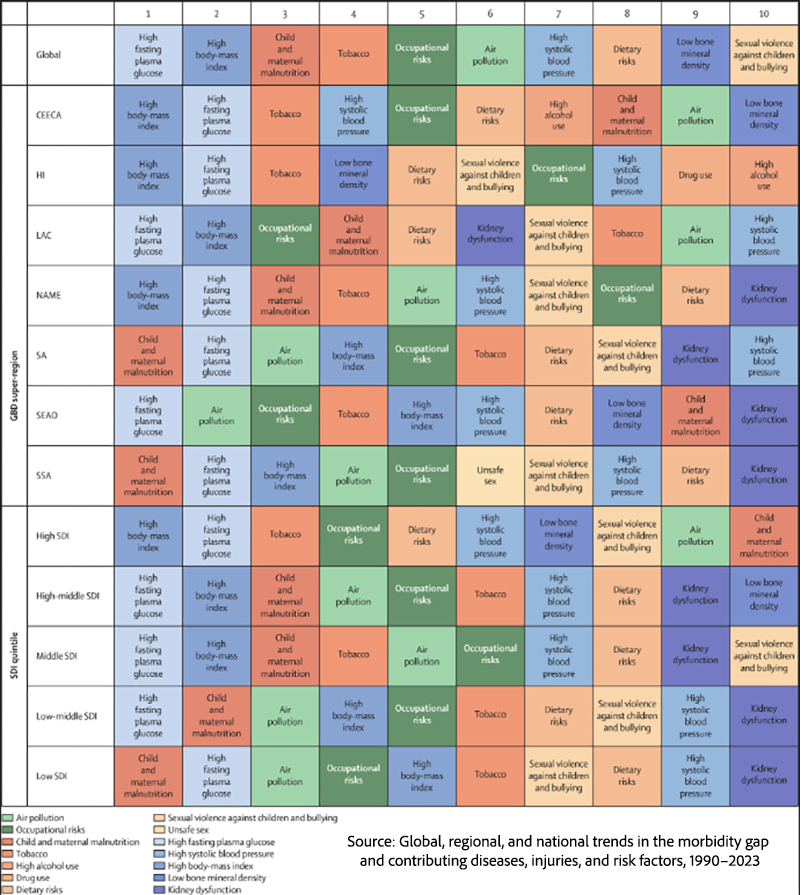
Those more general factors, which the authors note account for much of our unhealthy years, vary with the usual demographics, cultural differences, and geography. 


As can be seen, the US’s biggest contributors to our morbidity gap are our relationship with food, tobacco use, and occupational risk. Of the top five, 4 are within our immediate control and do not require any greater intervention from our health systems than a reminder about diet, exercise, and not smoking. Of course, those all require an individual level of responsibility, aided by an occasional prescription. As a physician and fellow human, I can attest to the difficulty in changing behavior. 

It is unclear how we might do better at preventing hearing and sight loss, but our healthcare system can identify needs, and our social service structure can provide mitigation through hearing aids, treatment for cataracts and glaucoma, and adaptive visual aids, i.e., audiobooks and large-print editions. We can predict falls but rarely alter the home environment to provide the necessary infrastructure adaptations, i.e., ramps, handrails, ambient lighting. The loneliness of aging, with its attendant depression and anxiety, can be identified by our physicians, but the solutions lie with our families and social structures that can replace generational households that no longer exist. 

Extending human life without protecting functional well-being represents a bittersweet triumph for modern medicine. As survival gains continue to convert acute fatal events into long-term chronic conditions, public health performance can no longer be measured by solely by longevity. Healthy aging will not come solely from pills and potions; it requires individuals to manage controllable lifestyle risks and for societies to find ways to “strengthen the feeble hands, steady the knees that give way.” That will require more than a shifting focus by healthcare systems.


Source: Global, regional, and national trends in the morbidity gap and contributing diseases, injuries, and risk factors, 1990–2023: a systematic analysis for the Global Burden of Disease Study 2023 The Lancet DOI: 10.1016/S2468-2667(26)00098-8

https://www.acsh.org/news/2026/07/24/mind-gap-growing-divide-between-lifespan-and-good-health-50245